



ILOPROST 10 MICROGRAMOS/ML SOLUCIÓN PARA INHALACIÓN POR NEBULIZADOR

Revisión de receta online
Un médico revisará tu caso y determinará si la prescripción es médicamente apropiada.

Habla con un médico sobre este medicamento
Comenta tus síntomas y las opciones de tratamiento en una consulta online.



Cómo usar ILOPROST RAFARM 10 MICROGRAMOS/ML SOLUCION PARA INHALACION POR NEBULIZADOR
Contenido del prospecto
- Introducción
- Qué es Iloprost Rafarm y para qué se utiliza
- Qué necesita saber antes de empezar a usar Iloprost Rafarm
- Cómo usar Iloprost Rafarm
- Posibles efectos adversos
- Conservación de Iloprost Rafarm
- Contenido del envase e información adicional
Introducción
Prospecto: información para el usuario
Iloprost Rafarm 10 microgramos/ml solución para inhalación por nebulizador
Lea todo el prospecto detenidamente antes de empezar a usar este medicamento, porque contiene información importante para usted.
- Conserve este prospecto, ya que puede tener que volver a leerlo.
- Si tiene alguna duda, consulte a su médico, farmacéutico o enfermero.
- Este medicamento se le ha recetado solamente a usted, y no debe dárselo a otras personas aunque tengan los mismos síntomas que usted, ya que puede perjudicarles.
-Si experimenta efectos adversos, consulte a su médico, farmacéutico o enfermero, incluso si se trata de efectos adversos que no aparecen en este prospecto. Ver sección 4.
Contenido del prospecto
- Qué es Iloprost Rafarm y para qué se utiliza
- Qué necesita saber antes de empezar a usar Iloprost Rafarm
- Cómo usar Iloprost Rafarm
- Posibles efectos adversos
- Conservación de Iloprost Rafarm
- Contenido del envase e información adicional
1. Qué es Iloprost Rafarm y para qué se utiliza
Qué es Iloprost Rafarm
El principio activo de este medicamento es iloprost. Iloprost imita a una sustancia natural del organismo llamada prostaciclina. Iloprost inhibe el bloqueo o el estrechamiento no deseado de los vasos sanguíneos y permite que fluya más sangre a través de los vasos sanguíneos.
Para qué se utiliza Iloprost Rafarm
Iloprost se utiliza para tratar los casos moderados de hipertensión pulmonar primaria (HPP) en pacientes adultos. La HPP es una clase de hipertensión pulmonar en la que se desconoce la causa del aumento de la presión arterial.
Se trata de una enfermedad en la que la presión arterial está demasiado elevada en los vasos sanguíneos situados entre el corazón y los pulmones.
Iloprost se utiliza para mejorar la capacidad para realizar ejercicio, (es decir la capacidad para realizar actividades de tipo físico) y los síntomas de esta enfermedad.
Cómo actúa Iloprost Rafarm
Al inhalar el aerosol hace que llegue iloprost a los pulmones, en donde actúa de forma más efectiva en la arteria situada entre el corazón y los pulmones. Al mejorar el flujo sanguíneo, el suministro de oxígeno al organismo es mejor y se reduce la carga al corazón.

¿No estás seguro de si este medicamento es adecuado para ti?
Comenta tus síntomas y tratamiento con un médico online.
2. Qué necesita saber antes de empezar a usar Iloprost Rafarm
No useIloprost Rafarm:
- si es alérgico a iloprost o a alguno de los demás componentes de este medicamento (incluidos en la sección 6),
- si tiene riesgo de hemorragia –por ejemplo, si tiene una úlcera activa en el estómago o en la primera parte del intestino delgado (úlceras duodenales), si ha sufrido una lesión física (traumatismo), si está en riesgo de sufrir una hemorragia intracraneal,
- si tiene un problema de corazón, como por ejemplo
- flujo de sangre deficiente a los músculos del corazón (enfermedad coronaria grave o angina inestable). Un síntoma puede incluir el dolor en el pecho,
- un infarto en los últimos seis meses,
- corazón débil (fallo cardíaco descompensado) que no esté sometido a supervisión médica estrecha,
- alteraciones graves del latido cardíaco,
- un defecto en las válvulas cardíacas (congénito o adquirido) que hace que el corazón no funcione bien (no relacionado con la hipertensión pulmonar),
- si ha sufrido en los últimos 3 meses un accidente cerebrovascular o cualquier otro acontecimiento que haya reducido el flujo sanguíneo al cerebro (p. ej., accidente isquémico transitorio),
- si su hipertensión pulmonar se debe a una vena obstruida o estrechada (enfermedad venosa oclusiva).
Advertenciasy precauciones
Consulte a su médico, farmacéutico o enfermero antes de empezar a usar iloprost:
- La inhalación de iloprost podría desencadenar dificultades respiratorias (ver sección 4), especialmente en pacientes con broncoespasmo (un estrechamiento repentino de la musculatura de las pequeñas vías aéreas) y sibilancias. Informe a su médico si tiene una infección pulmonar, asma grave u otra enfermedad pulmonar crónica (enfermedad pulmonar obstructiva crónica). Su médico le hará un estricto seguimiento.
- Se le tomará la presión arterial antes del tratamiento y si es demasiado baja (menos de 85 mmHg para el valor más alto) no se debe comenzar la terapia con iloprost.
- En general, tendrá que tener un cuidado especial para evitar los efectos de una presión arterial baja, como por ejemplo, desvanecimientos y mareo:
- Informe a su médico si está tomando otros medicamentos, ya que la combinación con este medicamento puede hacer bajar su presión arterial aún más (ver más adelante “Otros medicamentos y Iloprost Rafarm”).
- Levántese lentamente de la silla o de la cama.
- Si tiene tendencia a desmayarse cuando se levanta de la cama, puede ser útil que tome la primera dosis del día mientras sigue acostado.
- Si tiende a padecer episodios de desmayo, evite cualquier esfuerzo excepcional, por ejemplo durante el ejercicio físico; puede serle útil inhalar iloprost antes de realizarlo.
- Los episodios de desmayo pueden deberse a la enfermedad subyacente. Informe a su médico si estos empeoran, ya que él/ella podría considerar ajustarle la dosis o un cambio de tratamiento.
- Si padece de una enfermedad del corazón, como fallo cardíaco derecho y nota que su enfermedad está empeorando, dígaselo a su médico. Los síntomas pueden incluir hinchazón de pies y tobillos, dificultad para respirar, palpitaciones, necesidad de orinar con más frecuencia por la noche o edema. Su médico considerará si tiene que cambiar el tratamiento.
- Si tiene dificultad para respirar, tose con sangre y/o suda en exceso, pueden ser signos de que tiene agua en los pulmones (edema pulmonar). Deje de usar iloprost y dígaselo a su médico inmediatamente. Él/ella buscará la causa y tomarán las medidas apropiadas.
- Si tiene problemas hepáticos o problemas renales muy graves que hacen que requiera diálisis, informe a su médico.
Puede que le cambien gradualmente a la dosis prescrita o que le receten una dosis más baja de iloprost que a los demás pacientes (ver sección 3 “Cómo usar Iloprost Rafarm”).
ContactodeIloprost Rafarm con la piel o ingestiónde Iloprost Rafarm
- NO deje que la solución de iloprost entre en contacto con la piel o los ojos.
Si esto ocurre, lave inmediatamente la piel o los ojos con abundante agua.
- NO beba ni trague la solución de iloprost
Si accidentalmente esto ocurre, beba gran cantidad de agua e informe a su médico.
Niñosy adolescentes
No se ha establecido la seguridad y eficacia de iloprost 1 en niños de hasta 18 años.
Otros medicamentos y Iloprost Rafarm
Informe a su médico o farmacéutico si estáutilizando, ha utilizado recientemente o pudiera tener que utilizar cualquier otro medicamento. Iloprost puede afectar al modo de acción de otros medicamentos y viceversa.
Informe a su médico si está tomando:
- Medicamentos para el tratamiento de la hipertensión o de cardiopatías, como
- beta-bloqueantes,
- vasodilatadores de tipo nitrato,
- inhibidores del ECA.
Su presión sanguínea puede bajar excesivamente.
Su médico podrá cambiarle la dosis.
- Medicamentos que hacen menos espesa la sangre o que inhiben su coagulación,como
- ácido acetilsalicílico (AAS, un compuesto presente en muchos medicamentos que reduce la fiebre y calma el dolor),
- heparina,
- anticoagulantes del tipo cumarina, como warfarina o fenprocumón,
- antiinflamatorios no esteroideos,
- inhibidores no selectivos de la fosfodiesterasa, como pentoxifilina,
- inhibidores selectivos de la fosfodiesterasa 3 (PDE 3), como cilostazol o anagrelida,
- ticlopidina,
- clopidogrel,
- antagonistas de la glucoproteína IIb/IIIa, como abciximab, eptifibatida, tirofibán
- defibrotida
Su médico le mantendrá bajo estrecha vigilancia.
Antes de tomar cualquier medicamento, consulte a su médico o farmacéutico, quien tiene más información sobre los medicamentos con los que debe tener precaución o que debe evitar cuando utilice Iloprost Rafarm.
UsodeIloprost Rafarm conalimentosy bebidas
No cabe esperar que los alimentos o las bebidas afecten a iloprost. Sin embargo, debe evitar tomar alimentos o beber durante la inhalación.
Embarazo
- Si padece hipertensión pulmonar, evite quedarse embarazada, ya que el embarazo puede provocar un empeoramiento de su enfermedad e incluso poner en peligro su vida.
- Si pudiera quedarse embarazada, utilice anticonceptivos fiables desde el inicio del tratamiento y durante el tratamiento.
- Si está embarazada, cree que podría estar embarazada o tiene intención de quedarse embarazada, debe comunicárselo a su médico inmediatamente. Iloprost sólo debe usarse durante el embarazo si su médico decide que el beneficio potencial supera los posibles riesgos para usted y el feto.
Lactancia
Se desconoce si iloprost pasa a la leche materna. No se puede excluir el riesgo potencial en lactantes y es preferible evitar la lactancia durante el tratamiento con iloprost
Consulte a su médico o farmacéutico antes de utilizar cualquier medicamento.
Los recién nacidos, lactantes y mujeres embarazadas no deben estar en la misma habitación mientras esté inhalando iloprost
Conducción y uso de máquinas
Iloprost reduce la presión arterial y puede causar mareo o inestabilidad en algunas personas.
No conduzca ni utilice herramientas ni máquinas si nota estos efectos.
Iloprost Rafarm contiene etanol
Iloprost Rafarm contiene una pequeña cantidad de etanol (alcohol) (menos de 100 mg por dosis).Este medicamento contiene 0.081% w/v de etanol (alcohol), que se corresponde con una cantidad de 0.81 mg/ml. La cantidad en 0.81mg/ml de este medicamento es equivalente a menos de 0.0203 ml de cerveza o 0.0081 ml de vino. La pequeña cantidad de alcohol en este medicamento no tiene efectos notables.
3. Cómo usar Iloprost Rafarm
El tratamiento con iloprost sólo debe iniciarlo un médico con experiencia en el tratamiento de la hipertensión pulmonar.
Cuánto inhalar y durante cuánto tiempo
Siga exactamente las instrucciones de administración de este medicamento indicadas por su médico. En caso de duda, consulte de nuevo a su médico.
La dosis que necesita de iloprost y la duración del tratamiento que necesita depende de su estado. Su médico le aconsejará. No cambie la dosis recomendada sin consultar antes con su médico.
Se pueden utilizar diferentes dispositivos nebulizadores para administrar Iloprost Rafarm. Dependiendo del tipo de dispositivo utilizado y la dosis prescrita, es apropiado el uso de 1 ml o 2 ml de Iloprost Rafarm 10 microgramos/ml.
- Nebulizador Breelib
Al iniciar el tratamiento con iloprost o si se cambia de un dispositivo alternativo, la primera inhalación debe realizarse con iloprost 10 microgramos/ml (ampolla de 1 ml con un punto redondo amarillo). Si tolera bien esta dosis, su próxima inhalación será con iloprost 20 microgramos/ml (ampolla con un punto redondo naranja). Deberá continuar con esta dosis.
Si no puede tolerar la inhalación de iloprost 20 microgramos/ml, consulte a su médico, quien es posible que decida que usted debe recibir iloprost 10 microgramos/ml (ampolla de 1 ml).
La mayoría de las personas deberán realizar de 6 a 9 sesionesde inhalación repartidas a lo largo del día. La duración de cada sesión de inhalación con Breelib suele ser de 3 minutos.
Su médico supervisará su tratamiento cuando usted comience a usar el nebulizador Breelib para asegurar que tolera bien la dosis y velocidad de inhalación.
- Nebulizador I-Neb AAD (ampolla de 1 ml con un punto redondo amarillo)
En general, al iniciar el tratamiento con iloprost, la primera dosis inhalada debe de ser de
2,5 microgramos de iloprost liberado por la boquilla del nebulizador. Si tolera bien esta dosis, debe aumentarse la dosis a 5 microgramos de iloprost y debe continuar con esta dosis. Si no puede tolerar la dosis de 5 microgramos, la dosis se debe reducir a 2,5 microgramos.
La mayoría de las personas deberán realizar de 6 a 9 sesionesde inhalación repartidas a lo largo del día. La duración de cada sesión de inhalación con I-Neb AAD suele ser de 4 a 10 minutos dependiendo de la dosis prescrita.
- Nebulizador Venta-Neb (ampolla de 2 ml con un punto redondo azul)
En general, al iniciar el tratamiento con iloprost, la primera dosis inhalada debe ser de 2,5 microgramos de iloprost liberado por la boquilla del nebulizador. Si tolera bien esta dosis, debe aumentarse la dosis a 5 microgramos y debe continuar con esta dosis. Si no puede tolerar la dosis de 5 microgramos, la dosis se debe reducir a 2,5 microgramos.
La mayoría de las personas deberán realizar de 6 a 9 sesionesde inhalación repartidas a lo largo del día. La duración de cada sesión de inhalación con Venta-Neb suele ser de 4 a 10 minutos dependiendo de la dosis prescrita.
En función de sus necesidades individuales, iloprost se puede usar para tratamiento a largo plazo.
Si tiene problemas renales o hepáticos
No es necesario modificar la dosis en los pacientes con problemas renales leves o moderados (pacientes con un aclaramiento de creatinina > 30 ml/min).
Si tiene problemas renales muy graves y precisa diálisis o sufre problemas hepáticos, su médico introducirá iloprost gradualmente y es posible que le prescriba menos inhalaciones al día. Inicie el tratamiento inhalando 2,5 microgramos de iloprost, utilizando una ampolla de 1 ml de iloprost 10 microgramos/ml (con un punto redondo amarillo). Utilice intervalos de dosificación de 3 - 4 horas (lo que corresponde a un máximo de 6 administraciones por día). A partir de entonces, su médico puede acortar con precaución los intervalos de dosificación en función de cómo tolere usted el tratamiento. Si su médico decide aumentar adicionalmente la dosis hasta 5 microgramos, al principio deberán establecerse de nuevo intervalos de dosificación de 3 - 4 horas y se acortarán en función de cómo tolere usted el tratamiento.
Si nota que la acción de iloprost es demasiado fuerte o débil, consulte a su médico o farmacéutico. Solicite a su médico que alguien le ayude a familiarizarse con el uso del nebulizador. No debe cambiar a otro nebulizador sin consultar con el doctor que le está tratando.
Modo de inhalar
En cada sesión de inhalación debe usar una ampolla nueva de iloprost. Justo antes de comenzar a inhalar, rompa la ampolla de vidrio y eche la solución a la cámara de medicación siguiendo las instrucciones de uso del nebulizador.
Siga atentamente las instrucciones que acompañan al nebulizador, especialmente las relativas a la higiene y limpieza del nebulizador.
Siga exactamente las instrucciones de administración de iloprost indicadas por su médico.
- Iloprost 10 microgramos/ml se inhala utilizando los nebulizadores que su médico le haya prescrito (Breelib, Venta-Neb o I-Neb AAD).
- El nebulizador transforma la solución de iloprost en un aerosol que se inhala a través de la boca.
- Para la inhalación debe usar una boquilla para evitar que iloprost toque su piel. No utilice una mascarilla.
- Siga cuidadosamente las instrucciones que acompañan al nebulizador. Consulte con su médico o farmacéutico si tiene dudas.
- Debe desecharse cualquier resto de la solución de iloprost que quede en el nebulizador después de la inhalación (ver sección 5).
Ventilación de la habitación
Asegúrese de ventilar o airear la habitación en la que haya tomado el tratamiento de iloprost. Otras personas podrían exponerse accidentalmente a iloprost a través del aire de la habitación. En especial, los recién nacidos, lactantes y mujeres embarazadas no deben estar en la misma habitación mientras esté inhalando iloprost.
- Breelib
Llene la cámara de medicación con iloprost inmediatamente antes del uso. Siga las instrucciones de uso del nebulizador en relación con el llenado.
Dispositivo | Medicamento | Dosisdeiloprosten la boquilla | Tiempode inhalación estimado |
Breelib | Iloprost 10 microgramos/ml (un punto amarillo) | 2,5 microgramos | 3 minutos |
- I-Neb AAD
- Inmediatamente antes de la inhalación, rompa la ampolla de vidrio que contiene 1 ml de solución, que tiene un punto amarillo, y eche todo su contenido a la cámara de medicación del nebulizador.
- La dosis preestablecida administrada por el sistema I-Neb AAD está controlada por la cámara de medicación, en combinación con un disco de control. Hay dos cámaras de medicación con códigos de colores distintos. Por cada cámara de medicación hay un disco de control con su código de color correspondiente:
- Para la dosis de 2,5 microgramos, la cámara de medicación con el pestillo rojo se usa junto al disco de control rojo.
- Para la dosis de 5 microgramos, la cámara de medicación con el pestillo morado se usa junto al disco de control morado.
- Para asegurar que recibe la dosis prescrita, compruebe el color de la cámara de medicación y el
color del disco de control. Estos deben tener el mismo color, ya sea rojo para la dosis de
2,5 microgramos o morado para la dosis de 5 microgramos.
Dispositivo | Dosisdeiloprost en la boquilla | Tiempode inhalación estimado |
I-Neb AAD | 2,5 microgramos 5 microgramos | 3,2 min 6,5 min |
En la tabla siguiente se incluye un resumen de las instrucciones para el uso del I-Neb:
Medicamento | Punto de ampolla redonda de color | Dosis | I-Neb AAD |
Pestillo de la cámara de medicación | Disco de control | ||
Iloprost 10 microgramos/ml | Ampolla de 1 ml Un punto amarillo | 2,5 microgramos | rojo rojo |
5 microgramos | morado morado |
- Venta-Neb
- Inmediatamente antes de la inhalación, rompa la ampolla de vidrio que contiene 2 ml de solución, que tiene un punto azul y eche todo su contenido a la cámara de medicación del nebulizador.
- Se pueden utilizar dos programas:
- Su médico ajustará el programa del sistema Venta-Neb a sus necesidades para que reciba la dosis prescrita para usted.
- P1 Programa 1: 5 microgramos de principio activo en la boquilla, 25 ciclos de inhalación.
- P2 Programa 2: 2,5 microgramos de principio activo en la boquilla, 10 ciclos de inhalación.
- Para obtener el tamaño óptimo de la gota para la administración de iloprost se debe usar la placa deflectora verde.
Dispositivo | Dosisdeiloprost en la boquilla | Tiempode inhalación estimado |
Venta-Neb | 2,5 microgramos 5 microgramos | 4 min 8 min |
Para más detalles, consulte el manual de instrucciones del dispositivo nebulizador o consulte con su médico.
Si usa másIloprost Rafarm del que debe
Usar más iloprost del que debiera puede producir mareo, dolor de cabeza, rubor (enrojecimiento de la cara), náuseas (sensación de malestar), dolor de mandíbula o de espalda.
En caso de sobredosis o ingestión accidental consulte inmediatamente a su médico o farmacéutico o llame al Servicio de Información Toxicológica, teléfono: 91 562 04 20 indicando el medicamento y la cantidad ingerida.
Puede presentartambién un descensoo un aumentodelapresiónarterial,bradicardia (descenso de la frecuenciacardiaca), taquicardia(aumento de lafrecuenciacardiaca),vómitos, diarreao dolor en lasextremidades.
Sicualquieradeéstosocurre cuando hausadomásiloprost del quedebe,interrumpa la sesión de inhalación y consulte a su médico. Su médicolecontrolaráy tratarácualquiera de los síntomasresultantes.No se conoce ningún antídoto específico.
Si olvidó usarIloprost Rafarm
No tome una dosis doble para compensar las dosis olvidadas. Consulte a su médico lo que debe hacer.
Si interrumpeel tratamiento con Iloprost Rafarm
Si interrumpe o desea interrumpir el tratamiento, consúltelo primero con su médico.
Si tiene cualquier otra duda sobre el uso de este medicamento, pregunte a su médico, farmacéutico o enfermero.

¿Has empezado a tomar el medicamento y tienes preguntas?
Comenta tus síntomas y tratamiento con un médico online.
4. Posibles efectos adversos
Al igual que todos los medicamentos, este medicamento puede producir efectos adversos, aunque no todas las personas los sufran.
Pueden producirse los siguientes efectos adversos graves. Si se producen consulte con su médico de inmediato:
Muy frecuentes(pueden afectar a más de 1 de cada 10 personas):
- Pueden producirse muy frecuentemente episodios de sangrado (en su mayoría sangrado
por la nariz [epistaxis] y toser sangre [hemoptisis]), especialmente si está tomando tratamiento para hacer menos espesa la sangre (anticoagulantes). El riesgo de sangrado puede aumentar en los pacientes tratados al mismo tiempo con inhibidores de la agregación plaquetaria o anticoagulantes (ver también la sección 2).
- En muy raras ocasiones, se han notificado casos mortales que incluyeron hemorragia en el cerebro (hemorragia cerebral e intracraneal).
Frecuentes(pueden afectar hasta 1 de cada 10 personas):
- El desvanecimiento (síncope) es un síntoma de la propia enfermedad, pero también puede aparecer durante el tratamiento con Iloprost Rafarm 10 microgramos/ml solución para inhalación por nebulizador (ver también sección 2 “Advertencias y precauciones” para las recomendaciones sobre lo que puede hacer para evitar estos síntomas).
- Presión arterial baja (hipotensión)
Frecuencianoconocida(no puede estimarse a partir de los datos disponibles):
- Broncoespasmo (estrechamiento repentino de la musculatura de las pequeñas vías aéreas) y sibilancias (ver también sección 2 “Advertencias y precauciones”).
A continuación, se incluye una lista de otros posibles efectos adversos en función de su probabilidad de aparición:
Muy frecuentes:pueden afectar a más de 1 de cada 10 personas
- dilatación de los vasos sanguíneos (vasodilatación). Los síntomas pueden ser rubor o enrojecimiento de la cara
- malestar en el pecho / dolor en el pecho
- tos
- dolor de cabeza
- náuseas
- dolor de las mandíbulas / espasmo de los músculos de la mandíbula (trismo)
- hinchazón de las extremidades (edema periférico)
Frecuentes:pueden afectar hasta a 1 de cada 10 personas
- dificultad para respirar (disnea)
- mareos
- vómitos
- diarrea
- dolor al tragar (irritación faringolaríngea)
- irritación de garganta
- irritación en la boca y lengua, incluyendo dolor
- erupción cutánea
- latido cardiaco rápido (taquicardia)
- conciencia de latido cardiaco rápido o intenso (palpitaciones)
Frecuencianoconocida:la frecuencia no puede estimarse a partir de los datos disponibles.
- reducción del número de plaquetas en la sangre (trombocitopenia)
- hipersensibilidad (es decir, alergia)
- alteraciones del gusto (disgeusia)
Otrosposibles efectos adversos
- La hinchazón principalmente de los tobillos y las piernas debido a la retención de líquido (edema periférico) es un síntoma muy frecuente de la misma enfermedad, pero también puede producirse durante el tratamiento con iloprost.
Comunicación deefectosadversos
Si experimenta cualquier tipo de efecto adverso, consulte a su medico, farmaceutico o enfermero, incluso si se trata de posibles efectos adversos que no aparecen en este prospecto. Tambien puede comunicarlos directamente a traves del Sistema Espanol de Farmacovigilancia de Medicamentos de Uso Humano: https://www.notificaram.es. Mediante la comunicacion de efectos adversos usted puede contribuir a proporcionar mas information sobre la seguridad de este medicamento.
5. Conservación de Iloprost Rafarm
Mantener este medicamento fuera de la vista y del alcance de los niños.
No utilice este medicamento después de la fecha de caducidad que aparece en el envase y ampolla. No requiere condiciones especiales de conservación.
Debe desecharse cualquier resto de solución de Iloprost Rafarm que quede en el nebulizador después de la inhalación.
Los medicamentos no se deben tirar por los desagües ni a la basura. Deposite los envases y los medicamentos que no necesita en el Punto SIGRE de la farmacia. Pregunte a su farmacéutico cómo deshacerse de los envases y de los medicamentos que ya no necesita. De esta forma, ayudará a proteger el medio ambiente.
6. Contenido del envase e información adicional
Composición deIloprost Rafarm:
El principio activo es iloprost. 1 ml de solución contiene 10 microgramos de iloprost (como iloprost trometamol). Cada ampolla de 1 ml contiene 10 microgramos de iloprost.
Los demás componentes son trometamol, etanol, cloruro sódico, ácido clorhídrico 1N (para el ajuste del pH) y agua para preparaciones inyectables
Aspectodel producto y contenido delenvase
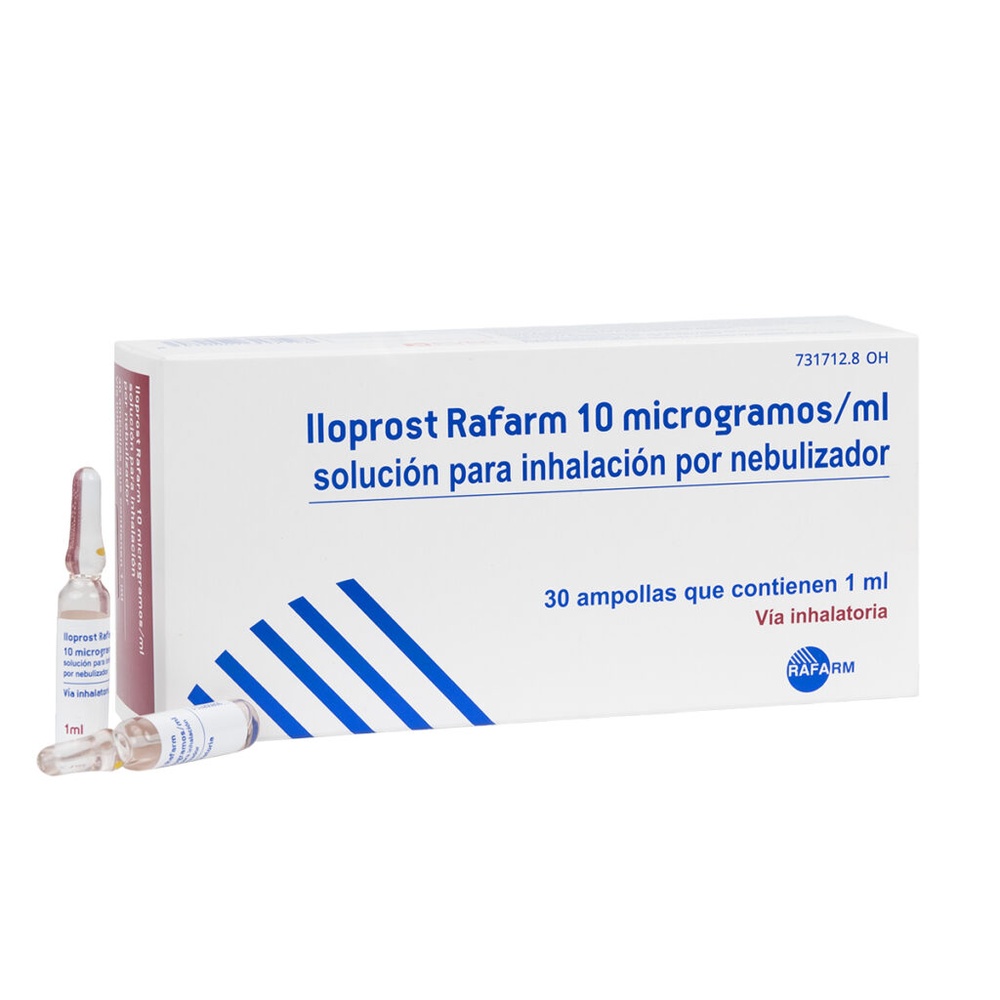
Iloprost Rafarm 10 microgramos/ml solución para inhalación por nebulizador es una solución transparente e incolora sin partículas visibles para inhalación con el nebulizador Breelib, I-Neb o Venta-Neb.
Iloprost Rafarm 10 microgramos/ml solución para inhalación por nebulizador está disponible en ampollas incoloras que contienen 1 ml o 2 ml de solución para nebulizador.
Iloprost Rafarm 10 microgramos/ml solución para inhalación por nebulizadorestá disponible enlossiguientesenvases:
- Ampollas de 1 ml para uso con los nebulizadores Breelib o I-Neb:
- Envase que contiene 30 o 42 ampollas para uso con los nebulizadores Breelib e I-Neb.
- Envase múltiple que contiene 168 (4 x 42) ampollas.
Las ampollas que contienen 1 ml están marcadas con un punto amarillo.
- Ampollas de 2 ml para uso con el nebulizador Venta-Neb:
- Envase que contiene 30 ampollas.
- Envase múltiple que contiene 300 (10 x 30) ampollas.
Las ampollas que contienen 2 ml están marcadas con un punto azul.
Puede que sólo estén comercializados algunos tamaños de envases.
Titulardelaautorizaciónde comercialización:
Rafarm S.A.
12 Korinthou str., N. Psihiko,
15451 Athens, Grecia
Τel: +30 210 6776550-1
Fax: +30 210 6776552
Responsabledelafabricación:
Rafarm S.A.
Thesi Pousi –Xatzi
Agiou Louka
19002, Paiania Attiki
Grecia
Tel. 210 6643835
Fax 210 6645813
E-mail: [email protected]
Pueden solicitar más información respecto a este medicamento dirigiéndose al representante local del titular de la autorización de comercialización:
EVER Pharma Therapeutics Spain, S.L.
C/ Toledo 170
28005 Madrid
España
Fechadelaúltima revisión deesteprospecto Junio/2021
La información detallada y actualizada de este medicamento está disponible en la página web de la Agencia Española de Medicamentos y Productos Sanitarios (AEMPS) http://www.aemps.gob.es/.
Esta información está destinada únicamente a profesionales del sector sanitario:
Instrucciones de uso y manipulación
Los pacientes estabilizados con un nebulizador no deben cambiar a otro nebulizador sin la estrecha supervisión del médico a cargo del tratamiento, ya que se ha demostrado que nebulizadores diferentes producen aerosoles con características físicas ligeramente diferentes y pueden tener una administración más rápida de la solución (ver sección 5.2 de la Ficha Técnica).
Para reducir al mínimo la exposición accidental, se recomienda mantener la habitación bien ventilada.
- Breelib
Si se utiliza el nebulizador Breelib, deben seguirse las instrucciones de uso que acompañan al dispositivo.
Llene la cámara de medicación con Iloprost Rafarm inmediatamente antes del uso.
Dispositivo | Medicamento | Dosisdeiloprosten la boquilla | Tiempode inhalación estimado |
Breelib | Iloprost Rafarm 10 microgramos/ml (un punto amarillo) | 2,5 microgramos | 3 minutos |
- I-Neb AAD
El sistema I-Neb AAD es un sistema de nebulizador portátil, manual y con tecnología de malla vibratoria. Este sistema genera por ultrasonido pequeñas gotas, que hacen pasar la solución a través de una malla. Se ha demostrado que el nebulizador I-Neb AAD es adecuado para la administración de Iloprost Rafarm 10 microgramos/ml (ampolla de 1 ml con un punto amarillo).
La MMAD medida de las pequeñas gotas de aerosol fue de 2,1 micrómetros.
Este nebulizador controla el patrón de respiración para determinar el tiempo de inhalación requerido para administrar la dosis preestablecida de 2,5 o 5 microgramos de iloprost.
La dosis administrada por el sistema I-Neb AAD es controlada por la cámara de medicación, en combinación con un disco de control. Cada cámara de medicación dispone de un código de color y tiene un disco de control con su código de color correspondiente.
- Para dosis de 2,5 microgramos, la cámara de medicación con el pestillo rojo se usa junto al disco de control rojo.
- Para dosis de 5 microgramos, la cámara de medicación con el pestillo morado se usa junto al disco de control morado.
En cada sesión de inhalación con el I-Neb AAD, inmediatamente antes del uso, se echará a la cámara de medicación el contenido de una ampolla de 1 ml de Iloprost Rafarm, que tiene un punto de color amarillo.
Dispositivo | Dosisdeiloprost en la boquilla | Tiempode inhalación estimado |
I-Neb AAD | 2,5 microgramos 5 microgramos | 3,2 min 6,5 min |
En la tabla siguiente se incluye un resumen de las instrucciones para el uso del I-Neb para Iloprost Rafarm:
Medicamento | Punto de ampolla redonda de color | Dosis | I-Neb AAD |
Pestillo de la cámara de medicación | Disco de control | ||
Iloprost Rafarm 10 microgramos/ml | Ampolla de 1 ml Un punto amarillo | 2,5 microgramos | rojo rojo |
5 microgramos | morado morado |
- Venta-Neb
Venta-Neb, nebulizador ultrasónico portátil con batería, ha demostrado también ser adecuado para la administración de Iloprost Rafarm 10 microgramos/ml. Se determinó que la MMAD medida de las gotas de aerosol fue de 2,6 micrómetros. En cada sesión de inhalación se echará el contenido de una ampolla que contiene 2 ml de Iloprost Rafarm 10 microgramos/ml, que está marcada con un punto azul, al interior de la cámara de medicación del nebulizador inmediatamente antes de su uso.
Se pueden utilizar dos programas:
- P1 Programa 1: 5 microgramos de principio activo en la boquilla, 25 ciclos de inhalación.
- P2 Programa 2: 2,5 microgramos de principio activo en la boquilla, 10 ciclos de inhalación.
El médico es quien selecciona el programa preajustado.
Una señal óptica y acústica del sistema Venta-Neb avisa al paciente para que inhale. Se detiene automáticamente después de aplicar la dosis preestablecida. Para obtener el tamaño óptimo de la gota para la administración de Iloprost Rafarm se debe usar la placa deflectora verde. Consultar los detalles en el manual de instrucción del nebulizador Venta-Neb.
Dispositivo | Dosisdeiloprost en la boquilla | Tiempode inhalación estimado |
Venta-Neb | 2,5 microgramos 5 microgramos | 4 min 8 min |
No se han establecido la eficacia y la tolerabilidad de iloprost inhalado cuando se administra con otros sistemas de nebulización que proporcionan diferentes características de nebulización de la solución de iloprost.
- País de registro
- Forma farmacéuticaINHALACIÓN PULMONAR, 10 microgramos/ml
- Código ATCB01AC11
- Principio activo
- Requiere recetaSí
- Fabricante
- ComposiciónETANOL AL 96% (0,81 mg/ml mg), CLORURO DE SODIO (9 mg/ml mg)
- Esta información es de carácter general y no sustituye la consulta con un profesional sanitario.
- Alternativas a ILOPROST RAFARM 10 MICROGRAMOS/ML SOLUCION PARA INHALACION POR NEBULIZADORForma farmacéutica: INYECTABLE PERFUSION, 0,067 mg iloprost/ampollaPrincipio activo: IloprostFabricante: Bayer Hispania S.L.Requiere recetaForma farmacéutica: INHALACIÓN PULMONAR, 10 microgramos/mlPrincipio activo: IloprostFabricante: Zentiva K.S.Requiere recetaForma farmacéutica: INHALACIÓN PULMONAR, 20 microgramos/mlPrincipio activo: IloprostFabricante: Zentiva K.S.Requiere receta
Médicos online para ILOPROST RAFARM 10 MICROGRAMOS/ML SOLUCION PARA INHALACION POR NEBULIZADOR
Comenta la dosis, los posibles efectos secundarios, interacciones, contraindicaciones o la revisión de receta de ILOPROST RAFARM 10 MICROGRAMOS/ML SOLUCION PARA INHALACION POR NEBULIZADOR, sujeto a valoración médica y a la normativa local.









Obtén una receta de ILOPROST RAFARM 10 MICROGRAMOS/ML SOLUCION PARA INHALACION POR NEBULIZADOR online
Rellena un formulario de 2 minutos
Cuéntanos tus síntomas, historial y el medicamento que necesitas.
Elige un médico o nosotros te asignamos uno
Escoge un especialista o te conectamos con el próximo médico disponible.
El médico revisa tu caso
Normalmente en 30 minutos. Puede hacerte preguntas adicionales por chat.
Recógela en cualquier farmacia
Receta electrónica enviada a tu correo, válida en toda España.
Preguntas frecuentes
ILOPROST RAFARM 10 MICROGRAMOS/ML SOLUCION PARA INHALACION POR NEBULIZADOR requiere receta en España. Puedes confirmarlo con un médico online según tu caso.
El principio activo de ILOPROST RAFARM 10 MICROGRAMOS/ML SOLUCION PARA INHALACION POR NEBULIZADOR es Iloprost. Esta información ayuda a identificar medicamentos con la misma composición pero con diferentes nombres comerciales.
ILOPROST RAFARM 10 MICROGRAMOS/ML SOLUCION PARA INHALACION POR NEBULIZADOR es fabricado por Rafarm S.A.. La marca y el envase pueden variar según el distribuidor.
Los Médicos de familia, Psiquiatras, Dermatólogos, Cardiólogos, Endocrinólogos, Gastroenterólogos, Neumólogos, Nefrólogos, Reumatólogos, Hematólogos, Infectólogos, Alergólogos, Geriatras, Pediatras, Oncólogos pueden valorar la prescripción de ILOPROST RAFARM 10 MICROGRAMOS/ML SOLUCION PARA INHALACION POR NEBULIZADOR cuando esté clínicamente indicado. Puedes reservar una videoconsulta para comentar tu caso y las opciones de tratamiento.
España cuenta con una infraestructura sanitaria bien desarrollada en ciudades principales como Madrid, Barcelona, Valencia y Sevilla. Las farmacias están ampliamente disponibles y operan bajo estrictas regulaciones, garantizando el acceso a medicamentos con receta.
Puedes comprar ILOPROST RAFARM 10 MICROGRAMOS/ML SOLUCION PARA INHALACION POR NEBULIZADOR en Madrid, Barcelona, Sevilla o Valencia en cualquier farmacia local con una receta válida.
Para obtener una receta, puedes utilizar Oladoctor:
Otros medicamentos con el mismo principio activo (Iloprost) incluyen ILOMEDIN 50 MICROGRAMOS/0,5 ML, CONCENTRADO PARA SOLUCION PARA PERFUSION, ILOPROST ZENTIVA 10 MICROGRAMOS/ML SOLUCION PARA INHALACION POR NEBULIZADOR, ILOPROST ZENTIVA 20 MICROGRAMOS/ML SOLUCION PARA INHALACION POR NEBULIZADOR. Pueden tener diferentes nombres comerciales o formulaciones, pero contienen el mismo componente terapéutico. Consulta siempre con un médico antes de cambiar o iniciar un nuevo medicamento.
