



ILOMEDIN 50 micrograms/0.5 ml Injectable Perfusion

Prescription review online
A doctor will review your case and decide whether a prescription is medically appropriate.

Talk to a doctor about this medicine
Discuss your symptoms and possible next steps in a quick online consultation.



How to use ILOMEDIN 50 micrograms/0.5 ml, concentrate for infusion solution
Contents of the leaflet
- Introduction
- What is Ilomedin and what is it used for
- What you need to know before you use Ilomedin
- Pregnancy, breastfeeding, and fertility
- How to use Ilomedin
- Possible side effects
- Storage of Ilomedin
- Container Contents and Additional Information
Introduction
PACKAGE LEAFLET: Information for the user
Ilomedin 50 micrograms / 0.5 ml, concentrate for solution for infusion
iloprost tromethamine
Read all of this leaflet carefully before you start using this medicine because it contains important information for you.
|
Contents of the pack
- What is Ilomedin and what is it used for.
- What you need to know before you use Ilomedin.
- How to use Ilomedin.
- Possible side effects.
- Storage of Ilomedin.
- Contents of the pack and further information
1. What is Ilomedin and what is it used for
Ilomedin belongs to a group of medicines called anti-thrombotic agents, platelet aggregation inhibitors, excluding heparin.
Ilomedin is a prostacyclin analogue that is indicated for the treatment of:
Advanced thromboangiitis obliterans (Buerger's disease) with severe ischemia of the limbs in cases where revascularization is not indicated.
Patients with severe occlusive peripheral arterial disease, particularly in cases with a risk of amputation and in whom surgery or angioplasty is not possible.
Patients with severe and disabling Raynaud's phenomenon who do not respond to other therapeutic measures.

Not sure if this medicine is right for you?
Discuss your symptoms and treatment with a doctor online.
2. What you need to know before you use Ilomedin
Do not use Ilomedin
- If you are allergic to iloprost or any of the other ingredients of this medicine (listed in section 6).
- If you are pregnant or breastfeeding.
- In situations where the effects of Ilomedin may increase the risk of bleeding (e.g., active peptic ulcers, trauma, intracranial hemorrhage).
- If you have severe coronary heart disease or unstable angina; myocardial infarction in the last six months; acute or chronic congestive heart failure (NYHA classes II-IV); arrhythmias of prognostic significance; suspected pulmonary congestion.
Warnings and precautions
Talk to your doctor or pharmacist before starting to use Ilomedin.
- If you need an urgent amputation (e.g., in case of infected gangrene), surgery should not be delayed.
- If you smoke, you should be strongly advised to quit smoking.
- If you have low blood pressure, you should be carefully monitored to avoid further hypotension, and if you have significant heart disease, you should be closely monitored.
- You should be aware of the possibility of hypotension if you change from lying down to standing after the infusion is finished.
- You should be aware that paravascular infusion of the undiluted Ilomedin solution may cause local alterations at the injection site.
Talk to your doctor, even if any of the above circumstances have occurred to you in the past.
Other medicines and Ilomedin
Tell your doctor or pharmacist if you are using, have recently used, or might use any other medicines.
Certain medicines may interact, in which case it may be necessary to change the dose or discontinue treatment with one of the medicines. It is especially important that you inform your doctor if you are using any of the following medicines.
If you are being treated with heparin or coumarin anticoagulants, treatment with Ilomedin may increase the risk of bleeding. If this occurs, the infusion of this medicine should be stopped.
If you are being treated with other platelet aggregation inhibitors (acetylsalicylic acid or other non-steroidal anti-inflammatory drugs, phosphodiesterase inhibitors, and nitrate vasodilators, e.g., molsidomine), the administration of Ilomedin may have an additive or superadditive effect on platelet function.
Additionally, you should be aware that in pharmacological studies, iloprost has been shown to have an additive effect on the antihypertensive activity of beta-blockers, calcium antagonists, and vasodilators, as well as a potentiating effect on the antihypertensive activity of angiotensin-converting enzyme inhibitors (ACE inhibitors). If significant hypotension occurs, it can be corrected by reducing the dose of iloprost.
Ilomedin contains ethanol
This medicine contains 4.05 mg of alcohol (ethanol) in each ampoule. The amount of this medicine is equivalent to less than 1 ml of beer or wine. The small amount of alcohol in this medicine does not produce any noticeable effect.
Ilomedin contains sodium
This medicine contains less than 1 mmol of sodium (23 mg) per ampoule; i.e., it is essentially "sodium-free".
Pregnancy, breastfeeding, and fertility
If you are pregnant or breastfeeding, think you may be pregnant, or plan to become pregnant, consult your doctor or pharmacist before using this medicine.
Ilomedin should not be administered during pregnancy. The potential risk of therapeutic use of iloprost during pregnancy is unknown; therefore, if you are of childbearing age, you should use an effective contraceptive method during treatment.
Ilomedin should not be administered during breastfeeding. It is unknown whether iloprost can pass into breast milk.
Driving and using machines
Not applicable.

Started taking the medicine and have questions?
Discuss your symptoms and treatment with a doctor online.
3. How to use Ilomedin
Follow exactly the administration instructions of this medicine indicated by your doctor. In case of doubt, consult your doctor again.
This medicine should only be used in hospitals and healthcare centers that are properly equipped and under strict surveillance.
The infusion solution should be prepared daily to ensure sterility.
This medicine is administered daily for 6 hours as an intravenous infusion, after dilution, through a central venous catheter or a peripheral vein. The dose is adjusted according to individual tolerance within the range of 0.5 - 2.0 ng of iloprost/kg of body weight/min. The exact infusion rate should be calculated based on body weight (for more information, see section "6. Further information of interest to the healthcare professional supervising the test").
During the first 2-3 days, the dose that you tolerate is established. If side effects such as headache and nausea, or an undesirable decrease in blood pressure, occur, the infusion rate will be reduced until the tolerated dose is established. If the side effects are severe, the infusion should be discontinued. Subsequently, treatment should be continued (usually for 4 weeks) with the tolerated dose established during the first 2-3 days.
Blood pressure and heart rate should be recorded at the start of the infusion and after each dose increase.
The duration of treatment is up to 4 weeks. In the case of Raynaud's phenomenon (crisis of paleness followed by cyanosis and redness of the limbs in relation to cold or emotional stress), shorter treatment periods (3 to 5 days) are often sufficient to achieve an improvement that lasts for several weeks.
If you have renal insufficiency that requires dialysis or liver cirrhosis, the elimination of iloprost decreases, and the dose should be reduced (e.g., to half of the recommended dose).
Continuous infusion for several days is not recommended, given the possibility of an immunization phenomenon on platelet effects or a rebound effect with platelet hyperaggregability at the end of treatment, although no clinical complications associated with these phenomena have been reported.
Your doctor will indicate the duration of your treatment with Ilomedin. Do not stop treatment before.
If you use more Ilomedin than you should
You may experience the following symptoms: marked facial flushing, severe headache, nausea, vomiting, and diarrhea, and possibly pain in the limbs or back. Decrease or increase in blood pressure, bradycardia (decrease in heart rate) or tachycardia (increase in heart rate).
In case of symptoms that indicate you have been administered more Ilomedin than necessary, the infusion of Ilomedin should be discontinued, and you should be treated with symptomatic measures. There is no specific antidote known.
In case of overdose or accidental ingestion, consult the Toxicological Information Service; Telephone 91 562 04 20
If you have any further questions about the use of this product, ask your doctor or pharmacist.
4. Possible side effects
Like all medicines, this medicine can cause side effects, although not everybody gets them.
The most frequently observed side effects in patients treated with Iloprost (may affect 1 or more in every 10 patients) are headache, flushing (redness of the face), hyperhidrosis (sweating), and gastrointestinal symptoms such as nausea (feeling sick) and vomiting.
These are expected to occur at the start of treatment while the dose is being adjusted and the best tolerated dose is being established. However, all these side effects usually disappear quickly with a reduction in dose.
The most serious adverse reactions in which a fatal or life-threatening outcome has been observed in patients treated with Iloprost were:
- stroke (cerebrovascular accident)
- myocardial infarction (heart attack)
- pulmonary embolism (difficulty breathing or chest pain when inhaling caused by a blood clot in the lung)
- heart failure (heart failure)
- seizures
- hypotension (abnormally low blood pressure)
- tachycardia (accelerated heart rate)
- asthma
- angina pectoris (chest pain or pressure caused by insufficient blood flow to the heart)
- dyspnea (difficulty breathing)
- pulmonary edema (difficulty breathing or coughing up blood caused by fluid accumulation in the lungs)
Another group of side effects is related to local reactions at the infusion site. For example, redness and pain at the infusion site or cutaneous vasodilation that causes a linear erythema (redness) over the infusion vein may occur.
Side effects are listed below by frequency.
Very common(may affect more than 1 in every 10 patients)
- headache
- flushing (redness of the face)
- nausea (feeling sick)
- vomiting
- hyperhidrosis (sweating)
Common(may affect 1 to 10 patients in every 100)
- decreased appetite
- apathy
- confusion
- dizziness / vertigo
- paresthesia (numbness and tingling) / pulsating sensation / hyperesthesia (increased sensitivity to pain or touch) / burning sensation
- restlessness / agitation
- sedation
- somnolence
- tachycardia (accelerated heart rate)
- bradycardia (decreased heart rate)
- angina pectoris (chest pain or pressure caused by insufficient blood flow to the heart)
- hypotension (abnormally low blood pressure)
- increased blood pressure
- dyspnea (difficulty breathing)
- diarrhea
- abdominal discomfort / abdominal pain
- jaw pain / trismus (jaw spasms)
- myalgia (muscle pain) / arthralgia (joint pain)
- pain
- fever / increased body temperature
- feeling of heat
- asthenia (weakness) / feeling of discomfort
- chills
- fatigue / tiredness
- thirst
- erythema, pain, and phlebitis at the infusion site (vein inflammation)
Uncommon(may affect 1 to 10 patients in every 1,000)
- thrombocytopenia (blood disorder characterized by easy bruising or bleeding)
- hypersensitivity (allergy)
- anxiety, depression, hallucinations
- seizures
- syncope (brief loss of consciousness)
- tremor
- migraine
- blurred vision
- eye irritation
- eye pain
- myocardial infarction (heart attack)
- heart failure (heart failure)
- arrhythmia / extrasystoles (irregular heart rhythm)
- stroke / cerebral ischemia (cerebrovascular accident)
- pulmonary embolism (difficulty breathing or chest pain when inhaling caused by a blood clot in the lung)
- deep vein thrombosis (formation of a clot and displacement into the bloodstream)
- asthma
- pulmonary edema (accumulation of abnormal fluid in the lungs)
- hemorrhagic diarrhea (diarrhea with blood) rectal hemorrhage (bleeding)
- dyspepsia (heartburn or stomach pain)
- rectal tenesmus (pain due to constipation)
- constipation
- eructation
- dysphagia (difficulty swallowing)
- dry mouth / dysgeusia (alteration of taste)
- jaundice (yellowing of the skin or whites of the eyes and/or itching due to liver disorder)
- pruritus (itching)
- tetany (painful muscle spasm) / muscle spasms
- hypertonia (increased muscle tension)
- kidney pain
- vesical tenesmus (constant feeling of needing to urinate)
- urinary disorders
- dysuria (pain or difficulty urinating)
- urinary tract disorders
Rare(may affect 1 to 10 patients in every 10,000)
- vestibular disorder (dizziness caused by inner ear disorder)
- cough
- proctitis (rectal inflammation)
Iloprost may cause chest pain or pressure due to angina pectoris, especially in patients with coronary insufficiency.
The risk of bleeding increases if you are being treated concomitantly with platelet aggregation inhibitors, heparin, or coumarin anticoagulants.
If you experience side effects, talk to your doctor or pharmacist, even if they are not listed in this leaflet.
Reporting of side effects
If you experience any side effects, talk to your doctor, pharmacist, or nurse, even if they are not listed in this leaflet. You can also report them directly through the Spanish Pharmacovigilance System for Human Use Medicines: www.notificaRAM.es. By reporting side effects, you can help provide more information on the safety of this medicine.
5. Storage of Ilomedin
Keep this medicine out of the sight and reach of children.
Do not use this medicine after the expiry date stated on the packaging after EXP. The expiry date is the last day of the month indicated.
No special storage conditions are required.
Medicines should not be disposed of via wastewater or household waste. Ask your pharmacist how to dispose of medicines no longer required. This will help protect the environment.
6. Container Contents and Additional Information
Ilomedin Composition
- The active ingredient is iloprost.
- The other components are: trometamol, ethanol, hydrochloric acid, sodium chloride, water for injectable preparations.
Product Appearance and Container Contents
Ilomedin is a clear, particle-free solution. One ampoule contains 0.5 ml of solution.
Marketing Authorization Holder:
Bayer Hispania, S.L.
Av. Baix Llobregat 3-5
08970 – Sant Joan Despí (Barcelona)
Spain
Manufacturer:
Berlimed, S.A
Francisco Alonso, s/n. Polígono Industrial Sta. Rosa.
28806 - Alcalá de Henares
Spain
Date of Last Revision of this Leaflet: January 2014
Other Sources of Information
Detailed information about this medicinal product is available on the website of the Spanish Agency for Medicines and Health Products (AEMPS) (http://www.aemps.gob.es/)
This information is intended solely for healthcare professionals.
Posology and Method of Administration
Ilomedin is administered daily for 6 hours as an intravenous infusion, after dilution, through a central venous catheter or a peripheral vein. During the first 2-3 days, the dose that the patient tolerates is established. To this effect, treatment should be started at an infusion rate of 0.5 ng/kg/min for 30 minutes. Then, the dose should be increased by 0.5 ng/kg/min at intervals of approximately 30 minutes, until reaching 2.0 ng/kg/min. The exact infusion rate should be calculated based on body weight to achieve an infusion rate within the range of 0.5-2.0 ng/kg/min (for use with an infusion pump or injector, see the tables below).
Arterial pressure and heart rate should be recorded at the start of the infusion and after each dose increase.
Infusion Rates (ml/h) for Different Doses for Administration via Infusion Pump
Generally, the ready-to-use solution for infusion is administered intravenously via an infusion pump (e.g., Infusomat?). For this purpose, the contents of a 0.5 ml ampoule of Ilomedin are diluted with 250 ml of sterile physiological saline solution or 5% glucose solution. The contents of the ampoule and the diluent must be thoroughly mixed. In the case where an Ilomedin concentration of 2 μg/ml is to be administered, the required infusion rate should be established according to the previously described scheme to achieve a dose within the range of 0.5-2.0 ng/kg/min.
(To establish the infusion rate, interpolate and match the patient's body weight with the desired dose in ng/kg/min).
Body Weight (kg) | Dose (ng/kg/min) | |||
0.5 | 1.0 | 1.5 | 2.0 | |
Infusion Rate (ml/h) | ||||
40 | 6.0 | 12 | 18.0 | 24 |
50 | 7.5 | 15 | 22.5 | 30 |
60 | 9.0 | 18 | 27.0 | 36 |
70 | 10.5 | 21 | 31.5 | 42 |
80 | 12.0 | 24 | 36.0 | 48 |
90 | 13.5 | 27 | 40.5 | 54 |
100 | 15.0 | 30 | 45.0 | 60 |
110 | 16.5 | 33 | 49.5 | 66 |
Infusion Rates (ml/h) for Different Doses for Administration via Injector
An injector with a 50 ml syringe (e.g., Perfusor?) can also be used. In this case, the contents of a 0.5 ml ampoule of Ilomedin are diluted with 25 ml of sterile physiological saline solution or 5% glucose solution. The contents of the ampoule and the diluent must be thoroughly mixed. In the case where an Ilomedin concentration of 2 μg/ml is to be administered, the required infusion rate should be determined according to the previously described scheme to achieve a dose within the range of 0.5-2.0 ng/kg/min.
(To establish the infusion rate, interpolate and match the patient's body weight with the desired dose in ng/kg/min).
Body Weight (kg) | Dose (ng/kg/min) | |||
0.5 | 1.0 | 1.5 | 2.0 | |
Infusion Rate (ml/h) | ||||
40 | 0.60 | 1.2 | 1.80 | 2.4 |
50 | 0.75 | 1.5 | 2.25 | 3.0 |
60 | 0.90 | 1.8 | 2.70 | 3.6 |
70 | 1.05 | 2.1 | 3.15 | 4.2 |
80 | 1.20 | 2.4 | 3.60 | 4.8 |
90 | 1.35 | 2.7 | 4.05 | 5.4 |
100 | 1.50 | 3.0 | 4.50 | 6.0 |
110 | 1.65 | 3.3 | 4.95 | 6.6 |
The duration of treatment is up to 4 weeks. In the case of Raynaud's phenomenon, shorter treatment periods (3 to 5 days) are often sufficient to achieve an improvement that lasts for several weeks.
Pregnancy and Lactation
- Pregnancy
Ilomedin should not be administered during pregnancy. There are no sufficient data on the use of iloprost in pregnant women. Preclinical studies have shown evidence of fetotoxicity in rats, but not in rabbits or monkeys.
- Lactation
Since extremely low amounts of iloprost pass into breast milk in rats, iloprost should not be administered to women who are breastfeeding.
Incompatibilities
This medicinal product should not be mixed with, nor should any other substance be added to, the ready-to-use infusion solution.
Shelf Life
4 years.
Instructions for Use and Handling
Ilomedin should only be used after dilution. Due to the possibility of interactions, no other substance should be added to the ready-to-use infusion solution.
The ready-to-use infusion solution should be prepared daily before administration to ensure its sterility.
- Handling
Oral ingestion and contact with mucous membranes should be avoided.
Upon contact with the skin, iloprost can cause a long-lasting, painless erythema. Therefore, adequate precautions should be taken to avoid contact between iloprost and the skin. If such contact occurs, the affected area should be washed immediately with a large amount of water or physiological saline solution.
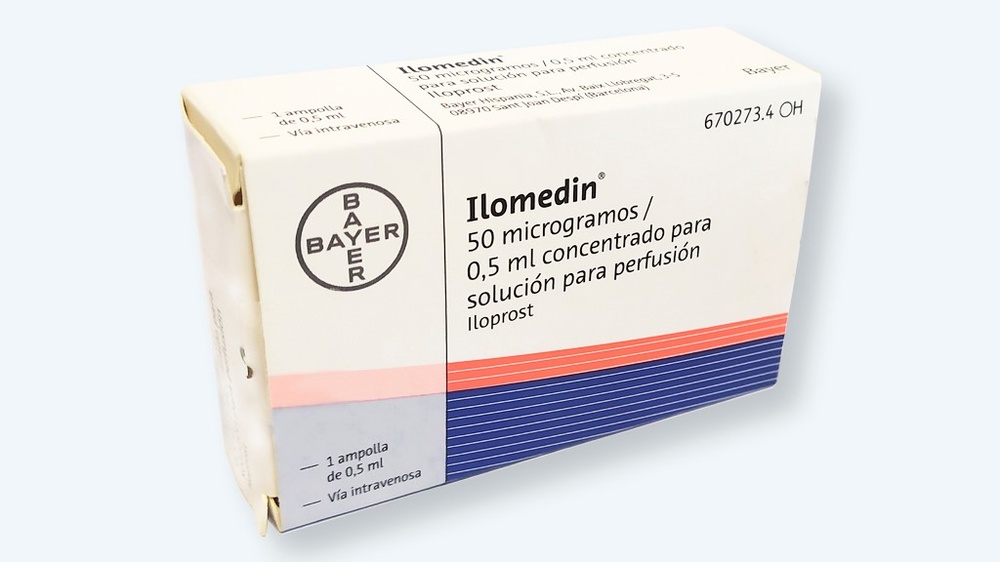
- Country of registration
- Dosage formINJECTABLE PERFUSION, 0.067 mg iloprost/ampoule
- ATC codeB01AC11
- Active substance
- Prescription requiredYes
- Manufacturer
- CompositionALCOHOL ETILICO (ETANOL) (4,05 mg mg), CLORURO DE SODIO (4,5 mg mg)
- This information is for reference only and does not constitute medical advice. Always consult a doctor before taking any medication. Oladoctor is not responsible for medical decisions based on this content.
- Alternatives to ILOMEDIN 50 micrograms/0.5 ml, concentrate for infusion solutionDosage form: PULMONARY INHALATION, 10 micrograms/mlActive substance: iloprostManufacturer: Rafarm S.A.Prescription requiredDosage form: PULMONARY INHALATION, 10 micrograms/mlActive substance: iloprostManufacturer: Zentiva K.S.Prescription requiredDosage form: PULMONARY INHALATION, 20 micrograms/mlActive substance: iloprostManufacturer: Zentiva K.S.Prescription required
Online doctors for ILOMEDIN 50 micrograms/0.5 ml, concentrate for infusion solution
Discuss questions about ILOMEDIN 50 micrograms/0.5 ml, concentrate for infusion solution, including use, safety considerations and prescription review, subject to medical assessment and local regulations.









Get ILOMEDIN 50 micrograms/0.5 ml, concentrate for infusion solution Prescription Online
Fill in a 2-min form
Tell us your symptoms, history, and what medicine you're requesting.
Pick a doctor or let us assign
Choose a specialist or we'll match you with the next available doctor.
Doctor reviews your case
Usually within 30 minutes. They may ask follow-up questions via chat.
Collect from any pharmacy
Electronic prescription sent to your email — valid across Spain.
Frequently Asked Questions
ILOMEDIN 50 micrograms/0.5 ml, concentrate for infusion solution requires a prescription in Spain. You can check with a doctor online whether this medicine may be appropriate for your situation.
The active ingredient in ILOMEDIN 50 micrograms/0.5 ml, concentrate for infusion solution is iloprost. This information helps identify medicines with the same composition but different brand names.
ILOMEDIN 50 micrograms/0.5 ml, concentrate for infusion solution is manufactured by Bayer Hispania S.L.. Pharmacy brands and packaging may differ depending on the distributor.
Doctors such as Family doctors, Psychiatrists, Dermatologists, Cardiologists, Endocrinologists, Gastroenterologists, Pulmonologists, Nephrologists, Rheumatologists, Hematologists, Infectious disease physicians, Allergists, Geriatricians, Paediatricians, Oncologists may assess whether ILOMEDIN 50 micrograms/0.5 ml, concentrate for infusion solution is appropriate, depending on your situation and local regulations. You can book an online consultation to discuss your symptoms and possible next steps.
Spain has a well-developed healthcare infrastructure across major cities such as Madrid, Barcelona, Valencia, and Seville. Pharmacies are widely available and operate under strict regulations, ensuring access to prescribed medications.
You can buy ILOMEDIN 50 micrograms/0.5 ml, concentrate for infusion solution in Madrid, Barcelona, Seville, or Valencia at any local pharmacy with a valid prescription.
To obtain a prescription, you can use Oladoctor:
Other medicines with the same active substance (iloprost) include ILOPROST RAFARM 10 micrograms/ml SOLUTION FOR NEBULIZER INHALATION, ILOPROST ZENTIVA 10 micrograms/ml SOLUTION FOR NEBULIZER INHALATION, ILOPROST ZENTIVA 20 micrograms/ml SOLUTION FOR NEBULIZER INHALATION. These may have different brand names or formulations but contain the same therapeutic ingredient. Always consult a doctor before switching or starting a new medicine.
