


Vinorelbina Medac 20 mg cápsulas blandas

Revisión de receta online
Un médico revisará tu caso y determinará si la prescripción es médicamente apropiada.

Habla con un médico sobre este medicamento
Comenta tus síntomas y las opciones de tratamiento en una consulta online.



Cómo usar VINORELBINA MEDAC 20 MG CAPSULAS BLANDAS EFG
Contenido del prospecto
- Introducción
- Qué es Vinorelbina medac y para qué se utiliza
- Qué necesita saber antes de empezar a tomar Vinorelbina medac
- Cómo tomar Vinorelbina medac
- Posibles efectos adversos
- Conservación de Vinorelbina medac
- Contenido del envase e información adicional
Introducción
Prospecto: información para el usuario
Vinorelbina medac 20mg cápsulas blandas EFG
Vinorelbina medac 30mg cápsulas blandas EFG
Vinorelbina medac 80mg cápsulas blandas EFG
tartrato de vinorelbina
Lea todo el prospecto detenidamente antes de empezar a tomar este medicamento, porque contiene información importante para usted.
- Conserve este prospecto, ya que puede tener que volver a leerlo.Si tiene alguna duda, consulte a su médico o farmacéutico.
- Este medicamento se le ha recetado solamente a usted, y no debe dárselo a otras personas aunque tengan los mismos síntomas que usted, ya que puede perjudicarles.
- Si experimenta efectos adversos, consulte a su médico, farmacéutico o enfermero, incluso si se trata de efectos adversos que no aparecen en este prospecto. Ver sección 4.
Contenido del prospecto
- Qué es Vinorelbina medac y para qué se utiliza
- Qué necesita saber antes de empezar a tomar Vinorelbina medac
- Cómo tomar Vinorelbina medac
- Posibles efectos adversos
- Conservación de Vinorelbina medac
- Contenido del envase e información adicional
1. Qué es Vinorelbina medac y para qué se utiliza
Vinorelbina medac contiene el principio activo vinorelbina, y pertenece a la familia de fármacos denominados alcaloides de la vinca, que se utilizan para el tratamiento del cáncer.
Vinorelbina se utiliza para tratar algunos tipos de cáncer de pulmón y algunos tipos de cáncer de mama en pacientes de más de 18 años de edad.

¿No estás seguro de si este medicamento es adecuado para ti?
Comenta tus síntomas y tratamiento con un médico online.
2. Qué necesita saber antes de empezar a tomar Vinorelbina medac
No tome Vinorelbina medac:
- si es alérgico a la vinorelbina, o a alguno de los medicamentos oncológicos de la familia denominada alcaloides de la vinca, o a alguno de los demás componentes de este medicamento (incluidos en la sección 6)
- si está en periodo de lactancia
- si ha sido sometido a una operación de estómago o intestino delgado, o si tiene trastornos intestinales
- si tiene un recuento bajo de glóbulos blancos y/o plaquetas, o una infección severa en curso o reciente (dentro de las 2 semanas previas)
- si tiene planeado vacunarse o se acaba de vacunar contra la fiebre amarilla
- si requiere tratamiento con oxígeno a largo plazo
Advertencias y precauciones
Consulte a su médico o farmacéutico antes de empezar a tomar Vinorelbina medac:
- si tiene antecedentes de ataque cardíaco o dolor torácico intenso
- si su capacidad para llevar a cabo las actividades cotidianas está sumamente reducida
- si ha recibido radioterapia cuyo campo de tratamiento incluyó el hígado
- si tiene síntomas de infección (como fiebre, escalofríos, tos)
- si planea vacunarse. No se recomienda la administración de vacunas con virus vivos atenuados (por ej., vacuna contra el sarampión, paperas, rubeola...) con vinorelbina, ya que pueden aumentar el riesgo de enfermedad vacunal potencialmente mortal.
- si tiene una enfermedad hepática grave no relacionada con su cáncer
- si está embarazada.
Antes y durante el tratamiento con Vinorelbina medac se hacen recuentos sanguíneos, para verificar que recibir el tratamiento es seguro para usted. Si los resultados de estos análisis no son satisfactorios, puede que se demore su tratamiento y se hagan controles adicionales hasta que esos valores vuelvan a la normalidad.
Niños y adolescentes
No se recomienda el uso en niños menores de 18 años.
Otros medicamentos y Vinorelbina medac
Informe a su médico o farmacéutico si está tomando, ha tomado recientemente o pudiera tener que tomar cualquier otro medicamento.
Su médico deberá tener especial cuidado si está tomando los siguientes medicamentos:
- medicamentos utilizados para diluir la sangre (anticoagulantes)
- medicamentos antiepilépticos (por ej., fenitoína)
- medicamentos antifúngicos (por ej., itraconazol)
- medicamentos anticancerosos como mitomicina C o lapatinib
- medicamentos que deterioran el sistema inmunitario, como ciclosporina y tacrolimus
La combinación de Vinorelbina medac con otros medicamentos con toxicidad conocida sobre la médula ósea (que afectan los glóbulos rojos, blancos y plaquetas) también podría empeorar ciertos efectos adversos.
Embarazo, lactancia y fertilidad
Antes de iniciar el tratamiento, deberá informar a su médico si está embarazada, cree que podría estar embarazada o tiene intención de quedarse embarazada, ya que hay riesgos potenciales para el niño. No debe amamantar si está tomando Vinorelbina medac.
Las mujeres en edad fértil deben utilizar métodos anticonceptivos efectivos durante el tratamiento y durante al menos 7 meses tras finalizar el tratamiento.
A los hombres tratados con Vinorelbina medac se les aconseja no engendrar un hijo durante el tratamiento y durante al menos 4 meses después de tomar la última cápsula, y buscar asesoramiento sobre la conservación de esperma antes del tratamiento, ya que Vinorelbina medac puede alterar la fertilidad masculina.
Conducción y uso de máquinas
No se han hecho estudios sobre los efectos sobre la capacidad de conducir y usar máquinas, pero en base a su perfil farmacodinámico, la vinorelbina no afecta la capacidad para conducir y usar máquinas.
Sin embargo, como en todos los casos, no debe conducir si no se siente bien o si su médico le ha aconsejado no hacerlo.
Vinorelbina medac contiene sorbitol
Cada cápsula blanda con 20 mg de vinorelbina contiene 10,54 mg de sorbitol.
Cada cápsula blanda con 30 mg de vinorelbina contiene 15,96 mg de sorbitol.
Cada cápsula blanda con 80 mg de vinorelbina contiene 29,35 mg de sorbitol.
Vinorelbina medac contiene etanol
Este medicamento contiene 5 mg de alcohol (etanol) en cada cápsula blanda de 20 mg que equivale a 2,85%. La cantidad en 20 mg de este medicamento es equivalente a menos de 1 ml de cerveza o 1 ml de vino.
Este medicamento contiene 7,5 mg de alcohol (etanol) en cada cápsula blanda de 30 mg que equivale a 2,85%. La cantidad en 30 mg de este medicamento es equivalente a menos de 1 ml de cerveza o 1 ml de vino.
Este medicamento contiene 20 mg de alcohol (etanol) en cada cápsula blanda de 80 mg que equivale a 2,85%. La cantidad en 80 mg de este medicamento es equivalente a menos de 1 ml de cerveza o 1 ml de vino.
La pequeña cantidad de alcohol que contiene este medicamento no produce ningún efecto perceptible.
3. Cómo tomar Vinorelbina medac
Antes y durante el tratamiento con vinorelbina, su médico le controlará el recuento de células sanguíneas. Su médico le indicará la cantidad y la dosis de las cápsulas que debe tomar, con qué frecuencia debe tomar las cápsulas y por cuánto tiempo debe estar en tratamiento, dependiendo del área de su superficie corporal, los resultados de sus análisis de sangre y su estado general.
La dosis total nunca debe exceder los 160mg por semana.
No debe tomar nunca Vinorelbina medac más de una vez por semana.
Siga exactamente las instrucciones de administración de este medicamento indicadas por su médico o farmacéutico. En caso de duda, consulte de nuevo a su médico o farmacéutico.
Antes de abrir los blísteres de Vinorelbina medac, verifique que no haya ninguna cápsula dañada, ya que el líquido interior es irritante y puede ser nocivo si entra en contacto con la piel, los ojos o las mucosas. Si esto ocurre, lave el área afectada de inmediato y de forma exhaustiva.
No trague ninguna cápsula dañada;devuélvalas a su médico o farmacéutico.
Para abrir el blíster de tipo «despegar-presionar»:
- Corte el blíster a lo largo de la línea negra de puntos con una tijera.
- Despegue la lámina de plástico blando.
- Presione la cápsula a través de la lámina de aluminio.
Para tomar Vinorelbina medac:
- Trague la cápsula de vinorelbina entera con agua, preferiblemente con una comida ligera. No la debe tomar con bebidas calientes porque la cápsula se disolvería demasiado rápido.
- No masticar ni chupar las cápsulas.
- Si por error mastica o chupa una cápsula, enjuáguese la boca exhaustivamente e informe de inmediato a su médico.
- Si vomita al cabo de pocas horas de tomar este medicamento, comuníquese de inmediato con su médico. No repita la dosis.
Si toma un medicamento contra las náuseas
Pueden producirse vómitos con vinorelbina (consultar la sección 4. «Posibles efectos adversos»). Si su médico le ha recetado un medicamento contra las náuseas, tómelo siempre siguiendo exactamente las instrucciones de administración indicadas por su médico.
Tome este medicamento durante una comida ligera; esto ayudará a reducir las náuseas.
Si toma más Vinorelbina medac del que debe
Si ha tomado más medicamento del que debe, comuníquese de inmediato con su médico.
Pueden aparecer síntomas severos relacionados con los componentes de la sangre, y puede que presente signos de infección (como fiebre, escalofríos, tos). También podría sufrir un estreñimiento severo.
En caso de sobredosis o ingestión accidental consulte con su médico o llame al Servicio de Información Toxicológica, teléfono 91 562 0420, indicando el medicamento y la cantidad ingerida.
Si olvidó tomar Vinorelbina medac
No tome una dosis doble para compensar las dosis olvidadas. Comuníquese con su médico, quien tomará la decisión sobre reprogramar su dosis.
Si interrumpe el tratamiento con Vinorelbina medac
Su médico decidirá cuándo debe interrumpir el tratamiento. Sin embargo, si desea suspender anticipadamente su tratamiento, debe analizar otras opciones con su médico.
Si tiene cualquier otra duda sobre el uso de este medicamento, pregunte a su médico o farmacéutico.

¿Has empezado a tomar el medicamento y tienes preguntas?
Comenta tus síntomas y tratamiento con un médico online.
4. Posibles efectos adversos
Al igual que todos los medicamentos, este medicamento puede producir efectos adversos, aunque no todas las personas los sufran.
Mientras esté tomando Vinorelbina medac, comuníquese de inmediato con su médico si desarrolla cualquiera de los siguientes síntomas:
- Signos de una infección, como tos, fiebre y escalofríos
- Estreñimiento severo con dolor abdominal después de varios días sin evacuar
- Mareo intenso, vahídos al ponerse de pie, signo de una reducción severa de la presión arterial
- Dolor de pecho grave, que sea anormal para usted; los síntomas pueden deberse a una alteración de la función cardíaca tras un flujo sanguíneo insuficiente, denominado infarto de miocardio (a veces con un desenlace mortal)
- Dificultad para respirar, mareo, disminución de la presión arterial, erupción en todo el cuerpo o hinchazón de los párpados, la cara, los labios o la garganta, que pueden ser signos de una reacción alérgica
- Dolor torácico, dificultad al respirar y desfallecimiento que puede ser síntoma de coágulo en un vaso sanguíneo en los pulmones (embolia pulmonar)
- Cefaleas, cambios en el estado mental que pueden llevar a confusión y coma, convulsiones, visión borrosa y presión arterial alta, lo cual podría indicar un trastorno neurológico como el síndrome de encefalopatía posterior reversible
Muy frecuentes(pueden afectar a más de 1 de cada 10 personas)
- Infecciones en distintos sitios
- Trastornos gástricos; diarrea; estreñimiento, dolor abdominal; náuseas, vómitos
- Inflamación en la boca
- Una disminución de glóbulos rojos que puede hacer palidecer la piel y provocar debilidad o falta de aire
- Una disminución de plaquetas que puede aumentar el riesgo de sangrado o hematomas
- Una disminución de glóbulos blanco que puede hacerlo más vulnerable a las infecciones
- Pérdida de ciertas reacciones reflejas; ocasionalmente alteración en la percepción del tacto
- Pérdida del cabello, por lo general en forma leve
- Cansancio
- Fiebre
- Malestar
- Pérdida de peso, pérdida del apetito
Frecuentes(pueden afectar hasta a 1 de cada 10 personas)
- Dificultad para coordinar movimientos musculares
- Diferencias en la visión
- Falta de aire, tos
- Dificultad para orinar; otros trastornos genitourinarios
- Dificultad para dormir
- Dolor de cabeza, mareo; alteración en la percepción de sabores
- Inflamación del esófago, dificultad al tragar alimentos o líquidos
- Reacciones cutáneas
- Escalofríos
- Aumento de peso
- Dolor articular, dolor mandibular, dolor muscular
- Dolor en distintos lugares del cuerpo, y en el lugar del tumor
- Presión arterial alta
- Trastornos hepáticos (pruebas hepáticas anormales)
Poco frecuentes(pueden afectar hasta a 1 de cada 100 personas)
- Insuficiencia cardíaca que puede provocar falta de aire e hinchazón de los tobillos; latidos irregulares
- La falta de control muscular puede estar asociada con una marcha anormal, cambios en el habla y anomalías en los movimientos oculares (ataxia).
Frecuencia no conocida: no puede estimarse a partir de los datos disponibles
- Infecciones de la sangre (sepsis), con síntomas como fiebre alta y deterioro de la salud general
- Ataque cardíaco (infarto de miocardio)
- Hemorragia gastrointestinal
- Bajo nivel de sodio en la sangre, que provoca debilidad, espasmos musculares, cansancio, confusión y pérdida del conocimiento. Este bajo nivel de sodio puede atribuirse en algunos casos a una superproducción de una hormona que provoca retención de líquidos (síndrome de secreción inadecuada de la hormona antidiurética (SSIHA)
Comunicación de efectos adversos:
Si experimenta cualquier tipo de efecto adverso, consulte a su médico o farmacéutico, incluso si se trata de posibles efectos adversos que no aparecen en este prospecto. También puede comunicarlos directamente a través del Sistema Español de Farmacovigilancia de Medicamentos de Uso Humano: www.notificaRAM.es.
Mediante la comunicación de efectos adversos usted puede contribuir a proporcionar más información sobre la seguridad de este medicamento.
5. Conservación de Vinorelbina medac
Mantener este medicamento fuera de la vista y del alcance de los niños.
No utilice este medicamento después de la fecha de caducidad que aparece en el blíster y en la caja después de “EXP/CAD”. La fecha de caducidad es el último día del mes que se indica.
Conservar en nevera (entre 2 ºC y 8 ºC) en el embalaje original para protegerlo de la luz.
Los medicamentos no se deben tirar por los desagües ni a la basura. Por motivos de seguridad, todas las cápsulas no utilizadas se le deberán devolver a su médico o farmacéutico para su destrucción. De esta forma, ayudará a proteger el medio ambiente.
6. Contenido del envase e información adicional
Composición de Vinorelbinamedac
El principio activo es vinorelbina (en forma de tartrato) 20 mg, 30 mg u 80 mg.
Los demás componentes son:
Contenido de la cápsula:
etanol anhidro
agua purificada
glicerol
macrogol 400
Cubierta de la cápsula:
gelatina
glicerol
sorbitol líquido parcialmente deshidratado
dióxido de titanio (E171)
agua purificada
Vinorelbina medac 20 mg y 80 mg cápsulas blandas - óxido de hierro amarillo (E172)
Vinorelbina medac 30 mg cápsulas blandas - óxido de hierro rojo (E172)
Otros componentes:
tinta de impresión (componente no volátil-baño de goma laca, óxido de hierro negro (E172), propilenglicol)
triglicéridos de cadena media
Aspecto del producto y contenido del envase
Cápsula blanda de 20 mg: Cápsula blanda ovalada de color marrón claro de 9,0 mm x 7,0 mm de tamaño, con «20» impreso en negro en la superficie
Cápsula blanda de 30 mg: Cápsula blanda oblonga de color rosa, de 15,0 mm x 6,0 mm de tamaño, con «30» impreso en negro en la superficie
Cápsula blanda de 80 mg: Cápsula blanda oblonga de color amarillo pálido, de 20,0 mm x 8,0 mm de tamaño, con «80» impreso en negro en la superficie.
Vinorelbina medac 20 mg cápsulas blandas: Envase de 1 blíster con 1 cápsula blanda.
Envase de 4 blísteres con 1 cápsula blanda cada uno
Vinorelbina medac 30 mg cápsulas blandas: Envase de 1 blíster con 1 cápsula blanda.
Envase de 4 blísteres con 1 cápsula blanda cada uno
Vinorelbina medac 80 mg cápsulas blandas: Envase de 1 blíster con 1 cápsula blanda.
Puede que solamente estén comercializados algunos tamaños de envases.
Titular de la autorización de comercialización
medac Gesellschaft für klinische Spezialpräparate mbH
Theaterstr. 6
22880 Wedel
Alemania
Tel.: +49 4103 8006-0
Fax: +49 4103 8006-100
Puede solicitar más información respecto a este medicamento dirigiéndose al representante local del titular de la autorización de comercialización:
Laboratorios Gebro Pharma, S.A.
Avenida Tibidabo n° 29
08022 Barcelona
España
Tel. +34 93 205 86 86
Responsable de la fabricación
medac Gesellschaft für klinische Spezialpräparate mbH
Theaterstr. 6
22880 Wedel
Alemania
Este medicamento está autorizado en los estados miembros del Espacio Económico Europeo con los siguientes nombres:
Alemania, Dinamarca, Noruega: Vinorelbin medac
Eslovaquia, Finlandia, Malta, Polonia, República Checa, Suecia: Vinorelbine medac
España: Vinorelbina medac 20 mg/30 mg/80 mg cápsulas blandas EFG.
Francia: VINORELBINE MEDAC
Italia: Vinorelbina medac
Portugal: Vinorrelbina medac
Fecha de la última revisión de este prospecto: 06/2023
La información detallada de este medicamento está disponible en la página web de la Agencia Española de Medicamentos y Productos Sanitarios (AEMPS) (http://www.aemps.gob.es/)
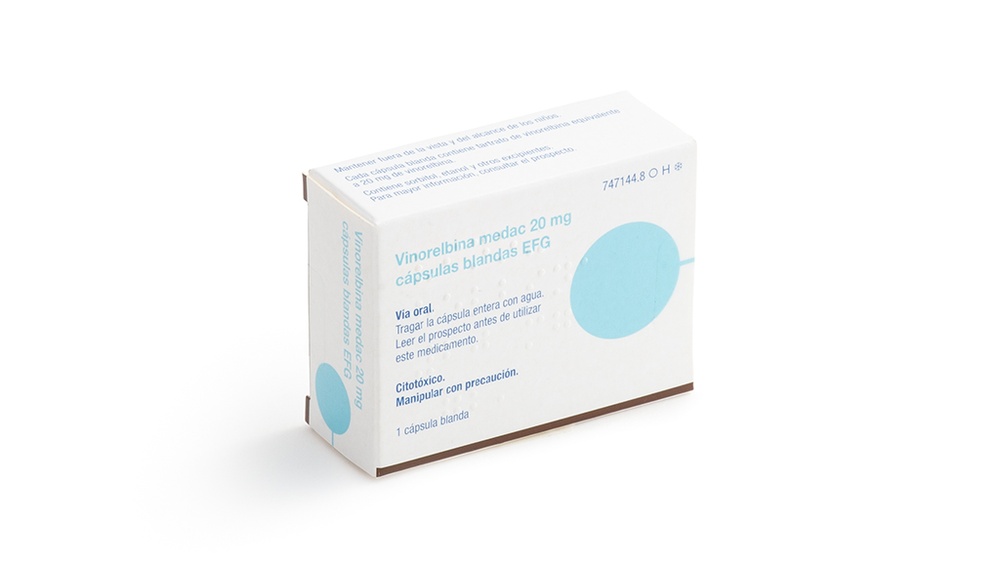
- País de registro
- Forma farmacéuticaCAPSULA, 20 mg
- Código ATCL01CA04
- Principio activo
- Requiere recetaSí
- Fabricante
- ComposiciónALCOHOL ETILICO ANHIDRO (5 mg mg), GLICEROL (E 422) (2 mg mg), GLICEROL (E 422) (32,4 mg mg), SORBITOL LIQUIDO, PARCIALMENTE DESHIDRATADO (E-420) (12,4 mg mg), PROPILENGLICOL (0,02 mg mg)
- Esta información es de carácter general y no sustituye la consulta con un profesional sanitario.
- Alternativas a VINORELBINA MEDAC 20 MG CAPSULAS BLANDAS EFGForma farmacéutica: CAPSULA, 20 mgPrincipio activo: vinorelbinaFabricante: Pierre Fabre Iberica S.A.Requiere recetaForma farmacéutica: CAPSULA, 30mgPrincipio activo: vinorelbinaFabricante: Pierre Fabre Iberica S.A.Requiere recetaForma farmacéutica: INYECTABLE PERFUSION, 10 mg/mlPrincipio activo: vinorelbinaFabricante: Accord Healthcare S.L.U.Requiere receta
Médicos online para VINORELBINA MEDAC 20 MG CAPSULAS BLANDAS EFG
Comenta la dosis, los posibles efectos secundarios, interacciones, contraindicaciones o la revisión de receta de VINORELBINA MEDAC 20 MG CAPSULAS BLANDAS EFG, sujeto a valoración médica y a la normativa local.
Preguntas frecuentes
VINORELBINA MEDAC 20 MG CAPSULAS BLANDAS EFG requiere receta en España. Puedes confirmarlo con un médico online según tu caso.
El principio activo de VINORELBINA MEDAC 20 MG CAPSULAS BLANDAS EFG es vinorelbina. Esta información ayuda a identificar medicamentos con la misma composición pero con diferentes nombres comerciales.
VINORELBINA MEDAC 20 MG CAPSULAS BLANDAS EFG es fabricado por Medac Gesellschaft Für Klinische Spezialpräparate Gmbh. La marca y el envase pueden variar según el distribuidor.
Los Médicos de familia, Psiquiatras, Dermatólogos, Cardiólogos, Endocrinólogos, Gastroenterólogos, Neumólogos, Nefrólogos, Reumatólogos, Hematólogos, Infectólogos, Alergólogos, Geriatras, Pediatras, Oncólogos pueden valorar la prescripción de VINORELBINA MEDAC 20 MG CAPSULAS BLANDAS EFG cuando esté clínicamente indicado. Puedes reservar una videoconsulta para comentar tu caso y las opciones de tratamiento.
La receta la emite un médico tras valorar tu estado de salud. En España, VINORELBINA MEDAC 20 MG CAPSULAS BLANDAS EFG se dispensa en las farmacias con esa receta médica. Una consulta online no garantiza su emisión: la decisión corresponde siempre al médico.
Para solicitar una valoración puedes usar Oladoctor:
Otros medicamentos con el mismo principio activo (vinorelbina) incluyen NAVELBINE 20 mg CAPSULAS BLANDAS, NAVELBINE 30 mg CAPSULAS BLANDAS, VINORELBINA ACCORD 10 MG/ML CONCENTRADO PARA SOLUCION PARA PERFUSION EFG. Pueden tener diferentes nombres comerciales o formulaciones, pero contienen el mismo componente terapéutico. Consulta siempre con un médico antes de cambiar o iniciar un nuevo medicamento.
