


Navelbine 20 mg cápsulas blandas

Revisión de receta online
Un médico revisará tu caso y determinará si la prescripción es médicamente apropiada.

Habla con un médico sobre este medicamento
Comenta tus síntomas y las opciones de tratamiento en una consulta online.



Cómo usar NAVELBINE 20 mg CAPSULAS BLANDAS
Contenido del prospecto
- Introducción
- Qué es Navelbine y para qué se utiliza
- Qué necesita saber antes de empezar a tomar Navelbine
- Cómo tomar Navelbine
- Posibles efectos adversos
- Conservación de Navelbine
- Contenido del envase e información adicional
Introducción
Prospecto: Información para el usuario
Navelbine 20 mg cápsulas blandas
vinorelbina
Lea todo el prospecto detenidamente antes de empezar a tomar este medicamento, porque contiene información importante para usted.
- Conserve este prospecto, ya que puede tener que volver a leerlo.
- Si tiene alguna duda, consulte a su médico o farmacéutico.
- Este medicamento se le ha recetado solamente a usted, y no debe dárselo a otras personas aunque tengan los mismos síntomas que usted, ya que puede perjudicarles.
- Si experimenta efectos adversos, consulte a su médico o farmacéutico, incluso si se trata de efectos adversos que no aparecen en este prospecto. Ver sección 4.
Contenido del prospecto
- Qué es Navelbine y para qué se utiliza
- Qué necesita saber antes de empezar a tomar Navelbine
- Cómo tomar Navelbine
- Posibles efectos adversos
- Conservación de Navelbine
- Contenido del envase e información adicional
1. Qué es Navelbine y para qué se utiliza
Este medicamento contiene el principio activo de vinorelbina (como tartrato), y pertenece a una familia de medicamentos denominada alcaloides de la vinca, familia utilizada para el tratamiento del cáncer.
Navelbine se utiliza para tratar ciertos tipos de cáncer de pulmón y de mama en pacientes mayores de 18 años.

¿No estás seguro de si este medicamento es adecuado para ti?
Comenta tus síntomas y tratamiento con un médico online.
2. Qué necesita saber antes de empezar a tomar Navelbine
No tome Navelbine
- si es alérgico al principio activo (vinorelbina) u otros medicamentos relacionados con el cáncer llamados alcaloides de la vinca o a alguno de los demás componentes de este medicamento (incluidos en la sección 6);
- si está en periodo de lactancia;
- si ha sufrido alguna intervención quirúrgica en el estómago o en el intestino delgado o si tiene trastornos intestinales;
- si tiene un descenso importante del número de glóbulos blancos y/o plaquetas, o una infección grave actual o reciente (en el periodo de 2 semanas);
- si tiene previsto recibir una vacuna contra la fiebre amarilla o acaba de recibirla;
- si está en tratamiento con oxígeno de forma continua.
Advertencias y precauciones
Consulte a su médico antes de empezar a tomar este medicamento, especialmente si:
- Tiene antecedentes de ataque cardíaco o dolor grave en el pecho;
- Su capacidad para realizar actividades cotidianas se reduce considerablemente;
- Está recibiendo radioterapia, y la zona tratada incluye el hígado;
- Presenta síntomas de una infección (como fiebre, escalofríos, tos);
- Tiene prevista una vacunación. No se recomienda usar este medicamento con las vacunas vivas atenuadas (p.ej. vacuna del sarampión, paperas, rubeola…) ya que puede verse incrementado el riesgo de enfermedad vacunal fatal;
- Si tiene un trastorno hepático grave no relacionado con el cáncer.
- Si está embarazada.
Antes y durante el tratamiento con este medicamento, se realizará el recuento de células sanguíneas para comprobar que es seguro que pueda recibir el tratamiento. Si los resultados de este análisis no son satisfactorios, puede retrasarse su tratamiento y pueden realizarle otros análisis hasta que los resultados vuelvan a ser normales.
Niños y adolescentes
No se recomienda para uso en niños ni en adolescentes menores de 18 años.
Toma de Navelbine con otros medicamentos
Informe a su médico o farmacéutico si está tomando o ha tomado recientemente o pudiera tener que tomar cualquier otro medicamento.
Su médico deberá prestar especial atención si está tomando alguno de los siguientes medicamentos:
- medicamentos para licuar la sangre (anticoagulantes),
- medicamentos antiepilépticos como fenitoína,
- antibióticos (ej: Rifampicina),
- medicamentos antifúngicos (ej: itraconazol, ketoconazol),
- medicamentos anticancerígenos como mitomicina C,
- medicamentos que pueden dañar el sistema inmune como ciclosporina y tacrolimus.
La combinación de este medicamento con otros medicamentos con toxicidad conocida sobre la médula ósea (que afecta a sus glóbulos blancos, rojos y a las plaquetas) también puede empeorar algunos efectos adversos.
La vacuna de la fiebre amarilla está contraindicada, ver apartado “No tome Navelbine”.
Toma de Navelbine con alimentos y bebidas
La cápsula blanda debe tragarse entera con agua sin masticarla ni chuparla.
Se recomienda tomar este medicamento con una comida ligera. Este medicamento no debe tomarse con una bebida caliente ya que podría disolver la cápsula rápidamente.
Embarazo, lactancia y fertilidad
Si está embarazada, o en periodo de lactancia, cree que puede estar embarazada o tiene intención de quedarse embarazada consulte con su médico antes de utilizar este medicamento, ya que existen riesgos potenciales para el niño.
No debe dar el pecho si está tomando Navelbine (ver sección 2 “No tome Navelbine”).
Si es una mujer en edad fértil, debe utilizar un método anticonceptivo efectivo (control de la natalidad) durante el tratamiento y durante 7 meses después de finalizar el tratamiento.
Si es un hombre que está siendo tratado con este medicamento, se le aconseja que no conciba un hijo durante el tratamiento y durante 4 meses después de tomar la última cápsula, y que antes de iniciar el tratamiento debería buscarse asesoramiento para conservar esperma ya que este medicamento puede alterar su fertilidad. Debe utilizar un método anticonceptivo efectivo durante el tratamiento y durante 4 meses después de finalizar éste.
Conducción y uso de máquinas
No se han realizado estudios sobre los efectos en la capacidad de conducir y utilizar máquinas.
Sin embargo, como en todos los casos, no debe conducir si se encuentra mal o si su médico le ha aconsejado que no conduzca.
Navelbine contiene sorbitol, alcohol, sodio
Este medicamentocontiene 5,36 mg de sorbitol en cada cápsula.
Este medicamento contiene 5 mg de alcohol (etanol) en cada cápsula. La cantidad en cada cápsula de este medicamento es equivalente a menos de 1 ml de cerveza o 1 ml de vino.
La pequeña cantidad de alcohol que contiene este medicamento no produce ningún efecto perceptible.
Este medicamento contiene menos de 1 mmol de sodio (23 mg) por cápsula; esto es, esencialmente “exento de sodio”.
3. Cómo tomar Navelbine
Este medicamento será administrado bajo la supervisión de un médico especialista en el tratamiento del cáncer.
Siga exactamente las instrucciones de administración de este medicamento indicadas por su médico. En caso de duda, consulte de nuevo a su médico o farmacéutico.
La dosis recomendada es:
Antes y durante el tratamiento con este medicamento, su médico controlará el recuento de células sanguíneas para determinar el momento en que debe recibir el tratamiento y la dosis adecuada. Su médico le indicará la dosis y el número de cápsulas que debe tomar a la semana.
La dosis total nunca debe exceder de 160 mg por semana.
No debe tomar nunca este medicamento más de una vez por semana.
Frecuencia de administración
Este medicamento se administrará normalmente una vez a la semana. La frecuencia será determinada por su médico.
Duración del tratamiento
La duración de su tratamiento la decidirá su médico.
Uso en niños y adolescentes
No se recomienda para uso en niños ni en adolescentes (menores de 18 años). Este medicamento se utiliza en pacientes adultos.
Método de administración:
Este medicamento se toma por vía oral.
Como tomar las cápsulas:
- Tragar la cápsula entera con agua, preferiblemente con una comida ligera. No debe tomar la cápsula blanda con una bebida caliente ya que podría disolver la cápsula rápidamente.
- No masticar ni chupar las cápsulas.
- Si mastica o chupa la cápsula por error, enjuáguese la boca minuciosamente e informe a su médico inmediatamente.
- Si vomita al cabo de pocas horas de haber tomado Navelbine informe a su médico inmediatamente. No repita la dosis.
Antes de abrir el blíster que contiene las cápsulas
Asegúrese de que la cápsula no está dañada ya que el líquido que contiene es irritante y puede causar lesión si entra en contacto con la piel, mucosa u ojos. Si esto ocurre, proceder inmediatamente al lavado minucioso de la zona afectada. Las capsulas alteradas no deben tragarse; deben devolverse a la farmacia o al médico.
Para abrir el envase de seguridad:
- Corte el blíster a lo largo de la línea punteada negra con unas tijeras.
- Quite la lámina de plástico blando.
- Empuje la cápsula a través de la lámina de aluminio.
Si toma más Navelbine del que debe
Si ha tomado más cápsulas de las recetadas por su médico, consulte inmediatamente a su médico.
Pueden aparecer síntomas graves en relación con los componentes de la sangre y puede desarrollar signos de infección (tales como fiebre, escalofríos, tos). Puede tener estreñimiento grave. Si esto ocurre, consulte con su médico inmediatamente.
En caso de sobredosis o ingestión accidental, consulte inmediatamente a su médico o farmacéutico o llame al Servicio de Información Toxicológica. Teléfono 91 562 04 20, indicando el medicamento y la cantidad ingerida.
Si olvidó tomar Navelbine
No tome una dosis doblepara compensar la dosis olvidada.
Contacte con su médico quien le indicará si debe modificar la dosis que tiene que tomar.
Si interrumpe el tratamiento con Navelbine
Es su médico quien decidirá cuando debe dejar su tratamiento. En cualquier caso, si desea interrumpir el tratamiento antes, debe consultarlo con su médico para que pueda valorar otras opciones de tratamiento.
Si tiene cualquier otra duda sobre el uso de este medicamento, pregunte a su médico o farmacéutico.

¿Has empezado a tomar el medicamento y tienes preguntas?
Comenta tus síntomas y tratamiento con un médico online.
4. Posibles efectos adversos
Al igual que todos los medicamentos, este medicamento puede producir efectos adversos, aunque no todas las personas los sufran.
Informeinmediatamente a su médico si mientras utiliza Navelbine desarrolla cualquiera de los síntomas siguientes:
|
Efectos adversos muy frecuentes (pueden afectar a más de 1 de cada 10 personas)
- infecciones en diferentes sitios;
- trastornos gástricos, diarrea, estreñimiento, dolor abdominal, náuseas, vómitos;
- inflamación en la boca;
- descenso en los glóbulos rojos que puede provocar palidez en la piel y causar debilidad o dificultad al respirar;
- descenso del número de plaquetas que puede incrementar el riesgo de sangrado o de hematomas;
- descenso de los glóbulos blancos que le hace ser más vulnerable a las infecciones;
- pérdida de algunos reflejos, ocasionalmente alteraciones en la percepción del tacto;
- pérdida de pelo normalmente moderada;
- cansancio;
- fiebre;
- malestar;
- aumento de peso, pérdida de apetito.
Efectos adversos frecuentes (pueden afectar hasta 1 de cada 10 personas):
- dificultad para coordinar los movimientos musculares;
- diferencias en la vista;
- dificultades para respirar, tos;
- dificultades para orinar, otros síntomas genitourinarios;
- dificultad para dormir;
- dolor de cabeza, mareos, alteración de la percepción de sabores;
- inflamación de la garganta, dificultad para tragar alimentos o líquidos;
- reacciones en la piel;
- escalofríos;
- aumento de peso;
- dolor articular; dolor en mandíbula, dolor muscular;
- dolor en diferentes partes del cuerpo y dolor donde se encuentra el tumor;
- tensión arterial alta;
- alteraciones hepáticas (pruebas hepáticas alteradas).
Efectos adversos poco frecuentes (pueden afectar hasta 1 de cada 100 personas):
- insuficiencia cardíaca que puede causar dificultad para respirar e hinchazón de tobillos, latidos irregulares del corazón;
- falta de control muscular que puede estar asociada con una marcha anormal, cambios en el habla y anormalidades en el movimiento de los ojos (ataxia);
Frecuencia no conocida (no puede estimarse a partir de los datos disponibles)
- infecciones sanguíneas (sepsis) ) con síntomas como fiebre alta y deterioro de la salud general;
- ataque al corazón (infarto de miocardio);
- sangrado gastrointestinal;
- nivel bajo de sodio en la sangre que produce debilidad, contracciones musculares, cansancio, confusión o pérdida del conocimiento. Este nivel bajo de sodio puede atribuirse en algunos casos a una sobreproducción de una hormona que causa retención de líquidos (Síndrome de secreción inadecuada de hormona antidiurética - SIADH).
Comunicación de efectos adversos:
Si experimenta cualquier tipo de efecto adverso, consulte a su médico o farmacéutico incluso si se trata de posibles efectos adversos que no aparecen en este prospecto. También puede comunicarlos directamente a través del Sistema Español de Farmacovigilancia de medicamentos de Uso Humano: https://www.notificaram.es. Mediante la comunicación de efectos adversos usted puede contribuir a proporcionar más información sobre la seguridad de este medicamento.
5. Conservación de Navelbine
Mantener este medicamento fuera de la vista y del alcance de los niños.
Conservar en nevera (entre 2°C y 8 °C). Mantener el blíster perfectamente cerrado.
No utilice este medicamento después de la fecha de caducidad que aparece en la caja y en el blíster, después de CAD.
La fecha de caducidad es el último día del mes que se indica.
Los medicamentos no se deben tirar por los desagües ni a la basura. Deposite los envases y los medicamentos que no necesita en el Punto SIGRE de su farmacia. En caso de duda pregunte a su farmacéutico cómo deshacerse de los envases y de los medicamentos que no necesita. De esta forma ayudará a proteger el medio ambiente.
6. Contenido del envase e información adicional
Composición deNavelbine
El principio activo es vinorelbina. Cada cápsula blanda contiene 20 mg de vinorelbina (equivalente a 27,7 mg de vinorelbina tartrato).
La solución contiene: etanol anhidro, agua purificada, glicerol, macrogol 400.
Cubierta de la cápsula contiene: gelatina, glicerol 85%, Anidrisorb 85/70 (contiene: sorbitol (E420); 1,4-sorbitano; manitol (E421); polioles superiores), agentes colorantes (óxido de hierro amarillo (E-172), dióxido de titanio (E-171)), triglicéridos de cadena media, PHOSAL 53 MCT (contiene: fosfatidilcolina, glicéridos).
La tinta de impresión comestible contiene: ácido carmínico (E-120), hidróxido de sodio, cloruro de aluminio hexahidrato, hipromelosa, propilenglicol (E1520).
AspectodeNavelbiney contenido del envase
Cápsula blanda, de color marrón claro y con la impresión N20.
Cada envase contiene un blíster con 1 cápsula blanda.
Titular de la autorización de comercialización
PIERRE FABRE IBÉRICA, S.A.
C/ Ramón Trias Fargas, 7-11
08005 – BARCELONA (España)
Responsable de la fabricación
FAREVA PAU 1
Avenue du Béarn
64320 IDRON
Francia
Fecha de la última revisión de este prospecto:Enero 2024
La información detallada y actualizada de este medicamento está disponible en la página web de la Agencia Española de Medicamentos y Productos Sanitarios (AEMPS) http://www.aemps.gob.es
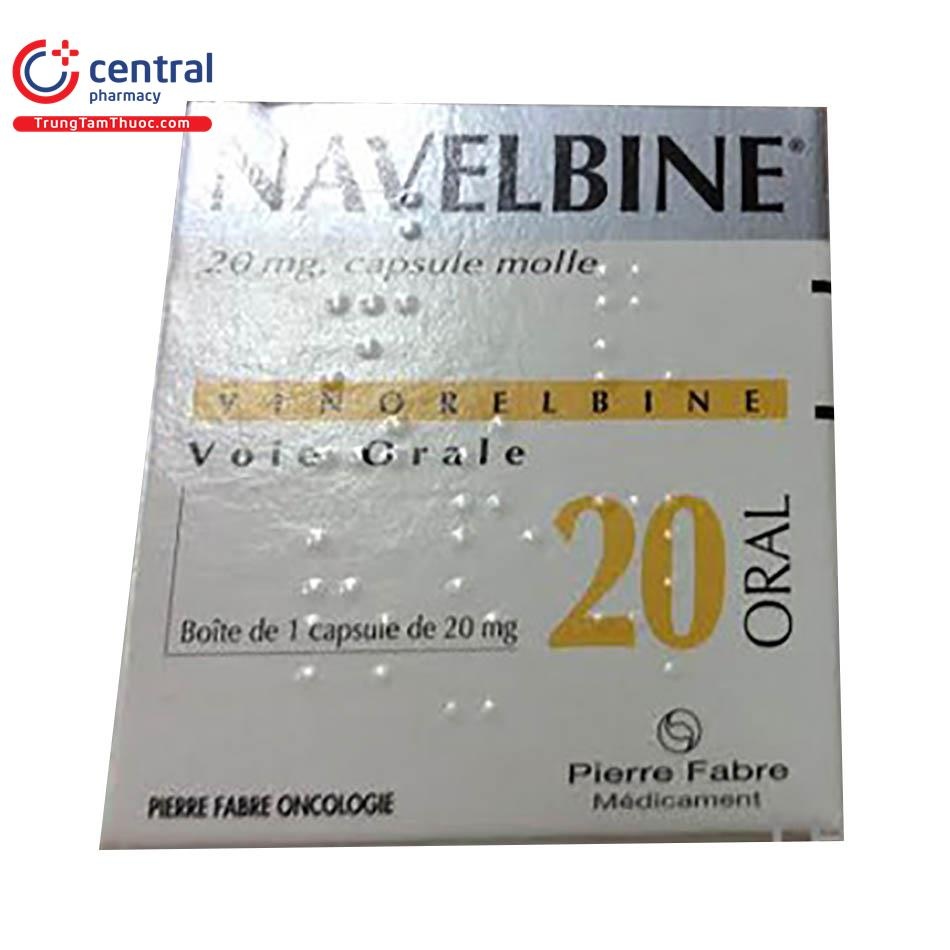
- País de registro
- Forma farmacéuticaCAPSULA, 20 mg
- Código ATCL01CA04
- Principio activo
- Requiere recetaSí
- Fabricante
- ComposiciónETANOL ANHIDRO (5,00 mg mg), GLICEROL (E 422) (2,00 mg mg), GLICEROL (85%) (37,98 mg mg)
- Esta información es de carácter general y no sustituye la consulta con un profesional sanitario.
- Alternativas a NAVELBINE 20 mg CAPSULAS BLANDASForma farmacéutica: CAPSULA, 30mgPrincipio activo: vinorelbinaFabricante: Pierre Fabre Iberica S.A.Requiere recetaForma farmacéutica: INYECTABLE PERFUSION, 10 mg/mlPrincipio activo: vinorelbinaFabricante: Accord Healthcare S.L.U.Requiere recetaForma farmacéutica: CAPSULA, 20 mgPrincipio activo: vinorelbinaFabricante: Accord Healthcare S.L.U.Requiere receta
Médicos online para NAVELBINE 20 mg CAPSULAS BLANDAS
Comenta la dosis, los posibles efectos secundarios, interacciones, contraindicaciones o la revisión de receta de NAVELBINE 20 mg CAPSULAS BLANDAS, sujeto a valoración médica y a la normativa local.
Preguntas frecuentes
NAVELBINE 20 mg CAPSULAS BLANDAS requiere receta en España. Puedes confirmarlo con un médico online según tu caso.
El principio activo de NAVELBINE 20 mg CAPSULAS BLANDAS es vinorelbina. Esta información ayuda a identificar medicamentos con la misma composición pero con diferentes nombres comerciales.
NAVELBINE 20 mg CAPSULAS BLANDAS es fabricado por Pierre Fabre Iberica S.A.. La marca y el envase pueden variar según el distribuidor.
Los Médicos de familia, Psiquiatras, Dermatólogos, Cardiólogos, Endocrinólogos, Gastroenterólogos, Neumólogos, Nefrólogos, Reumatólogos, Hematólogos, Infectólogos, Alergólogos, Geriatras, Pediatras, Oncólogos pueden valorar la prescripción de NAVELBINE 20 mg CAPSULAS BLANDAS cuando esté clínicamente indicado. Puedes reservar una videoconsulta para comentar tu caso y las opciones de tratamiento.
La receta la emite un médico tras valorar tu estado de salud. En España, NAVELBINE 20 mg CAPSULAS BLANDAS se dispensa en las farmacias con esa receta médica. Una consulta online no garantiza su emisión: la decisión corresponde siempre al médico.
Para solicitar una valoración puedes usar Oladoctor:
Otros medicamentos con el mismo principio activo (vinorelbina) incluyen NAVELBINE 30 mg CAPSULAS BLANDAS, VINORELBINA ACCORD 10 MG/ML CONCENTRADO PARA SOLUCION PARA PERFUSION EFG, VINORELBINA ACCORD 20 MG CAPSULA BLANDA EFG. Pueden tener diferentes nombres comerciales o formulaciones, pero contienen el mismo componente terapéutico. Consulta siempre con un médico antes de cambiar o iniciar un nuevo medicamento.
