



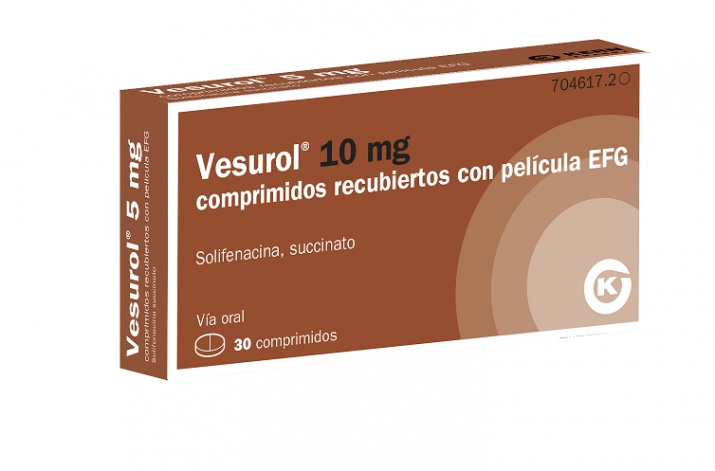
VESUROL 10 mg Comprimidos Recubiertos Con Pelicula

Revisión de receta online
Un médico revisará tu caso y determinará si la prescripción es médicamente apropiada.

Habla con un médico sobre este medicamento
Comenta tus síntomas y las opciones de tratamiento en una consulta online.



Cómo usar VESUROL 10 MG COMPRIMIDOS RECUBIERTOS CON PELICULA EFG
Contenido del prospecto
- Introducción
- Qué es Vesurol y para qué se utiliza
- Qué necesita saber antes de empezar a tomar Solifenacina Vesurol
- Cómo tomar Vesurol
- Posibles efectos adversos
- Conservación de Vesurol
- Contenido del envase e información adicional
Introducción
Prospecto: Información para el usuario
Vesurol 10 mg comprimidos recubiertos con película EFG
Solifenacina, succinato
Lea todo el prospecto detenidamente antes de empezar a tomar este medicamento, porque contiene información importante para usted.
- Conserve este prospecto, ya que puede tener que volver a leerlo.
- Si tiene alguna duda, consulte a su médico o farmacéutico.
- Este medicamento se le ha recetado solamente a usted, y no debe dárselo a otras personas aunque tengan los mismos síntomas que usted, ya que puede perjudicarles.
- Si experimenta efectos adversos, consulte a su médico o farmacéutico, incluso si se trata de efectos adversos que no aparecen en este prospecto. Ver sección 4.
Contenido del prospecto:
- Qué es Vesurol y para qué se utiliza
- Qué necesita saber antes de empezar a tomar Vesurol
- Cómo tomar Vesurol
- Posibles efectos adversos
5 Conservación de Vesurol
- Contenido del envase e información adicional
1. Qué es Vesurol y para qué se utiliza
El principio activo de Vesurol pertenece al grupo de los anticolinérgicos. Estos medicamentos se utilizan para reducir la actividad de la vejiga hiperactiva. Esto le permite que pueda disponer de más tiempo antes de tener que ir al servicio y aumenta la cantidad de orina que su vejiga puede retener.
Vesurol se utiliza para tratar los síntomas del síndrome vejiga hiperactiva. Estos síntomas incluyen: tener una fuerte y repentina necesidad de orinar sin previo aviso, tener que orinar con frecuencia o tener escapes de orina por no llegar a tiempo al servicio.

¿No estás seguro de si este medicamento es adecuado para ti?
Comenta tus síntomas y tratamiento con un médico online.
2. Qué necesita saber antes de empezar a tomar Solifenacina Vesurol
No tome Vesurol
- si es alérgico a succinato de solifenacina o a cualquiera de los demás componentes de este medicamento (incluidos en la sección 6),
- si tiene dificultad para orinar o para vaciar completamente su vejiga (retención urinaria),
- si tiene una alteración del estómago o del intestino grave (incluyendo megacolon tóxico, una complicación asociada a colitis ulcerosa),
- si padece una enfermedad muscular llamada miastenia gravis, que puede provocar una extremada debilidad de ciertos músculos,
- si padece presión alta en los ojos, con pérdida gradual de la visión (glaucoma),
- si está sometido a diálisis renal,
- si tiene una enfermedad hepática grave,
- si padece una enfermedad renal grave o enfermedad hepática moderada y al mismo tiempo está siendo tratado con medicamentos que pueden disminuir la eliminación de solifenacina del cuerpo (p.ej. ketoconazol). Su médico o farmacéutico le tendrá informado si éste es el caso.
Antes de iniciar el tratamiento con solifenacina, informe a su médico si tiene o ha tenido cualquiera de las enfermedades mencionadas anteriormente.
Advertencias y precauciones
Consulte a su médico o farmacéutico antes de empezar a tomar este medicamento.
- si tiene problema para vaciar su vejiga (obstrucción de la vejiga) o para orinar (p. ej. un flujo de orina débil). El riesgo de acumulación de orina en la vejiga (retención urinaria) es mucho mayor,
- si tiene alguna obstrucción del sistema digestivo (estreñimiento),
- si tiene riesgo aumentado de disminución de la actividad del sistema digestivo (movimientos del estómago y del intestino). Su médico le tendrá informado si este es el caso,
- si padece una enfermedad renal grave,
- si tiene una enfermedad hepática moderada,
- si tiene hernia de hiato o ardor de estómago,
- si tiene un trastorno nervioso (neuropatía autonómica).
Niños y adolescentes
Estemedicamentono debe utilizarse en niños ni adolescentes menores de 18 años.
Informe a su médico antes de iniciar el tratamiento con este medicamento, si cualquiera de las circunstancias anteriormente mencionadas le hubiera ocurrido alguna vez.
Antes de iniciar el tratamiento con solifenacina, su médico valorará si hay otras causas en su necesidad de orinar con frecuencia (por ejemplo insuficiencia cardiaca (insuficiente capacidad de bombeo del corazón) o enfermedad renal). Si tiene una infección del tracto urinario, su médico le prescribirá un antibiótico (un tratamiento contra determinadas infecciones bacterianas).
Uso de Vesurol con otros medicamentos
Comunique a su médico o farmacéutico que está utilizando, ha utilizado recientemente o podría tener que utilizar cualquier otro medicamento.
Es especialmente importante que informe a su médico si está tomando:
- otros medicamentos anticolinérgicos, la actividad y los efectos adversos de ambos medicamentos podrían aumentar,
- colinérgicos ya que pueden reducir el efecto de solifenacina,
- medicamentos tales como metoclopramida o cisaprida, que hacen que el sistema digestivo trabaje más rápido. Solifenacina puede reducir su efecto,
- medicamentos tales como ketoconazol, ritonavir, nelfinavir, intraconazol, verapamilo y diltiazem, que disminuyen la velocidad de eliminación de solifenacina del organismo,
- medicamentos tales como rifampicina, fenitoína y carbamazepina, ya que pueden aumentar la velocidad eliminación de solifenacina del organismo,
- medicamentos tales como los bifosfonatos, que pueden provocar o empeorar la inflamación del esófago (esofagitis).
Uso de Vesurol con alimentos, bebidas y alcohol
Este medicamento se puede tomar con o sin alimentos, según prefiera.
Embarazo, lactancia y fertilidad
Si está embarazada o en periodo de lactancia, cree que podría estar embarazada o tiene intención de quedarse embarazada, consulte a su médico o farmacéutico antes de utilizar este medicamento.
No debe usar solifenacina si está embarazada a menos que sea absolutamente necesario.
No use solifenacina durante la lactancia ya que solifenacina puede pasar a la leche materna.
Conducción y uso de máquinas
Solifenacina puede provocar visión borrosa y algunas veces somnolencia o fatiga. Si sufre alguno de estos efectos secundarios, no conduzca ni use máquinas.
Advertencia sobre excipientes
Vesurol contiene lactosa
Este medicamento contiene lactosa. Si su médico le ha indicado que padece una intolerancia a ciertos azúcares, consulte con él antes de tomar este medicamento.
3. Cómo tomar Vesurol
Instruccionesparasuusocorrecto
Siga exactamente las instrucciones de administración de este medicamento indicadas por su médico. En caso de duda, consulte de nuevo a su médico o farmacéutico.
Debe tragar el comprimido con algún líquido. Se puede tomar con o sin alimentos, según su preferencia. No triture los comprimidos.
El comprimido se puede dividir en dosis iguales.
La dosis recomendada es de 5 mg al día, a menos que su médico le indique que tome 10 mg al día.
Si toma más Vesurol del que debe
En caso de sobredosis o ingesta accidental, póngase en contacto con su médico o farmacéutico inmediatamente, o llame al servicio de Información Toxicológica, teléfono: 91 562 04 20, indicando el medicamento y la cantidad ingerida.
Los síntomas en caso de sobredosis pueden incluir: dolor de cabeza, sequedad de boca, mareo, somnolencia y visión borrosa, percepción de cosas que no están (alucinaciones), excitación pronunciada, convulsiones, dificultad respiratoria, aumento de la frecuencia cardiaca (taquicardia), acumulación de orina en la vejiga (retención urinaria), y dilatación de las pupilas (midriasis).
Si olvidó tomar Vesurol
Si olvida tomar una dosis a la hora habitual, tómela en cuanto se acuerde, a menos que sea el momento de tomar la siguiente dosis. Nunca tome más de una dosis al día. Si tiene alguna duda, consulte siempre a su médico o farmacéutico.
Si interrumpe el tratamiento con Vesurol
Si deja de tomar solifenacina, sus síntomas de vejiga hiperactiva pueden volver o empeorar. Consulte siempre a su médico si está pensando interrumpir el tratamiento.
Si tiene cualquier otra duda sobre el uso de este medicamento, pregunte a su médico o farmacéutico.

¿Has empezado a tomar el medicamento y tienes preguntas?
Comenta tus síntomas y tratamiento con un médico online.
4. Posibles efectos adversos
Al igual que todos los medicamentos, este medicamento puede producir efectos adversos, aunque no todas las personas los sufran.
Si sufre un ataque de alergia o una reacción cutánea grave (por ejemplo formación de ampollas y descamación de la piel), debe informar a su médico o enfermero inmediatamente.
Se ha notificado angioedema (alergia en la piel que resulta en la inflamación que se produce en el tejido que está debajo de la superficie de la piel) con obstrucción de vías respiratorias (dificultad para respirar) en algunos pacientes tratados con succinato de solifenacina. Si aparece angioedema, se debe interrumpir el tratamiento inmediatamentecon succinato de solifenacina y se debe tomar el tratamiento adecuado y/o las medidas adecuadas.
Solifenacina puede producir los siguientes efectos adversos:
Muy frecuentes (pueden afectar a más de 1 de cada 10 personas)
- sequedad de boca,
Frecuentes (pueden afectar hasta 1 de cada 10 personas)
- visión borrosa,
- estreñimiento, náuseas, indigestión con síntomas tales como sensación de pesadez de estómago, dolor abdominal, eructos, náuseas y ardor de estómago (dispepsia), malestar de estómago.
Efectos adversos poco frecuentes (puede afectar hasta 1 de cada 100 personas)
- infección del tracto urinario, infección de la vejiga,
- somnolencia,
- percepción anormal del gusto (disgeusia),
- ojos secos (irritados),
- sequedad de las fosas nasales,
- enfermedad de reflujo (reflujo gastroesofágico),
- garganta seca,
- piel seca,
- dificultad para orinar,
- cansancio,
- acumulación de líquido en las extremidades inferiores (edema).
Efectos adversos raros (pueden afectar hasta 1 de cada 1.000 personas)
- acumulación de gran cantidad de heces endurecidas en el intestino grueso (impactación fecal),
- acumulación de orina en la vejiga por incapacidad para vaciar la vejiga (retención urinaria),
- mareo, dolor de cabeza,
- vómitos,
- picor, erupción cutánea.
Efectos adversos muy raros (pueden afectar hasta 1 de cada 10.000 personas)
- alucinaciones, confusión,
- erupción cutánea alérgica.
Frecuencia no conocida (la frecuencia no puede estimarse a partir de los datos disponibles)
- disminución del apetito, altos niveles de potasio en sangre que pueden causar un ritmo del corazón anormal,
- aumento de la presión en los ojos,
- cambios en la actividad eléctrica del corazón (ECG), latidos irregulares (Torsades de Pointes),
- trastorno de la voz,
- trastorno del hígado,
- debilidad muscular,
- trastorno renal.
Comunicación de efectos adversos
Si experimenta cualquier tipo de efecto adverso, consulte a su médico o farmacéutico, incluso si se trata de posibles efectos adversos que no aparecen en este prospecto. También puede comunicarlos directamente a través del Sistema Español de Farmacovigilancia de Medicamentos de Uso Humano Website: www.notificaRAM.es. Mediante la comunicación de efectos adversos usted puede contribuir a proporcionar más información sobre la seguridad de este medicamento.
5. Conservación de Vesurol
Mantener este medicamento fuera de la vista y del alcance de los niños.
No requiere condiciones especiales de conservación.
No utilice este medicamento después de la fecha de caducidad que aparece en el envase después de “CAD”. La fecha de caducidad es el último día del mes que se indica.
Los medicamentos no se deben tirar por los desagües ni a la basura. Deposite los envases y los medicamentos que no necesita en el Punto SIGRE de la farmacia. En caso de duda pregunte a su farmacéutico cómo deshacerse de los envases y de los medicamentos que no necesita. De esta forma ayudará a proteger el medio ambiente.
6. Contenido del envase e información adicional
Composición de Vesurol
- El principio activo es succinato de solifenacina 10 mg (equivalente a 7,5 mg de solifenacina).
- Los demás componentes (excipientes) son:
Núcleo del comprimido: almidón de maíz, lactosa monohidrato, hipromelosa (E464) y estearato de magnesio.
Cubierta pelicular: hipromelosa (E464), macrogol, talco, dióxido de titanio (E171) y óxido de hierro rojo (E172).
Aspecto del producto y contenido del envase
Los comprimidos recubiertos de Vesurol son comprimidos redondos, de color rosa y con ranura en uno de los lados. El comprimido se puede dividir en mitades iguales.
Los comprimidos de Vesurol se suministran en blísters de 30 comprimidos.
Titular de la autorización de comercialización y responsable de la fabricación
Kern Pharma, S.L.
Venus, 72 - Pol. Ind. Colón II
08228 Terrassa - Barcelona
España
Fecha de la última revisión de este prospecto:Diciembre 2014
La información detallada y actualizada de este medicamento está disponible en la página Web de la Agencia Española de Medicamentos y Productos Sanitarios (AEMPS) http://www.aemps.gob.es/
- País de registro
- Forma farmacéuticaCOMPRIMIDO, 10 mg
- Código ATCG04BD08
- Precio medio en farmacia40.81 EUR
- Principio activo
- Requiere recetaSí
- Fabricante
- ComposiciónLACTOSA MONOHIDRATO (164,80 mg mg)
- Esta información es de carácter general y no sustituye la consulta con un profesional sanitario.
- Alternativas a VESUROL 10 MG COMPRIMIDOS RECUBIERTOS CON PELICULA EFGForma farmacéutica: COMPRIMIDO, 10 mgPrincipio activo: solifenacinaFabricante: Laboratorios Alter S.A.Requiere recetaForma farmacéutica: COMPRIMIDO, 5 mgPrincipio activo: solifenacinaFabricante: Laboratorios Alter S.A.Requiere recetaForma farmacéutica: COMPRIMIDO, 10 mgPrincipio activo: solifenacinaFabricante: Laboratorios Q Pharma S.L.Requiere receta
Médicos online para VESUROL 10 MG COMPRIMIDOS RECUBIERTOS CON PELICULA EFG
Comenta la dosis, los posibles efectos secundarios, interacciones, contraindicaciones o la revisión de receta de VESUROL 10 MG COMPRIMIDOS RECUBIERTOS CON PELICULA EFG, sujeto a valoración médica y a la normativa local.

Obtén una receta de VESUROL 10 MG COMPRIMIDOS RECUBIERTOS CON PELICULA EFG online
Rellena un formulario de 2 minutos
Cuéntanos tus síntomas, historial y el medicamento que necesitas.
Elige un médico o nosotros te asignamos uno
Escoge un especialista o te conectamos con el próximo médico disponible.
El médico revisa tu caso
Normalmente en 30 minutos. Puede hacerte preguntas adicionales por chat.
Recógela en cualquier farmacia
Receta electrónica enviada a tu correo, válida en toda España.
Preguntas frecuentes
VESUROL 10 MG COMPRIMIDOS RECUBIERTOS CON PELICULA EFG requiere receta en España. Puedes confirmarlo con un médico online según tu caso.
El principio activo de VESUROL 10 MG COMPRIMIDOS RECUBIERTOS CON PELICULA EFG es solifenacina. Esta información ayuda a identificar medicamentos con la misma composición pero con diferentes nombres comerciales.
El precio medio en farmacia de VESUROL 10 MG COMPRIMIDOS RECUBIERTOS CON PELICULA EFG es de aproximadamente 40.81 EUR. Puede variar según el fabricante y la forma farmacéutica.
VESUROL 10 MG COMPRIMIDOS RECUBIERTOS CON PELICULA EFG es fabricado por Kern Pharma S.L.. La marca y el envase pueden variar según el distribuidor.
Los Médicos de familia, Psiquiatras, Dermatólogos, Cardiólogos, Endocrinólogos, Gastroenterólogos, Neumólogos, Nefrólogos, Reumatólogos, Hematólogos, Infectólogos, Alergólogos, Geriatras, Pediatras, Oncólogos pueden valorar la prescripción de VESUROL 10 MG COMPRIMIDOS RECUBIERTOS CON PELICULA EFG cuando esté clínicamente indicado. Puedes reservar una videoconsulta para comentar tu caso y las opciones de tratamiento.
España cuenta con una infraestructura sanitaria bien desarrollada en ciudades principales como Madrid, Barcelona, Valencia y Sevilla. Las farmacias están ampliamente disponibles y operan bajo estrictas regulaciones, garantizando el acceso a medicamentos con receta.
Puedes comprar VESUROL 10 MG COMPRIMIDOS RECUBIERTOS CON PELICULA EFG en Madrid, Barcelona, Sevilla o Valencia en cualquier farmacia local con una receta válida.
Para obtener una receta, puedes utilizar Oladoctor:
Otros medicamentos con el mismo principio activo (solifenacina) incluyen DICRISOL 10 MG COMPRIMIDOS RECUBIERTOS CON PELICULA EFG, DICRISOL 5 MG COMPRIMIDOS RECUBIERTOS CON PELICULA EFG, SINCAL 10 MG COMPRIMIDOS RECUBIERTOS CON PELICULA EFG. Pueden tener diferentes nombres comerciales o formulaciones, pero contienen el mismo componente terapéutico. Consulta siempre con un médico antes de cambiar o iniciar un nuevo medicamento.
