



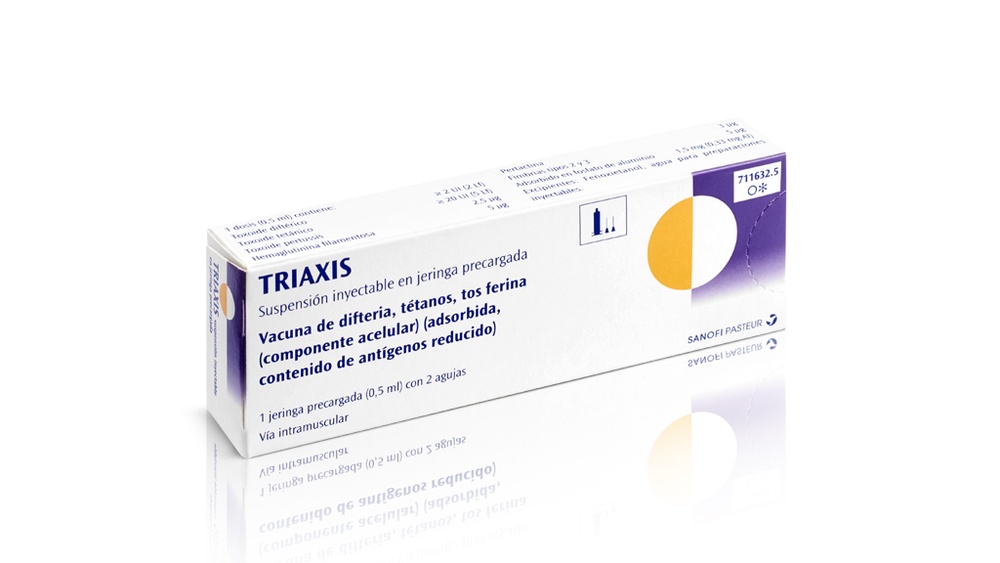
TRIAXIS 1 dosis Inyectable

Revisión de receta online
Un médico revisará tu caso y determinará si la prescripción es médicamente apropiada.

Habla con un médico sobre este medicamento
Comenta tus síntomas y las opciones de tratamiento en una consulta online.



Cómo usar TRIAXIS POLIO SUSPENSION INYECTABLE EN JERINGA PRECARGADA
Contenido del prospecto
- Introducción
- Qué es Triaxis Polio y para qué se utiliza
- Qué necesita saber antes de que usted o su hijo reciban Triaxis Polio
- Cómo usar Triaxis Polio
- Posibles efectos adversos
- Conservación de Triaxis Polio
- Contenido del envase e información adicional
Introducción
Prospecto: información para el usuario
TRIAXIS POLIO, suspensión inyectable en jeringa precargada
Vacuna de difteria, tétanos, tos ferina (componente acelular) y poliomielitis(adsorbida, contenido de antígenos reducido)
Lea todo el prospecto detenidamente antes de que usted o su hijo sean vacunados porque contiene información importante para usted.
- Conserve este prospecto, ya que puede tener que volver a leerlo.
- Si tiene alguna duda, consulte a su médico, farmacéutico o enfermero.
- Este medicamento se le ha recetado solamente a usted o a su hijo y no debe dárselo a otras personas, aunque tengan los mismos síntomas que usted, ya que puede perjudicarles.
- Si usted o su hijo experimentan efectos adversos, consulte a su médico, farmacéutico o enfermero, incluso si se trata de efectos adversos que no aparecen en este prospecto. Ver sección 4.
Contenido del prospecto
- Qué es Triaxis Polio y para qué se utiliza
- Qué necesita saber antes de que usted o su hijo reciban Triaxis Polio
- Cómo usar Triaxis Polio
- Posibles efectos adversos
- Conservación de Triaxis Polio
- Contenido del envase e información adicional
1. Qué es Triaxis Polio y para qué se utiliza
Triaxis Polio (Tdap-IPV) es una vacuna. Las vacunas se utilizan para proteger frente a enfermedades infecciosas. Las vacunas hacen que el cuerpo genere su propia protección frente a las bacterias y virus que provocan estas enfermedades infecciosas.
Esta vacuna se utiliza como protección de refuerzo frente a la difteria, tétanos, pertussis (tos ferina) y poliomielitis (polio) en niños a partir de tres años, adolescentes y adultos tras completar la pauta primaria de vacunación.
El uso de Triaxis Polio durante el embarazo permite transmitir la protección al/la niño/a en el seno materno frente a la tos ferina durante los primeros meses de vida.
Limitaciones de la protección proporcionada
Triaxis Polio solamente prevendrá estas enfermedades si están causadas por las bacterias o virus utilizados para producir la vacuna. Es posible que usted o su hijo padezcan enfermedades similares que están provocadas por otras bacterias o virus.
Triaxis Polio no contiene ninguna bacteria ni virus vivo y no puede provocar ninguna de las enfermedades infecciosas frente a las que protege.
Recuerde que ninguna vacuna puede ofrecer una protección completa y de larga duración a todas las personas que se vacunan.

¿No estás seguro de si este medicamento es adecuado para ti?
Comenta tus síntomas y tratamiento con un médico online.
2. Qué necesita saber antes de que usted o su hijo reciban Triaxis Polio
Para garantizar que Triaxis Polio es adecuada para usted o su hijo, es importante que indique a su médico o enfermero si alguno de los puntos siguientes es aplicable a usted o su hijo. Si hay algo que no entiende, consulte con su médico o enfermero.
No use Triaxis Polio si usted o su hijo
- ha tenido una reacción alérgica:
- a vacunas de difteria, tétanos, pertussis (tos ferina) o poliomielitis
- a cualquier otro componente (enumerado en el apartado 6)
- a cualquier componente residual transferido durante la fabricación (formaldehído, glutaraldehído, estreptomicina, neomicina, polimixina B y albumina sérica bovina) que pueda estar presente en pequeñas cantidades.
- ha tenido alguna vez una reacción grave que afectara al cerebro en el plazo de una semana tras una dosis previa de una vacuna contra la tos ferina.
- tiene una enfermedad febril aguda grave. La vacunación debe retrasarse hasta que usted o su hijo se haya recuperado. Una enfermedad menor sin fiebre no suele ser motivo para retrasar la vacunación. El médico determinará si usted o su hijo deberían recibir Triaxis Polio.
Advertencias y precauciones
Consulte a su médico o enfermero antes de vacunarse si usted o su hijo
- ha recibido una dosis de recuerdo de una vacuna frente a la difteria y al tétanos en las últimas 4 semanas. En este caso usted o su hijo no debería recibir Triaxis Polio y su médico decidirá, de acuerdo a las recomendaciones oficiales, si usted o su hijo pueden recibir una inyección más.
- ha tenido el síndrome de Guillain-Barré (pérdida temporal de movilidad y sensibilidad en todo el cuerpo o en parte de él) durante las 6 semanas después de recibir una dosis previa de una vacuna con antígeno de tétanos. El médico decidirá si usted o su hijo debería recibir Triaxis Polio.
- tiene una enfermedad progresiva que afecte al cerebro/nervios o ataques incontrolados. El médico iniciará por primera vez el tratamiento y llevará a cabo la vacunación cuando la condición se haya estabilizado.
- tiene un sistema inmunológico reducido o deficiente, debido a:
- medicamentos (p. ej., esteroides, quimioterapia o radioterapia).
- infección por VIH o SIDA.
- cualquier otra enfermedad.
Es posible que la vacuna no proteja a dichas personas de la misma forma que protege a todas las personas con un sistema inmunológico sano. Si es posible, la vacunación debería posponerse hasta el final de dicha enfermedad o tratamiento.
- tiene problemas sanguíneos que provoquen hematomas fácilmente o hemorragia durante un periodo prolongado tras cortes menores (por ejemplo debido a un trastorno sanguíneo como la hemofilia, la trombocitopenia o el tratamiento con medicamentos anticoagulantes).
Después de cualquier inyección con aguja, o incluso antes, puede producirse, desfallecimiento. Por lo tanto, informe a su médico o enfermero si usted o su hijo ha sufrido desfallecimiento con alguna inyección previa.
Otros medicamentos o vacunas y Triaxis Polio
Informe a su médico o farmacéutico si usted o su hijo están utilizando o han utilizado recientemente o pudiera tener que utilizar cualquier otro medicamento.
Debido a que Triaxis Polio no contiene ninguna bacteria o virus vivos, es posible administrarla al mismo tiempo que otras vacunas o inmunoglobulinas, aunque en un lugar de inyección diferente. Existen estudios que han demostrado que Triaxis Polio se puede usar al mismo tiempo que alguna de las siguientes vacunas: vacuna inactivada frente a la gripe, vacuna frente a la hepatitis B, y vacuna recombinante del virus del Papiloma Humano respectivamente. Las inyecciones de más de una vacuna al mismo tiempo se realizarán en diferentes extremidades.
Si usted o su hijo está recibiendo un tratamiento médico que afecta a su sangre o sistema inmunológico (como los anticoagulantes, esteroides o quimioterapia), consulte el apartado anterior "Advertencias y precauciones".
Embarazo, lactancia y fertilidad
Consulte a su médico o enfermero si usted está embarazada, cree que podría estarlo o tiene intención de quedarse embarazada o está en período de lactancia. Su médico o enfermero le ayudará a decidir si debería recibir Triaxis Polio durante el embarazo.
Conducción y uso de máquinas
No se han realizado estudios sobre los efectos en la capacidad de conducir y utilizar máquinas. La vacuna tiene un efecto nulo o insignificante sobre la capacidad para conducir y utilizar máquinas.
Triaxis Polio contiene Etanol
Triaxis Polio contiene 1,01 miligramos de alcohol (etanol) por cada dosis de 0,5 ml. La pequeña cantidad de alcohol que contiene este medicamento no provocará efectos apreciables.
3. Cómo usar Triaxis Polio
Cuándo recibirá la vacuna usted o su hijo
El médico determinará si Triaxis Polio se debe administrar a usted o a su hijo, en función de:
- qué vacunas se le han administrado a usted o a su hijo en el pasado
- cuántas dosis de vacunas similares se le han administrado a usted o a su hijo en el pasado
- cuándo se le ha administrado la última dosis de una vacuna similar a usted o a su hijo
El médico decidirá qué período debe esperar entre vacunaciones.
Si está embarazada, el médico le ayudará a decidir si debería recibir Triaxis Polio durante el embarazo.
Posología y forma de administración
¿Quién le administrará Triaxis Polio?
Triaxis Polio debe ser administrada por profesionales sanitarios formados en el uso de vacunas y en una clínica o ambulatorio con el equipamiento necesario para tratar cualquier reacción alérgica grave rara a la vacuna.
Posología
Todos los grupos de edad para los cuales Triaxis Polio está indicado recibirán una inyección (medio mililitro).
En caso de que usted o su hijo experimenten una lesión que requiera una acción preventiva para la enfermedad del tétanos, su médico puede decidir darle Triaxis Polio con o sin inmunoglobulina antitetánica.
Triaxis Polio se puede utilizar para vacunación de recuerdo. Su médico le recomendará repetir la vacunación.
Forma de administración
El médico o la enfermera le administrarán la vacuna en un músculo de la parte superior externa del brazo (músculo deltoides).
El médico o la enfermera nole administrarán la vacuna en un vaso sanguíneo, en las nalgas ni bajo la piel. En caso de desórdenes de coagulación sanguínea, puede que decidan inyectar bajo la piel, aunque esto puede provocar más efectos secundarios locales, incluido un pequeño bulto bajo la piel.
Si tiene dudas sobre el uso de este medicamento, consulte con su médico o farmacéutico o enfermero.

¿Has empezado a tomar el medicamento y tienes preguntas?
Comenta tus síntomas y tratamiento con un médico online.
4. Posibles efectos adversos
Al igual que todos los medicamentos, Triaxis Polio puede producir efectos adversos, aunque no todas las personas los sufran.
Reacciones alérgicas graves
Si cualquiera de estos síntomas aparece después de abandonar el lugar donde usted o su hijo recibieron la inyección, debe consultar a un médico INMEDIATAMENTE.
- dificultad en la respiración
- coloración azul de la lengua o los labios
- una erupción
- hinchazón de la cara o la garganta
- tensión arterial baja causando mareos o desmayo (colapso)
Cuando estos signos o síntomas se producen, normalmente se desarrollan muy rápido tras la inyección y mientras usted o su hijo están todavía en la consulta del médico. Las reacciones alérgicas graves son una posibilidad muy rara (pueden afectar a 1 de cada 10.000 personas) después de recibir cualquier vacuna.
Otros efectos adversos
Los siguientes efectos adversos se observaron durante los estudios clínicos llevados a cabo en grupos de edad específicos.
En niños de entre 3 y 6 años
Muy frecuentes (pueden ocurrir en más de 1 de cada 10 personas):
- dolor
- hinchazón y enrojecimiento en el lugar de inyección
- cansancio
- fiebre (una temperatura de o por encima de 37,5 ºC)
- diarrea
Frecuentes (pueden ocurrir hasta en 1 de cada 10 personas):
- hematomas
- picor e inflamación de la piel en el lugar de inyección
- dolor de cabeza
- náuseas
- vómitos
- erupciones
- articulaciones doloridas o hinchadas
- irritabilidad
En adolescentes (11 años de edad o mayores) y adultos
Los adolescentes son un poco más propensos que los adultos a tener efectos secundarios. La mayoría de los efectos secundarios ocurren dentro de los primeros 3 días después de la vacunación.
Muy frecuentes (pueden ocurrir en más de 1 de cada 10 personas):
- dolor
- enrojecimiento e hinchazón en el lugar de inyección
- dolor de cabeza
- náuseas
- articulaciones doloridas o hinchadas
- dolor muscular
- debilidad
- escalofríos
Frecuentes (pueden ocurrir hasta en 1 de cada 10 personas):
- vómitos
- diarrea
- fiebre (una temperatura de o por encima de 38ºC)
Se ha informado de los siguientes acontecimientos adversos adicionales en los distintos grupos de edad recomendados durante el uso comercial de Triaxis Polio. No es posible calcular con precisión la frecuencia de estos acontecimientos adversos, ya que se basaría en los informes voluntarios de notificación en relación con el número estimado de personas vacunadas.
Trastorno de los ganglios linfáticos, reacciones alérgicas/alérgicas graves, ataques (convulsiones), desmayos, parálisis de parte o de todo el cuerpo (síndrome de Guillain-Barré), parálisis facial, inflamación de la médula espinal, inflamación de los nervios del brazo (neuritis braquial), pérdida temporal o alteración de la sensación en la extremidad vacunada, mareos, dolor en la extremidad vacunada, hinchazón extensa de las extremidades (frecuentemente asociada con enrojecimiento y alguna vez con ampollas), sensación de malestar, piel pálida, bulto (induración) en el área donde se ha inyectado la vacuna, dolor abdominal.
Comunicación de efectos adversos
Si usted o su hijo experimenta cualquier tipo de efecto adverso, consulte a su médico, farmacéutico o enfermero, incluso si se trata de posibles efectos adversos que no aparecen en este prospecto. También puede comunicarlos directamente a través del Sistema Español de Farmacovigilancia de medicamentos de Uso Humano: https://www.notificaram.es. Mediante la comunicación de efectos adversos usted puede contribuir a proporcionar más información sobre la seguridad de este medicamento.
5. Conservación de Triaxis Polio
Mantener este medicamento fuera de la vista y del alcance de los niños.
No utilice Triaxis Polio después de la fecha de caducidad que aparece en el envase y en la etiqueta después de CAD/EXP. La fecha de caducidad es el último día del mes que se indica.
Conservar en nevera (entre 2°C y 8°C). No congelar. Desechar la vacuna si se congela.
Conservar la jeringa en el embalaje exterior para protegerla de la luz.
Los medicamentos no se deben tirar por los desagües ni a la basura. Deposite los envases y los medicamentos que no necesita en el Punto SIGRE de la farmacia. En caso de duda pregunte a su farmacéutico cómo deshacerse de los envases y de los medicamentos que no necesita. De esta forma, ayudará a proteger el medio ambiente.
6. Contenido del envase e información adicional
Composición de Triaxis Polio
Los principios activos de cada dosis (0,5 ml) de vacuna son:
Toxoide diftérico no menos de 2 unidades internacionales (2 Lf)Toxoide tetánico no menos de 20 unidades internacionales (5 Lf)Antígenos de pertussis: Toxoide pertussis 2,5 microgramos Hemaglutinina filamentosa 5 microgramos Pertactina 3 microgramos Fimbrias tipos 2 y 3 5 microgramos
Virus inactivado de la Poliomielitis (cultivado en células Vero):
Tipo 1 (Mahoney) 29 unidades de antígeno D1
Tipo 2 (MEF1) 7 unidades de antígeno D1
Tipo 3 (Saukett) 26 unidades de antígeno D1
Adsorbido en fosfato de aluminio 1,5 mg (0,33 mg de Al3+)
1 Estas cantidades de antígeno son estrictamente las mismas que las expresadas anteriormente como 40-8-32 unidades de antígeno D, para virus tipo 1, 2 y 3 respectivamente, cuando se miden por otro método inmunoquímico adecuado.
El fosfato de aluminio que contiene la vacuna es un adyuvante. Los adyuvantes son sustancias incluidas en algunas vacunas para acelerar, mejorar y/o prolongar los efectos protectores de la vacuna.
Los demás componentes son: fenoxietanol, etanol, polisorbato 80, agua para preparaciones inyectables.
Aspecto del producto y contenido del envase
Triaxis Polio se presenta como una suspensión inyectable en una jeringa precargada (0,5 ml):
- sin aguja - envase de 1, 10 o 20
- con 1 o 2 agujas separadas - envase de 1 o 10
Puede que solamente estén comercializados algunos tamaños de envases.
El aspecto normal de la vacuna es una suspensión blanca y turbia, que puede sedimentarse durante la conservación. Después de una correcta agitación, el líquido tiene un aspecto blanco uniforme.
Titular de la autorización de comercialización y responsable de la fabricación
El titular de la autorización de comercialización es:
Sanofi Winthrop Industrie
82 avenue Raspail
94250 Gentilly
Francia
El responsable de la fabricación es:
Sanofi Winthrop Industrie
1541 avenue Marcel Mérieux
69280 Marcy l’Etoile
Francia
o
Sanofi Winthrop Industrie
Voie de l’Institut – Parc Industriel d’Incarville
B.P 101
27100 Val de Reuil
Francia
o
Sanofi-Aventis Zrt.
Campona Utca. 1 (Harbor Park)
H-1225 Budapest
Hungria
Representante local
sanofi-aventis, S.A.
C/ Rosselló i Porcel, 21
08016 Barcelona - España
Tel: +34 93 485 94 00
Este medicamento se ha autorizado en los Estados Miembros del EEA bajo los siguientes nombres:
Austria, Alemania, Dinamarca, Finlandia, Francia, Grecia, Irlanda, Islandia, Noruega, Portugal, Suecia, Reino Unido (Irlanda del Norte): | REPEVAX |
Bélgica, Italia, Luxemburgo, Holanda, España: | TRIAXIS POLIO |
Bulgaria, Croacia, Eslovaquia, Eslovenia, Hungría, Polonia, República Checa, Rumanía: | ADACEL POLIO |
Fecha de la última revisión de este prospecto:Febrero 2023
La información detallada de este medicamento está disponible en la página Web de la Agencia Española de Medicamentos y Productos Sanitarios (AEMPS) http://www.aemps.gob.es/
Esta información está destinada únicamente a profesionales del sector sanitario:
Instrucciones de uso
En ausencia de estudios de compatibilidad, Triaxis Polio no debe mezclarse con otros medicamentos.
Los productos biológicos parenterales deben inspeccionarse visualmente para detectar partículas extrañas y/o decoloración antes de su administración. Si se producen estas condiciones, no se debe administrar el producto.
Para productos sin aguja, la aguja se debe ajustar firmemente en el extremo de la jeringa precargada mediante un giro de 90 grados.
No se debe volver a colocar el tapón a las agujas.
- País de registro
- Forma farmacéuticaINYECTABLE, 1 dosis
- Código ATCJ07CA02
- Principio activo
- Requiere recetaSí
- Fabricante
- ComposiciónPOLISORBATO 80 (cs C.S mg)
- Esta información es de carácter general y no sustituye la consulta con un profesional sanitario.
- Alternativas a TRIAXIS POLIO SUSPENSION INYECTABLE EN JERINGA PRECARGADAForma farmacéutica: INYECTABLE, 0.5 mlPrincipio activo: diphtheria-pertussis-poliomyelitis-tetanusFabricante: Glaxosmithkline S.A.Requiere recetaForma farmacéutica: INYECTABLE, 0,5 mlPrincipio activo: diphtheria-pertussis-poliomyelitis-tetanusFabricante: Glaxosmithkline S.A.Requiere recetaForma farmacéutica: INYECTABLE, 0,5 mlPrincipio activo: diphtheria-pertussis-poliomyelitis-tetanusFabricante: Sanofi Winthrop IndustrieRequiere receta
Médicos online para TRIAXIS POLIO SUSPENSION INYECTABLE EN JERINGA PRECARGADA
Comenta la dosis, los posibles efectos secundarios, interacciones, contraindicaciones o la revisión de receta de TRIAXIS POLIO SUSPENSION INYECTABLE EN JERINGA PRECARGADA, sujeto a valoración médica y a la normativa local.









Obtén una receta de TRIAXIS POLIO SUSPENSION INYECTABLE EN JERINGA PRECARGADA online
Rellena un formulario de 2 minutos
Cuéntanos tus síntomas, historial y el medicamento que necesitas.
Elige un médico o nosotros te asignamos uno
Escoge un especialista o te conectamos con el próximo médico disponible.
El médico revisa tu caso
Normalmente en 30 minutos. Puede hacerte preguntas adicionales por chat.
Recógela en cualquier farmacia
Receta electrónica enviada a tu correo, válida en toda España.
Preguntas frecuentes
TRIAXIS POLIO SUSPENSION INYECTABLE EN JERINGA PRECARGADA requiere receta en España. Puedes confirmarlo con un médico online según tu caso.
El principio activo de TRIAXIS POLIO SUSPENSION INYECTABLE EN JERINGA PRECARGADA es diphtheria-pertussis-poliomyelitis-tetanus. Esta información ayuda a identificar medicamentos con la misma composición pero con diferentes nombres comerciales.
TRIAXIS POLIO SUSPENSION INYECTABLE EN JERINGA PRECARGADA es fabricado por Sanofi Winthrop Industrie. La marca y el envase pueden variar según el distribuidor.
Los Médicos de familia, Psiquiatras, Dermatólogos, Cardiólogos, Endocrinólogos, Gastroenterólogos, Neumólogos, Nefrólogos, Reumatólogos, Hematólogos, Infectólogos, Alergólogos, Geriatras, Pediatras, Oncólogos pueden valorar la prescripción de TRIAXIS POLIO SUSPENSION INYECTABLE EN JERINGA PRECARGADA cuando esté clínicamente indicado. Puedes reservar una videoconsulta para comentar tu caso y las opciones de tratamiento.
España cuenta con una infraestructura sanitaria bien desarrollada en ciudades principales como Madrid, Barcelona, Valencia y Sevilla. Las farmacias están ampliamente disponibles y operan bajo estrictas regulaciones, garantizando el acceso a medicamentos con receta.
Puedes comprar TRIAXIS POLIO SUSPENSION INYECTABLE EN JERINGA PRECARGADA en Madrid, Barcelona, Sevilla o Valencia en cualquier farmacia local con una receta válida.
Para obtener una receta, puedes utilizar Oladoctor:
Otros medicamentos con el mismo principio activo (diphtheria-pertussis-poliomyelitis-tetanus) incluyen BOOSTRIX POLIO SUSPENSION INYECTABLE EN JERINGA PRECARGADA, INFANRIX-IPV SUSPENSION INYECTABLE EN JERINGA PRECARGADA, TETRAXIM SUSPENSION INYECTABLE EN JERINGA PRECARGADA. Pueden tener diferentes nombres comerciales o formulaciones, pero contienen el mismo componente terapéutico. Consulta siempre con un médico antes de cambiar o iniciar un nuevo medicamento.
