


Tetraxim suspensión FOR inyectable IN jeringa precargada

Prescription review online
A doctor will review your case and decide whether a prescription is medically appropriate.

Talk to a doctor about this medicine
Discuss your symptoms and possible next steps in a quick online consultation.



How to use TETRAXIM SUSPENSION FOR INJECTION IN PRE-FILLED SYRINGE
Contents of the leaflet
- Introduction
- What is Tetraxim and what is it used for
- What you need to know before Tetraxim is administered to your child
- How to use Tetraxim
- Possible side effects
- Storage of Tetraxim
- Container Contents and Additional Information
Introduction
Package Leaflet: Information for the User
Tetraximinjectable suspension in pre-filled syringe
Diphtheria, tetanus, pertussis (acellular component) and poliomyelitis (inactivated) (adsorbed) vaccine
Read all of this leaflet carefully before your child is vaccinated because it contains
important information.
- Keep this leaflet, you may need to read it again.
- If you have any further questions, ask your doctor, pharmacist, or nurse.
- This medicine has been prescribed only for your child, do not give it to others.
- If your child experiences any side effects, consult your doctor, pharmacist, or nurse, even if they are not listed in this leaflet. See section 4.
Contents of the package leaflet
- What is Tetraxim and what is it used for
- What you need to know before Tetraxim is administered to your child
- How to use Tetraxim
- Possible side effects
- Storage of Tetraxim
- Contents of the pack and other information
1. What is Tetraxim and what is it used for
Tetraxim is a vaccine (DTaP-IPV) used to protect against infectious diseases.
Tetraxim helps protect your child against diphtheria, tetanus, pertussis (whooping cough), and poliomyelitis.
It is administered as primary vaccination in children from 2 months of age and as a booster vaccine in children who received this vaccine or a similar one when they were younger.
When a Tetraxim injection is administered, the body's natural defenses produce protection against these different diseases.
- Diphtheria is an infectious disease that usually affects the throat first. In the throat, the infection causes pain and swelling that can lead to asphyxia. The bacteria that cause the disease also produce a toxin (poison) that can damage the heart, kidneys, and nerves.
- Tetanus (often called lockjaw) is caused by the tetanus bacterium that enters a deep wound. The bacterium produces a toxin (poison) that causes muscle spasms that prevent breathing and can cause asphyxia.
- Pertussis (often called whooping cough) is a respiratory infection that can occur at any age, but mainly affects infants and young children. The disease is characterized by bouts of coughing that get worse over time and can last for several weeks. The coughing bouts can be followed by a whooping sound.
- Poliomyelitis (often called polio) is caused by viruses that affect the nerves. It can cause paralysis or muscle weakness, especially in the legs. Paralysis of the muscle that controls breathing and swallowing can be fatal.
Important
Tetraxim will only help prevent these diseases if they are caused by the same bacteria or viruses used to produce the vaccine. Your child may still contract infectious diseases if they are caused by other bacteria or viruses.

Not sure if this medicine is right for you?
Discuss your symptoms and treatment with a doctor online.
2. What you need to know before Tetraxim is administered to your child
It is important that you inform your doctor, pharmacist, or nurse if any of the following points apply to your child so that they can make sure Tetraxim is suitable for your child.
Do not use Tetraxim
- if your child is allergic to:
- the active substances of Tetraxim or any of the other components of Tetraxim (see section 6)
- other vaccines that contain any of the components included in section 6
- any vaccine that protects against pertussis
- if your child has any active brain disease (evolving encephalopathy);
- if your child has had a severe reaction to any pertussis vaccine that affected the brain.
Warnings and precautions
Tell your doctor or nurse before vaccination:
- If your child has a fever or an acute illness (e.g., temperature, sore throat, cough, cold, or flu). It may be necessary to delay vaccination until the child is better.
- If your child has received a pertussis vaccine in the past and shortly after experienced any of the following:
- Fever of 40°C or higher in the 48 hours following that was not due to any other identifiable cause.
- Collapsing or a shock-like state with a hypotonic-hyporesponsive episode in the 48 hours following vaccination.
- Prolonged, inconsolable crying that lasted for 3 hours or more, and occurred within 48 hours of vaccination.
- Seizures with or without fever, that occurred within 3 days of vaccination.
- If your child is allergic (hypersensitive) to glutaraldehyde, neomycin, streptomycin, and polymyxin B. This is because these substances are used during the production of Tetraxim and there may be undetectable traces of these substances still in the vaccine.
- If your child has had febrile seizures, not related to a previous administration of the vaccine; in this case, it is particularly important that the temperature is controlled in the 48 hours following vaccination and that antipyretic treatment is administered regularly to help reduce fever during 48 hours.
- If your child has had a temporary loss of movement and sensation (Guillain-Barré syndrome) or loss of movement, pain, and numbness (brachial neuritis) of the arm and shoulder after a previous injection with a vaccine containing tetanus toxoid. Your doctor or nurse will decide whether to administer Tetraxim to your child.
- If your child has immunodeficiency or is receiving treatment that suppresses their immune system, as this may reduce the immune response to the vaccine. It is recommended to wait until the end of such illness or treatment before vaccination. It is recommended to administer Tetraxim to children with chronic immunodeficiency (including HIV infection), but protection against infections may be limited.
- If your child has thrombocytopenia (low platelet count) or a bleeding disorder (such as hemophilia) because they may bleed at the injection site.
After any injection with a needle, or even before, fainting can occur. Therefore, inform your doctor or nurse if you or your child has fainted with any previous injection.
Other medicines/vaccines and Tetraxim
Tetraxim can be administered at the same time as:
- Act-HIB (Haemophilus influenzae type b conjugate)
- Vaccines against measles, mumps, rubella, and varicella
- Hepatitis B vaccine
but in separate injection sites.
Ask your doctor or pharmacist for more information if your child is given Tetraxim at the same time as any of the other vaccines mentioned.
Tell your doctor or pharmacist if your child is using, has recently used, or might use any other medicines.
Pregnancy and breastfeeding
Not applicable. This vaccine is intended only for children.
Tetraxim contains phenylalanine, ethanol, and sodium.
Tetraxim contains 12.5 micrograms of phenylalanine in each 0.5 ml dose. Phenylalanine may be harmful if you have phenylketonuria (PKU), a rare genetic disorder in which phenylalanine accumulates because the body cannot eliminate it properly.
Tetraxim contains 2 mg of alcohol (ethanol) in each 0.5 ml dose. The small amount of alcohol in this medicine will not produce noticeable effects.
Tetraxim contains less than 1 mmol (23 mg) of sodium per dose, i.e., it is essentially "sodium-free".
3. How to use Tetraxim
Follow exactly the administration instructions of this medicine given by your doctor. If you are unsure, consult your doctor again.
Posology:
Primary vaccination and first booster dose:
The vaccination program includes primary vaccination, which consists of:
- two injections (administered with an interval of at least two months)
- or three injections (administered with an interval of at least one month), followed by a booster dose from 12 months of age.
Additional booster vaccination
A booster dose is recommended between 4 and 13 years of age.
The use of this vaccine should be according to official recommendations.
Method of administration:
Vaccination should be administered by medically trained professionals or healthcare professionals trained in the use of vaccines and equipped to handle any unusual severe allergic reaction.
Tetraxim is administered as an injection into a muscle [intramuscularly (IM)] in the upper leg or arm of your child. The vaccine should never be administered into a blood vessel.
If your child misses a dose of Tetraxim
If your child misses a scheduled injection, your doctor will decide when to administer the missed dose.
If your child uses more Tetraxim than they should
Since your doctor or nurse administers Tetraxim to your child, it is unlikely that your child will receive too much Tetraxim. If you think that your child has received too much Tetraxim or the interval between two injections was too short, inform your doctor or nurse.
If you have any other questions about the use of this medicine, ask your doctor, nurse, or pharmacist.

Started taking the medicine and have questions?
Discuss your symptoms and treatment with a doctor online.
4. Possible side effects
Like all vaccines and medicines, Tetraxim can cause side effects, although not everybody gets them.
Severe allergic reactions
If any of these symptoms occur after leaving the place where your child received the injection, you must consult a doctor IMMEDIATELY.
The possibility of severe allergic reactions occurring after the administration of any vaccine is very rare (affects less than 1 in 10,000 people). These reactions can be:
- Difficulty breathing
- Bluish discoloration of the tongue or lips
- Rash
- Swelling of the face or throat or other parts of the body
- Drop in blood pressure that causes dizziness or fainting
When these signs and symptoms occur, they usually develop rapidly after the injection and while your child is still in the clinic or doctor's office.
Other side effects
If your child experiences any of the following side effects and they get worse or if you notice any side effect not mentioned in this leaflet, consult your doctor, nurse, or pharmacist.
- Very common side effects (may affect more than 1 in 10 people) are:
- Vomiting
- Loss of appetite (feeding disorders)
- Drowsiness (somnolence)
- Headache
- Irritability
- Abnormal crying
- Muscle pain (myalgia)
- Redness at the injection site
- Pain at the injection site
- Swelling at the injection site
- Fever of 38°C or higher
- Malaise
- Common side effects (may affect up to 1 in 10 people) are:
- Diarrhea
- Insomnia (sleep disorders)
- Hardening of the skin (induration at the injection site)
- Uncommon side effects (may affect up to 1 in 100 people) are:
- Prolonged, inconsolable crying
- Redness and swelling of more than 5 cm at the injection site
- Fever of 39°C or higher
- Rare side effects (may affect up to 1 in 1,000 people) are:
- Fever above 40°C
- Side effects with unknown frequency (frequency cannot be estimated from the available data):
- Seizures (convulsions), with or without fever
- Fainting (syncope)
- Rash, redness, and itching of the skin (erythema, urticaria)
- Large reactions at the injection site (larger than 5 cm) extensive inflammation of the limbs from the injection site beyond one or both joints. These reactions occur within 24-72 hours after vaccination, may be associated with redness, heat, sensitivity, or pain at the injection site, and improve within 3-5 days without the need for treatment. The risk seems to depend on the number of previous doses of pertussis vaccines, with a higher risk after the 4th and 5th doses.
- Swelling of the lymph nodes in the neck, armpit, or groin (lymphadenopathy)
Another reaction that may occur when Tetraxim is administered at the same time as another vaccine against Haemophilus influenzaetype b:
- Swelling of one or both lower limbs. This may occur along with bluish discoloration of the skin (cyanosis), redness, small areas of bleeding under the skin (transient purpura), and intense crying. If this reaction occurs, it mainly occurs after the first injections (primaries) and is observed in the first hours after vaccination. All symptoms will disappear completely within 24 hours without the need for treatment.
Potential side effects(i.e., the following side effects have not been directly reported with Tetraxim, but have been reported with other vaccines that contain one or more of the antigenic components of Tetraxim) are:
- Temporary loss of movement or sensation (Guillain-Barré syndrome) and loss of movement, pain, and numbness (brachial neuritis) of the arm and shoulder.
- Episodes in which your child enters a shock-like state or is pale, floppy, and unresponsive for a period of time (hypotonic-hyporesponsive episodes).
- In children born very prematurely (at 28 weeks of gestation or less), longer-than-normal intervals between breaths may occur during the 2-3 days following vaccination.
Reporting of side effects
If your child experiences any side effects, consult your child's doctor, pharmacist, or nurse, even if they are not listed in this leaflet. You can also report them directly through the Spanish Medicines Monitoring System for Human Use: www.notificaRAM.es. By reporting side effects, you can help provide more information on the safety of this medicine.
5. Storage of Tetraxim
Keep this medicine out of the sight and reach of children.
Store in a refrigerator (between 2°C and 8°C).
Do not freeze.
Do not use this medicine after the expiry date stated on the label and carton after EXP.
The expiry date is the last day of the month stated.
Medicines should not be disposed of via wastewater or household waste. Ask your pharmacist how to dispose of medicines no longer required. These measures will help protect the environment.
6. Container Contents and Additional Information
Composition of Tetraxim
- The active ingredients are:
A dose (0.5 ml) contains:
Diphtheria Toxoid1 not less than 20 UI2,3 (30 Lf)
Tetanus Toxoid1 not less than 40 UI3,4 (10 Lf)
Bordetella pertussisantigens
Pertussis Toxoid1 25 micrograms
Filamentous Hemagglutinin1 25 micrograms
Inactivated Poliovirus 5
Type 1 (Mahoney)4 29 units of antigen D6
Type 2 (MEF-1)4 7 units of antigen D6
Type 3 (Saukett) 4 26 units of antigen D6
1 Adsorbed on hydrated aluminum hydroxide (0.3 milligrams Al3+)
2 As a lower confidence limit (p = 0.95) and not less than 30 UI as a mean value
3 Or equivalent activity determined by immunogenicity evaluation
4 As a lower confidence limit (p = 0.95)
5 Grown in Vero cells
6 These antigen quantities are strictly the same as those previously expressed as 40-8-32 units of antigen D, for virus types 1, 2, and 3, respectively, when measured by another suitable immunochemical method.
This vaccine includes aluminum hydroxide as an adjuvant. Adjuvants are substances included in certain vaccines to accelerate, enhance, and/or prolong the protective effects of the vaccine.
- The other components are: Hanks 199 medium without phenol red (a complex mixture of amino acids that includes phenylalanine, mineral salts, vitamins, and other substances such as glucose), formaldehyde, glacial acetic acid and/or sodium hydroxide to adjust the pH, phenoxyethanol, anhydrous ethanol, and water for injectable preparations.
The vaccine may contain traces of glutaraldehyde, neomycin, streptomycin, and polymyxin B used during the manufacturing process.
Appearance of the Product and Container Contents
Tetraxim, injectable suspension, is available in a single-dose pre-filled syringe (0.5 ml).
Container sizes of 1 or 10 without a needle, with a fixed needle, with 1 separate needle, or with 2 separate needles.
Only some container sizes may be marketed.
Marketing Authorization Holder and Manufacturer
The marketing authorization holder is:
Sanofi Winthrop Industrie
82 avenue Raspail
94250 Gentilly
France
The manufacturer is:
Sanofi Winthrop Industrie
1541 avenue Marcel Mérieux
69280 Marcy l’Etoile
France
or
Sanofi Winthrop Industrie
Voie de l’Institut – Parc Industriel d’Incarville
B.P 101
27100 Val de Reuil
France
Local Representative
sanofi-aventis, S.A.
C/ Rosselló i Porcel, 21
08016 Barcelona
Spain
Tel: +34 93 485 94 00
This medicinal product is authorized in the Member States of the European Economic Area under the following names:
Tetraxim: Croatia, Cyprus, Czech Republic, Hungary, Poland, Slovakia, Spain.
Date of the last revision of this leaflet: 08/2024
Detailed and updated information on this medicinal product is available on the website of the Spanish Agency for Medicines and Health Products (AEMPS) http://www.aemps.gob.es/
-------------------------------------------------------------------------------------------------------------------------
This information is intended solely for healthcare professionals:
Instructions for use - Tetraxim, injectable suspension
Diphtheria, tetanus, pertussis (acellular component), and poliomyelitis (inactivated) vaccine, adsorbed.
For syringes without a fixed needle, the separate needle should be firmly attached to the syringe, turning it a quarter turn.
Shake before injection until a homogeneous, whitish-turbid suspension is obtained.
The suspension should be visually inspected before administration. If foreign particles and/or a change in physical appearance are observed, the pre-filled syringe should be discarded.
Tetraxim can be administered by reconstituting the Act-HIB vaccine (Haemophilus influenzae type b conjugate) as follows:
Shake the pre-filled syringe until the contents become homogeneous and reconstitute the solution by injecting the suspension of the combined vaccine against diphtheria, tetanus, pertussis, and poliomyelitis into the vial with the powder of the conjugate vaccine against Haemophilus type b.
- Gently shake the vial until the powder is completely dissolved. After reconstitution, the whitish-turbid appearance of the suspension is normal.
- Immediately withdraw the reconstituted suspension into the syringe.
- The whitish-turbid suspension should be used immediately after reconstitution and shaken before injection.
- After reconstitution and withdrawal into the syringe, separation of the suspension into a transparent phase and a gelatinous phase may occur.
In this case, the syringe should be shaken again vigorously before administration.
Tetraxim should be administered intramuscularly. The recommended injection sites are the anterolateral aspect of the upper thigh in infants and the deltoid muscle in older children.
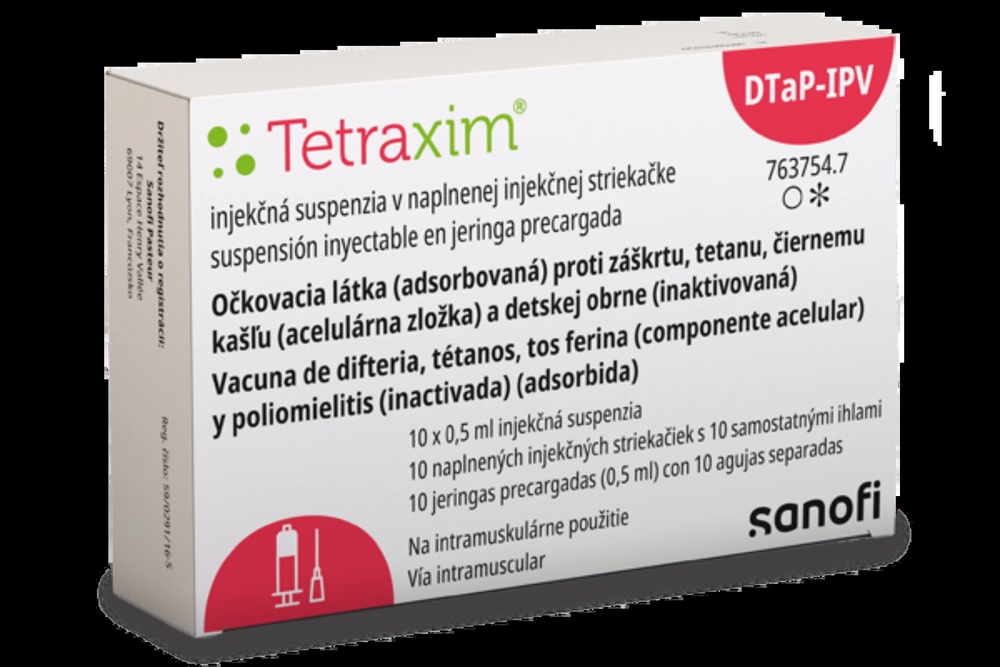
- Country of registration
- Dosage formINJECTABLE, 0.5 ml
- ATC codeJ07CA02
- Active substance
- Prescription requiredYes
- Manufacturer
- CompositionHIDROXIDO DE SODIO (E 524) (cs pH mg)
- This information is for reference only and does not constitute medical advice. Always consult a doctor before taking any medication. Oladoctor is not responsible for medical decisions based on this content.
- Alternatives to TETRAXIM SUSPENSION FOR INJECTION IN PRE-FILLED SYRINGEDosage form: INJECTABLE, 0.5 mlActive substance: diphtheria-pertussis-poliomyelitis-tetanusManufacturer: Glaxosmithkline S.A.Prescription requiredDosage form: INJECTABLE, 0.5 mlActive substance: diphtheria-pertussis-poliomyelitis-tetanusManufacturer: Glaxosmithkline S.A.Prescription requiredDosage form: INJECTABLE, 1 doseActive substance: diphtheria-pertussis-poliomyelitis-tetanusManufacturer: Sanofi Winthrop IndustriePrescription required
Online doctors for TETRAXIM SUSPENSION FOR INJECTION IN PRE-FILLED SYRINGE
Discuss questions about TETRAXIM SUSPENSION FOR INJECTION IN PRE-FILLED SYRINGE, including use, safety considerations and prescription review, subject to medical assessment and local regulations.









Frequently Asked Questions
TETRAXIM SUSPENSION FOR INJECTION IN PRE-FILLED SYRINGE requires a prescription in Spain. You can check with a doctor online whether this medicine may be appropriate for your situation.
The active ingredient in TETRAXIM SUSPENSION FOR INJECTION IN PRE-FILLED SYRINGE is diphtheria-pertussis-poliomyelitis-tetanus. This information helps identify medicines with the same composition but different brand names.
TETRAXIM SUSPENSION FOR INJECTION IN PRE-FILLED SYRINGE is manufactured by Sanofi Winthrop Industrie. Pharmacy brands and packaging may differ depending on the distributor.
Doctors such as Family doctors, Psychiatrists, Dermatologists, Cardiologists, Endocrinologists, Gastroenterologists, Pulmonologists, Nephrologists, Rheumatologists, Hematologists, Infectious disease physicians, Allergists, Geriatricians, Paediatricians, Oncologists may assess whether TETRAXIM SUSPENSION FOR INJECTION IN PRE-FILLED SYRINGE is appropriate, depending on your situation and local regulations. You can book an online consultation to discuss your symptoms and possible next steps.
The prescription is issued by a doctor after assessing your health. In Spain, TETRAXIM SUSPENSION FOR INJECTION IN PRE-FILLED SYRINGE is then dispensed in pharmacies with that prescription. An online consultation does not guarantee that a prescription will be issued: the decision always rests with the doctor.
To request a review, you can use Oladoctor:
Other medicines with the same active substance (diphtheria-pertussis-poliomyelitis-tetanus) include BOOSTRIX POLIO Injectable Suspension in Pre-filled Syringe, INFANRIX-IPV PRE-FILLED SYRINGE SUSPENSION FOR INJECTION, TRIAXIS POLIO INJECTABLE SUSPENSION IN PRE-FILLED SYRINGE. These may have different brand names or formulations but contain the same therapeutic ingredient. Always consult a doctor before switching or starting a new medicine.
