



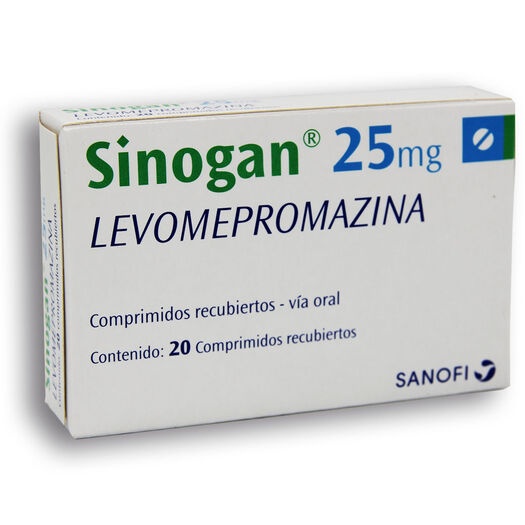
SINOGAN 25 mg Comprimidos Recubiertos Con Película

Revisión de receta online
Un médico revisará tu caso y determinará si la prescripción es médicamente apropiada.

Habla con un médico sobre este medicamento
Comenta tus síntomas y las opciones de tratamiento en una consulta online.



Cómo usar SINOGAN 25 mg COMPRIMIDOS RECUBIERTOS CON PELÍCULA
Contenido del prospecto
- Introducción
- Qué es Sinogan y para qué se utiliza
- Qué necesita saber antes de empezar a tomar Sinogan
- Cómo tomar Sinogan
- Posibles efectos adversos
- Conservación de Sinogan
- Contenido del envase e información adicional
Introducción
Prospecto: información para el paciente
Sinogan 25 mg comprimidos recubiertos con película
levomepromazina, maleato
Lea todo el prospecto detenidamente antes de empezar a tomar este medicamento, porque contiene información importante para usted.
- Conserve este prospecto, ya que puede tener que volver a leerlo.
- Si tiene alguna duda, consulte a su médico o farmacéutico.
- Este medicamento se le ha recetado solamente a usted, y no debe dárselo a otras personas aunque tengan los mismos síntomas que usted, ya que puede perjudicarles.
- Si experimenta efectos adversos, consulte a su médico o farmacéutico, incluso si se trata de efectos adversos que no aparecen en este prospecto. Ver sección 4.
Contenido del prospecto:
- Qué es Sinogan y para qué se utiliza
- Qué necesita saber antes de empezar a tomar Sinogan
- Cómo tomar Sinogan
- Posibles efectos adversos
- Conservación de Sinogan
- Contenido del envase e información adicional.
1. Qué es Sinogan y para qué se utiliza
La levomepromazina, es un fármaco antipsicótico que pertenece al grupo de medicamentos denominados fenotiazinas dotado de propiedades sedantes, reductor de la ansiedad, con gran capacidad para combatir el dolor e importante poder inductor del sueño.
Siempre bajo la prescripción de su médico, este medicamento está indicado para el tratamiento de:
- Esquizofrenia, psicosis agudas transitorias y estados paranoides incluyendo psicosis maniacas, psicosis orgánicas y tratamiento a corto plazo de los síntomas prominentes de psicosis como parte de un trastorno de la personalidad.
- Tratamiento coadyuvante para el alivio del delirio, agitación, nerviosismo y confusión, asociados al dolor en la fase terminal.

¿No estás seguro de si este medicamento es adecuado para ti?
Comenta tus síntomas y tratamiento con un médico online.
2. Qué necesita saber antes de empezar a tomar Sinogan
Lea atentamente las instrucciones que se proporcionan en la sección 3 (ver “Cómo tomar Sinogan”).
No tome Sinogan
- si es alérgico a la levomepromazina, o a cualquiera de los demás componentes de este medicamento (incluidos en la sección 6),
- si padece la enfermedad de Parkinson,
- si ha padecido porfiria (enfermedad de la sangre),
- si está en tratamiento con levodopa,
- en combinación con bebidas alcohólicas.
Advertencias y precauciones
Antes y durante el tratamiento crónico, su médico le solicitará análisis de sangre para controlar su función hepática.
Consulte a su médico o farmacéutico antes de empezar a tomar Sinogan
- Si su temperatura corporal aumenta de manera inexplicable, consulte inmediatamente a su médico, debido al riesgo de aparición de un síndrome denominado neuroléptico maligno, descrito durante el tratamiento con este tipo de medicamentos cuyos efectos incluyen rigidez muscular, aumento de la temperatura corporal y alteración de la conciencia. La sudoración y el pulso o la presión arterial irregular pueden ser signos de alerta temprana. Aunque este síndrome aparece con este tipo de medicamentos, hay que tener en cuenta que haya pacientes con alguna predisposición.
- En caso de fiebre, dolor de garganta, infección o aparición de úlceras en la boca, su médico le realizará un análisis de sangre para descartar una posible disminución de un tipo de glóbulos blancos, los granulocitos, o aumento de otro tipo de glóbulos blancos, los leucocitos. Si esto sucede su médico suspenderá el tratamiento.
- Si tiene factores de riesgo de sufrir un accidente cerebrovascular.
- Si tiene problemas del corazón y/o circulación sanguínea.
- Si tiene trastornos del hígado y/o del riñón (insuficiencia hepática y/o renal).
- Si sufre ataques epilépticos. Puede aumentar el riesgo de aparición de los mismos, por lo que su médico le someterá a un especial control, realizándole un electroencefalograma.
- Si su tratamiento es prolongado su médico podrá recomendarle un examen de ojos y un análisis de sangre.
- Este tipo de medicamentos puede potenciar la aparición de alteraciones del ritmo cardiaco (prolongación del intervalo QT) que pueden llegar a ser graves (torsades de pointes) y provocar la muerte. Por ello su médico realizará los controles necesarios para excluir posibles factores de riesgo antes de iniciar su tratamiento y si fuera necesario durante el mismo.
- Los pacientes de edad avanzada tienen mayor probabilidad de sufrir somnolencia y mareos al incorporarse debido a una disminución de la presión arterial. También pueden ser susceptibles de padecer estreñimiento crónico y problemas de próstata.
- En pacientes de edad avanzada con psicosis relacionada con demencia, que estén en tratamiento con antipsicóticos (posibilidad de presentar un mayor riesgo de muerte).
- Si tiene factores de riesgo de sufrir tromboembolismo venoso (formación de coágulos) (ver “Posibles efectos adversos”).
- Consulte con su médico inmediatamente si sufre distensión y dolor abdominal (riesgo de íleo paralítico).
- Se debe utilizar con precaución en caso de estreñimiento, hipotiroidismo, insuficiencia cardiaca, feocromocitoma (tiene un tumor de la glándula suprarrenal), miastemia gravis (enfermedad muscular que causa párpados caídos, visión doble, dificultad para hablar y tragar y, a veces, debilidad muscular en brazos o piernas) e hipertrofia de próstata.
- Se debe tener en cuenta el riesgo de aparición de discinesia tardía (movimientos involuntarios), incluso a dosis bajas, particularmente en niños y pacientes de edad avanzada.
- Si tiene diabetes mellitus o factores de riesgo para padecerla, ya que si toma Sinogan debe controlar adecuadamente su glucemia (niveles de glucosa en sangre).
- Al inicio del tratamiento se realizaran pruebas de la función hepática debido al riesgo de sobredosis. Durante el tratamiento crónico se deben realizar exámenes cada 6-12 meses.
Niños y adolescentes
No utilizar en niños menores de 3 años. Se recomienda una estricta vigilancia médica de las reacciones adversas, principalmente neurológicas, en niños mayores de 3 años tratados con Sinogan.
En este tipo de población se recomienda utilizar Sinogan 40 mg/ml gotas orales en solución.
Debido al impacto en el aprendizaje se recomienda un examen clínico una vez al año. La dosis se adaptará regularmente según el estado clínico del niño. Su uso en menores de 6 años se realizará en un ambiente especializado.
Uso de Sinogan con otros medicamentos
Informe a su médico o farmacéutico si está tomando, ha tomado recientemente o podría tener que tomar cualquier otro medicamento.
Al igual que con otros medicamentos utilizados en el tratamiento de las psicosis, si se administra conjuntamente Sinogan y levodopa (medicamento utilizado para el tratamiento del Parkinson) el efecto de estos medicamentos se puede anular. En el caso de que aparecieran trastornos en el movimiento su médico no le recetará, o le sustituirá la levodopa por otro medicamento.
Se debe evitar el uso de medicamentos dopaminérgicos junto con Sinogan. En caso de necesitar retirar un medicamento dopaminergico, este último debe reducirse gradualmente (la interrupción repentina de los agentes dopaminérgicos expone al paciente a un riesgo de "síndrome neuroléptico maligno").
Se debe evitar el uso de cabergolina o quinagolida (medicamentos utilizados para tratar el flujo de leche anormal).
Informe a su médico si está tomando alguno de estos medicamentos, ya que pueden prolongar el intervalo QT (producir cambios en su electrocardiograma). Existe un mayor riesgo de arritmias cuando se usa Sinogan con medicamentos que prolongan el intervalo QT (ciertos antiarrítmicos, antidepresivos y otros antipsicóticos) y medicamentos que causan desequilibrio de electrolitos.
Medicamentos que pueden prolongar el intervalo QT:
- Antiarrítmicos (medicamentos para el ritmo de su corazón): quinidina, procainamida, amiodarona, mibefradil.
- Antibióticos: eritromicina, cotrimoxazol, trimetoprima-sulfametoxazol, azitromicina, ketoconazol, pentamidina.
- Fármacos que actúan sobre la motilidad gastrointestinal: cisaprida.
- Antihistamínicos (medicamentos para la alergia): terfenadina, astemizol.
- Hipolipemiantes (medicamentos para disminuir sus niveles de colesterol): probucol.
- Otros agentes psicotrópicos (medicamentos que mejoran su estado psicológico): antidepresivos tricíclicos y tetracíclicos, haloperidol y otras fenotiazinas.
- Otros medicamentos: organofosforados y vasopresina.
La administración conjunta con antiácidos (sales, óxidos e hidróxidos de aluminio, magnesio y calcio), produce una disminución de la absorción de Sinogan. Por ello, se aconseja tomarlos, al menos, con dos horas de diferencia.
La administración de Sinogan con medicamentos utilizados para disminuir la tensión arterial (antihipertensivos), aumenta el efecto de éstos y el riesgo de que disminuya la tensión arterial al incorporarse, pudiendo producir mareos.
Los medicamentos que actúan sobre el cerebro, como: tranquilizantes, derivados de la morfina (medicamentos para el tratamiento del dolor y de la tos), barbitúricos, medicamentos para el tratamiento de la alergia, inductores del sueño, medicamentos para el tratamiento de la ansiedad, clonidina y sustancias relacionadas, metadona y talidomida, refuerzan el efecto de Sinogan, pudiendo aparecer depresión respiratoria.
Los medicamentos para el tratamiento de la depresión (tipo imipramina), los medicamentos para el tratamiento de la alergia que actúan sobre el cerebro, los sedantes, algunos medicamentos para el tratamiento de la enfermedad de Parkinson y los espasmos y la disopiramida, cuando se administran conjuntamente con Sinogan, aumentan la aparición de las reacciones adversas de tipo atropínicocomo retención de la orina, estreñimiento, sequedad de boca, etc.
Hay una posibilidad de interacción entre los inhibidores de CYP2D6 como son las fenotiazinas (incluido la levomepromazina) y los sustratos de CYP2D6, por ello si toma usted Sinogan junto con alguno de los siguientes medicamentos:
- Algunos antidepresivos: amitriptilina/amitriptilinóxido, clomipramina, desipramina, imipramina, fluoxetina, fluvoxamina, sertralina, paroxetina.
- Algunos medicamentos que se utilizan para el tratamiento de arritmias cardiacas: encainida, flecainida, propafenona.
- Algunos medicamentos para el tratamiento de la hipertensión: metoprolol, propanolol.
- Algunos medicamentos para el tratamiento de la tos: codeína, dextrometorfano.
- Otros medicamentos para el tratamiento de la psicosis: perfenazina.
Podría necesitar un ajuste de dosis de dichos medicamentos, como consecuencia de un aumento en sus niveles sanguíneos.
Sinogan inhibe el efecto antihipertensivo de guanetidina.
Litio: existe riesgo de desarrollar síntomas sugestivos de síndrome neuroléptico maligno o de envenenamiento por litio.
El uso combinado de medicamentos proconvulsivos o que disminuyen el umbral epiléptico con Sinogan debe sopesarse cuidadosamente debido a la gravedad del riesgo de aparición de convulsiones.
Toma de Sinogan con los alimentos, bebidas y alcohol
No se deben tomar bebidas alcohólicas durante el tratamiento con Sinogan, ya que el efecto del alcohol potencia la sedación.
Embarazo, lactancia y fertilidad
Si está embarazada o en periodo de lactancia, cree que podría estar embarazada o tiene intención de quedarse embarazada, consulte a su médico o farmacéutico antes de utilizar este medicamento.
Embarazo
Sinogan no está recomendado durante el embarazo. Consulte con su médico antes de tomar este medicamento:
- si es una mujer en edad fértil que no utiliza anticonceptivos efectivos
- si está embarazada, podría quedar embarazada o cree que puede estarlo.
Se han notificado los siguientes síntomas, en recién nacidos de madres en tratamiento con Sinogan durante el tercer trimestre de embarazo (últimos tres meses de embarazo): temblor, rigidez de los músculos y/o debilidad muscular, somnolencia, agitación, problemas para respirar y para recibir alimentación al inicio, latido cardiaco lento o rápido, distensión abdominal, íleo meconial, eliminación retardada del meconio y estreñimiento. Si su bebé desarrolla cualquiera de estos síntomas, debe ponerse en contacto con su médico.
Lactancia
Si está amamantando a un bebé no debe tomar Sinogan, ya que Sinogan pasa a la leche materna en pequeñas cantidades.
Se debe decidir si es necesario interrumpir la lactancia o interrumpir el tratamiento tras considerar el beneficio de la lactancia para el niño y el beneficio del tratamiento para la madre.
No se puede excluir un riesgo para los niños de pecho.
Fertilidad
En humanos, levomepromazina puede producir un aumento de los niveles de la hormona prolactina en sangre (hiperprolactinemia) que puede estar asociada con problemas de fertilidad en las mujeres.
Algunos datos sugieren que el tratamiento de levomepromazina está asociado con problemas de fertilidad en los hombres.
Conducción y uso de máquinas
Sinogan puede producir síntomas tales como somnolencia, mareo o alteraciones en la vista, desorientación y confusión y disminuir la capacidad de reacción. Estos efectos, así como la propia enfermedad, pueden dificultar su capacidad para conducir vehículos o manejar máquinas. Por lo tanto no conduzca, ni maneje máquinas, ni practique otras actividades que requieran especial atención, hasta que su médico valore su respuesta a este medicamento.
Sinogan contiene gluten y lactosa:
Gluten
Este medicamento contiene niveles muy bajos de gluten (procedente de almidón de trigo) y es muy poco probable que le cause problemas si padece la enfermedad celíaca. Un comprimido no contiene más de 5,87 microgramos de gluten.
Si usted padece alergia al trigo (distinta de la enfermedad celíaca) no debe tomar este medicamento.
Lactosa: Este medicamento contiene lactosa. Si su médico le ha indicado que padece una intolerancia a ciertos azúcares, consulte con él antes de tomar este medicamento.
3. Cómo tomar Sinogan
Siga exactamente las instrucciones de administración de este medicamento indicadas por su médico. En caso de duda consulte de nuevo a su médico o farmacéutico.
Al empezar a tomar Sinogan, debe mantenerse acostado durante la hora siguiente a cada toma. Si su dosis es elevada es importante controlar su tensión arterial debido al riesgo de que baje al incorporarse.
Recuerde tomar su medicamento.
Las dosis recomendadas son las siguientes:
- en pacientes psicóticos: la dosis recomendada es de 4 a 8 comprimidos (100 a 200 mg de levomepromazina) diarios, en ocasiones más, repartidos en 2 o 3 tomas.
- en pacientes no psicóticos: la dosis recomendada es de 1 a 3 comprimidos (25 a 75 mg de levomepromazina) diarios, repartidos en 2 o 3 tomas.
Nunca cambie usted mismo la dosis que su médico le ha recetado. Si estima que la acción de Sinogan es demasiado fuerte o débil, comuníqueselo a su médico o farmacéutico.
Su médico le indicará la duración de su tratamiento con Sinogan. No suspenda su tratamiento antes.
Si toma más Sinogan del que debe
En caso de sobredosis o ingestión accidental, consulte inmediatamente a su médico o farmacéutico o llame al Servicio de Información Toxicológica, teléfono 91 562 04 20, indicando el medicamento y la cantidad ingerida.
Consulte inmediatamente a su médico, o diríjase al hospital más próximo. Los síntomas de una
intoxicación por Sinogan pueden ser convulsiones, síndrome parkinsoniano gravísimo e incluso coma. Aunque no existe un antídoto específico, en caso de intoxicación aguda se recomienda tratamiento de los síntomas y administración de fármacos restauradores de la actividad cardiaca por vía intravenosa.
Si olvidó tomar Sinogan
No tome una dosis doble para compensar las dosis olvidadas.

¿Has empezado a tomar el medicamento y tienes preguntas?
Comenta tus síntomas y tratamiento con un médico online.
4. Posibles efectos adversos
Al igual que todos los medicamentos, Sinogan puede producir efectos adversos, aunque no todas las personas los sufran.
Poco frecuentes(pueden afectar hasta 1 de cada 100 personas)
Trastornos del sistema nervioso:
- convulsiones
Trastornos vasculares:
- formación de coágulos (tromboembolismo venoso)
Frecuencia no conocida(no se puede estimar la frecuencia a partir de los datos disponibles)
Trastornos endocrinos:
- dificultad para regular la temperatura corporal
- aumento de los niveles en sangre de una hormona llamada prolactina (hiperprolactinemia) que podría dar lugar a falta del periodo menstrual (amenorrea), secreción no habitual de leche (galactorrea), volumen excesivo de las mamas en el hombre (ginecomastia) e impotencia..
Trastornos del metabolismo y de la nutrición:
- intolerancia a la glucosa
- niveles altos de glucosa en sangre (hiperglucemia)
- niveles bajos de sodio en sangre (hiponatremia)
- síndrome de secreción inadecuada de la hormona antidiurética (retención de líquidos y disminución de ciertos niveles de electrolitos en la sangre).
Trastornos psiquiátricos:
- reacciones de ansiedad
- cambios del estado de ánimo
- confusión
- delirio.
Trastornos del sistema nervioso:
- parkinsonismo (con dosis altas y prolongadas)
- sedación o somnolencia, sobre todo al inicio del tratamiento
- discinesia precoz (incoordinación o dificultad de movimientos, caracterizada por contracción de los músculos del cuello, del ojo, de la boca,...)
- discinesia tardía (movimientos involuntarios)
- síndrome extrapiramidal:
- acinesia con o sin hipertonia. (pérdida de movimiento con o sin rigidez en los músculos),
- hipercinética – movimientos hipertónicos (movimientos con rigidez muscular), excitación motora.
- acatisia (sensación de inquietud tanto a nivel físico como mental)
- síndrome neuroléptico maligno (ver sección “Advertencias y precauciones”).
- efectos anticolinergicos como íleo paralítico, riesgo de retención urinaria y sequedad de boca, estreñimiento, problemas de acomodación ocular,
Trastornos cardiacos:
- torsades de pointes (un tipo de arritmia)
- cambios en el electrocardiograma que incluyen prolongación del intervalo QT como sucede con otros neurolépticos
- arritmias cardiacas que pueden dar lugar a fibrilación ventricular o paro cardiaco posiblemente relacionado con la dosis.
Trastornos vasculares:
- formación de coágulos que pueden afectar a los pulmones (embolismo pulmonar), que a veces puede ser mortal
- trombosis venosa profunda (ver “Advertencias y precauciones”)
- disminución de la presión arterial al ponerse de pie tras estar sentado o acostado (hipotensión postural).
Trastornos del hígado:
- coloración amarilla en ojos y piel (ictericia colestásica)
- daño hepático (hepatocelular, colestásico y mixto).
Trastornos de la piel:
- aumento de la sensibilidad de la piel al sol
- reacciones alérgicas en la piel..
Trastornos del aparato genital:
- erección en ausencia de deseo sexual (priapismo).
Trastornos del ojo:
- disminución de la tensión de los músculos del ojo
- depósitos de color marrón en el segmento anterior del ojo causados por la acumulación de medicamento y en general sin efecto en la visión.
Exploraciones complementarias:
- aumento de peso
Trastornos generales y alteraciones en el lugar de administración
- muerte súbita con posibles causas de origen cardiaco (ver “Advertencias y precauciones”)
- muerte súbita inexplicable en pacientes que reciben neurolépticos fenotiazínicos.
Trastornos de la sangre:
- disminución del número de glóbulos blancos en general (leucopenia)
- disminución de un tipo de glóbulos blancos, los granulocitos (agranulocitosis)
- Trombocitopenia, que es una disminución del número de plaquetas (células de la sangre que ayudan a la coagulación) que se encuentran en un análisis de sangre, lo que puede conducir a sangrado y hematomas (púrpura trombocitopénica).
- Eosinofilia, que es un aumento en el número de eosinófilos (un tipo de celulas blancas de la sangre) que se encuentran en un análisis de sangre.
Trastornos digestivos:
- inflamación del intestino delgado y el colon que puede ser mortal (enterocolitis necrótica)
- estreñimiento
- obstrucción intestinal (íleo paralítico).
Embarazo, puerperio y enfermedades perinatales:
- síntomas de retirada en recién nacidos (ver “Embarazo, lactancia y fertilidad”).
Comunicación de efectos adversos
Si experimenta cualquier tipo de efecto adverso, consulte a su médico o farmacéutico, incluso si se trata de posibles efectos adversos que no aparecen en este prospecto. También puede comunicarlos directamente a través del Sistema Español de Farmacovigilancia de medicamentos de Uso Humano: https://www.notificaram.es. Mediante la comunicación de efectos adversos usted puede contribuir a proporcionar más información sobre la seguridad de este medicamento.
5. Conservación de Sinogan
Mantener este medicamento fuera de la vista y del alcance de los niños.
No conservar a temperatura superior a 25ºC.
No utilice este medicamento después de la fecha de caducidad que aparece en el envase después de CAD. La fecha de caducidad es el último día del mes que se indica.
Los medicamentos no se deben tirar por los desagües ni a la basura. Deposite los envases y los medicamentos que no necesita en el Punto SIGRE de la farmacia. En caso de duda pregunte a su farmacéutico cómo deshacerse de los envases y de los medicamentos que no necesita. De esta forma, ayudará a proteger el medio ambiente.
6. Contenido del envase e información adicional
Composición de Sinogan
- El principio activo es levomepromazina. Cada comprimido contiene 25 mg de levomepromazina (en forma de maleato).
- Los demás componentes son: almidón de trigo (contiene gluten), lactosa, levilite, dextrina, estearato de magnesio. Barniz: hipromelosa, polietilenglicol, agua desmineralizada y etanol.
Aspecto del producto y contenido del envase
Los comprimidos son de color blanco, redondos, con una ranura en una de las caras y grabado ‘Sinogan 25’ y la otra cara es lisa.
Cada envase contiene 20 comprimidos.
Titular de la autorización de comercialización y responsable de la fabricación
Titular:
Neuraxpharm Spain, S.L.U.
Avda. Barcelona, 69
08970 Sant Joan Despí
Barcelona - España
Responsable de la fabricación:
Famar Health Care Services Madrid, S.A.U.
Avda. de Leganés nº 62
28923 Alcorcón (Madrid)
Fecha de la última revisión de este prospecto: Mayo 2023
La información detallada de este medicamento está disponible en la página Web de la Agencia Española de Medicamentos y Productos Sanitarios (AEMPS) http://www.aemps.gob.es/
- País de registro
- Forma farmacéuticaCOMPRIMIDO, 25 mg levomepromazina
- Código ATCN05AA02
- Precio medio en farmacia1.64 EUR
- Principio activo
- Requiere recetaSí
- Fabricante
- ComposiciónLACTOSA (122,5 mg mg), ALMIDON DE TRIGO (58,7 mg mg), ALCOHOL ETILICO (ETANOL) (83,7 g mg)
- Esta información es de carácter general y no sustituye la consulta con un profesional sanitario.
- Alternativas a SINOGAN 25 mg COMPRIMIDOS RECUBIERTOS CON PELÍCULAForma farmacéutica: COMPRIMIDO, 100 mg levomepromazinaPrincipio activo: levomepromazineFabricante: Neuraxpharm Spain S.L.Requiere recetaForma farmacéutica: INYECTABLE, 25 mg levomepromazina/ mlPrincipio activo: levomepromazineFabricante: Neuraxpharm Spain S.L.Requiere recetaForma farmacéutica: SOLUCION/SUSPENSION GOTAS ORALES, 4 % levomepromazinaPrincipio activo: levomepromazineFabricante: Neuraxpharm Spain S.L.Requiere receta
Médicos online para SINOGAN 25 mg COMPRIMIDOS RECUBIERTOS CON PELÍCULA
Comenta la dosis, los posibles efectos secundarios, interacciones, contraindicaciones o la revisión de receta de SINOGAN 25 mg COMPRIMIDOS RECUBIERTOS CON PELÍCULA, sujeto a valoración médica y a la normativa local.







Obtén una receta de SINOGAN 25 mg COMPRIMIDOS RECUBIERTOS CON PELÍCULA online
Rellena un formulario de 2 minutos
Cuéntanos tus síntomas, historial y el medicamento que necesitas.
Elige un médico o nosotros te asignamos uno
Escoge un especialista o te conectamos con el próximo médico disponible.
El médico revisa tu caso
Normalmente en 30 minutos. Puede hacerte preguntas adicionales por chat.
Recógela en cualquier farmacia
Receta electrónica enviada a tu correo, válida en toda España.
Preguntas frecuentes
SINOGAN 25 mg COMPRIMIDOS RECUBIERTOS CON PELÍCULA requiere receta en España. Puedes confirmarlo con un médico online según tu caso.
El principio activo de SINOGAN 25 mg COMPRIMIDOS RECUBIERTOS CON PELÍCULA es levomepromazine. Esta información ayuda a identificar medicamentos con la misma composición pero con diferentes nombres comerciales.
El precio medio en farmacia de SINOGAN 25 mg COMPRIMIDOS RECUBIERTOS CON PELÍCULA es de aproximadamente 1.64 EUR. Puede variar según el fabricante y la forma farmacéutica.
SINOGAN 25 mg COMPRIMIDOS RECUBIERTOS CON PELÍCULA es fabricado por Neuraxpharm Spain S.L.. La marca y el envase pueden variar según el distribuidor.
Los Médicos de familia, Psiquiatras, Dermatólogos, Cardiólogos, Endocrinólogos, Gastroenterólogos, Neumólogos, Nefrólogos, Reumatólogos, Hematólogos, Infectólogos, Alergólogos, Geriatras, Pediatras, Oncólogos pueden valorar la prescripción de SINOGAN 25 mg COMPRIMIDOS RECUBIERTOS CON PELÍCULA cuando esté clínicamente indicado. Puedes reservar una videoconsulta para comentar tu caso y las opciones de tratamiento.
España cuenta con una infraestructura sanitaria bien desarrollada en ciudades principales como Madrid, Barcelona, Valencia y Sevilla. Las farmacias están ampliamente disponibles y operan bajo estrictas regulaciones, garantizando el acceso a medicamentos con receta.
Puedes comprar SINOGAN 25 mg COMPRIMIDOS RECUBIERTOS CON PELÍCULA en Madrid, Barcelona, Sevilla o Valencia en cualquier farmacia local con una receta válida.
Para obtener una receta, puedes utilizar Oladoctor:
Otros medicamentos con el mismo principio activo (levomepromazine) incluyen SINOGAN 100 mg COMPRIMIDOS RECUBIERTOS CON PELÍCULA, SINOGAN 25 mg / ml SOLUCION INYECTABLE, SINOGAN 40 mg/ml GOTAS ORALES EN SOLUCION. Pueden tener diferentes nombres comerciales o formulaciones, pero contienen el mismo componente terapéutico. Consulta siempre con un médico antes de cambiar o iniciar un nuevo medicamento.
