



SINOGAN 25 mg /Ml Injectable Solution

Prescription review online
A doctor will review your case and decide whether a prescription is medically appropriate.

Talk to a doctor about this medicine
Discuss your symptoms and possible next steps in a quick online consultation.



How to use SINOGAN 25 mg/ml INJECTABLE SOLUTION
Contents of the leaflet
- Introduction
- What Sinogan is and what it is used for
- What you need to know before taking Sinogan
- How to Use Sinogan
- Possible Adverse Effects
- Storage of Sinogan
- Package Contents and Additional Information
Introduction
Package Leaflet: Information for the Patient
Sinogan 25 mg/ml Injectable Solution
Levomepromazine, Hydrochloride
Read the entire package leaflet carefully before starting to use this medication, as it contains important information for you.
- Keep this package leaflet, as you may need to read it again.
- If you have any questions, consult your doctor or pharmacist.
- This medication has been prescribed to you only, and you should not give it to others, even if they have the same symptoms as you, as it may harm them.
- If you experience side effects, consult your doctor or pharmacist, even if they are not listed in this package leaflet. See section 4.
Contents of the Package Leaflet:
- What Sinogan is and what it is used for
- What you need to know before taking Sinogan
- How to take Sinogan
- Possible side effects
- Storage of Sinogan
- Package Contents and Additional Information
1. What Sinogan is and what it is used for
Levomepromazine is an antipsychotic medication belonging to the group of medications known as phenothiazines, with sedative, anxiolytic, and analgesic properties, and a significant ability to induce sleep.
Under the prescription of your doctor, this medication is indicated for the treatment of:
- Schizophrenia, acute transient psychoses, and paranoid states, including manic psychoses, organic psychoses, and short-term treatment of prominent symptoms of psychosis as part of a personality disorder.
- Adjuvant treatment for the relief of delirium, agitation, nervousness, and confusion associated with pain in the terminal phase.

Not sure if this medicine is right for you?
Discuss your symptoms and treatment with a doctor online.
2. What you need to know before taking Sinogan
Read the instructions provided in section 3 (see "How to take Sinogan") carefully.
Do not take Sinogan
- if you are allergic to levomepromazine or any of the other components of this medication (listed in section 6),
- if you have Parkinson's disease,
- if you have had porphyria (a blood disorder),
- if you are being treated with levodopa,
- in combination with alcoholic beverages.
Warnings and Precautions
Before and during chronic treatment, your doctor will request blood tests to monitor your liver function.
Consult your doctor or pharmacist before taking Sinogan
- If your body temperature increases inexplicably, consult your doctor immediately, due to the risk of developing a syndrome called neuroleptic malignant syndrome, described during treatment with this type of medication, whose effects include muscle rigidity, increased body temperature, and altered consciousness. Sweating and irregular pulse or blood pressure may be early warning signs. Although this syndrome appears with this type of medication, it should be taken into account that there may be patients with some predisposition.
- If you have risk factors for stroke.
- In case of fever, sore throat, infection, or the appearance of ulcers in the mouth, your doctor will perform a blood test to rule out a possible decrease in a type of white blood cell, granulocytes, or an increase in another type of white blood cell, leukocytes. If this happens, your doctor will suspend treatment.
- If you have heart and/or circulatory problems.
- If you have liver and/or kidney disorders (hepatic and/or renal insufficiency).
- If you suffer from epileptic seizures. It may increase the risk of their appearance, so your doctor will subject you to special control, performing an electroencephalogram.
- If your treatment is prolonged, your doctor may recommend an eye exam and a blood test.
- This type of medication can potentiate the appearance of cardiac rhythm disorders (prolongation of the QT interval) that can be serious (torsades de pointes) and cause death. Therefore, your doctor will perform the necessary checks to exclude possible risk factors before starting treatment and, if necessary, during treatment.
- Elderly patients are more likely to experience drowsiness and dizziness when getting up due to a decrease in blood pressure. They may also be susceptible to chronic constipation and prostate problems.
- In elderly patients with psychosis related to dementia, who are being treated with antipsychotics (possibility of presenting a higher risk of death).
- If you have risk factors for venous thromboembolism (blood clot formation) (see "Possible side effects").
- Consult your doctor immediately if you experience abdominal distension and pain (risk of paralytic ileus).
- It should be used with caution in cases of constipation, hypothyroidism, heart failure, pheochromocytoma (you have a tumor of the adrenal gland), myasthenia gravis (a muscular disease that causes drooping eyelids, double vision, difficulty speaking and swallowing, and sometimes muscle weakness in arms or legs), and prostate hypertrophy.
- The risk of developing tardive dyskinesia (involuntary movements) should be taken into account, even at low doses, particularly in children and elderly patients.
- If you have diabetes mellitus or risk factors for developing it, as you should adequately control your blood glucose levels if you take Sinogan.
- At the start of treatment, liver function tests will be performed due to the risk of overdose. During chronic treatment, exams will be performed every 6-12 months.
- Patients who experience postural hypotension should be warned not to get up quickly and to ask for help when necessary.
Children and Adolescents
Do not use in children under 3 years of age. Strict medical monitoring of adverse reactions, mainly neurological, is recommended in children over 3 years of age treated with Sinogan.
In this population, it is recommended to use Sinogan 40 mg/ml oral drops in solution.
Due to the impact on learning, a clinical examination is recommended once a year. The dose will be regularly adjusted according to the child's clinical condition. Its use in children under 6 years of age will be carried out in a specialized environment.
Using Sinogan with Other Medications
Inform your doctor or pharmacist if you are using, have recently used, or may need to use any other medication.
Like other medications used to treat psychoses, if Sinogan and levodopa (a medication used to treat Parkinson's disease) are administered together, the effect of these medications may be canceled. In case of movement disorders, your doctor will not prescribe, or will substitute levodopa with another medication.
The use of dopaminergic medications with Sinogan should be avoided. In case of needing to withdraw a dopaminergic medication, it should be gradually reduced (sudden interruption of dopaminergic agents exposes the patient to the risk of "neuroleptic malignant syndrome").
The use of cabergoline or quinagolide (medications used to treat abnormal milk flow) should be avoided.
Inform your doctor if you are taking any of these medications, as they may prolong the QT interval (produce changes in your electrocardiogram). There is a higher risk of arrhythmias when using Sinogan with medications that prolong the QT interval (certain antiarrhythmics, antidepressants, and other antipsychotics) and medications that cause electrolyte imbalance.
Medications that may prolong the QT interval:
- Antiarrhythmics (medications for heart rhythm): quinidine, procainamide, amiodarone, mibefradil.
- Antibiotics: erythromycin, cotrimoxazole, trimethoprim-sulfamethoxazole, azithromycin, ketoconazole, pentamidine.
- Medications that act on gastrointestinal motility: cisapride.
- Antihistamines (medications for allergies): terfenadine, astemizole.
- Lipid-lowering medications (medications to lower cholesterol levels): probucol.
- Other psychotropic agents (medications that improve your psychological state): tricyclic and tetracyclic antidepressants, haloperidol, and other phenothiazines.
- Other medications: organophosphates and vasopressin.
The concomitant administration with antacids (salts, oxides, and hydroxides of aluminum, magnesium, and calcium) produces a decrease in the absorption of Sinogan. Therefore, it is recommended to take them at least 2 hours apart.
The administration of Sinogan with medications used to lower blood pressure
(antihypertensives) increases the effect of these medications and the risk of decreased blood pressure when standing up, which can cause dizziness.
Medications that act on the brain, such as: tranquilizers, morphine derivatives
(medications for pain and cough treatment), barbiturates, medications for allergy treatment, sleep inducers, medications for anxiety treatment, clonidine, and related substances, methadone, and thalidomide, enhance the effect of Sinogan, which can lead to respiratory depression.
Medications for depression treatment (such as imipramine), medications for allergy treatment that act on the brain, sedatives, some medications for Parkinson's disease treatment, and spasm treatment, and disopyramide, when administered concomitantly with Sinogan, increase the appearance of atropine-like adverse reactions such as urinary retention, constipation, dry mouth, etc.
There is a possibility of interaction between CYP2D6 inhibitors, such as phenothiazines (including levomepromazine), and CYP2D6 substrates. Therefore, if you take Sinogan with any of the following medications:
- Some antidepressants: amitriptyline/amitriptylinoxide, clomipramine, desipramine, imipramine, fluoxetine, fluvoxamine, sertraline, paroxetine.
- Some medications for cardiac arrhythmia treatment: encainide, flecainide, propafenone.
- Some medications for hypertension treatment: metoprolol, propranolol.
- Some medications for cough treatment: codeine, dextromethorphan.
- Other medications for psychosis treatment: perphenazine.
You may need a dose adjustment of these medications due to an increase in their blood levels.
Sinogan inhibits the antihypertensive effect of guanethidine.
Lithium: there is a risk of developing symptoms suggestive of neuroleptic malignant syndrome or lithium poisoning.
The combined use of proconvulsant medications or those that decrease the epileptic threshold with Sinogan should be carefully weighed due to the severity of the risk of seizure appearance.
Using Sinogan with Food, Drinks, and Alcohol
Alcoholic beverages should not be consumed during treatment with Sinogan, as the effect of alcohol potentiates sedation.
Pregnancy, Breastfeeding, and Fertility
If you are pregnant or breastfeeding, think you may be pregnant, or plan to become pregnant, consult your doctor or pharmacist before using this medication.
Pregnancy
Sinogan is not recommended during pregnancy. Consult your doctor before taking this medication:
- if you are a woman of childbearing age who does not use effective contraceptives
- if you are pregnant, may be pregnant, or think you may be pregnant.
The following symptoms have been reported in newborns of mothers treated with Sinogan during the third trimester of pregnancy (last three months of pregnancy): tremors, muscle rigidity and/or weakness, drowsiness, agitation, breathing and feeding problems at the start, slow or fast heart rate, abdominal distension, meconial ileus, delayed meconium elimination, and constipation. If your baby develops any of these symptoms, you should contact your doctor.
Breastfeeding
If you are breastfeeding, you should not use Sinogan, as Sinogan passes into breast milk in small amounts.
A decision should be made to either discontinue breastfeeding or discontinue treatment, considering the benefit of breastfeeding for the child and the benefit of treatment for the mother.
A risk to breastfed children cannot be excluded.
Fertility
In humans, levomepromazine may produce an increase in prolactin levels in the blood (hyperprolactinemia) that may be associated with fertility problems in women.
Some data suggest that levomepromazine treatment is associated with fertility problems in men.
Driving and Using Machines
Sinogan may produce symptoms such as drowsiness, dizziness, or vision changes, disorientation, and confusion, and may decrease your reaction ability. These effects, as well as the disease itself, may impair your ability to drive vehicles or operate machines. Therefore, do not drive, operate machines, or engage in other activities that require special attention until your doctor assesses your response to this medication.
Sinogan Contains Sodium Sulfite:
- Sodium Sulfite. This medication may cause severe allergic reactions and bronchospasm (sudden feeling of suffocation) because it contains sodium sulfite.
- Sodium. This medication contains less than 1 mmol of sodium (23 mg) per ampoule; it is essentially "sodium-free".
3. How to Use Sinogan
Follow your doctor's instructions for administering this medication exactly. If you have any doubts, consult your doctor or pharmacist again. When starting treatment, you should be closely monitored, and it is recommended that you remain lying down to avoid decreased blood pressure, dizziness, and fainting.
As a general rule, the recommended dose is 75 to 100 mg of levomepromazine per day, divided into 3 or 4 injections of 25 mg, administered intramuscularly. In some cases, higher doses are needed. The maximum recommended dose is 200 mg.
Never change the dose prescribed by your doctor yourself. If you think the effect of Sinogan is too strong or too weak, inform your doctor or pharmacist.
Your doctor will indicate the duration of your treatment with Sinogan. Do not stop treatment before.
If You Use More Sinogan Than You Should
In case of overdose or accidental ingestion, consult your doctor or pharmacist immediately or call the Toxicology Information Service, phone 91 562 04 20, indicating the medication and the amount administered.
Consult your doctor immediately or go to the nearest hospital. The symptoms of Sinogan poisoning can be convulsions, severe parkinsonian syndrome, and even coma. Although there is no specific antidote, in case of acute poisoning, treatment of symptoms and administration of medications that restore cardiac activity intravenously is recommended.
If You Forget to Use Sinogan
Do not use a double dose to make up for forgotten doses.

Started taking the medicine and have questions?
Discuss your symptoms and treatment with a doctor online.
4. Possible Adverse Effects
Like all medicines, Sinogan can produce adverse effects, although not all people suffer from them.
Uncommon(may affect up to 1 in 100 people)
Nervous System Disorders:
- seizures
Vascular Disorders:
- blood clot formation (venous thromboembolism)
Frequency Not Known(frequency cannot be estimated from available data)
Endocrine Disorders:
- difficulty regulating body temperature
- increased levels of a hormone called prolactin in the blood (hyperprolactinemia) that may lead to absence of menstrual period (amenorrhea), unusual milk secretion (galactorrhea), excessive breast volume in men (gynecomastia), and impotence.
Metabolic and Nutritional Disorders:
- glucose intolerance
- high blood glucose levels (hyperglycemia)
- low sodium levels in the blood (hyponatremia)
- inadequate secretion of antidiuretic hormone syndrome (fluid retention and decreased levels of certain electrolytes in the blood).
Psychiatric Disorders:
- anxiety reactions
- mood changes
- confusion
- delirium.
Nervous System Disorders:
- parkinsonism (with high and prolonged doses)
- sedation or drowsiness, especially at the start of treatment,
- early dyskinesia (incoordination or difficulty moving, characterized by contraction of neck, eye, mouth muscles,...)
- late dyskinesia (involuntary movements)
- extrapyramidal syndrome:
- akinesia with or without hypertonia (loss of movement with or without muscle stiffness)
- hyperkinetic - hypertonic movements (movements with muscle stiffness), motor excitement
- akathisia (feeling of restlessness both physically and mentally).
- malignant neuroleptic syndrome (see "Warnings and Precautions") anticholinergic effects such as paralytic ileus, risk of urinary retention, dry mouth, constipation, eye accommodation problems.
- Cardiac Disorders:
- Torsades de Pointes (a type of arrhythmia)
- changes in the electrocardiogram including prolonged QT interval as with other neuroleptics
- cardiac arrhythmias that can lead to ventricular fibrillation or cardiac arrest possibly related to the dose.
- Vascular Disorders:
- blood clots that can affect the lungs (pulmonary embolism), which can sometimes be fatal
- deep vein thrombosis (see "Warnings and Precautions")
- decrease in blood pressure when standing up from sitting or lying down (postural hypotension).
- Hepatic Disorders:
- yellowing of the eyes and skin (cholestatic jaundice)
- liver damage (hepatocellular, cholestatic, and mixed).
- Skin Disorders:
- increased sensitivity of the skin to the sun
- allergic reactions on the skin.
- Genital Disorders:
- erection without sexual desire (priapism).
- Eye Disorders:
- decreased tension of the eye muscles
- brown deposits in the anterior segment of the eye caused by the accumulation of the medication and generally without effect on vision.
- Investigations:
- weight gain
- General Disorders and Administration Site Conditions
- sudden death with possible cardiac causes (see "Warnings and Precautions")
- sudden unexplained death in patients receiving phenothiazine neuroleptics.
- Blood Disorders:
- decrease in the number of white blood cells in general (leukopenia)
- decrease in a type of white blood cell, granulocytes (agranulocytosis).
- Thrombocytopenia, which is a decrease in the number of platelets (blood cells that help with clotting) found in a blood test, which can lead to bleeding and bruising (thrombocytopenic purpura).
- Eosinophilia, which is an increase in the number of eosinophils (a type of white blood cell) found in a blood test.
- Digestive Disorders:
- inflammation of the small intestine and colon that can be fatal (necrotizing enterocolitis)
- constipation
- intestinal obstruction (paralytic ileus).
- Pregnancy, Puerperium, and Perinatal Disorders:
- withdrawal symptoms in newborns (see "Pregnancy, Breastfeeding, and Fertility").
Reporting of Adverse Effects
If you experience any type of adverse effect, consult your doctor or pharmacist, even if it is a possible adverse effect that is not listed in this prospectus. You can also report them directly through the Spanish Pharmacovigilance System for Human Use Medicines: https://www.notificaram.es. By reporting adverse effects, you can contribute to providing more information on the safety of this medicine.
5. Storage of Sinogan
Keep this medicine out of the sight and reach of children.
Do not store above 25°C. Store in the original packaging to protect from light.
Expiration Date
Do not use this medicine after the expiration date shown on the packaging after CAD. The expiration date is the last day of the month indicated.
Medicines should not be disposed of via wastewater or household waste. Deposit the packaging and any unused medicines at the pharmacy's SIGRE point. If in doubt, ask your pharmacist how to dispose of the packaging and any unused medicines. This will help protect the environment.
6. Package Contents and Additional Information
Composition of Sinogan 25 mg/ml injectable solution
- The active ingredient is levomepromazine. Each 1 ml ampoule contains 25 mg of levomepromazine (as hydrochloride)
- The other ingredients are ascorbic acid, sodium sulfite (E-221), sodium chloride, and water for injectable preparations.
Appearance of the Product and Package Contents
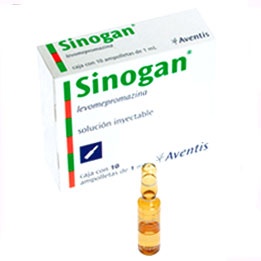
Each package contains 10 ampoules. Each ampoule contains 1 ml of injectable solution.
Marketing Authorization Holder and Manufacturer
Holder:
Neuraxpharm Spain, S.L.U.
Avda. Barcelona, 69
08970 Sant Joan Despí
Barcelona - Spain
Manufacturer:
Famar Health Care Services Madrid, S.A.U.
Avda. de Leganés nº 62
28923 Alcorcón (Madrid)
Date of the Last Revision of this Prospectus: May 2023
Detailed information on this medicine is available on the website of the Spanish Agency for Medicines and Health Products (AEMPS) http://www.aemps.gob.es/
- Country of registration
- Dosage formINJECTABLE, 25 mg levomepromazine/ ml
- ATC codeN05AA02
- Average pharmacy price2.83 EUR
- Active substance
- Prescription requiredYes
- Manufacturer
- CompositionSULFITO SODICO (0,5 mg mg), SOLUCION SULFITO SODICO (c.s.p pH4,7-4,9 - mg), CLORURO DE SODIO (6,5 mg mg)
- This information is for reference only and does not constitute medical advice. Always consult a doctor before taking any medication. Oladoctor is not responsible for medical decisions based on this content.
- Alternatives to SINOGAN 25 mg/ml INJECTABLE SOLUTIONDosage form: TABLET, 100 mg levomepromazineActive substance: levomepromazineManufacturer: Neuraxpharm Spain S.L.Prescription requiredDosage form: TABLET, 25 mg levomepromazineActive substance: levomepromazineManufacturer: Neuraxpharm Spain S.L.Prescription requiredDosage form: ORAL DROPS SOLUTION/SUSPENSION, 4% levomepromazineActive substance: levomepromazineManufacturer: Neuraxpharm Spain S.L.Prescription required
Online doctors for SINOGAN 25 mg/ml INJECTABLE SOLUTION
Discuss questions about SINOGAN 25 mg/ml INJECTABLE SOLUTION, including use, safety considerations and prescription review, subject to medical assessment and local regulations.







Get SINOGAN 25 mg/ml INJECTABLE SOLUTION Prescription Online
Fill in a 2-min form
Tell us your symptoms, history, and what medicine you're requesting.
Pick a doctor or let us assign
Choose a specialist or we'll match you with the next available doctor.
Doctor reviews your case
Usually within 30 minutes. They may ask follow-up questions via chat.
Collect from any pharmacy
Electronic prescription sent to your email — valid across Spain.
Frequently Asked Questions
SINOGAN 25 mg/ml INJECTABLE SOLUTION requires a prescription in Spain. You can check with a doctor online whether this medicine may be appropriate for your situation.
The active ingredient in SINOGAN 25 mg/ml INJECTABLE SOLUTION is levomepromazine. This information helps identify medicines with the same composition but different brand names.
The average pharmacy price for SINOGAN 25 mg/ml INJECTABLE SOLUTION is around 2.83 EUR. Prices may vary depending on the manufacturer and dosage form.
SINOGAN 25 mg/ml INJECTABLE SOLUTION is manufactured by Neuraxpharm Spain S.L.. Pharmacy brands and packaging may differ depending on the distributor.
Doctors such as Family doctors, Psychiatrists, Dermatologists, Cardiologists, Endocrinologists, Gastroenterologists, Pulmonologists, Nephrologists, Rheumatologists, Hematologists, Infectious disease physicians, Allergists, Geriatricians, Paediatricians, Oncologists may assess whether SINOGAN 25 mg/ml INJECTABLE SOLUTION is appropriate, depending on your situation and local regulations. You can book an online consultation to discuss your symptoms and possible next steps.
Spain has a well-developed healthcare infrastructure across major cities such as Madrid, Barcelona, Valencia, and Seville. Pharmacies are widely available and operate under strict regulations, ensuring access to prescribed medications.
You can buy SINOGAN 25 mg/ml INJECTABLE SOLUTION in Madrid, Barcelona, Seville, or Valencia at any local pharmacy with a valid prescription.
To obtain a prescription, you can use Oladoctor:
Other medicines with the same active substance (levomepromazine) include SINOGAN 100 mg FILM-COATED TABLETS, SINOGAN 25 mg FILM-COATED TABLETS, SINOGAN 40 mg/ml ORAL DROPS IN SOLUTION. These may have different brand names or formulations but contain the same therapeutic ingredient. Always consult a doctor before switching or starting a new medicine.
