


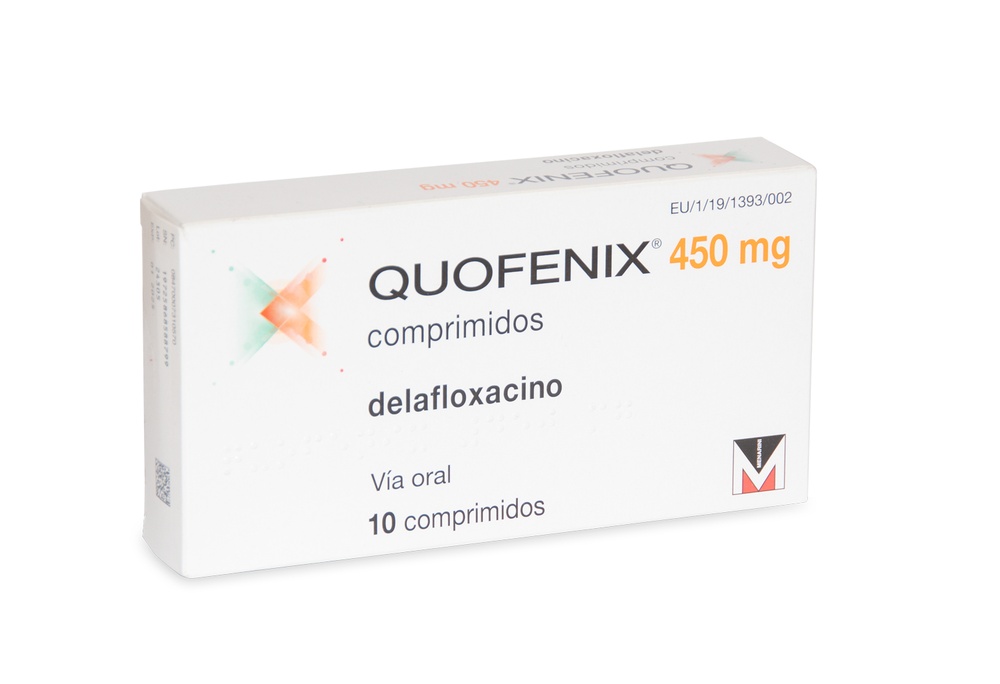
Quofenix 450 mg comprimidos

Revisión de receta online
Un médico revisará tu caso y determinará si la prescripción es médicamente apropiada.

Habla con un médico sobre este medicamento
Comenta tus síntomas y las opciones de tratamiento en una consulta online.



Cómo usar QUOFENIX 450 mg COMPRIMIDOS
Contenido del prospecto
- Introducción
- Qué es Quofenix y para qué se utiliza
- Qué necesita saber antes de empezar a tomar Quofenix
- Cómo tomar Quofenix
- Posibles efectos adversos
- Conservación de Quofenix
- Contenido del envase e información adicional
Introducción
Prospecto: información para el paciente
Quofenix 450 mg comprimidos
delafloxacino
Lea todo el prospecto detenidamente antes de empezar a tomar este medicamento, porque contiene información importante para usted.
- Conserve este prospecto, ya que puede tener que volver a leerlo.
- Si tiene alguna duda, consulte a su médico, o farmacéutico o enfermero.
- Este medicamento se le ha recetado solamente a usted, y no debe dárselo a otras personas aunque tengan los mismos síntomas que usted, ya que puede perjudicarles.
- Si experimenta efectos adversos, consulte a su médico, o farmacéutico o enfermero, incluso si se trata de efectos adversos que no aparecen en este prospecto. Ver sección 4.
Contenido del prospecto
- Qué es Quofenix y para qué se utiliza
- Qué necesita saber antes de empezar a tomar Quofenix
- Cómo tomar Quofenix
- Posibles efectos adversos
- Conservación de Quofenix
- Contenido del envase e información adicional
1. Qué es Quofenix y para qué se utiliza
Quofenix es un antibiótico que contiene el principio activo delafloxacino. Pertenece a un grupo de medicamentos llamados fluoroquinolonas.
Se utiliza para el tratamiento en adultos de infecciones graves y de corta duración causadas por ciertas bacterias, cuando los antibióticos habituales no se pueden utilizar o no han funcionado:
- infecciones de la piel y del tejido subcutáneo
- infección de los pulmones llamada “neumonía”
Bloquea las enzimas que las bacterias necesitan para copiar y reparar su ADN. Al bloquear estas enzimas, Quofenix mata las bacterias que causan la infección.

¿No estás seguro de si este medicamento es adecuado para ti?
Comenta tus síntomas y tratamiento con un médico online.
2. Qué necesita saber antes de empezar a tomar Quofenix
No tome Quofenix
- Si es alérgico a delafloxacino o a alguno de los demás componentes de este medicamento (incluidos en la sección 6).
- Si es alérgico a cualquier otro medicamento antibacteriano del tipo fluoroquinolona o quinolona.
- Si alguna vez ha tenido un problema con los tendones, como tendinitis, relacionado con el tratamiento con “antibióticos del tipo quinolona”. Un tendón es el cordón que une el músculo con el esqueleto.
- Si está embarazada, tiene intención de quedarse embarazada o cree que podría estar embarazada.
- Si está en periodo de lactancia
- Si es un niño o un adolescente en edad de crecimiento menor de 18 años de edad.
Advertencias y precauciones
Antes de tomar este medicamento
No debe tomar medicamentos antibacterianos del tipo fluoroquinolona o quinolona, incluyendo Quofenix, si ha experimentado alguna reacción adversa grave en el pasado al tomar una quinolona o fluoroquinolona. En este caso, debe informe a su médico lo antes posible.
Cuando esté tomando este medicamento
- En raras ocasiones puede ocurrir dolor e hinchazón en las articulaciones, e inflamación o ruptura de los tendones. Su riesgo aumenta si es un paciente de edad avanzada (más de 60 años de edad), ha recibido un trasplante de órgano, tiene problemas renales o si está siendo tratado con corticosteroides. La inflamación y las rupturas de tendones pueden ocurrir dentro de las primeras 48 horas de tratamiento e incluso hasta varios meses después de suspender el tratamiento con Quofenix. A la primera señal de dolor o inflamación de un tendón (por ejemplo, en el tobillo, la muñeca, el codo, el hombro o la rodilla), deje de tomar Quofenix, contacte a su médico y descanse la zona dolorida. Evite cualquier ejercicio innecesario, ya que esto podría aumentar el riesgo de ruptura de tendones.
- En raras ocasiones, pueden presentarse síntomas de daño nervioso (neuropatía) como dolor, quemazón, hormigueo, entumecimiento y/o debilidad, especialmente en los pies y las piernas o en las manos y los brazos. Si esto sucede, deje de tomar Quofenix e informe a su médico inmediatamente para prevenir el desarrollo de una alteración potencialmente irreversible.
Consulte a su médico o farmacéutico o enfermero antes de tomar Quofenix si:
- Le han diagnosticado un agrandamiento o protuberancia de un vaso sanguíneo de gran tamaño (aneurisma aórtico o aneurisma periférico de vaso grande).
- Ha tenido un desgarro en la pared de la aorta (el principal vaso sanguíneo del corazón) conocido como disección aórtica.
- Se le ha diagnosticado una insuficiencia de la válvula cardíaca (regurgitación de las válvulas cardíacas).
- Si tiene antecedentes familiares de aneurisma aórtico o disección aórtica, enfermedad congénita de las válvulas cardíacas u otros factores de riesgo o condiciones predisponentes (p.ej., trastornos del tejido conjuntivo como el síndrome de Marfan o el síndrome vascular de Ehlers-Danlos, el síndrome de Turner o el síndrome de Sjögren (una enfermedad autoinmune inflamatoria), o trastornos vasculares como la arteritis de Takayasu o la arteritis de células gigantes, la enfermedad de Behçet, hipertensión arterial o aterosclerosis conocida, artritis reumatoide (una enfermedad de las articulaciones= o endocarditis (una infección del corazón)).
- Ha tenido problemas de tendones durante el tratamiento anterior con un antibiótico del tipo fluoroquinolona o quinolona.
- Tiene o puede tener problemas del sistema nervioso central (por ejemplo, arteriosclerosis cerebral grave, epilepsia) o tiene otros factores de riesgo que pueden aumentar el riesgo de sufrir convulsiones (ataques). En esos casos, su médico considerará si este tratamiento es la mejor opción para usted.
- Sufre miastenia gravis (un tipo de debilidad muscular), ya que los síntomas pueden empeorar.
- Sufre diarrea, o ha sufrido anteriormente diarrea al tomar antibióticos o hasta 2 meses después. Contacte con su médico inmediatamente si tiene diarrea durante o después del tratamiento. No tome ningún medicamento para tratar la diarrea sin antes consultar a su médico.
- Tiene problemas renales.
- A veces ha tenido un tratamiento prolongado con antibióticos; puede significar que contrae otra infección causada por otras bacterias (superinfección) que no se puede tratar con el antibiótico. Consulte con su médico si tiene alguna duda o pregunta sobre esto y sobre el uso de Quofenix.
- Puede tener una reacción cutánea severa, como ampollas o lesiones.
- Usted o un miembro de su familia tiene una deficiencia de glucosa-6-fosfato deshidrogenasa.
- Sufre diabetes. Los antibióticos del tipo fluoroquinolona, incluyendo Quofenix, pueden provocar que los niveles de glucosa en sangre aumenten o disminuyan demasiado. Si tiene diabetes, debe controlar cuidadosamente sus niveles de glucosa en sangre.
Si siente un dolor fuerte y repentino en el abdomen, el pecho o la espalda, que pueden ser síntomas de disección o aneurisma aórticos, acuda inmediatamente a un servicio de urgencias. Puede aumentar el riesgo si está recibiendo un tratamiento con corticoesteroides sistémicos.
Si empieza a experimentar una aparición repentina de disnea, especialmente cuando se tumba en la cama, o si observa hinchazón en los tobillos los pies o el abdomen o la aparición de palpitaciones cardíacas (sensación de latido cardíaco rápido o irregular), debe informar a su médico inmediatamente.
Efectos secundarios graves, prolongados, incapacitantes y potencialmente irreversibles
Los medicamentos antibacterianos del tipo fluoroquinolona/quinolona se han asociado a efectos secundarios muy raros pero graves, algunos de los cuales son de larga duración (durante meses o años continuos), incapacitantes o potencialmente irreversibles. Esto incluye dolor en los tendones, músculos y articulaciones de las extremidades superiores e inferiores, dificultad para caminar, sensaciones anormales como hormigueo, cosquilleo, entumecimiento o quemazón (parestesia), trastornos sensoriales como deterioro de la visión, el gusto y el olfato, y la audición, depresión, deterioro de la memoria, fatiga severa y trastornos severos del sueño.
Si experimenta alguno de estos efectos secundarios después de tomar Quofenix, contacte a su médico inmediatamente antes de continuar con el tratamiento. Usted y su médico decidirán si continuar con el tratamiento considerando también un antibiótico de otra clase.
Niños y adolescentes
Este medicamento no se debe usar en niños y adolescentes, ya que no se ha estudiado suficientemente en estos grupos.
Otros medicamentos y Quofenix
Informe a su médico o farmacéutico si está tomando, ha tomado recientemente o pudiera tener que tomar cualquier otro medicamento.
Los comprimidos de Quofenix se deben tomar al menos 2 horas antes o 6 horas después de:
- un antiácido, multivitamínico u otro producto que contenga magnesio, aluminio, hierro o zinc
- sucralfato
- comprimidos tamponados de didanosina para suspensión oral o polvo pediátrico para solución oral
Embarazoylactancia
Quofenix no se debe usar si está embarazada o en periodo de lactancia. Quofenix no se debe usar en mujeres en edad fértil que no usan métodos anticonceptivos.
Si está embarazada o en periodo de lactancia, cree que podría estar embarazada o tiene intención de quedarse embarazada, consulte a su médico antes de utilizar este medicamento.
Si pudiera quedarse embarazada debe usar métodos anticonceptivos efectivos durante el tratamiento con Quofenix.
Conducción y uso de máquinas
Quofenix puede hacer que se sienta mareado y aturdido. Hasta que no sepa cómo le afecta Quofenix no conduzca, ni utilice máquinas, o realice otras actividades que requieran agudeza mental o coordinación.
Quofenix contiene sodio
Este medicamento contiene 39 mg de sodio (componente principal de la sal de mesa para cocinar) en cada comprimido. Esto equivale al 2% de la ingesta diaria máxima de sodio recomendada para un adulto.
3. Cómo tomar Quofenix
Siga exactamente las instrucciones de administración de este medicamento indicadas por su médico o farmacéutico. En caso de duda, consulte de nuevo a su médico o farmacéutico.
La dosis recomendada es de 450 mg vía oral cada 12 horas para una duración total de 5 a 14 días para las infecciones cutáneas y de 5 a 10 días para la neumonía, según criterio médico. Los comprimidos se deben tomar enteros con una cantidad suficiente de agua, y se pueden tomar con o sin comida.
Si toma más Quofenix del que debe
Si accidentalmente toma más comprimidos de los que debiera, consulte a su médico o busque otro consejo médico. Llévese el medicamento con usted.
Si olvidó tomar Quofenix
Si olvidó tomar una dosis, debe tomarla lo más pronto posible hasta 8 horas antes de la próxima dosis programada. Si quedan menos de 8 horas antes de la siguiente dosis, espere hasta la siguiente dosis programada. No tome una dosis doble para compensar las dosis olvidadas.
Si interrumpe el tratamiento con Quofenix
Si interrumpe el tratamiento con Quofenix sin el consejo de su médico, sus síntomas pueden empeorar. Hable con su médico o farmacéutico antes de interrumpir el tratamiento con su medicamento.
Si tiene cualquier otra duda sobre el uso de éste medicamento, pregunte a su médico, farmacéutico o enfermero.

¿Has empezado a tomar el medicamento y tienes preguntas?
Comenta tus síntomas y tratamiento con un médico online.
4. Posibles efectos adversos
Al igual que otros medicamentos, Quofenix puede producir efectos adversos, aunque no todas las personas lo sufran.
Efectos adversos graves
Por favor, informe inmediatamente a su médico o enfermero si sufre alguno de estos síntomas, ya que el tratamiento con el medicamento debe ser interrumpido y es posible que necesite atención médica urgente:
- Dificultad para tragar o dificultad para respirar y toser; hinchazón de los labios, cara, garganta o lengua; garganta seca o estrechamiento de la garganta y sarpullido severo. Estos pueden ser signos y síntomas de una reacción de hipersensibilidad (alérgica) y pueden ser potencialmente mortales. Estas reacciones graves son efectos adversos poco frecuentes que pueden afectar hasta a 1 de cada 100 personas.
- Disminución de la presión arterial; visión borrosa; mareo. Esta reacción grave es un efecto adverso poco frecuente que puede afectar hasta a 1 de cada 100 personas.
- Dolor abdominal (vientre) con posible diarrea severa, fiebre y náuseas. Estos pueden ser signos de una infección intestinal, que no debe tratarse con medicamentos para la diarrea que paren el movimiento del intestino. La infección del intestino (infección por Clostridioides difficile) es un efecto adverso poco frecuente que puede afectar hasta a 1 de cada 100 personas.
Otros efectos adversos pueden incluir:
Efectos adversos frecuentes (pueden afectar hasta 1 de cada 10 personas):
- Infección por hongos
- Dolor de cabeza
- Vómitos
- Aumento en la cantidad de enzimas producidas por el hígado, llamadas transaminasas, que se muestran en los análisis de sangre
- Picor
Efectos adversos poco frecuentes (pueden afectar hasta a 1 de cada 100 personas):
- Reducción del número de glóbulos blancos en la sangre (leucopenia)
- Niveles bajos de hemoglobina (anemia)
- Reacción alérgica
- Niveles altos de glucosa en sangre
- Disminución del apetito
- Insomnio
- Debilidad muscular en las extremidades
- Sensaciones como entumecimiento, hormigueo y cosquilleo
- Disminución de la sensación del tacto
- Alteración del gusto
- Sentir los latidos del corazón (palpitaciones)
- Presión arterial alta
- Enrojecimiento (por ejemplo en la cara o el cuello)
- Inflamación de la pared del estómago, inflamación de los tejidos internos de la boca, dolor abdominal, molestias/dolor de estómago o indigestión, boca seca, flatulencias
- Sudor anormal
- Reacción alérgica de la piel
- Picor sarpullido rojo
- Dolor en las articulaciones
- Dolor e hinchazón de los tendones
- Dolor musculoesquelético (por ejemplo dolor en las extremidades, dolor de espalda, dolor de cuello), debilidad muscular
- Aumento del nivel de creatina fosfocinasa en sangre (un indicador de daño muscular)
- Disminución de la función renal
- Sensación de cansancio
- Alteración del análisis de sangre relacionada con la función hepática (aumento de la fosfatasa alcalina en sangre)
- Aumento de la temperatura corporal (pirexia)
- Hinchazón de las extremidades inferiores
Efectos adversos raros (pueden afectar hasta a 1 de cada 1000 personas):
- Infección del tracto urinario
- Inflamación de la mucosa de la cavidad nasal
- Recuento de glóbulos blancos bajo (reducción de la cantidad de células sanguíneas)
- Disminución de un tipo especial de células sanguíneas necesarias para la coagulación de la sangre
- Cambios en los tests que miden cómo funciona la coagulación sanguínea
- Alergia estacional
- Niveles bajos de glucosa en sangre
- Altos niveles de ácido úrico
- Altos niveles de potasio en sangre
- Bajos niveles de potasio en sangre
- Oír cosas que no existen (alucinaciones auditivas)
- Ansiedad
- Alteraciones del sueño
- Confusión
- Somnolencia
- Sensación de mareo o desmayo, generalmente debido a una caída de la presión arterial
- Ojos secos
- Mareos o pérdida del equilibrio (vértigo)
- Zumbidos en los oídos (tinnitus)
- Alteración del equilibrio
- Latidos del corazón irregulares o rápidos, disminución de los latidos del corazón
- Venas hinchadas, rojas e irritadas (flebitis)
- Coágulo de sangre, conocido como trombo en la vena profunda
- Acidez, regurgitación ácida
- Pérdida de la sensación del tacto en la boca
- Reducción de la sensación táctil en la boca
- Sensación de ardor en la boca
- Cambio de color de las heces
- Alteración de los análisis de sangre relacionados con la función hepática (disminución de la albúmina en sangre y aumento de la gamma-glutamiltransferasa)
- Sudor frío
- Sudor nocturno
- Pérdida anormal del cabello
- Espasmos musculares
- Inflamación/dolor muscular
- Inflamación de las articulaciones, dolor en manos o pies, dolor de espalda
- Sangre en la orina
- Orina turbia debido a la presencia de componentes sólidos
- Escalofríos
- Empeoramiento de la herida
- Edema periférico
Se han asociado con la administraciónde antibióticos de quinolona y fluoroquinolona, en algunos casos independientemente de los factores de riesgo preexistentes, casos muy raros de reacciones adversas a los medicamentos, del tipo permanentes o de larga duración (hasta meses o años), como inflamaciones de tendones, ruptura de tendones, dolor en las articulaciones, dolor en las extremidades, dificultad para caminar, sensaciones anormales como hormigueo y cosquilleo, quemazón, entumecimiento o dolor (neuropatía), depresión, fatiga, trastornos del sueño, alteraciones de la memoria, así como alteraciones de la audición, la visión, y el gusto y el olfato.
Se han notificado casos de aumento de tamaño y debilitamiento o desgarro de la pared aórtica (aneurismas y disecciones), lo que podría producir una rotura y llegar a ser mortal, e insuficiencia de válvulas cardíacas en pacientes que han recibid fluoroquinolonas. Ver también la sección 2.
Comunicación de efectos adversos
Si experimenta cualquier tipo de efecto adverso, consulte a su médico o, farmacéutico o enfermero, incluso si se trata de posibles efectos adversos que no aparecen en este prospecto. También puede comunicarlos directamente a través del sistema nacional de notificación incluido en el Apéndice V*. Mediante la comunicación de efectos adversos puede contribuir a proporcionar más información sobre la seguridad de este medicamento.
5. Conservación de Quofenix
Mantener este medicamento fuera de la vista y del alcance de los niños.
No utilice este medicamento después de la fecha de caducidad que aparece en la caja o envase después de CAD. La fecha de caducidad es el último día del mes que se indica.
Este medicamento no requiere ninguna temperatura especial de conservación.
Conservar en el embalaje original para protegerlo de la luz.
Los medicamentos no se deben tirar por los desagües ni a la basura. Pregunte a su farmacéutico cómo deshacerse de los envases y de los medicamentos que ya no necesita. De esta forma, ayudará a proteger el medio ambiente.
6. Contenido del envase e información adicional
Composición de Quofenix
- El principio activo es delafloxacino. Cada comprimido contiene 450 mg de delafloxacino (como meglumina)
- Los demás componentes (excipientes) son celulosa microcristalina, povidona, crospovidona, hidrogenocarbonato de sodio, dihidrogenofosfato de sodio monohidrato, ácido cítrico, estearato de magnesio.
Aspecto del producto y contenido del envase
Quofenix es un comprimido biconvexo, oblongo, de color beige a beige moteado.
Está disponible en envases de blisters de 5 comprimidos en envases de 10, 20, 30, 50, 60 o 100 comprimidos.
Puede que solamente estén comercializados algunos tamaños de envases.
Titular de la autorización de comercialización y responsable de la fabricación
- Menarini – Industrie Farmaceutiche Riunite – s.r.l.
Via Sette Santi 3
50131 Florencia
Italia
Responsable de fabricación
AlfaSigma
1 Via Enrico Fermi
65020 Alanno (PE)
Italia
o
Special Product’s Line S.p.A.
1 Via Fratta Rotonda Vado Largo
03012 Anagni (FR)
Italia
Pueden solicitar más información respecto a este medicamento dirigiéndose al representante local del titular de la autorización de comercialización:
België/Belgique/Belgien Menarini Benelux NV/SA Tél/Tel: + 32 (0)2 721 4545 | Lietuva UAB “BERLIN-CHEMIE MENARINI BALTIC” Tel: +370 52 691 947 |
| Luxembourg/Luxemburg Menarini Benelux NV/SA Tél/Tel: + 32 (0)2 721 4545 |
Ceská republika Berlin-Chemie/A.Menarini Ceska republika s.r.o. Tel: +420 267 199 333 | Magyarország Berlin-Chemie/A. Menarini Kft. Tel.: +36 17997320 |
Danmark
Tel: +39-055 56801 | Malta
Tel: +39-055 56801 |
Deutschland Berlin-Chemie AG Tel: +49 (0) 30 67070 | Nederland Menarini Benelux NV/SA Tel: +32 (0)2 721 4545 |
Eesti OÜ Berlin-Chemie Menarini Eesti Tel: +372 667 5001 | Norge
Tel: +39-055 56801 |
Ελλ?δα MENARINI HELLAS AE Τηλ: +30 210 8316111-13 | Österreich
Tel: +43 1 879 95 85-0 |
España Laboratorios Menarini S.A. Tel: +34-93 462 88 00 | Polska Berlin-Chemie/Menarini Polska Sp. z o.o. Tel.: +48 22 566 21 00 |
France MENARINI France Tél: +33 (0)1 45 60 77 20 | Portugal
Tel: +351 210 935 500 |
Hrvatska Berlin-Chemie Menarini Hrvatska d.o.o. Tel: + 385 1 4821 361 | România Berlin-Chemie A. Menarini S.R.L. Tel: +40 21 232 34 32 |
Ireland
Tel: +353 1 284 6744 | Slovenija Berlin-Chemie / A. Menarini Distribution Ljubljana d.o.o. Tel: +386 01 300 2160 |
Ísland
Tel: +39-055 56801 | Slovenská republika Berlin-Chemie / A. Menarini Distribution Slovakia s.r.o. Tel: +421 2 544 30 730 |
Italia
Tel: +39-055 56801 | Suomi/Finland Berlin-Chemie/A.Menarini Suomi OY Puh/Tel: +358 403 000 760 |
Κ?προς MENARINI HELLAS AE Τηλ: +30 210 8316111-13 | Sverige
Tel: +39-055 56801 |
Latvija SIA Berlin-Chemie/Menarini Baltic Tel: +371 67103210 | United Kingdom (Irlanda del Norte)
Tel: +44 (0)1628 856400 |

Fecha de la última revisión de este prospecto:09/2024
Otras fuentes de información
La información detallada de este medicamento está disponible en la página web de la Agencia Europea de Medicamentos http://www.ema.europa.eu.
- País de registro
- Forma farmacéuticaCOMPRIMIDO, 450 mg
- Código ATCJ01MA23
- Principio activo
- Requiere recetaSí
- Fabricante
- ComposiciónHIDROGENOCARBONATO DE SODIO (140 mg mg), FOSFATO DE SODIO MONOBASICO MONOHIDRATADO (5,5 mg mg)
- Esta información es de carácter general y no sustituye la consulta con un profesional sanitario.
- Alternativas a QUOFENIX 450 mg COMPRIMIDOSForma farmacéutica: INYECTABLE PERFUSION, 300 mgPrincipio activo: delafloxacinRequiere recetaForma farmacéutica: INYECTABLE PERFUSION, 400 mg/250 mlPrincipio activo: moxifloxacinaFabricante: Bayer Hispania S.L.Requiere recetaForma farmacéutica: COMPRIMIDO, 500 MGPrincipio activo: levofloxacinoFabricante: Especialidades Farmaceuticas Centrum S.A.Requiere receta
Médicos online para QUOFENIX 450 mg COMPRIMIDOS
Comenta la dosis, los posibles efectos secundarios, interacciones, contraindicaciones o la revisión de receta de QUOFENIX 450 mg COMPRIMIDOS, sujeto a valoración médica y a la normativa local.









Preguntas frecuentes
QUOFENIX 450 mg COMPRIMIDOS requiere receta en España. Puedes confirmarlo con un médico online según tu caso.
El principio activo de QUOFENIX 450 mg COMPRIMIDOS es delafloxacin. Esta información ayuda a identificar medicamentos con la misma composición pero con diferentes nombres comerciales.
QUOFENIX 450 mg COMPRIMIDOS es fabricado por A. Menarini Industrie Farmaceutiche Riunite S.R.L.. La marca y el envase pueden variar según el distribuidor.
Los Médicos de familia, Psiquiatras, Dermatólogos, Cardiólogos, Endocrinólogos, Gastroenterólogos, Neumólogos, Nefrólogos, Reumatólogos, Hematólogos, Infectólogos, Alergólogos, Geriatras, Pediatras, Oncólogos pueden valorar la prescripción de QUOFENIX 450 mg COMPRIMIDOS cuando esté clínicamente indicado. Puedes reservar una videoconsulta para comentar tu caso y las opciones de tratamiento.
La receta la emite un médico tras valorar tu estado de salud. En España, QUOFENIX 450 mg COMPRIMIDOS se dispensa en las farmacias con esa receta médica. Una consulta online no garantiza su emisión: la decisión corresponde siempre al médico.
Para solicitar una valoración puedes usar Oladoctor:
Otros medicamentos con el mismo principio activo (delafloxacin) incluyen QUOFENIX 300 mg POLVO PARA CONCENTRADO PARA SOLUCION PARA PERFUSION, ACTIRA 400 MG/ 250 ML SOLUCION PARA PERFUSION, ASEY 500 mg COMPRIMIDOS RECUBIERTOS CON PELICULA EFG. Pueden tener diferentes nombres comerciales o formulaciones, pero contienen el mismo componente terapéutico. Consulta siempre con un médico antes de cambiar o iniciar un nuevo medicamento.
