



PREVENAR 13 2.2 µg/2.2 µg/2.2 µg/2.2 µg/2.2 µg/2.2 µg/2.2 µg/2.2 µg/4.4 µg/2.2 µg/2.2 µg/2.2 µg/2.2 µg suspensión inyectable

Revisión de receta online
Un médico revisará tu caso y determinará si la prescripción es médicamente apropiada.

Habla con un médico sobre este medicamento
Comenta tus síntomas y las opciones de tratamiento en una consulta online.



Cómo usar PREVENAR 13 SUSPENSION INYECTABLE
Contenido del prospecto
- Introducción
- Qué es Prevenar 13 y para qué se utiliza
- Qué necesita saber antes de que usted o su hijo reciba Prevenar 13
- Cómo se administra Prevenar 13
- Posibles efectos adversos
- Conservación de Prevenar 13
- Contenido del envase e información adicional
Introducción
Prospecto: información para el usuario
Prevenar13 suspensión inyectable
Vacuna antineumocócica polisacárida conjugada (13-valente, adsorbida)
Lea todo el prospecto detenidamente antes de que usted o su hijo reciba esta vacuna, porque contiene información importante para usted.
- Conserve este prospecto, ya que puede tener que volver a leerlo.
- Si tiene alguna duda, consulte a su médico, farmacéutico o personal de enfermería.
- Esta vacuna se le ha recetado solamente a usted o a su hijo, y no debe dársela a otras personas.
- Si usted o su hijo experimenta efectos adversos, consulte a su médico, farmacéutico o personal de enfermería, incluso si se trata de efectos adversos que no aparecen en este prospecto. Ver sección 4.
Contenido del prospecto
- Qué es Prevenar 13 y para qué se utiliza
- Qué necesita saber antes de que usted o su hijo reciba Prevenar 13
- Cómo se administra Prevenar 13
- Posibles efectos adversos
- Conservación de Prevenar 13
- Contenido del envase e información adicional
1. Qué es Prevenar 13 y para qué se utiliza
Prevenar 13 es una vacuna antineumocócica que se administra a:
- niños desde 6semanas a 17años de edad:para ayudar a protegerlos contra enfermedades tales como: meningitis (inflamación alrededor del cerebro), sepsis o bacteriemia (bacterias en el torrente sanguíneo), neumonía (infección en el pulmón) e infecciones de oído,
- adultos de 18 años de edad o mayores:para ayudar a prevenir enfermedades tales como: neumonía (infección del pulmón), sepsis o bacteriemia (bacterias en el torrente sanguíneo) y meningitis (inflamación alrededor del cerebro),
causadas por 13 tipos de la bacteria Streptococcus pneumoniae.
Prevenar 13 proporciona protección frente a 13 tipos de la bacteria Streptococcus pneumoniaey sustituye a Prevenar, que proporcionaba protección frente a 7 tipos.
La vacuna actúa ayudando al cuerpo a fabricar sus propios anticuerpos, que le protegen a usted o a su hijo contra estas enfermedades.

¿No estás seguro de si este medicamento es adecuado para ti?
Comenta tus síntomas y tratamiento con un médico online.
2. Qué necesita saber antes de que usted o su hijo reciba Prevenar 13
No se debe administrar Prevenar13
- si usted o su hijo esalérgico (hipersensible) a los principios activos o a cualquiera de los demás componentes de este medicamento (incluidos en la sección 6) o a cualquier otra vacuna que contenga toxoide diftérico.
- si usted o su hijo padece una infección grave con temperatura alta (más de 38ºC). Si esto le sucede a usted o a su hijo, deberá posponerse la vacunación hasta que usted o su hijo se encuentre mejor. Una infección menor, como un resfriado, no debería suponer un problema. Sin embargo, consulte antes con su médico, farmacéutico o personal de enfermería.
Advertencias y precauciones
Consulte a su médico, farmacéutico o personal de enfermería antes de la vacunación, si usted o su hijo/a:
- tiene o ha tenido en el pasado algún problema médico después de la administración de cualquier dosis de Prevenar o Prevenar 13, como una reacción alérgica o problemas al respirar.
- tiene problemas de sangrado o le aparecen cardenales con facilidad.
- tiene un sistema inmunitario debilitado (por ejemplo, por una infección por el VIH) podría no obtener todo el beneficio de Prevenar 13.
- ha sufrido convulsiones, ya que puede ser necesario tomar medicamentos para bajar la fiebre, antes de administrar Prevenar 13. Si su hijo/a no responde al medicamento o si sufre convulsiones después de la vacunación, consulte inmediatamente a su médico. Ver también la sección 4.
Consulte a su médico, farmacéutico o enfermero antes de la vacunación si su hijo ha sido muy prematuro (ha nacido a las 28 semanas o menos de gestación), ya que el intervalo entre respiraciones podría ser más largo de lo normal durante los 2 o 3 días posteriores a la vacunación. Ver también la sección 4.
Como con cualquier vacuna, Prevenar 13 no protegerá a todas las personas vacunadas.
Prevenar 13 protegerá solamente contra infecciones de oído en niños causadas por los tipos de Streptococcus pneumoniaepara los que se ha desarrollado la vacuna. No protegerá contra otros agentes infecciosos que pueden provocar infecciones de oído.
Uso de Prevenar13 con otros medicamentos/vacunas
Su médico puede indicarle que antes de la administración de Prevenar 13 dé a su hijo paracetamol u otras medicinas que bajan la fiebre. Esto ayudará a reducir algunos de los efectos adversos de Prevenar 13.
Informe a su médico, farmacéutico o personal de enfermería si usted o su hijo está utilizando, ha utilizado recientemente o podría tener que utilizar otros medicamentos, incluso los adquiridos sin receta, o ha recibido recientemente otra vacuna.
Embarazo y lactancia
Si está embarazada o en periodo de lactancia, cree que podría estar embarazada o tiene intención de quedarse embarazada, consulte a su médico o farmacéutico antes de recibir esta vacuna.
Conducción y uso de máquinas
La influencia de Prevenar 13 sobre la capacidad para conducir y utilizar máquinas es nula o insignificante. No obstante, algunos de los efectos mencionados en la sección 4 “Posibles efectos adversos” pueden afectar de forma temporal a la capacidad para conducir y utilizar máquinas.
Prevenar13 contiene polisorbato80
Esta vacuna contiene 0,1 mg de polisorbato 80 por dosis. Los polisorbatos pueden causar reacciones alérgicas. Informe a su médico si usted o su hijo tiene cualquier alergia conocida.
Prevenar13 contiene sodio
Este medicamento contiene menos de 1 mmol de sodio (23 miligramos) por dosis, es decir, esencialmente está "libre de sodio".
3. Cómo se administra Prevenar 13
El médico o personal de enfermería inyectarán la dosis recomendada (0,5 ml) de la vacuna en un músculo de su brazo o del brazo o la pierna de su hijo.
Lactantes de 6 semanas a 6 meses de edad
Generalmente, su hijo debe recibir una serie inicial de tres inyecciones de la vacuna, seguidas de una dosis de refuerzo.
- La primera inyección puede administrarse a partir de las 6 semanas de edad.
- Todas las inyecciones deben administrarse separadas por un mínimo de un mes.
- Se administrará una cuarta inyección (de refuerzo) entre los 11 y los 15 meses de edad.
- Se le indicará cuándo debe volver con su hijo para la siguiente inyección.
De acuerdo con las recomendaciones oficiales de su país, el profesional sanitario podría seguir un calendario alternativo. Por favor, pida más información a su médico, farmacéutico o personal de enfermería.
Lactantes prematuros
Su hijo recibirá un ciclo inicial de tres inyecciones. La primera inyección puede administrarse a partir de la edad de seis semanas, con al menos un mes entre las dosis. Entre los 11 y los 15 meses, su hijo recibirá una cuarta inyección (de refuerzo).
Lactantes, niños y adolescentes mayores de 7 meses de edad no vacunados
Los lactantes de 7 a 11mesesde edad deben recibir dos inyecciones. Las inyecciones se administrarán separadas por un mínimo de un mes. Se administrará una tercera inyección en el segundo año de vida.
Los niños de 12 a 23mesesde edad deben recibir dos inyecciones. Las inyecciones se administrarán separadas por un mínimo de dos meses.
Los niños de 2 a 17añosdeben recibir una única inyección.
Lactantes, niños y adolescentes vacunados previamente con Prevenar
Los lactantes y niños que hayan recibido Prevenar previamente pueden recibir Prevenar 13 para completar la serie de inyecciones.
En el caso de los niños de 1 a 5añosde edad vacunados previamente con Prevenar, su médico o personal de enfermería recomendará cuántas inyecciones de Prevenar 13 se precisan.
Los niños y adolescentes de 6 a 17 años de edad deben recibir una inyección.
Es importante seguir las instrucciones del médico, farmacéutico o personal de enfermería de forma que su hijo complete la serie de inyecciones.
Si olvidara volver en el momento programado, consulte con su médico, farmacéutico o personal de enfermería.
Adultos
Los adultos deben recibir una única inyección.
Informe a su médico, farmacéutico o personal de enfermería si ha recibido previamente una vacuna antineumocócica.
Si tiene cualquier otra duda sobre el uso de Prevenar 13, pregunte a su médico, farmacéutico o personal de enfermería.
Poblaciones especiales
Las personas que pueden tener un mayor riesgo de tener una infección neumocócica (por ejemplo, las que tienen anemia falciforme o infección por el VIH), incluidos los vacunados anteriormente con una o más dosis de la vacuna antineumocócica de polisacáridos de 23 serotipos, pueden recibir al menos una dosis de Prevenar 13.
Las personas que se hayan sometido a un trasplante de las células madre que forman la sangre pueden recibir tres inyecciones, la primera de las cuales se administra entre 3 y 6 meses después del trasplante y las siguientes con un intervalo mínimo de un mes entre las dosis. Se recomienda administrar una cuarta dosis (refuerzo) 6 meses después de la tercera inyección.

¿Has empezado a tomar el medicamento y tienes preguntas?
Comenta tus síntomas y tratamiento con un médico online.
4. Posibles efectos adversos
Al igual que todas las vacunas, Prevenar 13 puede producir efectos adversos, aunque no todas las personas los sufran.
Los efectos adversos observados con Prevenar13 en lactantes y niños (de 6 semanas a 5 años de edad) incluyen los siguientes:
Los efectos adversos más frecuentes(los que pueden presentarse en más de 1 de 10 dosis de la vacuna) son:
- Disminución del apetito.
- Fiebre; irritabilidad; dolor, sensibilidad o dolor a la palpación en el lugar de vacunación, enrojecimiento, hinchazón o endurecimiento en el lugar de vacunación; somnolencia; sueño intranquilo.
- Enrojecimiento, endurecimiento o hinchazón de 2,5 cm – 7 cm en el lugar de vacunación (tras la dosis de refuerzo y en niños de más edad [entre 2 y 5 años de edad]).
Los efectos adversos frecuentes(los que pueden presentarse hasta en 1 de 10 dosis administradas de la vacuna) son:
- Vómitos, diarrea
- Fiebre de más de 39ºC; sensibilidad o dolor a la palpación en el lugar de vacunación que interfiere con los movimientos de la extremidad, enrojecimiento, hinchazón o endurecimiento de 2,5 cm – 7 cm en el lugar de vacunación (tras la serie inicial de inyecciones).
- Erupción (rash)
Los efectos adversos poco frecuentes(los que pueden presentarse hasta en 1 de 100 dosis de la vacuna) son:
- Convulsiones (o ataques), incluidas las causadas por una temperatura alta
- Ronchas (urticaria o erupción parecida a la urticaria)
- Enrojecimiento, hinchazón o endurecimiento de más de 7 cm en el lugar de vacunación; llanto.
Los efectos adversos raros(los que pueden presentarse hasta en 1 de 1.000 dosis de la vacuna) son:
- Colapso o estado similar al shock (episodio hipotónico con hiporrespuesta).
- Reacción alérgica (hipersensibilidad), incluidas hinchazón de la cara y/o los labios, dificultad para respirar.
Los efectos adversos observados con Prevenar13 en niños y adolescentes (de 6 a 17 años de edad) son los siguientes:
Los efectos adversos más frecuentes(los que pueden presentarse en más de 1 de 10 dosis de la vacuna) son:
- Disminución del apetito.
- Irritabilidad; dolor, sensibilidad o dolor a la palpación, enrojecimiento, hinchazón o endurecimiento en el lugar de vacunación; somnolencia; sueño intranquilo; sensibilidad o dolor a la palpación en el lugar de vacunación que interfiere con los movimientos de la extremidad.
Los efectos adversos frecuentes(los que pueden presentarse hasta en 1 de 10 dosis de la vacuna) son:
- Cefaleas.
- Vómitos, diarrea.
- Erupción (rash); ronchas (urticaria o erupción similar a la urticaria).
- Fiebre.
Los niños y los adolescentes con infección por el VIH, anemia falciforme o que se habían sometido a un trasplante de las células madre que forman la sangre presentaron efectos adversos similares; sin embargo, las frecuencias de las cefaleas, los vómitos, la diarrea, la fiebre, la fatiga, el dolor de articulaciones y el dolor muscular fueron muy frecuentes.
En bebés nacidos muy prematuros (a las 28 semanas de gestación o antes) pueden producirse intervalos más largos de lo normal entre respiraciones durante 2‑3 días después de la vacunación.
Los siguientes efectos adversos han sido observados con Prevenar13 en adultos:
Los efectos adversos más frecuentes(los que pueden presentarse en más de 1 de 10 dosis de la vacuna) son:
- Disminución del apetito; dolores de cabeza; diarrea; vómitos (en las personas entre 18 y 49 años de edad).
- Escalofríos; cansancio; erupción cutánea; dolor, enrojecimiento, hinchazón, endurecimiento o sensibilidad o dolor a la palpación en el lugar de vacunación que interfiere con el movimiento del brazo (dolor intenso/dolor a la palpación en el lugar de la vacunación en las personas de entre 18 y 39 años de edad y limitación importante del movimiento del brazo muy frecuente en las personas de entre 18 y 39 años).
- Empeoramiento o nuevo dolor en las articulaciones; empeoramiento o nuevo dolor en los músculos.
- Fiebre (en las personas de entre 18 y 29 años de edad).
Los efectos adversos frecuentes(los que pueden presentarse hasta en 1 de 10 dosis de la vacuna) son:
- Vómitos (en las personas de 50 años o mayores); fiebre (en las personas de 30 años o mayores).
Los efectos adversos poco frecuentes(los que pueden presentarse hasta en 1 de 100 dosis de la vacuna) son:
- Náuseas.
- Reacción alérgica (hipersensibilidad), incluido hinchazón de la cara y /o de los labios, dificultad para respirar.
- Aumento de tamaño de los ganglios linfáticos (linfadenopatía) cerca del lugar de vacunación, por ejemplo, debajo del brazo.
Los adultos con infección por el VIH presentaron unos efectos adversos similares; sin embargo, las frecuencias fueron muy frecuentes en el caso de la fiebre y los vómitos, y frecuentes en el caso de las náuseas.
Los adultos que se habían sometido a un trasplante de las células madre que forman la sangre presentaron unos efectos adversos similares; sin embargo, las frecuencias fueron muy frecuentes en el caso de la fiebre y los vómitos.
En la experiencia postcomercialización con Prevenar13 se han observado los siguientes efectos adversos adicionales:
- Reacción alérgica grave, incluido el shock (colapso cardiovascular); angioedema (hinchazón de los labios, la cara o la garganta).
- Ronchas (urticaria), enrojecimiento e irritación de la piel (dermatitis) y picor (prurito) en el lugar de vacunación; rubor (sofoco).
- Aumento de tamaño de los ganglios linfáticos (linfadenopatía) cerca del lugar de vacunación, por ejemplo, debajo del brazo o en la ingle.
- Una erupción con manchas rojas que pican (eritema multiforme).
Comunicación de efectos adversos
Si usted o su hijo experimenta efectos adversos, consulte a su médico, farmacéutico o personal de enfermería, incluso si se trata de efectos adversos que no aparecen en este prospecto. También puede comunicarlos directamente a través del Sistema Español de Farmacovigilancia de Medicamentos de Uso Humano: www.notificaRAM.es. Mediante la comunicación de efectos adversos usted puede contribuir a proporcionar más información sobre la seguridad de este medicamento.
5. Conservación de Prevenar 13
Mantener este medicamento fuera de la vista y del alcance de los niños.
No utilice este medicamento después de la fecha de caducidad que aparece en el envase y en la etiqueta después de EXP. La fecha de caducidad es el último día del mes que se indica.
Conservar en nevera (entre 2ºC y 8ºC).
No congelar.
Prevenar 13 es estable a temperaturas de hasta 25ºC durante cuatro días. Pasado este tiempo, Prevenar 13 debe ser utilizado o eliminado. Esta información pretende servir de guía a los profesionales sanitarios en caso de rotura de la cadena de frío.
Los medicamentos no se deben tirar por los desagües ni a la basura. Pregunte a su farmacéutico cómo deshacerse de los envases y de los medicamentos que no necesita. De esta forma ayudará a proteger el medio ambiente.
6. Contenido del envase e información adicional
Composición de Prevenar13
Los principios activos son polisacáridos conjugados con CRM197 compuestos por:
- 2,2 µg de polisacáridos de los serotipos 1, 3, 4, 5, 6A, 7F, 9V, 14, 18C, 19A, 19F y 23F
- 4,4 µg de polisacárido del serotipo 6B
1 dosis (0,5 ml) contiene aproximadamente 32 µg de proteína transportadora CRM197 adsorbidos en fosfato de aluminio (0,125 mg de aluminio).
Los demás componentes son cloruro sódico, ácido succínico, polisorbato 80 y agua para preparaciones inyectables.
Aspecto de Prevenar13 y contenido del envase
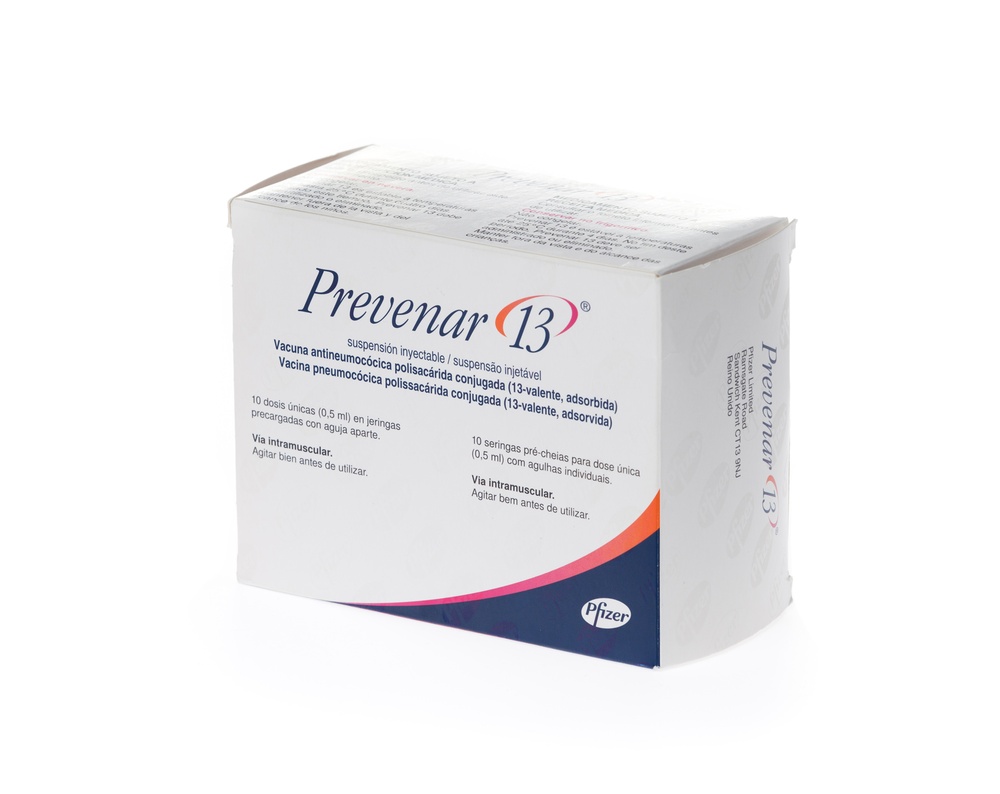
La vacuna es una suspensión inyectable blanca en una jeringa precargada de una sola dosis (0,5 ml).
Presentaciones de 1, 10 y 50, con o sin aguja. Puede que solamente estén comercializados algunos tamaños de envases.
Titular de la autorización de comercialización y responsable de la fabricación
Titular de la autorización de comercialización: Pfizer Europe MA EEIG Boulevard de la Plaine 17 1050 Bruxelles Bélgica | Fabricante responsable de la liberación de los lotes: Pfizer Manufacturing Belgium NV Rijksweg 12 2870 Puurs-Sint-Amands Bélgica |
Pueden solicitar más información respecto a este medicamento dirigiéndose al representante local del titular de la autorización de comercialización:
België/Belgique/Belgien Luxembourg/Luxemburg Pfizer NV/SA Tél/Tel: + 32 (0)2 554 62 11 | Latvija Pfizer Luxembourg SARL filiale Latvija Tel.: + 371 670 35 775 |
| Lietuva Pfizer Luxembourg SARL filialas Lietuvoje Tel. + 370 52 51 4000 |
Ceská Republika Pfizer, spol. s r.o. Tel: +420 283 004 111 | Magyarország Pfizer KftTel: +36 1 488 3700 |
Danmark Pfizer ApS Tlf.: + 45 44 201 100 | Malta Vivian Corporation Ltd. Tel: + 35621 344610 |
Deutschland Pfizer Pharma GmbH Tel: + 49 (0)30 550055-51000 | Nederland Pfizer BV Tel: +31 (0)10 406 43 01 |
Eesti Pfizer Luxembourg SARL Eesti filiaal Tel: +372 666 7500 | Norge Pfizer AS Tlf: +47 67 52 61 00 |
Ελλ?δα Pfizer Ελλ?ς A.E.Τηλ.: +30 210 6785 800 | Österreich Pfizer Corporation Austria Ges.m.b.H Tel: + 43 (0)1 521 15-0 |
España Pfizer, S.L. Télf:+34914909900 | Polska Pfizer Polska Sp. z o.o. Tel.: +48 22 335 61 00 |
France Pfizer Tél +33 1 58 07 34 40 | Portugal Laboratórios Pfizer, Lda. Tel: +351 21 423 5500 |
Hrvatska Pfizer Croatia d.o.o. Tel: + 385 1 3908 777 | RomâniaPfizer Romania S.R.L Tel: +40 (0) 21 207 28 00 |
Ireland Pfizer Healthcare Ireland Unlimited Company Tel: 1800 633 363 (toll free) +44 (0)1304 616161 | Slovenija Pfizer Luxembourg SARL Pfizer, podružnica za svetovanje s podrocja farmacevtske dejavnosti, LjubljanaTel.: + 386 (0) 1 52 11 400 |
Ísland Icepharma hf Simi: + 354 540 8000 | Slovenská republika Pfizer Luxembourg SARL,organizacná zložka Tel: + 421 2 3355 5500 |
Italia Pfizer S.r.l. Tel: +39 06 33 18 21 | Suomi/Finland Pfizer Oy Puh/Tel: +358 (0)9 430 040 |
K?προς Pfizer Ελλ?ς Α.Ε. (Cyprus Branch) Tηλ: +357 22 817690 | Sverige Pfizer AB Tel: +46 (0)8 550 520 00 |
Fecha de la última revisión de este prospecto: 04/2025
Otras fuentes de información
La información detallada de este medicamento está disponible en la página web de la Agencia Europea de Medicamentos https://www.ema.europa.eu.
-----------------------------------------------------------------------------------------------------------------------
Esta información está destinada únicamente a profesionales del sector sanitario:
Durante la conservación, puede observarse un sedimento blanco y un sobrenadante transparente. Esto no constituye un signo de deterioro.
Inspeccionar visualmente en busca de partículas y/o un aspecto físico anormal; no utilizar en tales casos.
Antes de expulsar el aire de la jeringa, agitar bien hasta obtener una suspensión homogénea blanca.
Administrar toda la dosis.
Prevenar 13 es solamente para administración intramuscular. No administrar por vía intravascular.
Prevenar 13 no debe mezclarse con ninguna otra vacuna en la misma jeringa.
Prevenar 13 puede administrarse al mismo tiempo que otras vacunas infantiles; en tal caso, deberán utilizarse diferentes lugares de vacunación.
Prevenar 13 puede administrarse a adultos de 50 años de edad o mayores al mismo tiempo que la vacuna trivalente o tetravalente inactivada frente al virus de la gripe.
La eliminación del medicamento no utilizado y de todos los materiales que hayan estado en contacto con él, se realizará de acuerdo con la normativa local.
- País de registro
- Forma farmacéuticaINYECTABLE, 2,2 µg / 2,2 µg / 2,2 µg / 2,2 µg / 2,2 µg / 2,2 µg / 2,2 µg / 2,2 µg / 4,4 µg / 2,2 µg / 2,2 µg / 2,2 µg / 2,2 µg
- Código ATCJ07AL02
- Principio activo
- Requiere recetaSí
- Fabricante
- ComposiciónCLORURO DE SODIO (0 - mg), POLISORBATO 80 (0 - mg)
- Esta información es de carácter general y no sustituye la consulta con un profesional sanitario.
- Alternativas a PREVENAR 13 SUSPENSION INYECTABLEForma farmacéutica: INYECTABLE, 4 microgramos/dosisPrincipio activo: pneumococcus, purified polysaccharides antigen conjugatedFabricante: Merck Sharp & Dohme B.V.Requiere recetaForma farmacéutica: INYECTABLE, 2,2 µg / 2,2 µg / 2,2 µg / 2,2 µg / 2,2 µg / 2,2 µg / 2,2 µg / 2,2 µg / 4,4 µg / 2,2 µg / 2,2 µg / 2,2 µg / 2,2 µgPrincipio activo: pneumococcus, purified polysaccharides antigen conjugatedFabricante: Pfizer Europe Ma EeigRequiere recetaForma farmacéutica: INYECTABLE, 0,5 mlPrincipio activo: pneumococcus, purified polysaccharides antigen conjugatedFabricante: Pfizer Europe Ma EeigRequiere receta
Médicos online para PREVENAR 13 SUSPENSION INYECTABLE
Comenta la dosis, los posibles efectos secundarios, interacciones, contraindicaciones o la revisión de receta de PREVENAR 13 SUSPENSION INYECTABLE, sujeto a valoración médica y a la normativa local.









Obtén una receta de PREVENAR 13 SUSPENSION INYECTABLE online
Rellena un formulario de 2 minutos
Cuéntanos tus síntomas, historial y el medicamento que necesitas.
Elige un médico o nosotros te asignamos uno
Escoge un especialista o te conectamos con el próximo médico disponible.
El médico revisa tu caso
Normalmente en 30 minutos. Puede hacerte preguntas adicionales por chat.
Recógela en cualquier farmacia
Receta electrónica enviada a tu correo, válida en toda España.
Preguntas frecuentes
PREVENAR 13 SUSPENSION INYECTABLE requiere receta en España. Puedes confirmarlo con un médico online según tu caso.
El principio activo de PREVENAR 13 SUSPENSION INYECTABLE es pneumococcus, purified polysaccharides antigen conjugated. Esta información ayuda a identificar medicamentos con la misma composición pero con diferentes nombres comerciales.
PREVENAR 13 SUSPENSION INYECTABLE es fabricado por Pfizer Europe Ma Eeig. La marca y el envase pueden variar según el distribuidor.
Los Médicos de familia, Psiquiatras, Dermatólogos, Cardiólogos, Endocrinólogos, Gastroenterólogos, Neumólogos, Nefrólogos, Reumatólogos, Hematólogos, Infectólogos, Alergólogos, Geriatras, Pediatras, Oncólogos pueden valorar la prescripción de PREVENAR 13 SUSPENSION INYECTABLE cuando esté clínicamente indicado. Puedes reservar una videoconsulta para comentar tu caso y las opciones de tratamiento.
España cuenta con una infraestructura sanitaria bien desarrollada en ciudades principales como Madrid, Barcelona, Valencia y Sevilla. Las farmacias están ampliamente disponibles y operan bajo estrictas regulaciones, garantizando el acceso a medicamentos con receta.
Puedes comprar PREVENAR 13 SUSPENSION INYECTABLE en Madrid, Barcelona, Sevilla o Valencia en cualquier farmacia local con una receta válida.
Para obtener una receta, puedes utilizar Oladoctor:
Otros medicamentos con el mismo principio activo (pneumococcus, purified polysaccharides antigen conjugated) incluyen CAPVAXIVE SOLUCION INYECTABLE EN JERINGA PRECARGADA, PREVENAR 13 SUSPENSION INYECTABLE, PREVENAR 20 SUSPENSION INYECTABLE EN JERINGA PRECARGADA. Pueden tener diferentes nombres comerciales o formulaciones, pero contienen el mismo componente terapéutico. Consulta siempre con un médico antes de cambiar o iniciar un nuevo medicamento.
