


POTASIO GRIFOLS 0,02 mEq/ml EN GLUCOSA 5% SOLUCIÓN PARA PERFUSIÓN
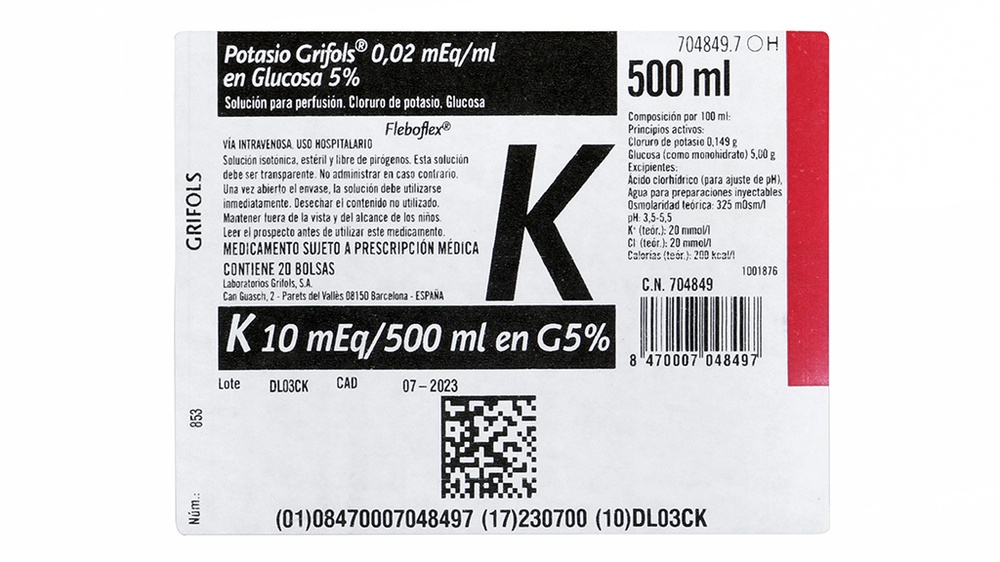



Cómo usar POTASIO GRIFOLS 0,02 mEq/ml EN GLUCOSA 5% SOLUCIÓN PARA PERFUSIÓN
Traducción generada por IA
Este contenido ha sido traducido automáticamente y se ofrece solo con fines informativos. No sustituye la consulta con un profesional sanitario.
Ver originalContenido del prospecto
- Introducción
- Qué es Potasio Grifols 0,02 mEq/ml en Glucosa 5% y para qué se utiliza
- Qué necesita saber antes de empezar a usar Potasio Grifols 0,02 mEq/ml en Glucosa 5%
- Cómo usar Potasio Grifols 0,02 mEq/ml en Glucosa 5%
- Posibles efectos adversos
- Conservación de Potasio Grifols 0,02 mEq/ml en Glucosa 5%
- Contenido del envase e información adicional
Introducción
Prospecto: información para el usuario
Potasio Grifols 0,02 mEq/ml en Glucosa 5% Solución para perfusión
Cloruro de potasio, Glucosa
Lea todo el prospecto detenidamente antes de empezar a usar este medicamento, porque contiene información importante para usted.
- Conserve este prospecto, ya que puede tener que volver a leerlo.
- Si tiene alguna duda, consulte a su médico o enfermero.
- Si experimenta efectos adversos, consulte a su médico o enfermero, incluso si se trata de efectos adversos que no aparecen en este prospecto. Ver sección 4.
Contenido del prospecto
- Qué es Potasio Grifols 0,02 mEq/ml en Glucosa 5% y para qué se utiliza
- Qué necesita saber antes de empezar a usar Potasio Grifols 0,02 mEq/ml en Glucosa 5%
- Cómo usar Potasio Grifols 0,02 mEq/ml en Glucosa 5%
- Posibles efectos adversos
- Conservación de Potasio Grifols 0,02 mEq/ml en Glucosa 5%
- Contenido del envase e información adicional
1. Qué es Potasio Grifols 0,02 mEq/ml en Glucosa 5% y para qué se utiliza
Potasio Grifols 0,02 mEq/ml en Glucosa 5% es una solución intravenosa restauradora del equilibrio electrolítico conteniendo electrolitos asociados con hidratos de carbono.
Potasio Grifols 0,02 mEq/ml en Glucosa 5% está indicado en las siguientes situaciones:
- Hipopotasemias (niveles bajos de potasio en sangre).
- Depleción de potasio por vómitos, diarreas, aspiración gastrointestinal o fístulas.
- Déficits nutricionales exentos de potasio.
- Tratamientos prolongados con diuréticos deplectores de potasio y corticosteroides.
- Hiperaldosteronismo primario o secundario (producción y secreción aumentadas de la hormona aldosterona).
- Desórdenes tubulares con eliminación de potasio.
- Arritmias cardíacas por intoxicación digitálica.
- Alcalosis hipoclorémica (aumento del pH de la sangre debido a la baja concentración del ion cloruro en sangre).
- Parálisis periódica familiar hipopotasémica (trastorno hereditario que produce episodios ocasionales de debilidad muscular, durante los cuales el nivel de potasio en sangre es bajo).

2. Qué necesita saber antes de empezar a usar Potasio Grifols 0,02 mEq/ml en Glucosa 5%
No use Potasio Grifols 0,02 mEq/ml en Glucosa 5%
- si es alérgico al cloruro de potasio, a la glucosa o a alguno de los demás componentes de este medicamento (incluidos en la sección 6)
- si padece hiperpotasemia (niveles altos de potasio en sangre) o hipercloremia (niveles altos de cloruro en sangre)
- si padece insuficiencia renal aguda (fallo en el funcionamiento del riñón) o supresión o disminución de la producción de orina
- si padece insuficiencia suprarrenal (fallo en el funcionamiento de las glándulas suprarrenales): enfermedad de Addison o hipoaldosteronismo (secreción disminuida de la hormona aldosterona)
- si sufre quemaduras extensas (fase inicial)
- si sufre crisis hemolíticas (destrucción de glóbulos rojos de la sangre)
- si padece acidosis metabólica o respiratoria
- si se encuentra bajo tratamiento con diuréticos ahorradores de potasio o agentes inhibidores de la aldosterona
- si padece parálisis periódica familiar hiperpotasémica (trastorno hereditario que produce episodios ocasionales de debilidad muscular pudiendo haber niveles de potasio en sangre más altos de lo normal)
- si es un paciente digitalizado con bloqueo cardíaco severo, ya que en este caso no se recomienda el uso de sales de potasio
Advertencias y precauciones
Consulte a su médico o enfermero antes de empezar a usar Potasio Grifols 0,02 mEq/ml en Glucosa 5%.
- Por su contenido en glucosa, este medicamento debe ser administrado con precaución en caso de pacientes diabéticos, manteniéndose controlada la glucemia. Cada 100 ml de este medicamento contienen 5 g de glucosa.
- Es recomendable realizar frecuentes controles de la diuresis (producción de orina), balance iónico y glucemia (nivel de glucosa en sangre) durante el tratamiento. Se requiere una especial vigilancia de la potasemia (nivel de potasio en sangre) y del electrocardiograma durante la administración de las soluciones con potasio.
- Este medicamento puede hacerse fisiológicamente hipotónico en el cuerpo debido a la rápida metabolización de la glucosa (ver sección 3).
- Dependiendo del volumen y la velocidad de perfusión, de su estado clínico inicial y de su capacidad para metabolizar la glucosa, la administración intravenosa de este tipo de soluciones puede causarle alteraciones electrolíticas como la hiponatremia (niveles bajos de sodio en sangre).
Hiponatremia:
Si es un paciente con liberación no osmótica de vasopresina (hormona antidiurética) (p. ej., en presencia de estados críticos, dolor, estrés posoperatorio, infecciones, quemaduras y enfermedades del sistema nervioso central), si padece enfermedades del corazón, el hígado y el riñón, y si está expuesto a agonistas de la vasopresina (ver siguiente subsección) tiene un riesgo especial de sufrir hiponatremia aguda tras la administración de soluciones hipotónicas.
La hiponatremia aguda puede causar una encefalopatía hiponatrémica aguda (edema cerebral) caracterizada por dolor de cabeza, náuseas, convulsiones, letargo y vómitos. Los pacientes con edema cerebral tienen un riesgo especial de sufrir un daño cerebral grave, irreversible y potencialmente mortal.
Los niños, las mujeres en edad fértil y los pacientes con distensibilidad cerebral reducida (p. ej., en caso de meningitis, hemorragia intracraneal y contusión cerebral) tienen un riesgo especial de sufrir edema cerebral grave y potencialmente mortal causado por una hiponatremia aguda.
Otros medicamentos y Potasio Grifols 0,02 mEq/ml en Glucosa 5%
Informe a su médico si está utilizando, ha utilizado recientemente o pudiera tener que utilizar cualquier otro medicamento.
- No administrar con medicamentos que disminuyan la capacidad funcional del riñón.
- La administración conjunta de sales de potasio con captopril puede ocasionar hiperpotasemia.
- La administración junto con sustitutos de la sal o diuréticos ahorradores de potasio (espironolactona, triamtereno, amilorida) puede producir hiperpotasemia que puede ser grave, sobre todo en pacientes con insuficiencia renal.
- La administración intravenosa de soluciones fisiológicamente hipotónicas junto con medicamentos que aumentan el efecto de la hormona antidiurética (como clorpropamida, clofibrato, carbamazepina, vincristina, inhibidores selectivos de la recaptación de serotonina, 3,4-metilendioxi-N-metanfetamina, ifosfamida, antipsicóticos, narcóticos, AINE (antiinflamatorios no esteroideos), ciclofosfamida, desmopresina, oxitocina, vasopresina, terlipresina), los cuales hacen que se reduzca la excreción de agua en orina, aumenta el riesgo de hiponatremia hospitalaria (ver subsección anterior y secciones 3 y 4).
- Los diuréticos en general y los antiepilépticos como la oxcarbazepina aumentan el riesgo de hiponatremia.
Embarazo y lactancia
Si está embarazada o en periodo de lactancia, cree que podría estar embarazada o tiene intención de quedarse embarazada, consulte a su médico antes de utilizar este medicamento.
La seguridad de su uso durante el embarazo y la lactancia no ha sido establecida. Por ello, se debe utilizar únicamente cuando sea claramente necesario y cuando los efectos beneficiosos sobrepasen los posibles riesgos para el feto o el lactante.
Este medicamento debe administrarse con especial precaución en mujeres embarazadas durante el parto, especialmente si se administra en combinación con oxitocina, debido al riesgo de hiponatremia (ver subsecciones anteriores y sección 4).
Conducción y uso de máquinas
Dado que este medicamento se administra únicamente en pacientes hospitalizados, no han sido realizados estudios sobre tales efectos.
3. Cómo usar Potasio Grifols 0,02 mEq/ml en Glucosa 5%
La dosificación se establecerá según criterio médico dependiendo del grado de hipopotasemia y de la situación clínica del paciente. Por lo general, se recomiendan 500-1000 ml al día a razón de 20-30 gotas/min por vía intravenosa. La dosis máxima diaria es de 2000 ml a un ritmo de 60-80 gotas/min.
Puede que le tengan que vigilar el balance hídrico, la glucosa sérica, el sodio sérico y otros electrolitos antes y durante la administración, especialmente si padece un aumento de la liberación no osmótica de vasopresina (síndrome de secreción inadecuada de la hormona antidiurética, SIADH) y si recibe simultáneamente medicación con agonistas de la vasopresina, debido al riesgo de hiponatremia. La vigilancia del sodio sérico es especialmente importante cuando se administran soluciones fisiológicamente hipotónicas. Este medicamento puede hacerse hipotónico tras su administración debido a la rápida metabolización de la glucosa en el cuerpo (ver secciones 2 y 4).
Si recibe más Potasio Grifols 0,02 mEq/ml en Glucosa 5%del que debe
En caso de sobredosis o administración demasiado rápida, podría aparecer hiperpotasemia.
En caso de hiperpotasemia deberá suspenderse la administración y se hará un tratamiento sintomático orientado principalmente a antagonizar los efectos del potasio y a estimular su eliminación.
Para ello es adecuado administrar por perfusión intravenosa bicarbonato sódico al 1,4%, cloruro de calcio o gluconato de calcio (10 ó 20 ml de solución al 10%), o bien glucosa (100 ml de solución al 50% ó 1000 ml al 10%) junto con 30 unidades de insulina cristalina.
En casos graves con insuficiencia renal, deberá realizarse hemodiálisis o diálisis peritoneal para eliminar el potasio corporal y corregir la hiperpotasemia.
De existir alteraciones electrocardiográficas por exceso de potasio, éste puede eliminarse administrando por vía oral o por enema una resina de intercambio iónico (poliestireno-sulfonato sódico).
En caso de sobredosis o ingestión accidental, consultar al Servicio de Información Toxicológica. Teléfono: 915 620 420.
Si tiene cualquier otra duda sobre el uso de este medicamento, pregunte a su médico o enfermero.

4. Posibles efectos adversos
Al igual que todos los medicamentos, este medicamento puede producir efectos adversos, aunque no todas las personas los sufran.
Los efectos adversos pueden aparecer en el caso de que se administre una dosis excesiva de cloruro de potasio. Si existen niveles elevados de potasio en sangre (hiperpotasemia) pueden producirse los siguientes efectos adversos:
- Depresión mental
- Confusión
- Parestesia (sensación anormal de los sentidos o de la sensibilidad general)
- Debilidad muscular y parálisis flácida (pérdida de fuerza y tono muscular) de las extremidades y de los músculos respiratorios
- Bradicardia (disminución del ritmo cardíaco)
- Hipotensión (disminución de la presión arterial)
- Alteraciones electrocardiográficas
- Paro cardíaco
- Muerte
La hiperpotasemia produce también una serie de efectos hormonales ya que estimula la secreción de aldosterona, insulina y glucagón e inhibe la producción de renina.
En pacientes con liberación no osmótica de vasopresina, en pacientes con enfermedades del corazón, el hígado y el riñón, y en pacientes tratados con agonistas de la vasopresina aumenta el riesgo de sufrir hiponatremia aguda tras la administración de soluciones hipotónicas. La hiponatremia hospitalaria puede causar un daño cerebral irreversible y la muerte debido a la aparición de un edema cerebral (ver secciones 2 y 3).
Comunicación de efectos adversos
Si experimenta cualquier tipo de efecto adverso, consulte a su médico o enfermero, incluso si se trata de posibles efectos adversos que no aparecen en este prospecto. También puede comunicarlos directamente a través del Sistema Español de Farmacovigilancia de Medicamentos de Uso Humano: www.notificaRAM.es. Mediante la comunicación de efectos adversos usted puede contribuir a proporcionar más información sobre la seguridad de este medicamento.
5. Conservación de Potasio Grifols 0,02 mEq/ml en Glucosa 5%
No requiere condiciones especiales de conservación.
Una vez abierto el envase, la solución debe utilizarse inmediatamente.
Mantener este medicamento fuera de la vista y del alcance de los niños.
No utilice este medicamento después de la fecha de caducidad que aparece en el envase. La fecha de caducidad es el último día del mes que se indica.
No utilice este medicamento si observa que la solución no es transparente o contiene precipitados.
6. Contenido del envase e información adicional
Composición dePotasio Grifols 0,02 mEq/ml en Glucosa 5%
- Los principios activos son el cloruro de potasio y la glucosa. Cada 100 ml de solución contienen 0,149 g de cloruro de potasio y 5,00 g de glucosa (como monohidrato).
- Los demás componentes (excipientes) son ácido clorhídrico (para ajuste de pH) y agua para preparaciones inyectables.
Aspecto del producto y contenido del envase
Potasio Grifols 0,02 mEq/ml en Glucosa 5% es una solución para perfusión, incolora o ligeramente amarillenta y transparente, que se presenta en bolsas flexibles de polipropileno (Fleboflex) de 500 y 1000 ml.
Titular de la autorización de comercialización
LABORATORIOS GRIFOLS, S.A.
Can Guasch, 2
08150 Parets del Vallès, Barcelona (ESPAÑA)
Responsable de la fabricación
LABORATORIOS GRIFOLS, S.A.
Polígono Industrial Los Llanos. C/ Marte, 4
30565 Las Torres de Cotillas, Murcia (ESPAÑA)
Fecha de la última revisión de este prospecto:Junio 2018
Otras fuentes de información
La información detallada de este medicamento está disponible en la página web de la Agencia Española de Medicamentos y Productos Sanitarios (AEMPS) (http://www.aemps.gob.es/)
------------------------------------------------------------------------------------------------------------------
Esta información está destinada únicamente a profesionales del sector sanitario:
Potasio Grifols 0,02 mEq/ml en Glucosa 5% se administrará por perfusión. El medicamento se presenta listo para su administración.
La solución debe ser transparente y no contener partículas o precipitados. No administrar en caso contrario.
Una vez abierto el envase, la solución debe utilizarse inmediatamente. Desechar el contenido no utilizado.
No extraer la bolsa Fleboflex de la sobrebolsa protectora hasta el momento inmediatamente anterior a su uso.
Comprobar la ausencia de pequeñas fugas presionando firmemente la bolsa. Si se detectan fugas desechar el producto.
Las bolsas Fleboflex están diseñadas para una administración sin entrada de aire. Si tiene que utilizarse un equipo de perfusión con entrada de aire, asegurarse de que éste esté siempre cerrado.
Para conectar el equipo de perfusión, separar la lengüeta protectora del puerto de infusión, dejando al descubierto la membrana de acceso a la bolsa.
En caso de añadir medicamentos a la solución, desinfectar el punto de inyección de la bolsa. Preparar una jeringuilla con la medicación, utilizando una aguja de 20-22 G.
Utilizar una técnica aséptica para administrar la solución, así como para añadir medicamentos a la solución, si fuera necesario.
Al igual que otras soluciones parenterales, antes de adicionar medicamentos deben consultarse las tablas de incompatibilidades.
En general, se recomiendan 500-1000 ml al día a razón de 20-30 gotas/min por vía intravenosa, aunque se deberá ajustar la dosis según criterio médico. La dosis máxima diaria es de 2000 ml a un ritmo de 60-80 gotas/min.
- País de registro
- Forma farmacéuticaINYECTABLE PERFUSION, 5000 mg glucosa;149 mg potasio cloruro/ 100 ml
- Código ATCB05BB02
- Principio activo
- Requiere recetaSí
- Fabricante
- Esta información es de carácter general y no sustituye la consulta con un profesional sanitario.
- Alternativas a POTASIO GRIFOLS 0,02 mEq/ml EN GLUCOSA 5% SOLUCIÓN PARA PERFUSIÓNForma farmacéutica: INYECTABLE PERFUSION, 0,09 g / 0,07 g / 1,6 g / 0,17 g / 12,5 g / 0,19 g / 1,23 gPrincipio activo: electrolytes with carbohydratesFabricante: Fresenius Kabi España, S.A.U.Requiere recetaForma farmacéutica: INYECTABLE PERFUSION, 0,31 g / 21,9 mg / 0,03 g / 0,6 gPrincipio activo: electrolytes with carbohydratesFabricante: Fresenius Kabi España, S.A.U.Requiere recetaForma farmacéutica: INYECTABLE PERFUSION, NAPrincipio activo: electrolytes with carbohydratesFabricante: Fresenius Kabi España, S.A.U.Requiere receta

Médicos online para POTASIO GRIFOLS 0,02 mEq/ml EN GLUCOSA 5% SOLUCIÓN PARA PERFUSIÓN
Comenta la dosis, los posibles efectos secundarios, interacciones, contraindicaciones o la revisión de receta de POTASIO GRIFOLS 0,02 mEq/ml EN GLUCOSA 5% SOLUCIÓN PARA PERFUSIÓN, sujeto a valoración médica y a la normativa local.











Preguntas frecuentes
