


Benelyte solución para perfusión

Revisión de receta online
Un médico revisará tu caso y determinará si la prescripción es médicamente apropiada.

Habla con un médico sobre este medicamento
Comenta tus síntomas y las opciones de tratamiento en una consulta online.



Cómo usar BENELYTE SOLUCION PARA PERFUSION
Contenido del prospecto
- Introducción
- Qué es Benelyte y para qué se utiliza
- Qué necesita saber antes de empezar a usar Benelyte
- Cómo usar Benelyte
- Posibles efectos adversos
- Conservación de Benelyte
- Contenido del envase e información adicional
Introducción
Prospecto: información para el usuario
Benelyte solución para perfusión
(cloruro de sodio, cloruro de potasio, cloruro de calcio dihidrato, cloruro de magnesio hexahidrato, acetato de sodio trihidrato y glucosa monohidrato)
Lea todo el prospecto detenidamente antes de empezar a usar el medicamento, porque contiene información importante para usted.
- Conserve este prospecto, ya que puede tener que volver a leerlo.
- Si tiene alguna duda, consulte a su médico, farmacéutico o enfermero.
- Si experimenta efectos adverso, consulte a su médico, farmacéutico o enfermero, incluso si se trata de efectos adversos que no aparecen en este prospecto. Ver sección 4.
Contenido del prospecto
- Qué es Benelyte y para qué se utiliza
- Qué necesita saber antes de empezar a usar Benelyte
- Cómo usar Benelyte
- Posibles efectos adversos
- Conservación de Benelyte
- Contenido del envase e información adicional
1. Qué es Benelyte y para qué se utiliza
Benelyte es una solución para perfusión intravenosa (en una vena). Contiene minerales denominados electrolitos que afectan a la cantidad de agua de su organismo y otros procesos importantes. También contiene carbohidratos.
Benelyte se utiliza en recién nacidos (de 0 a ≤28 días), lactantes (28 días para ≤2 años), niños (de 2 a ≤12 años) y adolescentes (12 a ≤14 años) para:
- Ayudar a restaurar los niveles de líquidos y el equilibrio normal de electrolitos (sal) después de una operación. También contiene glucosa que proporciona una fuente de energía.
- Actúa como un sustituto del volumen plasmático que se utiliza para restaurar el volumen de sangre.
- Ayudar a restaurar las deficiencias de líquidos y electrolitos.
Se utiliza como una solución de transporte para otros electrolitos y medicamentos.

¿No estás seguro de si este medicamento es adecuado para ti?
Comenta tus síntomas y tratamiento con un médico online.
2. Qué necesita saber antes de empezar a usar Benelyte
No use Benelyte
- si su hijo es alérgico (hipersensible) al cloruro de sodio, cloruro de potasio, cloruro de calcio, cloruro de magnesio, acetato de sodio, glucosa o a alguno de los demás componentes de este medicamento (incluidos en la sección 6).
- Para recién nacidos prematuros y neonatos (≤28 días de edad): Su hijo no debe recibir un determinado antibiótico llamado ceftriaxona como un goteo en una vena al mismo tiempo que este medicamento.
- si su hijo tiene exceso de agua en su organismo (hiperhidratación)
Advertencias y precauciones
Consulte a su médico, farmacéutico o enfermero antes de que le administren a su hijo Benelyte si su hijo tiene:
- menos ácido en el cuerpo de lo normal (alcalosis metabólica)
- nivel de azúcar en sangre anormalmente alto (hiperglucemia)
- nivel de potasio en sangre anormalmente bajo (hipopotasemia)
- nivel de sodio en sangre anormalmente alto (hipernatremia)
- nivel de cloruro en sangre anormalmente alto (hipercloremia)
- insuficiencia renal o disminución de la función renal
- ha sido tratado con determinado antibiótico llamado ceftriaxona; no debe meclarse ni administrarse simultáneamente con ninguna solución que contenga calcio administrada por goteo en vena. Su médico lo sabe y no los administrará juntos, ni a través de diferentes líneas de perfusión o diferentes lugares de perfusión.
- Sin embargo, en niños mayores de 28 días, su médico puede administrar calcio y ceftriaxona secuencialmente uno tras otro si se usan líneas de perfusión en diferentes sitios o si las líneas de perfusión se reemplazan o si se enjuagan completamente con solución salina fisiológica entre las perfusiones, para evitar la precipitación. Si usted o su hijo sufren de bajo volumen sanguíneo, su médico evitará administrar calcio y ceftriaxona secuencialmente
Mientras se le administra a su hijo este medicamento, se deben controlan de vez en cuando los niveles séricos de electrolitos, el equilibrio de agua, los niveles de glucosa en sangre y el estado ácido-base.
Cuando se administre el medicamento, se debe tener precaución en niños, especialmente en recién nacidos y bebés, debido a que puede producirse acidosis láctica (aumento del ácido láctico en el organismo). Esto debe tenerse en consideración en niños que nacen con problemas de utilización del lactato.
Uso de Benelyte con otros medicamentos
Informe a su médico o farmacéutico si su hijo está utilizando, ha utilizado recientemente o pudiera tener que utilizar cualquier otro medicamento.
No se recomienda el uso simultáneo con ceftriaxona (un antibiótico) cuando se utiliza la vía intravenosa (ver sección Advertencias y precauciones).
Embarazo y lactancia
Benelyte es únicamente para uso en niños (menores de 14 años).
3. Cómo usar Benelyte
Su médico u otro profesional sanitario le administrará a su hijo este medicamento por perfusión en una vena (goteo intravenoso).
Dosis
El médico determinará la cantidad de medicamento que se le administrará a su hijo y dependerá de la edad, peso, estado clínico de su hijo y otro tratamiento que esté recibiendo. Por tanto, se tendrán en cuenta sus necesidades individuales de líquidos, electrolitos y energía. Su médico decidirá la dosis correcta para su hijo.
Siga exactamente las instrucciones de administración de Benelyte indicadas por su médico o farmacéutico. En caso de duda, consulte de nuevo a su médico o farmacéutico.
Si usa más Benelyte del que debe
Es poco probable que le administren a su hijo una dosis equivocada, ya que el medicamento le será administrado por un médico u otro profesional sanitario.
Una sobredosis puede provocar un exceso de líquidos en el cuerpo (hiperhidratación) y un exceso del azúcar en sangre (hiperglucemia).
El médico determinará el tratamiento adecuado para normalizar la condición de su hijo, que puede incluir interrupción de la perfusión, controlar el nivel de sal en la sangre de su hijo y la administración de medicamentos adecuados para el tratamiento de los síntomas del niño (por ejemplo, diuréticos, insulina).
Si tiene cualquier otra duda sobre el uso de este medicamento, pregunte a su médico o farmacéutico.

¿Has empezado a tomar el medicamento y tienes preguntas?
Comenta tus síntomas y tratamiento con un médico online.
4. Posibles efectos adversos
Al igual que todos los medicamentos, este medicamento puede producir efectos adversos, aunque no todas las personas los sufran.
Frecuencia no conocida(no puede estimarse a partir de los datos disponibles)
Reacciones locales en el lugar de inyección debido a la técnica de administración:
- fiebre (respuesta febril)
- infección en el sitio de la perfusión
- irritación e inflamación de la vena en la que se infunde la solución (flebitis). Esto puede causar enrojecimiento, dolor o ardor e inflamación a lo largo de la vena en la que la solución se está administrando
- formación de un coágulo de sangre (trombosis venosa) en el sitio de la perfusión, lo que provoca dolor, hinchazón o enrojecimiento en la zona del coágulo
- escape de la solución para perfusión a los tejidos de alrededor de la vena (extravasación). Esto puede dañar los tejidos y causar cicatrices.
Comunicación de efectos adversos
Si experimenta cualquier tipo de efecto adverso, consulte a su médico o farmacéutico, incluso si se trata de posibles efectos adversos que no aparecen en este prospecto. También puede comunicarlos directamente a través del Sistema Español de Farmacovigilancia de Medicamentos de Uso Humano: www.notificaRAM.es. Mediante la comunicación de efectos adversos usted puede contribuir a proporcionar más información sobre la seguridad de este medicamento.
5. Conservación de Benelyte
Mantener este medicamento fuera de la vista y del alcance de los niños.
No utilice este medicamento después de la fecha de caducidad que aparece en la etiqueta o en la caja después de CAD. La fecha de caducidad es el último día del mes que se indica.
Este medicamento no requiere condiciones especiales de conservación.
Utilizar únicamente si la solución es transparente, sin partículas visibles y si el envase no está dañado.
Utilizar inmediatamente tras la primera apertura. Desde el punto de vista microbiológico, el producto debe utilizarse inmediatamente. Si no se utiliza inmediatamente, los tiempos y las condiciones de almacenamiento en uso son responsabilidad del usuario y normalmente no deben ser más de 24 horas a 2ºC-8ºC, a menos que el almacenamiento y la apertura se realicen en condiciones asépticas controladas y validadas.
Cuando se combina con otras soluciones para perfusión, se debe tener en cuenta los requerimientos actuales generales para la mezcla de medicamentos (p. ej. Condiciones asépticas, compatibilidad y mezcla completa).
Los medicamentos no se deben tirar por los desagües ni a la basura. Pregunte a su farmacéutico cómo deshacerse de los envases y de los medicamentos que ya no necesita. De esta forma ayudará a proteger el medio ambiente.
6. Contenido del envase e información adicional
Composición de Benelyte:
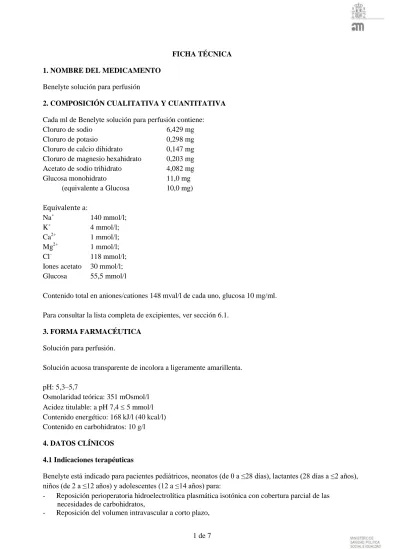
Cada ml de Benelyte solución para perfusión contiene:
Cloruro de sodio 6,429 mg
Cloruro de potasio 0,298 mg
Cloruro de calcio dihidrato 0,147 mg
Cloruro de magnesio hexahidrato 0,203 mg
Acetato de sodio trihidrato 4,082 mg
Glucosa monohidrato 11,0 mg
(equivalente a Glucosa 10,0 mg)
Los demás componentes son: ácido clorhídrico al 37 % (para ajuste de pH), hidróxido de sodio (para ajuste de pH) y agua para preparaciones inyectables.
Aspecto del producto y contenido del envase
Benelyte es una solución acuosa para perfusión transparente de incolora a ligeramente amarillenta.
Benelyte está disponible en frascos de polietileno de baja densidad (KabiPac) de 100 ml, 250 ml, y 500 ml como envase primario cerrados con tapón de polietileno o polietileno/polipropileno con un precinto de poliisopreno.
Tamaños de envases:
40 x 100 ml frascos
20 x 250 ml frascos
10 x 500 ml frascos
Puede que solamente estén comercializados algunos tamaños de envases.
Titular de la autorización de comercialización y responsable de la fabricación
Titular de la autorización de comercialización
Fresenius Kabi España, S.A.U.
Marina 16-18,
08005-Barcelona
Responsable de la fabricación
Fresenius Kabi Polska Sp. z o.o.
ul. Sienkiewicza 25,
PL-99-300 Kutno
Polonia
Este medicamento está autorizado en los estados miembros del Espacio Económico Europeo y en Reino Unido (Irlanda del Norte) con los siguientes nombres:
Austria | ELO-MEL paediatric Infusionslösung |
Bélgica | Benelyte oplossing voor infusie/solution pour perfusion/Infusionslösung |
Bulgaria Croacia República Checa | Benelyte ???????? ?????????? ??????? Benelyte solution for infusion Benelyte otopina za infuzij Benelyte |
Dinamarca Estonia Alemania | Benelyte Benelyte Benelyte Infusionslösung |
Finlandia | Benelyte Infuusioneste, liuos |
Francia | Pedialyte, solution pour perfusion |
Hungría | Benelyte oldatos infúzió |
Irlanda | Paedisol solution for infusion |
Letonia Lituania Luxemburgo | Benelyte škidums infuzijam Benelyte infuzinis tirpalas Benelyte Infusionslösung |
Países Bajos | Benelyte oplossing voor infusie |
Noruega | Benelyte |
Polonia | Benelyte |
Portugal | Benelyte |
Rumanía Eslovenia | Benelyte solu?ie perfuzabila Benelyte raztopina za infundiranje |
Eslovaquia | Benelyte |
España | Benelyte solución para perfusión |
Suecia | Benelyte |
Reino Unido (Irlanda del Norte) | Minorsol solution for infusion |
Fecha de la última revisión de este prospecto: Agosto 2023
La información detallada y actualizada de este medicamento está disponible en la página Web de la Agencia Española de Medicamentos y Productos Sanitarios (AEMPS) (http://www.aemps.gob.es/).
-----------------------------------------------------------------------------------------------------------------------
Esta información está destinada únicamente a profesionales del sector sanitario
Para más información consulte la ficha técnica.
Posología
La dosis para la terapia de perfusión intravenosa perioperatoria depende de las necesidades de líquidos, electrolitos y glucosa:
Durante la primera hora, por ejemplo, 10 a 20 ml/kg/hora, y después ajustar la velocidad de perfusión de acuerdo con los requerimientos básicos y de corrección con seguimiento de los parámetros cardiovasculares y de laboratorio relevantes.
Para las necesidades de líquidos se aplican los siguientes valores de referencia:
Recién nacidos (de 0 a ≤28 días), lactantes (28 días a ≤1 año):
100 - 140 ml/kg de masa corporal/día
Lactantes de 1 a ≤ 2 años:
80 - 120 ml/kg de masa corporal/día
Niños de 2 a ≤ 5 años:
80 - 100 ml/kg de masa corporal/día
Niños de 5 a ≤ 10 años:
60 - 80 ml/kg de masa corporal/día
Niños de 10 a ≤12 años y adolescentes de 12 a ≤14 años:
50 - 70 ml/kg de masa corporal/día
Para la reposición de volumen intravascular a corto plazo la dosis debe administrarse individualmente de acuerdo con las necesidades de líquidos.
Para el tratamiento de la deshidratación isotónica en la población pediátrica la velocidad de perfusión y la dosis diaria debe determinarse individualmente de acuerdo con la naturaleza y gravedad del desequilibrio hidroelectrolítico mediante el control de los parámetros cardiovasculares y de laboratorio relevantes.
Si Benelyte se utiliza en combinación con otras soluciones para perfusión se deben considerar las guías actuales sobre administración de fluidos totales para el cálculo de la dosis del grupo de edad correspondiente.
Se deben calcular las necesidades individuales de agua, electrolitos y carbohidratos y reemplazarse en consecuencia; en particular, en los recién nacidos prematuros y con bajo peso, y también en todas las demás situaciones terapéuticas excepcionales. El equilibrio necesita ser más exacto en pacientes prematuros, en los más jóvenes, y en los de bajo peso.
Forma de administración
Vía intravenosa.
Duración de la administración
La duración de la administración depende de las necesidades de líquidos y electrolitos de los pacientes.
Incompatibilidades
Debe evaluarse la compatibilidad de los medicamentos que se van a añadir a Benelyte antes de la adición. En general, se puede afirmar que los siguientes medicamentos (grupos) no deben mezclarse con Benelyte:
- Medicamentos que podrían formar precipitados difícilmente solubles con los constituyentes de la solución. (La preparación contiene iones de Ca2+.. Se puede producir precipitación con la adición de fosfato inorgánico, hidrógeno carbonato / carbonato u oxalato).
- Medicamentos que no son estables en un intervalo de pH ácido o no presentan una eficacia óptima o que se descomponen
Las soluciones para perfusión que contienen glucosa no se deben administrar simultáneamente en el mismo equipo de perfusión con sangre debido a la posibilidad de pseudo-aglutinación.
- País de registro
- Forma farmacéuticaINYECTABLE PERFUSION, NA
- Código ATCB05BB02
- Principio activo
- Requiere recetaSí
- Fabricante
- ComposiciónHIDROXIDO DE SODIO (E 524) (CS C.S mg)
- Esta información es de carácter general y no sustituye la consulta con un profesional sanitario.
- Alternativas a BENELYTE SOLUCION PARA PERFUSIONForma farmacéutica: INYECTABLE PERFUSION, 0,09 g / 0,07 g / 1,6 g / 0,17 g / 12,5 g / 0,19 g / 1,23 gPrincipio activo: electrolytes with carbohydratesFabricante: Fresenius Kabi España, S.A.U.Requiere recetaForma farmacéutica: INYECTABLE PERFUSION, 0,31 g / 21,9 mg / 0,03 g / 0,6 gPrincipio activo: electrolytes with carbohydratesFabricante: Fresenius Kabi España, S.A.U.Requiere recetaForma farmacéutica: INYECTABLE PERFUSION, 3,3% + 0,3% + 0,02 mEq/mlPrincipio activo: electrolytes with carbohydratesFabricante: Fresenius Kabi España, S.A.U.Requiere receta
Médicos online para BENELYTE SOLUCION PARA PERFUSION
Comenta la dosis, los posibles efectos secundarios, interacciones, contraindicaciones o la revisión de receta de BENELYTE SOLUCION PARA PERFUSION, sujeto a valoración médica y a la normativa local.









Preguntas frecuentes
BENELYTE SOLUCION PARA PERFUSION requiere receta en España. Puedes confirmarlo con un médico online según tu caso.
El principio activo de BENELYTE SOLUCION PARA PERFUSION es electrolytes with carbohydrates. Esta información ayuda a identificar medicamentos con la misma composición pero con diferentes nombres comerciales.
BENELYTE SOLUCION PARA PERFUSION es fabricado por Fresenius Kabi España, S.A.U.. La marca y el envase pueden variar según el distribuidor.
Los Médicos de familia, Psiquiatras, Dermatólogos, Cardiólogos, Endocrinólogos, Gastroenterólogos, Neumólogos, Nefrólogos, Reumatólogos, Hematólogos, Infectólogos, Alergólogos, Geriatras, Pediatras, Oncólogos pueden valorar la prescripción de BENELYTE SOLUCION PARA PERFUSION cuando esté clínicamente indicado. Puedes reservar una videoconsulta para comentar tu caso y las opciones de tratamiento.
La receta la emite un médico tras valorar tu estado de salud. En España, BENELYTE SOLUCION PARA PERFUSION se dispensa en las farmacias con esa receta médica. Una consulta online no garantiza su emisión: la decisión corresponde siempre al médico.
Para solicitar una valoración puedes usar Oladoctor:
Otros medicamentos con el mismo principio activo (electrolytes with carbohydrates) incluyen APIROSERUM NORMAION RESTAURADOR, APIROSERUM RINGER-LACTATO SOLUCION PARA PERFUSION, CLORURO DE POTASIO KABI 0,02 MEQ/ML EN GLUCOSA 3,3% Y CLORURO DE SODIO 0,3% SOLUCION PARA PERFUSION. Pueden tener diferentes nombres comerciales o formulaciones, pero contienen el mismo componente terapéutico. Consulta siempre con un médico antes de cambiar o iniciar un nuevo medicamento.
