


HIDROCLORURO DE PETIDINA ALTAN 50 MG/ML SOLUCION INYECTABLE EFG



Cómo usar HIDROCLORURO DE PETIDINA ALTAN 50 MG/ML SOLUCION INYECTABLE EFG
Traducción generada por IA
Este contenido ha sido traducido automáticamente y se ofrece solo con fines informativos. No sustituye la consulta con un profesional sanitario.
Ver originalContenido del prospecto
Introducción
PROSPECTO: INFORMACIÓN PARA EL USUARIO
HIDROCLORURO DE PETIDINA ALTAN 50 mg/ml
Solución inyectable EFG
Lea todo el prospecto detenidamente antes de empezar a usar el medicamento.
|
Contenido del prospecto:
- Qué es Hidrocloruro de Petidina y para qué se utiliza.
- Qué necesita saber antes de usar Hidrocloruro de Petidina.
- Cómo usar Hidrocloruro de Petidina.
- Posibles efectos adversos.
- Conservación de Hidrocloruro de Petidina.
- Contenido del prospecto e información adicional.
1. Qué es Hidrocloruro de Petidina Altan y para qué se utiliza
Hidrocloruro de petidina pertenece a un grupo de medicamentos llamados analgésicos opioides que se utilizan para aliviar el dolor intenso.
Hidrocloruro de petidina puede utilizarse en:
- El tratamiento del dolor intenso, incluido el dolor desencadenado por operaciones o fracturas, dolores derivados de la afectación del sistema nervioso periférico (neuralgias) o de espasmos de los músculos lisos (vías o conductos que trasportan la bilis del hígado al tubo digestivo, aparato genital o urinario, etc.), angina de pecho o crisis tabéticas.
- El tratamiento del dolor en el parto, en caso de rigidez y espasmos del útero, contracturas dolorosas y dolores en la expulsión del feto.
- Como medicación antes de la anestesia.

2. Qué necesita saber antes de usar Hidrocloruro de Petidina Altan
No use Hidrocloruro de Petidina Altan:
- Si es alérgico o alguna vez ha tenido una reacción alérgica a la petidina.
- Si tiene problemas respiratorios graves.
- Si está siendo tratado o ha sido tratado desde hace menos de dos semanas con algún fármaco para la depresión que pertenece al grupo de inhibidores de la monoaminooxidasa (IMAOs), tales como iproniacida, nialamida, fenelzina, moclobemida, toloxatona o selegilina.
- Si está tomando algún fármaco que pertenece al grupo de agonistas-antagonistas de la morfina, como buprenorfina, nalbufina o pentazocina.
- Si está tomando ritonavir, un medicamento usado en el tratamiento del SIDA.
- Si tiene problemas graves de riñón.
- Si tiene problemas graves de hígado.
- Si se le ha diagnosticado feocromocitoma, un problema de las glándulas suprarrenales.
- Si tiene aumento de la presión del cerebro o si acaba de tener alguna lesión cerebral.
- Si el paciente está en coma.
- Si ha bebido mucho alcohol.
- Si tiene riesgo de obstrucción del intestino.
- Si sufre diarrea intensa causada por antibióticos o intoxicación.
- Si tiene riesgo de presentar convulsiones.
- Si el paciente es un niño de menos de 6 meses.
- Si está dando el pecho.
Tenga especial cuidado con Hidrocloruro de Petidina Altan
- En caso de embarazo o si está intentando quedarse embarazada.
- Si tiene asma. Si su asma está controlado puede tomar este medicamento pero con especial cuidado. No debe tomar este medicamento durante un ataque agudo de asma.
- Si tiene bronquitis, acumulación de aire en los pulmones (enfisema), cor pulmonar (un tipo de problema del corazón), obesidad severa o deformidad severa de la columna vertebral.
- Si tiene alguna enfermedad en hígado o vesícula biliar.
- Si tiene problemas de riñón (no se le debe administrar esta inyección si tiene insuficiencia renal severa).
- Si tiene problemas de próstata o dificultad al orinar.
- Si tiene baja actividad del tiroides o de las cápsulas suprarrenales.
- Si tiene baja la presión sanguínea, si está en un estado severo de choque, o si se encuentra muy debilitado.
- Si es anciano.
- Si tiene alguna enfermedad del intestino tal como enfermedad de Crohn, colitis ulcerosa.
- Si tiene molestias abdominales recientes cuya causa no ha sido identificada por su médico
- Si tiene historial de epilepsia (ataques epilépticos).
- Si tiene tendencia al abuso de drogas o ha abusado de drogas en el pasado.
- Si tiene un latido del corazón rápido e irregular.
- Si tiene cáncer o un tipo de anemia denominada falciforme.
- Si se administra a niños.
Otros medicamentos y Hidrocloruro de Petidina Altan
Informe a su médico o farmacéutico si está utilizando o ha utilizado recientemente cualquier otro medicamento, incluso los adquiridos sin receta médica, homeopáticos, plantas medicinales y otros productos relacionados con la salud, ya que puede ser necesario interrumpir el tratamiento o ajustar la dosis de alguno de ellos.
No usar al mismo tiempo:
- Si está siendo o ha sido tratado desde hace menos de dos semanas con medicamentos inhibidores de la monoaminooxidasa (IMAOs) tales como iproniazida, nialamida, fenelzina, moclobemida, toloxatona o selegilina.
- Medicamentos como buprenorfina, nalbufina o pentazocina.
- Ritonavir, medicamento usado en el tratamiento del SIDA.
Existe riesgo de interacción con los siguientes medicamentos:
- Alcohol: puede potenciar los efectos sedantes y de disminución de la tensión.
- Antiarrítmicos, como mexiletina.
- Antibacterianos, como ciprofloxacino.
- Antipsicóticos, como clorpromacina
- Antidiarreicos, como loperamida y caolín, pues existe riesgo de estreñimiento severo.
- Antiepilépticos, como fenobarbital y fenitoina, pues se puede aumentar el efecto depresor.
- Antimuscarínicos como atropina, pues pueden aparecer estreñimiento y retención urinaria severos.
- Metoclopramida y domperidona.
- Cimetidina.
El uso concomitante de hidrocloruro de petidina y de medicamentos sedantes como las benzodiacepinas o medicamentos relacionados aumenta el riesgo de somnolencia, dificultades para respirar (depresión respiratoria), coma y puede ser mortal. Por ello, el uso concomitante sólo debe considerarse cuando no sean posibles otras opciones de tratamiento.
Sin embargo, si su médico le prescribe hidrocloruro de petidina junto con medicamentos sedantes, la dosis y duración del tratamiento concomitante debe ser limitada por su médico.
Informe a su médico sobre todos los medicamentos sedantes que esté tomando y siga atentamente las recomendaciones de su médico en cuanto a la dosis. Podría ser útil informar a amigos o familiares para que estén al tanto de los signos y síntomas antes mencionados. Póngase en contacto con su médico cuando experimente tales síntomas.
Uso de Hidrocloruro de Petidina Altancon los alimentos y bebidas
No ingerir bebidas alcohólicas.
Uso en niños
No se puede usar este medicamento en niños menores de 6 meses.
Embarazo y lactancia
Consulte a su médico o farmacéutico antes de utilizar cualquier medicamento. Se desconoce si Hidrocloruro de Petidina Altan produce alteraciones en el desarrollo del feto durante el embarazo. Se desaconseja la utilización de este medicamento durante el primer trimestre de embarazo y como medida de precaución, es preferible no utilizar este medicamento durante el segundo y tercer trimestre de embarazo.
Hidrocloruro de Petidina Altan puede causar alteraciones respiratorias y problemas de succión en el recién nacido.
Los niños hijos de madres que reciben tratamiento durante periodos de tiempo prolongados y desarrollan dependencia, pueden a su vez desarrollar también dependencia y manifestar síntomas de abstinencia después del parto.
Durante el parto aumenta el riesgo para la madre de neumonía.
No se debe utilizar este medicamento mientras se está dando el pecho.
Uso en mayores de 65 años
Los mayores de 65 años pueden ser más sensibles a la petidina, por lo que su médico puede prescribirle una dosis más baja.
Uso en deportistas
Se informa a los deportistas de que este medicamento puede dar positivo en los análisis de control de dopaje.
Conducción y uso de máquinas
Pregunte a su médico si puede conducir o utilizar máquinas durante el tratamiento con Hidrocloruro de Petidina Altan Es importante que antes de conducir o utilizar máquinas, observe como le afecta este medicamento. No conduzca ni utilice máquinas si siente sueño, mareo, tiene visión borrosa o ve doble, o tiene dificultad para concentrarse.
3. Cómo usar Hidrocloruro de Petidina Altan
Siga exactamente las instrucciones de administración de Hidrocloruro de Petidina Altan indicadas por su médico. Consulte a su médico o farmacéutico si tiene dudas.
Si estima que la acción de Hidrocloruro de Petidina Altan es demasiado fuerte o débil, comuníqueselo a su médico o farmacéutico.
Siga estas instrucciones a menos que su médico le haya dado otras distintas.
Duración del tratamiento
Su médico le indicará la duración de su tratamiento con Hidrocloruro de Petidina Altan
Forma de administración
Hidrocloruro de Petidina Altan puede ser administrado por vía intramuscular, vía subcutánea o mediante una inyección intravenosa lenta, diluyendo el contenido de la ampolla en un suero.
Dosificación
La dosis de hidrocloruro de petidina deberá ajustarse en función de la intensidad del dolor y la
respuesta de cada paciente.
Tratamiento del dolor severo, incluido el dolor tras cirugía
Adultos
- 25 mg-100 mg cada 4 horas, mediante inyección intramuscular o subcutánea.
- 25 mg-50 mg cada 4 horas, mediante inyección intravenosa lenta.
Ancianos
Los ancianos pueden ser más sensibles a los efectos de hidrocloruro de petidina, especialmente a sus efectos sobre el sistema nervioso central. La dosis inicial no debe exceder los 25 mg, pudiendo ser necesario reducir la dosis total diaria en caso de administraciones repetidas.
Tratamiento del dolor en el parto
- 50 mg-100 mg mediante inyección intramuscular o subcutánea, tan pronto como aparezcan contracciones a intervalos regulares. La dosis se puede repetir transcurridas de 1-3 horas si fuera necesario, hasta un máximo de 400 mg en 24 horas.
Medicación preanestésica
Administrar aproximadamente 1 hora antes de la intervención.
Adultos
- 50 mg-100 mg mediante inyección intramuscular
Ancianos
- 50 mg-100 mg mediante inyección intramuscular
Los ancianos pueden ser más sensibles a los efectos de petidina.
Niños
- 1,0 mg/kg – 2,0 mg/kg cada 4 horas, mediante inyección intramuscular.
Poblaciones especiales
Niños
Sólo está indicado su uso como medicación previa a la anestesia. Está contraindicado en niños menores de 6 meses.
Uso en mayores de 65 años
Los mayores de 65 años pueden ser más sensibles a la petidina, por lo que su médico puede prescribirle una dosis más baja
Pacientes con insuficiencia hepática
Debe reducirse la dosis en caso de problemas que afecten al hígado leves y moderados. Está contraindicado en caso de insuficiencia hepática grave.
Pacientes con insuficiencia renal
Debe reducirse la dosis en caso de problemas que afecten al riñón leves o moderadas. Su uso está contraindicado en caso de insuficiencia renal grave.
Si usa más Hidrocloruro de Petidina Altan del que debe
Si usted ha utilizado más Hidrocloruro de Petidina Altan de lo que debe, consulte inmediatamente a su médico, farmacéutico o llame al Servicio de Información de Toxicología, teléfono.: 91 562 04 20, indicando el medicamento y la cantidad utilizada. Es conveniente que lleve el envase y el prospecto del medicamento a su médico o farmacéutico.
La administración de una dosis alta de Hidrocloruro de Petidina Altan puede producir disminución de la capacidad para respirar, coma, estupor, y disminución del tamaño de las pupilas. Si la sobredosis es muy alta se puede llegar a producir una parada de la respiración y muerte.
Los efectos excitantes de Hidrocloruro de Petidina Altan incluyen temblores, tics musculares y convulsiones. Otros síntomas que pueden aparecer con dosis altas incluyen frío, piel fría y húmeda y disminución de la temperatura del cuerpo, debilidad muscular, bajada de la tensión, disminución de los latidos del corazón, reducción de la circulación de la sangre, parada del corazón, confusión, mareo, somnolencia, nerviosismo o inquietud, alucinaciones, hinchazón de los pulmones y problemas en el riñón.
Si olvidó usar Hidrocloruro de Petidina Altan
En caso de olvido de una dosis, utilice el medicamento lo antes posible, continuando el tratamiento de la forma preescrita. Sin embargo, cuando esté próxima la siguiente dosis, es mejor que no le administren la dosis olvidada y esperar a la siguiente. No solicite la administración de una dosis doble para compensar la dosis olvidada.
Si interrumpe el tratamiento con Hidrocloruro de Petidina Altan
Su médico le indicará la duración de su tratamiento con Hidrocloruro de Petidina Altan. No suspenda el tratamiento antes, ya que podrían volver a aparecer los dolores y podría sufrir síntomas de abstinencia.
Si tiene cualquier otra duda sobre el uso de este producto, pregunte a su médico o farmacéutico.

4. Posibles efectos adversos
Al igual que todos los medicamentos, Hidrocloruro de Petidina Altan puede producir efectos adversos, aunque no todas las personas los sufran.
Los efectos adversos han sido clasificados en frecuencias según lo siguiente: Muy frecuentes (afecta a más de 1 de cada 10 pacientes/personas); frecuentes (afecta entre 1 y 10 de cada 100 pacientes/personas); poco frecuentes (afecta entre 1 y 10 de cada 1.000 pacientes/personas); raros (afecta entre 1 y 10 de cada 10.000 pacientes/personas); muy raros (afecta a menos de 1 por cada 10.000 personas), frecuencia no conocida (no puede estimarse a partir de los datos disponibles).
Trastornos cardíacos
Frecuentes: disminución de la tensión, disminución o aumento del ritmo del corazón, palpitaciones.
Trastornos del sistema nervioso
Frecuentes: adormecimiento, mareos, sudores, confusión, euforia o sensación aumentada de bienestar, alucinaciones, dolor de cabeza, convulsiones o temblor, disminución del ritmo de la respiración.
Trastornos oculares
Frecuentes: disminución del tamaño de las pupilas y otras alteraciones de la visión.
Trastornos gastrointestinales
Frecuentes: náuseas y vómitos, estreñimiento, boca seca.
Trastornos renales y urinarios
Poco frecuentes: retención de orina y falta de orina.
Trastornos de la piel y del tejido subcutáneo
Raras: reacciones alérgicas, reacciones en el lugar de la inyección.
Si considera que alguno de los efectos adversos que sufre es grave o si aprecia cualquier efecto adverso no mencionado en este prospecto consulte a su médico o farmacéutico.
Comunicación de efectos adversos
Si experimenta cualquier tipo de efecto adverso, consulte a su médico o farmacéutico, incluso si se trata de posibles efectos adversos que no aparecen en este prospecto. También puede comunicarlos directamente a través del Sistema Español de Farmacovigilancia de Medicamentos de Uso Humano: www.notificaram.es. Mediante la comunicación de efectos adversos usted puede contribuir a proporcionar más información sobre la seguridad de este medicamento.
5. Conservación de Hidrocloruro de Petidina Altan
Mantener fuera de la vista y del alcance de los niños.
No utilice este medicamento después de la fecha de caducidad que aparece en el envase después de “cad”. La fecha de caducidad es el último día del mes que se indica.
No requiere condiciones especiales de conservación, pero se aconseja conservar las ampollas en el embalaje exterior.
No utilice Hidrocloruro de Petidina Altan si observa la presencia de partículas. Una vez abiertas las ampollas o diluido su contenido, se debe administrar inmediatamente.
Los medicamentos no se deben tirar por los desagües ni a la basura. Pregunte a su farmacéutico cómo desechar los envases y los medicamentos que no necesita. De esta forma ayudará a proteger el medio ambiente.
6. Contenido del envase e información adicional
Composición de Hidrocloruro de Petidina Altan:
- El principio activo es Hidrocloruro de petidina 50 mg/ml.
- Los demás componentes (excipientes) son: Agua para preparaciones inyectables.
Aspecto del producto y contenido del envase
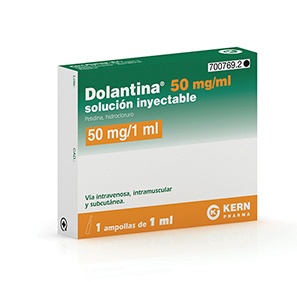
Hidrocloruro de Petidina Altan se presenta en forma de solución inyectable límpida e incolora. Ampollas que contienen 1 ml o 2 ml de solución en cajas de 1 ampolla y de 10 ampollas.
Titular de la autorización de comercialización
Altan Pharmaceuticals, S.A.
c/ Cólquide nº 6, Portal 2, 1ª Planta - Oficina F Edificio Prisma
28230 Las Rozas, Madrid-España
Responsable de fabricación
LABORATORIO RENAUDIN
Z.A. Errobi 64205 Itxassou-Francia
Este prospecto se ha aprobado en Enero 2025
- País de registro
- Forma farmacéuticaINYECTABLE, 50 mg/ml
- Código ATCN02AB02
- Disponibilidad en farmacias
Problema de suministro reportado
Los datos de la Agencia Española de Medicamentos y Productos Sanitarios (AEMPS) indican un problema de suministro que afecta a este medicamento.<br><br>La disponibilidad puede ser limitada en algunas farmacias.<br><br>Para actualizaciones o alternativas, consulte a su farmacéutico. - Principio activo
- Requiere recetaSí
- Fabricante
- Esta información es de carácter general y no sustituye la consulta con un profesional sanitario.
- Alternativas a HIDROCLORURO DE PETIDINA ALTAN 50 MG/ML SOLUCION INYECTABLE EFGForma farmacéutica: INYECTABLE, 100 mg/2 ml hidrocloruro de petidinaPrincipio activo: pethidineFabricante: Kern Pharma S.L.Requiere recetaForma farmacéutica: INYECTABLE, 50 mg/mlPrincipio activo: pethidineFabricante: Laboratorios Basi Industria Farmaceutica S.A.Requiere recetaForma farmacéutica: PARCHE TRANSDERMICO, 12 MCG/HPrincipio activo: fentaniloFabricante: Aristo Pharma Iberia S.L.Requiere receta

Médicos online para HIDROCLORURO DE PETIDINA ALTAN 50 MG/ML SOLUCION INYECTABLE EFG
Comenta la dosis, los posibles efectos secundarios, interacciones, contraindicaciones o la revisión de receta de HIDROCLORURO DE PETIDINA ALTAN 50 MG/ML SOLUCION INYECTABLE EFG, sujeto a valoración médica y a la normativa local.



.jpg)







Preguntas frecuentes
