



FOSQUEL 800 mg Comprimidos Recubiertos Con Pelicula

Revisión de receta online
Un médico revisará tu caso y determinará si la prescripción es médicamente apropiada.

Habla con un médico sobre este medicamento
Comenta tus síntomas y las opciones de tratamiento en una consulta online.



Cómo usar FOSQUEL 800 MG COMPRIMIDOS RECUBIERTOS CON PELICULA
Contenido del prospecto
- Introducción
- Qué es Fosquel y para qué se utiliza
- Qué necesita saber antes de empezar a tomar Fosquel
- Cómo tomar Fosquel
- Posibles efectos adversos
- Conservación de Fosquel
- Contenido del envase e información adicional
Introducción
Prospecto: información para el usuario
Fosquel 800 mg comprimidos recubiertos con película
Carbonato de sevelámero
Lea todo el prospecto detenidamente antes de empezar a tomar este medicamento, porque contiene información importante para usted.
- Conserve este prospecto, ya que puede tener que volver a leerlo.
- Si tiene alguna duda, consulte a su médico o farmacéutico.
- Este medicamento se le ha recetado solamente a usted, y no debe dárselo a otras personas aunque tengan los mismos síntomas que usted, ya que puede perjudicarles.
- Si experimenta efectos adversos, consulte a su médico o farmacéutico, incluso si se trata de efectos adversos que no aparecen en este prospecto. Ver sección 4.
Contenido del prospecto
- Qué es Fosquel y para qué se utiliza
- Qué necesita saber antes de empezar a tomar Fosquel
- Cómo tomar Fosquel
- Posibles efectos adversos
- Conservación de Fosquel
- Contenido del envase e información adicional
1. Qué es Fosquel y para qué se utiliza
Fosquel contiene carbonato de sevelámero como principio activo. Se une al fósforo de los alimentos en el tubo digestivo y de este modo reduce los niveles de fósforo sérico en la sangre.
Este medicamento se utiliza para controlar la hiperfosfatemia (niveles de fosfato altos en sangre) en:
- pacientes adultos en diálisis (una técnica de limpieza de la sangre). Se puede utilizar en pacientes sometidos a hemodiálisis (utilización de una máquina para filtrar la sangre) o diálisis peritoneal (donde el fluido es bombeado al abdomen y una membrana corporal interna filtra la sangre);
- pacientes con enfermedad renal crónica (a largo plazo) que no están sometidos a diálisis y tienen un nivel sérico (en sangre) de fósforo igual o por encima de 1,78 mmol/l.
Este medicamento se debe utilizar con otros tratamientos como suplementos de calcio y vitamina D para prevenir el desarrollo de enfermedad ósea.
El aumento de los niveles de fósforo sérico puede producir depósitos duros en el cuerpo llamados calcificaciones. Estos depósitos se pueden endurecer en los vasos sanguíneos y hacer más difícil que la sangre sea bombeada por el cuerpo. El aumento del fósforo sérico también puede producir picor de la piel, ojos rojos, dolor en los huesos y fracturas.

¿No estás seguro de si este medicamento es adecuado para ti?
Comenta tus síntomas y tratamiento con un médico online.
2. Qué necesita saber antes de empezar a tomar Fosquel
No tome Fosquel:
- si es alérgico al principio activo o a alguno de los demás componentes de este medicamento (incluidos en la sección 6)
- si tiene niveles bajos de fósforo en la sangre (su médico comprobará esto por usted)
- si tiene obstrucción intestinal.
Advertencias y precauciones
Consulte a su médico antes de tomar Fosquel, si se encuentra en alguna de las siguientes situaciones:
- problemas para tragar. Su médico puede preferir recetarle Fosquel en polvo para suspensión oral
- problemas con la motilidad (movimiento) del estómago y del intestino
- tiene vómitos frecuentemente
- inflamación activa del intestino
- se ha sometido a cirugía mayor del estómago o del intestino.
- si tiene una enfermedad intestinal inflamatoria grave.
Consulte con su médico mientras esté tomando Fosquel:
- si experimenta dolor abdominal intenso, trastornos estomacales o intestinales, o sangre en heces (hemorragia gastrointestinal). Estos síntomas se pueden deber al depósito de cristales de sevelámero en el intestino. Póngase en contacto con su médico, que decidirá si continúa el tratamiento o no.
Tratamientos adicionales
Debido a su afección renal o a su tratamiento de diálisis, puede que:
- los niveles de calcio en su sangre sean bajos o altos. Como este medicamento no contiene calcio, su médico puede recetarle comprimidos suplementarios de calcio
- tenga una cantidad baja de vitamina D en la sangre. Por lo tanto, su médico puede controlar los niveles de vitamina D en sangre y recetarle un suplemento de vitamina D si lo considera necesario. Si no toma suplementos multivitamínicos pueden también disminuir los niveles sanguíneos de las vitaminas A, E, K y ácido fólico, por lo que el médico podrá vigilar estos niveles y recetarle suplementos vitamínicos según sea necesario
- tenga alterado el nivel de bicarbonato en sangre y elevada la acidez en sangre y en otros tejidos corporales. Su médico debe controlar el nivel de bicarbonato en su sangre.
Nota especial para pacientes en diálisis peritoneal
Puede que desarrolle peritonitis (infección del líquido abdominal) asociada a la diálisis peritoneal. Este riesgo puede disminuir con el uso cuidadoso de técnicas estériles durante los cambios de las bolsas. Debe informar inmediatamente a su médico si experimenta algún signo o síntoma nuevo de molestia abdominal, hinchazón abdominal, dolor abdominal, dolor a la palpación abdominal o rigidez abdominal, estreñimiento, fiebre, escalofríos, náuseas o vómitos.
Niños
No se ha estudiado la seguridad y eficacia en niños (menores de 6 años). Por lo tanto, no se recomienda el uso de este medicamento en niños menores de 6 años.
Uso de Fosquel con otros medicamentos
Informe a su médico si está tomando, ha tomado recientemente o podría tener que tomar cualquier otro medicamento.
- Fosquel no debe administrarse al mismo tiempo que ciprofloxacino (un antibiótico).
- Si utiliza medicamentos para problemas del ritmo cardiaco o para la epilepsia, debe consultar a su médico cuando tome Fosquel.
- Los efectos de medicamentos como ciclosporina, micofenolato mofetilo y tacrolimus (medicamentos que se usan para suprimir el sistema inmunitario) pueden ser reducidos por Fosquel. Su médico le aconsejará en caso de que usted esté tomando estos medicamentos.
- Se podría observar con poca frecuencia un déficit de la hormona tiroidea en ciertas personas que toman levotiroxina (usada para tratar los niveles bajos de la hormona tiroidea) y Fosquel. Por lo tanto, su médico podría monitorizar más cuidadosamente los niveles de la hormona estimulante de tiroides en la sangre.
- Medicamentos para tratar la acidez estomacal y el reflujo en su estómago o esófago, como omeprazol, pantoprazol, o lansoprazol, conocidos como “inhibidores de la bomba de protones”, pueden reducir la eficacia de Fosquel. Su médico debe controlar el nivel de fosfato en su sangre.
Su médico comprobará si hay interacciones entre Fosquel y otros medicamentos de forma regular.
En algunos casos, cuando Fosquel debe tomarse a la vez que otro medicamento, su médico puede indicarle que tome este medicamento 1 hora antes o 3 horas después de tomar Fosquel. Su médico debe considerar incluso controlar los niveles de ese medicamento en su sangre.
Embarazo y lactancia
Si está embarazada o en periodo de lactancia, cree que podría estar embarazada o tiene intención de quedarse embarazada, consulte a su médico antes de utilizar este medicamento. Se desconoce el riesgo potencial de Fosquel durante el embarazo humano. Consulte con su médico, que decidirá si puede continuar el tratamiento con Fosquel.
Se desconoce si Fosquel puede pasar a la leche materna y afectar a su bebé. Consulte con su médico, que decidirá si puede amamantar a su bebé o no y si es necesario interrumpir el tratamiento con Fosquel.
Conducción y uso de máquinas
Es poco probable que Fosquel afecte a su capacidad para conducir o utilizar máquinas.
Fosquel contiene lactosa
Este medicamento contiene lactosa. Si su médico le ha indicado que padece una intolerancia a ciertos azúcares, consulte con él antes de tomar este medicamento.
3. Cómo tomar Fosquel
Fosquel se debe tomar según le indique su médico. El médico establecerá la dosis según los niveles de fósforo sérico.
La dosis inicial recomendada de Fosquel comprimidos para adultos y pacientes de edad avanzada es de uno a dos comprimidos de 800 mg con cada comida 3 veces al día. Consulte con su médico, farmacéutico o enfermero si no está seguro.
Tome Fosquel después de una comida o con alimento.
Los comprimidos deben ingerirse enteros. No machacar, masticar ni fraccionar.
Inicialmente, su médico comprobará sus concentraciones de fósforo en sangre cada 2-4 semanas y podría ajustar la dosis de Fosquel cuando fuera necesario para alcanzar un nivel de fósforo adecuado.
Siga la dieta prescrita por su médico.
Si toma más Fosquel del que debe
En caso de una posible sobredosis, debe ponerse inmediatamente en contacto con su médico o farmacéutico o llame al Servicio de Información Toxicológica, teléfono 91 562 04 20, indicando el medicamento y la cantidad ingerida.
Si olvidó tomarFosquel
En el caso de que se olvide de tomar una dosis, ésta debe omitirse, de forma que la siguiente dosis debe ser tomada a la hora habitual junto con la comida. No tome una dosis doble para compensar las dosis olvidadas.
Si interrumpe el tratamiento con Fosquel
Tomar su tratamiento con Fosquel es importante para mantener un nivel apropiado de fosfato en su sangre. Interrumpir el tratamiento de Fosquel conllevaría importantes consecuencias, como calcificación en los vasos sanguíneos. Si considera interrumpir su tratamiento con Fosquel, contacte primero con su médico o farmacéutico.
Si tiene cualquier otra duda sobre el uso de este medicamento, pregunte a su médico o farmacéutico.

¿Has empezado a tomar el medicamento y tienes preguntas?
Comenta tus síntomas y tratamiento con un médico online.
4. Posibles efectos adversos
Al igual que todos los medicamentos, este medicamento puede producir efectos adversos, aunque no todas las personas los sufran.
El estreñimiento es un efecto adverso muy frecuente (puede afectar a más de 1 de cada 10 pacientes). Puede ser un síntoma temprano de una obstrucción del intestino. En caso de estreñimiento, informe a su médico o farmacéutico.
Algunos efectos adversos pueden ser graves. Si usted tiene alguno de los siguientes efectos adversos, busque atención médica de inmediato:
Muy raro (puede afectar hasta 1 de cada 10.000 pacientes:
Reacción alérgica (signos que incluyen erupción, habones, hinchazón, dificultad para respirar).
Se han notificado otros efectos adversos en pacientes que toman Fosquel:
Muy frecuentes (pueden afectar a más de 1 de cada 10 pacientes):
Vómitos, dolor en la zona superior del abdomen, náuseas
Frecuentes (pueden afectar hasta 1 de cada 10 pacientes):
Diarrea, dolor de estómago, indigestión, flatulencia
Frecuencia no conocida (no puede estimarse a partir de los datos disponibles):
Se han notificado casos de picor, erupción, motilidad intestinal lenta (movimiento), obstrucción intestinal (los signos incluyen: distensión severa; dolor abdominal, hinchazón o calambres; estreñimiento severo), rotura en la pared intestinal (los signos incluyen: dolor de estómago intenso, escalofríos, fiebre, náuseas, vómitos o abdomen dolorido o con sensibilidad), sangrado intestinal, inflamación del intestino grueso y depósito de cristales en el intestino).
Comunicación de efectos adversos
Si experimenta cualquier tipo de efecto adverso, consulte a su médico, incluso si se trata de posibles efectos adversos que no aparecen en este prospecto. También puede comunicarlos directamente a través del Sistema Español de Farmacovigilancia de Medicamentos de Uso Humano: www.notificaRAM.es. Mediante la comunicación de efectos adversos usted puede contribuir a proporcionar más información sobre la seguridad de este medicamento.
5. Conservación de Fosquel
Mantener este medicamento fuera de la vista y del alcance de los niños.
No utilice este medicamento después de la fecha de caducidad que aparece en el frasco después de las letras «CAD». La fecha de caducidad es el último día del mes que se indica.
Mantener el frasco perfectamente cerrado para protegerlo de la humedad.
Este medicamento no requiere condiciones especiales de conservación.
Los medicamentos no se deben tirar por los desagües ni a la basura. Deposite los envases y los medicamentos que no necesita en el Punto SIGRE de la farmacia. En caso de duda pregunte a su farmacéutico cómo deshacerse de los envases y de los medicamentos que no necesita. De esta forma, ayudará a proteger el medio ambiente.
6. Contenido del envase e información adicional
Composición de Fosquel
- El principio activo es el carbonato de sevelámero. Cada comprimido recubierto con película contiene 800 mg de carbonato de sevelámero.
- Los demás componentes son lactosa monohidrato, sílice coloidal anhidra y estearato de zinc. El recubrimiento del comprimido contiene hipromelosa (E464) y monoglicéridos diacetilados.
Aspecto del producto y contenido del envase
Los comprimidos recubiertos con película de Fosquel son comprimidos ovalados, de color blanco a blanquecino que llevan impreso “SVL” por una cara. Los comprimidos se envasan en frascos de HDPE con un tapón de polipropileno.
Los frascos de HDPE contienen un desecante. No quite el desecante del frasco.
Tamaños de envase:
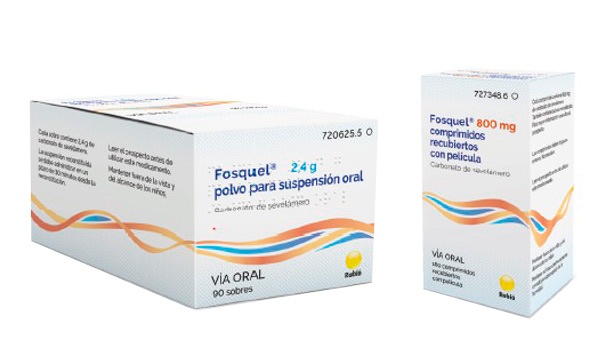
Cada frasco contiene 180 comprimidos.
Titular de la autorización de comercialización y responsable de la fabricación
Titular de la autorización de comercialización:
Laboratorios Rubió, S.A.
Industria, 29. Pol. Ind. Comte de Sert
08755 Castellbisbal (Barcelona)
España
Responsable de la fabricación:
Synthon Hispania S.L.
C/ Castelló, no 1, Pol. Las Salinas
08830 Sant Boi de Llobregat (Barcelona)
España
Fecha de la última revisión de este prospecto:Abril 2020
Otras fuentes de información
La información detallada y actualizada de este medicamento está disponible en la página Web de la Agencia Española de Medicamentos y Productos Sanitarios (AEMPS) http://www.aemps.gob.es/.
- País de registro
- Forma farmacéuticaCOMPRIMIDO, 800 mg
- Código ATCV03AE02
- Precio medio en farmacia145.71 EUR
- Principio activo
- Requiere recetaSí
- Fabricante
- ComposiciónLACTOSA MONOHIDRATO (286.25 mg mg)
- Esta información es de carácter general y no sustituye la consulta con un profesional sanitario.
- Alternativas a FOSQUEL 800 MG COMPRIMIDOS RECUBIERTOS CON PELICULAForma farmacéutica: COMPRIMIDO, 800 mgPrincipio activo: sevelamerFabricante: Sanofi Winthrop IndustrieRequiere recetaForma farmacéutica: SOLUCIÓN/SUSPENSIÓN ORAL, 2,4 gPrincipio activo: sevelamerFabricante: Laboratorios Rubio S.A.Requiere recetaForma farmacéutica: COMPRIMIDO, 800 mgPrincipio activo: sevelamerFabricante: Waymade B.V.Requiere receta
Médicos online para FOSQUEL 800 MG COMPRIMIDOS RECUBIERTOS CON PELICULA
Comenta la dosis, los posibles efectos secundarios, interacciones, contraindicaciones o la revisión de receta de FOSQUEL 800 MG COMPRIMIDOS RECUBIERTOS CON PELICULA, sujeto a valoración médica y a la normativa local.









Obtén una receta de FOSQUEL 800 MG COMPRIMIDOS RECUBIERTOS CON PELICULA online
Rellena un formulario de 2 minutos
Cuéntanos tus síntomas, historial y el medicamento que necesitas.
Elige un médico o nosotros te asignamos uno
Escoge un especialista o te conectamos con el próximo médico disponible.
El médico revisa tu caso
Normalmente en 30 minutos. Puede hacerte preguntas adicionales por chat.
Recógela en cualquier farmacia
Receta electrónica enviada a tu correo, válida en toda España.
Preguntas frecuentes
FOSQUEL 800 MG COMPRIMIDOS RECUBIERTOS CON PELICULA requiere receta en España. Puedes confirmarlo con un médico online según tu caso.
El principio activo de FOSQUEL 800 MG COMPRIMIDOS RECUBIERTOS CON PELICULA es sevelamer. Esta información ayuda a identificar medicamentos con la misma composición pero con diferentes nombres comerciales.
El precio medio en farmacia de FOSQUEL 800 MG COMPRIMIDOS RECUBIERTOS CON PELICULA es de aproximadamente 145.71 EUR. Puede variar según el fabricante y la forma farmacéutica.
FOSQUEL 800 MG COMPRIMIDOS RECUBIERTOS CON PELICULA es fabricado por Laboratorios Rubio S.A.. La marca y el envase pueden variar según el distribuidor.
Los Médicos de familia, Psiquiatras, Dermatólogos, Cardiólogos, Endocrinólogos, Gastroenterólogos, Neumólogos, Nefrólogos, Reumatólogos, Hematólogos, Infectólogos, Alergólogos, Geriatras, Pediatras, Oncólogos pueden valorar la prescripción de FOSQUEL 800 MG COMPRIMIDOS RECUBIERTOS CON PELICULA cuando esté clínicamente indicado. Puedes reservar una videoconsulta para comentar tu caso y las opciones de tratamiento.
España cuenta con una infraestructura sanitaria bien desarrollada en ciudades principales como Madrid, Barcelona, Valencia y Sevilla. Las farmacias están ampliamente disponibles y operan bajo estrictas regulaciones, garantizando el acceso a medicamentos con receta.
Puedes comprar FOSQUEL 800 MG COMPRIMIDOS RECUBIERTOS CON PELICULA en Madrid, Barcelona, Sevilla o Valencia en cualquier farmacia local con una receta válida.
Para obtener una receta, puedes utilizar Oladoctor:
Otros medicamentos con el mismo principio activo (sevelamer) incluyen CARBONATO DE SEVELAMERO WINTHROP 800 MG COMPRIMIDOS RECUBIERTOS CON PELICULA, FOSQUEL 2,4 G POLVO PARA SUSPENSION ORAL, HIDROCLORURO DE SEVELAMERO WAYMADE 800 MG COMPRIMIDOS RECUBIERTOS CON PELICULA. Pueden tener diferentes nombres comerciales o formulaciones, pero contienen el mismo componente terapéutico. Consulta siempre con un médico antes de cambiar o iniciar un nuevo medicamento.
