


Fabrazyme 35 mg polvo para concentrado para solución para perfusión

Revisión de receta online
Un médico revisará tu caso y determinará si la prescripción es médicamente apropiada.

Habla con un médico sobre este medicamento
Comenta tus síntomas y las opciones de tratamiento en una consulta online.



Cómo usar FABRAZYME 35 MG POLVO PARA CONCENTRADO PARA SOLUCION PARA PERFUSION
Contenido del prospecto
- Introducción
- Qué es Fabrazyme y para qué se utiliza
- Qué necesita saber antes de empezar a usar Fabrazyme
- Cómo usar Fabrazyme
- Posibles efectos adversos
- Conservación de Fabrazyme
- Contenido del envase e información adicional
Introducción
Prospecto: información para el usuario
Fabrazyme 35mg polvo para concentrado para solución para perfusión.
agalsidasa beta
Lea todo el prospecto detenidamente antes de empezar a usar este medicamento, porque contiene información importante para usted.
- Conserve este prospecto, ya que puede tener que volver a leerlo.
- Si tiene alguna duda, consulte a su médico o farmacéutico.
- Este medicamento se le ha recetado solamente a usted, y no debe dárselo a otras personas aunque tengan los mismos síntomas que usted, ya que puede perjudicarles.
- Si experimenta efectos adversos, consulte a su médico o farmacéutico, incluso si se trata de efectos adversos que no aparecen en este prospecto. Ver sección 4.
Contenido del prospecto:
- Qué es Fabrazyme y para qué se utiliza
- Qué necesita saber antes de empezar a usar Fabrazyme
- Cómo usar Fabrazyme
- Posibles efectos adversos
- Conservación de Fabrazyme
- Contenido del envase e información adicional
1. Qué es Fabrazyme y para qué se utiliza
Fabrazyme contiene el principio activo agalsidasa beta y se utiliza como terapia de sustitución enzimática en la enfermedad de Fabry, en la que el nivel de actividad enzimática de la ?-galactosidasa es inexistente o inferior al normal. En los afectados por la enfermedad de Fabry, una sustancia grasa, denominada globotriaosilceramida (GL-3), no se elimina de las células del cuerpo y se va acumulando en las paredes de los vasos sanguíneos de los órganos.
Fabrazyme está indicado para el uso como terapia de sustitución enzimática a largo plazo en pacientes con diagnóstico confirmado de enfermedad de Fabry.
Fabrazyme está indicado en adultos, adolescentes y niños de 8 años o mayores.

¿No estás seguro de si este medicamento es adecuado para ti?
Comenta tus síntomas y tratamiento con un médico online.
2. Qué necesita saber antes de empezar a usar Fabrazyme
No use Fabrazyme
- si es alérgico a agalsidasa beta o a alguno de los demás componentes de este medicamento (incluidos en la sección 6).
Advertencias y precauciones
Consulte a su médico o farmacéutico antes de empezar a usar Fabrazyme.
Si está en tratamiento con Fabrazyme puede desarrollar reacciones relacionadas con la perfusión. Una reacción relacionada con la perfusión es cualquier efecto adverso que se produce durante la perfusión o hasta el final del día de la perfusión (ver sección 4). Si experimenta una reacción como esta, debe decírselo a su médico inmediatamente. Puede que necesite otros medicamentos para prevenir este tipo de reacciones.
Niños y adolescentes
No se han realizado estudios clínicos en niños de 0 a 4 años. No se han establecido todavía los riesgos y beneficios de Fabrazyme en niños de entre 5 y 7 años de edad y, por tanto, no se pueden recomendar dosis para este grupo de edad.
Otros medicamentos y Fabrazyme
Informe a su médico o farmacéutico si está tomando, ha tomado recientemente o pudiera tener que tomar cualquier otro medicamento.
Informe a su médico si utiliza otros medicamentos que contienen cloroquina, amiodarona, benoquin o gentamicina. Existe un riesgo teórico de reducción de la actividad de la agalsidasa beta.
Embarazo, lactancia y fertilidad
La experiencia en la utilización de Fabrazyme en mujeres embarazadas es limitada. Como precaución, es preferible evitar el uso de Fabrazyme durante el embarazo.Fabrazyme pasa a la leche materna. Hable con su médico sobre los riesgos y beneficios de la lactancia frente a continuar el tratamiento con Fabrazyme. No se han realizado estudios para examinar los efectos de Fabrazyme en la fertilidad.
Si está embarazada o en periodo de lactancia, o cree que podría estar embarazada o tiene intención de quedarse embarazada, consulte a su médico o farmacéutico antes de utilizar este medicamento.
Conducción y uso de máquinas
No conduzca ni maneje herramientas o máquinas si experimenta mareos, somnolencia, vértigo o desvanecimientos durante o poco después de la administración de Fabrazyme (ver sección 4). Hable primero con su médico.
Fabrazyme contiene sodio
Este medicamento contiene menos de 1mmol de sodio (23 mg) por vial; esto es, esencialmente “exento de sodio”.
3. Cómo usar Fabrazyme
Fabrazyme se administra mediante goteo en una vena (mediante perfusión intravenosa). Se suministra en forma de polvo que se mezclará con agua estéril antes de administrarse (ver información destinada a los profesionales sanitarios al final de este prospecto).
Siga exactamente las instrucciones de administración de este medicamento indicadas por su médico. En caso de duda, consulte de nuevo a su médico.
Fabrazyme sólo se usa bajo la supervisión de un médico con experiencia en el tratamiento de la enfermedad de Fabry. En caso de cumplir ciertos criterios, puede que su médico considere que puede recibir el tratamiento en casa. Póngase en contacto con su médico si desea recibir el tratamiento en casa.
La dosis recomendada de Fabrazyme para adultos es de 1 mg/kg de peso corporal, una vez cada 2 semanas. No es necesario cambiar la dosis en pacientes con enfermedades renales.
Uso en niños y adolescentes
La dosis recomendada de Fabrazyme para niños y adolescentes de 8 a 16 años es de 1 mg/kg de peso corporal, una vez cada 2 semanas. No es necesario cambiar la dosis en pacientes con enfermedad renal.
Si usted usa más Fabrazyme del que debiera
Se ha demostrado que dosis de hasta 3 mg/kg de peso corporal son seguras.
Si olvidó usar Fabrazyme
Si se le ha olvidado una perfusión de Fabrazyme, póngase en contacto con su médico.
Si tiene cualquier otra duda sobre el uso de este medicamento, pregunte a su médico.

¿Has empezado a tomar el medicamento y tienes preguntas?
Comenta tus síntomas y tratamiento con un médico online.
4. Posibles efectos adversos
Al igual que todos los medicamentos, este medicamento puede producir efectos adversos, aunque no todas las personas los sufran.
En los estudios clínicos, los efectos adversos se observaron principalmente mientras los pacientes estaban recibiendo el medicamento o poco después (“reacciones relacionadas con la perfusión”). Se han comunicado reacciones alérgicas graves potencialmente mortales (“reacciones anafilácticas”) en algunos pacientes. Si sufre algún efecto adverso grave, póngase en contacto con su médico inmediatamente.
Algunos síntomas muy frecuentes (pueden afectar a más de 1 de cada 10 personas) incluyen escalofríos, fiebre, sensación de frío, náuseas, vómitos, cefaleas y sensaciones anormales en la piel como ardor u hormigueo. Puede que su médico decida reducir la velocidad de perfusión o administrar medicamentos adicionales para evitar que ocurran tales reacciones.
Lista de otros efectos adversos:
Frecuentes (pueden afectar hasta 1 de cada 10 personas): | ||
|
|
|
|
| |
|
|
|
|
|
|
|
|
|
|
|
|
|
|
|
|
|
|
|
|
|
|
|
|
|
|
|
|
|
|
|
|
|
|
|
|
|
|
|
|
|
|
|
|
|
| ||
Poco frecuentes (pueden afectar hasta 1 de cada 100 personas): | ||
|
|
|
|
|
|
|
|
|
|
|
|
|
| |
|
|
|
|
|
|
|
|
|
|
|
|
|
|
|
Frecuencia no conocida (la frecuencia no se puede estimar a partir de los datos disponibles) | ||
|
|
En algunos pacientes tratados inicialmente con la dosis recomendada y cuya dosis se redujo posteriormente durante un periodo adicional se observaron con más frecuencia ciertos síntomas de la enfermedad de Fabry.
Comunicación de efectos adversos
Si experimenta cualquier tipo de efecto adverso, consulte a su médico o enfermero, incluso si se trata de posibles efectos adversos que no aparecen en este prospecto. También puede comunicarlos directamente a través del sistema nacional de notificación incluido en el Apéndice V. Mediante la comunicación de efectos adversos usted puede contribuir a proporcionar más información sobre la seguridad de este medicamento.
5. Conservación de Fabrazyme
Mantener este medicamento fuera de la vista y del alcance de los niños.
No utilice este medicamento después de la fecha de caducidad que aparece en la etiqueta después de “CAD”. La fecha de caducidad es el último día del mes que se indica.
Viales no abiertos
Conservar en nevera (entre 2 ºC y 8 ºC).
Soluciones reconstituidas y diluidas
La solución reconstituida no se debe almacenar y se debe diluir rápidamente. La solución diluida se puede mantener un máximo de 24 horas a una temperatura entre 2 ºC y 8 ?C.
Los medicamentos no se deben tirar por los desagües ni a la basura. Pregunte a su farmacéutico cómo deshacerse de los envases y de los medicamentos que ya no necesita. De esta forma, ayudará a proteger el medio ambiente.
6. Contenido del envase e información adicional
Composición de Fabrazyme
- El principio activo es agalsidasa beta, un vial contiene 35 mg. Después de la reconstitución, cada vial contiene 5 mg de agalsidasa beta por ml.
- Los demás componentes son:
- Manitol (E421)
- Dihidrogenofosfato de sodio monohidrato (E339)
- Fosfato de disodio heptahidrato (E339)
Aspecto del producto y contenido del envase
Fabrazyme se presenta como polvo de color blanco a blanquecino. Después de la reconstitución, es un líquido transparente, incoloro, sin materia extraña. La solución reconstituida debe ser diluida posteriormente.
Contenido de los envases: 1, 5 y 10 viales por caja. Puede que solamente estén comercializados algunos tamaños de envases.
Titular de la autorización de comercialización y responsable de la fabricación
Titular de la autorización de comercialización
Sanofi B.V., Paasheuvelweg 25, 1105 BP Ámsterdam, Países Bajos.
Responsable de la fabricación
Genzyme Ireland Limited, IDA Industrial Park, Old Kilmeaden Road, Waterford, Irlanda
Pueden solicitar más información respecto a este medicamento dirigiéndose al representante local del titular de la autorización de comercialización:
België/Belgique/Belgien/Luxembourg/Luxemburg Sanofi Belgium Tél/Tel: + 32 2 710 54 00 | Lietuva Swixx Biopharma UAB Tel: +370 5 236 91 40 |
| Magyarország SANOFI-AVENTIS Zrt. Tel: +36 1 505 0050 |
Ceská republika Sanofi s.r.o. Tel: +420 233 086 111 | Malta Sanofi S.r.l. Tel: +39 02 39394275 |
Danmark Sanofi A/S Tlf: +45 45 16 70 00 | Nederland Genzyme Europe B.V. Tel: +31 20 245 4000 |
Deutschland Sanofi-Aventis Deutschland GmbH Tel.: 0800 04 36 996 Tel. aus dem Ausland: +49 69 305 70 13 | Norge sanofi-aventis Norge AS Tlf: + 47 67 10 71 00 |
Eesti Swixx Biopharma OÜ Tel: +372 640 10 30 | Österreich sanofi-aventis GmbH Tel: + 43 1 80 185 - 0 |
Ελλ?δα sanofi-aventis AEBE Τηλ: +30 210 900 1600 | Polska Sanofi Sp. z o.o. Tel.: +48 22 280 00 00 |
España sanofi-aventis, S.A. Tel: +34 93 485 94 00 | Portugal Sanofi – Produtos Farmacêuticos, Lda. Tel: +351 21 35 89 400 |
France sanofi-aventis France Tél: 0 800 222 555 Appel depuis l’étranger: +33 1 57 63 23 23 | România Sanofi Romania SRL Tel: +40 (0) 21 317 31 36 |
Hrvatska Swixx Biopharma d.o.o. Tel: +385 1 2078 500 | Slovenija Swixx Biopharma d.o.o. Tel: +386 1 235 51 00 |
Ireland sanofi-aventis Ireland Ltd. T/A SANOFI Tel: +353 (0) 1 403 56 00 | Slovenská republika Swixx Biopharma s.r.o. Tel: +421 2 208 33 600 |
Ísland Vistor hf. Sími: +354 535 7000 | Suomi/Finland Sanofi Oy Puh/Tel: + 358 201 200 300 |
Italia Sanofi S.r.l. Tel: 800536389 | Sverige Sanofi AB Tel: +46 (0)8 634 50 00 |
Κ?προς C.A. Papaellinas Ltd. Τηλ: +357 22 741741 | United Kingdom (Northern Ireland) sanofi-aventis Ireland Ltd. T/A SANOFI Tel: +44 (0) 800 035 2525 |
Latvija Swixx Biopharma SIA Tel: +371 6 616 47 50 |
Fecha de la última revisión de esteprospecto:
Otras fuentes de información
La información detallada de este medicamento está disponible en la página web de la Agencia Europea de Medicamentos: http://www.ema.europa.eu. También existen enlaces a otras páginas web sobre enfermedades raras y medicamentos huérfanos.
--------------------------------------------------------------------------------------------------------------------
Esta información está destinada únicamente a profesionales del sector sanitario
Instrucciones de uso – reconstitución, dilución y administración
El polvo para concentrado para solución para perfusión se debe reconstituir con agua para preparaciones inyectables, diluir con solución inyectable de cloruro de sodio al 0,9% y luego administrar mediante perfusión intravenosa.
Desde un punto de vista microbiológico, el medicamento se debe usar inmediatamente. Si no se usa inmediatamente, la conservación y las condiciones en uso son responsabilidad del usuario. La solución reconstituida no se puede almacenar y se debe diluir sin demora; sólo la solución diluida se puede mantener hasta 24 horas de 2 ºC a 8 ºC.
Utilice una técnica aséptica
- Se debe calcular el número de viales necesarios para la reconstitución en función del peso de cada paciente y los viales necesarios se deben sacar de la nevera para que se estabilicen a temperatura ambiente (aproximadamente 30 minutos). Cada vial de Fabrazyme es para un único uso.
Reconstitución
- Cada vial de Fabrazyme 35 mg se tiene que reconstituir con 7,2 ml de agua para preparaciones inyectables. Se debe evitar el impacto violento del agua para preparaciones inyectables sobre el polvo y la formación de espuma. Esto se consigue añadiendo lentamente el agua para preparaciones inyectables mediante goteo por la pared interior del vial y no directamente sobre el liofilizado. Cada vial se debe inclinar y girar suavemente. El vial no se debe invertir, dar vueltas o agitar.
- La solución reconstituida, contiene 5 mg de agalsidasa beta por ml, y presenta una apariencia transparente e incolora. El pH de la solución reconstituida es aproximadamente de 7,0. Antes de volver a diluirla, se debe comprobar visualmente que la solución reconstituida de cada vial no contiene partículas ni ha cambiado de color. No se debe utilizar la solución si observa partículas extrañas o si la solución presenta cambios de color.
- Después de la reconstitución, se recomienda diluir rápidamente los viales, para minimizar la formación de partículas proteicas al transcurrir el tiempo.
- La eliminación del medicamento no utilizado y de todos los materiales que hayan estado en contacto con él se realizará de acuerdo con la normativa local.
Dilución
- Antes de añadir el volumen reconstituido de Fabrazyme necesario para la dosis del paciente, se recomienda retirar de la bolsa para perfusión, un volumen equivalente de solución inyectable de cloruro de sodio al 0,9%.
- El aire contenido en la bolsa para perfusión se debe eliminar para minimizar la interfase aire/líquido.
- Se deben extraer lentamente 7,0 ml (equivalentes a 35 mg) de la solución reconstituida de cada vial hasta completar el volumen necesario para la dosis del paciente. No se deben utilizar agujas con filtro y se debe evitar la formación de espuma.
- Se debe inyectar lentamente la solución reconstituida directamente en la solución inyectable de cloruro de sodio al 0,9% (evitando hacerlo en un espacio de aire) hasta una concentración final entre 0,05 mg/ml y 0,7 mg/ml. El volumen total de solución para perfusión de cloruro de sodio al 0,9% (entre 50 y 500 ml) se debe determinar basándose en la dosis individual. Para dosis inferiores a 35 mg se debe usar un mínimo de 50 ml, para dosis de 35 a 70 mg se debe usar un mínimo de 100 ml, para dosis de 70 a 100 mg se debe usar un mínimo de 250 ml y para dosis mayores de 100 mg solo se deben usar 500 ml. La bolsa para perfusión se debe invertir suavemente o masajear ligeramente para mezclar la solución diluida. La bolsa para perfusión no se debe sacudir ni agitar excesivamente.
Administración
- Para la administración de la solución diluida, se recomienda usar un filtro en línea de 0,2 ?m con baja unión a las proteínas plasmáticas para eliminar cualquier partícula proteica, lo cual no producirá ninguna pérdida de actividad de la agalsidasa beta. La velocidad inicial de perfusión (IV) no debe exceder los 0,25 mg/min (15 mg/hora). La velocidad de perfusión se puede reducir en caso de reacciones asociadas a la perfusión (RAPs).
Una vez se haya determinado bien la tolerancia del paciente, la velocidad de perfusión se puede aumentar en incrementos de 0,05 a 0,083 mg/min (incrementos de 3 a 5 mg/h) con cada perfusión posterior. En los ensayos clínicos con pacientes clásicos, la velocidad de perfusión se incrementó progresivamente hasta alcanzar un mínimo de 2 horas. Esto se logró después de 8 perfusiones iniciales a 0,25 mg/min (15 mg/h), sin ninguna RAP, sin cambio en la velocidad de perfusión o sin interrupción de la perfusión. Se permitió una reducción adicional del tiempo de perfusión a 1,5 horas para los pacientes sin nuevas RAPs durante las últimas 10 perfusiones o sin acontecimientos adversos graves notificados en las últimas 5 perfusiones. Cada incremento de velocidad de 0,083 mg/min (~5 mg/h) se mantuvo durante 3 perfusiones consecutivas, sin nuevas RAPs, sin cambio en la velocidad de perfusión o sin interrupción de la perfusión, antes de los aumentos de velocidad posteriores.
Para pacientes que pesan < 30 kg, la velocidad de perfusión máxima debe permanecer a 0,25 mg/min (15 mg/h).
- País de registro
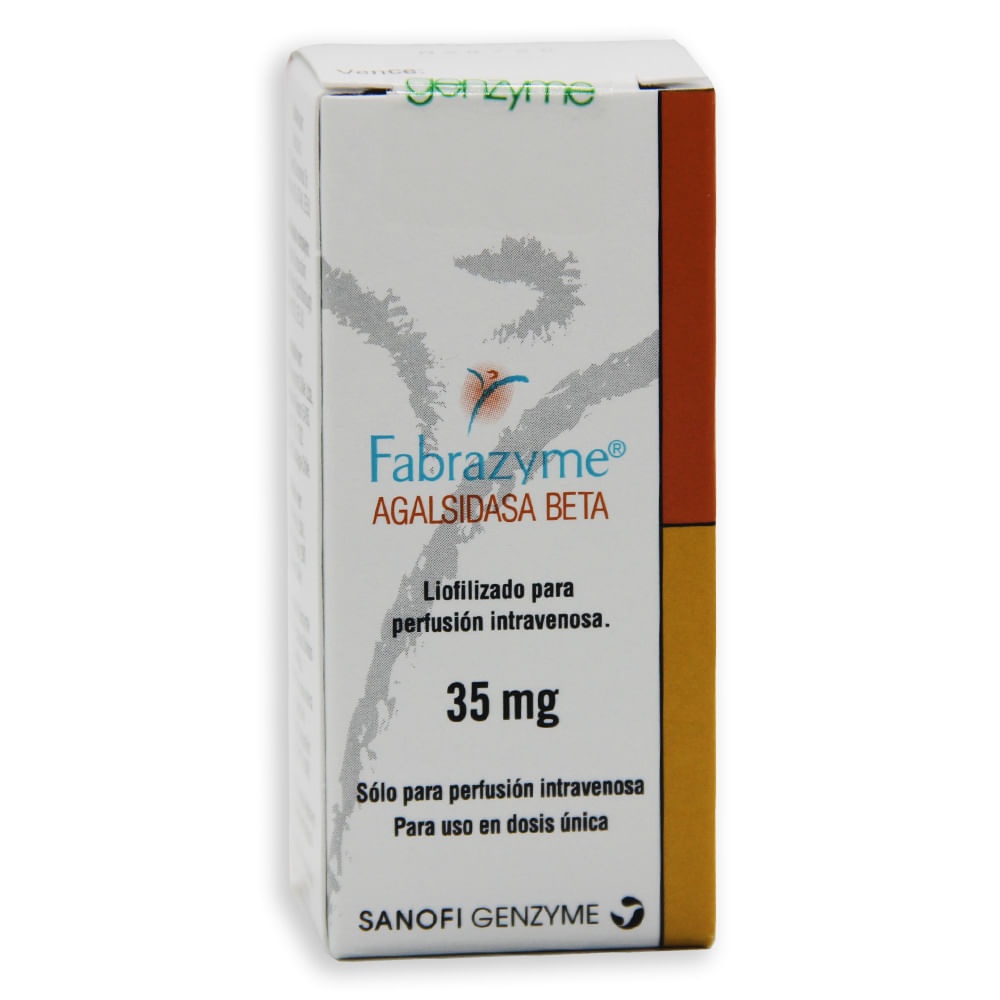
- Forma farmacéuticaINYECTABLE PERFUSION, Desconocida
- Código ATCA16AB04
- Principio activo
- Requiere recetaSí
- Fabricante
- ComposiciónHIDROGENOFOSFATO DE SODIO HEPTAHIDRATO (0 - mg), FOSFATO DE SODIO MONOBASICO MONOHIDRATADO (0 - mg), MANITOL (E-421) (0 - mg)
- Esta información es de carácter general y no sustituye la consulta con un profesional sanitario.
- Alternativas a FABRAZYME 35 MG POLVO PARA CONCENTRADO PARA SOLUCION PARA PERFUSIONForma farmacéutica: INYECTABLE PERFUSION, DesconocidaPrincipio activo: Agalsidasa betaFabricante: Sanofi B.V.Requiere recetaForma farmacéutica: INYECTABLE PERFUSION, 100 UPrincipio activo: LaronidasaFabricante: Sanofi B.V.Requiere recetaForma farmacéutica: INYECTABLE PERFUSION, 30 mg/mlPrincipio activo: Cerliponasa alfaFabricante: Biomarin International LimitedRequiere receta
Médicos online para FABRAZYME 35 MG POLVO PARA CONCENTRADO PARA SOLUCION PARA PERFUSION
Comenta la dosis, los posibles efectos secundarios, interacciones, contraindicaciones o la revisión de receta de FABRAZYME 35 MG POLVO PARA CONCENTRADO PARA SOLUCION PARA PERFUSION, sujeto a valoración médica y a la normativa local.









Preguntas frecuentes
FABRAZYME 35 MG POLVO PARA CONCENTRADO PARA SOLUCION PARA PERFUSION requiere receta en España. Puedes confirmarlo con un médico online según tu caso.
El principio activo de FABRAZYME 35 MG POLVO PARA CONCENTRADO PARA SOLUCION PARA PERFUSION es Agalsidasa beta. Esta información ayuda a identificar medicamentos con la misma composición pero con diferentes nombres comerciales.
FABRAZYME 35 MG POLVO PARA CONCENTRADO PARA SOLUCION PARA PERFUSION es fabricado por Sanofi B.V.. La marca y el envase pueden variar según el distribuidor.
Los Médicos de familia, Psiquiatras, Dermatólogos, Cardiólogos, Endocrinólogos, Gastroenterólogos, Neumólogos, Nefrólogos, Reumatólogos, Hematólogos, Infectólogos, Alergólogos, Geriatras, Pediatras, Oncólogos pueden valorar la prescripción de FABRAZYME 35 MG POLVO PARA CONCENTRADO PARA SOLUCION PARA PERFUSION cuando esté clínicamente indicado. Puedes reservar una videoconsulta para comentar tu caso y las opciones de tratamiento.
La receta la emite un médico tras valorar tu estado de salud. En España, FABRAZYME 35 MG POLVO PARA CONCENTRADO PARA SOLUCION PARA PERFUSION se dispensa en las farmacias con esa receta médica. Una consulta online no garantiza su emisión: la decisión corresponde siempre al médico.
Para solicitar una valoración puedes usar Oladoctor:
Otros medicamentos con el mismo principio activo (Agalsidasa beta) incluyen FABRAZYME 5 MG POLVO PARA CONCENTRADO PARA SOLUCION PARA PERFUSION, ALDURAZYME, 100 U/ML CONCENTRADO PARA SOLUCION PARA PERFUSION, BRINEURA 150 MG SOLUCION PARA PERFUSION. Pueden tener diferentes nombres comerciales o formulaciones, pero contienen el mismo componente terapéutico. Consulta siempre con un médico antes de cambiar o iniciar un nuevo medicamento.
