


Brineura 30 mg/ml solución para perfusión

Revisión de receta online
Un médico revisará tu caso y determinará si la prescripción es médicamente apropiada.

Habla con un médico sobre este medicamento
Comenta tus síntomas y las opciones de tratamiento en una consulta online.



Cómo usar BRINEURA 150 MG SOLUCION PARA PERFUSION
Contenido del prospecto
- Introducción
- Qué es Brineura y para qué se utiliza
- Qué necesita saber antes de que a usted o a su hijo les administren Brineura
- Cómo se administra Brineura
- Posibles efectos adversos
- Conservación de Brineura
- Contenido del envase e información adicional
Introducción
Prospecto: información para el usuario
Brineura 150 mg solución para perfusión
cerliponasa alfa
Este medicamento está sujeto a seguimiento adicional, lo que agilizará la detección de nueva información sobre su seguridad. Puede contribuir comunicando los efectos adversos que pudiera usted tener. La parte final de la sección 4 incluye información sobre cómo comunicar estos efectos adversos.
Lea todo el prospecto detenidamente antes de que le administren este medicamento, porque contiene información importante para usted.
- Conserve este prospecto, ya que puede tener que volver a leerlo.
- Si tiene alguna duda, consulte a su médico.
- Si usted o su hijo experimentan efectos adversos, consulte a su médico, incluso si se trata de efectos adversos que no aparecen en este prospecto. Ver sección 4.
Contenido del prospecto
- Qué es Brineura y para qué se utiliza
- Qué necesita saber antes de que a usted o a su hijo les administren Brineura
- Cómo se administra Brineura
- Posibles efectos adversos
- Conservación de Brineura
- Contenido del envase e información adicional
1. Qué es Brineura y para qué se utiliza
Brineura contiene el principio activo cerliponasa alfa, que pertenece a un grupo de medicamentos llamados tratamientos de sustitución enzimática. Se usa para tratar a pacientes con la enfermedad lipofuscinosis neuronal ceroidea de tipo 2 (LNC2), también llamada déficit de tripeptidil-peptidasa 1 (TPP1).
Las personas con la enfermedad LNC2 no tienen una enzima llamada TPP1, o tienen demasiado poca, y eso produce una acumulación de sustancias llamadas materiales de almacenamiento lisosómico. En las personas con la enfermedad LNC2 estos materiales se acumulan en ciertas partes del organismo, sobre todo en el cerebro.
Cómo funciona Brineura
Este medicamento sustituye a la enzima que falta, la TPP1, con lo que reduce la acumulación de los materiales de almacenamiento lisosómico. Este medicamento actúa para retrasar la progresión de la enfermedad.

¿No estás seguro de si este medicamento es adecuado para ti?
Comenta tus síntomas y tratamiento con un médico online.
2. Qué necesita saber antes de que a usted o a su hijo les administren Brineura
No deben administrarle Brineura:
- Si usted o su hijo han tenido reacciones alérgicas a la cerliponasa alfa o a alguno de los demás componentes de este medicamento (incluidos en la sección 6) que pudieran ser potencialmente mortales, y las reacciones volvían a aparecer al administrarle de nuevo la cerliponasa alfa.
- Si usted o su hijo tienen implantado un dispositivo para drenar el líquido en exceso del cerebro.
- Si usted o su hijo tienen en ese momento signos de infección del dispositivo o problemas con él. Su médico puede decidir seguir con el tratamiento una vez que la infección o los problemas con el dispositivo se hayan resuelto.
Advertencias y precauciones
Consulte a su médico antes de que a usted a o su hijo les empiecen a administrar Brineura.
- Usted o su hijo pueden tener problemas con el dispositivo implantado que se usa durante el tratamiento con Brineura (ver sección 4 «Posibles efectos adversos»), incluidas infección o avería en el dispositivo. El tratamiento se puede interrumpir si es necesario cambiar el dispositivo o hasta que se cure la infección. Consulte a su médico si tiene alguna pregunta sobre el dispositivo.
- Con Brineura se pueden producir reacciones alérgicas potencialmente mortales. Su médico les hará controles a usted o a su hijo para detectar síntomas de reacciones alérgicas que puedan ser potencialmente mortales, como por ejemplo ronchas, picores o enrojecimiento, hinchazón de los labios, la lengua y/o la garganta, dificultad para respirar, ronquera, coloración azulada de los labios o las puntas de los dedos, tono muscular bajo, desmayos o incontinencia.
- El médico le tomará a usted o a su hijo la frecuencia cardíaca, la tensión arterial, la frecuencia respiratoria y la temperatura antes, durante y después del tratamiento. El médico puede decidir hacerle también otros controles si es necesario.
- El médico le hará cada 6 meses una prueba para descartar anomalías en la actividad eléctrica del corazón (electrocardiograma o ECG). Si usted o su hijo tienen antecedentes de problemas del corazón, el médico o enfermero monitorizará la actividad cardíaca durante cada perfusión.
- El médico puede mandar a analizar muestras del líquido del cerebro para buscar signos de infección.
- Brineura no se ha administrado a pacientes con enfermedad avanzada al inicio del tratamiento ni a niños de menos de 2 años. Su médico le comentará si el tratamiento con Brineura es adecuado para usted o para su hijo.
Otros medicamentos y Brineura
Informe a su médico si usted o su hijo están tomando, han tomado recientemente o pudieran tener que tomar cualquier otro medicamento
Embarazo, lactancia y fertilidad
Si está embarazada o en periodo de lactancia, cree que podría estar embarazada o tiene intención de quedarse embarazada, consulte a su médico antes del tratamiento con este medicamento.
No debe recibir tratamiento con Brineura durante el embarazo a no ser que sea claramente necesario. Se desconoce si Brineura pasa a la leche materna. Debe interrumpirse la lactancia durante el tratamiento con Brineura. Se desconoce si Brineura influye en la fertilidad de los seres humanos.
Conducción y uso de máquinas
No se sabe si Brineura influirá en la capacidad para conducir o utilizar máquinas. Consulte a su médico.
Brineura contiene sodio:
Este medicamento contiene 44 mg de sodio por vial, lo que debe ser tenido en cuenta en pacientes con dietas pobres en sodio .
3. Cómo se administra Brineura
Usted o su hijo tendrán que someterse a una operación para implantar el dispositivo que se usa para administrar Brineura. El dispositivo ayuda a que el medicamento llegue a una parte específica del cerebro.
Le administrará Brineura un médico con conocimientos sobre la administración de medicamentos mediante perfusión intracerebroventricular (perfusión en el líquido que hay en el cerebro) en un hospital o una clínica.
Brineura no se ha administrado a pacientes de menos de 2 años ni más de 8 años de edad (al inicio del ensayo clínico). La experiencia en menores de 2 años se limita a unos cuantos niños.
La dosis recomendada de Brineura que se le administrará en semanas alternas depende de la edad que tengan usted o su hijo:
- desde el nacimiento hasta < 6 meses: 100 mg
- de 6 meses a < 1 año: 150 mg
- de 1 año a < 2 años: 200 mg (4 primeras dosis), 300 mg (todas las demás dosis)
- ≥ 2 años: 300 mg
El médico puede ajustar su dosis o la de su hijo, o el tiempo que tarda en administrarse el medicamento, si no se tolera la perfusión, se produce una reacción alérgica o existe un posible aumento de la presión en el cerebro.
El medicamento se bombea poco a poco a través del dispositivo implantado. Después de administrar el medicamento se realiza una perfusión más breve de una solución a fin de arrastrar la cantidad de Brineura que quede en el equipo de perfusión para que llegue al cerebro toda la dosis. La administración del medicamento y la solución tardarán entre 2 horas y 4 horas y media, aproximadamente, según la dosis que necesiten usted o su hijo. El médico puede bajar la dosis o la velocidad de la perfusión según cuál sea su respuesta durante el tratamiento.
Su médico puede darle medicamentos a usted o a su hijo, como por ejemplo antipiréticos para bajar la fiebre o antihistamínicos para tratar las reacciones alérgicas, antes de cada tratamiento con Brineura para reducir los efectos adversos que pueden producirse durante el tratamiento o poco después.
Si tiene cualquier otra duda sobre el uso de este medicamento, pregunte a su médico.

¿Has empezado a tomar el medicamento y tienes preguntas?
Comenta tus síntomas y tratamiento con un médico online.
4. Posibles efectos adversos
Al igual que todos los medicamentos, este medicamento puede producir efectos adversos, aunque no todas las personas los sufran.
Consulte a su médico o enfermero inmediatamente si tiene alguno de los siguientes efectos adversos:
Efectos adversos muy frecuentes (pueden afectar a más de 1 de cada 10 personas):
- Fiebre
- Vómitos
- Irritabilidad
- Convulsiones
- Reacciones durante la administración del medicamento o poco después, como por ejemplo ronchas, picores o enrojecimiento, hinchazón de los labios, la lengua y/o la garganta, dificultad para respirar, ronquera, coloración azulada de los labios o las puntas de los dedos, tono muscular bajo, desmayos o incontinencia.
Efectos adversos frecuentes (pueden afectar hasta 1 de cada 10 personas):
- Infecciones bacterianas relacionadas con el dispositivo
- Latidos del corazón más lentos
- Funcionamiento incorrecto del dispositivo debido a una obstrucción detectada durante la preparación para la perfusión
Frecuencia no conocida (no puede estimarse a partir de los datos disponibles)
- El dispositivo se mueve y no funciona correctamente cuanto se prepara para la perfusión
Este medicamento puede causar otros efectos adversos:
Efectos adversos muy frecuentes:
- Dolor de cabeza
- Aumento o disminución de las proteínas en el líquido del cerebro
- Resultados anómalos de la actividad eléctrica del corazón (ECG)
- Aumento de las células en el líquido cefalorraquídeo detectado en los análisis de laboratorio
- Infección de la nariz o la garganta (resfriado)
- Problemas con la aguja (la aguja de perfusión se sale del dispositivo implantado)
Efectos adversos frecuentes:
- Dolor
- Erupción en la piel
- Ronchas
- Cabeza caída (de forma que la barbilla cae sobre el pecho)
- Dolor de estómago
- Fuga en el dispositivo
- Ampollas en la boca o en la lengua
- Hinchazón o enrojecimiento del párpado y la parte blanca del ojo
- Nerviosismo
- Trastorno del estómago o los intestinos
Comunicación de efectos adversos
Si usted o su hijo experimentan efectos adversos, consulte a su médico, incluso si se trata de efectos adversos que no aparecen en este prospecto. También puede comunicarlos directamente a través del sistema nacional de notificación incluido en el Apéndice V. Mediante la comunicación de efectos adversos usted puede contribuir a proporcionar más información sobre la seguridad de este medicamento.
5. Conservación de Brineura
Mantener este medicamento fuera de la vista y del alcance de los niños.
No utilizar este medicamento después de la fecha de caducidad, que aparece en los viales y en la caja después de CAD. La fecha de caducidad es el último día del mes que se indica.
Conservar en el congelador en posición vertical (entre -25 °C y -15 °C). Transportar y distribuir congelado (entre -85 °C y -15 °C). Conservar en el envase original para protegerlo de la luz.
Una vez descongelados, Brineura y la solución de lavado deben usarse inmediatamente. El medicamento solo debe extraerse de los viales sin abrir inmediatamente antes de su uso. Si no se pueden utilizar de inmediato, los viales sin abrir de Brineura o la solución de lavado deben almacenarse a 2-8 ºC y usarse antes de 24 horas.
Se ha demostrado la estabilidad química y física del medicamento en uso durante un periodo de hasta 12 horas a temperatura ambiente (19-25 °C). Por cuestiones microbiológicas, los viales abiertos o el medicamento contenido en jeringas deben usarse inmediatamente. Si no se utilizan de inmediato, los tiempos de conservación durante el uso y las condiciones previas al uso son responsabilidad del usuario
El médico o farmacéutico es el responsable de conservar Brineura. También es responsable de desechar correctamente cualquier cantidad de Brineura que no se haya usado.
6. Contenido del envase e información adicional
Composición de Brineura
- El principio activo es la cerliponasa alfa. Cada vial de Brineura contiene 150 mg de cerliponasa alfa en 5 ml de solución. Cada ml de solución para perfusión contiene 30 mg de cerliponasa alfa.
- Los demás componentes de Brineura y la solución de lavado son: hidrogenofosfato de sodio heptahidratado, dihidrogenofosfato de sodio monohidratado, cloruro sódico, cloruro potásico, cloruro de magnesio hexahidratado, cloruro de calcio dihidratado y agua para preparaciones inyectables (ver la sección 2 «Brineura contiene sodio»).
Aspecto de Brineura y contenido del envase
Brineura y la solución de lavado son soluciones para perfusión. Las soluciones son incoloras o de color amarillo claro, transparentes o ligeramente opalescentes; en ocasiones la solución de Brineura puede contener fibrillas translúcidas o partículas opacas.
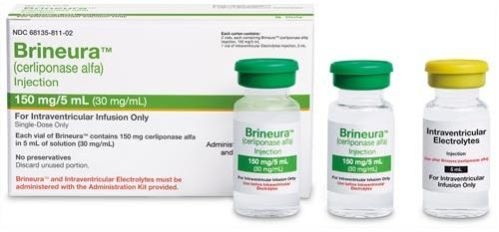
Tamaño del envase: 3 viales (dos viales de Brineura y un vial de la solución de lavado), cada uno con 5 ml de solución.
Titular de la autorización de comercialización y responsable de la fabricación
BioMarin International Limited
Shanbally, Ringaskiddy
County Cork
Irlanda
Fecha de la última revisión de este prospecto: MM/AAAA
Este medicamento se ha autorizado en «circunstancias excepcionales». Esta modalidad de aprobación significa que debido a la rareza de su enfermedad no ha sido posible obtener información completa de este medicamento.
La Agencia Europea de Medicamentos revisará anualmente la información nueva de este medicamento que pueda estar disponible y este prospecto se actualizará cuando sea necesario.
Otras fuentes de información
La información detallada de este medicamento está disponible en la página web de la Agencia Europea de Medicamentos: http://www.ema.europa.eu. También existen enlaces a otras páginas web sobre enfermedades raras y medicamentos huérfanos.
- País de registro
- Forma farmacéuticaINYECTABLE PERFUSION, 30 mg/ml
- Código ATCA16AB17
- Principio activo
- Requiere recetaSí
- Fabricante
- ComposiciónHIDROGENOFOSFATO DE SODIO HEPTAHIDRATO (0.55 mg mg), DIHIDROGENOFOSFATO DE SODIO MONOHIDRATO (0.40 mg mg), CLORURO DE SODIO (43.85 mg mg), CLORURO POTASICO (1.10 mg mg)
- Esta información es de carácter general y no sustituye la consulta con un profesional sanitario.
- Alternativas a BRINEURA 150 MG SOLUCION PARA PERFUSIONForma farmacéutica: INYECTABLE PERFUSION, 100 UPrincipio activo: LaronidasaFabricante: Sanofi B.V.Requiere recetaForma farmacéutica: INYECTABLE PERFUSION, DesconocidaPrincipio activo: ImiglucerasaFabricante: Sanofi B.V.Requiere recetaForma farmacéutica: INYECTABLE PERFUSION, 2 mg/mlPrincipio activo: IdursulfasaRequiere receta
Médicos online para BRINEURA 150 MG SOLUCION PARA PERFUSION
Comenta la dosis, los posibles efectos secundarios, interacciones, contraindicaciones o la revisión de receta de BRINEURA 150 MG SOLUCION PARA PERFUSION, sujeto a valoración médica y a la normativa local.









Preguntas frecuentes
BRINEURA 150 MG SOLUCION PARA PERFUSION requiere receta en España. Puedes confirmarlo con un médico online según tu caso.
El principio activo de BRINEURA 150 MG SOLUCION PARA PERFUSION es Cerliponasa alfa. Esta información ayuda a identificar medicamentos con la misma composición pero con diferentes nombres comerciales.
BRINEURA 150 MG SOLUCION PARA PERFUSION es fabricado por Biomarin International Limited. La marca y el envase pueden variar según el distribuidor.
Los Médicos de familia, Psiquiatras, Dermatólogos, Cardiólogos, Endocrinólogos, Gastroenterólogos, Neumólogos, Nefrólogos, Reumatólogos, Hematólogos, Infectólogos, Alergólogos, Geriatras, Pediatras, Oncólogos pueden valorar la prescripción de BRINEURA 150 MG SOLUCION PARA PERFUSION cuando esté clínicamente indicado. Puedes reservar una videoconsulta para comentar tu caso y las opciones de tratamiento.
La receta la emite un médico tras valorar tu estado de salud. En España, BRINEURA 150 MG SOLUCION PARA PERFUSION se dispensa en las farmacias con esa receta médica. Una consulta online no garantiza su emisión: la decisión corresponde siempre al médico.
Para solicitar una valoración puedes usar Oladoctor:
Otros medicamentos con el mismo principio activo (Cerliponasa alfa) incluyen ALDURAZYME, 100 U/ML CONCENTRADO PARA SOLUCION PARA PERFUSION, CEREZYME 400 UNIDADES POLVO PARA CONCENTRADO PARA SOLUCION PARA PERFUSION, ELAPRASE 2 MG/ML CONCENTRADO PARA SOLUCION PARA PERFUSION. Pueden tener diferentes nombres comerciales o formulaciones, pero contienen el mismo componente terapéutico. Consulta siempre con un médico antes de cambiar o iniciar un nuevo medicamento.
