


COXUMADOL 500 mg/30 mg GRANULADO EFERVESCENTE



Cómo usar COXUMADOL 500 mg/30 mg GRANULADO EFERVESCENTE
Traducción generada por IA
Este contenido ha sido traducido automáticamente y se ofrece solo con fines informativos. No sustituye la consulta con un profesional sanitario.
Ver originalContenido del prospecto
Introducción
Prospecto: información para el usuario
Coxumadol 500 mg/30 mg granulado efervescente
Paracetamol/Codeína fosfato hemihidrato
Si experimenta efectos adversos, consulte a su médico o farmacéutico, incluso si se trata de efectos adversos que no aparecen en este prospecto. Ver sección 4. |
Contenido del prospecto:
- Qué es Coxumadol y para qué se utiliza.
- Qué necesita saber antes de empezar a tomar Coxumadol.
- Cómo tomar Coxumadol.
- Posibles efectos adversos.
- Conservación de Coxumadol.
- Contenido del envase e información adicional.
1. Qué es Coxumadol y para qué se utiliza
Coxumadol pertenece al grupo de los medicamentos analgésicos.
Coxumadol está indicado en pacientes mayores de 15 años para el tratamiento a corto plazo del
dolor agudo moderado que no se alivia por otros analgésicos como paracetamol o ibuprofeno solos.
Este medicamento contiene codeína. La codeína pertenece a un grupo de medicamentos llamados analgésicos opiáceos que actúan aliviando el dolor. Puede utilizarse sola o en combinación con otros analgésicos como paracetamol.

2. Qué necesita saber antes de empezar a tomar Coxumadol
No tome Coxumadol:
- Si es menor de 15 años.
- Si es alérgico al paracetamol, a la codeína o a cualquiera de los demás componentes de este medicamento (incluidos en la sección 6).
- Si padece una enfermedad grave del hígado.
- Si padece depresión respiratoria aguda, asma aguda o enfermedad pulmonar obstructiva crónica.
- Para aliviar el dolor en niños y adolescentes (0-18 años de edad) tras la extracción de las amígdalas o adenoides debido al síndrome de apnea del sueño obstructiva.
- Si sabe que metaboliza muy rápido la codeína en morfina.
- Si está en periodo de lactancia.
Advertencias y precauciones
Consulte a su médico o farmacéutico antes de empezar a tomar este medicamento.
Es importante que utilice la dosis más pequeña que alivie/controle el dolor. No tomar más dosis de la recomendada por su médico o la que aparece en la sección 3 de este prospecto “Cómo tomar Coxumadol”. Para ello, evite tomar simultáneamente otros medicamentos que contengan paracetamol o codeína (usados por ejemplo, para tratar el resfriado, el dolor y la fiebre).
Durante el tratamiento con Coxumadol, informe inmediatamente a su médico:
- Si tiene alguna enfermedad del corazón o pulmón y en pacientes con anemia (disminución de la tasa de hemoglobina en la sangre, a causa o no, de una disminución de glóbulos rojos), consultar con el médico antes de tomar el medicamento.
- Si tiene problemas de hígado o riñón o sufre malnutrición crónica o se encuentra deshidratado puede requerir una reducción de la dosis de este medicamento.
- Si tiene alguna enfermedad que afecte a la capacidad para respirar, presenta lesiones intracraneales por ejemplo debidas a una contusión en la cabeza, es asmático o con antecedentes de asma, y/o sensible además al ácido acetilsalicílico.
- Si padece alguna enfermedad del tiroides, de la próstata o estrechamiento de la uretra (ambas cursan con dificultad en la micción), insuficiencia adrenal (enfermedad de Addison) o afecciones intestinales o de la vesícula biliar.
- Si es usted una persona de edad avanzada o se siente debilitado.
- Si padece estreñimiento crónico, el uso de este medicamento puede agravar los síntomas.
- Si consume bebidas alcohólicas puede provocar que el paracetamol produzca daño en el hígado. Como precaución no deben tomar más de 4 comprimidos (2 g de paracetamol) en menos de 24 horas.
- Si el dolor se mantiene durante más de 3 días, empeora o aparecen otros síntomas, se debe interrumpir el tratamiento y consultar al médico.
- La codeína se transforma en morfina en el hígado por una enzima. La morfina es la sustancia que produce el alivio del dolor. Algunas personas tienen una variación de esta enzima que puede afectar a las personas de distinta manera. En algunas personas, no se produce morfina o se produce en muy bajas cantidades, y no proporcionará suficiente alivio del dolor. Otras personas es más probable que sufran reacciones adversas graves porque en ellas se produce una cantidad muy alta de morfina. Si sufre alguno de los siguientes efectos adversos, debe dejar de tomar este medicamento y buscar ayuda médica inmediatamente: respiración lenta o superficial, confusión, somnolencia, pupilas contraídas, náuseas o vómitos, estreñimiento, falta de apetito.
- El uso prolongado o frecuente de analgésicos para tratar los dolores de cabeza puede agravar los síntomas, que no deben tratarse con dosis superiores del medicamento.
- Con la administración repetida de este fármaco puede aparecer dependencia física y tolerancia. La administración debe suspenderse gradualmente tras tratamientos prolongados según le indique su médico.
- Si necesita tomar este medicamento durante un periodo prolongado, el tratamiento debe ser el tratamiento debe ser reevaluado periódicamente por parte del médico. Si tiene enfermedades graves, como insuficiencia renal grave o sepsis (cuando las bacterias y sus toxinas circulan en la sangre, lo que provoca daños en los órganos), o si padece malnutrición, alcoholismo crónico o si también está tomando flucloxacilina (un antibiótico). Se ha notificado una enfermedad grave denominada acidosis metabólica (una anomalía en la sangre y los líquidos) en pacientes en estas situaciones cuando se utiliza paracetamol a dosis regulares durante un período prolongado o cuando se toma paracetamol junto con flucloxacilina. Los síntomas de acidosis metabólica pueden incluir: dificultad respiratoria grave con respiración profunda y rápida, somnolencia, sensación de malestar (náuseas) y vómitos.
Niños y adolescentes:
Este medicamento está contraindicado en niños y adolescentes menores de 15 años.
Uso en niños y adolescentes tras cirugía:
No se debe utilizar codeína para el alivio del dolor en adolescentes ni en niños tras la extracción de amígdalas o adenoides debido al síndrome de apnea obstructiva del sueño.
Uso en niños y adolescentes con problemas respiratorios:
No se recomienda el uso de codeína en niños y adolescentes con problemas respiratorios, dado que los síntomas de la toxicidad de la morfina pueden ser peores en estos pacientes.
Interferencias con pruebas analíticas:
Si le van a realizar alguna prueba analítica (incluidos análisis de sangre, orina, pruebas cutáneas que utilizan alergenos, etc.) comunique al médico que está tomando Coxumadol, ya que puede alterar los resultados de dichas pruebas.
Uso de Coxumadol con otros medicamentos
Comunique a su médico o farmacéutico si está tomando, ha tomado o podría tener que tomar cualquier otro medicamento.
El paracetamolpuede tener interacciones con los siguientes medicamentos:
- Anticoagulantes (utilizados para el tratamiento de enfermedades tromboembólicas), aunque el paracetamol puede administrarse ocasionalmente como analgésico de elección.
- Antiepilépticos (utilizados para el tratamiento de crisis epilépticas).
- Diuréticos (utilizados para aumentar la eliminación de orina).
- Isoniazida (utilizado para el tratamiento de la tuberculosis).
- Lamotrigina (utilizado para el tratamiento de la epilepsia).
- Probenecid (utilizado para el tratamiento de la gota).
- Propranolol (utilizado para el tratamiento de la hipertensión, arritmias cardiacas).
- Rifampicina (utilizado para el tratamiento de la tuberculosis).
- Metoclopramida y domperidona (utilizados para evitar las nauseas y los vómitos).
- Zidovudina (utilizado para el tratamiento de las infecciones por VIH).
- Colestiramina (utilizado para disminuir los niveles de colesterol en sangre).
- Flucloxacilina (antiobiótico), debido a un riesgo grave de anomalía sanguínea y de los fluidos (denominda acidosis metabólica) que debe recibir un tratamiento urgente (vease la sección 2).
Tampoco debe utilizarse con otros analgésicos (medicamentos que disminuyen el dolor) sin consultar con su médico.
La codeínapuede tener interacciones con los siguientes medicamentos:
- Analgésicos narcóticos (utilizados para el tratamiento del dolor) como la nalbufina, buprenorfina, Pentazocina.
- Alcohol: Puede potenciar el efecto depresivo de la codeína.
- Antidepresivos (utilizados para tratar la depresión).
- Sedantes (utilizados para tratar la depresión, la ansiedad).
- Antihistamínicos H1 sedantes (utilizados para tratar la alergia).
- Ansiolíticos (utilizados para tratar la ansiedad).
- Hipnóticos neurolépticos (utilizados para tratar el insomnio).
- Clonidina y relacionados (utilizados para tratar la hipertensión y la migraña).
- Talidomida (utilizado para tratar algunos tipos de cáncer).
- Benzodiacepinas.
- Medicamentos usados para el alivio de espasmos o calambres de estómago, intestino y vejiga (anticolinérgicos).
Toma de Coxumadol con alimentos, bebidas y alcohol
La utilización de paracetamol en pacientes que consumen habitualmente alcohol (tres o más bebidas alcohólicas al día) puede dañar el hígado. Además el alcohol puede potenciar el efecto depresivo de la codeína. Por lo que no debe tomarse alcohol durante el tratamiento con este medicamento.
Embarazo, lactancia y fertilidad
Embarazo:
Consulte a su médico o farmacéutico antes de utilizar cualquier medicamento.
El consumo de medicamentos durante el embarazo puede ser peligroso para el embrión o para el feto.
Si está embarazada o cree que puede estarlo consulte a su médico antes de tomar Coxumadol.
Lactancia:
Consulte a su médico o farmacéutico antes de utilizar cualquier medicamento.
No tome este medicamento si está en periodo de lactancia. Codeína y morfina pasan a la leche materna.
Conducción y uso de máquinas
Este medicamento contiene codeína que puede producir somnolencia alterando la capacidad mental y/o física. Si nota estos efectos, evite conducir vehículos o utilizar máquinas.
Uso en deportistas:Este medicamento contiene codeína. Como consecuencia de su metabolismo, se producen algunos compuestos que pueden producir un resultado positivo en las pruebas de control de dopaje.
Este medicamento contiene sacarosa y sodio. Si su médico le ha indicado que padece una intolerancia a ciertos azúcares, consúlte con él antes de tomar este medicamento.
Los pacientes con dietas pobres en sodio deben tener en cuenta que este medicamento contiene 629 mg (27,35 mmol) de sodio por sobre.
3. Cómo tomar Coxumadol
Siga exactamente las instrucciones de administración de este medicamento indicadas por su médico.
En caso de duda, consulte de nuevo a su médico o farmacéutico.
Este medicamento no se debe tomar durante más de 3 días. Si el dolor no mejora después de 3 días, pida consejo a su médico.
La dosis recomendada es:
Adultos y adolescentes mayores de 15 años: 1 ó 2 sobres, 1 a 3 veces en 24 h. Las tomas deben espaciarse al menos 4 horas. No se excederá de 8 sobres al día.
Adolescentes menores de 15 años:no deben tomar este medicamento (ver sección 2).
Niños menores de 12 años de edad:
Los niños menores de 12 años de edad no deben tomar este medicamento, debido al riesgo de sufrir problemas respiratorios graves.
Pacientes con enfermedad de hígado o de los riñones: debe consultar a su médico (ver sección 2).
Pacientes de edad avanzada:deben consultar al médico (ver sección 2).
Este medicamento debe tomarse por vía oral.
Disolver el contenido del sobre en un vaso de agua y esperar a que cese la efervescencia.
Si estima que la acción de Coxumadol es demasiado fuerte o débil, comuníqueselo a su médico o farmacéutico.
Si toma más Coxumadol de lo que debe
Si toma más Coxumadol del que debe, consulte inmediatamente a su médico o farmacéutico o llame al Servicio de Información Toxicológica, teléfono 915 620 420, indicando el medicamento y la cantidad ingerida. Se recomienda llevar el envase y el prospecto del medicamento al profesional sanitario.
Si se ha tomado una sobredosis, debe acudirse rápidamente a un centro médico aunque no haya síntomas, ya que a menudo no se manifiestan hasta pasados 3 días desde la toma de la sobredosis, aun en casos de intoxicación grave. El tratamiento de la sobredosis es más eficaz si se inicia dentro de las 4 horas siguientes a la ingestión del medicamento.
Los síntomas por sobredosis debidos al paracetamol pueden ser: mareos, vómitos, pérdida del apetito, coloración amarillenta de la piel y los ojos (ictericia) y dolor abdominal.
Los pacientes en tratamiento con barbitúricos o que padezcan alcoholismo crónico pueden ser más susceptibles a una sobredosis de paracetamol.
Los síntomas por sobredosis debidos a la codeína pueden ser: dolor de cabeza, zumbido de oídos, visión borrosa y somnolencia llegando incluso al estupor, piel fría, flacidez muscular y en ocasiones bradicardia, hipotensión y depresión respiratoria.
Si olvidó tomar Coxumadol
No tome una dosis doble para compensar las dosis olvidadas, simplemente tome la dosis olvidada cuando se acuerde, tomando las siguientes dosis con la separación entre tomas indicada en cada caso (al menos 4 horas). Sin embargo, si la hora de la siguiente toma está muy próxima, salte la dosis que olvidó y tome la dosis siguiente en su hora habitual.
Si tiene cualquier otra duda sobre el uso de este medicamento, pregunte a su médico o farmacéutico.

4. Posibles efectos adversos
Al igual que todos los medicamentos, este medicamento puede producir efectos adversos, aunque no todas las personas los sufran.
Coxumadol, por su contenido en paracetamol puede producir los siguientes efectos adversos, ordenados de acuerdo con su frecuencia:
- Raros (pueden afectar hasta 1 de cada 1.000 personas): malestar, niveles aumentados de transaminasas hepáticas (enzimas hepáticas) e hipotensión (disminución de la tensión arterial).
- Muy raros (pueden afectar hasta 1 de cada 10.000 personas): (hipersensibilidad) que oscilan entre una simple erupción cutánea (enrojecimiento o inflamación de la piel) o una urticaria (ronchas) y shock anafiláctico (un tipo de reacción alérgica grave), hepatotoxicidad (toxicidad del hígado) e ictericia (color amarillento de piel y mucosas), hipoglucemia (niveles reducidos de glucosa en sangre), trombocitopenia (reducción de plaquetas en sangre), agranulocitosis, leucopenia, neutropenia (disminución de glóbulos blancos en sangre), anemia hemolítica (disminución de glóbulos rojos en sangre), piuria estéril (orina turbia) y efectos renales adversos. Se han notificado muy raramente casos de reacciones graves en la piel.
- Frecuencia no conocida (no puede estimarse a partir de los datos disponibles): Una enfermedad grave que puede hacer que la sangre sea más ácida (denominada acidosis metabólica) en pacientes con enfermedad grave que utilizan paracetamol (ver sección 2).
Por su contenido en codeína puede producir:
- Raros (pueden afectar hasta 1 de cada 1.000 personas): Malestar, somnolencia (sensación de sueño), estreñimiento, náuseas y vértigo, broncoespasmo (espasmos en los bronquios que dificultan la respiración) y depresión respiratoria (respiración lenta).
- Muy raros (pueden afectar hasta 1 de cada 10.000 personas): Reacciones alérgicas (hipersensibilidad) que oscilan entre una simple erupción cutánea o una urticaria y shock anafiláctico, fiebre, ictericia (coloración amarillenta de la piel y los ojos), hipoglucemia (niveles reducidos de glucosa en sangre), trombocitopenia, agranulocitosis, leucopenia, neutropenia, anemia hemolítica.
Comunicación de efectos adversos
Si experimenta cualquier tipo de efecto adverso, consulte a su médico o farmacéutico, incluso si se trata de posibles efectos adversos que no aparecen en este prospecto. También puede comunicarlos directamente a través del Sistema Español de Farmacovigilancia de medicamentos de Uso Humano: https://www.notificaram.es. Mediante la comunicación de efectos adversos usted puede contribuir a proporcionar más información sobre la seguridad de este medicamento.
5. Conservación de Coxumadol
Mantener este medicamento fuera de la vista y del alcance de los niños.
No conservar a temperatura superior a 30 ºC.
No utilizar este medicamento después de la fecha de caducidad indicada en el envase, después de CAD. La fecha de caducidad es el último día del mes que se indica.
Los medicamentos no se deben tirar por los desagües ni a la basura. Deposite los envases y los medicamentos que no necesita en el Punto SIGRE de su farmacia habitual. En caso de duda pregunte a su farmacéutico cómo deshacerse de los envases y de los medicamentos que no necesita. De esta forma, ayudará a proteger el medio ambiente.
6. Contenido del envase e información adicional
Composición de Coxumadol:
- Los principios activos son paracetamol y codeína fosfato. Cada sobre contiene 500 mg de paracetamol y 30 mg de codeína fosfato hemihidrato.
- Los demás componentes (excipientes) son: sacarina sódica, sacarosa, povidona, carbonato sódico, bicarbonato sódico, ácido cítrico, citrato sódico, aroma de naranja y aroma de limón.
Aspecto del producto y contenido del envase:
Coxumadol es un granulado efervescente de color blanco amarillento con olor y sabor cítrico que se presenta en sobres monodosis.
Titular de la autorización de comercialización y Responsable de la fabricación:
Titular de la autorización de comercialización:
ITALFARMACO S.A.
San Rafael, 3, 28108 – Alcobendas (Madrid). España
Responsable de la fabricación:
Kern Pharma S.L.
Polígono Industrial Colón II
Venus 72-08228-Tarrasa (Barcelona). España
Fecha de la última revisión de este prospecto: diciembre 2024
La información detallada y actualizada de este medicamento está disponible en la página Web de la Agencia Española de Medicamentos y Productos Sanitarios (AEMPS) http://www.aemps.gob.es/
- País de registro
- Forma farmacéuticaSOLUCIÓN/SUSPENSIÓN ORAL EFERVESCENTE, 500 mg / 30 mg
- Código ATCN02AJ06
- Principio activo
- Requiere recetaSí
- Fabricante
- Esta información es de carácter general y no sustituye la consulta con un profesional sanitario.
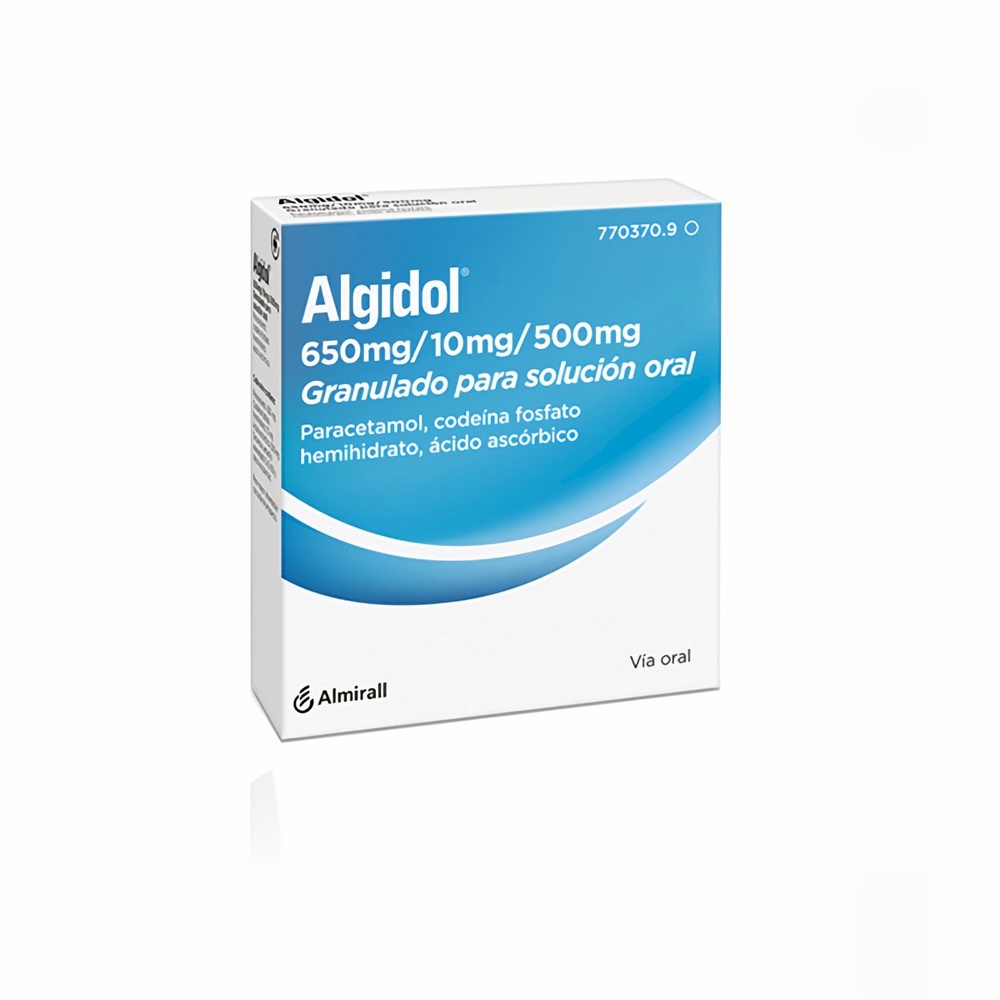
- Alternativas a COXUMADOL 500 mg/30 mg GRANULADO EFERVESCENTEForma farmacéutica: SOLUCIÓN/SUSPENSIÓN ORAL, 650/10/500 mg/mg/mgPrincipio activo: codeine and paracetamolFabricante: Laboratorios Ern S.A.Requiere recetaForma farmacéutica: COMPRIMIDO, Pracetamol 500 mg/Cafeina 30 mg/Fosf. Codeina10 mgPrincipio activo: codeine and paracetamolFabricante: Faes Farma S.A.Requiere recetaForma farmacéutica: COMPRIMIDO, 500 mg paracetamol/ 30 mg codeina fosfatoPrincipio activo: codeine and paracetamolFabricante: Faes Farma S.A.Requiere receta

Médicos online para COXUMADOL 500 mg/30 mg GRANULADO EFERVESCENTE
Comenta la dosis, los posibles efectos secundarios, interacciones, contraindicaciones o la revisión de receta de COXUMADOL 500 mg/30 mg GRANULADO EFERVESCENTE, sujeto a valoración médica y a la normativa local.











Preguntas frecuentes
