


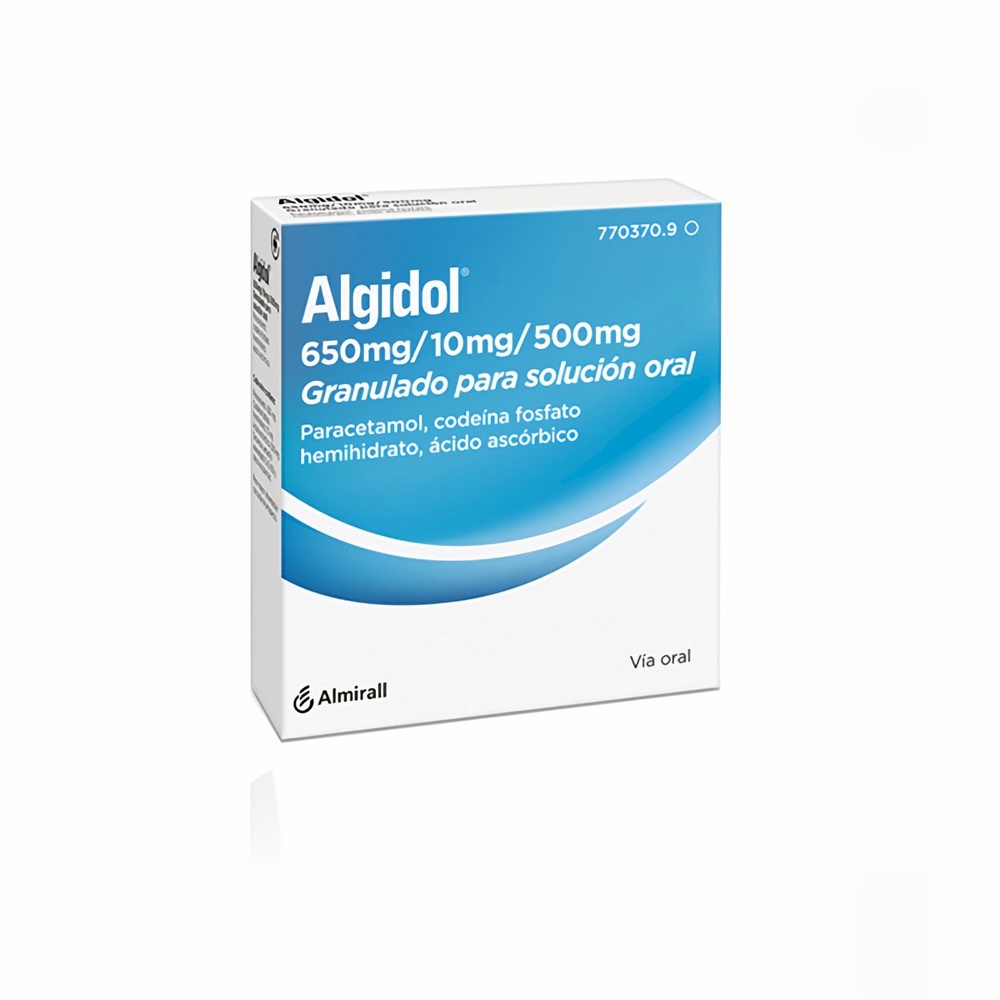
Algidol granulado para solución oral

Solicitud de receta online
Un médico revisará tu caso y determinará si la prescripción es médicamente apropiada.

Habla con un médico sobre este medicamento
Comenta tus síntomas y las opciones de tratamiento en una consulta online.



Cómo usar ALGIDOL 650 mg/ 10 mg/ 500 mg GRANULADO PARA SOLUCION ORAL
Contenido del prospecto
- Introducción
- Qué es Algidol y para qué se utiliza
- Qué necesita saber antes de empezar a tomar Algidol
- Cómo tomar Algidol
- Posibles efectos adversos
- Conservación de Algidol
- Contenido del envase e información adicional
Introducción
Prospecto: información para el usuario
Algidol 650 mg/ 10 mg/ 500 mg
granulado para solución oral
paracetamol / codeína fosfato hemihidrato / ácido ascórbico
Lea todo el prospecto detenidamente antes de empezar a tomar este medicamento, porque contiene información importante para usted.
- Conserve este prospecto, ya que puede tener que volver a leerlo.
- Si tiene alguna duda, consulte a su médico o farmacéutico.
- Este medicamento se le ha recetado solamente a usted y no debe dárselo a otras personas, aunque tengan los mismos síntomas que usted, ya que puede perjudicarles.
- Si experimenta efectos adversos, consulte a su médico o farmacéutico, incluso si se trata de efectos adversos que no aparecen en este prospecto. Ver sección 4.
Contenido del prospecto:
- Qué es Algidol y para qué se utiliza
- Qué necesita saber antes de empezar a tomar Algidol
- Cómo tomar Algidol
- Posibles efectos adversos
- Conservación de Algidol
- Contenido del envase e información adicional
1. Qué es Algidol y para qué se utiliza
Algidol contiene los principios activos paracetamol, codeína y ácido ascórbico, y pertenece al grupo de medicamentos llamados analgésicos y antipiréticos (para el tratamiento del dolor y la fiebre).
Algidol está indicado para el tratamiento sintomático del dolor de intensidad leve o moderada, así como en estados febriles.
Este producto contiene codeína. La codeína pertenece a un grupo de medicamentos llamados analgésicos opiáceos que actúan aliviando el dolor. Puede utilizarse sola o en combinación con otros analgésicos como paracetamol.
Debe consultar a un médico si el dolor o la fiebre empeoran o si no mejoran después de 3 días.

¿No estás seguro de si este medicamento es adecuado para ti?
Comenta tus síntomas y tratamiento con un médico online.
2. Qué necesita saber antes de empezar a tomar Algidol
No tome Algidol
- Si es alérgico a los principios activos o a cualquiera de los demás componentes de este medicamento (incluidos en la sección 6).
- Para aliviar el dolor en niños y adolescentes (0-18 años de edad) tras la extracción de las amígdalas o adenoides debido al síndrome de apnea del sueño obstructiva.
- Si sabe que metaboliza muy rápido la codeína en morfina.
- Si está en periodo de lactancia.
Advertencias y precauciones
Consulte a su médico o farmacéutico antes de empezar a tomar Algidol. No tome más dosis de las recomendadas en la sección 3.
Durante el tratamiento con Algidol, informe a su médico:
- Si tiene enfermedades graves, como insuficiencia renal grave o sepsis (cuando las bacterias y sus toxinas circulan en la sangre, lo que provoca daños en los órganos), o si padece malnutrición, alcoholismo crónico o si también está tomando flucloxacilina (un antibiótico). Se ha notificado una enfermedad grave denominada acidosis metabólica (una anomalía en la sangre y los líquidos) en pacientes en estas situaciones cuando se utiliza paracetamol a dosis regulares durante un período prolongado o cuando se toma paracetamol junto a flucloxacilina. Los síntomas de acidosis metabólica pueden incluir: dificultad respiratoria grave con respiración profunda y rápida, somnolencia, sensación de malestar (náuseas) y vómitos.
- En caso de padecer anemia (disminución de los glóbulos rojos en la sangre), alguna enfermedad del corazón, de los pulmones, del riñón, una enfermedad del tiroides llamada hipotiroidismo, o de una glándula denominada suprarrenal, si es usted anciano o se encuentra débil, si ha sufrido un traumatismo craneal, o si tiene un aumento del tamaño de la próstata. En estos casos evite sobre todo tratamientos prolongados, ya que el medicamento contiene paracetamol.
- Si usted es asmático y además tiene cierta sensibilidad o alergia al ácido acetilsalicílico ya que la toma de paracetamol puede provocar asma. Evite tomar dosis altas.• También se deben evitar los tratamientos prolongados en enfermedades del hígado, con o sin insuficiencia hepática (incluyendo hepatitis por virus). La dosis máxima en caso de sufrir insuficiencia hepática son 2 g/día de paracetamol (un sobre de Algidol cada 8 horas).
- Si está tomando otros medicamentos que contienen paracetamol, ya que puede aumentar su toxicidad en el hígado. Como norma general deberá tener la precaución de no tomar más de 4 g/día de paracetamol.
- El consumo de bebidas alcohólicas (tres o más bebidas alcohólicas al día) puede provocar que el paracetamol produzca daño en el hígado. En pacientes alcohólicos se deberá tener la precaución de no tomar más de 2 g/día de paracetamol (lo cual equivale a una dosis máxima de un sobre de Algidol cada 8 h).
- Si padece algún trauma craneal (lesiones en la cabeza) y presión intracraneal elevada, o si tiene depresión respiratoria (problemas para respirar), ya que pueden empeorar sus síntomas debido a la codeína.
- Evite la administración prolongada y excesiva del preparado, ya que la codeína puede ocasionar dependencia psíquica, dependencia física y tolerancia con síntomas de abstinencia después de la suspensión del fármaco. Por lo tanto, después de tratamientos prolongados, debe interrumpirse gradualmente su administración.
- Si ha padecido cálculos (piedras) en el riñón o gota, si tiene exceso de hierro en la sangre, o si es diabético, ya que el ácido ascórbico puede empeorar estas situaciones.
La codeína se transforma en morfina en el hígado por una enzima. La morfina es la sustancia que produce el alivio del dolor. Algunas personas tienen una variación de esta enzima que puede afectar a las personas de distinta manera. En algunas personas, no se produce morfina o se produce en muy bajas cantidades, y no proporcionará suficiente alivio del dolor. Otras personas es más probable que sufran reacciones adversas graves porque en ellas se produce una cantidad muy alta de morfina. Si sufre alguno de los siguientes efectos adversos, debe dejar de tomar este medicamento y buscar ayuda médica inmediatamente: respiración lenta o superficial, confusión, somnolencia, pupilas contraídas, náuseas o vómitos, estreñimiento, falta de apetito.
Consulte a su médico, incluso si cualquiera de las circunstancias anteriormente mencionadas le hubiera ocurrido alguna vez.
Interferencias con pruebas analíticas: Si le van a realizar alguna prueba diagnóstica (incluidos análisis de sangre u orina) comunique al médico que está tomando este medicamento, ya que puede alterar los resultados.
Este medicamento puede interferir con los siguientes tests de diagnóstico:
- ácido úrico
- glucosa en sangre
- glucosa en orina
- sangre en heces
- determinaciones de paracetamol en orina
Niños y adolescentes
Este medicamento no se debe utilizar en niños menores de 12 años ni en adolescentes de menos de 43 kg de peso.
Uso en niños y adolescentes tras cirugía:
No se debe utilizar codeína para el alivio del dolor en niños y adolescentes tras la extracción de amígdalas o adenoides debido al síndrome de apnea del sueño obstructiva.
Uso en niños con problemas respiratorios:
No se recomienda el uso de codeína en niños con problemas respiratorios, dado que los síntomas de la toxicidad de la morfina pueden ser peores en estos niños.
Otros medicamentos y Algidol
Comunique a su médico o farmacéutico que está utilizando, ha utilizado recientemente o podría tener que utilizar cualquier otro medicamento.
El paracetamol puede tener interacciones con los siguientes medicamentos:
- Anticoagulantes orales (utilizados para fluidificar la sangre) como el acenocumarol y la warfarina, ya que dosis superiores a 2 g/día de paracetamol pueden aumentar el efecto anticoagulante de estos medicamentos.
- Anticolinérgicos (utilizados para el alivio de espasmos o contracciones de estómago, intestino y vejiga), porque pueden retrasar o reducir la acción del paracetamol.
- Anticonceptivos orales (utilizados para evitar el embarazo) y tratamientos con estrógenos, ya que reducen el efecto del paracetamol.
- Antiepilépticos (utilizados para el tratamiento de crisis epilépticas), como fenitoína u otras hidantoínas, fenobarbital, metilfenobarbital, primidona, carbamacepina, porque pueden retrasar o reducir el efecto del paracetamol. En el caso de la lamotrigina, el paracetamol puede reducir el efecto de este medicamento.
- Antivirales utilizados para el tratamiento de las infecciones por VIH como zidovudina. El paracetamol puede reducir los efectos de este medicamento.
- Beta-bloqueantes (utilizados para el tratamiento de la hipertensión y de la taquicardia) como el propanolol, ya que pueden aumentar la acción del paracetamol.
- El antibiótico cloranfenicol (utilizado en el tratamiento de infecciones) ya que el paracetamol puede aumentar su toxicidad.
- Diuréticos del asa, como los del grupo furosemida u otros (utilizados para aumentar la eliminación de orina), porque el paracetamol puede reducir el efecto de estos medicamentos.
- Antituberculosos (utilizados para el tratamiento de la tuberculosis) como por ejemplo la isoniazida y la rifampicina, ya que pueden potenciar la acción y toxicidad del paracetamol.
- Antieméticos (utilizados para evitar las náuseas y los vómitos) como metoclopramida y domperidona, porque estos medicamentos pueden aumentar la absorción del paracetamol.
- Flucloxacilina (antibiótico), debido a un riesgo grave de alteración de la sangre y los fluidos (denominada acidosis metabólica con alto desequilibrio aniónico) que debe ser tratada urgentemente (véase la sección 2).
- Medicamentos utilizados para el tratamiento de la gota, como probenecida y sulfinpirazona, ya que el primero puede aumentar la acción del paracetamol y el segundo la puede disminuir
- Resinas de intercambio iónico (utilizadas para disminuir los niveles de colesterol en sangre) como colestiramina, porque pueden reducir la cantidad de paracetamol en la sangre.
La codeína puede interaccionar con los siguientes medicamentos:
- Analgésicos narcóticos (utilizados para tratar el dolor) como la nalbufina, buprenorfina y pentazocina. No tome Algidol si está tomando analgésicos narcóticos ya que la codeína puede reducir el efecto de estos medicamentos.
- Ansiolíticos (utilizados para tratar la ansiedad), antidepresivos (utilizados para tratar la depresión), antihistamínicos sedantes (utilizados para tratar la alergia), medicamentos utilizados para tratar la hipertensión y la migraña, como la clonidina, hipnóticos neurolépticos (utilizados para tratar el insomnio), sedantes (utilizados para tratar la depresión, la ansiedad), el medicamento talidomida (utilizado para tratar algunos tipos de cáncer). La codeína puede aumentar los efectos de estos medicamentos sobre el sistema nervioso reduciendo la capacidad de alerta.
- Otros analgésicos morfínicos, barbitúricos, benzodiacepinas (utilizados para tratar el dolor), junto con la codeína aumentan el riesgo de somnolencia, dificultad para respirar (depresión respiratoria), coma y puede poner la vida en riesgo. Debido a esto, el uso concomitante solo debe considerarse cuando otras opciones de tratamiento no son posibles.
Sin embargo, si su médico le prescribe Algidol junto con medicamentos sedantes, su médico debe limitar la dosis y la duración del tratamiento concomitante.
Informe a su médico sobre todos los medicamentos sedantes que esté tomando y siga de cerca la recomendación de la dosis de su médico. Podría ser útil informar a amigos o familiares que estén al tanto de los signos y síntomas indicados anteriormente. Póngase en contacto con su médico cuando experimente dichos síntomas.
Por su parte, el ácido ascórbico puede interaccionar con los siguientes medicamentos:
- Anticoagulantes orales (utilizados para fluidificar la sangre), ya que cantidades elevadas de ácido ascórbico (más de 2 g/día) pueden dificultar la absorción de estos medicamentos.
- Antiácidos que contengan aluminio (utilizados para aliviar la acidez de estómago), ya que el ácido ascórbico puede aumentar la absorción de aluminio y causar toxicidad.
- Anticonceptivos orales (utilizados para evitar el embarazo), como etinilestradiol, porque dosis elevadas de ácido ascórbico puede dificultar su absorción. Es recomendable utilizar métodos anticonceptivos adicionales (por ejemplo, de barrera).
- Antivirales con indinavir (utilizados para el tratamiento de personas infectadas por el VIH), porque el ácido ascórbico puede reducir la eficacia de estos medicamentos.
- Medicamentos o complementos alimenticios con cianocobalamina (vitamina B12), porque el ácido ascórbico puede reducir su efecto.
- Otros medicamentos que contengan ácido ascórbico (vitamina C), porque puede aumentar la aparición de efectos adversos debidos al ácido ascórbico.
- Medicamentos o complementos de la dieta con amigdalina (vitamina B17), porque pueden aumentar su toxicidad.
- Preparados quelantes del hierro (utilizados para reducir la cantidad de hierro y aluminio del organismo) como deferoxamina, ya que puede causar problemas del corazón.
No utilizar con otros analgésicos (medicamentos que disminuyen el dolor) sin consultar al médico. Como norma general para cualquier medicamento es recomendable informar sistemáticamente al médico o farmacéutico si está en tratamiento con otro medicamento. En caso de tratamiento con anticoagulantes orales se puede administrar ocasionalmente como analgésico de elección.
Toma de Algidol con alimentos, bebidas y alcohol
No deben ingerirse bebidas alcohólicas mientras esté en tratamiento con Algidol. Si usted toma alcohol de forma habitual informe a su médico o farmacéutico ya que puede aumentar el riesgo de los efectos tóxicos del paracetamol sobre el hígado y aumentar la alteración que la codeína produce sobre el estado de alerta.
Embarazo, lactancia y fertilidad
Si está embarazada o en periodo de lactancia, cree que podría estar embarazada o tiene intención de quedarse embarazada, consulte a su médico antes de utilizar este medicamento.
No tome codeína si está en periodo de lactancia. Codeína y morfina pasan a la leche materna.
Conducción y uso de máquinas
Tenga especial precaución al conducir vehículos, manejar maquinaria peligrosa y, en general, en aquellas actividades donde la falta de concentración y de destreza supongan un riesgo, ya que este medicamento puede producir somnolencia.
Algidol contiene sacarosa. Si su médico le ha indicado que padece una intolerancia a ciertos azúcares, consulte con él antes de tomar este medicamento.
Este medicamento puede producir reacciones alérgicas porque contiene colorante amarillo anaranjado S(E-110.) Puede provocar asma, especialmente en pacientes alérgicos al ácido acetilsalicílico.
Este medicamento contiene menos de 23 mg de sodio (1 mmol) por sobre; esto es, esencialmente “exento de sodio”.
3. Cómo tomar Algidol
Siga exactamente las instrucciones de administración de este medicamento indicadas por su médico. En caso de duda, consulte de nuevo a su médico o farmacéutico.
Este medicamento no se debe tomar durante más de 3 días. Si el dolor no mejora después de 3 días, pida consejo a su médico.
Posología:
La dosis de Algidol debe ser la que su médico le indique en función de sus necesidades individuales.
Adultos:
La dosis recomendada en adultos es de 1 sobre cada 4/6 horas, no excediendo los 6 sobres cada 24 horas.
Población pediátrica:
La dosis será según prescripción médica y se ajustará a la gravedad del proceso y la respuesta del paciente. Las dosis recomendadas son:
Adolescentes a partir de los 15 años: 1 sobre cada 4-6 horas, cuando sea necesario, no excediendo los 6 sobres cada 24 horas.
Adolescentes a partir de los 13 años de edad:
- peso entre 43 y 54 kg: 1 sobre cada 6 horas, cuando sea necesario, no excediendo los 4 sobres cada 24 horas (2,600 g de paracetamol).
- peso superior a 54 kg: hasta 1 sobre cada 4-6 horas, cuando sea necesario, no excediendo de los 5 sobres cada 24 horas (3,250 g de paracetamol).
Algidol no se debe administrar a niños menores de 12 años ni a adolescentes de menos de 43 kg de peso.
Los niños menores de 12 años de edad no deben tomar Algidol, debido al riesgo de problemas respiratorios graves.
Pacientes deedadavanzada: la dosis recomendada es de 1 sobre cada 8 horas.
Pacientes conenfermedades del hígado: antes de tomar este medicamento tiene que consultar a su médico. Debe tomar la cantidad de medicamento prescrita por su médico con un intervalo mínimo entre cada toma de 8h. No debe tomar más de 2 gramos de paracetamol en 24 horas.
Pacientesconenfermedadesdelriñón: antes de tomar este medicamento tienen que consultar a su médico.
Debido a la dosis, el medicamento no está indicado para este grupo de pacientes.
Forma de administración:
Para su administración, el contenido del sobre debe disolverse en medio vaso de agua. Algidol puede tomarse antes, durante o después de las comidas.
Si estima que el efecto de Algidol es demasiado fuerte o débil, comuníqueselo a su médico o farmacéutico.
Si toma más Algidol del que debe
Si toma más Algidol del que se le ha indicado, consulte inmediatamente al médico o consulte al Servicio de Información Toxicológica, Teléfono 915 620 420.
Si olvidó tomar Algidol
No tome una dosis doble para compensar las dosis olvidadas, simplemente tome la dosis olvidada cuando se acuerde, y tome las siguientes dosis con la separación entre tomas indicada en cada caso (al menos 4 horas).
Si tiene cualquier otra duda sobre el uso de este medicamento, pregunte a su médico o farmacéutico.

¿Has empezado a tomar el medicamento y tienes preguntas?
Comenta tus síntomas y tratamiento con un médico online.
4. Posibles efectos adversos
Al igual que todos los medicamentos, Algidol puede producir efectos adversos, aunque no todas las personas los sufran.
Los efectos adversos observados se describen a continuación según la frecuencia de presentación:
Poco frecuentes (puede afectar hasta 1 de cada 100 pacientes), raros (puede afectar hasta 1 de cada 1.000 pacientes) y muy raros (puede afectar hasta 1 de cada 10.000 pacientes).
Se han observado los siguientes efectos adversos producidos por paracetamol:
Raros: Malestar, niveles aumentados de transaminasas hepáticas (enzimas hepáticas) e hipotensión (disminución de la tensión arterial).
Muy raros: Reacciones cutáneas graves, reacciones alérgicas (hipersensibilidad) que oscilan entre una simple erupción cutánea (enrojecimiento o inflamación de la piel) o una urticaria (ronchas) y shock anafiláctico (un tipo de reacción alérgica grave), hepatotoxicidad (toxicidad del hígado) e ictericia (color amarillento de piel y mucosas), hipoglucemia (niveles reducidos de glucosa en sangre), trombocitopenia (reducción de plaquetas en sangre), agranulocitosis, leucopenia, neutropenia (disminución de glóbulos blancos en sangre), anemia hemolítica (disminución de glóbulos rojos en sangre), piuria estéril (orina turbia) y efectos renales adversos.
Frecuencia no conocida (no puede estimarse a partir de los datos disponibles): Una enfermedad grave que puede hacer que la sangre sea más ácida (denominada acidosis metabólica) en pacientes con enfermedad grave que utilizan paracetamol (ver sección 2).
Se han descrito los siguientes efectos adversos producidos por codeína:
Raros: Malestar, somnolencia (sensación de sueño), estreñimiento, náuseas y vértigo, broncoespasmo (espasmos en los bronquios que dificultan la respiración) y depresión respiratoria (respiración lenta).
Muy raros: Reacciones alérgicas (hipersensibilidad) que oscilan entre una simple erupción cutánea o una urticaria y shock anafiláctico, fiebre, ictericia (coloración amarillenta de la piel y los ojos), hipoglucemia (niveles reducidos de glucosa en sangre), trombocitopenia, agranulocitosis, leucopenia, neutropenia, anemia hemolítica.
Se han descrito los siguientes efectos adversos producidos por el ácido ascórbico:
Muy raros: hiperglucemia (niveles elevados de glucosa en sangre).
Efectos adversos de frecuencia no establecida: formación de piedras en el riñón (cálculos renales), ataques agudos de gota (en personas predispuestas), diarreas, náuseas, vómitos, dolor abdominal, reacciones alérgicas (hipersensibilidad), síndrome de asma alérgico (que se presenta con sarpullidos, urticaria, edema, prurito y más raramente shock anafiláctico).
Comunicación de efectos adversos
Si experimenta cualquier tipo de efecto adverso, consulte a su médico o farmacéutico, incluso si se trata de posibles efectos adversos que no aparecen en este prospecto. También puede comunicarlos directamente a través del Sistema Español de Farmacovigilancia de medicamentos de Uso Humano: https://www.notificaram.es. Mediante la comunicación de efectos adversos usted puede contribuir a proporcionar más información sobre la seguridad de este medicamento.
5. Conservación de Algidol
No requiere condiciones especiales de conservación.
Mantener este medicamento fuera de la vista y del alcance de los niños.
No utilice este medicamento después de la fecha de caducidad que aparece en el envase después de CAD. La fecha de caducidad es el último día del mes que se indica.
Los medicamentos no se deben tirar por los desagües ni a la basura. Deposite los envases y los medicamentos que no necesita en el Punto SIGRE de la farmacia. En caso de duda, pregunte a su farmacéutico cómo deshacerse de los envases y de los medicamentos que no necesita. De esta forma ayudará a proteger el medio ambiente.
6. Contenido del envase e información adicional
Composición de Algidol
Los principios activos son paracetamol, codeína y ácido ascórbico.
Cada sobre de Algidol contiene: 650 mg de paracetamol, 10 mg de codeína fosfato hemihidrato y 500 mg de ácido ascórbico.
Los demás componentes son sacarosa, sacarina de sodio, sílice coloidal, povidona, maltosa, celulosa microcristalina, aroma de naranja y colorante amarillo anaranjado S (E–110).
Aspecto del producto y contenido del envase
Algidol se presenta en forma de sobres monodosis con granulado para solución oral. Cada envase contiene 12 ó 20 sobres de aluminio y polietileno de baja densidad.
Titular de la autorización de comercialización
Laboratorios ERN, S.A.
C/Perú, 228
08020 Barcelona, España
Responsable de la fabricación
Industrias Farmacéuticas Almirall, S.A.
Ctra. de Martorell, 41-61, 08740 Sant Andreu de la Barca - Barcelona (España).
Fecha de la última revisión de este prospecto:enero 2025
La información detallada y actualizada de este medicamento está disponible en la página Web de la Agencia Española de Medicamentos y Productos Sanitarios (AEMPS) http://www.aemps.gob.es/
- País de registro
- Forma farmacéuticaSOLUCIÓN/SUSPENSIÓN ORAL, 650/10/500 mg/mg/mg
- Código ATCN02AJ06
- Precio medio en farmacia2.2 EUR
- Principio activo
- Requiere recetaSí
- Fabricante
- ComposiciónAZUCAR (0,500 g mg), SACARINA SODICA (0,024 g mg)
- Esta información es de carácter general y no sustituye la consulta con un profesional sanitario.
- Alternativas a ALGIDOL 650 mg/ 10 mg/ 500 mg GRANULADO PARA SOLUCION ORALForma farmacéutica: COMPRIMIDO, Pracetamol 500 mg/Cafeina 30 mg/Fosf. Codeina10 mgPrincipio activo: codeine and paracetamolFabricante: Faes Farma S.A.Requiere recetaForma farmacéutica: COMPRIMIDO, 500 mg paracetamol/ 30 mg codeina fosfatoPrincipio activo: codeine and paracetamolFabricante: Faes Farma S.A.Requiere recetaForma farmacéutica: COMPRIMIDO EFERVESCENTE, Paracetamol: 500mg y Codeina: 30mgPrincipio activo: codeine and paracetamolFabricante: Upsa S.A.S.Requiere receta
Médicos online para ALGIDOL 650 mg/ 10 mg/ 500 mg GRANULADO PARA SOLUCION ORAL
Comenta la dosis, los posibles efectos secundarios, interacciones, contraindicaciones o si una receta es apropiada para ALGIDOL 650 mg/ 10 mg/ 500 mg GRANULADO PARA SOLUCION ORAL, sujeto a valoración médica y a la normativa local.









Preguntas frecuentes
ALGIDOL 650 mg/ 10 mg/ 500 mg GRANULADO PARA SOLUCION ORAL requiere receta en España. Puedes confirmarlo con un médico online según tu caso.
El principio activo de ALGIDOL 650 mg/ 10 mg/ 500 mg GRANULADO PARA SOLUCION ORAL es codeine and paracetamol. Esta información ayuda a identificar medicamentos con la misma composición pero con diferentes nombres comerciales.
El precio medio en farmacia de ALGIDOL 650 mg/ 10 mg/ 500 mg GRANULADO PARA SOLUCION ORAL es de aproximadamente 2.2 EUR. Puede variar según el fabricante y la forma farmacéutica.
ALGIDOL 650 mg/ 10 mg/ 500 mg GRANULADO PARA SOLUCION ORAL es fabricado por Laboratorios Ern S.A.. La marca y el envase pueden variar según el distribuidor.
Los Médicos de familia, Psiquiatras, Dermatólogos, Cardiólogos, Endocrinólogos, Gastroenterólogos, Neumólogos, Nefrólogos, Reumatólogos, Hematólogos, Infectólogos, Alergólogos, Geriatras, Pediatras, Oncólogos pueden valorar la prescripción de ALGIDOL 650 mg/ 10 mg/ 500 mg GRANULADO PARA SOLUCION ORAL cuando esté clínicamente indicado. Puedes reservar una videoconsulta para comentar tu caso y las opciones de tratamiento.
La receta la emite un médico tras valorar tu estado de salud. En España, ALGIDOL 650 mg/ 10 mg/ 500 mg GRANULADO PARA SOLUCION ORAL se dispensa en las farmacias con esa receta médica. Una consulta online no garantiza su emisión: la decisión corresponde siempre al médico.
Para solicitar una valoración puedes usar Oladoctor:
Otros medicamentos con el mismo principio activo (codeine and paracetamol) incluyen ANALGILASA 500 mg /30 mg/ 10 mg COMPRIMIDOS RECUBIERTOS CON PELICULA, ANALGIPLUS 500 mg/30 mg COMPRIMIDOS RECUBIERTOS CON PELICULA, COD-EFFERALGAN 500 mg/ 30 mg comprimidos efervescentes. Pueden tener diferentes nombres comerciales o formulaciones, pero contienen el mismo componente terapéutico. Consulta siempre con un médico antes de cambiar o iniciar un nuevo medicamento.
