



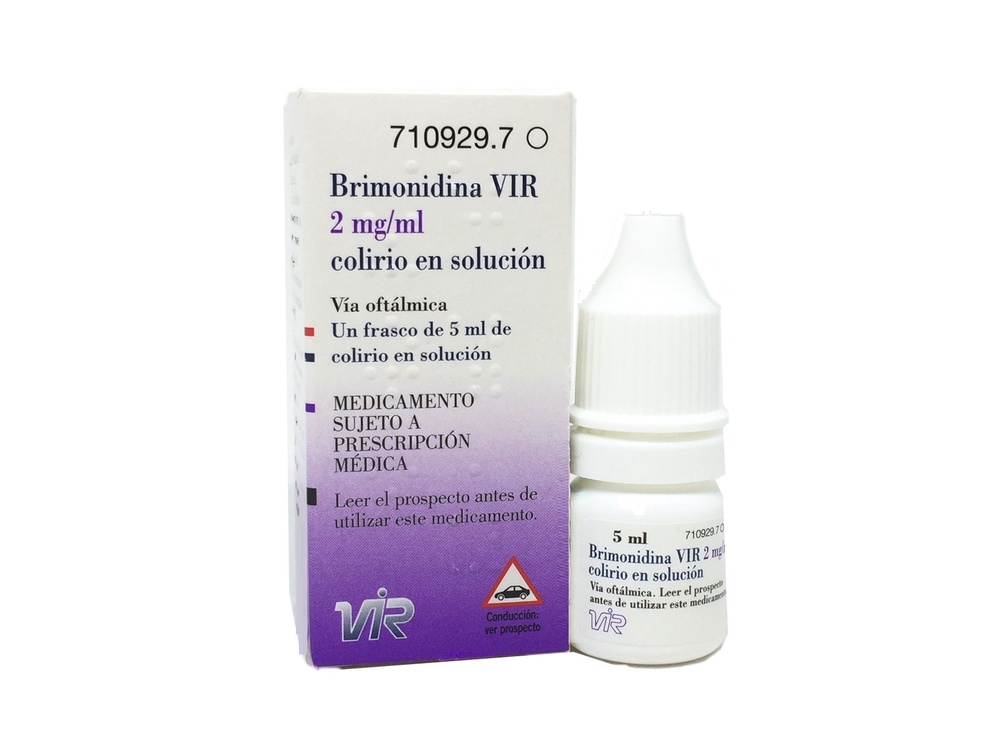
BRIMONIDINA 2 mg /Ml Colirio En Solución

Revisión de receta online
Un médico revisará tu caso y determinará si la prescripción es médicamente apropiada.

Habla con un médico sobre este medicamento
Comenta tus síntomas y las opciones de tratamiento en una consulta online.



Cómo usar BRIMONIDINA VIATRIS 2 mg/ml COLIRIO EN SOLUCION
Contenido del prospecto
- Introducción
- Qué es Brimonidina Viatris y para qué se utiliza
- Qué necesita saber antes de usar Brimonidina Viatris
- Cómo usar Brimonidina Viatris
- Posibles efectos adversos
- Conservación de Brimonidina Viatris
- Contenido del envase e información adicional
Introducción
Prospecto: información para el paciente
Brimonidina Viatris 2 mg/ml colirio en solución
Tartrato de brimonidina
Lea todo el prospecto detenidamente antes de empezar a usar el medicamento, porque contiene información importante para usted.
- Conserve este prospecto, ya que puede tener que volver a leerlo.
- Si tiene alguna duda, consulte a su médico o farmacéutico.
- Este medicamento se le ha recetado solamente a usted y no debe dárselo a otras personas, aunque tengan los mismos signos, ya que puede perjudicarles.
- Si experimenta efectos adversos, consulte a su médico, o farmacéutico, incluso si se trata de efectos adversos que no aparecen en este prospecto. Ver sección 4.
Contenido del prospecto
- Qué es Brimonidina Viatris y para qué se utiliza
- Qué necesita saber antes de empezar a usar Brimonidina Viatris
- Cómo usar Brimonidina Viatris
- Posibles efectos adversos
- Conservación de Brimonidina Viatris
- Contenido del envase e información adicional
1. Qué es Brimonidina Viatris y para qué se utiliza
Brimonidina Viatris contiene el principio activo tartrato de brimonidina, que se utiliza para reducir la presión intraocular (presión en el interior del ojo) en pacientes con glaucoma de ángulo abierto o hipertensión ocular (presión de líquido en el interior del ojo).
Brimonidina Viatris puede usarse solo o en combinación con otros medicamentos para reducir la presión intraocular.

¿No estás seguro de si este medicamento es adecuado para ti?
Comenta tus síntomas y tratamiento con un médico online.
2. Qué necesita saber antes de usar Brimonidina Viatris
No use Brimonidina Viatris:
- Si es alérgico a brimonidina o a cualquiera de los demás componentes de este medicamento (incluidos en la sección 6).
- Si está siendo tratado con medicamentos clasificados como inhibidores de la monoaminooxidasa (inhibidores de la MAO), utilizado para tratar la depresión o la enfermedad de Parkinson, por ejemplo, selegilina, fenelzina.
- Si está siendo tratado con ciertos medicamentos antidepresivos (como los antidepresivos tricíclicos, por ejemplo, clomipramina, amitriptilina o mianserina).
Debe informar al médico si está tomando algún medicamento antidepresivo.
- Si el paciente es un neonato o en niños (hasta los 2 años).
Advertencias y precauciones
Consulte a su médico o farmacéutico antes de empezar a usar Brimonidina Viatris
- Si tiene alguna enfermedad de corazón grave o inestable, que no está respondiendo al tratamiento.
- Si padece depresión.
- Si sufre una disminución en el aporte sanguíneo afectando al cerebro (insuficiencia cerebral) o al corazón, por ejemplo, angina de pecho o los vasos sanguíneos bloqueados.
- Si tiene bajadas de presión sanguínea que provoquen vértigo y mareos al incorporarse o levantarse después de estar tumbado (hipotensión ortostática).
- Si padece constricción en los vasos sanguíneos, principalmente de las manos y brazos (enfermedad de Raynaud), o alguna enfermedad inflamatoria vascular con una obstrucción de los vasos sanguíneos como resultado de coagulación (tromboangiítis obliterante).
- Si padece insuficiencia renal o hepática.
Niños y adolescentes
No administre tartrato de brimonidina a recién nacidos o niños (desde el nacimiento hasta los 2 años).
Tartrato de brimonidina, normalmente, no está recomendada en niños (de 2 a 12 años), debido a un aumento del riesgo de efectos adversos (por ejemplo, somnolencia).
Otros medicamentos y Brimonidina Viatris
Informe a su médico o farmacéutico si está utilizando, ha utilizado recientemente o pudiera tener que utilizar cualquier otro medicamento.
No utilice Brimonidina Viatris si está siendo tratado con MAO (inhibidor de la monoaminooxidasa), un antidepresivo tricíclico o mianserina (ver "No tomar”).
Sustancias que afectan al sistema nervioso central (SNC):el efecto de sustancias que afectan al SNC (tales como alcohol, barbitúricos, por ejemplo, usados en la epilepsia como fenobarbital, opiáceos usados en el alivio del dolor, por ejemplo, codeína, sedantes usados para adormir, por ejemplo, diazepam o anestésicos) puede verse incrementado por tartrato de brimonidina.
Medicamentos para el tratamiento de trastornos del sistema nervioso (clorpromazina, metilfenidato), medicamentos antihipertensivos (reserpina):se recomienda precaución en el caso de pacientes tratados con medicamentos que pueden afectar la absorción y metabolismo de la adrenalina, noradrenalina y las denominadas aminas biogénicas en sangre.
Agentes antihipertensivos, medicamentos para el corazón:se ha detectado en algunos pacientes una ligera disminución en la presión sanguínea tras la administración de tartrato de brimonidina. Se recomienda precaución si se utiliza Brimonidina Viatris junto con agentes antihipertensivos (utilizados para tratar la presión arterial alta) y/o medicamentos para el corazón del grupo de los digitálicos glicosídicos.
Agonistas o antagonistas de los receptores adrenérgicos:se recomienda precaución si está tomando agonistas ?-adrenérgicos, tales como la fenilefrina (por ejemplo, gotas para los ojos, aerosoles nasales) o antagonistas (por ejemplo, isoprenalina o prazosina (que puede usarse para tratar la presión arterial alta u otros problemas circulatorios)).
Embarazo y lactancia
Si está embarazada o en periodo de lactancia, cree que podría estar embarazada o tiene intención de quedarse embarazada, consulte a su médico o farmacéutico antes de utilizar este medicamento.
Embarazo
Aún no se han llevado a cabo estudios para determinar si es seguro el uso de tartrato de brimonidina durante el embarazo. En consecuencia, Brimonidina Viatris debe ser utilizada con precaución durante el embarazo y únicamente, si el beneficio esperado para la madre justifica el posible riesgo para el feto.
Lactancia
Se desconoce si tartrato de brimonidina se excreta por la leche materna. Brimonidina Viatris no se debe administrar a mujeres en período de lactancia.
Conducción y uso de maquinaria
Brimonidina Viatris puede causar cansancio y/o somnolencia. Esto puede afectar a la capacidad para conducir o manejar maquinaria de forma segura.
Brimonidina Viatris puede causar visión borrosa y/o visión alterada, lo que puede afectar a la capacidad para conducir o utilizar máquinas de forma segura, especialmente por la noche o cuando exista poca luz y bajo condiciones lumínicas pobres.
Espere hasta que estos efectos desaparezcan para conducir o usar maquinaria.
Brimonidina Viatris contiene cloruro de benzalconio
Este medicamento contiene 0.05 mg de cloruro de benzalconio en cada mililitro de colirio en solución. Cloruro de benzalconio se puede absorber por las lentes de contacto blandas y puede alterar el color de las lentes de contacto. Retirar las lentes de contacto antes de usar este medicamento y esperar 15 minutos antes de volver a colocarlas.
Cloruro de benzalconio puede causar irritación ocular, especialmente si padece de ojo seco u otras enfermedades de la córnea (la capa transparente del frente del ojo). Consulte a su médico si siente una sensación extraña, escozor o dolor en el ojo después de usar este medicamento.
3. Cómo usar Brimonidina Viatris
Siga exactamente las instrucciones de administración de este medicamento indicadas por su médico o farmacéutico. Consulte a su médico o farmacéutico si tiene dudas.
Es muy importante utilizar Brimonidina Viatris durante el periodo de tiempo prescrito por su médico.
Si cree que el efecto de Brimonidina Viatris es demasiado fuerte o demasiado débil, consulte con su médico.
Adultos (incluyendo pacientes de edad avanzada)
A menos que su médico le haya indicado otra cosa, la dosis recomendada es una gota en el ojo o los ojos afectados, dos veces al día, con un intervalo de dosis de aproximadamente 12 horas.
Instrucciones de empleo
Brimonidina es un medicamento para utilizar vía oftálmica. No se debe tragar.
Siempre se deben lavar las manos antes de la aplicación del colirio.
Aplicar las gotas de la siguiente manera:
- Incline la cabeza hacia atrás y mire hacia arriba.
- Tire suavemente hacia abajo del párpado inferior hasta que quede un pequeño hueco.
- Invierta el frasco y apriételo para que caiga una gota en el ojo.
Inmediatamente después de aplicar cada gota, cierre el ojo y apriete con su dedo la parte del lagrimal (esquina interna del ojo) durante 1 minuto. Esto ayuda a reducir la absorción de tartrato de brimonidina en su cuerpo.
Si está utilizando más de un medicamento por vía oftálmica, los medicamentos se deben aplicar, al menos, con 5-15 minutos de diferencia entre ellos.
Después de su uso vuelva a tapar inmediatamente. Evite tocar con la punta del gotero el ojo o cualquier otra cosa.
Si usa más Brimonidina Viatris del que debe
Adultos
Los efectos adversos en la sección 4 del prospecto, han sido notificados para adultos que han usado más tartrato de brimonidina del recomendado, en el ojo.
En casos de adultos que habían tragado accidentalmente tartrato de brimonidina, se informó de presión arterial baja. En algunos pacientes, esto fue seguido de un fuerte aumento de la presión arterial.
Consulte a su médico inmediatamente si ha ingerido tartrato de brimonidina. Los siguientes efectos adversos han sido reportados en otros medicamentos que tienen una forma similar de trabajar que brimonidina cuando se ingiere: debilidad inusual, vómitos, cansancio, disminución de la consciencia, ritmo cardíaco lento, cambios en la frecuencia cardíaca, disminución del tamaño de la pupila del ojo, disminución del tono muscular, dificultades respiratorias, temperatura corporal baja y convulsiones.
Niños
Se han notificado casos de sobredosis en niños que habían ingerido accidentalmente tartrato de brimonidina. Los síntomas incluyen, coma temporal o bajo nivel de consciencia, cansancio, somnolencia, decaimiento, ritmo cardíaco lento, baja temperatura corporal, palidez y dificultad para respirar. Si sufre cualquiera de estos síntomas, consulte inmediatamente a su médico.
Adultos y niños
En caso de sobredosis o ingestión accidental, consulte inmediatamente a su médico o farmacéutico o llame al Servicio de Información Toxicológica, teléfono: 91 562 04 20. Lleve el envase del medicamento con usted para que el médico conozca lo que ha tomado.
Si olvidó usar Brimonidina Viatris
Si olvidó utilizar Brimonidina Viatris, aplíquese la dosis olvidada tan pronto como se acuerde. Sin embargo, si casi es la hora de la siguiente dosis, omita la dosis olvidada y continúe con la siguiente aplicación a la hora habitual. No se aplique una dosis doble para compensar la dosis olvidada.
No cambie la dosis prescrita por su cuenta.
Si interrumpe el tratamiento con Brimonidina Viatris
No interrumpa o suspenda el tratamiento con Brimonidina Viatris sin haberlo consultado previamente con su médico.
Si tiene cualquier otra duda sobre el uso de este medicamento, pregunte a su médico o farmacéutico.

¿Has empezado a tomar el medicamento y tienes preguntas?
Comenta tus síntomas y tratamiento con un médico online.
4. Posibles efectos adversos
Al igual que todos los medicamentos, este medicamento puede producir efectos adversos, aunque no todas las personas los sufran.
Si nota cualquiera de los siguientes efectos adversos, o un empeoramiento durante el tratamiento con tartrato de brimonidina, contacte con su médico u hospital inmediatamente.
Muy frecuentes: pueden afectar a más de 1 de cada 10 personas
- Irritación de los ojos, incluyendo reacciones alérgicas (enrojecimiento, dolor,escozor, quemazón, picor, sensación de tener un cuerpo extraño en el ojo).
Frecuentes: pueden afectar hasta 1 de cada 10 personas
- Decoloración/coloración de la córnea (la superficie del ojo), ampollas, hinchazón o daño grave (que puede ser visto por un oftalmólogo o causar molestias o dolor en los ojos) en la superficie del ojo (erosión corneal y manchas).
Poco frecuente: pueden afectar hasta 1 de cada 100 personas
- Reacciones alérgicas, que pueden causar dificultades respiratorias, falta de aliento, hinchazón de la cara, garganta o lengua.
Muy raras: pueden afectar hasta 1 de cada 10.000 personas
- Inflamación de la parte coloreada del ojo, lo que puede causar enrojecimiento, visión borrosa y cambios en la forma de las pupilas (parte negra del ojo) y dolor de cabeza (iritis).
Otros efectos adversos incluyen:
Muy frecuentes: pueden afectar a más de 1 de cada 10 personas
- Enrojecimiento, lagrimeo de los ojos y picazón de los ojos con una secreción pegajosa (conjuntivitis, que puede ser debido a la alergia o infección), visión borrosa, hinchazón y enrojecimiento del párpado (que puede ser debido a la alergia (blefaritis)), elevación en la superficie del ojo, lo que puede ser visto por un óptico (folículos conjuntivales).
- Dolor de cabeza, sequedad de boca, cansancio/somnolencia.
Frecuentes: pueden afectar hasta 1 de cada 10 personas
- Ojos llorosos, sensibilidad a la luz, daño en la parte frontal del ojo (daño superficial en la córnea), ojos secos, visión anormal.
- Síntomas en las vías respiratorias superiores, mareo, dolor de estómago e intestino, debilidad, alteración del gusto.
Poco frecuentes:pueden afectar hasta 1 de cada 100 personas
- Latidos/ritmo cardíaco irregular (incluyendo latidos lentos o rápidos), depresión, sequedad nasal.
Raras: pueden afectar hasta 1 de cada 1000 personas
- Falta de aliento (disnea).
Muy raras:pueden afectar hasta 1 de cada 10.000 personas
- Reducción del tamaño de la pupila (miosis).
- Síncope, aumento de la presión arterial (hipertensión), disminución de la presión arterial (hipotensión), insomnio.
Frecuencia no conocida: la frecuencia no puede estimarse a partir de los datos disponibles
- Reacciones de la piel, incluyendo hinchazón de la cara, enrojecimiento de la piel (que puede ser debido a la dilatación de los vasos sanguíneos), picor de la piel, erupción, picor en los párpados.
Otros efectos adversos en niños y adolescentes
Muy frecuentes: pueden afectar a más de 1 de cada 10 niños:
- Somnolencia. Esto puede afectar a más de 1 de cada 2 niños.
Comunicación de efectos adversos:
Si experimenta cualquier tipo de efecto adverso, consulte a su médico o farmacéutico, incluso si se trata de posibles efectos adversos que no aparecen en este prospecto. También puede comunicarlos directamente a través del Sistema Español de Farmacovigilancia de Medicamentos de Uso Humano: https://www.notificaram.es. Mediante la comunicación de efectos adversos usted puede contribuir a proporcionar más información sobre la seguridad de este medicamento.
5. Conservación de Brimonidina Viatris
Mantener este medicamento fuera de la vista y del alcance de los niños.
No utilice este medicamento después de la fecha de caducidad que aparece en la etiqueta y el envase después de CAD. La fecha de caducidad es el último día del mes que se indica.
Este medicamento no requiere condiciones especiales de conservación.
Después de abrir por primera vez, Brimonidina Viatris se debe utilizar dentro de los 28 días posteriores a la apertura.
Los medicamentos no se deben tirar por los desagües ni a la basura. Deposite los envases y los medicamentos que no necesita en el Punto SIGREde la farmacia. En caso de duda pregunte a su farmacéutico cómo deshacerse de los envases y de los medicamentos que no necesita. De esta forma, ayudará a proteger el medio ambiente.
6. Contenido del envase e información adicional
Composición deBrimonidina Viatris
- El principio activo es: tartrato de brimonidina.1 ml de solución contiene 2 mg de tartrato de brimonidina, equivalente a 1,3 mg de brimonidina.
- Los demás componentes son:cloruro de benzalconio (ver sección 2 “Brimonidina Viatris contiene cloruro de benzalconio”), alcohol polivinílico, cloruro de sodio, citrato de sodio, ácido cítrico monohidrato, agua purificada, hidróxido sódico y ácido clorhídrico para ajuste del pH.
Aspecto del producto y contenido del envase
Brimonidina Viatris es una solución clara ligeramente amarillo verdosa.
Está disponible en frasco de plástico de 5 ml con tapón cuentagotas, en envases de 1, 3 o 6.
Puede que solamente estén comercializados algunos tamaños de envases.
Titular de la autorización de comercialización
Viatris Limited
Damastown Industrial Park
Mulhuddart, Dublín 15
Dublín
Irlanda
Responsable de la fabricación
Mylan SAS
117 Allée des Parcs
69800 Saint Priest
Francia
o
Famar A.V.E. Alimos Plant
63 Agiou Dimitriou str.
17456 – Alimos Attiki
Grecia
Pueden solicitar más información respecto a este medicamento dirigiéndose al representante local del titular de la autorización de comercialización:
Viatris Pharmaceuticals, S.L.U.
C/ General Aranaz, 86
28027 - Madrid
España
Este medicamento está autorizado en los estados miembros del Espacio Económico Europeo con los siguientes nombres:
Austria: Brimonidin Arcana 2 mg/ml – Augentropfen
Dinamarca: Glaudin
España: Brimonidina Viatris 2 mg/ml colirio en solución
Francia: Brimonidine Viatris 0,2% (2 mg/ml), collyre en solution
Italia: Brimonidina Viatris Generics
Países Bajos: Brimonidinetartraat Viatris 2 mg/ml, oogdruppels (oplossing)
Portugal: Brimonidina Viatris, 2 mg/mL, colirio solução
Reino Unido: Brimonidine tartrate 2 mg/ml eye drops, solution
Suecia: Glaudin 2 mg/ml ögondroppar, lösning
Fecha de la última revisión de este prospecto: Diciembre 2021
La información detallada y actualizada de este medicamento está disponible en la página web de la Agencia Española de Medicamentos y Productos Sanitarios (AEMPS) https://www.aemps.gob.es/
- País de registro
- Forma farmacéuticaCOLIRIO, 2 MG/ML
- Código ATCS01EA05
- Precio medio en farmacia7.31 EUR
- Principio activo
- Requiere recetaSí
- Fabricante
- ComposiciónBENZALCONIO, CLORURO DE (0.05 mg mg), CLORURO DE SODIO (6.90 mg mg), CITRATO DE SODIO (E-331) (4.70 mg mg), HIDROXIDO DE SODIO (E 524) (QS PH 6.4 - mg)
- Esta información es de carácter general y no sustituye la consulta con un profesional sanitario.
- Alternativas a BRIMONIDINA VIATRIS 2 mg/ml COLIRIO EN SOLUCIONForma farmacéutica: COLIRIO, 2 mg/mlPrincipio activo: BrimonidinaFabricante: Tiedra Farmaceutica S.L.Requiere recetaForma farmacéutica: COLIRIO, 2 mg/ml de tartrato de brimonidinaPrincipio activo: BrimonidinaFabricante: Abbvie Spain, S.L.U.Requiere recetaForma farmacéutica: COLIRIO, 2 MG/MLPrincipio activo: BrimonidinaFabricante: Industria Quimica Y Farmaceutica Vir S.A.Requiere receta
Médicos online para BRIMONIDINA VIATRIS 2 mg/ml COLIRIO EN SOLUCION
Comenta la dosis, los posibles efectos secundarios, interacciones, contraindicaciones o la revisión de receta de BRIMONIDINA VIATRIS 2 mg/ml COLIRIO EN SOLUCION, sujeto a valoración médica y a la normativa local.









Obtén una receta de BRIMONIDINA VIATRIS 2 mg/ml COLIRIO EN SOLUCION online
Rellena un formulario de 2 minutos
Cuéntanos tus síntomas, historial y el medicamento que necesitas.
Elige un médico o nosotros te asignamos uno
Escoge un especialista o te conectamos con el próximo médico disponible.
El médico revisa tu caso
Normalmente en 30 minutos. Puede hacerte preguntas adicionales por chat.
Recógela en cualquier farmacia
Receta electrónica enviada a tu correo, válida en toda España.
Preguntas frecuentes
BRIMONIDINA VIATRIS 2 mg/ml COLIRIO EN SOLUCION requiere receta en España. Puedes confirmarlo con un médico online según tu caso.
El principio activo de BRIMONIDINA VIATRIS 2 mg/ml COLIRIO EN SOLUCION es Brimonidina. Esta información ayuda a identificar medicamentos con la misma composición pero con diferentes nombres comerciales.
El precio medio en farmacia de BRIMONIDINA VIATRIS 2 mg/ml COLIRIO EN SOLUCION es de aproximadamente 7.31 EUR. Puede variar según el fabricante y la forma farmacéutica.
BRIMONIDINA VIATRIS 2 mg/ml COLIRIO EN SOLUCION es fabricado por Viatris Limited. La marca y el envase pueden variar según el distribuidor.
Los Médicos de familia, Psiquiatras, Dermatólogos, Cardiólogos, Endocrinólogos, Gastroenterólogos, Neumólogos, Nefrólogos, Reumatólogos, Hematólogos, Infectólogos, Alergólogos, Geriatras, Pediatras, Oncólogos pueden valorar la prescripción de BRIMONIDINA VIATRIS 2 mg/ml COLIRIO EN SOLUCION cuando esté clínicamente indicado. Puedes reservar una videoconsulta para comentar tu caso y las opciones de tratamiento.
España cuenta con una infraestructura sanitaria bien desarrollada en ciudades principales como Madrid, Barcelona, Valencia y Sevilla. Las farmacias están ampliamente disponibles y operan bajo estrictas regulaciones, garantizando el acceso a medicamentos con receta.
Puedes comprar BRIMONIDINA VIATRIS 2 mg/ml COLIRIO EN SOLUCION en Madrid, Barcelona, Sevilla o Valencia en cualquier farmacia local con una receta válida.
Para obtener una receta, puedes utilizar Oladoctor:
Otros medicamentos con el mismo principio activo (Brimonidina) incluyen ABRADEL 2 MG/ML COLIRIO EN SOLUCION, ALPHAGAN 2 mg/ml COLIRIO EN SOLUCION, BRIMONIDINA VIR 2 mg/ml COLIRIO EN SOLUCION. Pueden tener diferentes nombres comerciales o formulaciones, pero contienen el mismo componente terapéutico. Consulta siempre con un médico antes de cambiar o iniciar un nuevo medicamento.
