






Cómo usar ARTICAINA/EPINEFRINA NORMON 40 MG/ML + 10 MICROGRAMOS/ML SOLUCIÓN INYECTABLE EFG
Traducción generada por IA
Este contenido ha sido traducido automáticamente y se ofrece solo con fines informativos. No sustituye la consulta con un profesional sanitario.
Ver originalContenido del prospecto
Introducción
Prospecto: información para el paciente
Articaína/Epinefrina Normon40mg/ml + 10microgramos/mlsolución inyectable EFG
articaína hidrocloruro/epinefrina (adrenalina)
Lea todo el prospecto detenidamente antes de empezar a usar este medicamento, porque contiene información importante para usted.
- Conserve este prospecto, ya que puede tener que volver a leerlo.
- Si tiene alguna duda, consulte a su dentista, médico o farmacéutico.
- Si experimenta efectos adversos, consulte a su dentista, médico o farmacéutico, incluso si se trata de efectos adversos que no aparecen en este prospecto. Ver sección 4.
Contenido del prospecto
- Qué es Articaína/Epinefrina Normon y para qué se utiliza
- Qué necesita saber antes de empezar a usar Articaína/Epinefrina Normon
- Cómo usar Articaína/Epinefrina Normon
- Posibles efectos adversos
- Conservación de Articaína/Epinefrina Normon
- Contenido del envase e información adicional
1. Qué es Articaína/Epinefrina Normon y para qué se utiliza
Articaína/Epinefrina Normon es un anestésico local (medicamento que se utiliza para entumecer a nivel local) para uso en odontología. Contiene el anestésico local articaína, así como epinefrina (adrenalina). La epinefrina estrecha los vasos sanguíneos del lugar de inyección y da lugar a isquemia local en la zona, así como a la prolongación del efecto del anestésico local.
Articaína/Epinefrina Normon se emplea para anestesia por infiltración y anestesia por bloqueo nervioso antes de tratamientos dentales. Esto incluye:
- Intervenciones quirúrgicas en la membrana mucosa y el tejido óseo que requieren una isquemia más fuerte.
- Intervenciones quirúrgicas en la pulpa (amputación y extirpación).
- Extracción de dientes desmodoncia o fracturados (osteotomía).
- Procedimientos quirúrgicos más prolongados.
- Osteosíntesis percutánea.
- Cistectomía.
- Procedimientos mucogingivales.
- Resección del ápice radicular.

2. Qué necesita saber antes de empezar a usar Articaína/Epinefrina Normon
No use Articaína/Epinefrina Normon
- Si es alérgico a la articaína o a otros anestésicos locales de tipo ácido-amida.
- Si es alérgico a la epinefrina o a alguno de los demás componentes de este medicamento (incluidos en la sección 6).
- Si padece arritmias cardíacas graves (p. ej., bloqueo AV de segundo y tercer grado).
- Si tiene el pulso muy bajo.
- Si padece insuficiencia cardíaca congestiva (debilidad cardíaca aguda, p. ej., dolor torácico inesperado en reposo o después de una lesión miocárdica [p. ej., ataque al corazón]).
- Si tiene la presión arterial muy baja.
- Si tiene asma bronquial y padece hipersensibilidad al sulfito (ataques de asma provocados por el sulfito).
- Si padece epilepsia que no se controla con un tratamiento médico adecuado.
Debido a los efectos del principio activo epinefrina, no debería emplearse articaína/epinefrina:
- Si padece presión intraocular elevada (glaucoma).
- Si tiene hipertiroidismo.
- Si tiene ataques de frecuencia cardíaca elevada (taquicardia paroxística).
- Si tiene un tipo específico de arritmia cardíaca (arritmia absoluta con latido rápido e irregular).
- Si ha sufrido un ataque al corazón en los últimos 3 o 6 meses.
- Si ha tenido un baipás coronario en los últimos 3 meses.
- Si toma ciertos betabloqueantes (p. ej., propanolol), existe riesgo de que padezca una crisis de tensión arterial elevada (presión sanguínea muy elevada) o una desaceleración grave de la frecuencia cardíaca.
- Si padece feocromocitoma (tumor productor de adrenalina que normalmente se encuentra en la médula suprarrenal).
- Si tiene la presión arterial muy alta.
- Si está siendo tratado al mismo tiempo con ciertos antidepresivos y medicamentos antiparkinsonianos (antidepresivos tricíclicos o inhibidores de la MAO), ya que estos principios activos pueden aumentar los efectos cardiovasculares de la epinefrina; esto puede aplicarse hasta 14 días después de finalizar un tratamiento con inhibidores de la MAO.
Articaína/epinefrina no puede administrarse por vía intravenosa (en vena).
Debido al contenido de epinefrina, Articaína/Epinefrina Normon no está indicado para anestesia de la falange distal de las extremidades (p. ej., dedos de la mano y el pie) porque existe riesgo de que se bloquee el riego sanguíneo local.
Advertencias y precauciones
Consulte a su dentista o farmacéutico antes de empezar a usar Articaína/Epinefrina Normon:
- Si padece una deficiencia de una enzima específica (deficiencia de colinesterasa), ya que cabe esperar un aumento prolongado y a veces aumentado del efecto de articaína/epinefrina.
- Si presenta inflamación o infección de la zona de la inyección. En este caso, se puede anticipar un aumento de la absorción de articaína/epinefrina, lo cual reduce la eficacia.
- Si tiene más de 70 años.
- Si presenta reducción del nivel de oxígeno en el tejido corporal (hipoxia), un nivel elevado de potasio en sangre (hiperpotasemia) y alteraciones metabólicas debido a un exceso de ácido en sangre (acidosis metabólica).
Articaína/Epinefrina Normon solo debe usarse tras un riguroso examen médico:
- Si padece trastornos de la coagulación.
- Si padece trastornos de la función renal (p. ej., nefritis).
- Si padece trastornos de la función hepática (p. ej., cirrosis hepática).
- Si está recibiendo de manera simultánea otros anestésicos locales, es decir, medicamentos que provocan una pérdida reversible de la sensibilidad, lo que incluye los anestésicos por inhalación, como el halotano (ver “Otros medicamentos y Articaína/Epinefrina Normon”).
- Si padece epilepsia (ver sección 4).
- Si, de manera simultánea, toma medicamentos llamados inhibidores de la agregación plaquetaria o inhibidores de la coagulación para prevenir la constricción y/o el endurecimiento de los vasos sanguíneos de los brazos y las piernas.
- Si tiene la tensión arterial baja.
- Si padece una enfermedad llamada miastenia gravis provoca debilidad muscular.
- Si padece una enfermedad llamada porfiria que provoca complicaciones neurológicas o problemas cutáneos.
- En caso de reducción del nivel de oxígeno en el tejido corporal (hipoxia), un nivel elevado de potasio en sangre (hiperpotasemia) y alteraciones metabólicas debido a un exceso de ácido en sangre (acidosis metabólica).
Si padece las siguientes enfermedades, entonces, Articaína/Epinefrina Normon 40 mg/ml + 10 microgramos/ml solo debe emplearse tras un examen riguroso por parte de un facultativo, y su dentista debe valorar la opción de administrar Articaína/Epinefrina Normon 40 mg/ml + 5 microgramos/ml en vez de Articaína/Epinefrina Normon 40 mg/ml + 10 microgramos/ml debido al contenido inferior de epinefrina:
- Trastornos cardiovasculares, como, por ejemplo:
- Insuficiencia cardíaca (debilidad miocardíaca).
- Enfermedad coronaria (constricción de los vasos coronarios).
- Angina de pecho (alteración del riego sanguíneo del corazón con dolor y presión en el pecho).
- Tras un ataque al corazón.
- Arritmias cardíacas (frecuencia cardíaca irregular).
- Tensión arterial elevada.
- Arterioesclerosis (estrechamiento de las arterias debido a sedimentaciones, p. ej., de lípidos sanguíneos).
- Alteración de la circulación sanguínea en el cerebro.
- Tras un accidente cerebrovascular.
- Bronquitis crónica, enfisema (distensión anormal de los pulmones).
- Diabetes mellitus.
- Trastorno de ansiedad grave.
Su dentista revisará su historia clínica:
- Y la medicación que esté recibiendo de forma concomitante para prevenir efectos adversos.
- Practicará una inyección de prueba en caso de que exista riesgo de que padezca alergia al medicamento.
- Seleccionará la dosis mínima posible.
- Y verificará detenidamente antes de la inyección que no ha golpeado ningún vaso sanguíneo.
El uso de este medicamento puede dar lugar a entumecimiento prolongado de la zona de la boca tras el tratamiento dental. En niños pequeños, se debe extremar la precaución de que no se muerdan, ya que esto puede dar lugar a lesiones del tejido blando.
Tras el uso de articaína/epinefrina, no se debe consumir comida hasta que la anestesia local haya remitido.
Otros medicamentos y Articaína/Epinefrina Normon
Informe a su dentista o farmacéutico si está tomando/usando, ha tomado/usado recientemente o pudiera tener que tomar/usar cualquier otro medicamento.
Es especialmente importante informar a su dentista si está tomando/usando alguno de los siguientes medicamentos:
- Sedantes (con efecto sedante central, p. ej., benzodiazepinas, opioides), por ejemplo, para reducir su ansiedad debido a la cita con el dentista.
- Antidepresivos tricíclicos para tratar la depresión (como amitriptilina, desipramina, imipramina, nortriptilina, maprotilina y protriptilina), inhibidores de la COMT para tratar la enfermedad de Parkinson (como entacapona o tolcapona).
- Inhibidores de la MAO para tratar trastornos depresivos o de ansiedad (p. ej., moclobemida, fenelzina, tranilcipromina, linezolid).
- Medicamentos para tratar las arritmias cardíacas (p. ej., digitálicos, quinidina).
- Medicamentos para los ataques de migraña (como metisergida o ergotamina).
- Medicamentos para el corazón y la presión arterial (como guanadrel, guanetidina, propranolol, nadolol).
- Vasoconstrictores (como la cocaína, anfetaminas, fenilefrina, pseudoefedrina, oximetazolina) para aumentar la tensión arterial: Si se han empleado en las últimas 24 horas, entonces, el tratamiento dental programado debe aplazarse.
- Neurolépticos (p. ej., fenotiazina).
Si está recibiendo de manera simultánea otros anestésicos locales, sus efectos sobre el sistema cardiovascular y el sistema nervioso pueden aumentar.
Articaína/Epinefrina Normon contiene el principio activo epinefrina. Esta sustancia activa estrecha los vasos sanguíneos y aumenta la tensión arterial. El efecto hipertenso de epinefrina puede intensificarse mediante otros medicamentos para el tratamiento de la depresión y de la enfermedad de Parkinson. No deben tomarse al mismo tiempo antidepresivos tricíclicos e inhibidores de la MAO (por favor, ver sección 2 “Qué necesita saber antes de empezar a usar Articaína/Epinefrina Normon”).
Si toma algunos betabloqueantes (p. ej., propanolol), entonces, no se le deberá administrar articaína/epinefrina (ver sección “No use Articaína/Epinefrina Normon”).
La epinefrina puede inhibir la liberación de insulina del páncreas, reduciendo, por tanto, la eficacia de medicamentos antidiabéticos orales (medicamentos para el tratamiento de la diabetes mellitus).
Si articaína/epinefrina se emplea de forma simultánea con ciertos anestésicos por inhalación (p. ej., el halotano), esto puede desencadenar arritmias cardíacas.
Por favor, tenga en cuenta: en pacientes tratados con inhibidores de la coagulación («anticoagulantes» como, por ejemplo, heparina o ácido acetilsalicílico), una punción accidental del vaso sanguíneo al administrar anestésicos locales puede provocar un sangrado grave; además, estos pacientes presentan una elevada tendencia al sangrado en general.
Uso de Articaína/Epinefrina Normon con alimentos
Tras la intervención, evite comer y mascar chicle hasta que recupere la sensibilidad normal; de lo contrario, existe riesgo de que se muerda los labios, los carrillos o la lengua. Esto aplica especialmente a los niños.
Embarazo y lactancia
Si está embarazada o en periodo de lactancia, cree que podría estar embarazada o tiene intención de quedarse embarazada, consulte a su dentista o médico antes de usar este medicamento.
Si está embarazada, su dentista deberá usar articaína/epinefrina solo tras un riguroso balance de los riesgos y los beneficios.
En cuanto al uso de articaína, no se dispone de experiencia documentada durante el embarazo, excepto en el momento del nacimiento. Estudios experimentales en animales han demostrado que la epinefrina a dosis más altas que las de la anestesia dental han tenido efectos nocivos para las criaturas. Tras la inyección accidental de articaína/epinefrina en un vaso sanguíneo de la madre, la epinefrina puede dar lugar a una reducción del riego sanguíneo al útero.
Si está embarazada, entonces, Articaína/Epinefrina Normon 40 mg/ml + 5 microgramos/ml debería preferirse frente a Articaína/Epinefrina Normon 40 mg/ml + 10 microgramos/ml, ya que la primera contiene menos epinefrina.
Las sustancias activas de Articaína/Epinefrina Normon se descomponen rápido en el organismo. Consecuentemente, no se transfieren cantidades de las sustancias activas nocivas para el bebé en la leche materna. Por consiguiente, durante el uso a corto plazo de articaína/epinefrina, no es necesario interrumpir la lactancia. La lactancia se puede reanudar 5 horas después de la anestesia.
En las dosis utilizadas para un tratamiento dental, no se esperan efectos negativos sobre la capacidad reproductiva.
Conducción y uso de máquinas
Tras la intervención, su dentista decide cuándo se le permitirá participar activamente en los viajes por carretera o manejar máquinas. En los estudios correspondientes, la anestesia local con articaína no provoca ningún deterioro detectable de la capacidad normal para conducir.
Si experimenta efectos secundarios como mareos, problemas de visión o fatiga, entonces no puede conducir vehículos ni operar máquinas hasta que se sienta mejor nuevamente (por regla general, esto ocurre dentro de los 30 minutos posteriores al tratamiento dental).
Uso en deportistas
Este medicamento contiene epinefrina que puede producir un resultado positivo en las pruebas de control de dopaje.
Articaína/Epinefrina Normoncontiene sodio
Este medicamento contiene menos de 1 mmol de sodio (23 mg) por cartucho; esto es, esencialmente “exento de sodio”.
Articaína/Epinefrina Normon contienemetabisulfito de sodio (E233)
Raramente puede provocar reacciones de hipersensibilidad graves y broncoespasmo.
Si existe el riesgo de reacción alérgica, su dentista elegirá otro anestésico.
3. Cómo usar Articaína/Epinefrina Normon
Solo los médicos y dentistas están capacitados para usar Articaína/Epinefrina Normon.
Su dentista elegirá entre Articaína/Epinefrina Normon 40 mg/ml + 5 microgramos/ml y Articaína/Epinefrina Normon 40 mg/ml + 10 microgramos/ml, y determinará la dosis adecuada teniendo en cuenta su edad, peso, estado de salud general y el procedimiento dental.
Se debe usar la dosis más baja que sea suficiente para una anestesia efectiva (adormecimiento).
Este medicamento se administra mediante inyección lenta en la cavidad bucal.
Su dentista decide la dosificación y el modo de aplicación de Articaína/Epinefrina Normon. Se guiará, en general, por las siguientes recomendaciones:
Dosis
Para la extracción de dientes sin complicaciones de dientes superiores en una etapa no inflamada, una inyección de 1,7 ml por diente suele ser suficiente. En algunos casos, puede ser necesaria una inyección posterior de 1 a 1,7 ml para lograr un adormecimiento local completo. En la mayoría de los casos, no se requiere inyección dolorosa en las encías.
Si es necesario un corte o un punto en la encía, es suficiente una inyección de aproximadamente 0,1 ml por punción.
Para la extracción de una fila de dientes adyacentes, normalmente no es necesaria la dosis completa de articaína/epinefrina. Normalmente se puede reducir el número de inyecciones.
Para extracciones con fórceps recto de premolares inferiores en una etapa no inflamada, por regla general, una inyección de 1,7 ml por diente es suficiente. Si aún no se logra la efectividad completa después de esto, su dentista puede realizar una inyección posterior de 1 a 1,7 ml. Solo si aún no se logra la anestesia completa, su dentista puede realizar la anestesia de todo el nervio de la mandíbula inferior (anestesia mandibular) que es habitual en estos casos.
Para la cirugía oral, su dentista ajusta individualmente la dosis de articaína/epinefrina de acuerdo con la gravedad y la duración de la intervención.
En el transcurso de un tratamiento, a los adultos se les puede administrar hasta 7 mg de articaína por kilogramo de peso corporal. Normalmente se toleran bien cantidades de hasta 500 mg (correspondientes a 12,5 ml de solución inyectable).
Pacientes de edad avanzada y pacientes con trastornos graves de la función hepática y renal
En pacientes de edad avanzada y en pacientes con trastornos graves de la función hepática y renal (p. ej., nefritis o cirrosis hepática), pueden producirse niveles elevados de articaína en plasma. Si se encuentra entre estos pacientes, entonces su dentista debe tener especial cuidado en que se use la menor cantidad posible de anestesia suficiente.
Uso en niños y adolescentes
Si Articaína/Epinefrina Normon se usa en niños, se debe usar el volumen mínimo necesario para una anestesia suficiente. La dosificación de la inyección debe determinarse de forma individual teniendo en cuenta la edad y el peso del niño. No se debe exceder una dosis máxima de 7 mg de articaína por kilogramo de peso corporal (0,175 ml/kg).
No se ha estudiado el uso de este medicamento en niños menores de 1 año.
Método de uso
Articaína/Epinefrina Normon está destinado al uso en la cavidad oral.
Para prevenir infecciones (p. ej., transmisión de hepatitis), se deben utilizar siempre jeringas y cánulas nuevas y estériles para cada inyección.
Para evitar la inyección intravascular, por regla general, antes de la inyección se debe realizar una prueba de aspiración en dos niveles?, es decir, girando la cánula 90°, o incluso mejor 180°?. Cuando se utilizan ampollas cilíndricas, Uniject® K o Uniject® K vario son especialmente adecuados para este propósito. La presión de la inyección debe ajustarse a la sensibilidad del tejido.
Advertencias
El funcionamiento adecuado y la protección óptima contra la rotura del cristal se garantizan mediante el uso de soportes de inyección adecuados (anestesia por infiltración: Uniject® K o Uniject® K vario; anestesia intraligamentaria: Ultraject®). Las ampollas cilíndricas dañadas no pueden utilizarse para inyección.
Para un único uso. La solución no utilizada debe desecharse.
La solución debe ser transparente e incolora. Si presenta coloración o turbidez, no se debe usar el medicamento.
Si usa más Articaína/Epinefrina Normon del que debe
No es probable que le administren demasiada cantidad de esta inyección, pero, si comienza a encontrarse mal, informe a su dentista. Los síntomas de sobredosis incluyen debilidad intensa, palidez de la piel, dolor de cabeza, sensación de agitación o inquietud, sensación de desorientación, pérdida del equilibrio, temblores o estremecimientos involuntarios, dilatación de la pupila, visión borrosa, problemas para enfocar claramente un objeto, trastornos del habla, mareos, convulsiones, estupor, pérdida del conocimiento, coma, bostezos, respiración anormalmente lenta o rápida que podría provocar una interrupción temporal de la respiración, insuficiencia cardíaca para contraerse de manera efectiva (llamada paro cardíaco).
En caso de sobredosis o ingestión accidental, consulte inmediatamente a su dentista, médico, farmacéutico o llame al Servicio de Información Toxicológica, teléfono: 91 562 04 20, indicando el medicamento y la cantidad ingerida.
Si tiene más preguntas sobre el uso de este medicamento, contacte a su dentista, médico o farmacéutico.

4. Posibles efectos adversos
Al igual que todos los medicamentos, este medicamento puede producir efectos adversos, aunque no todas las personas los sufran.
Mientras esté en la consulta de su dentista, su dentista observará atentamente los efectos de Articaína/Epinefrina Normon.
Informe a su dentista, médico o farmacéuticoinmediatamentesi nota uno de los siguientes efectos adversos graves:
- Cara, lengua o garganta hinchadas, dificultad para tragar, urticaria o dificultad para respirar (angioedema).
- Erupción, picazón, hinchazón del cuello y dificultad para respirar: Estos pueden ser síntomas de una reacción alérgica (hipersensibilidad).
- Una combinación de caída del párpado y constricción de las pupilas (síndrome de Horner).
Estos efectos adversos son raros (pueden afectar hasta 1 de cada 1.000 personas).
Sin embargo, en algunos pacientes pueden ocurrir otros efectos secundarios que no se han mencionado anteriormente.
Frecuentes (pueden afectar hasta 1 de cada 10 personas)
- Inflamación de las encías.
- Náuseas.
- Vómitos.
- Sensaciones incómodas (parestesias).
- Dolor neuropático (dolor debido a una lesión nerviosa).
- Sabor metálico, distorsiones del gusto o pérdida del sentido del gusto.
- Reducción de la sensibilidad en la boca o el área facial (hipestesia).
- Dolor de cabeza.
- Percepción táctil aumentada, desagradable o inusual.
- Mayor sensibilidad al calor.
- Latido cardíaco anormalmente rápido.
- Latido cardíaco anormalmente lento.
- Tensión baja.
- Hinchazón de lengua, labios y encías.
Poco frecuentes (pueden afectar hasta 1 de cada 100 personas)
- Mareo.
- Sensación de quemazón.
- Tensión arterial elevada.
- Inflamación de la lengua y la boca.
- Diarrea.
- Erupción, picor.
- Dolor de cuello o dolor en el lugar de inyección.
Raros (pueden afectar hasta 1 de cada 1.000 personas)
- Podrían producirse reacciones de hipersensibilidad (reacciones alérgicas o de tipo alérgico). Se pueden manifestar como hinchazón y/o inflamación en el lugar de inyección. Las reacciones de hipersensibilidad que no se limitan al lugar de la inyección se manifiestan como:
- Rojeces.
- Picores.
- Ojos rojos y llorosos.
- Rinorrea.
- Hinchazón facial (angioedema) con hinchazón del labio superior y/o inferior y/o los carrillos.
- Hinchazón en la zona de la garganta con opresión y dificultad para tragar.
- Ronchas.
- Dificultad para respirar, incluso hasta shock anafiláctico.
- Nerviosismo, estados de ansiedad.
- Trastorno de los nervios faciales (parálisis facial).
- Somnolencia.
- Movimiento involuntario de los ojos.
- Durante o poco tiempo después de la inyección de anestésicos locales en el área de la cabeza, se pueden producir problemas de visión (visión borrosa, visión doble, pupilas dilatadas, ceguera). Estos suelen ser transitorios.
- Caída del párpado y constricción de las pupilas (síndrome de Horner).
- Hundimiento del globo ocular en la cuenca del ojo debido a un cambio en el volumen de la cuenca del ojo (enoftalmos).
- Tinnitus, hipersensibilidad de la audición.
- Palpitaciones.
- Sofocos.
- Sibilancias (espasmos bronquiales), asma.
- Dificultad en la respiración.
- Descamación y ulceración de las encías.
- Descamación en el lugar de la inyección.
- Ronchas (urticaria).
- Espasmos musculares, contracciones musculares involuntarias.
- Fatiga, debilidad.
- Escalofríos.
Muy raros (pueden afectar hasta 1 de cada 10.000 personas)
- Pérdida persistente de la sensibilidad, entumecimiento extenso y pérdida del sentido del gusto.
Frecuencia no conocida (no puede estimarse a partir de los datos disponibles)
- Enrojecimiento de la piel (eritema).
- Buen humor extremo (euforia).
- Trastornos del sistema de formación o conducción de estímulos en el corazón (trastornos de conducción, bloqueo AV).
- Arritmias cardíacas, insuficiencia cardíaca y shock (a veces potencialmente mortal).
- Dependiendo de la dosis (especialmente en dosis demasiado altas o en el caso de una inyección accidental en un vaso sanguíneo), trastornos del sistema nervioso central, p. ej.:
- Inquietud, nerviosismo.
- Letargo, aturdimiento incluso hasta la pérdida del conocimiento, coma.
- Trastornos respiratorios hasta paro respiratorio.
- Temblores musculares, espasmos musculares hasta convulsiones.
- Puede producirse daño nervioso (por ejemplo, del nervio facial) durante cualquier intervención dental y, por lo tanto, no se puede descartar. Es provocado por el trayecto de los nervios a través del área de inyección o por una técnica de inyección incorrecta. Puede producirse parálisis del nervio facial. También es posible una reducción del sentido del gusto.
- En el área de inyección, una inyección accidental en un vaso sanguíneo puede conducir a un suministro inadecuado de oxígeno al tejido e incluso a la necrosis del tejido.
- Aumento de la cantidad de sangre en una parte del cuerpo, lo que conduce a la obstrucción de los vasos sanguíneos.
- Dilatación o constricción de los vasos sanguíneos.
- Ronquera.
- Dificultad para tragar.
- Hinchazón de las mejillas e hinchazón local.
- Sensación de ardor en la lengua (síndrome de boca ardiente).
- Sudoración inusual.
- Empeoramiento de los síntomas neuromusculares del síndrome Kearns-Sayre.
- Sensación de calor o sensación de frío.
- Trismo.
El metabisulfito de sodio (E233) puede desencadenar reacciones de hipersensibilidad graves y espasmos de las vías respiratorias (espasmos bronquiales). Las reacciones de hipersensibilidad pueden expresarse como vómitos, diarrea, sibilancias, ataques agudos de asma, alteración de la conciencia o shock.
Efectos secundarios adicionales en niños
En los niños pequeños, en comparación con los adultos, existe un mayor riesgo de lesiones por mordedura y, por lo tanto, de lesiones en los tejidos blandos debido al entumecimiento prolongado del área de la boca después del tratamiento dental.
Advertencias especiales
En caso de que un efecto indeseable ocurra repentinamente o se intensifique rápidamente, informe a un médico de inmediato. Esto es especialmente importante, ya que algunos de estos efectos secundarios (p. ej., descenso de la presión arterial o dificultad para respirar) pueden poner en peligro la vida.
Comunicación de efectos adversos
Si considera que alguno de los efectos adversos que sufre es grave o si aprecia cualquier efecto. Esto incluye cualquier efecto adverso no mencionado en este prospecto. También puede comunicarlos directamente a través del Sistema Español de Farmacovigilancia de Medicamentos de Uso Humano: www.notificaRAM.es. Mediante la comunicación de efectos adversos usted puede contribuir a proporcionar más información sobre la seguridad de este medicamento.
5. Conservación de Articaína/Epinefrina Normon
Mantener este medicamento fuera de la vista y del alcance de los niños.
No utilice este medicamento después de la fecha de caducidad que aparece en la etiqueta y la caja después de CAD. La fecha de caducidad es el último día del mes que se indica.
Conservar por debajo de 25°C.
No congelar.
Conservar los cartuchos en el embalaje exterior para protegerlos de la luz.
No utilice este medicamento si nota que la solución está turbia o presenta un cambio de color.
Los cartuchos son de un solo uso. Usar inmediatamente tras abrir el cartucho. Desechar la solución sobrante.
Los medicamentos no se deben tirar por los desagües ni a la basura. Deposite los envases y los medicamentos que no necesita en el Punto SIGRE de la farmacia. Su dentista sabrá cómo deshacerse de los medicamentos que ya no utiliza. De esta forma, ayudará a proteger el medio ambiente.
6. Contenido del envase e información adicional
Composición de Articaína/Epinefrina Normon
- Las sustancias activas son articaína hidrocloruro y epinefrina. Un mililitro de solución inyectable contiene 40 mg de hidrocloruro de articaína y 10 microgramos de adrenalina (epinefrina).
Cada cartucho de 1,7 ml de solución inyectable de Articaína/Epinefrina Normon contiene 68 mg de hidrocloruro de articaína y 17 microgramos de adrenalina (epinefrina).
- Los demás ingredientes son: cloruro de sodio, metabisulfito de sodio (E233), ácido clorhídrico y agua para preparaciones inyectables.
Aspecto del producto y contenido del envase
Articaína/Epinefrina Normon es una solución transparente e incolora, prácticamente libre de partículas visibles.
Cartucho de vidrio incoloro tipo I.
Émbolo de goma de bromobutilo gris.
Cápsula con sello de aluminio y un disco interior de goma de bromobutilo gris.
Soporte de los cartuchos (PVC/Aluminio blíster).
Envase que contiene 1 cartucho de 1,7 ml.
Envase que contiene 50 cartuchos de 1,7 ml.
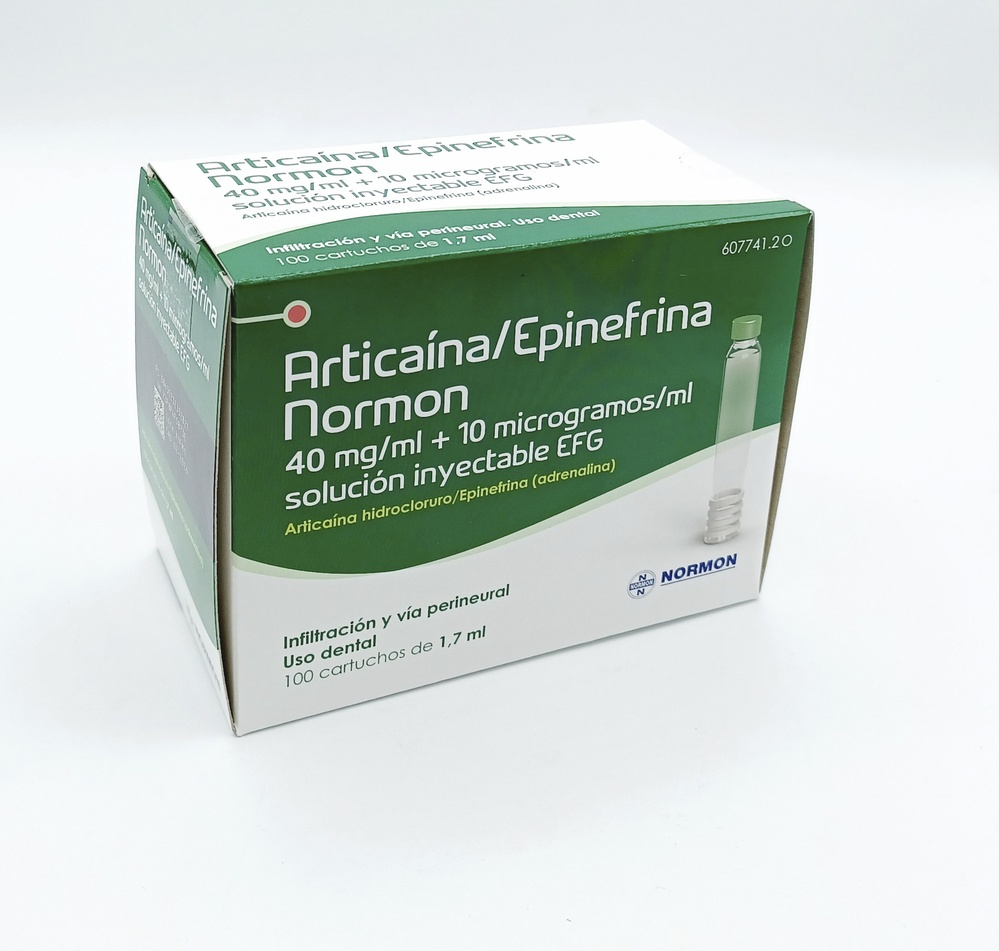
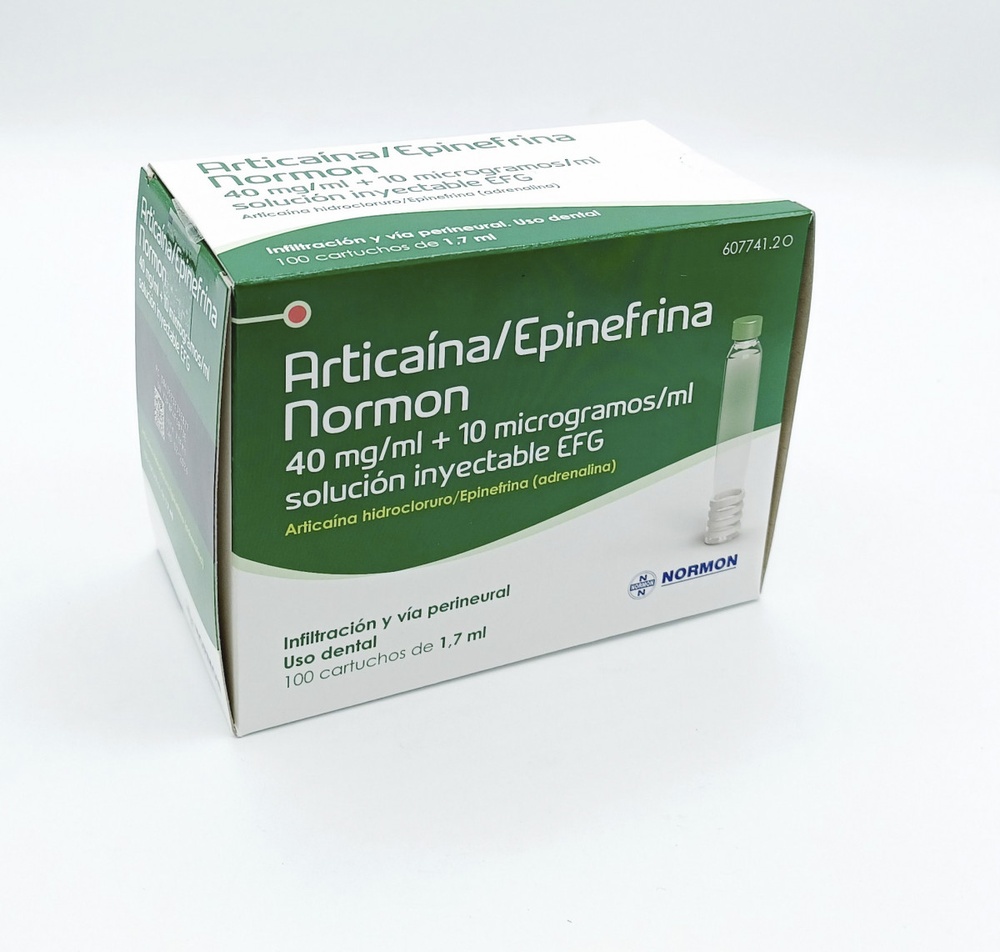
Envase que contiene 100 cartuchos de 1,7 ml.
Puede que solamente estén comercializados algunos tamaños de envases.
Titular de la autorización de comercialización y responsable de la fabricación
LABORATORIOS NORMON, S.A.
Ronda de Valdecarrizo, 6 - 28760 Tres Cantos - Madrid (ESPAÑA)
Este medicamento está autorizado en los estados miembros del Espacio Económico Europeo con los siguientes nombres
Portugal Normocain
Bulgaria Normocain
Francia CHLORHYDRATE D’ARTICAINE NORMON 40mg/ml ADRENALINE 1/100 000, solution injectable
Rumanía Normocain 40 mg/ 0.010 mg/ml solutie injectabila
Fecha de la última revisión de este prospecto:Mayo 2023
La información detallada de este medicamento está disponible en la página web de la Agencia Española de Medicamentos y Productos Sanitarios (AEMPS) (http://www.aemps.gob.es/).
-

- País de registro
- Forma farmacéuticaINYECTABLE, 40 mg/ml +10 microgramos/ml
- Código ATCN01BB58
- Principio activo
- Requiere recetaSí
- Fabricante
- Esta información es de carácter general y no sustituye la consulta con un profesional sanitario.
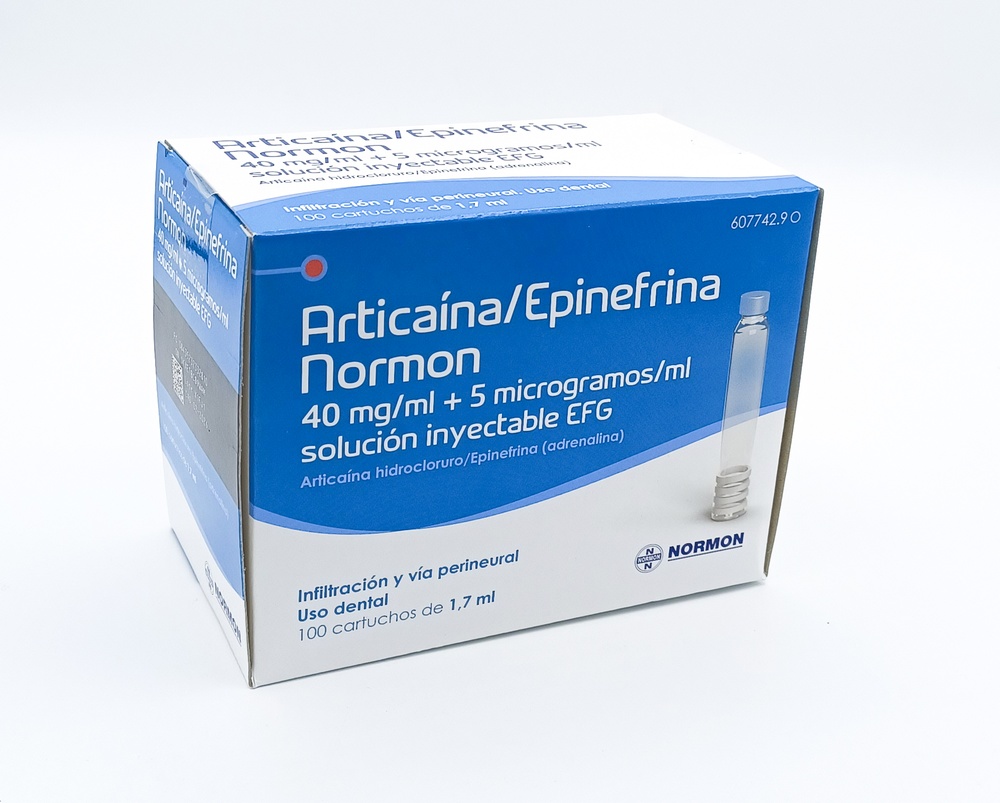
- Alternativas a ARTICAINA/EPINEFRINA NORMON 40 MG/ML + 10 MICROGRAMOS/ML SOLUCIÓN INYECTABLE EFGForma farmacéutica: INYECTABLE, 4%; articaina;0,001 % epinefrina bitartratoPrincipio activo: articaine, combinationsFabricante: Farmalider S.A.Requiere recetaForma farmacéutica: INYECTABLE, 4%; articaina;0.0005 % epinefrina bitartratoPrincipio activo: articaine, combinationsFabricante: Farmalider S.A.Requiere recetaForma farmacéutica: INYECTABLE, 40 mg/ml + 5 microgramos/mlPrincipio activo: articaine, combinationsFabricante: Laboratorios Normon S.A.Requiere receta

Médicos online para ARTICAINA/EPINEFRINA NORMON 40 MG/ML + 10 MICROGRAMOS/ML SOLUCIÓN INYECTABLE EFG
Comenta la dosis, los posibles efectos secundarios, interacciones, contraindicaciones o la revisión de receta de ARTICAINA/EPINEFRINA NORMON 40 MG/ML + 10 MICROGRAMOS/ML SOLUCIÓN INYECTABLE EFG, sujeto a valoración médica y a la normativa local.









Obtén una receta de ARTICAINA/EPINEFRINA NORMON 40 MG/ML + 10 MICROGRAMOS/ML SOLUCIÓN INYECTABLE EFG online
Rellena un formulario de 2 minutos
Cuéntanos tus síntomas, historial y el medicamento que necesitas.
Elige un médico o nosotros te asignamos uno
Escoge un especialista o te conectamos con el próximo médico disponible.
El médico revisa tu caso
Normalmente en 30 minutos. Puede hacerte preguntas adicionales por chat.
Recógela en cualquier farmacia
Receta electrónica enviada a tu correo, válida en toda España.
Preguntas frecuentes
ARTICAINA/EPINEFRINA NORMON 40 MG/ML + 10 MICROGRAMOS/ML SOLUCIÓN INYECTABLE EFG requires receta en España. Puedes confirmarlo con un médico online según tu caso.
El principio activo de ARTICAINA/EPINEFRINA NORMON 40 MG/ML + 10 MICROGRAMOS/ML SOLUCIÓN INYECTABLE EFG es articaine, combinations. Esta información ayuda a identificar medicamentos con la misma composición pero con diferentes nombres comerciales.
ARTICAINA/EPINEFRINA NORMON 40 MG/ML + 10 MICROGRAMOS/ML SOLUCIÓN INYECTABLE EFG es fabricado por Laboratorios Normon S.A.. La marca y el envase pueden variar según el distribuidor.
Los Médicos de familia, Psiquiatras, Dermatólogos, Cardiólogos, Endocrinólogos, Gastroenterólogos, Neumólogos, Nefrólogos, Reumatólogos, Hematólogos, Infectólogos, Alergólogos, Geriatras, Pediatras, Oncólogos pueden valorar la prescripción de ARTICAINA/EPINEFRINA NORMON 40 MG/ML + 10 MICROGRAMOS/ML SOLUCIÓN INYECTABLE EFG cuando esté clínicamente indicado. Puedes reservar una videoconsulta para comentar tu caso y las opciones de tratamiento.
España cuenta con una infraestructura sanitaria bien desarrollada en ciudades principales como Madrid, Barcelona, Valencia y Sevilla. Las farmacias están ampliamente disponibles y operan bajo estrictas regulaciones, garantizando el acceso a medicamentos con receta.
Puedes comprar ARTICAINA/EPINEFRINA NORMON 40 MG/ML + 10 MICROGRAMOS/ML SOLUCIÓN INYECTABLE EFG en Madrid, Barcelona, Sevilla o Valencia en cualquier farmacia local con una receta válida.
Para obtener una receta, puedes utilizar Oladoctor:
Otros medicamentos con el mismo principio activo (articaine, combinations) incluyen ARTICAINA / EPINEFRINA DERMOGEN 40 MG/ML + 10 MICROGRAMOS/ML SOLUCION INYECTABLE EFG, ARTICAINA / EPINEFRINA DERMOGEN 40 MG/ML + 5 MICROGRAMOS/ML SOLUCION INYECTABLE EFG, ARTICAINA/EPINEFRINA NORMON 40 MG/ML + 5 MICROGRAMOS/ML SOLUCIÓN INYECTABLE EFG. Pueden tener diferentes nombres comerciales o formulaciones, pero contienen el mismo componente terapéutico. Consulta siempre con un médico antes de cambiar o iniciar un nuevo medicamento.
