


Articaina Farmalider 40 mg/ml + 10 microgramos/ml solución inyectable

Revisión de receta online
Un médico revisará tu caso y determinará si la prescripción es médicamente apropiada.

Habla con un médico sobre este medicamento
Comenta tus síntomas y las opciones de tratamiento en una consulta online.



Cómo usar ARTICAINA / EPINEFRINA DERMOGEN 40 MG/ML + 10 MICROGRAMOS/ML SOLUCION INYECTABLE EFG
Contenido del prospecto
- Introducción
- Qué es ARTICAÍNA / EPINEFRINA DERMOGEN y para qué se utiliza
- Qué necesita saber antes de que le administren ARTICAÍNA / EPINEFRINA DERMOGEN
- Cómo usar ARTICAÍNA / EPINEFRINA DERMOGEN
- Posibles efectos adversos
- Conservación de ARTICAINA / EPINEFRINA DERMOGEN
- Contenido del envase e información adicional
Introducción
PROSPECTO: INFORMACIÓN PARA EL USUARIO
ARTICAÍNA / EPINEFRINA DERMOGEN 40 mg/ml + 10 microgramos/ml solución inyectable EFG
hidrocloruro de articaína/ epinefrina (adrenalina)
Lea todo el prospecto detenidamente antes de empezar a usar el medicamento, porque contiene información importante para usted.
- Conserve este prospecto, ya que puede tener que volver a leerlo.
- Si tiene alguna duda, consulte con su dentista, médico o farmacéutico.
- Si experimenta efectos adversos, consulte a su dentista, médico o farmacéutico, incluso si se trata de efectos adversos que no aparecen en este prospecto. Ver sección 4.
Contenido del prospecto
- Qué es ARTICAINA / EPINEFRINA DERMOGEN y para qué se utiliza.
- Qué necesita saber antes de que le administren ARTICAINA / EPINEFRINA DERMOGEN
- Cómo usar ARTICAINA / EPINEFRINA DERMOGEN
- Posibles efectos adversos.
- Conservación de ARTICAINA / EPINEFRINA DERMOGEN
- Contenido del envase e información adicional.
1. Qué es ARTICAÍNA / EPINEFRINA DERMOGEN y para qué se utiliza
Articaína / Epinefrina Dermogen se utiliza para entumecer (anestesiar) la cavidad oral durante procedimientos dentales.
Este medicamento contiene dos principios activos:
- articaína, un anestésico local que previene el dolor.
- adrenalina, un vasoconstrictor que estrecha los vasos sanguíneos del lugar de inyección y, por tanto, prolonga el efecto de la articaína. También reduce las hemorragias durante la cirugía.
Su dentista le administrará Articaína / Epinefrina Dermogen 40 mg/ml + 5 microgramos/ml o Articaína / Epinefrina Dermogen 40 mg/ml + 10 microgramos/ml.
Articaína / Epinefrina Dermogen está indicado en niños mayores de 4 años (de unos 20 kg de peso corporal), adolescentes y adultos.
Dependiendo del tipo de procedimiento dental realizado, el dentista escogerá uno de los dos medicamentos:
- Articaína / Epinefrina Dermogen 40 mg/ml + 5 microgramos/ml se suele utilizar para procedimientos dentales sencillos y breves.
- Articaína / Epinefrina Dermogen 40 mg/ml + 10 microgramos/ml está más adaptado a procedimientos más largos o con posibles hemorragias importantes.

¿No estás seguro de si este medicamento es adecuado para ti?
Comenta tus síntomas y tratamiento con un médico online.
2. Qué necesita saber antes de que le administren ARTICAÍNA / EPINEFRINA DERMOGEN
No use ARTICAINA / EPINEFRINA DERMOGEN si padece alguna de las dolencias siguientes:
- alergia a la articaína o a la adrenalina o a alguno de los demás componentes de este medicamento (incluidos en la sección 6).
- alergia a otros anestésicos locales.
- epilepsia no controlada correctamente con medicamentos.
Advertencias y precauciones
Consulte a su dentista antes de empezar a usar Articaína / Epinefrina Dermogen si padece alguna de las dolencias siguientes:
- trastornos del ritmo cardiaco graves (p. ej., bloqueo AV de segundo y tercer grado).
- insuficiencia cardíaca aguda (debilidad cardiaca aguda, p. ej., dolor torácico inesperado en reposo o después de un infarto de miocardio [es decir, ataque al corazón]).
- hipotensión arterial.
- latidos cardíacos anormalmente rápidos.
- infarto de miocardio en los últimos 3-6 meses.
- injerto de revascularización coronaria en los últimos 3 meses.
- está tomando unos medicamentos para la presión arterial llamados betabloqueantes, como el propranolol. Existe el riesgo de crisis hipertensiva (presión arterial muy alta) o de ralentización del pulso grave (ver sección «Uso de Articaína / Epinefrina Dermogen con otros medicamentos»).
- presión arterial muy alta.
- está tomando simultáneamente medicamentos para el tratamiento de la depresión y para la enfermedad de Parkinson (antidepresivos tricíclicos). Estos medicamentos pueden intensificar los efectos de la adrenalina.
- epilepsia.
- carencia de una sustancia química natural llamada colinesterasa en la sangre (deficiencia de colinesterasa plasmática).
- problemas renales.
- problemas hepáticos graves
- una enfermedad llamada Miastenia Gravisque causa debilidad muscular.
- porfiria que causa tanto complicaciones neurológicas como problemas de piel
- si está usando otros anestésicos locales que causen pérdida reversible de la sensibilidad (lo que incluye anestésicos volátiles, como el halotano).
- si está tomando unos medicamentos llamados antiplaquetarios o anticoagulantes para prevenir el estrechamiento o el endurecimiento de los vasos sanguíneos de brazos y piernas.
- si tiene más de 70 años.
- padece o ha padecido algún problema de corazón.
- tiene diabetes no controlada.
- un caso grave de exceso de funcionamiento de la tiroides (tirotoxicosis).
- un tumor llamado feocromocitoma.
- una enfermedad llamada glaucoma de ángulo cerrado que afecta a los ojos.
- inflamación o infección de la zona en la que recibirá la inyección.
- cantidades reducidas de oxígeno en los tejidos del cuerpo (hipoxia), nivel alto de potasio en sangre (hipercalemia) y trastornos metabólicos como resultado de demasiado ácido en la sangre (acidosis metabólica).
Uso de ARTICAÍNA / EPINEFRINA DERMOGENconotros medicamentos
Informe a su dentista si está tomando, ha tomado recientemente o pudiera tener que tomar cualquier otro medicamento.
Es sumamente importante informar a su dentista si está tomando alguno de los siguientes medicamentos:
- Otros anestésicos locales que causen pérdida reversible de la sensibilidad (lo que incluye anestésicos volátiles, como el halotano).
- Sedantes (como la benzodiazepina, opiáceos), por ejemplo, para reducir la aprensión antes del procedimiento dental.
- Medicamentos para el corazón y la presión arterial (como guanadrel, guanetidina, propranolol, nadolol).
- Antidepresivos tricíclicos para tratar la depresión (como amitriptilina, desipramina, imipramina, nortriptilina, maprotilina y protriptilina).
- Inhibidores de la COMT para tratar la enfermedad de Parkinson (como entacapona o tolcapona).
- Inhibidores de la MAO para tratar trastornos depresivos o de ansiedad (como moclobemida,
- fenelzina, tranilcipromina, linezolid).
- Medicamentos para tratar los latidos irregulares del corazón (por ejemplo, digitálicos, quinidina).
- Medicamentos para los ataques de migraña (como metisergida o ergotamina).
- Vasopresores simpatomiméticos (como cocaína, anfetaminas, fenilefrina, pseudoefedrina, oximetazolina), empleados para elevar la presión arterial: si se han tomado en las 24 horas previas al tratamiento dental planeado, este debe posponerse.
- Fármacos neurolépticos (por ejemplo, fenotiazinas).
Uso deArticaína / Epinefrina Dermogencon alimentos
Evite comer, incluso mascar chicle, hasta que haya recuperado la sensibilidad normal. De lo contrario, existe el riesgo de que se muerda los labios, las mejillas o la lengua, especialmente en el caso de los niños.
Embarazo,lactancia y fertilidad:
Si está embarazada o en periodo de lactancia, cree que podría estar embarazada o tiene intención de quedarse embarazada, consulte a su dentista, médico o farmacéutico antes de usar un medicamento.
Su dentista o médico decidirán si puede tomar Articaína / Epinefrina Dermogen durante el embarazo.
La lactancia puede reanudarse al cabo de 5 horas tras la anestesia.
No se esperan efectos adversos sobre la fertilidad con las dosis empleadas en un procedimiento dental
Conducción y uso de máquinas
Si experimenta efectos adversos, lo que incluye mareos, visión borrosa o fatiga, no debe conducir ni manejar maquinaria hasta que haya recuperado sus facultades (normalmente, durante los 30 minutos siguientes al procedimiento dental
ARTICAÍNA / EPINEFRINA DERMOGENcontiene sodio ymetabisulfito
- Sodio: este medicamento contiene menos de 23 mg (1 mmol) de sodio por cartucho, por lo que se considera esencialmente «exento de sodio».
- Metabisulfito sódico: en raras ocasiones puede causar reacciones alérgicas graves y dificultades para respirar (broncoespasmo).
Si existe algún riesgo de reacción alérgica, su dentista escogerá otro medicamento para la anestesia.
3. Cómo usar ARTICAÍNA / EPINEFRINA DERMOGEN
Solo los médicos y dentistas están formados para emplear Articaína / Epinefrina Dermogen.
Su dentista escogerá entre Articaína / Epinefrina Dermogen 40 mg/ml + 5 microgramos/ml o Articaína / Epinefrina Dermogen 40 mg/ml + 10 microgramos/ml y determinará la dosis adecuada teniendo en cuenta su edad, peso, estado de salud general y el procedimiento dental.
Debe utilizarse la dosis más baja que proporcione una anestesia eficaz.
Este medicamento se administra mediante una inyección lenta en la cavidad bucal.
Si usa más ARTICAÍNA / EPINEFRINA DERMOGEN del que debe
Es poco probable que le administren demasiada cantidad de esta inyección, pero si comienza a sentirse mal, dígaselo a su dentista. Los síntomas de una sobredosis incluyen debilidad aguda, palidez de la piel, cefalea, agitación o inquietud, desorientación, pérdida de equilibrio, temblores o estremecimientos involuntarios, dilatación de la pupila, visión borrosa, problemas para enfocar los objetos con claridad, alteraciones del habla, mareos, convulsiones, estupor, pérdida de consciencia, coma, bostezos, respiración anormalmente lenta o rápida que puede llevar a un paro respiratorio temporal, incapacidad del corazón para contraerse (fallo cardiaco).
Si tiene cualquier otra duda sobre el uso de este medicamento, pregunte a su dentista. .

¿Has empezado a tomar el medicamento y tienes preguntas?
Comenta tus síntomas y tratamiento con un médico online.
4. Posibles efectos adversos
Al igual que todos los medicamentos, este medicamento puede tener efectos adversos, aunque no todas las personas los sufran.
Cuando esté en la consulta del dentista, este hará un detenido seguimiento de los efectos de Articaína / Epinefrina Dermogen.
Informe a su dentista, médico o farmacéuticoinmediatamentesi experimenta alguno de los siguientes efectos adversos graves:
- Hinchazón del rostro, lengua o faringe, dificultad para tragar, habones urticantes o dificultad para respirar (angioedema)
- Erupción, picor, hinchazón de la garganta y dificultad para respirar: pueden ser síntomas de una reacción alérgica (hipersensibilidad).
- Una combinación de caída del párpado y constricción de la pupila (síndrome de Horner).
Estos efectos adversos son raros (pueden afectar hasta 1 de cada 1.000 personas).
En otros pacientes también pueden aparecer otros efectos adversos no indicados más arriba.
Efectos adversos frecuentes: pueden afectar hasta 1 de cada 10 personas:
- Inflamación de las encías
- Dolor neuropático: dolor debido a lesión nerviosa
- Entumecimiento o disminución del sentido del tacto dentro y alrededor de la boca
- Gusto metálico, alteraciones del gusto o pérdida de la función gustativa
- Sentido del tacto aumentado, desagradable o anormal
- Aumento de la sensibilidad al calor
- Dolor de cabeza
- Latidos cardiacos anormalmente rápidos
- Latidos cardiacos anormalmente lentos
- Presión arterial baja
- Hinchazón de la lengua, los labios y las encías
Efectos adversos poco frecuentes: pueden afectar hasta 1 de cada 100 personas:
- Sensación de ardor
- Presión arterial alta
- Inflamación de la lengua y la boca
- Náuseas, vómitos, diarrea
- Erupción, picor
- Dolor en el cuello o en el lugar de inyección
Efectos adversos raros: pueden afectar hasta 1 de cada 1.000 personas:
- Nerviosismo, ansiedad
- Trastorno de los nervios faciales (parálisis facial)
- Somnolencia
- Movimiento involuntario de los ojos
- Visión doble, ceguera temporal
- Caída del párpado y constricción de la pupila (síndrome de Horner)
- Hundimiento del globo ocular dentro de la órbita (enoftalmia)
- Zumbido en los oídos, mayor sensibilidad del oído
- Palpitaciones
- Bochornos
- Sibilancias (broncoespasmo, pitos, silbidos en bronquios), asma
- Dificultad para respirar
- Exfoliación y ulceración de las encías
- Exfoliación del lugar de inyección
- Habones urticantes.
- Contracción involuntaria de los músculos
- Fatiga, debilidad
- Escalofríos
Efectos adversos muy raros: pueden afectar a hasta 1 de cada 10.000 personas:
- Pérdida persistente de la sensibilidad, entumecimiento extenso y pérdida del gusto
Frecuencia no conocida: no puede estimarse a partir de los datos disponibles
- Buen humor extremo (euforia)
- Problemas de coordinación de los latidos cardiacos (trastornos de conducción, bloqueo auriculoventricular)
- Aumento de la cantidad de sangre en una parte del cuerpo que lleva a la congestión de los vasos sanguíneos
- Ensanchamiento o estrechamiento de los vasos sanguíneos
- Ronquera
- Dificultad para tragar
- Hinchazón de las mejillas e hinchazón local
- Síndrome de boca ardiente
- Enrojecimiento de la piel (eritema)
- Aumento anormal de la sudoración
- Empeoramiento de los síntomas neuromusculares del síndrome Kearns-Sayre
- Sensación de calor o de frío
- Bloqueo de la mandíbula
Comunicación de efectos adversos
Si experimenta cualquier tipo de efecto adverso, consulte a su médico o farmacéutico, incluso si se trata de posibles efectos adversos que no aparecen en este prospecto. También puede comunicarlos directamente a través del Sistema Español de Farmacovigilancia de Medicamentos de Uso Humano: www.notificaRAM.es Mediante la comunicación de efectos adversos usted puede contribuir a proporcionar más información sobre la seguridad de este medicamento.
5. Conservación de ARTICAINA / EPINEFRINA DERMOGEN
Mantener este medicamento fuera de la vista y del alcance de los niños.
No utilice este medicamento después de la fecha de caducidad que aparece en el envase después de CAD. La fecha de caducidad es el último día del mes que se indica.
No conservar a temperatura superior a 30ºC. Conservar el blíster en el embalaje exterior para protegerlo de la luz.
No utilice este medicamento si ve que la solución está turbia o presenta un cambio de color.
Los cartuchos son de un solo uso. Usar inmediatamente tras abrir el cartucho. La solución sin usar debe desecharse.
Los medicamentos no se deben tirar por los desagües ni a la basura. Su dentista sabrá cómo deshacerse de los medicamentos que ya no utiliza De esta forma ayudará a proteger el medio ambiente.
6. Contenido del envase e información adicional
Composición de ARTICAÍNA / EPINEFRINA DERMOGEN
- Los principios activos son hidrocloruro de articaína y tartrato de adrenalina.
- Cada cartucho de 1,8 ml de solución inyectable de Articaína / Epinefrina Dermogen 40 mg/ml + 10 microgramos/ml contiene 72 mg de hidrocloruro de articaína y 18 microgramos de adrenalina (como tartrato de adrenalina).
- Cada mililitro de Articaína / Epinefrina Dermogen 40 mg/ml + 10 microgramos/ml contiene 40 mg de hidrocloruro de articaína y 10 microgramos de adrenalina (como tartrato de adrenalina).
- Los demás componentes son cloruro sódico, edetato disódico, metabisulfito sódico (E-223), hidróxido sódico, agua para preparaciones inyectables.
Aspecto del producto y contenido del envase
ARTICAINA / EPINEFRINA DERMOGEN es una solución transparente e incolora.
Envase conteniendo un cartucho de 1,8 ml y un prospecto.
Envase conteniendo 50 cartuchos de 1,8 ml (envase clínico) en 5 soportes blíster de PVC con 10 cartuchos cada uno y un prospecto.
Envase conteniendo 100 cartuchos de 1,8 ml (envase clínico) en 10 soportes blister de PVC con 10 cartuchos cada uno y un prospecto.
Puede que solamente estén comercializados algunos tamaños de envases.
Titular de la autorización de comercialización y responsable de la fabricación
Titular de la autorización de comercialización
FARMALIDER, S.A.
c\ La Granja 1
28108– Alcobendas (Madrid)
España
Responsable de la fabricación
PIERREL, S.P.A.
Via Nazzionale Appia (Capua, Caserta)
I-81043 Italia
Fecha de la última revisión de este prospecto:febrero de 2020
Otras fuentes de información
La información detallada de este medicamento está disponible en la página web de la Agencia Española de Medicamentos y Productos Sanitarios.
……………………………………………………………………………………………………
Esta información está destinada únicamente a profesionales del sector sanitario
Posología
Para todas las poblaciones, debe utilizarse la dosis más baja con la que se obtenga una anestesia eficaz. La dosis necesaria debe determinarse de forma individual.
Para un procedimiento rutinario, la dosis normal para pacientes adultos es de 1 cartucho, pero el contenido de menos de un cartucho puede ser suficiente para una anestesia efectiva. Según el criterio del dentista, es posible que se requieran más cartuchos para procedimientos más extensos, sin exceder la dosis máxima recomendada.
En el caso de la mayoría de los procedimientos dentales rutinarios, es preferible utilizar Articaína / Epinefrina Dermogen 40 mg/ml + 5 microgramos/ml.
Para procedimientos más complejos, como una hemostasia pronunciada necesaria, es preferible utilizar Articaína / Epinefrina Dermogen 40 mg/ml + 10 microgramos/ml.
Uso concomitante de sedantes para reducir la ansiedad del paciente:
La dosis máxima segura del anestésico local puede reducirse en pacientes sedados debido a un efecto aditivo sobre la depresión del sistema nervioso central.
Adultos y adolescentes (de entre 12 y 18 años de edad)
En adultos y adolescentes, la dosis máxima de articaína es 7 mg/kg, con una dosis máxima absoluta de articaína de 500 mg. La dosis máxima de articaína de 500 mg corresponde a un adulto sano de más de 70 kg de peso corporal.
Niños (entre 4 y 11 años de edad)
No se ha establecido la seguridad de Articaína / Epinefrina Dermogen en niños de 4 años y menores de 4 años. No hay datos disponibles.
La cantidad a inyectar debe determinarse mediante la edad y el peso del niño y la magnitud de la operación. La dosis media efectiva es 2 mg/kg y 4 mg/kg para procedimientos simples y complejos, respectivamente. Debe usarse la dosis más baja que proporcione una anestesia dental eficaz. En niños de 4 años (o a partir de 20 kg (44 lbs) de peso corporal) y mayores, la dosis máxima de articaína es solo 7 mg/kg, con una dosis máxima absoluta de 385 mg de articaína para un niño sano de 55 kg de peso corporal.
Poblaciones especiales
Pacientes de edad avanzada y pacientes con trastornos renales:
Debido a la ausencia de datos clínicos, se deben tomar precauciones especiales para administrar la dosis más baja que proporcione una anestesia eficaz en pacientes de edad avanzada y en pacientes con trastornos renales.
Pueden producirse niveles plasmáticos elevados del medicamento en estos pacientes, sobre todo tras un uso repetido. En caso de requerir una reinyección, debe monitorizarse al paciente de modo estricto para identificar cualquier signo de sobredosis relativa.
Pacientes con insuficiencia hepática
Para los pacientes con insuficiencia hepática, se deben tomar precauciones especiales para administrar la dosis más baja que proporcione una anestesia eficaz, sobre todo tras un uso repetido, aunque el 90 % de la articaína queda primero desactivada por esterasas plasmáticas inespecíficas de los tejidos y la sangre.
Pacientes con deficiencia de colinesterasa plasmática
Pueden producirse niveles plasmáticos elevados del medicamento en pacientes con deficiencia de colinesterasa o bajo tratamiento con inhibidores de la acetilcolinesterasa, ya que el producto queda desactivado en un 90 % por esterasas plasmáticas. Por lo tanto, debe utilizarse la dosis más que proporcione una anestesia eficaz.
Forma de administración
Infiltración y uso perineural en la cavidad oral.
Si existe inflamación y/o infección en el lugar de inyección, la anestesia local debe inyectarse con precaución. La velocidad de inyección debe ser muy lenta (1 ml/min).
Precauciones que se deben tomar antes de manipular o administrar el medicamento
Este medicamento solo debe utilizarlo un médico o un dentista con la formación suficiente y familiarizado con el diagnóstico y el tratamiento de la toxicidad sistémica, o bajo su supervisión. Antes de la inducción de la anestesia regional con anestésicos locales, debe garantizarse la disponibilidad de un equipo de reanimación y de medicación adecuados para poder aplicar tratamiento inmediato a cualquier emergencia respiratoria o cardiovascular. El estado de consciencia del paciente debe monitorizarse después de cada inyección de anestesia local.
Al utilizar Articaína / Epinefrina Dermogen para una infiltración o un bloqueo anestésico regional, la inyección siempre se debe administrar lentamente y con aspiración previa.
Advertencias especiales
La adrenalina reduce el flujo sanguíneo en las encías, pudiendo causar necrosis local del tejido.
Se han notificado casos muy raros de lesión nerviosa prolongada o irreversible y de pérdida gustativa tras una analgesia de bloqueo mandibular.
Precauciones de empleo
Riesgo asociado a inyección intravascular accidental:
Una inyección intravascular accidental puede causar altos niveles de adrenalina y articaína en la circulación sistémica. Esto puede asociarse a reacciones adversas graves, tales como convulsiones, seguidas de depresión nerviosa central y cardiorrespiratoria y coma, que progresa a paro respiratorio y circulatorio.
Por tanto, para asegurar que la aguja no penetra en un vaso sanguíneo durante la inyección, debe realizarse una aspiración antes de inyectar el medicamento anestésico local. No obstante, la ausencia de sangre en la jeringa no garantiza que la inyección intravascular no haya tenido lugar.
Riesgo asociado a inyección intraneural:
Una inyección intraneural accidental puede hacer que el fármaco se desplace de forma retrógrada por el nervio.
Para evitar una inyección intraneural y prevenir lesiones nerviosas cuando se realicen bloqueos nerviosos, la aguja debe retirarse ligeramente siempre que el paciente note una sensación de descarga durante la inyección o si la inyección le resulta particularmente dolorosa. Si se producen lesiones nerviosas por la aguja, el efecto neurotóxico puede agravarse por la posible neurotoxicidad química de la articaína y la presencia de adrenalina, ya que puede reducir el riego sanguíneo perineural y evitar la eliminación local de la articaína.
Tratamiento de la sobredosis
Antes de la administración de la anestesia regional con anestésicos locales, se debe garantizar la disponibilidad un equipo de reanimación y medicación adecuados para poder aplicar tratamiento inmediato a cualquier emergencia respiratoria o cardiovascular.
Según la gravedad de los síntomas de la sobredosis, el médico o el dentista deben implementar protocolos que prevean la necesidad de proteger las vías respiratorias y suministrar ventilación asistida
El estado de consciencia del paciente debe monitorizarse después de cada inyección de anestesia local.
Si aparecen signos de toxicidad sistémica aguda, debe detenerse la inyección del anestésico local inmediatamente. Si es necesario, coloque al paciente en decúbito supino.
Los síntomas del SNC (convulsiones, depresión del SNC) deben tratarse inmediatamente con el soporte de las vías respiratorias/respiratorio adecuado y la administración de fármacos anticonvulsivantes.
La oxigenación y la ventilación óptimas, junto con el soporte circulatorio y el tratamiento de la acidosis pueden evitar un paro cardiaco.
Si se produce depresión cardiovascular (hipotensión, bradicardia), debe contemplarse un tratamiento adecuado con líquidos intravenosos, vasopresores o agentes inotrópicos. A los niños se les deben administrar dosis acordes a su edad y peso.
En caso de paro cardiaco, se debe practicar inmediatamente reanimación cardiopulmonar.
Precauciones especiales de eliminación y otras manipulaciones
Este medicamento no debe emplearse si la solución está turbia o presenta un cambio de color.
Para evitar el riesgo de infección (p. ej., la transmisión de hepatitis), la jeringa y las agujas usadas para preparar la solución deben ser siempre nuevas y estériles.
Los cartuchos son de un solo uso. Si solo se utiliza una parte del cartucho, el resto debe desecharse.
La eliminación del medicamento no utilizado y de todos los materiales que hayan estado en contacto con él se realizará de acuerdo con las normativas locales.
- País de registro
- Forma farmacéuticaINYECTABLE, 4%; articaina;0,001 % epinefrina bitartrato
- Código ATCN01BB58
- Principio activo
- Requiere recetaSí
- Fabricante
- ComposiciónCLORURO DE SODIO (0.16 g mg), SODIO, METABISULFITO DE (E 223) (0.05 g mg), EDTA SODICO (0.025 g mg), HIDROXIDO DE SODIO (E 524) (csp PH 3.3-3.5 - mg)
- Esta información es de carácter general y no sustituye la consulta con un profesional sanitario.
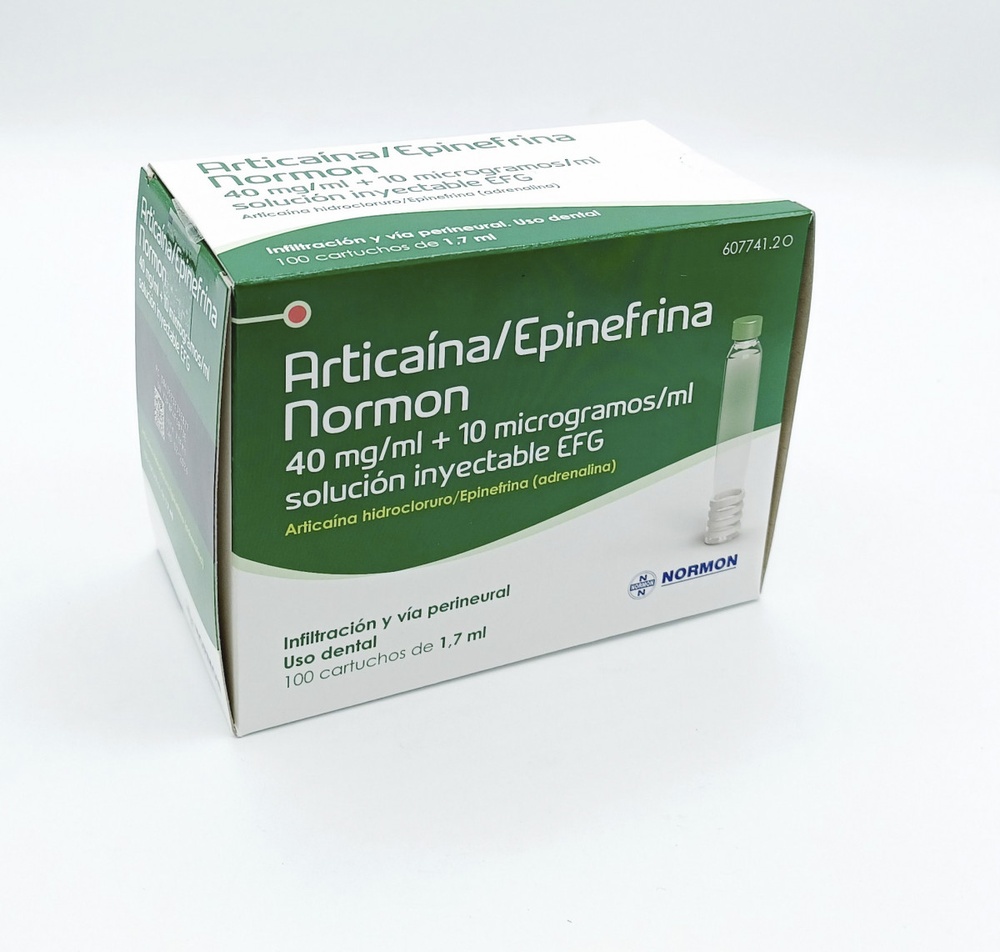
- Alternativas a ARTICAINA / EPINEFRINA DERMOGEN 40 MG/ML + 10 MICROGRAMOS/ML SOLUCION INYECTABLE EFGForma farmacéutica: INYECTABLE, 4%; articaina;0.0005 % epinefrina bitartratoPrincipio activo: articaine, combinationsFabricante: Farmalider S.A.Requiere recetaForma farmacéutica: INYECTABLE, 40 mg/ml +10 microgramos/mlPrincipio activo: articaine, combinationsFabricante: Laboratorios Normon S.A.Requiere recetaForma farmacéutica: INYECTABLE, 40 mg/ml + 5 microgramos/mlPrincipio activo: articaine, combinationsFabricante: Laboratorios Normon S.A.Requiere receta
Médicos online para ARTICAINA / EPINEFRINA DERMOGEN 40 MG/ML + 10 MICROGRAMOS/ML SOLUCION INYECTABLE EFG
Comenta la dosis, los posibles efectos secundarios, interacciones, contraindicaciones o la revisión de receta de ARTICAINA / EPINEFRINA DERMOGEN 40 MG/ML + 10 MICROGRAMOS/ML SOLUCION INYECTABLE EFG, sujeto a valoración médica y a la normativa local.









Preguntas frecuentes
ARTICAINA / EPINEFRINA DERMOGEN 40 MG/ML + 10 MICROGRAMOS/ML SOLUCION INYECTABLE EFG requiere receta en España. Puedes confirmarlo con un médico online según tu caso.
El principio activo de ARTICAINA / EPINEFRINA DERMOGEN 40 MG/ML + 10 MICROGRAMOS/ML SOLUCION INYECTABLE EFG es articaine, combinations. Esta información ayuda a identificar medicamentos con la misma composición pero con diferentes nombres comerciales.
ARTICAINA / EPINEFRINA DERMOGEN 40 MG/ML + 10 MICROGRAMOS/ML SOLUCION INYECTABLE EFG es fabricado por Farmalider S.A.. La marca y el envase pueden variar según el distribuidor.
Los Médicos de familia, Psiquiatras, Dermatólogos, Cardiólogos, Endocrinólogos, Gastroenterólogos, Neumólogos, Nefrólogos, Reumatólogos, Hematólogos, Infectólogos, Alergólogos, Geriatras, Pediatras, Oncólogos pueden valorar la prescripción de ARTICAINA / EPINEFRINA DERMOGEN 40 MG/ML + 10 MICROGRAMOS/ML SOLUCION INYECTABLE EFG cuando esté clínicamente indicado. Puedes reservar una videoconsulta para comentar tu caso y las opciones de tratamiento.
La receta la emite un médico tras valorar tu estado de salud. En España, ARTICAINA / EPINEFRINA DERMOGEN 40 MG/ML + 10 MICROGRAMOS/ML SOLUCION INYECTABLE EFG se dispensa en las farmacias con esa receta médica. Una consulta online no garantiza su emisión: la decisión corresponde siempre al médico.
Para solicitar una valoración puedes usar Oladoctor:
Otros medicamentos con el mismo principio activo (articaine, combinations) incluyen ARTICAINA / EPINEFRINA DERMOGEN 40 MG/ML + 5 MICROGRAMOS/ML SOLUCION INYECTABLE EFG, ARTICAINA/EPINEFRINA NORMON 40 MG/ML + 10 MICROGRAMOS/ML SOLUCIÓN INYECTABLE EFG, ARTICAINA/EPINEFRINA NORMON 40 MG/ML + 5 MICROGRAMOS/ML SOLUCIÓN INYECTABLE EFG. Pueden tener diferentes nombres comerciales o formulaciones, pero contienen el mismo componente terapéutico. Consulta siempre con un médico antes de cambiar o iniciar un nuevo medicamento.
