



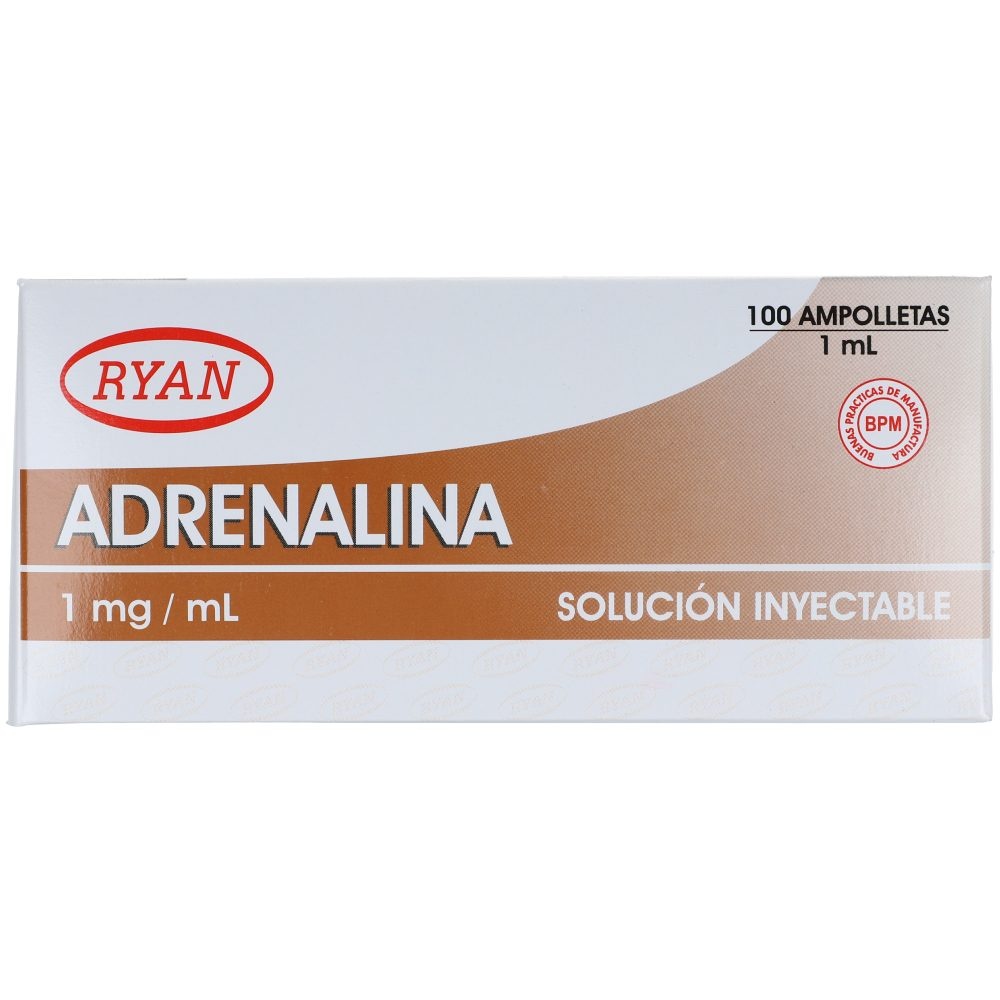
ADRENALINA 1 mg /Ml Solución Inyectable

Revisión de receta online
Un médico revisará tu caso y determinará si la prescripción es médicamente apropiada.

Habla con un médico sobre este medicamento
Comenta tus síntomas y las opciones de tratamiento en una consulta online.



Cómo usar ADRENALINA BASI 1 MG/ML SOLUCIÓN INYECTABLE
Contenido del prospecto
- Introducción
- Qué es Adrenalina Basi y para qué se utiliza
- Qué necesita saber antes de que le administren Adrenalina Basi
- Cómo se administra Adrenalina Basi
- Posibles efectos adversos
- Conservación de Adrenalina Basi
- Contenido del envase e información adicional
Introducción
Prospecto: información para el usuario
Adrenalina Basi 1 mg/ml solución inyectable
epinefrina
Lea todo el prospecto detenidamente antes de que le administren este medicamento, porque contiene información importante para usted.
- Conserve este prospecto, ya que puede tener que volver a leerlo.
- Si tiene alguna duda, consulte a su médico, farmacéutico o enfermero.
- Este medicamento se le ha recetado solamente a usted, y no debe dárselo a otras personas aunque tengan los mismos síntomas que usted, ya que puede perjudicarles.
- Si experimenta efectos adversos, consulte a su médico, farmacéutico o enfermero, incluso si se trata de efectos adversos que no aparecen en este prospecto. Ver sección 4.
Contenido del prospecto
- Qué es Adrenalina Basi y para qué se utiliza
- Qué necesita saber antes de que le administren Adrenalina Basi
- Cómo se administra Adrenalina Basi
- Posibles efectos adversos
- Conservación de Adrenalina Basi
- Contenido del envase e información adicional
1. Qué es Adrenalina Basi y para qué se utiliza
La adrenalina pertenece a una clase de medicamentos denominados adrenérgicos y dopaminérgicos.
Adrenalina Basi se utiliza en urgencias potencialmente mortales como reacciones alérgicas graves o paro cardiaco.

¿No estás seguro de si este medicamento es adecuado para ti?
Comenta tus síntomas y tratamiento con un médico online.
2. Qué necesita saber antes de que le administren Adrenalina Basi
No use Adrenalina Basi
- si es alérgico a la adrenalina o a alguno de los demás componentes de este medicamento (incluidos en la sección 6).
Advertencias y precauciones
Consulte a su médico, farmacéutico o enfermero antes de que se le administre Adrenalina Basi si:
- es una persona de edad avanzada;
- padece problemas cardiacos, en especial si afectan a la frecuencia cardiaca o si sufre dolor torácico;
- tiene problemas cerebrales (p. ej., ictus, daño cerebral o enfermedad de los vasos sanguíneos);
- tiene hipertiroidismo, diabetes o glaucoma (tensión alta en el ojo);
- tiene feocromocitoma (un tumor en la glándula suprarrenal);
- presenta niveles sanguíneos bajos de potasio o altos de calcio;
- tiene un tumor en la glándula prostática o enfermedad renal;
- está en choque o ha perdido mucha sangre;
- va a someterse a una intervención quirúrgica con anestesia general;
- padece hipertensión arterial;
- padece ateroesclerosis, que es un estrechamiento y endurecimiento de los vasos sanguíneos (su médico se lo indicará).
Hable con su médico si se da cualquiera de estas circunstancias antes de que se le administre este medicamento.
Otros medicamentos y Adrenalina Basi
Informe a su médico o farmacéutico si está tomando, ha tomado recientemente o pudiera tener que tomar cualquier otro medicamento.
Un gran número de medicamentos pueden interactuar con Adrenalina Basi lo que puede alterar significativamente sus efectos. Estos medicamentos incluyen:
- inhibidores de la monoaminoxidasa (IMAO) como moclobemida o antidepresivos tricíclicos como imipramina, amitriptilina, ambos utilizados para la depresión;
- inhibidores de la catecol-O-metil transferasa (COMT), como entacapona, tolcapona, opicapona, utilizados para tratar los síntomas de enfermedad de Parkinson;
- glucósidos cardiacos como la digoxina, utilizada para la insuficiencia cardiaca;
- guanetidina, utilizada para el control rápido de la tensión arterial;
- diuréticos, como hidroclorotiazida, furosemida;
- anestésicos generales inhalados, como halotano;
- medicamentos para aumentar o reducir la tensión arterial, incluidos betabloqueantes, como propranolol, atenolol, bisoprolol, fentolamina;
- antidiabéticos como insulina o hipoglucemiantes orales (p. ej., glipizida);
- aminofilina y teofilina (medicamentos utilizados para tratar el asma);
- corticoesteroides (medicamentos utilizados para tratar afecciones inflamatorias del organismo como el asma o la artritis);
- antihistamínicos (p. ej., difenhidramina), utilizados para el tratamiento de alergias;
- medicamentos utilizados para tratar enfermedad mental como clorpromazina, periciazina o flufenazina;
- medicamentos utilizados para tratar el hipotiroidismo;
- oxitocina (utilizada para inducir el parto a término y para controlar el sangrado después del parto);
- cualquier remedio para la tos o el resfriado (simpaticomiméticos).
Si ya está tomando cualquiera de estos medicamentos, hable con su médico antes de recibir Adrenalina Basi.
Embarazo y lactancia
Si está embarazada o en periodo de lactancia, cree que podría estar embarazada o tiene intención de quedarse embarazada, consulte a su médico o farmacéutico antes de utilizar este medicamento.
Adrenalina Basi no debe utilizarse durante el embarazo y el parto.
La adrenalina se excreta en la leche materna. Si está en periodo de lactancia, hable con su médico antes de recibir Adrenalina Basi.
La adrenalina solo debería utilizarse durante el embarazo y la lactancia si su médico lo considera esencial.
Conducción y uso de máquinas
Es improbable que sea aplicable, pues no se encontrará tan bien como para conducir o utilizar maquinaria.
Consulte a su médico antes de considerar dicha medida.
Adrenalina Basi contiene metabisulfito de sodio y cloruro de sodio
El metabisulfito de sodio (un conservante) raramente puede provocar reacciones de hipersensibilidad graves y broncoespasmo.
Este medicamento contiene menos de 1 mmol de sodio (23 mg) por ampolla; esto es, esencialmente “exento de sodio”.
Adrenalina Basi puede diluirse en cloruro de sodio al 0,9%, glucosa al 5%, glucosa al 5% en cloruro de sodio al 0,9%. Este hecho debe tenerse en cuenta en los pacientes que siguen una dieta pobre en sodio.
3. Cómo se administra Adrenalina Basi
La adrenalina puede inyectarse en un músculo (intramuscular) o en un hueso (intraóseo). Debe diluirse antes de su inyección en una vena.
La inyección de adrenalina no debe utilizarse en áreas como los dedos de las manos o los pies, las orejas, la nariz o el pene, puesto que el aporte sanguíneo en estas zonas puede devenir insuficiente.
Adrenalina Basi será administrada por un profesional sanitario formado. Su médico decidirá la dosis más adecuada y la vía de administración para su caso concreto en función de su edad y circunstancias físicas.
Si cree que le han administrado más Adrenalina Basi de la que deben
Es improbable, puesto que la inyección se la administrará un médico o enfermero.
Los posibles signos de sobredosis incluyen inquietud, confusión, palidez, frecuencia cardiaca en reposo anormalmente rápida (taquicardia), frecuencia cardiaca lenta (bradicardia), frecuencia cardiaca irregular (arritmias cardiacas) y paro cardiaco.
Hable con su médico si experimenta cualquier efecto adverso, de modo que pueda administrarle tratamiento adecuado. Si ya ha abandonado el centro médico, contacte con su hospital, médico o farmacéutico más cercano.
Si tiene cualquier otra duda sobre el uso de este medicamento, pregunte a su médico, farmacéutico o enfermero.

¿Has empezado a tomar el medicamento y tienes preguntas?
Comenta tus síntomas y tratamiento con un médico online.
4. Posibles efectos adversos
Al igual que todos los medicamentos, este medicamento puede producir efectos adversos, aunque no todas las personas los sufran.
También se han notificado los siguientes efectos adversos (frecuencia desconocida):
- dolor de cabeza, mareos;
- sensación de ansiedad o miedo o inquietud;
- temblor;
- insomnio, confusión, irritabilidad;
- alteración del estado de ánimo o la conducta;
- sequedad de boca o producción de demasiada saliva;
- debilidad o sudoración;
- cambios en el ritmo y la velocidad del corazón;
- palpitación (latido rápido o irregular), taquicardia (frecuencia cardiaca en reposo anormalmente rápida), angina (dolor torácico de intensidad variable);
- hipertensión arterial;
- frío en los brazos o las piernas;
- dificultad respiratoria;
- reducción del apetito, náuseas o vómitos;
- las inyecciones repetidas pueden dañar los tejidos en el lugar de inyección y también pueden producirse daños en las extremidades, los riñones y el hígado;
- dificultad de no poder orinar, retención urinaria;
- puede producirse acidosis metabólica (un desequilibrio en determinados componentes de la sangre);
- aumento de los temblores y la rigidez en pacientes con una afección conocida como síndrome parkinsoniano;
- hemorragia cerebral;
- parálisis de una mitad del cuerpo;
- aumento de los niveles de azúcar en la sangre;
- reducción de los niveles de potasio en sangre;
- edema pulmonar.
Comunicación de efectos adversos
Si experimenta cualquier tipo de efecto adverso, consulte a su médico, farmacéutico o enfermero, incluso si se trata de posibles efectos adversos que no aparecen en este prospecto. También puede comunicarlos directamente a través del Sistema Español de Farmacovigilancia de Medicamentos de Uso Humano: www.notificaRAM.es. Mediante la comunicación de efectos adversos usted puede contribuir a proporcionar más información sobre la seguridad de este medicamento.
5. Conservación de Adrenalina Basi
Mantener este medicamento fuera de la vista y del alcance de los niños.
No utilice este medicamento después de la fecha de caducidad que aparece en el envase y en la etiqueta de la ampolla después de EXP. La fecha de caducidad es el último día del mes que se indica.
Conservar por debajo de 25 °C. Conservar las ampollas en el embalaje exterior para protegerlas de la luz.
Para un solo uso. Si solo se utiliza parte de una ampolla, deberá desecharse la solución restante.
No retirar la ampolla de la caja hasta que no esté listo para su uso.
Tras la dilución, deberá administrarse una solución lista para su uso lo antes posible.
Solo se deben utilizar soluciones transparentes, libres de partículas o precipitados.
Los medicamentos no se deben tirar por los desagües ni a la basura. Pregunte a su farmacéutico cómo deshacerse de los envases y de los medicamentos que ya no necesita. De esta forma, ayudará a proteger el medio ambiente.
6. Contenido del envase e información adicional
Composición de Adrenalina Basi
- El principio activo es epinefrina (adrenalina) en forma de tartrato de epinefrina (adrenalina). Cada 1 ml de esta solución para inyección contiene 1 mg de epinefrina (adrenalina) en forma de tartrato de adrenalina.
- Los demás componentes (excipientes) son cloruro de sodio, metabisulfito de sodio (E223) y agua para preparaciones inyectables.
Aspecto del producto y contenido del envase
Adrenalina Basi es una solución inyectable transparente y estéril, en ampollas de vidrio de tipo I de color ámbar de 1 ml.
Adrenalina Basi está disponible en envases de 10 y 50 ampollas.
Titular de la autorización de comercialización y responsable de la fabricación
Titular de la autorización de comercialización
Laboratórios Basi – Indústria Farmacêutica, S.A.
Parque Industrial Manuel Lourenço Ferreira, Lote 15
3450-232 Mortágua
Portugal
Tel.: + 351 231 920 250 | Fax: + 351 231 921 055
E-mail: [email protected]
Responsable de la fabricación
Laboratórios Basi - Indústria Farmacêutica, S.A.
Parque Industrial Manuel Lourenço Ferreira, Lotes 8, 15, 16
3450-232 Mortágua
Portugal
Pueden solicitar más información respecto a este medicamento dirigiéndose al representante local del titular de la autorización de comercialización:
Representante Local
Laphysan, S.A.U.
Calle Anabel Segura 11,
Complejo Empresarial Albatros, Edificio A, Planta 4, puerta D,
28108 Alcobendas (Madrid)
Este medicamento está autorizado en los estados miembros del Espacio Económico Europeo con los siguientes nombres:
Portugal Adrenalina Basi
España Adrenalina Basi 1 mg/ml solución inyectable
Fecha de la última revisión de este prospecto: Julio 2023
La información detallada y actualizada de este medicamento está disponible en la página web de la Agencia Española de Medicamentos y Productos Sanitarios (AEMPS). (http://www.aemps.gob.es/)
<------------------------------------------------------------------------------------------------------------------------>
Preparación y manejo:
Solo se deben utilizar soluciones transparentes, libres de partículas o precipitados.
La administración local repetida puede provocar necrosis en los lugares de inyección.
El mejor lugar para la inyección intramuscular es la parte anterolateral del tercio medio del muslo. Deberán evitarse las inyecciones intramusculares de Adrenalina Basi en las nalgas debido al riesgo de necrosis tisular.
Incompatibilidades:
No mezcle Adrenalina Basi con otros fármacos, salvo que se conozca la compatibilidad.
Para administración intravenosa, Adrenalina Basi debe diluirse a una solución 0,1 mg/ml (una dilución 1:10 del contenido de la ampolla) con cloruro de sodio al 0,9%, glucosa al 5% o glucosa al 5% en cloruro de sodio al 0,9%.
Posología y forma de administración:
Este medicamento será administrado por un profesional sanitario formado.
Adrenalina Basi es para administración intravenosa, intraósea, intramuscular o subcutánea.
Para administración intravenosa solo después de diluirlo.
Anafilaxia aguda
La vía intramuscular (IM) es la vía de elección para la mayoría de las personas a las que se les debe administrar adrenalina para el tratamiento de la anafilaxia aguda.
Deberá controlarse al paciente lo antes posible (pulso, tensión arterial, ECG, oximetría de pulso). Esto ayudará a evaluar la respuesta a la adrenalina.
El mejor lugar para la inyección IM es la parte anterolateral del tercio medio del muslo.
La aguja utilizada para la inyección tiene que ser lo bastante larga para garantizar que la adrenalina se inyecte en el músculo.
No se recomienda la vía subcutánea para adrenalina en el tratamiento de una reacción anafiláctica, ya que es menos eficaz.
Adultos
La dosis habitual es de 0,5 mg (0,5 ml de adrenalina 1 mg/ml (1:1 000)). En caso necesario, esta dosis puede repetirse varias veces a intervalos de 5 minutos en función de la tensión arterial, el pulso y la función respiratoria.
Personas de edad avanzada:
No hay regímenes de dosificación específicos para la inyección de adrenalina en pacientes de edad avanzada. Sin embargo, la adrenalina debe usarse con mucha precaución en estos pacientes que pueden ser más susceptibles a los efectos adversos cardiovasculares de la adrenalina.
Población pediátrica
Se recomiendan las siguientes dosis de Adrenalina 1 mg/ml (1:1 000) solución inyectable:
Edad | Dosis |
Mayores de 12 años | 0,5 mg (0,5 ml de solución) |
6 – 12 años | 0,3 mg (0,3 ml de solución) |
6 meses – 6 años | 0,15 mg (0,15 ml de solución) |
Menos de 6 meses | 0,01 mg/kg (0,01 ml/kg de solución) |
En caso necesario, estas dosis podrán repetirse varias veces a intervalos de 5-15 minutos en función de la tensión arterial, el pulso y la función respiratoria.
Deberá utilizarse una jeringa de poco volumen.
Reanimación cardiopulmonar
Adultos
1 mg de adrenalina por vía intravenosa o intraósea repetida cada 3-5 minutos hasta la recuperación de la circulación espontánea. Si se inyecta a través de una vía periférica, debe ir seguido de purgado de al menos 20 ml de líquido.
Población pediátrica
La dosis intravenosa o intraósea recomendada de adrenalina en niños es de 10 microgramos/kg. Dependiendo del peso, es posible que esta dosis deba administrarse con una solución de 0,1 mg/ml (es decir, una dilución 1:10 ml del contenido de la ampolla). Podrán administrarse dosis posteriores de adrenalina cada 3-5 min. La dosis única máxima es de 1 mg.
Forma de administración
Adrenalina 1 mg/ml (1:1 000) solución inyectable puede administrarse por las vías IM, IV e IO.
La dosis deberá ajustarse con bolos de 50 microgramos en función de la respuesta. Esta dosis solo puede administrarse con una solución de 0,1 mg/ml (es decir, una dilución 1:10 ml del contenido de la ampolla). Para consultar las instrucciones de dilución del medicamento antes de la administración, ver sección 6.6. La solución de adrenalina no diluida de 1 mg/ml no deberá administrarse por vía intravenosa.
En caso de precisar dosis repetidas de adrenalina, se recomienda una perfusión de adrenalina intravenosa con ajuste de la velocidad en función de la respuesta en presencia de control hemodinámico continuo.
- País de registro
- Forma farmacéuticaINYECTABLE, 1 mg/ml
- Código ATCC01CA24
- Principio activo
- Requiere recetaSí
- Fabricante
- ComposiciónCLORURO DE SODIO (8 mg mg), SODIO, METABISULFITO DE (E 223) (0,1 mg mg)
- Esta información es de carácter general y no sustituye la consulta con un profesional sanitario.
- Alternativas a ADRENALINA BASI 1 MG/ML SOLUCIÓN INYECTABLEForma farmacéutica: INYECTABLE, 1 mg/10 mlPrincipio activo: AdrenalinaFabricante: Laboratoire AguettantRequiere recetaForma farmacéutica: INYECTABLE, Adrenalina base 1 mg/mlPrincipio activo: AdrenalinaFabricante: B Braun Medical S.A.Requiere recetaForma farmacéutica: INYECTABLE, 1 mg/mlPrincipio activo: AdrenalinaFabricante: Bradex S.A.Requiere receta
Médicos online para ADRENALINA BASI 1 MG/ML SOLUCIÓN INYECTABLE
Comenta la dosis, los posibles efectos secundarios, interacciones, contraindicaciones o la revisión de receta de ADRENALINA BASI 1 MG/ML SOLUCIÓN INYECTABLE, sujeto a valoración médica y a la normativa local.
Obtén una receta de ADRENALINA BASI 1 MG/ML SOLUCIÓN INYECTABLE online
Rellena un formulario de 2 minutos
Cuéntanos tus síntomas, historial y el medicamento que necesitas.
Elige un médico o nosotros te asignamos uno
Escoge un especialista o te conectamos con el próximo médico disponible.
El médico revisa tu caso
Normalmente en 30 minutos. Puede hacerte preguntas adicionales por chat.
Recógela en cualquier farmacia
Receta electrónica enviada a tu correo, válida en toda España.
Preguntas frecuentes
ADRENALINA BASI 1 MG/ML SOLUCIÓN INYECTABLE requiere receta en España. Puedes confirmarlo con un médico online según tu caso.
El principio activo de ADRENALINA BASI 1 MG/ML SOLUCIÓN INYECTABLE es Adrenalina. Esta información ayuda a identificar medicamentos con la misma composición pero con diferentes nombres comerciales.
ADRENALINA BASI 1 MG/ML SOLUCIÓN INYECTABLE es fabricado por Laboratorios Basi Industria Farmaceutica S.A.. La marca y el envase pueden variar según el distribuidor.
Los Médicos de familia, Psiquiatras, Dermatólogos, Cardiólogos, Endocrinólogos, Gastroenterólogos, Neumólogos, Nefrólogos, Reumatólogos, Hematólogos, Infectólogos, Alergólogos, Geriatras, Pediatras, Oncólogos pueden valorar la prescripción de ADRENALINA BASI 1 MG/ML SOLUCIÓN INYECTABLE cuando esté clínicamente indicado. Puedes reservar una videoconsulta para comentar tu caso y las opciones de tratamiento.
España cuenta con una infraestructura sanitaria bien desarrollada en ciudades principales como Madrid, Barcelona, Valencia y Sevilla. Las farmacias están ampliamente disponibles y operan bajo estrictas regulaciones, garantizando el acceso a medicamentos con receta.
Puedes comprar ADRENALINA BASI 1 MG/ML SOLUCIÓN INYECTABLE en Madrid, Barcelona, Sevilla o Valencia en cualquier farmacia local con una receta válida.
Para obtener una receta, puedes utilizar Oladoctor:
Otros medicamentos con el mismo principio activo (Adrenalina) incluyen ADRENALINA AGUETTANT 0,1 MG/ML SOLUCION INYECTABLE EN JERINGA PRECARGADA, ADRENALINA B. BRAUN 1 mg/ml SOLUCION INYECTABLE, ADRENALINA BRADEX 1 MG/ML SOLUCION INYECTABLE. Pueden tener diferentes nombres comerciales o formulaciones, pero contienen el mismo componente terapéutico. Consulta siempre con un médico antes de cambiar o iniciar un nuevo medicamento.
