



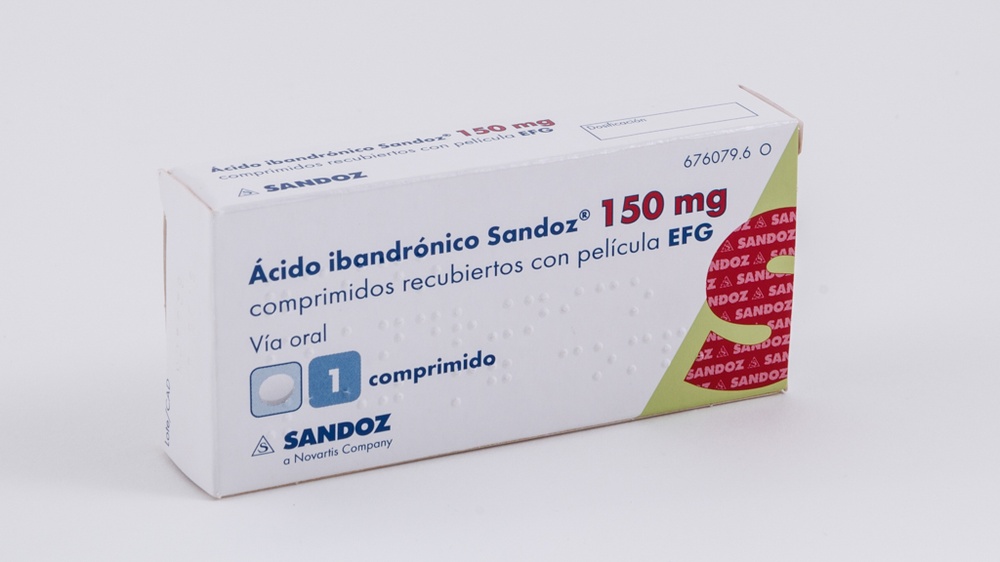
ACIDO IBANDRONICO SANDOZ 150 mg Comprimidos recubiertos con película

Revisión de receta online
Un médico revisará tu caso y determinará si la prescripción es médicamente apropiada.

Habla con un médico sobre este medicamento
Comenta tus síntomas y las opciones de tratamiento en una consulta online.



Cómo usar ACIDO IBANDRONICO SANDOZ 150 mg COMPRIMIDOS RECUBIERTOS CON PELICULA EFG
Contenido del prospecto
- Introducción
- Qué es Ácido ibandrónico Sandoz y para qué se utiliza
- Qué necesita saber antes de empezar a tomar Ácido ibandrónico Sandoz
- Cómo tomar Ácido ibandrónico Sandoz
- Posibles efectos adversos
- Conservación de Ácido ibandrónico Sandoz
- Contenido del envase e información adicional
Introducción
Prospecto: información para el paciente
Ácido ibandrónico Sandoz 150 mg comprimidos recubiertos con película EFG
Lea todo el prospecto detenidamente antes de empezar a tomar este medicamento, porque contiene información importante para usted.
- Conserve este prospecto, ya que puede tener que volver a leerlo.
- Si tiene alguna duda, consulte a su médico o farmacéutico.
- Este medicamento se le ha recetado solamente a usted, y no debe dárselo a otras personas aunque tengan los mismos síntomas que usted, ya que puede perjudicarles.
- Si experimenta efectos adversos, consulte a su médico o farmacéutico, incluso si se trata de efectos adversos que no aparecen en este prospecto. Ver sección 4.
Contenido del prospecto
- Qué es Ácido ibandrónico Sandoz y para qué se utiliza
- Qué necesita saber antes de tomar Ácido ibandrónico Sandoz
- Cómo tomar Ácido ibandrónico Sandoz
- Posibles efectos adversos
- Conservación de Ácido ibandrónico Sandoz
- Contenido del envase e información adicional
1. Qué es Ácido ibandrónico Sandoz y para qué se utiliza
Ácido ibandrónico Sandoz pertenece a un grupo de medicamentos denominados bifosfonatos.
Contiene la sustancia activa ácido ibandrónico. Ácido ibandrónico puede invertir la pérdida de hueso ya que impide que se pierda más y aumenta la masa de hueso en la mayoría de las mujeres que lo toman, aún incluso cuando éstas no son capaces de ver o apreciar la diferencia. Ácido ibandrónico puede ayudar a reducir los casos de rotura de huesos (fracturas). Esta reducción ha sido demostrada en fracturas vertebrales pero no en las de cadera.
Se le ha recetado ácido ibandrónico para tratar su osteoporosis posmenopáusica porque tiene un riesgo elevado de sufrir fracturas.La osteoporosis consiste en un adelgazamiento y debilitamiento de los huesos, que es frecuente entre las mujeres después de la menopausia. En la menopausia, los ovarios dejan de producir la hormona femenina, estrógeno, que ayuda a conservar la salud del esqueleto.
Cuanto antes llegue una mujer a la menopausia, mayor es el riesgo de que sufra fracturas por osteoporosis.
Otros factores que aumentan el riesgo de sufrir fracturas son:
- aporte insuficiente de calcio y de vitamina D en la dieta,
- tabaquismo o consumo excesivo de alcohol,
- pasear poco o ejercicios con carga de peso,
- antecedentes familiares de osteoporosis.
Loshábitos saludablesde vida también facilitan los efectos favorables del tratamiento. Entre éstos se encuentran:
- una alimentación equilibrada, rica en calcio y en vitamina D,
- pasear o cualquier otro ejercicio con carga de peso,
no fumar, y un consumo no excesivo de alcohol.

¿No estás seguro de si este medicamento es adecuado para ti?
Comenta tus síntomas y tratamiento con un médico online.
2. Qué necesita saber antes de empezar a tomar Ácido ibandrónico Sandoz
No tome Ácido ibandrónico Sandoz
- si es alérgico a ácido ibandrónico o a alguno de los demás componentes de este medicamento (incluidos en la sección 6),
- si tiene ciertos problemas con su garganta/tubo por donde pasan los alimentos (esófago) tales como estrechamiento o dificultad al tragar,
- si no puede permanecer erguido, tanto de pie como sentado, durante al menos una hora seguida (60 minutos),
- si tiene o ha tenido valores bajos de calcio en la sangre.Por favor consulte con su médico.
Advertencias y precauciones
Se ha comunicado de forma muy rara una reacción adversa denominada osteonecrosis de la mandíbula (ONM) (daño óseo en la mandíbula) durante la experiencia post-comercialización en pacientes tratados con ácido ibandrónico para osteoporosis. La ONM también puede aparecer tras interrumpir el tratamiento.
Es importante tratar de prevenir el desarrollo de ONM ya que es un estado doloroso que puede ser difícil de tratar. Con el fin de reducir el riesgo de desarrollar osteonecrosis de la mandíbula, se deben tomar ciertas precauciones.
También se han comunicado fracturas atípicas de huesos largos, como el hueso del antebrazo (cúbito) y de la espinilla (tibia), en pacientes que reciben tratamiento a largo plazo con ibandronato. Estas fracturas se producen tras traumatismos mínimos o ningún traumatismo y algunos pacientes experimentan dolor en la zona de la fractura antes de presentar una fractura completa.
Antes de recibir el tratamiento, informe a su médico/enfermero (profesional sanitario) si:
- tiene problemas en la boca o dientes, como son, una salud dental pobre, enfermedad de las encías, o una extracción de los dientes planificada,
- si no recibe un cuidado dental rutinario o si no ha tenido un chequeo dental desde hace mucho tiempo,
- si es fumador (ya que esto puede incrementar el riesgo de problemas dentales),
- si ha sido tratado previamente con un bifosfonato (utilizado para tratar o prevenir alteraciones óseas),
- si está tomando medicamentos denominados corticosteroides (tales como prednisolona o dexametasona),
- si tiene cáncer.
Su médico le puede pedir que se someta a un examen dental antes de iniciar el tratamiento con ácido ibandrónico.
Mientras esté en tratamiento, debe mantener una buena higiene bucal (incluyendo cepillado regular de los dientes) y someterse a revisiones dentales rutinarias. Si lleva dentadura postiza, debe asegurarse que esté fijada adecuadamente. Si está bajo tratamiento dental o va a someterse a una cirugía dental (p. ej. extracción dental), informe a su médico acerca de su tratamiento dental e informe a su dentista que está siendo tratado con ácido ibandrónico.
Contacte con su médico y su dentista inmediatamente si experimenta cualquier problema en la boca o dientes, tales como pérdida dental, dolor o hinchazón, o dificultad en la curación de las úlceras o secreción, ya que estos pueden ser signos de osteonecrosis de la mandíbula.
Algunas personas precisan cuidados especiales durante el tratamiento con ácido ibandrónico. Consulte a su médico:
- si padece algún trastorno del metabolismo mineral (por ejemplo, carencia de vitamina D),
- si tiene algún problema en los riñones,
- si tiene cualquier problema al tragar o problemas digestivos.
Se puede producir irritación, inflamación o ulceración de la garganta/tubo por donde pasan los alimentos (esófago) a menudo con síntomas de dolor intenso en el pecho, dolor intenso después de tragar comida y/o bebida, náuseas intensas o vómitos, especialmente si los pacientes no beben un vaso de agua y/o si se tumban antes de que transcurra una hora tras la toma de ácido ibandrónico. Si desarrolla estos síntomas, deje de tomar ácido ibandrónico e informe a su médico inmediatamente (ver sección 3).
Niños y adolescentes
No administre Ácido ibandrónico Sandoz a niños o adolescentes menores de 18 años.
Uso de Ácido ibandrónico Sandoz con otros medicamentos
Informe a su médico o farmacéutico si está utilizando, ha utilizado recientemente o podría tener que utilizar cualquier otro medicamento. Especialmente si está tomando:
- Suplementos que contengan calcio, magnesio, hierro o aluminioya que posiblemente podrían influir en los efectos de ácido ibandrónico.
- Ácido acetilsalicílico y otros antiinflamatorios no esteroideos (AINEs) (como ibuprofeno, diclofenaco sódico y naproxeno) que pueden irritar el estómago y el intestino; al igual que el ácido ibandrónico. Por lo tanto, tenga mucho cuidado cuando tome analgésicos o antiinflamatorios al mismo tiempo que ácido ibandrónico.
Después de ingerir el comprimido mensual de ácido ibandrónico, espere 1 hora para tomar cualquier otro medicamento, incluso los comprimidos para la indigestión, los suplementos de calcio o las vitaminas.
Toma de Ácido ibandrónico Sandoz con alimentos y bebidas
No tomeácido ibandrónico con alimentos. Ácido ibandrónico pierde eficacia si se toma con alimentos.
Puede beber agua pero no otros líquidos.
Tras haber tomado Ácido ibandrónico Sandoz, por favor espere 1 hora antes de tomar la primera comida y bebida (ver sección 3 “Como tomar Ácido ibandrónico Sandoz”).
Embarazo y lactancia
Ácido ibandrónico Sandoz es sólo para uso en mujeres postmenopáusicas y no debe ser tomado por mujeres en edad fértil. No tome ácido ibandrónico si está embarazada o si está dando el pecho.
Consulte a su médico o farmacéutico antes de utilizar este medicamento.
Conducción y uso de máquinas
Puede conducir y utilizar máquinas ya que se espera que ácido ibandrónico tenga un efecto insignificante o nulo sobre la capacidad para conducir y utilizar máquinas.
Ácido ibandrónico Sandoz contiene lactosa y sodio
Este medicamento contiene lactosa. Si su médico le ha indicado que padece una intolerancia a ciertos azúcares, consulte con él antes de tomar este medicamento.
Este medicamento contiene menos de 1 mmol (23 mg) de sodio por comprimido recubierto con película; esto es, esencialmente “exento de sodio”.
3. Cómo tomar Ácido ibandrónico Sandoz
Siga exactamente las instrucciones de administración de ácido ibandrónico indicadas por su médico. Consulte a su médico o farmacéutico si tiene dudas.
La dosis recomendada de ácido ibandrónico es 1 comprimido al mes.
Cómo tomar el comprimido mensual
Es importante que siga con atención estas instrucciones. Están diseñadas para que ácido ibandrónico llegue rápido al estómago y ocasione menos irritación.
- Tome un comprimido de Ácido ibandrónico Sandoz 150 mg una vez al mes.
- Elija el día del mesque le resulte más fácil de recordar. Puede elegir la misma fecha (ya sea el primer día de cada mes) o siempre el mismo día (como el primer domingo de cada mes). Elija lo que mejor se ajuste a su rutina.
- Tome el comprimido de ácido ibandrónico un mínimo de 6 horas después de la última comida o bebida, excepto agua.
- Tome el comprimido de ácido ibandrónico,
- nada más levantarse, y
- antes de desayunar o de ingerir líquidos(con el estómago vacío).
- Trague el comprimido con un vaso de agua(como mínimo, 180 ml).
Notome el comprimido con agua con alto contenido en calcio, zumo de fruta u otras bebidas. Si hay una preocupación con respecto a niveles potencialmente altos de calcio en el agua (agua dura), se aconseja utilizar agua embotellada con un bajo contenido de minerales.
- Trague el comprimido entero, no lo mastique, triture ni lo disuelva dentro de la boca.
- Durante la hora siguiente (60 minutos)después de haber ingerido el comprimido
- no se tumbe; si no permanece erguida (de pie o sentada), parte del medicamento podría regresar al esófago,

- no coma nada,

- no beba nada(salvo agua, si la necesita),
- no tome ningún otro medicamento.
- Después de esperar 1 hora, podrá tomar el desayuno y la primera bebida del día. Una vez que haya comido, puede, si lo desea, tumbarse y tomar los demás medicamentos que necesite.
Continuación del tratamiento con Ácido ibandrónico Sandoz
Es importante que tome ácido ibandrónico todos los meses, hasta que se lo indique el médico. Tras 5 años de tratamiento con Ácido ibandrónico Sandoz, contacte con su médico para saber si debe seguir con el tratamiento con Ácido ibandrónico Sandoz.
Si toma más Ácido ibandrónico Sandoz del que debe
Si ha tomado más de un comprimido por error, beba un vaso entero de leche y comuníqueselo de inmediato a su médico.
No se induzca el vómito ni se tumbeesto podría causar que ácido ibandrónico irrite su esófago.
Si olvidó tomar Ácido ibandrónico Sandoz
Si olvida tomar el comprimido en la mañana del día que ha elegido, no ingiera el comprimido más tarde. En su lugar, consulte su calendario para ver cuando le corresponde tomar su próxima dosis:
- Si olvida tomar su dosis el día señalado y su próxima dosis es dentro de 1 a 7 días
Nunca tome dos comprimidos de Ácido ibandrónico dentro de la misma semana.Espere hasta que le corresponda tomar la siguiente dosis y tómela de manera habitual, después vuelva a tomar un comprimido al mes según los días marcados en su calendario.
- Si olvida tomar su dosis el día señalado y si su próxima dosis es dentro de más de 7 días
Tome un comprimido la mañana siguiente al día que recuerde que olvidó la dosis, después vuelva a tomar un comprimido al mes según los días marcados en su calendario.
En caso de sobredosis o ingestión accidental, consulte inmediatamente a su médico o farmacéutico o llame al Servicio de Información Toxicológica, teléfono: 91 562 04 20, indicando el medicamento y la cantidad ingerida.

¿Has empezado a tomar el medicamento y tienes preguntas?
Comenta tus síntomas y tratamiento con un médico online.
4. Posibles efectos adversos
Al igual que todos los medicamentos, este medicamento puede producir efectos adversos, aunque no todas las personas los sufran.
Informe a un enfermero o médico inmediatamente si nota alguno de los siguientes efectos adversos graves- puede que necesite un tratamiento médico urgente:
Poco frecuentes(pueden afectar hasta 1 de cada 100 personas):
- Dolor grave en el pecho, dolor fuerte después de ingerir alimentos o líquidos, náuseas intensas o vómitos, dificultad para tragar. Puede tener una inflamación grave de la
garganta/esógafo, posiblemente con llagas o constricción de la garganta o del esófago.
Raros(pueden afectar hasta 1 de cada 1.000 personas):
- picor, hinchazón de la cara, labios, lengua y garganta, con dificultad para respirar,
- dolor ocular persistente e inflamación,
- dolor nuevo, debilidad o molestias en el muslo, la cadera o la ingle. Puede estar sufriendo los primeros signos de una posible fractura inusual del hueso del muslo.
Muy raros(pueden afectar hasta 1 de cada 10.000 personas):
- dolor o úlceras en la boca o en la mandíbula. Pueden ser síntomas precoces de problemas graves de mandíbula (necrosis (muerte del tejido óseo) del hueso de la mandíbula),
- reacción alérgica grave o potencialmente mortal,
- reacciones adversas graves en la piel,
- consulte a su médico si usted tiene dolor de oído, el oído le supura y/o sufre una infección de oído. Estos podrían ser síntomas de daño en los huesos del oído.
Otros posibles efectos adversos
Frecuentes(pueden afectar hasta 1 de cada 10 personas):
- dolor de cabeza,
- acidez de estómago, molestias al tragar, dolor de estómago o tripa (puede ser debida a la inflamación del estómago), indigestión, náusea, diarrea, pérdidas intestinales
- calambres musculares, rigidez en las articulaciones y extremidades.
- síntomas similares a la gripe, incluyendo fiebre, temblores y escalofríos, dolor de huesos, muscular y de articulaciones. Hable con un médico o enfermero si los efectos empeoran o duran más de un par de días,
- erupción.
Poco frecuentes(pueden afectar hasta 1 de cada 100 personas):
- mareos,
- flatulencias (gases, sentirse hinchado)
- dolor de espalda,
- sentirse cansado y agotado,
- ataques de asma,
- síntomas de niveles bajos de calcio en sangre (hipocalcemia), incluidos calambres o espasmos musculares y/o sensación de hormigueo en los dedos o alrededor de la boca.
Raros(pueden afectar hasta 1 de cada 1.000 personas):
- inflamación del duodeno (primera sección del intestino) causando dolor estomacal,
- urticaria.
Comunicación de efectos adversos:
Si experimenta cualquier tipo de efecto adverso, consulte a su médico o farmacéutico, incluso si se trata de posibles efectos adversos que no aparecen en este prospecto. También puede comunicarlos directamente a través del Sistema Español de Farmacovigilancia de Medicamentos de Uso Humano: https://www.notificaram.es. Mediante la comunicación de efectos adversos usted puede contribuir a proporcionar más información sobre la seguridad de este medicamento
5. Conservación de Ácido ibandrónico Sandoz
Mantener este medicamento fuera de la vista y del alcance de los niños.
No utilice este medicamento después de la fecha de caducidad que aparece en el blíster y envase después de CAD/EXP. La fecha de caducidad es el último día del mes que se indica.
No requiere condiciones especiales de conservación.
Los medicamentos no se deben tirar por los desagües ni a la basura. Deposite los envases y los medicamentos que no necesita en el Punto SIGRE de la farmacia. En caso de duda, pregunte a su farmacéutico cómo deshacerse de los envases y de los medicamentos que no necesita. De esta forma ayudará a proteger el medio ambiente.
6. Contenido del envase e información adicional
Composición de Ácido ibandrónico Sandoz
- El principio activo es ácido ibandrónico. Un comprimido recubierto con película contiene 150 mg de ácido ibandrónico (como ibandronato de sodio monohidrato).
- Los demás componentes son:
Núcleo: povidona, celulosa microcristalina, almidón de maiz pregelatinizado, crospovidona, sílice coloidal anhidra, glicerol dibehenato.
Recubrimiento: hipromelosa, lactosa monohidrato, dióxido de titanio (E171), macrogol 4000.
Aspecto del producto y contenido del envase
Comprimidos recubiertos con película blancos, redondos y biconvexos.
Ácido ibandrónico Sandoz se presenta en embalaje de cartón conteniendo un número apropiado de blísteres de (1, 3 o 6 comprimidos) PA/Aluminio/PVC-Aluminio (blíster Alu-Alu) y un prospecto.
Puede que solamente estén comercializados algunos tamaños de envases.
Titular de la autorización de comercialización y responsable de la fabricación
Titular de la autorización de comercialización
Sandoz Farmacéutica, S.A.
Centro Empresarial Parque Norte
Edificio Roble
C/ Serrano Galvache, 56
28033 Madrid
España
Responsable de la fabricación
LEK S.A.
ul. Domaniewska 50 C,
PL-02-672 Warszawa
Polonia
ó
Pharmathen S.A.
6 Dervenakion Str.,
153 51 Pallini, Attiki,
Grecia
ó
Lek pharmaceuticals d.d.
Verovskova 57
1526 Ljubljana
Eslovenia
ó
S.C. Sandoz, S.R.L.
Str. Livezeni nr. 7ª
RO-540472 Targu-Mures
Rumania
ó
Salutas Pharma GmbH
Otto-von-Guericke-Allee 1
39179 Barleben
Alemania
ó
Lek Pharmaceuticals d.d.
Trimlini 2D
9220 Lendava
Eslovenia
ó
Pharmathen International, S.A.
Sapes Industrial Park, Block 5
69300 Rodopi
Grecia
Este medicamento está autorizado en los estados miembros del Espacio Económico Europeo con los siguientes nombres:
Bélgica: Ibandronic acid Sandoz 150 mg filmomhulde tabletten
Italia: Acido Ibandronico Sandoz 150 mg compresse rivestite con film
Holanda: Ibandroninezuur Sandoz 150 mg, filmomhulde tabletten
Portugal: Ácido Ibandrónico Sandoz 150 mg comprimidos revestidos por película
Rumanía: Ibandronic Acid Sandoz 150 mg comprimate filmate
República Eslovaca: Kyselina ibandrónová Sandoz 150mg filmom obalené tablety
Irlanda del Norte: Ibandronic acid Sandoz 150mg Film-coated Tablets
Fecha de la última revisión de este prospecto:enero 2025
La información detallada de este medicamento está disponible en la página web de la Agencia Española de Medicamentos y Productos Sanitarios (AEMPS) http://www.aemps.gob.es/
- País de registro
- Forma farmacéuticaCOMPRIMIDO, 150 mg
- Código ATCM05BA06
- Precio medio en farmacia13 EUR
- Disponibilidad en farmaciasProblema de suministro reportado
- Principio activo
- Requiere recetaSí
- Fabricante
- ComposiciónDIBEHENATO DE GLICEROL (9,00 mg mg), LACTOSA MONOHIDRATO (C.S. mg mg), ALCOHOL ETILICO (ETANOL) (11,48 mg mg)
- Esta información es de carácter general y no sustituye la consulta con un profesional sanitario.
- Alternativas a ACIDO IBANDRONICO SANDOZ 150 mg COMPRIMIDOS RECUBIERTOS CON PELICULA EFGForma farmacéutica: COMPRIMIDO, 150 mgPrincipio activo: Ibandronico acidoFabricante: Especialidades Farmaceuticas Centrum S.A.Requiere recetaForma farmacéutica: INYECTABLE PERFUSION, 2 mgPrincipio activo: Ibandronico acidoFabricante: Accord Healthcare S.L.U.Requiere recetaForma farmacéutica: INYECTABLE PERFUSION, 6 mgPrincipio activo: Ibandronico acidoFabricante: Accord Healthcare S.L.U.Requiere receta
Médicos online para ACIDO IBANDRONICO SANDOZ 150 mg COMPRIMIDOS RECUBIERTOS CON PELICULA EFG
Comenta la dosis, los posibles efectos secundarios, interacciones, contraindicaciones o la revisión de receta de ACIDO IBANDRONICO SANDOZ 150 mg COMPRIMIDOS RECUBIERTOS CON PELICULA EFG, sujeto a valoración médica y a la normativa local.


Obtén una receta de ACIDO IBANDRONICO SANDOZ 150 mg COMPRIMIDOS RECUBIERTOS CON PELICULA EFG online
Rellena un formulario de 2 minutos
Cuéntanos tus síntomas, historial y el medicamento que necesitas.
Elige un médico o nosotros te asignamos uno
Escoge un especialista o te conectamos con el próximo médico disponible.
El médico revisa tu caso
Normalmente en 30 minutos. Puede hacerte preguntas adicionales por chat.
Recógela en cualquier farmacia
Receta electrónica enviada a tu correo, válida en toda España.
Preguntas frecuentes
ACIDO IBANDRONICO SANDOZ 150 mg COMPRIMIDOS RECUBIERTOS CON PELICULA EFG requiere receta en España. Puedes confirmarlo con un médico online según tu caso.
El principio activo de ACIDO IBANDRONICO SANDOZ 150 mg COMPRIMIDOS RECUBIERTOS CON PELICULA EFG es Ibandronico acido. Esta información ayuda a identificar medicamentos con la misma composición pero con diferentes nombres comerciales.
El precio medio en farmacia de ACIDO IBANDRONICO SANDOZ 150 mg COMPRIMIDOS RECUBIERTOS CON PELICULA EFG es de aproximadamente 13 EUR. Puede variar según el fabricante y la forma farmacéutica.
ACIDO IBANDRONICO SANDOZ 150 mg COMPRIMIDOS RECUBIERTOS CON PELICULA EFG es fabricado por Sandoz Farmaceutica S.A.. La marca y el envase pueden variar según el distribuidor.
Los Médicos de familia, Psiquiatras, Dermatólogos, Cardiólogos, Endocrinólogos, Gastroenterólogos, Neumólogos, Nefrólogos, Reumatólogos, Hematólogos, Infectólogos, Alergólogos, Geriatras, Pediatras, Oncólogos pueden valorar la prescripción de ACIDO IBANDRONICO SANDOZ 150 mg COMPRIMIDOS RECUBIERTOS CON PELICULA EFG cuando esté clínicamente indicado. Puedes reservar una videoconsulta para comentar tu caso y las opciones de tratamiento.
España cuenta con una infraestructura sanitaria bien desarrollada en ciudades principales como Madrid, Barcelona, Valencia y Sevilla. Las farmacias están ampliamente disponibles y operan bajo estrictas regulaciones, garantizando el acceso a medicamentos con receta.
Puedes comprar ACIDO IBANDRONICO SANDOZ 150 mg COMPRIMIDOS RECUBIERTOS CON PELICULA EFG en Madrid, Barcelona, Sevilla o Valencia en cualquier farmacia local con una receta válida.
Para obtener una receta, puedes utilizar Oladoctor:
Otros medicamentos con el mismo principio activo (Ibandronico acido) incluyen ABRION 150 mg COMPRIMIDOS RECUBIERTOS CON PELICULA EFG, Acido Ibandronico Accord 2 mg concentrado para solucion para perfusion EFG, Acido Ibandronico Accord 6 mg concentrado para solucion para perfusion EFG. Pueden tener diferentes nombres comerciales o formulaciones, pero contienen el mismo componente terapéutico. Consulta siempre con un médico antes de cambiar o iniciar un nuevo medicamento.
