


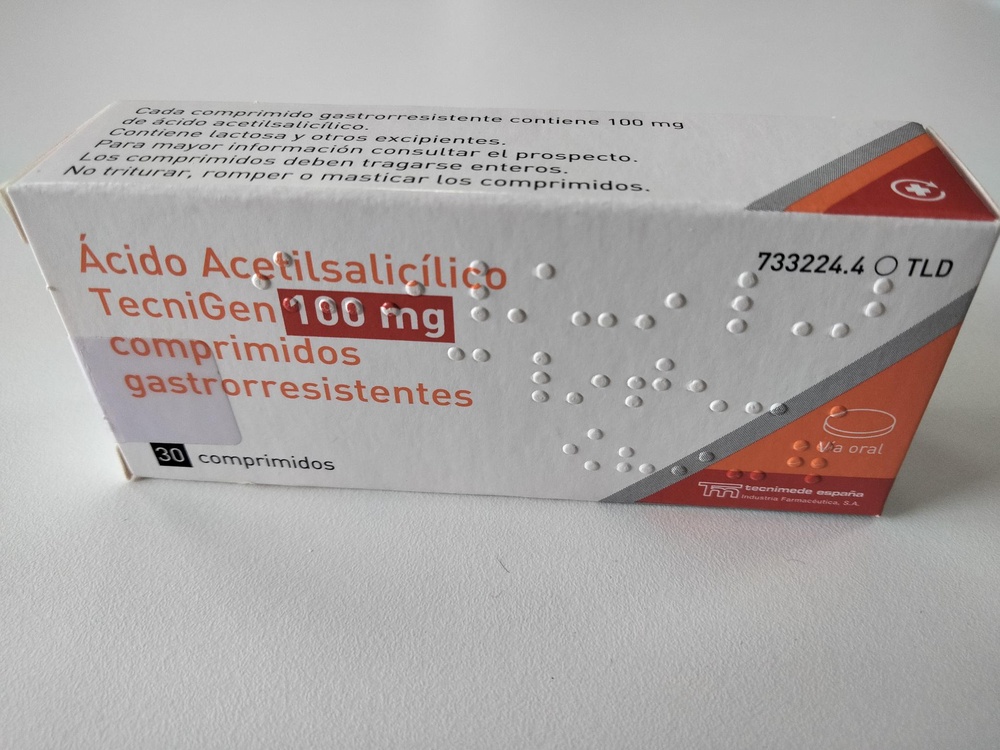
Acido acetilsalicilico tecnigen Tecnimede 100 mg comprimidos gastrorresistentes

Revisión de receta online
Un médico revisará tu caso y determinará si la prescripción es médicamente apropiada.

Habla con un médico sobre este medicamento
Comenta tus síntomas y las opciones de tratamiento en una consulta online.



Cómo usar ACIDO ACETILSALICILICO TECNIGEN 100 MG COMPRIMIDOS GASTRORRESISTENTES
Contenido del prospecto
- Introducción
- Qué es Ácido Acetilsalicílico TecniGen y para qué se utiliza
- Qué necesita saber antes de empezar a tomar Ácido Acetilsalicílico TecniGen
- Cómo tomar Ácido Acetilsalicílico TecniGen
- Posibles efectos adversos
- Conservación de Ácido Acetilsalicílico TecniGen
- Contenido del envase e información adicional
Introducción
Prospecto: información para el usuario
Ácido Acetilsalicílico TecniGen 100 mg comprimidos gastrorresistentes
Lea todo el prospecto detenidamente antes de empezar a tomar este medicamento, porque contiene información importante para usted.
- Conserve este prospecto, ya que puede tener que volver a leerlo.
- Si tiene alguna duda, consulte a su médico, farmacéutico o enfermero.
- Este medicamento se le ha recetado solamente a usted, y no debe dárselo a otras personas aunque tengan los mismos síntomas que usted, ya que puede perjudicarles.
- Si experimenta efectos adversos, consulte a su médico, farmacéutico o enfermero, incluso si se trata de efectos adversos que no aparecen en este prospecto. Ver sección 4.
Contenido del prospecto
- Qué es Ácido Acetilsalicílico TecniGen y para qué se utiliza
- Qué necesita saber antes de empezar a tomar Ácido Acetilsalicílico TecniGen
- Cómo tomar Ácido Acetilsalicílico TecniGen
- Posibles efectos adversos
- Conservación de Ácido Acetilsalicílico TecniGen
- Contenido del envase e información adicional
1. Qué es Ácido Acetilsalicílico TecniGen y para qué se utiliza
Ácido Acetilsalicílico TecniGen contiene ácido acetilsalicílico, que a bajas dosis pertenece a un grupo de medicamentos denominados antiagregantes plaquetarios. Las plaquetas son células pequeñas de la sangre, que producen la coagulación de la sangre y están implicadas en la trombosis. Cuando se origina un coágulo de sangre en una arteria, detiene el flujo sanguíneo y corta el suministro de oxígeno.
Cuando esto ocurre en el corazón puede producir un ataque al corazón o angina; en el cerebro puede producir un infarto cerebral.
Ácido acetilsalicílico se toma para reducir el riesgo de formación de trombos y por consiguiente prevenir:
- ataques al corazón
- infartos cerebrales
- problemas cardiovasculares en pacientes que tienen angina estable o inestable (un tipo de dolor en el pecho)
Este medicamento también se utiliza para prevenir la formación de trombos después de ciertos tipos de cirugía cardiaca con el fin de ensanchar o desbloquear los vasos sanguíneos.
Este medicamento no está recomendado para casos de emergencia. Sólo puede ser utilizado como un tratamiento preventivo.

¿No estás seguro de si este medicamento es adecuado para ti?
Comenta tus síntomas y tratamiento con un médico online.
2. Qué necesita saber antes de empezar a tomar Ácido Acetilsalicílico TecniGen
No tome Ácido Acetilsalicílico TecniGen
- si es alérgico al ácido acetilsalicílico, a otros salicilatos o a medicamentos antiinflamatorios no esteroideos (AINEs; los AINEs se utilizan con frecuencia para la artritis o reumatismo y dolor) o a cualquiera de los demás componentes de este medicamento (incluidos en la sección 6)
- si ha tenido un ataque de asma o hinchazón de algunas partes del cuerpo, p.ej. cara, labios, garganta o lengua (angioedema) tras tomar salicilatos o AINEs
- si actualmente tiene o ha tenido alguna vez una úlcera en su estómago o en el intestino delgado
- si tiene antecedentes de hemorragia o perforación (gástrica o intestinal) causados por un tratamiento previo con AINEs
- si tiene antecedentes de úlcera/hemorragia gastroduodenal recurrente con episodios de ulceración o hemorragia, o cualquier otro tipo de hemorragia como un infarto cerebral
- si ha tenido alguna vez el problema de que su sangre no coagula adecuadamente
- si tiene problemas graves de hígado o riñón
- si tiene problemas cardíacos graves, que pueden causar dificultad para respirar e hinchazón de los tobillos
- si se encuentra en los últimos 3 meses de embarazo; no debe usar dosis mayores de 100 mg al día (ver sección “Embarazo y lactancia”)
- si toma un medicamento llamado metotrexato (p.ej. para tratar el cáncer o artritis reumatoide) en dosis mayores de 15 mg a la semana
Advertencias y precauciones
Consulte a su médico, farmacéutico o enfermero antes de empezar a tomar este medicamento:
- si tiene problemas en sus riñones, hígado o corazón
- si tiene o ha tenido úlceras o hemorragias (por ejemplo, en el estómago o el intestino delgado)
- si tiene la presión arterial alta
- si es asmático, tiene fiebre del heno, pólipos nasales u otras enfermedades respiratorias crónicas; el ácido acetilsalicílico puede inducir un ataque de asma
- si ha tenido alguna vez gota
- si tiene menstruaciones abundantes
- si tiene una deficiencia de la enzima glucosa-6-fosfato deshidrogenasa (G6PD)
Debe consultar a un médico inmediatamente si sus síntomas empeoran o si experimenta efectos adversos graves o inesperados p.ej. síntomas hemorrágicos fuera de lo normal, reacciones graves de la piel o cualquier otro signo de alergia grave (ver sección “Posibles efectos adversos”).
Informe a su médico si tiene planeada una intervención quirúrgica (incluso una intervención menor, como una extracción dental) ya que como el ácido acetilsalicílico es anticoagulante, puede existir un aumento del riesgo de hemorragia.
Debe tener cuidado de no deshidratarse (puede sentir sed y la boca seca) ya que el uso de ácido acetilsalicílico al mismo tiempo puede producir deterioro de la función renal.
Este medicamento no es adecuado para aliviar el dolor o reducir la fiebre.
Si se encuentra en alguno de los casos anteriores, o si no está seguro, consulte a su médico o farmacéutico.
Niños y adolescentes
El ácido acetilsalicílico puede producir el síndrome de Reye cuando se administra a niños. El síndrome de Reye es una enfermedad muy rara que afecta al cerebro y al hígado y puede poner en peligro la vida. Por esta razón, este medicamento no debe ser administrado a adolescentes/niños menores de 16 años, a menos que lo indique un médico.
Otros medicamentos y Ácido Acetilsalicílico TecniGen
Informe a su médico o farmacéutico si está tomando, ha tomado recientemente o pudiera tener que tomar cualquier otro medicamento.
El efecto del tratamiento puede estar influenciado si el ácido acetilsalicílico se toma al mismo tiempo que otros medicamentos que se usan para:
- prevenir la formación de coágulos en la sangre (p.ej. warfarina, heparina, clopidogrel, altepasa)
- prevenir el rechazo de un órgano trasplantado (ciclosporina, tacrolimus)
- tratar la presión arterial alta (p.ej. diuréticos e inhibidores de la ECA)
- regular el latido del corazón (digoxina)
- trastorno maníaco-depresivo (litio)
- dolor e inflamación (p.ej. AINEs como ibuprofeno, o esteroides)
- Metamizol (sustancia para disminuir el dolor y la fiebre) puede reducir el efecto del ácido acetilsalicílico en la agregación plaquetaria (las células sanguíneas se unen y forman un coágulo sanguíneo). Por lo tanto, esta combinación se debe utilizar con precaución en pacientes que estén tomando dosis bajas de ácido acetilsalicílico como cardioprotector
- gota (p.ej. probenecid)
- epilepsia (valproato, fenitoína)
- glaucoma (acetazolamida)
- cáncer o artritis reumatoide (metotrexato; en dosis menores de 15 mg a la semana)
- diabetes (p.ej. glibenclamida, insulina)
- depresión (inhibidores selectivos de la recaptación de serotonina (ISRSs) como sertralina o paroxetina)
- se usan como terapia hormonal sustitutiva cuando las glándulas adrenales o la glándula pituitaria han sido destruidas o extraídas, o medicamentos para tratar la inflamación, incluyendo enfermedades reumáticas e inflamación de los intestinos (corticosteroides)
Toma de Ácido Acetilsalicílico TecniGen con alimentos,bebidas y alcohol
Beber alcohol puede posiblemente aumentar el riesgo de hemorragia gastrointestinal y prolongar el tiempo de sangrado.
Embarazo,lactancia y fertilidad
Si está embarazada o en periodo de lactancia, cree que podría estar embarazada o tiene intención de quedarse embarazada, consulte a su médico o farmacéutico antes de utilizar este medicamento.
Las mujeres embarazadas no deben tomar ácido acetilsalicílico durante el embarazo a menos que se lo indique su médico. No debe tomar este medicamento si está en los últimos 3 meses de embarazo, a menos que su médico se lo indique y en ese caso la dosis diaria no debe exceder de 100 mg (ver sección “No tome Ácido Acetilsalicílico TecniGen”). Dosis normales o altas de este medicamento durante la última fase del embarazo pueden causar complicaciones graves en la madre o el bebé.
Las mujeres que estén dando el pecho no deben tomar ácido acetilsalicílico a menos que se lo indique su médico.
El ácido acetilsalicílico puede afectar a la fertilidad femenina mediante su efecto sobre la ovulación. Este efecto es reversible tras la interrupción del tratamiento.
Conducción y uso de máquinas
Este medicamento no debe afectar a su capacidad de conducir y usar máquinas.
Ácido Acetilsalicílico TecniGen contiene lactosa
Este medicamento contiene lactosa. Si su médico le ha indicado que padece una intolerancia a ciertos azúcares, consulte con él antes de tomar este medicamento.
3. Cómo tomar Ácido Acetilsalicílico TecniGen
Siga exactamente las instrucciones de administración de este medicamento indicadas por su médico o farmacéutico. En caso de duda, consulte de nuevo a su médico o farmacéutico.
Adultos
Prevención de ataques al corazón:
- La dosis recomendada es 100 mg una vez al día.
Prevención de infartos cerebrales:
- La dosis recomendada es 100 mg una vez al día.
Prevención de problemas cardiovasculares en pacientes que tienen angina estable o inestable (un tipo de dolor en el pecho):
- La dosis recomendada es 100 mg una vez al día.
Prevención de la formación de trombos después de ciertos tipos de cirugía cardiaca:
- La dosis recomendada es 100 mg una vez al día.
Este medicamento no debe utilizarse en dosis más altas a menos que lo aconseje un médico. La dosis no debe superar los 300 mg al día.
Pacientes de edad avanzada
Dosis iguales a los adultos. De forma general, el ácido acetilsalicílico debe utilizarse con precaución en pacientes de edad avanzada que son más propensos a acontecimientos adversos. El tratamiento debe ser revisado a intervalos regulares.
Niños y adolescentes
El ácido acetilsalicílico no debe administrarse a niños y adolescentes menores de 16 años, a menos que lo prescriba un médico (ver sección “Advertencias y precauciones ”).
Forma de administración
Por vía oral.
Los comprimidos deben tragarse enteros con una cantidad suficiente de líquido (medio vaso de agua). Los comprimidos tienen un recubrimiento gastrorresistente que previene efectos irritantes en el intestino, y por tanto no se deben triturar, romper o masticar.
Si toma más Ácido Acetilsalicílico TecniGen del que debe
Si usted (u otra persona) toma accidentalmente demasiados comprimidos, debe informar a su médico de inmediato, contactar inmediatamente con el servicio de urgencias más cercano o llame al Servicio de Información Toxicológica, teléfono 91 562 04 20, indicando el medicamento y la cantidad ingerida.
Muestre a su médico el medicamento o el envase vacío.
Los síntomas de sobredosis pueden incluir pitidos en los oídos, problemas de audición, dolor de cabeza, mareo, confusión, náuseas, vómitos y dolor abdominal. Una sobredosis grande puede conducir a una respiración más rápida de lo normal (hiperventilación), fiebre, exceso de sudoración, inquietud, convulsiones, alucinaciones, bajos niveles de azúcar en sangre, edema pulmonar, coma y shock.
Si olvidó tomar Ácido Acetilsalicílico TecniGen
Si olvida tomar una dosis, espere hasta que llegue el momento de tomar la siguiente dosis y continúe el tratamiento de la forma habitual.
No tome una dosis doble para compensar las dosis olvidadas.
Si interrumpe el tratamiento con Ácido Acetilsalicílico TecniGen
No deje de tomar este medicamento sin consultar a su médico.
Si tiene cualquier otra duda sobre el uso de este medicamento, pregunte a su médico, farmacéutico o enfermero.

¿Has empezado a tomar el medicamento y tienes preguntas?
Comenta tus síntomas y tratamiento con un médico online.
4. Posibles efectos adversos
Al igual que todos los medicamentos, este medicamento puede producir efectos adversos, aunque no todas las personas los sufran.
Si nota cualquiera de los siguientes efectos adversos graves, deje de tomar este medicamento y contacte con su médico inmediatamente:
- Repentina dificultad para respirar, hinchazón de sus labios, cara o cuerpo, sarpullido, desvanecimiento o dificultades para tragar (reacción alérgica grave).
- Enrojecimiento de la piel con ampollas o descamación y puede estar asociado con fiebre alta y dolores articulares. Esto podría ser eritema multiforme, síndrome de Stevens-Johnson o síndrome de Lyell.
- Sangrado inusual, como tos con sangre, sangre en su vómito u orina, o heces negras.
Otros efectos adversos son:
Efectos adversos frecuentes (pueden afectar hasta 1 de cada 10 personas)
- Náuseas, vómitos, diarrea.
- Indigestión.
- Aumento de la tendencia a sangrar.
Efectos adversos poco frecuentes (pueden afectar hasta 1 de cada 100 personas)
- Urticaria.
- Goteo nasal.
- Dificultad para respirar.
Efectos adversos raros (pueden afectar hasta 1 de cada 1.000 personas)
- Sangrado intenso en el estómago o intestinos, hemorragia cerebral; número alterado de células sanguíneas.
- Calambres en el tracto respiratorio inferior, ataque de asma.
- Inflamación de los vasos sanguíneos.
- Magulladuras con manchas de color púrpura (sangrado cutáneo).
- Reacciones graves de la piel como sarpullido conocido como eritema multiforme, y se presenta en formas que puede poner en peligro la vida, síndrome de Stevens-Johnson y síndrome de Lyell.
- Reacciones de hipersensibilidad, como hinchazón de, p.ej. labios, cara o cuerpo, o shock.
- El síndrome de Reye (una enfermedad muy rara en los niños que afecta al cerebro y al hígado (ver sección 2 "Niños y adolescentes").
- Menstruaciones anormalmente abundantes o prolongadas.
Frecuencia no conocida (la frecuencia no puede estimarse a partir de los datos disponibles)
- Pitido en sus oídos (tinnitus) o reducida capacidad de audición.
- Dolor de cabeza.
- Vértigo.
- Úlceras en el estómago o intestino delgado y perforación.
- Tiempo de sangrado prolongado.
- Trastorno de la función renal, insuficiencia renal aguda.
- Trastorno de la función hepática, aumento de las enzimas hepáticas.
- Niveles altos de ácido úrico o niveles bajos de azúcar en la sangre.
Comunicación de efectos adversos
Si experimenta efectos adversos, consulte a su médico, farmacéutico o enfermero, incluso si se trata de efectos adversos que no aparecen en este prospecto. También puede comunicarlos directamente a través del Sistema Español de farmacovigilancia de Medicamentos de Uso Humano: www.notificaram.es. Mediante la comunicación de efectos adversos usted puede contribuir a proporcionar más información sobre la seguridad de este medicamento.
5. Conservación de Ácido Acetilsalicílico TecniGen
Mantener este medicamento fuera de la vista y del alcance de los niños.
No conservar a temperatura superior a 30ºC.
No utilice este medicamento después de la fecha de caducidad que aparece en el envase después de CAD. La fecha de caducidad es el último día del mes que se indica.
Los medicamentos no se deben tirar por los desagües ni a la basura. Deposite los envases y los medicamentos que no necesita en el Punto SIGRE de la farmacia. Pregunte a su farmacéutico cómo deshacerse de los envases y de los medicamentos que ya no necesita. De esta forma, ayudará a proteger el medio ambiente.
6. Contenido del envase e información adicional
Composición de Ácido Acetilsalicílico TecniGen
- El principio activo es ácido acetilsalicilico. Cada comprimido gastrorresistente contiene 100 mg de ácido acetilsalicílico.
- Los demás componentes son:
- Núcleo del comprimido: Lactosa monohidrato, celulosa microcristalina, sílice coloidal anhidra y almidón de patata.
- Película de recubrimiento gastrorresistente: Talco, triacetina y copolímero de ácido metacrílico y acrilato de etilo (1:1), dispersión de, al 30%.
Aspecto del producto y contenido del envase
Comprimidos blancos, redondos, biconvexos, recubiertos con película, con un diámetro de aproximadamente 8,1 mm y un grosor de aproximadamente 3,5 mm.
Envase de cartón con blíster de PVC/Al que contiene 30 y 100 comprimidos.
Puede que solamente estén comercializados algunos tamaños de envases.
Titular de la autorización de comercialización y responsable de la fabricación
Titular de la autorización de comercialización
Tecnimede España Industria Farmacéutica, S.A.
Avda. de Bruselas, 13, 3º D. Edificio América. Polígono Arroyo de la Vega,
28108 Alcobendas (Madrid)
España
Responsable de la fabricación
G.L. Pharma GmbH
Industriestrasse 1, A-8502 Lannach
Austria
o
G.L. Pharma GmbH
Schlossplatz 1, A-8502 Lannach
Austria
Este medicamento está autorizadoen los estados miembros del Espacio Económico Europeo con los siguientes nombres:
Italia: Acido Acetilsalicilico Tecnigen 100 mg compresse gastroresistenti
Portugal: Acido Acetilsalicilico Biofarmoz 100 mg comprimidos gastrorresistentes
España: Acido Acetilsalicilico Tecnigen 100 mg comprimidos gastrorresistentes
Fecha de la última revisión de este prospecto:Enero 2022
La información detallada de este medicamento está disponible en la página web de la Agencia Española de Medicamentos y Productos Sanitarios (AEMPS) http://www.aemps.gob.es/
- País de registro
- Forma farmacéuticaCOMPRIMIDO, 100 mg
- Código ATCB01AC06
- Precio medio en farmacia1.45 EUR
- Principio activo
- Requiere recetaSí
- Fabricante
- ComposiciónLACTOSA MONOHIDRATO (60 mg mg)
- Esta información es de carácter general y no sustituye la consulta con un profesional sanitario.
- Alternativas a ACIDO ACETILSALICILICO TECNIGEN 100 MG COMPRIMIDOS GASTRORRESISTENTESForma farmacéutica: COMPRIMIDO, 100 mgPrincipio activo: Acetilsalicilico acidoFabricante: Laboratorio Stada S.L.Requiere recetaForma farmacéutica: COMPRIMIDO, 100 mgPrincipio activo: Acetilsalicilico acidoFabricante: Laboratorios Alter S.A.Requiere recetaForma farmacéutica: COMPRIMIDO, 100 mgPrincipio activo: Acetilsalicilico acidoFabricante: Aristo Pharma Iberia S.L.Requiere receta
Médicos online para ACIDO ACETILSALICILICO TECNIGEN 100 MG COMPRIMIDOS GASTRORRESISTENTES
Comenta la dosis, los posibles efectos secundarios, interacciones, contraindicaciones o la revisión de receta de ACIDO ACETILSALICILICO TECNIGEN 100 MG COMPRIMIDOS GASTRORRESISTENTES, sujeto a valoración médica y a la normativa local.









Preguntas frecuentes
ACIDO ACETILSALICILICO TECNIGEN 100 MG COMPRIMIDOS GASTRORRESISTENTES requiere receta en España. Puedes confirmarlo con un médico online según tu caso.
El principio activo de ACIDO ACETILSALICILICO TECNIGEN 100 MG COMPRIMIDOS GASTRORRESISTENTES es Acetilsalicilico acido. Esta información ayuda a identificar medicamentos con la misma composición pero con diferentes nombres comerciales.
El precio medio en farmacia de ACIDO ACETILSALICILICO TECNIGEN 100 MG COMPRIMIDOS GASTRORRESISTENTES es de aproximadamente 1.45 EUR. Puede variar según el fabricante y la forma farmacéutica.
ACIDO ACETILSALICILICO TECNIGEN 100 MG COMPRIMIDOS GASTRORRESISTENTES es fabricado por Tecnimede España Industria Farmaceutica S.A.. La marca y el envase pueden variar según el distribuidor.
Los Médicos de familia, Psiquiatras, Dermatólogos, Cardiólogos, Endocrinólogos, Gastroenterólogos, Neumólogos, Nefrólogos, Reumatólogos, Hematólogos, Infectólogos, Alergólogos, Geriatras, Pediatras, Oncólogos pueden valorar la prescripción de ACIDO ACETILSALICILICO TECNIGEN 100 MG COMPRIMIDOS GASTRORRESISTENTES cuando esté clínicamente indicado. Puedes reservar una videoconsulta para comentar tu caso y las opciones de tratamiento.
La receta la emite un médico tras valorar tu estado de salud. En España, ACIDO ACETILSALICILICO TECNIGEN 100 MG COMPRIMIDOS GASTRORRESISTENTES se dispensa en las farmacias con esa receta médica. Una consulta online no garantiza su emisión: la decisión corresponde siempre al médico.
Para solicitar una valoración puedes usar Oladoctor:
Otros medicamentos con el mismo principio activo (Acetilsalicilico acido) incluyen A.A.S. 100 mg COMPRIMIDOS, ACIDO ACETILSALICILICO ALTER 100 MG COMPRIMIDOS GASTRORRESISTENTES EFG, ACIDO ACETILSALICILICO ARISTO 100 MG COMPRIMIDOS GASTRORRESISTENTES. Pueden tener diferentes nombres comerciales o formulaciones, pero contienen el mismo componente terapéutico. Consulta siempre con un médico antes de cambiar o iniciar un nuevo medicamento.
