






How to use DROGLICAN 200 mg/250 mg HARD CAPSULES
Translated with AI
This page provides general information and does not replace a doctor’s consultation. Always consult a doctor before taking any medication. Seek urgent medical care if symptoms are severe.
Show originalContents of the leaflet
Introduction
Package Leaflet: Information for the User
Droglican 200 mg/250 mg Hard Capsules
Sodium Chondroitin Sulfate / Glucosamine Hydrochloride
Read this package leaflet carefully before you start taking this medicine because it contains important information for you.
- Keep this package leaflet, you may need to read it again.
- If you have any further questions, ask your doctor or pharmacist.
- This medicine has been prescribed for you only. Do not pass it on to others, as it may harm them, even if their symptoms are the same as yours.
If you experience any side effects that are not listed in this package leaflet, see Section 4.
- If you experience any side effects that are not listed in this package leaflet, see Section 4.
Contents of the Package Leaflet:
- What is Droglican and what is it used for
- What you need to know before you take Droglican
- How to take Droglican
- Possible side effects
5 Storage of Droglican
- Contents of the pack and further information
1. What is Droglican and what is it used for
Droglican is a hard capsule that contains two active substances. One active substance is chondroitin sulfate and the other is glucosamine hydrochloride. Both active substances belong to the group of non-steroidal anti-inflammatory and anti-rheumatic drugs.
Droglican is used in the treatment of symptoms of knee osteoarthritis in patients with moderate to severe pain, where treatment with a combination of chondroitin sulfate and glucosamine is indicated.

2. What you need to know before you take Droglican
Do not take Droglican:
- If you are allergic (hypersensitive) to chondroitin sulfate, glucosamine, or any of the other components of this medicine (listed in Section 6).
If you are allergic to shellfish, as glucosamine comes from shellfish.
- If you are allergic to shellfish, as glucosamine comes from shellfish.
Warnings and precautions
Consult your doctor or pharmacist before taking Droglican.
- If you have altered sugar tolerance (glucose). More frequent monitoring of blood sugar levels may be necessary when starting treatment with glucosamine.
If you have any kidney or liver disorder, as no studies have been conducted in this type of patient, and therefore, no dosing recommendations can be given.
- If you have any kidney or liver disorder, as no studies have been conducted in this type of patient, and therefore, no dosing recommendations can be given.
- If you have any serious heart disease. Consult your doctor.
Children
This medicine is not recommended for use in children or adolescents under 18 years of age.
Using Droglican with other medicines
Inform your doctor or pharmacist if you are taking, have recently taken, or might take any other medicines.
Caution is recommended if Droglican is administered in combination with other medicines, especially with:
- Certain types of medicines used to prevent blood clotting (e.g., warfarin, dicumarol, phenprocoumon, acenocoumarol, and fluindione). The effect of these medicines may be enhanced if used with glucosamine. Therefore, patients treated with these combinations should be closely monitored at the start or end of glucosamine treatment.
- Medicines for treating infections (antibiotics such as tetracycline, chloramphenicol, or penicillin).
Consult your doctor or pharmacist for more information.
Taking Droglican with food and drinks
You can take the capsules before, during, or after meals. However, if you often experience stomach upset when taking medicines, it is advisable to take Droglican after meals.
Pregnancy and breastfeeding
If you are pregnant or breastfeeding, think you may be pregnant, or are planning to have a baby, ask your doctor or pharmacist for advice before taking this medicine.
It is not known whether the active substances of Droglican pass into breast milk. Therefore, do not take this medicine if you are breastfeeding, as there is not enough information on the safety of your baby.
Consult your doctor or pharmacist before taking any medicine.
Driving and using machines
If you feel dizzy or drowsy, avoid driving or using machinery.
3. How to take Droglican
Follow the instructions for administration of the medicine contained in this package leaflet or as indicated by your doctor or pharmacist.
The recommended dose is 2 capsules, 3 times a day.
The capsules should be swallowed without chewing with a sufficient amount of liquid.
If you take more Droglican than you should
If you have taken more capsules than you should, you may experience headache, dizziness, disorientation, joint pain, nausea, vomiting, or diarrhea, although it is likely that you will not experience any symptoms. In any case, inform your doctor.
In case of overdose or accidental ingestion, consult the Toxicology Information Service, telephone 91 562 04 20 (indicating the medicine and the amount ingested).
If you forget to take Droglican
You can take the missed dose when you remember, but do not take more than 6 capsules per day.
If you stop taking Droglican
The symptoms may reappear. If you have any other questions about the use of this product, ask your doctor or pharmacist.

4. Possible side effects
Like all medicines, this medicine can cause side effects, although not everybody gets them.
Tell your doctor immediately if you experience any of the following side effects:
Respiratory tract infection, urinary tract infection, or chest pain.
The most common side effects observed with Droglican are:
Frequent (may affect up to 1 in 10 patients/persons):
- headache
- diarrhea, nausea, indigestion, flatulence (gas)
Rare (may affect up to 1 in 1000 patients/persons):
- altered sense of taste
- stomach pain
- gastroesophageal reflux (a condition in which food or liquid is returned from the stomach to the esophagus, the tube that goes from the mouth to the stomach)
- constipation, acidity, abdominal distension
- muscle cramps, pain in a limb
- fatigue
- respiratory tract infection, urinary tract infection
- increased liver enzyme levels
- abnormalities in urine tests
The side effects observed in patients treated only with chondroitin sulfate (and not described above) are as follows:
Very rare (may affect up to 1 in 10,000 patients/persons):
- edema, water retention
- allergic reaction
The side effects observed in patients treated only with glucosamine hydrochloride (and not described above) are as follows:
Uncommon (may affect up to 1 in 100 patients/persons):
- redness or rash on some areas of the skin and itching
Frequency not known (cannot be estimated from the available data):
- swelling of the face, tongue, or throat
- hives, swelling / edema of ankles, legs, and feet
- dizziness, vomiting
- worsening of blood sugar control in patients with diabetes mellitus
Generally, the side effects that may occur during treatment with Droglican are mild and disappear with the suspension of treatment.
If you consider that any of the side effects you are experiencing is serious, or if you notice any side effects not listed in this package leaflet, inform your doctor or pharmacist.
Reporting of side effects:
If you experience any side effects, consult your doctor or pharmacist, even if it is a possible side effect not listed in this package leaflet. You can also report them directly through the Spanish Pharmacovigilance System for Human Use Medicines: www.notificaRAM.es. By reporting side effects, you can help provide more information on the safety of this medicine.
5. Storage of Droglican
Do not store above 30°C. Store in the original packaging to protect from moisture.
Keep this medicine out of the sight and reach of children.
Do not use this medicine after the expiry date which is stated on the carton after CAD. The expiry date is the last day of the month shown.
Medicines should not be disposed of via wastewater or household waste. Dispose of the packaging and any unused medicine in the SIGRE collection point at your usual pharmacy. Ask your pharmacist how to dispose of medicines no longer required. This will help protect the environment.
6. Contents of the pack and further information
Composition of Droglican
- The active substances are 200 mg of sodium chondroitin sulfate and 250 mg of glucosamine hydrochloride.
- The other component is magnesium stearate.
Appearance of the product and pack contents
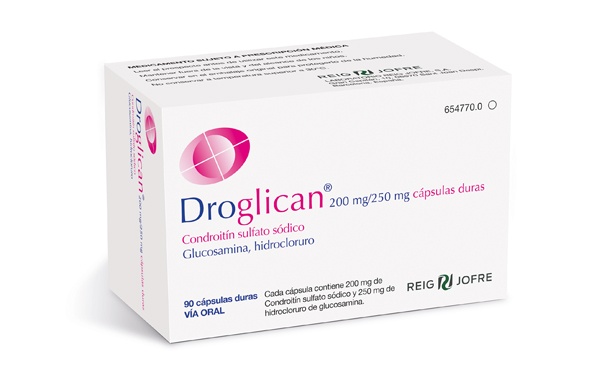
Droglican is presented in the form of hard gelatin capsules, size 1, turquoise in color. The contents of the capsules are white or off-white powder.
It is packaged in a cardboard box containing 90 capsules in aluminum and plastic (PVC/PVDC) blisters.
Marketing authorization holder and manufacturer
Marketing authorization holder:
LABORATORIO REIG JOFRE, S.A.
Gran Capitán, 10
08970 Sant Joan Despí (Barcelona) Spain.
Manufacturer:
NOUCOR HEALTH., S.A.
Avda. Camí Reial, 51-57
08184 Palau-solità i Plegamans (Barcelona) – Spain
or
SINCROFARM, S.L.
c/ Mercuri, 10. Pol. Ind. Almeda
08940 Cornellà de Llobregat (Barcelona), Spain
Date of last revision of this package leaflet September 2022
Detailed information on this medicine is available on the website of the Spanish Agency for Medicines and Health Products: http://www.aemps.gob.es
-

- Country of registration
- Dosage formCAPSULE, 200 mg / 250 mg
- Average pharmacy price17.8 EUR
- Prescription requiredYes
- Manufacturer
- This information is for reference only and does not constitute medical advice. Always consult a doctor before taking any medication. Oladoctor is not responsible for medical decisions based on this content.
- Alternatives to DROGLICAN 200 mg/250 mg HARD CAPSULESDosage form: CAPSULE, 250 mgActive substance: penicillamineManufacturer: Laboratorios Rubio S.A.Prescription requiredDosage form: TABLET, 50 mgActive substance: penicillamineManufacturer: Laboratorios Rubio S.A.Prescription requiredDosage form: TABLET, 100 mgActive substance: aceclofenacManufacturer: Laboratorios Cinfa S.A.Prescription required
Online doctors for DROGLICAN 200 mg/250 mg HARD CAPSULES
Discuss questions about DROGLICAN 200 mg/250 mg HARD CAPSULES, including use, safety considerations and prescription review, subject to medical assessment and local regulations.









Get DROGLICAN 200 mg/250 mg HARD CAPSULES Prescription Online
Fill in a 2-min form
Tell us your symptoms, history, and what medicine you're requesting.
Pick a doctor or let us assign
Choose a specialist or we'll match you with the next available doctor.
Doctor reviews your case
Usually within 30 minutes. They may ask follow-up questions via chat.
Collect from any pharmacy
Electronic prescription sent to your email — valid across Spain.
Frequently Asked Questions
DROGLICAN 200 mg/250 mg HARD CAPSULES requires a prescription in Spain. You can check with a doctor online whether this medicine may be appropriate for your situation.
The average pharmacy price for DROGLICAN 200 mg/250 mg HARD CAPSULES is around 17.8 EUR. Prices may vary depending on the manufacturer and dosage form.
DROGLICAN 200 mg/250 mg HARD CAPSULES is manufactured by Laboratorio Reig Jofre, S.A.. Pharmacy brands and packaging may differ depending on the distributor.
Doctors such as Family doctors, Psychiatrists, Dermatologists, Cardiologists, Endocrinologists, Gastroenterologists, Pulmonologists, Nephrologists, Rheumatologists, Hematologists, Infectious disease physicians, Allergists, Geriatricians, Paediatricians, Oncologists may assess whether DROGLICAN 200 mg/250 mg HARD CAPSULES is appropriate, depending on your situation and local regulations. You can book an online consultation to discuss your symptoms and possible next steps.
Spain has a well-developed healthcare infrastructure across major cities such as Madrid, Barcelona, Valencia, and Seville. Pharmacies are widely available and operate under strict regulations, ensuring access to prescribed medications.
You can buy DROGLICAN 200 mg/250 mg HARD CAPSULES in Madrid, Barcelona, Seville, or Valencia at any local pharmacy with a valid prescription.
To obtain a prescription, you can use Oladoctor:
Other medicines with the same active substance () include CUPRIPEN 250 mg CAPSULES, CUPRIPEN 50 mg TABLETS, ACECLOFENAC CINFA 100 mg FILM-COATED TABLETS. These may have different brand names or formulations but contain the same therapeutic ingredient. Always consult a doctor before switching or starting a new medicine.
