


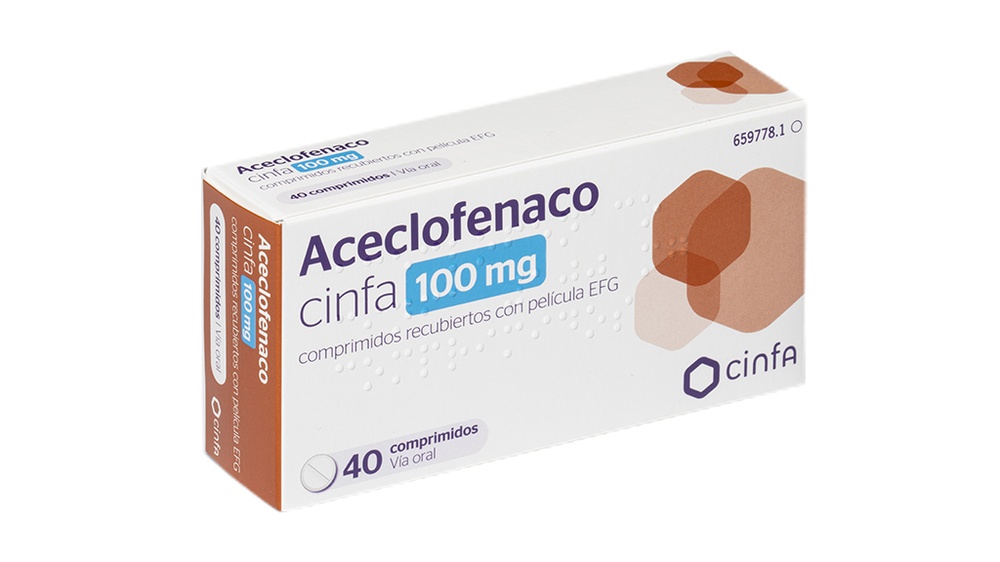
Aceclofenaco Cinfa 100 mg comprimidos recubiertos con película

Prescription request online
A doctor will review your case and decide whether a prescription is medically appropriate.

Talk to a doctor about this medicine
Discuss your symptoms and possible next steps in a quick online consultation.



How to use ACECLOFENAC CINFA 100 mg FILM-COATED TABLETS
Contents of the leaflet
- Introduction
- What is aceclofenaco cinfa and what is it used for
- What you need to know before taking aceclofenaco cinfa
- How to take aceclofenaco cinfa
- Possible side effects
- Storage of aceclofenaco cinfa
- Contents of the pack and further information
Introduction
Package Leaflet: Information for the User
aceclofenaco cinfa 100 mg film-coated tablets EFG
Read the entire package leaflet carefully before starting to take this medication, as it contains important information for you.
- Keep this package leaflet, as you may need to read it again.
- If you have any questions, consult your doctor or pharmacist.
- This medication has been prescribed to you only, and you should not give it to others, even if they have the same symptoms as you, as it may harm them.
- If you experience side effects, consult your doctor or pharmacist, even if they are not listed in this package leaflet. See section 4.
Contents of the Package Leaflet
- What is aceclofenaco cinfa and what is it used for.
- What you need to know before taking aceclofenaco cinfa.
- How to take aceclofenaco cinfa.
- Possible side effects.
- Storage of aceclofenaco cinfa.
- Contents of the pack and further information.
1. What is aceclofenaco cinfa and what is it used for
aceclofenaco cinfa is a film-coated tablet for oral administration.
Aceclofenaco has analgesic, anti-inflammatory, and antirheumatic activity.
Your doctor will prescribe this medication for the treatment of inflammatory and painful conditions such as lower back pain (lumbalgia), toothache (odontalgia), and joint pain (periarthritis of the shoulder and extra-articular rheumatism). aceclofenaco cinfa is also indicated for the chronic treatment of pain and inflammation associated with chronic joint conditions: osteoarthritis, rheumatoid arthritis, and ankylosing spondylitis.

Not sure if this medicine is right for you?
Discuss your symptoms and treatment with a doctor online.
2. What you need to know before taking aceclofenaco cinfa
It is essential to use the smallest dose that relieves/control the pain, and you should not take aceclofenaco cinfa for longer than necessary to control your symptoms.
Do not take aceclofenaco cinfa:
- If you are in the third trimester of pregnancy or breastfeeding.
- If you are allergic to aceclofenaco or any of the other components of this medication (listed in section 6).
- If acetylsalicylic acid or other non-steroidal anti-inflammatory drugs have caused you asthma, rhinitis, urticaria, or other allergic reactions.
- If you have had a stomach or duodenal ulcer or have suffered a perforation of the digestive tract.
- If you have bleeding or coagulation problems (you bleed easily).
- If you have severe kidney failure.
- If you have severe liver failure.
- If you have established heart disease and/or cerebrovascular disease, for example, if you have had a heart attack, stroke, mini-stroke (TIA), or blockages in the blood vessels of the heart or brain, or have had surgery to remove a blockage or perform a coronary bypass.
- If you have problems with blood circulation (peripheral arterial disease).
Warnings and Precautions
Consult your doctor or pharmacist before starting to take aceclofenaco cinfa
- If you have had or developed an ulcer, bleeding, or perforation in the stomach or duodenum, which may be manifested by intense or persistent abdominal pain and/or black stools, or even without previous warning symptoms.
This risk is higher when using high doses and prolonged treatments, in patients with a history of peptic ulcers, and in elderly patients. In these cases, your doctor will consider the possibility of associating a stomach-protecting medication.
Elderly patients suffer from a higher incidence of side effects, specifically gastrointestinal bleeding and perforation (in some cases fatal).
- If you have any liver disease.
- If you have kidney failure.
- If you have heart problems or have suffered a stroke (stroke, hemorrhage).
- If you smoke
- If you have diabetes
- If you have angina, blood clots, high blood pressure, high cholesterol, or high triglycerides.
Medications like aceclofenaco cinfa may be associated with an increased risk of suffering heart attacks ("myocardial infarctions"). Side effects can be minimized by using the lowest effective dose for the shortest possible time. Do not exceed the recommended dose or treatment duration.
Similarly, this type of medication may cause fluid retention, especially in patients with heart failure and/or high blood pressure (hypertension).
- If you have blood disorders.
- If you are taking medications that alter blood coagulation, such as oral anticoagulants like warfarin, or antiplatelet agents like acetylsalicylic acid, inform your doctor. You should also discuss the use of other medications that may increase the risk of bleeding, such as corticosteroids and selective serotonin reuptake inhibitor antidepressants.
- If you have Crohn's disease or ulcerative colitis, as medications like aceclofenaco cinfa may worsen these conditions.
- If you are recovering from major surgery.
- If you have had or still have bronchial asthma.
- In case of chickenpox, you should avoid using this medication because, in rare cases, it can cause severe skin infections related to its use.
- Hypersensitivity reactions may occur, and very rarely, severe allergic reactions (see section 4. Possible side effects) may appear. The risk is higher during the first month of treatment. Stop treatment immediately if you experience any symptoms of skin rash, mucosal lesions, or other signs of hypersensitivity.
Consult your doctor, even if any of the above circumstances have occurred to you at any time.
Taking aceclofenaco cinfa with other medications
Inform your doctor or pharmacist if you are taking, have recently taken, or may need to take any other medication.
Certain medications may interact with aceclofenaco. In these cases, it may be necessary to change the dose or interrupt treatment with one of the medications.
This is especially important if you are taking lithium, digoxin, diuretics, antihypertensives, anticoagulants, antiplatelet agents, hypoglycemic agents, methotrexate, corticosteroids, acetylsalicylic acid, or other non-steroidal anti-inflammatory medications, selective serotonin reuptake inhibitors (SSRIs), cyclosporine, tacrolimus, or zidovudine.
Taking aceclofenaco cinfa with food and drinks
aceclofenaco cinfa can be taken with or without food.
Pregnancy, breastfeeding, and fertility
If you are pregnant or breastfeeding, think you may be pregnant, or plan to become pregnant, consult your doctor or pharmacist before using this medication.
Pregnancy and women of childbearing age:
Do not take aceclofenaco if you are in the last 3 months of pregnancy, as it may harm the fetus or cause problems during delivery. It may cause kidney and heart problems in your fetus. It may affect your and your baby's tendency to bleed and delay or prolong delivery more than expected. You should not take aceclofenaco during the first 6 months of pregnancy unless it is strictly necessary and as directed by your doctor. If you need treatment during this period or while trying to become pregnant, you should take the minimum dose for the shortest possible time. From the 20th week of pregnancy, aceclofenaco may cause kidney problems in your fetus if taken for more than a few days, which may lead to low levels of amniotic fluid surrounding the baby (oligohydramnios) or narrowing of a blood vessel (ductus arteriosus) in the baby's heart. If you need treatment for more than a few days, your doctor may recommend additional monitoring.
For women of childbearing age, it should be noted that medications like aceclofenaco have been associated with a decrease in fertility.
Breastfeeding
Aceclofenaco should not be taken if you are breastfeeding.
Driving and using machines
If you experience dizziness, fainting, vertigo, or other central nervous system disorders while taking aceclofenaco, do not drive or use any tools or machinery.
aceclofenaco cinfa contains sodium
This medication contains less than 1 mmol of sodium (23 mg) per tablet; it is essentially "sodium-free".
3. How to take aceclofenaco cinfa
Follow your doctor's or pharmacist's instructions for taking this medication exactly. If you are unsure, consult your doctor or pharmacist again.
The recommended dose is 200 mg per day, which is one tablet in the morning and one in the evening (1 tablet every 12 hours).
The tablets should be swallowed whole with a little water.
The score line is only for breaking the tablet if you find it difficult to swallow it whole.
The duration of treatment will be determined by your doctor. Do not stop treatment before the indicated time, even if you feel well.
If you think the effect of aceclofenaco is too strong or too weak, inform your doctor or pharmacist.
Use in children:
Not recommended.
Use in elderly patients:
Your doctor will indicate the dose to take and will perform periodic checks.
Use in patients with kidney or heart failure:
Your doctor will indicate the dose to take and will perform periodic checks.
Use in patients with liver failure:
The dose should be reduced to 1 tablet per day.
Long-term treatment:
If you take aceclofenaco for a long time, your doctor will perform quarterly checks, for example, of the kidneys, liver, and blood tests.
If you take more aceclofenaco cinfa than you should
In case of overdose or accidental ingestion, consult your doctor or pharmacist immediately, call the Toxicology Information Service (telephone: 915 620 420), indicating the medication and the amount taken.
If you forget to take aceclofenaco cinfa
Do not worry. Do not take a double dose to make up for the missed doses. Take the next dose according to your usual schedule.
If you have any other questions about the use of this medication, ask your doctor or pharmacist.

Started taking the medicine and have questions?
Discuss your symptoms and treatment with a doctor online.
4. Possible side effects
Like all medications, this medication can cause side effects, although not everyone will experience them.
The side effects that may occur with aceclofenaco consist of:
Common (may affect up to 1 in 10 patients)
- Gastrointestinal disorders, abdominal pain, nausea, and diarrhea.
- Dizziness.
- Increased liver enzymes.
Uncommon (may affect up to 1 in 100 patients)
- Gas, stomach inflammation, constipation, vomiting, and mouth ulcers.
- Itching, skin rash, skin inflammation (dermatitis), and urticaria.
- Increased urea, increased creatinine.
Rare (may affect up to 1 in 1,000 patients)
- Blood in stools, gastrointestinal bleeding, gastrointestinal ulcer.
- Facial inflammation.
- Heart failure, high blood pressure.
- Anemia.
- Severe allergic reaction, allergies.
- Visual disturbances.
- Breathing difficulties.
Very rare (may affect up to 1 in 10,000 patients)
- Inflammation of the mouth mucosa, pancreatitis, intestinal perforation, vomiting blood.
- Worsening of ulcerative colitis and Crohn's disease has also been observed.
- Purple spots on the skin, severe skin reactions.
- Medications like aceclofenaco may be associated with severe mucocutaneous reactions, such as Stevens-Johnson syndrome and toxic epidermal necrolysis.
- Palpitations, flushing, warmth, inflammation of blood vessels (vasculitis).
- Liver damage (including hepatitis), increased alkaline phosphatase.
Medications like aceclofenaco may be associated with liver disorders that cause yellowing of the skin and eyes, sometimes with high fever or swelling and sensitivity of the upper abdomen. If you experience any of the following reactions: yellowing of the skin or eyes, stop treatment and inform your doctor IMMEDIATELY.
- Decreased white blood cells, decreased platelets, bone marrow depression, hemolytic anemia.
- Increased potassium in the blood.
- Depression, sleep disturbances, difficulty falling asleep.
- Numbness, drowsiness, headache, taste disturbances, tremors.
- Vertigo, ringing in the ears (tinnitus).
- Noisy breathing, bronchospasm.
- Leg cramps.
- Kidney function disorders (nephrotic syndrome), kidney failure.
- Fatigue, fluid retention (edema).
- Weight gain.
Exceptionally, severe skin infections have been observed during chickenpox.
Reporting side effects
If you experience any side effects, consult your doctor or pharmacist, even if they are not listed in this package leaflet. You can also report them directly through the Spanish Medicines and Healthcare Products Agency's (AEMPS) online system: https://www.notificaram.es. By reporting side effects, you can help provide more information on the safety of this medication.
5. Storage of aceclofenaco cinfa
Keep this medication out of the sight and reach of children.
Do not store above 30°C.
Do not use this medication after the expiration date stated on the packaging after "EXP". The expiration date is the last day of the month indicated.
Medications should not be disposed of via wastewater or household waste. Return the packaging and any unused medication to the pharmacy's SIGRE collection point. If you are unsure, ask your pharmacist how to dispose of the packaging and any unused medication. This will help protect the environment.
6. Contents of the pack and further information
Composition of aceclofenaco cinfa
The active ingredient is aceclofenaco. Each tablet contains 100 mg of aceclofenaco.
The other ingredients are:
- Core of the tablet: microcrystalline cellulose (E-460i), povidone, sodium croscarmellose, polysorbate 80, glycerol distearate, and anhydrous colloidal silica.
- Coating of the tablet: Opadry Y-5-7068 (hypromellose, hydroxypropylcellulose (E-463), titanium dioxide (E-171), and macrogol 400).
Appearance of the product and packaging contents
aceclofenaco cinfa is presented in the form of white, cylindrical, biconvex, scored film-coated tablets. Each pack contains 20, 40, or 500 (clinical pack) tablets.
Not all pack sizes may be marketed.
Marketing authorization holder and manufacturer
Laboratorios Cinfa, S.A.
Carretera Olaz-Chipi, 10. Polígono Industrial Areta.
31620 Huarte (Navarra)-Spain
Date of last revision of this package leaflet:March 2023.
Detailed information about this medication is available on the website of the Spanish Agency for Medicines and Healthcare Products (AEMPS) http://www.aemps.es/
You can access detailed and updated information about this medication by scanning the QR code included in the package leaflet and packaging with your smartphone. You can also access this information at the following internet address: https://cima.aemps.es/cima/dochtml/p/69223/P_69223.html
QR code to: https://cima.aemps.es/cima/dochtml/p/69223/P_69223.html
- Country of registration
- Dosage formTABLET, 100 mg
- ATC codeM01AB16
- Average pharmacy price2.83 EUR
- Active substance
- Prescription requiredYes
- Manufacturer
- CompositionCROSCARMELOSA SODICA (5,0 mg mg), POLISORBATO 80 (1,5 mg mg)
- This information is for reference only and does not constitute medical advice. Always consult a doctor before taking any medication. Oladoctor is not responsible for medical decisions based on this content.
- Alternatives to ACECLOFENAC CINFA 100 mg FILM-COATED TABLETSDosage form: TABLET, 100 mgActive substance: aceclofenacManufacturer: Kern Pharma S.L.Prescription requiredDosage form: TABLET, 100 mgActive substance: aceclofenacManufacturer: Laboratorios Normon S.A.Prescription requiredDosage form: TABLET, 100 mgActive substance: aceclofenacManufacturer: Laboratorio Stada S.L.Prescription required
Online doctors for ACECLOFENAC CINFA 100 mg FILM-COATED TABLETS
Discuss questions about ACECLOFENAC CINFA 100 mg FILM-COATED TABLETS, including use, safety considerations and whether a prescription is appropriate, subject to medical assessment and local regulations.









Frequently Asked Questions
ACECLOFENAC CINFA 100 mg FILM-COATED TABLETS requires a prescription in Spain. You can check with a doctor online whether this medicine may be appropriate for your situation.
The active ingredient in ACECLOFENAC CINFA 100 mg FILM-COATED TABLETS is aceclofenac. This information helps identify medicines with the same composition but different brand names.
The average pharmacy price for ACECLOFENAC CINFA 100 mg FILM-COATED TABLETS is around 2.83 EUR. Prices may vary depending on the manufacturer and dosage form.
ACECLOFENAC CINFA 100 mg FILM-COATED TABLETS is manufactured by Laboratorios Cinfa S.A.. Pharmacy brands and packaging may differ depending on the distributor.
Doctors such as Family doctors, Psychiatrists, Dermatologists, Cardiologists, Endocrinologists, Gastroenterologists, Pulmonologists, Nephrologists, Rheumatologists, Hematologists, Infectious disease physicians, Allergists, Geriatricians, Paediatricians, Oncologists may assess whether ACECLOFENAC CINFA 100 mg FILM-COATED TABLETS is appropriate, depending on your situation and local regulations. You can book an online consultation to discuss your symptoms and possible next steps.
The prescription is issued by a doctor after assessing your health. In Spain, ACECLOFENAC CINFA 100 mg FILM-COATED TABLETS is then dispensed in pharmacies with that prescription. An online consultation does not guarantee that a prescription will be issued: the decision always rests with the doctor.
To request an assessment, you can use Oladoctor:
Other medicines with the same active substance (aceclofenac) include ACECLOFENAC KERN PHARMA 100 MG FILM-COATED TABLETS, ACECLOFENAC NORMON 100 mg FILM-COATED TABLETS, ACECLOFENAC STADA 100 mg FILM-COATED TABLETS. These may have different brand names or formulations but contain the same therapeutic ingredient. Always consult a doctor before switching or starting a new medicine.
