


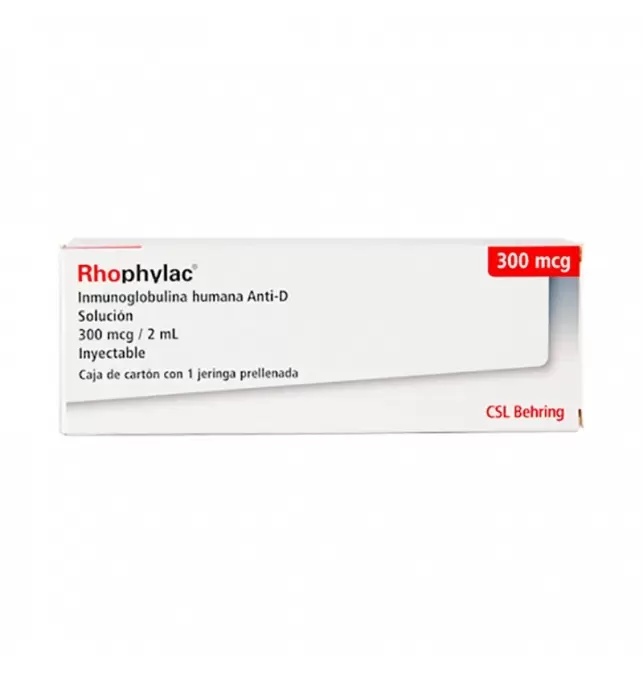
RHOPHYLAC 300 microgramos / 2ml DE SOLUCION INYECTABLE EN JERINGA PRECARGADA



Cómo usar RHOPHYLAC 300 microgramos / 2ml DE SOLUCION INYECTABLE EN JERINGA PRECARGADA
Traducción generada por IA
Este contenido ha sido traducido automáticamente y se ofrece solo con fines informativos. No sustituye la consulta con un profesional sanitario.
Ver originalContenido del prospecto
Introducción
Prospecto: Información para el paciente
Rhophylac 300 microgramos/2 ml de solución inyectable en jeringa precargada
Inmunoglobulina Humana Anti-D
Lea todo el prospecto detenidamente antes de empezar a usar este medicamento, porque contiene información importante para usted.
Siga exactamente las instrucciones de administración del medicamento contenidas en este prospecto o las indicadas por su médico, farmacéutico o enfermero.
- Conserve este prospecto, ya que puede tener que volver a leerlo.
- Si tiene alguna duda, consulte a su médico, farmacéutico o enfermero.
- Si experimenta efectos adversos, consulte a su médico, farmacéutico o enfermero, incluso si se trata de efectos adversos que no aparecen en este prospecto. Ver sección 4.
Contenido del prospecto
- Qué es Rhophylac 300 y para qué se utiliza
- Qué necesita saber antes de usar Rhophylac 300
- Cómo usar Rhophylac 300
- Posibles efectos adversos
- Conservación de Rhophylac 300
- Contenido del envase e información adicional
1. Qué es Rhophylac 300 y para qué se utiliza
Qué es Rhophylac 300
Este medicamento es una solución inyectable lista para su uso, que se presenta en jeringa precargada. La solución contiene proteínas especiales, aisladas del plasma humano. Estas proteínas pertenecen a la clase denominada “inmunoglobulinas”, también llamadas anticuerpos. El principio activo de Rhophylac 300 es un anticuerpo específico denominado “inmunoglobulina anti-D (Rh)”. Este anticuerpo actúa frente al factor Rhesus tipo D.
Qué es el factor Rhesus tipo D
Los factores Rhesus son características especiales de los glóbulos rojos humanos. Alrededor del 85% de la población tiene el denominado factor Rhesus tipo D (abreviado “Rh(D)”). Estas personas son denominadas Rh(D) positivas. Las personas que no poseen el factor Rhesus tipo D se denominan Rh(D) negativas.
Qué es la inmunoglobulina anti-D (Rh)
La inmunoglobulina Anti-D (Rh) es un anticuerpo, que actúa frene al factor Rhesus tipo D, y que es producido por el sistema inmunitario humano. Cuando una persona Rh(D) negativa recibe sangre Rh(D) positiva, su sistema inmunitario reconocerá los glóbulos rojos Rh(D) positivos como “extraños” a su organismo e intentará destruirlos. Con este propósito, el sistema inmunitario fabricará un anticuerpo específico frente al factor Rhesus tipo D. Este proceso es denominado “inmunización” y requiere, usualmente, cierto tiempo (2-3 semanas). Por lo tanto, los glóbulos rojos Rh(D) positivos no serán destruidos tras en el primer contacto, y no se aprecian, normalmente, signos o síntomas. Pero cuando la misma persona Rh(D) negativa recibe sangre Rh(D) positiva una segunda vez, los anticuerpos estarán “disponibles” y su sistema inmunitario destruirá los eritrocitos extraños inmediatamente.
Cómo actúa Rhophylac 300
Si una persona Rh(D) negativa recibe una dosis suficiente de inmunoglobulina humana anti-D (Rh), puede prevenirse la isoinmunización frente al factor Rhesus tipo D. Para lograr esto, el tratamiento con Rhophylac 300 debe comenzar antes o lo antes posible después del primer contacto con los glóbulos rojos Rh(D) positivos. La inmunoglobulina anti-D (Rh) contenida en este medicamento destruirá los glóbulos rojos Rh(D) positivo extraños inmediatamente. Así, el sistema inmunitario de la persona no fabricará sus propios anticuerpos.
Para qué su utiliza Rhophylac 300
Este medicamento se utiliza en dos situaciones distintas:
- Si usted es una mujer Rh(D) negativa, embarazada portadora de un bebé Rh(D) positivo
En esta situación especial usted puede ser inmunizada por los glóbulos rojos Rh(D) positivos de su bebé que hayan pasado a su circulación sanguínea. Si esto ocurre, el primer bebé, usualmente, no es afectado y es completamente sano. Sin embargo, en su próximo bebé Rh(D) positivo, sus anticuerpos maternos destruirían los glóbulos rojos Rh(D) positivos del bebé durante el embarazo. Esto produciría complicaciones en el desarrollo de su próximo bebé, incluida su posible muerte.
Por este motivo, usted debe recibir Rhophylac 300:
? cuando sea portadora, o acabe de tener un bebé Rh(D) positivo;
? cuando haya perdido un bebé Rh(D) positivo (muerte fetal intrauterina, aborto o amenaza de aborto);
? cuando su embarazo sea especialmente complicado (embarazo ectópico o embarazo con un óvulo fertilizado no viable (mola hidatídica));
? cuando sea probable que los glóbulos rojos Rh(D) positivos de su bebé hayan pasado a su circulación sanguínea (hemorragia transplacentariacomo consecuencia de una hemorragia preparto). Esto puede ocurrir, por ejemplo, cuando usted sufre hemorragias vaginales durante el embarazo.
? cuando su doctor necesite realizar pruebas para detectar malformaciones fetales (amniocentesis, biopsia coriónica, cordocentesis);
? cuando su doctor o comadrona necesiten intentar manipular su bebé desde el exterior (p. ej. versión externa del bebé u otras manipulaciones obstétricas);
? cuando usted padezca un accidente que dañe su estomago o vientre (traumatismo abdominal).
Este medicamento también se utiliza si usted es una mujer Rh(D) negativa embarazada y no se sabe si su bebé es Rh(D) positivo.
(B) Usted es un adulto, niño o adolescente (0 – 18 años) Rh(D) negativo, que ha recibido accidentalmente perfusiones (transfusiones de sangre) Rh(D) positiva u otros preparados que contienen glóbulos rojos Rh(D) positivos como un “concentrado de plaquetas” (transfusión equivocada).

2. Qué necesita saber antes de empezar a usar Rhophylac 300
?Lea esta sección detenidamente. La información contenida debe ser tenida en cuenta tanto por usted como por su médico antes de que se le administre este medicamento.
No use Rhophylac 300:
- Si es alérgico (hipersensible) a inmunoglobulinas humanas o a cualquiera de los demás componentes de este medicamento (incluidos en la sección 6).
- Por favor informe a su médico, farmacéutico o enfermero antes del tratamiento acerca de cualquier medicamento que no haya tolerado bien anteriormente.
- Usted no debe recibir inyecciones intramusculares si usted sufre una reducción grave en el número de plaquetas (trombocitopenia) o cualquier otro trastorno de la coagulación.
- Por favor informe a su médico, farmacéutico o enfermero antes del tratamiento si esto es aplicable a usted. En ese caso, este medicamento puede administrársele únicamente como inyección intravenosa.
Advertencias y precauciones
? Consulte a su médico o enfermero antes de empezar a usar Rhophylac 300.
- Para proteger mujeres Rh(D) negativas después del parto de un bebé Rh(D) positivo, este medicamento debe administrarse siempre a la madre, no al recién nacido.
- Este medicamento no está indicado en personas Rh(D) positivas ni en individuos inmunizados frente al antígeno Rh(D).
Al interrumpir la administración puede ser necesario
- Rhophylac 300 puede provocar reacciones de hipersensibilidad (de tipo alérgico). En raras ocasiones pueden aparecer reacciones alérgicas tales como disminución brusca de la presión sanguínea o shock (ver también la sección “4. Posibles efectos adversos”) incluso si previamente ha recibido inmunoglobulinas humanas y las ha tolerado bien.
? Por favor informe a su médico o enfermero inmediatamente si aparecen estas reacciones. Ellos interrumpirán la administración del producto e instaurarán el tratamiento adecuado, dependiendo de la naturaleza y gravedad del efecto adverso.
Su médico o enfermero tendrá especial cuidado
? Si usted tiene niveles bajos de inmunoglobulinas de tipo IgA tiene un mayor riesgo de presentar reacciones de hipersensibilidad.
? Por favor informe a su médico o enfermero si tiene niveles bajos de inmunoglobulinas de tipo IgA. Ellos sopesarán cuidadosamente el beneficio del tratamiento con este medicamento frente al riesgo incrementado de reacciones de hipersensibilidad.
- Si usted está siendo tratado/a con este medicamento, después de haber recibido una transfusión incompatible, a Usted le pueden administrar una gran cantidad del producto (hasta 3.000 microgramos, equivalente a 20 ml o 10 jeringas). En este caso, se presenta, la así llamada reacción hemolítica. Esto es consecuencia de la destrucción de los eritrocitos Rh(D) positivos extraños a su organismo. Por esta razón, su médico o profesional sanitario le monitorizará cuidadosamente y puede necesitar que le realicen pruebas sanguíneas especiales.
- Si su índice de masa corporal (IMC) es superior o igual a 30 (calculado dividiendo su masa corporal por el cuadrado de su altura), la inyección intramuscular de Rhophylac puede no ser totalmente efectiva. En este caso, su médico o enfermero debe inyectarle este medicamento en una vena.
Información de seguridad respecto a infecciones
Este medicamento se obtiene de plasma humano (que es la parte líquida de la sangre).
Cuando los medicamentos se fabrican a partir de sangre o plasma humanos, se toman ciertas medidas para prevenir infecciones que pasen a los pacientes. Éstas incluyen:
- una cuidadosa selección de los donantes de sangre y plasma para estar seguros de que los portadores que corren el riesgo de transmitir infecciones son excluidos,
- el análisis de cada donación y de las mezcla de plasma para detectar signos de virus/infección.
- la inclusión de pasos en el procesamiento de la sangre o plasma que pueden inactivar o eliminar los virus.
Pese a dichas medidas, cuando se administran medicamentos obtenidos de sangre o plasma humanos, no puede excluirse totalmente la posibilidad de transmisión de agentes infecciosos. Esto también se aplica a cualquier virus desconocido o emergente u otros tipos de infección.
Las medidas tomadas se consideran efectivas para virus envueltos tales como el virus de la inmunodeficiencia humana (VIH, el virus del SIDA), virus de la hepatitis B y virus de la hepatitis C.
Las medidas pueden tener un valor limitado frente a virus no envueltos tales como el virus de la hepatitis A y parvovirus B19.
Las inmunoglobulinas no han sido asociadas a infecciones por hepatitis A o parvovirus B19, posiblemente porque los anticuerpos frente a estas infecciones, que se hallan presentes en el producto, son protectores.
Se recomienda encarecidamente que cada vez que usted reciba una dosis de Rhophylac 300 se registre el nombre y número de lote del producto a fin de mantener un registro de los lotes utilizados.
Análisis de sangre
? Indique a su médico o enfermero que ha sido tratado con Rhophylac 300 si se le va a realizar un análisis de sangre (análisis serológico) a usted o a su hijo recién nacido.
Después de la administración de este medicamento, los resultados de ciertas pruebas sanguíneas pueden verse alterados durante cierto tiempo. Si usted es una madre a la que se le administró este medicamento antes del parto, los resultados de ciertas pruebas sanguíneas en su hijo recién nacido también pueden verse afectados.
Uso de Rhophylac con otros medicamentos
? Comunique a su médico o farmacéutico si está utilizando, ha utilizado recientemente o podría tener que utilizar cualquier otro medicamento, incluso los adquiridos sin receta.
Vacunaciones
? Si ha sido vacunado en las últimas 2 – 4 semanas, por favor informe a su médico o enfermero antes del tratamiento.
Informe también al médico que le administra las vacunas tras el tratamiento. Así podrá comprobar la eficacia de su vacunación.
Este medicamento puede perjudicar la eficacia de las vacunas con virus vivos, por ejemplo frente a sarampión, paperas, rubéola o varicela. Por lo tanto, tales vacunas no deben darse hasta transcurridos 3 meses después de la última administración de Rhophylac 300.
Embarazo y lactancia
Este medicamento es usado en el embarazo, o poco después del parto.
Las inmunoglobulinas son excretadas con la leche materna. En estudios clínicos en los que 432 madres recibieron este medicamento antes del parto y 256 de ellas de nuevo después del parto, no se detectaron efectos adversos en sus bebés.
Conducción y uso de máquinas
No son de esperar efectos de Rhophylac 300 sobre la capacidad de conducir o usar máquinas.
Rhophylac contiene sodio
Este medicamento contiene menos de 1 mmol (23 mg) de sodio por jeringa; esto es, esencialmente “exento de sodio”.
3. Cómo usar Rhophylac 300
Este medicamento le será administrado por su doctor o enfermero intramuscularmente, o directamente en vena. Su médico decidirá cuánto Rhophylac 300 debe recibir y la vía apropiada de administración. Por ejemplo, si su índice de masa corporal (IMC) es superior o igual a 30, le administrará este medicamento directamente en vena (ver también la sección 2).
La jeringa debe llevarse a temperatura ambiente (25 ºC) antes de la administración.
Una jeringadebe ser usada para un pacientesolamente (incluso si sobra producto).
Usted debe permanecer en observación al menos durante 20 minutos después de la administración de Rhophylac.
Si usa más Rhophylac 300 del que debe
No se conocen las consecuencias de una sobredosis.
En caso de sobredosis o ingestión accidental, consulte al Servicio de Información toxicológica al
teléfono 91 562 04 20.
Si olvidó usar Rhophylac 300
No use una dosis doble para compensar la dosis olvidada.
Si interrumpe el tratamiento con Rhopylac 300
Si interrumpe el tratamiento con Rhophylac 300, consulte con su médico.
Si tiene cualquier otra duda sobre el uso de este medicamento, pregunte a su médico, farmacéutico o enfermero.

4. Posibles efectos adversos
Al igual que todos los medicamentos, este medicamento puede tener efectos adversos, aunque no todas las personas los sufran. Tales efectos adversos pueden aparecer incluso si ha recibido previamente inmunoglobulinas humanas y las ha tolerado bien.
Raramente (entre 1 y 10 usuarios de cada 10.000) se han observado reacciones alérgicas (reacciones de hipersensibilidad). Los signos tempranos pueden ser pequeñas ampollas que pican (habones) en la piel de todo su cuerpo (urticaria generalizada). Pueden evolucionar a hipersensibilidad grave / reacciones anafilácticas como disminución brusca de la presión sanguínea o shock (p.ej. puede sentirse mareado, aturdido, desmayarse al ponerse de pie, sentir frío en manos y pies, sentir un latido del corazón anormal o dolor en el pecho, opresión en el pecho, jadeos o visión borrosa) incluso cuando no ha mostrado hipersensibilidad en administraciones anteriores.
? Informe a su médico, farmacéutico o enfermero inmediatamente si detecta estos síntomas durante la administración de Rhophylac. Ellos podrán decidir si detener la administración y empezar el tratamiento apropiado.
Si a usted le han administrado este medicamento por vía intramuscular, puede sentir dolor local y sensibilidad en el lugar de la inyección.
Los siguientes efectos adversos fueron poco frecuentes(afecta de 1 a 10 usuarios entre 1.000):
? fiebre y escalofríos (estremecimientos),
? malestar general (malestar),
? dolor de cabeza,
? reacciones cutáneas, enrojecimiento de la piel (eritema), picor (prurito)
Los siguientes efectos adversos fueron raros(afecta de 1 a 10 usuarios entre 10.000):
- reacciones alérgicas, shock anafiláctico,
? náusea y/o vómitos,
? presión arterial baja (hipotensión),
? latidos cardíacos rápidos, o velocidad acelerada del pulso (taquicardia),
? dolor de las articulaciones (artralgia),
- dificultad al respirar (disnea),
? reacciones en el lugar de inyección.
Comunicación de efectos adversos
?Si experimenta cualquier tipo de efecto adverso, consulte a su médico o enfermero, incluso si se trata de posibles efectos adversos que no aparecen en este prospecto. También puede comunicarlos directamente a través del Sistema Español de Farmacovigilancia de medicamentos de Uso Humano: https://www.notificaram.es. Mediante la comunicación de efectos adversos usted puede contribuir a proporcionar más información sobre la seguridad de este medicamento.
5. Conservación de Rhophylac 300
- Mantener fuera de la vista y del alcance de los niños.
- Conservar en nevera (entre 2 ºC y 8 ºC).
- No congelar.
- Mantener la jeringa en su estuche (en su envase de plástico) a fin de protegerla de la luz.
- No utilizar este medicamento si observa que la solución está turbia o presenta sedimentos.
- No utilice este medicamento después de la fecha de caducidad que aparece en el estuche y en la etiqueta de la jeringa después de EXP. La fecha de caducidad es el último día del mes que se indica.
- Los medicamentos no se deben tirar por los desagües ni a la basura. Deposite los envases y los medicamentos que no necesita en el Punto SIGRE de la farmacia. En caso de duda pregunte a su farmacéutico cómo deshacerse de los envases y de los medicamentos que no necesita. De esta forma, ayudará a proteger el medio ambiente
.
6. Contenido del envase e información adicional
Composición de Rhophylac 300
? El principio activoes inmunoglobulina humana anti-D (Rh) (anticuerpos de tipo IgG frente al factor Rhesus tipo D).
? Los demás componentes son albúmina humana, glicina, cloruro sódico y agua para preparaciones inyectables.
? El producto contiene un máximo de 30 mg de proteína humana plasmática /ml., de las cuales 10 mg/ml es albúmina humana que actúa como estabilizador. Al menos el 95% de otras proteínas plasmáticas son inmunoglobulinas humanas (anticuerpos) de tipo IgG. Rhophylac 300 contiene como máximo 5 microgramos/ml de inmunoglobulina humana (anticuerpos) de tipo IgA.
- Rhophylac no contiene conservantes.
Aspecto del producto y contenido del envase
Este medicamento es una solución inyectable clara o ligeramente opalescente incolora o amarillo pálido. Rhophylac 300 se proporciona en una jeringa precargada de cristal con 2 ml de solución estéril lista para usar que contiene 1.500 UI (300 microgramos) de inmunoglobulina anti-D.
Rhophylac 300 está disponible en envases unitarios conteniendo 1 jeringa precargada y una aguja de inyección, ambas envasadas en un blíster (contenedor de plástico transparente sellado con papel de aluminio) o en envases multipack que contienen 5 envases unitarios. Puede que solamente estén comercializados algunos tamaños.
Titular de la autorización de comercialización y responsable de la fabricación
CSL Behring GmbH
Emil von Behring Strasse, 76
35041 – Marburg
Alemania
Puede solicitar más información respecto a este medicamento dirigiéndose al representante local del titular de la autorización de comercialización:
CSL Behring, S.A.
c/ Tarragona 157, planta 18
08014 Barcelona. España
Este medicamento está autorizado en los estados miembros del Espacio Económico Europeo con los siguientes nombres:
Rhophylac 300 Mikrogramm / 2 ml
Injektionslösung in einer Fertigspritze Austria
Rhophylac 300 microgram / 2 ml
oplossing voor injectie in een voorgevulde spuit Bélgica
Rhophylac 300 μικρογραμμ?ρια/2 ml
εν?σιμο δι?λυμα σε προγεμισμ?νη σ?ριγγα Chipre, Grecia
Rhophylac 300 mikrogramu / 2 ml República Checa
Rhophylac Dinamarca, Finlandia, Islandia, Italia, Noruega, Suecia
Rhophylac 300 microgrammes/2 ml,
solution injectable en seringue préremplie Francia
Rhophylac 300 Alemania, Polonia, Portugal
Rhophylac 300 mikrogramm/2 ml oldatos
injekció eloretöltött fecskendoben Hungría
Rhophylac 1500 UI Luxemburgo
Rhophylac 300 microgram / 2 ml
oplossing voor injectie in een voorgevulde spuit Países Bajos
Rhophylac 300 micrograme/2 ml
solutie injectabila în seringa preumpluta Rumania
Rhophylac 300 mikrogramov / 2 ml Eslovaquia
Rhophylac 300 mikrogramov/2 ml raztopina
za injiciranje v napolnjeni injekcijski brizgi Eslovenia
Rhophylac 300 microgramos/2 ml de
solución inyectable en jeringa precargada España
Rhophylac 300 micrograms / 2 ml,
solution for injection in pre-filled syringe Reino Unido, Irlanda, Malta
Fecha de la última revisión de este prospecto: junio 2019
La información detallada y actualizada de este medicamento está disponible en la página web de la Agencia Española de Medicamentos y Productos Sanitarios (AEMPS) http://www.aemps.gob.es
- País de registro
- Precio medio en farmacia61.19 EUR
- Principio activo
- Requiere recetaSí
- Fabricante
- Esta información es de carácter general y no sustituye la consulta con un profesional sanitario.
- Alternativas a RHOPHYLAC 300 microgramos / 2ml DE SOLUCION INYECTABLE EN JERINGA PRECARGADAForma farmacéutica: INYECTABLE, 750 UI/mlPrincipio activo: inmunoglobulina anti-D (rh)Fabricante: Instituto Grifols S.A.Requiere recetaForma farmacéutica: INYECTABLE, 250 UIPrincipio activo: tetanus immunoglobulinFabricante: Instituto Grifols S.A.Requiere recetaForma farmacéutica: INYECTABLE, 500 UIPrincipio activo: tetanus immunoglobulinFabricante: Instituto Grifols S.A.Requiere receta
Médicos online para RHOPHYLAC 300 microgramos / 2ml DE SOLUCION INYECTABLE EN JERINGA PRECARGADA
Comenta la dosis, los posibles efectos secundarios, interacciones, contraindicaciones o la revisión de receta de RHOPHYLAC 300 microgramos / 2ml DE SOLUCION INYECTABLE EN JERINGA PRECARGADA, sujeto a valoración médica y a la normativa local.











Preguntas frecuentes
