


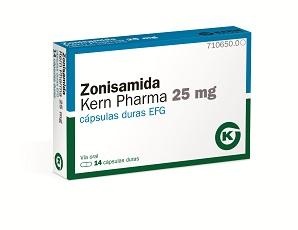
Zonisamida Kern Pharma 25 mg cápsulas duras

Revisión de receta online
Un médico revisará tu caso y determinará si la prescripción es médicamente apropiada.

Habla con un médico sobre este medicamento
Comenta tus síntomas y las opciones de tratamiento en una consulta online.



Cómo usar ZONISAMIDA KERN PHARMA 25 MG CAPSULAS DURAS EFG
Contenido del prospecto
- Introducción
- Qué es Zonisamida Kern Pharma y para qué se utiliza
- Qué necesita saber antes de empezar a tomar Zonisamida Kern Pharma
- Cómo tomar Zonisamida Kern Pharma
- Posibles efectos adversos
- Conservación de Zonisamida Kern Pharma
- Contenido del envase e información adicional
Introducción
Prospecto: Información para el usuario
Zonisamida Kern Pharma 25 mg cápsulas duras EFG
Lea todo el prospecto detenidamente antes de empezar a tomar este medicamento, porque contiene información importante para usted.
- Conserve este prospecto, ya que puede tener que volver a leerlo.
- Si tiene alguna duda, consulte a su médico o farmacéutico.
- Este medicamento se le ha recetado solamente a usted, y no debe dárselo a otras personas aunque tengan los mismos síntomas que usted, ya que puede perjudicarles.
- Si experimenta efectos adversos, consulte a su médico o farmacéutico incluso si se trata de efectos adversos que no aparecen en este prospecto. Ver sección 4.
Contenido del prospecto
- Qué es Zonisamida Kern Pharma y para qué se utiliza
- Qué necesita saber antes de empezar a tomar Zonisamida Kern Pharma
- Cómo tomar Zonisamida Kern Pharma
- Posibles efectos adversos
- Conservación de Zonisamida Kern Pharma
- Contenido del envase e información adicional
1. Qué es Zonisamida Kern Pharma y para qué se utiliza
Este medicamento contiene el principio activo zonisamida, y se utiliza como antiepiléptico.
Zonisamida se utiliza para tratar crisis que afectan a una parte del cerebro (crisis parcial), que puede o no ir seguida de una crisis que afecta a todo el cerebro (generalización secundaria).
Zonisamida puede utilizarse:
- Por sí solo para tratar las crisis convulsivas en adultos.
- Con otros antiepilépticos para tratar las crisis convulsivas en adultos, adolescentes y niños de 6 años y mayores.

¿No estás seguro de si este medicamento es adecuado para ti?
Comenta tus síntomas y tratamiento con un médico online.
2. Qué necesita saber antes de empezar a tomar Zonisamida Kern Pharma
No tome Zonisamida Kern Pharma:
- Si es alérgico a la zonisamida o a cualquiera de los demás componentes de este medicamento (incluidos en la sección 6).
- Si es alérgico a otras sulfonamidas, por ejemplo: antibióticos de sulfonamida, diuréticos de tiazida y antidiabéticos de sulfonilurea.
Advertencias y precauciones
Zonisamida pertenece a un grupo de medicamentos (sulfonamidas) que pueden producir reacciones alérgicas graves, exantemas graves y trastornos de la sangre, que muy rara vez pueden causar la muerte (ver sección 4).
Se dan casos de exantemas graves asociados con la terapia con zonisamida, incluyendo casos de síndrome de Stevens-Johnson. |
El uso de Zonisamida puede originar niveles altos de amonio en sangre, lo que podría cambiar la función cerebral, en especial si también está tomando otros medicamentos que pueden aumentar los niveles de amonio (p. ej., valproato), si padece un trastorno genético por el que se genera demasiado amonio en el organismo (trastorno del ciclo de la urea), o si padece trastornos hepáticos. Informe a su médico de inmediato si se encuentra somnoliento o confundido de manera atípica.
Consulte a su médico o farmacéutico antes de empezar a tomar este medicamento:
- Si es menor de 12 años, ya que puede tener más riesgo de presentar disminución de la sudoración,insolación, neumonía y problemas hepáticos. No se recomienda el uso de este medicamento en menores de 6 años.
- Si presenta edad avanzada, ya que puede ser necesario ajustar la dosis de zonisamida, y puede tener más posibilidades de desarrollar una reacción alérgica, exantema grave, hinchazón de piernas y pies y picor al tomar este medicamento (ver sección 4).
- Si padece problemas hepáticos, ya que podrá ser necesario ajustar la dosis de zonisamida.
- Si padece problemas renales, ya que podrá ser necesario ajustar la dosis de zonisamida.
- Si ha padecido previamente cálculos renales, ya que puede correr un mayor riesgo de tener más cálculos renales. Reduzca el riesgo de tener cálculos renales bebiendo suficiente agua.
- Si vive en un lugar o va de vacaciones a un lugar donde hace calor este medicamento puede hacer que sude menos, lo que puede resultar en que su temperatura corporal aumente. Reduzca el riesgo de alcanzar un exceso de temperatura bebiendo suficiente agua y manteniéndose fresco.
- Si está bajo de peso o ha perdido mucho peso, ya que zonisamida puede hacer que adelgace más. Informe a su médico, ya que podrá ser necesario controlarlo.
- Si padece problemas oculares tales como glaucoma.
- Si está embarazada o podría quedarse embarazada (para obtener más información, ver sección “Embarazo, lactancia y fertilidad”).
Si alguna de estas afirmaciones es aplicable en usted, informe a su médico antes de tomar este medicamento.
Niños y adolescentes
Consulte a su médico sobre los siguientes riesgos:
Prevención del calor excesivo y de la deshidratación en niños Este medicamento puede provocar que los niños suden menos o presenten un calor excesivo; lo que puede producir daños cerebrales y muerte si no se trata. Los niños son el grupo de población más vulnerable, especialmente en días calurosos. Cuando el niño está tomando este medicamento:
inhibidores de la anhidrasa carbónica (p.ej.: topiramato y acetazolamida) y anticolinérgicos (p. ej.: clomipramina, hidroxicina, difenhidramina, haloperidol, imipramina y oxibutinina). Si la piel de su hijo está muy caliente con poca o ninguna sudoración, el niño se siente confuso o presenta calambres musculares, o su latido cardiaco o respiración van rápidos.
|
- Peso: debe controlar mensualmente el peso de su hijo y acudir al médico lo antes posible si no gana el peso suficiente. Zonisamida no está recomendado en niños que están bajos de peso o con poco apetito, y debe utilizarse con precaución en niños con un peso inferior a 20 kg.
- Aumento del nivel de ácido en la sangre y cálculos en el riñón: reduzca estos riesgos asegurándose de que su hijo beba suficiente agua y no tome ningún medicamento que pueda causar cálculos en el riñón (ver Otros medicamentos). Su médico controlará los niveles de bicarbonato en sangre de su hijo y los riñones (ver también la sección 4).
No administre este medicamento a niños menores de 6 años ya que no se sabe si los posibles beneficios son mayores que los riesgos en este grupo de edad.
Uso de Zonisamida Kern Pharma con otros medicamentos
Informe a su médico o farmacéutico si está utilizando o ha utilizado recientemente cualquier otro medicamento, incluso los adquiridos sin receta.
- Zonisamida debe utilizarse con precaución en adultos si se toma con medicamentos que pueden producir cálculos renales, como el topiramato o la acetazolamida. En niños no se recomienda esta combinación.
- Zonisamida podría aumentar posiblemente los niveles en sangre de medicamentos como la digoxina y la quinidina, y por lo tanto puede ser necesario reducir la dosis de éstos.
- Otros medicamentos como la fenitoína, carbamazepina, fenobarbitona y rifampicina pueden disminuir los niveles en sangre de zonisamida, lo que podría requerir un ajuste de la dosis de este medicamento.
Toma de Zonisamida Kern Pharma con alimentos y bebidas
Zonisamida puede tomarse con o sin alimentos.
Embarazo, lactancia y fertilidad
Las mujeres en edad fértil tienen que utilizar medidas anticonceptivas eficaces durante el tratamiento con zonisamida y hasta un mes después de dejar este medicamento.
Si tiene la intención de quedarse embarazada, hable con su médico antes de dejar los anticonceptivos y antes de quedarse embarazada sobre la posibilidad de cambiar a otros tratamientos adecuados. Si está o cree que puede estar embarazada, informe a su médico inmediatamente. No debe suspender el tratamiento sin consultarlo con su médico.
Solo deberá tomar zonisamida durante el embarazo si el médico así lo indica. La investigación demuestra un mayor riesgo de defectos de nacimiento en los niños de las mujeres que toman antiepilépticos. Se desconoce el riesgo de defectos de nacimiento o trastornos del desarrollo neurológico (problemas en el desarrollo cerebral) para su hijo después de tomar zonisamida durante su embarazo. Un estudio demostró que los niños cuyas madres utilizaron zonisamida durante el embarazo eran más pequeños de lo esperado para su edad al nacer, en comparación con los niños cuyas madres fueron tratadas con lamotrigina en monoterapia. Asegúrese de que le informen detalladamente sobre los riesgos y beneficios de utilizar zonisamida para la epilepsia durante el embarazo.
No dé el pecho mientras tome zonisamida ni durante un mes después de dejar de tomar este medicamento.
No hay datos clínicos sobre los efectos de la zonisamida en la fertilidad humana. Los estudios realizados en animales han mostrado cambios en los parámetros de fertilidad.
Conducción y uso de máquinas
Zonisamida puede afectar a la concentración, capacidad de reaccionar/responder, y puede hacer que sienta somnolencia, especialmente al comienzo del tratamiento o después de aumentar la dosis. Si zonisamida le afecta de esta manera, tenga especial cuidado cuando conduzca o utilice máquinas.
3. Cómo tomar Zonisamida Kern Pharma
Siga exactamente las instrucciones de administración de este medicamento indicadas por su médico o farmacéutico. En caso de duda, consulte de nuevo a su médico o farmacéutico.
La dosis habitual en adultos:
Si toma Zonisamida Kern Pharma solo:
- La dosis inicial es 100 mg una vez al día.
- Se puede aumentar hasta en 100 mg en intervalos de dos semanas.
- La dosis habitual es 300 mg una vez al día.
Si toma Zonisamida Kern Pharma con otros antiepilépticos:
- La dosis inicial es 50 mg al día divididos en dos dosis iguales de 25 mg.
- Se puede aumentar hasta en 100 mg en intervalos de una a dos semanas.
- La dosis diaria habitual es entre 300 mg y 500 mg.
- Algunas personas responden a dosis inferiores. La dosis podría aumentarse de forma más lenta si experimenta efectos adversos o si padece problemas renales o hepáticos.
Uso en niños (de 6 a 11 años) y adolescentes (de 12 a 17 años) que pesen al menos 20 kg:
- La dosis inicial es 1 mg por kg de peso corporal una vez al día.
- Se puede aumentar en 1 mg por kg de peso corporal en intervalos de una a dos semanas.
- La dosis diaria habitual es entre 6 mg y 8 mg para un niño con un peso corporal de hasta 55 kg o entre 300 mg y 500 mg para un niño con un peso corporal superior a 55 kg (la dosis que sea menor) una vez al día.
Ejemplo: un niño que pese 25 kg debe tomar 25 mg una vez al día durante la primera semana, y a continuación se debe aumentar la dosis diaria en 25 mg al inicio de cada semana hasta alcanzar la dosis diaria de 150 a 200 mg.
Si estima que la acción de zonisamida es demasiado fuerte o débil, comuníqueselo a su médico o farmacéutico.
- Las cápsulas de zonisamida deben tragarse enteras con agua.
- No mastique las cápsulas.
- Zonisamida puede tomarse una vez o dos veces al día, conforme a las instrucciones de su médico.
- Si toma zonisamida dos veces al día, tome la mitad de la dosis diaria por la mañana y la otra mitad por la noche.
Si toma más Zonisamida Kern Pharma del que debe
Si ha tomado más zonisamida del que debe, comuníqueselo inmediatamente a la persona que le cuida (familiar o amigo), a su médico o farmacéutico, o póngase en contacto con el servicio de urgencias del hospital más cercano y lleve el medicamento con usted. Podría sentirse adormilado y podría perder el conocimiento. También podrá sentir ganas de vomitar, tener dolor de estómago, espasmos musculares, movimiento de ojos, sentir que se desmaya, tener un latido cardiaco lento y disminución del ritmo respiratorio y de la función renal. No intente conducir.
Si olvidó tomar Zonisamida Kern Pharma
Si olvidó tomar una dosis, no se preocupe; tome la siguiente dosis a la hora habitual.
No tome una dosis doble para compensar las dosis olvidadas.
Si interrumpe el tratamiento con Zonisamida Kern Pharma
Zonisamida está destinado a tomarse como medicamento a largo plazo. No reduzca la dosis ni deje de tomar el medicamento a menos que se lo indique el médico.
Si el médico le aconseja que deje el tratamiento, reducirá paulatinamente la dosis a fin de disminuir el riesgo de sufrir más crisis.
Si tiene cualquier otra duda sobre el uso de este medicamento, pregunte a su médico o farmacéutico.

¿Has empezado a tomar el medicamento y tienes preguntas?
Comenta tus síntomas y tratamiento con un médico online.
4. Posibles efectos adversos
Al igual que todos los medicamentos, este medicamento puede producir efectos adversos, aunque no todas las personas los sufran.
Zonisamida pertenece a un grupo de medicamentos (sulfonamidas) que pueden producir reacciones alérgicas severas, exantemas severos y trastornos de la sangre, que muy rara vez pueden causar la muerte.
Póngase en contacto inmediatamente con su médico si:
- Tiene dificultad respiratoria, hinchazón de cara, labios o lengua o exantema severo ya que estos síntomas pueden indicar que está teniendo una reacción alérgica severa.
- Tiene signos de calentamiento excesivo: temperatura corporal alta con poca o ninguna sudoración, latido cardiaco y respiración rápidos, calambres musculares y confusión.
- Ha tenido pensamientos de autolesionarse o de suicidarse. Un número pequeño de personas que recibían tratamiento con antiepilépticos tales como zonisamida ha tenido pensamientos de autolesionarse o de suicidarse.
- Tiene dolor muscular o se encuentra débil, ya que esto puede ser un signo de desintegración muscular anormal que puede dar lugar a problemas renales.
- Tiene un dolor repentino en la espalda o en el estómago, le duele al orinar o aprecia sangre en la orina, ya que esto puede ser un signo de cálculos renales.
- Presenta problemas visuales tales como dolor de ojos o visión borrosa mientras toma zonisamida.
Póngase en contacto lo antes posible con su médico si:
- Padece exantema sin explicar, ya que puede convertirse en un exantema más grave o descamación cutánea.
- Se siente especialmente cansado o febril, tiene dolor de garganta, las glándulas inflamadas u observa que le salen hematomas con más facilidad, ya que esto puede significar que tiene un trastorno de la sangre.
- Tiene signos de aumento de los niveles de ácido en la sangre: dolores de cabeza, somnolencia, dificultad respiratoria y pérdida de apetito. Puede ser necesario el control o tratamiento médico.
Su médico puede decidir que debe dejar de tomar zonisamida.
Los efectos adversos de zonisamida comunicados con mayor frecuencia son todos de carácter leve. Ocurren durante el primer mes de tratamiento y a menudo disminuyen al continuar el tratamiento. En niños de 6 a 17 años, los efectos adversos fueron coherentes con los descritos a continuación, salvo las siguientes excepciones: neumonía, deshidratación, disminución de la sudoración (frecuente) y enzimas hepáticas anómalas (poco frecuente).
Efectos adversos muy frecuentes: pueden afectar a más de 1 de cada 10 persona
- Agitación, irritabilidad, confusión, depresión.
- Mala coordinación muscular, mareos, mala memoria, somnolencia, visión doble.
- Pérdida de apetito, disminución de los niveles de bicarbonato (sustancia que evita que la sangre se vuelva ácida) en sangre.
Efectos adversos frecuentes: pueden afectar hasta 1 de cada 10 personas
- Dificultad para dormir, pensamientos extraños o poco habituales, sensación de ansiedad o inestabilidad afectiva.
- Pensamiento lento, pérdida de concentración, anomalías en el habla, sensación anormal en la piel (hormigueo), temblor, movimiento involuntario de los ojos.
- Cálculos renales.
- Exantemas, picor, reacciones alérgicas, fiebre, cansancio, síntomas pseudogripales, caída del cabello.
- Equimosis (un pequeño hematoma causado por la sangre procedente de un vaso sanguíneo roto de la piel).
- Pérdida de peso.
- Náuseas, indigestión, dolores de estómago, diarrea (vientre suelto), estreñimiento.
- Hinchazón de piernas y pies.
Efectos adversos poco frecuentes: pueden afectar hasta 1 de cada 100 personas
- Furia, agresión, pensamientos suicidas, intento de suicidio.
- Vómitos.
- Inflamación de la vesícula biliar o cálculos biliares.
- Cálculos urinarios.
- Infección/inflamación pulmonar, infecciones en el tracto urinario.
- Niveles bajos de potasio en sangre y crisis/ataques.
Efectos adversos muy raros: pueden afectar hasta 1 de cada 10.000 personas
- Alucinaciones, pérdida de memoria, coma, síndrome neuroléptico maligno (incapacidad de moverse, sudores, fiebre, incontinencia), estado epiléptico (convulsiones prolongadas o repetidas).
- Trastornos respiratorios, dificultad respiratoria, inflamación de los pulmones.
- Inflamación del páncreas (dolor severo de estómago o de espalda).
- Problemas hepáticos, insuficiencia renal, aumento de los niveles de creatinina (un producto de desecho que normalmente los riñones deberían eliminar).
- Exantemas severos o descamación cutánea (al mismo tiempo puede encontrarse mal y tener fiebre).
- Desintegración muscular anormal (puede tener dolor o debilidad muscular) que puede dar lugar a problemas renales.
- Glándulas inflamadas, trastornos de la sangre (reducción en el número de células de la sangre, lo que puede hacer que sea más probable que tenga infecciones y que esté pálido, se sienta cansado y febril, y le salgan hematomas con más facilidad).
- Disminución de la sudoración, temperatura corporal excesiva.
- Glaucoma, que es un bloqueo del drenaje del líquido del ojo que produce un aumento de la presión interna del ojo. Pueden ocurrir dolor de ojos, visión borrosa o disminución de la visión y pueden ser signos de glaucoma.
Comunicación de efectos adversos
Si experimenta cualquier tipo de efecto adverso, consulte con su médico o farmacéutico, incluso si se trata de efectos adversos que no aparecen en este prospecto. También puede comunicarlos directamente a través del Sistema Español de Farmacovigilancia de Medicamentos de uso humano: www.notificaram.es. Mediante la comunicación de efectos adversos puede contribuir a proporcionar más información sobre la seguridad de este medicamento.
5. Conservación de Zonisamida Kern Pharma
Mantener este medicamento fuera de la vista y del alcance de los niños.
No requiere condiciones especiales de conservación.
No utilice este medicamento después de la fecha de caducidad que aparece en el envase después de CAD. La fecha de caducidad es el último día del mes que se indica.
No utilice este medicamento si observa cualquier signo de deterioro en las cápsulas, blíster o caja, o algún signo visible de deterioro en el medicamento. Devuelva el envase a su farmacéutico.
Los medicamentos no se deben tirar por los desagües ni a la basura. Deposite los envases y los medicamentos que no necesita en el Punto SIGRE de la farmacia. En caso de duda pregunte a su farmacéutico cómo deshacerse de los envases y de los medicamentos que no necesita. De esta forma ayudará a proteger el medio ambiente.
6. Contenido del envase e información adicional
Composición de Zonisamida Kern Pharma
- El principio activo es zonisamida. Cada cápsula contiene 25 mg de zonisamida.
- Los demás componentes presentes en la cápsula son: celulosa microcristalina, laurilsulfato sódico y aceite vegetal hidrogenado Tipo I.
La cubierta de la cápsula contiene: dióxido de titanio y gelatina.
La tinta de impresión contiene: Shellac, óxido de hierro negro (E-172) y trazas de hidróxido de potasio.
Aspecto del producto y contenido del envase
Cápsulas duras de color blanco marcadas con “Z 25”.
Tamaños de los envases:
Blísters de 14 y 28 cápsulas.
Puede que solamente estén comercializados algunos tamaños de envases.
Titular de la autorización de comercialización
Kern Pharma S.L
Venus, 72 - Pol. Ind. Colón II
08228 Terrassa - Barcelona
España
Responsable de la fabricación
NOUCOR HEALTH, S.A.
Av. Camí Reial, 51-57
08184 – Palau-solità i Plegamans
Barcelona
España
Fecha de la última revisión de este prospecto:Marzo 2023
La información detallada y actualizada de este medicamento está disponible en la página Web de la Agencia Española de Medicamentos y Productos Sanitarios (AEMPS) http://www.aemps.gob.es/
- País de registro
- Forma farmacéuticaCAPSULA, 25 mg/cápsula
- Código ATCN03AX15
- Precio medio en farmacia4.85 EUR
- Principio activo
- Requiere recetaSí
- Fabricante
- ComposiciónLAURILSULFATO DE SODIO (0,75 mg mg)
- Esta información es de carácter general y no sustituye la consulta con un profesional sanitario.
- Alternativas a ZONISAMIDA KERN PHARMA 25 MG CAPSULAS DURAS EFGForma farmacéutica: CAPSULA, 100 mgPrincipio activo: ZonisamidaFabricante: Neuraxpharm Spain S.L.Requiere recetaForma farmacéutica: COMPRIMIDO, 100 mgPrincipio activo: ZonisamidaFabricante: Neuraxpharm Spain S.L.Requiere recetaForma farmacéutica: COMPRIMIDO, 200 mgPrincipio activo: ZonisamidaFabricante: Neuraxpharm Spain S.L.Requiere receta
Médicos online para ZONISAMIDA KERN PHARMA 25 MG CAPSULAS DURAS EFG
Comenta la dosis, los posibles efectos secundarios, interacciones, contraindicaciones o la revisión de receta de ZONISAMIDA KERN PHARMA 25 MG CAPSULAS DURAS EFG, sujeto a valoración médica y a la normativa local.




Preguntas frecuentes
ZONISAMIDA KERN PHARMA 25 MG CAPSULAS DURAS EFG requiere receta en España. Puedes confirmarlo con un médico online según tu caso.
El principio activo de ZONISAMIDA KERN PHARMA 25 MG CAPSULAS DURAS EFG es Zonisamida. Esta información ayuda a identificar medicamentos con la misma composición pero con diferentes nombres comerciales.
El precio medio en farmacia de ZONISAMIDA KERN PHARMA 25 MG CAPSULAS DURAS EFG es de aproximadamente 4.85 EUR. Puede variar según el fabricante y la forma farmacéutica.
ZONISAMIDA KERN PHARMA 25 MG CAPSULAS DURAS EFG es fabricado por Kern Pharma S.L.. La marca y el envase pueden variar según el distribuidor.
Los Médicos de familia, Psiquiatras, Dermatólogos, Cardiólogos, Endocrinólogos, Gastroenterólogos, Neumólogos, Nefrólogos, Reumatólogos, Hematólogos, Infectólogos, Alergólogos, Geriatras, Pediatras, Oncólogos pueden valorar la prescripción de ZONISAMIDA KERN PHARMA 25 MG CAPSULAS DURAS EFG cuando esté clínicamente indicado. Puedes reservar una videoconsulta para comentar tu caso y las opciones de tratamiento.
La receta la emite un médico tras valorar tu estado de salud. En España, ZONISAMIDA KERN PHARMA 25 MG CAPSULAS DURAS EFG se dispensa en las farmacias con esa receta médica. Una consulta online no garantiza su emisión: la decisión corresponde siempre al médico.
Para solicitar una valoración puedes usar Oladoctor:
Otros medicamentos con el mismo principio activo (Zonisamida) incluyen NYZOL 100 MG CAPSULAS DURAS EFG, NYZOL 100 MG COMPRIMIDOS EFG, NYZOL 200 MG COMPRIMIDOS. Pueden tener diferentes nombres comerciales o formulaciones, pero contienen el mismo componente terapéutico. Consulta siempre con un médico antes de cambiar o iniciar un nuevo medicamento.
