



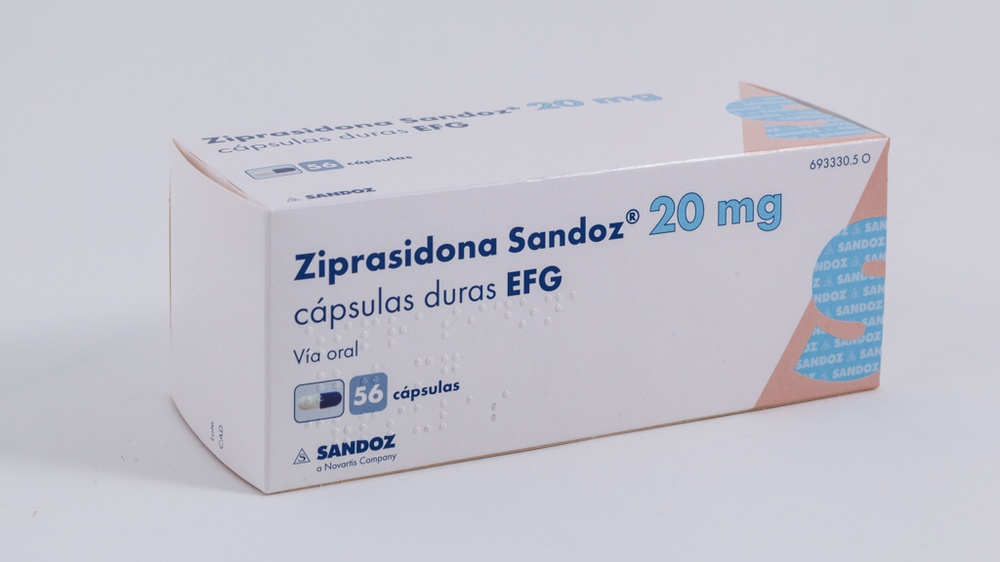
ZIPRASIDONA 20 mg Cápsulas Duras

Revisión de receta online
Un médico revisará tu caso y determinará si la prescripción es médicamente apropiada.

Habla con un médico sobre este medicamento
Comenta tus síntomas y las opciones de tratamiento en una consulta online.



Cómo usar ZIPRASIDONA SANDOZ 20 MG CAPSULAS DURAS EFG
Contenido del prospecto
- Introducción
- Qué es Ziprasidona Sandoz y para qué se utiliza
- Qué necesita saber antes de empezar a tomar Ziprasidona Sandoz
- Cómo tomar Ziprasidona Sandoz
- Posibles efectos adversos
- Conservación de Ziprasidona Sandoz
- Contenido del envase e información adicional
Introducción
Prospecto: información para el usuario
Ziprasidona Sandoz 20 mg cápsulas duras EFG
Ziprasidona Sandoz 40 mg cápsulas duras EFG
Ziprasidona Sandoz 60 mg cápsulas duras EFG
Ziprasidona Sandoz 80 mg cápsulas duras EFG
Ziprasidona (hidrocloruro monohidrato)
Lea todo el prospecto detenidamente antes de empezar a tomar este medicamento,porque contiene información importante para usted.
- Conserve este prospecto, ya que puede tener que volver a leerlo.
- Si tiene alguna duda, consulte a su médico o farmacéutico.
- Este medicamento se le ha recetado solamente a usted, y no debe dárselo a otras personas aunque tengan los mismos síntomas que usted, ya que puede perjudicarles.
- Si experimenta efectos adversos, consulte a su médico o farmacéutico incluso si se trata de efectos adversos que no aparecen en este prospecto. Ver sección 4.
Contenido del prospecto
- Qué es Ziprasidona Sandoz y para qué se utiliza
- Qué necesita saber antes de empezar a tomar Ziprasidona Sandoz
- Cómo tomar Ziprasidona Sandoz
- Posibles efectos adversos
5 Conservación de Ziprasidona Sandoz
- Contenido del envase e información adicional
1. Qué es Ziprasidona Sandoz y para qué se utiliza
Ziprasidona Sandoz contiene el principio activo ziprasidona y pertenece al grupo de medicamentos denominados antipsicóticos.
Ziprasidona está indicado en el tratamientode las siguientes enfermedades mentales:
- Esquizofreniaen adultos.
La esquizofrenia se caracteriza por los siguientes síntomas: oír, ver o sentir cosas que no existen, creer en algo que no es cierto, tener sospechas no habituales, estar ausente y tener dificultad para establecer relaciones sociales, nerviosismo, depresión o ansiedad.
- Episodios maniacos o mixtosde gravedad moderada en el trastorno bipolaren adultos y en niños y adolescentes de 10 a 17 años.
Es una enfermedad mental caracterizada por fases alternantes de estados de ánimo eufóricos (manía) o deprimidos. Durante los episodios de manía, los síntomas más característicos son: comportamiento eufórico, autoestima exagerada, incremento de la energía, disminución de la necesidad de dormir, falta de concentración o hiperactividad y repetición de comportamientos arriesgados.

¿No estás seguro de si este medicamento es adecuado para ti?
Comenta tus síntomas y tratamiento con un médico online.
2. Qué necesita saber antes de empezar a tomar Ziprasidona Sandoz
No tome Ziprasidona Sandoz
- si es alérgico a ziprasidona o a alguno de los demás componentes de este medicamento (incluidos en la sección 6). Los signos de una reacción alérgica son la aparición de erupción en la piel, picor, cara o labios hinchados, dificultad para respirar,
- si padece o ha padecido alguna enfermedad del corazón o ha tenido recientemente un ataque al corazón,
- si está tomando medicamentos para alteraciones del ritmo del corazón o medicamentos que pueden afectar el ritmo del corazón.
Consulte también la sección "Toma de Ziprasidona Sandoz con otros medicamentos” a continuación.
Advertencias y precauciones
Consulte a su médico o farmacéutico antes de empezar a tomar ziprasidona:
- si usted o alguien en su familia tiene antecedentes de coágulos de sangre, ya que este tipo de medicamentos se ha asociado a la formación de coágulos de sangre,
- si padece problemas de hígado,
- si padece o ha padecido convulsiones o epilepsia,
- si es una persona de edad avanzada (mayores de 65 años de edad) y sufre demencia y tiene un alto riesgo de sufrir un ictus,
- si presenta una disminución importante del ritmo cardiaco en reposo, y/o sabe que puede presentar niveles bajos de sales en sangre como resultado de haber sufrido diarrea y vómitos graves de forma prolongada o del uso de diuréticos (favorecen la eliminación del exceso de líquidos)
- si experimenta síntomas como latidos acelerados o irregulares del corazón, desmayo, síncope o mareos al ponerse de pie, ya que puede indicar un funcionamiento anormal del ritmo del corazón.
Póngase en contacto inmediatamente con su médico si experimenta alguno de los siguientes síntomas:
- Reacciones cutáneas graves como, sarpullido con ampollas que podría acompañarse de úlceras en la boca, descamación de la piel, fiebre y manchas en la piel con forma de diana que podrían ser síntomas del síndrome de Stevens-Johnson. Estas reacciones cutáneas podrían ser potencialmente mortales.
- Ziprasidona puede causar somnolencia, bajada de la presión arterial al levantarse, mareos y trastornos de la marcha, que pueden provocar caídas. Se debe tener precaución, especialmente si usted es un paciente de edad avanzada o sufre alguna debilidad.
Informe a su médico de que está tomando ziprasidona antes de hacerse alguna prueba diagnóstica (incluidos análisis de sangre, orina, pruebas de la función del hígado, del ritmo del corazón, etc.) ya que puede alterar los resultados de los análisis.
Niños y adolescentes
No se ha establecido la seguridad y eficacia de ziprasidona en el tratamiento de la esquizofrenia en niños y adolescentes.
Toma de Ziprasidona Sandoz con otros medicamentos
Informe a su médico o farmacéutico si está tomando, ha tomado recientemente o pudiera tener que tomar cualquier otro medicamento.
No tomeZiprasidonaSandozsi está tomando medicamentos para alteraciones del ritmo del corazón o medicamentos que pueden afectar el ritmo del corazón, tales como:
Antiarrítmicos de Clase IA y III, trióxido de arsénico, halofantrina, acetato de levometadilo, mesoridazina, tioridazina, pimozida, esparfloxacino, gatifloxacino, moxifloxacino, mesilato de dolasetrón, mefloquina, sertindol o cisaprida. Estos medicamentos pueden alterar el ritmo del corazón por prolongación del intervalo QT. Si tiene alguna pregunta adicional sobre este efecto, consulte con su médico.
Consulte a su médico o farmacéutico antes de empezar a tomar ziprasidona.
Informe a su médico o farmacéutico si está utilizando o ha utilizado recientemente medicamentos para el tratamiento de:
- infecciones por bacterias; estos medicamentos se conocen como antibióticos; p. ej., antibióticos macrólidos o rifampizina;
- cambios del estado de ánimo (desde estado de ánimo depresivo a euforia), agitación e irritación; estos medicamentos se conocen como estabilizadores del humor, p. ej., litio, carbamazepina, valproato;
- depresión, incluyendo algunos medicamentos serotoninérgicos, p. ej., ISRSs (Inhibidores Selectivos de la Recaptación de Serotonina) como la fluoxetina, paroxetina, sertralina; o plantas medicinales o remedios naturales que contienen Hierba de San Juan;
- epilepsia, p. ej., fenitoína, fenobarbital, carbamazepina, etosuximida;
- enfermedad de Parkinson, p. ej., levodopa, bromocriptina, ropinirol, pramipexol;
- o si está tomando o ha tomado recientemente los siguientes medicamentos: verapamilo, quinidina, itraconazol, o ritonavir.
Ver sección “No tome Ziprasidona Sandoz” anterior.
Toma de Ziprasidona Sandoz con alimentos,bebidas y alcohol
Ziprasidona Sandoz DEBE TOMARSE DURANTE LAS COMIDAS PRINCIPALES.
No debe ingerir bebidas alcohólicas durante el tratamiento con ziprasidona, ya que esto puede incrementar el riesgo de efectos adversos.
Embarazo ylactancia
Si está embarazada o en periodo de lactancia, cree que podría estar embarazada o tiene intención de quedarse embarazada, consulte a su médico o farmacéutico antes de utilizar este medicamento.
- Embarazo
No debe tomar ziprasidona durante el embarazo a menos que su médico le indique lo contrario, porque existe riesgo de que este medicamento pueda dañar a su bebé.
Los siguientes síntomas pueden ocurrir en los bebés recién nacidos de madres que hayan tomado ziprasidona en el último trimestre (tres últimos meses de embarazo): temblor, rigidez y/o debilidad muscular, somnolencia, agitación, problemas respiratorios, y dificultad en la alimentación. Si su bebé desarrolla cualquiera de estos síntomas, contacte con su médico.
- Lactancia
No del pecho si está tomando ziprasidona. Esto se debe a que pequeñas cantidades de este medicamento pueden pasar a la leche materna.
- Anticoncepción
Si puede quedarse embarazada, debería usar un método anticonceptivo adecuado al tomar este medicamento.
Conducción y uso de máquinas
La toma de ziprasidona puede producir somnolencia. Si experimenta este síntoma, absténgase de conducir y de manejar maquinaria peligrosa hasta que la somnolencia desaparezca.
Ziprasidona Sandoz contiene lactosa y sodio
Ziprasidona Sandoz contiene lactosa. Si su médico le ha indicado que tiene una intolerancia a ciertos azúcares, consulte con él antes de tomar este medicamento.
20 mg, 40 mg y 80 mg cápsulas duras:
Este medicamento contiene menos de 23 mg de sodio (1mmol) por cápsula dura; esto es, esencialmente “exento de sodio”.
3. Cómo tomar Ziprasidona Sandoz
Siga exactamente las instrucciones de administración de este medicamento indicadas por su médico. En caso de duda, consulte de nuevo a su médico o farmacéutico.
Las cápsulas se deben tragar enteras, sin masticar y se deben tomar junto con alimentos. Es importante no masticar las cápsulas puesto que puede verse afectado el punto en el que el medicamento se absorbe en el intestino.
Ziprasidona se debe tomar dos veces al día, una cápsula por la mañana durante un “desayuno” consistente y una por la noche durante la “cena”. Procure tomar este medicamento a la misma hora cada día.
Adultos
La dosis recomendada es de 40 a 80 mg de ziprasidona dos veces al día con alimentos.
En tratamientos de larga duración su médico puede ajustar la dosis. Se recomienda no sobrepasar la dosis máxima de 160 mg al día.
Uso en niños y adolescentes con manía bipolar
La dosis recomendada para iniciar el tratamiento es de 20 mg al día en una única toma con alimentos, tras la cual su médico le indicará su dosis óptima. Se recomienda no sobrepasar la dosis máxima establecida por rango de peso de 80 mg al día en el caso de los niños con peso inferior a 45 kg y de 160 mg al día en niños con peso igual o superior a 45 kg.
No se ha establecido la seguridad y eficacia de ziprasidona en el tratamiento de esquizofrenia en niños y adolescentes.
Pacientes de edad avanzada (mayores de 65 años)
Si es un paciente de edad avanzada, su médico decidirá la dosis idónea para usted. La dosis para mayores de 65 años es en ocasiones inferior a la utilizada en personas más jóvenes. Su médico le indicará cual es la dosis apropiada para usted.
Pacientes con problemas de hígado
Si tiene problemas de hígado es posible que tenga que tomar una dosis más baja de ziprasidona cápsulas. Su médico le indicará cual es la dosis correcta para usted.
Si toma más Ziprasidona Sandoz del que debe
Si ha tomado más Ziprasidona del que debe, consulte inmediatamente a su médico, a su farmacéutico o llame al Servicio de Información Toxicológica, teléfono: 91 562 04 20, indicando el medicamento y la cantidad utilizada.
Si ha tomado muchas cápsulas de Ziprasidona Sandoz, puede aparecer sensación de sueño, temblor, convulsiones y movimientos involuntarios de la cabeza y el cuello.
Si olvidó tomar Ziprasidona Sandoz
Es importante que tome ziprasidona a la misma hora cada día. Si olvida tomar una dosis, tómela cuanto antes. Sin embargo, si está cerca de la siguiente dosis, sáltese la dosis olvidada y tome la siguiente a su hora.
No tome una dosis doble para compensar las dosis olvidadas.
Si interrumpe el tratamiento con Ziprasidona Sandoz
Su médico le indicará durante cuánto tiempo debe tomar ziprasidona. No deje de tomar este medicamento, a menos que se lo indique su médico.
Es importante continuar con el tratamiento aunque se encuentre mejor. Si interrumpe el tratamiento demasiado pronto, los síntomas pueden volver.
Si tiene cualquier otra duda sobre el uso de este medicamento, pregunte a su médico o farmacéutico.

¿Has empezado a tomar el medicamento y tienes preguntas?
Comenta tus síntomas y tratamiento con un médico online.
4. Posibles efectos adversos
Al igual que todos los medicamentos, este medicamento puede producir efectos adversos, aunque no todas las personas los sufran.
Sin embargo, la mayoria de los efectos adversos son transitorios. A menudo puede resultar difícil distinguir los síntomas de su enfermedad de los efectos adversos.
DEJE de tomar Ziprasidona Sandoz y consulte a su médico inmediatamente si experimenta alguno de los siguientes efectos adversos graves:
Efectos adversos frecuentes (pueden afectar hasta 1 de cada 10 personas):
- movimientos involuntarios/no habituales, especialmente de su cara o lengua.
Efectos adversos poco frecuentes (pueden afectar hasta 1 de cada 100 personas):
- latidos rápidos o irregulares del corazón, sensación de mareo al ponerse de pie lo que puede indicar un funcionamiento alterado del corazón. Estos podrían ser síntomas de una afección conocida como hipotensión postural.
Efectos adversos raros(pueden afectar hasta 1 de cada 1.000 personas):
- hinchazón de la cara, labios, lengua o garganta, y dificultad para tragar o respirar, urticaria. Estos podrían ser síntomas de una reacción alérgica grave como angioedema,
- fiebre, respiración acelerada, sudoración, agarrotamiento muscular, temblor, dificultad al tragar y conciencia disminuida. Estos pueden ser síntomas de una enfermedad conocida como síndrome neuroléptico maligno,
- reacciones cutáneas, en particular erupción cutánea, fiebre y ganglios linfáticos inflamados que pueden ser síntomas de una afección llamada reacción farmacológica con eosinofilia y síntomas sistémicos (DRESS). Estas reacciones pueden ser potencialmente mortales,
- confusión, agitación, fiebre, sudoración, descoordinación de los movimientos musculares, espasmos musculares. Estos pueden ser síntomas de una enfermedad conocida como síndrome serotoninérgico,
- latidos del corazón rápidos, irregulares, desfallecimiento, que pueden ser síntomas de una enfermedad que puede poner en riesgo la vida, conocida como Torsades de Pointes,
- erección del pene anormalmente persistente y dolorosa.
Efectos adversos de frecuencia no conocida (no pueden estimarse a partir de los datos disponibles):
- hinchazón, dolor y rojez en la pierna. Estos pueden ser síntomas de coágulos de sangre en las venas, especialmente en las piernas, que pueden viajar por los vasos sanguíneos hasta los pulmones, causando dolor en el pecho y dificultando la respiración.
Puede que experimente alguno de los efectos adversos que se mencionan a continuación. Estos potenciales efectos adversos son generalmente de carácter leve a moderado y pueden desaparecer con el tiempo. No obstante, si el efecto adverso es grave o persistente, contacte con su médico.
Efectos adversos muy frecuentes(pueden afectar a más de 1 de cada 10 personas):
- dificultad para dormir,
- somnolencia o somnolencia diurna excesiva,
- dolor de cabeza.
Efectos adversos frecuentes (pueden afectar hasta 1 de cada 10 personas):
- moqueo,
- aumento del estado de ánimo, patrones de pensamiento extraño e hiperactividad, sentirse agitado o ansioso,
- inquietud,
- anormalidades del movimiento incluyendo movimientos involuntarios, rigidez muscular, lentitud de movimientos,
- mareos,
- sedación,
- visión borrosa o dañada,
- alta presión sanguínea,
- estreñimiento, diarrea, náuseas, vómitos e indigestión, boca seca, aumento de la salivación,
- erupción,
- problemas sexuales masculinos,
- fiebre,
- dolor,
- pérdida o ganancia de peso,
- agotamiento,
- sensación general de enfermedad.
Efectos adversos poco frecuentes (pueden afectar hasta 1 de cada 100 personas):
- altos niveles de prolactina en la sangre,
- incremento del apetito,
- ataque de pánico,
- sentirse nervioso o deprimido,
- disminución del deseo sexual,
- pérdida de consciencia,
- dificultad para controlar movimientos / movimientos involuntarios,
- piernas inquietas,
- opresión en la garganta, pesadillas,
- convulsiones, movimientos involuntarios de los ojos a una posición fija, torpeza, desorden del habla, entumecimiento, sensación de hormigueo y agujetas, disminución de la capacidad de concentración, babeo,
- palpitaciones, falta de aliento,
- sensibilidad a la luz, ojos secos, zumbido en los oídos, dolor de oído,
- dolor de garganta, viento, malestar estomacal,
- erupción cutánea con picazón, acné,
- calambres musculares, articulaciones rígidas o hinchadas,
- sed, malestar en el pecho, marcha anormal,
- reflujo ácido, dolor de estómago,
- pérdida de cabello,
- posición inusual de la cabeza,
- incontinencia urinaria, dolor o dificultad para orinar,
- producción anormal de leche materna,
- agrandamiento de mamas en hombres,
- ausencia de menstruación,
- resultados anormales de pruebas cardíacas o de sangre,
- resultados anormales de la prueba de función hepática,
- vértigo,
- debilidad general y cansancio.
Efectos adversos raros (pueden afectar hasta de 1 de cada 1.000 personas):
- disminución de los niveles de calcio en la sangre,
- pensamiento lento, falta de emociones,
- inclinación facial,
- parálisis,
- pérdida de visión parcial o completa en un ojo, picazón en los ojos,
- dificultad para hablar, hipo,
- heces sueltas,
- irritaciones de la piel,
- incapacidad para abrir la boca,
dificultad para vaciar la vejiga,
- síndrome de abstinencia de drogas en bebés recién nacidos,
- orgasmo reducido,
- sensación de calor,
- disminución o aumento de glóbulos blancos (en análisis de sangre),
- parches de piel roja inflamada y elevada cubiertos por una escala blanca conocida como psoriasis.
Frecuencia no conocida (no puede estimarse a partir de los datos disponibles):
- en pacientes de edad avanzada con demencia, se ha observado un pequeño incremento en el número de muertes en aquellos pacientes tratados con antipsicóticos en comparación con los que no estaban tomando antipsicóticos.
Comunicación de efectos adversos
Si experimenta cualquier tipo de efecto adverso, consulte a su médico o farmacéutico, incluso si se trata de posibles efectos adversos que no aparecen en este prospecto. También puede comunicarlos directamente a través del Sistema Español de Farmacovigilancia de medicamentos de Uso Humano: https://www.notificaram.es. Mediante la comunicación de efectos adversos usted puede contribuir a proporcionar más información sobre la seguridad de este medicamento.
5. Conservación de Ziprasidona Sandoz
Mantener este medicamento fuera de la vista y del alcance de los niños.
No utilice este medicamento después de la fecha de caducidad que aparece en el blíster; frasco y envase después de “CAD”. La fecha de caducidad es el último día del mes que se indica.
No conservar a temperatura superior a 30°C.
Frascos:tras la primera apertura: 6 meses.
Los medicamentos no se deben tirar por los desagües ni a la basura. Deposite los envases y los medicamentos que no necesita en el Punto SIGRE de la farmacia. En caso de duda pregunte a su farmacéutico cómo deshacerse de los envases y de los medicamentos que no necesita. De esta forma, ayudará a proteger el medio ambiente.
6. Contenido del envase e información adicional
Composición de Ziprasidona Sandoz
- El principio activo es ziprasidona.
Cada cápsula dura contiene 20 mg de ziprasidona (como ziprasidona hidrocloruro monohidrato).
Cada cápsula dura contiene 40 mg de ziprasidona (como ziprasidona hidrocloruro monohidrato).
Cada cápsula dura contiene 60 mg de ziprasidona (como ziprasidona hidrocloruro monohidrato).
Cada cápsula dura contiene 80 mg de ziprasidona (como ziprasidona hidrocloruro monohidrato).
- Los demás componentes son:
Ziprasidona Sandoz 20, 40 y 80 mg cápsulas duras:
Contenido de la cápsula: lactosa monohidrato, almidón pregelatinizado, estearato magnésico.
Cápsula: carmín índigo (contiene sodio) (E132), dióxido de titanio (E171), gelatina y agua.
Ziprasidona Sandoz 60 mg cápsulas duras:
Contenido de la cápsula: lactosa monohidrato, almidón pregelatinizado, estearato magnésico.
Cápsula: dióxido de titanio (E171), gelatina y agua.
Aspecto del producto y contenido del envase
Ziprasidona Sandoz son cápsulas duras de gelatina.
- Ziprasidona Sandoz 20 mg: cápsulas duras de tamaño 4 (altura: 14,3 mm), tapa de la cápsula azul opaco y cuerpo azul claro opaco.
- Ziprasidona Sandoz 40 mg: cápsulas duras de tamaño 3 (altura: 15,7 mm), tapa de la cápsula azul opaco y cuerpo azul opaco.
- Ziprasidona Sandoz 60 mg: cápsulas duras de tamaño 2 (altura: 17,6 mm), tapa de la cápsula blanco opaco y cuerpo blanco opaco.
- Ziprasidona Sandoz 80 mg: cápsulas duras de tamaño 1 (altura: 19,4 mm), tapa de la cápsula azul opaco y cuerpo azul claro opaco.
Tamaños de envase
Ziprasidona Sandoz se presenta en blísteres en envases de cartónque contienen: 10, 14, 20, 30, 50, 56, 60, 98, 100 cápsulas duras.
Ziprasidona Sandoz se presenta en frascos cerrados con tapas que contienen: 200 cápsulas duras.
Puede que solamente estén comercializados algunos tamaños de envases.
Titular de la autorización de comercialización y responsable de la fabricación
Titular de la autorización de comercialización
Sandoz Farmacéutica, S.A.
Centro Empresarial Parque Norte
Edificio Roble
C/ Serrano Galvache, 56
28033 Madrid
España
Responsable de la fabricación
Lek Pharmaceuticals d.d.
Verovškova 57,
1526 Ljubljana
Eslovenia
Salutas Pharma GmbH
Otto-von-Guericke-Allee 1,
39179 Barleben
Alemania
S.C. Sandoz, S.R.L.
Str. Livezeni nr. 7A,
RO-540472 Targu-Mures
Rumanía
Lek Pharmaceuticals d.d.
Lendava Site. Trimlini 2d
SI-9220 Lendava
Este medicamento está autorizado en los estados miembros del Espacio Económico Europeo con los siguientes nombres:
Alemania Ziprasidon – 1 A Pharma 20 mg Hartkapseln
Ziprasidon – 1 A Pharma 40 mg Hartkapseln
Ziprasidon – 1 A Pharma 60 mg Hartkapseln
Ziprasidon – 1 A Pharma 80 mg Hartkapseln
Dinamarca Ziprasidone Sandoz
Italia ZIPRASIDONE SANDOZ
España Ziprasidona Sandoz 20 mg cápsulas duras EFG,
Ziprasidona Sandoz 40 mg cápsulas duras EFG,
Ziprasidona Sandoz 60 mg cápsulas duras EFG,
Ziprasidona Sandoz 80 mg cápsulas duras EFG
Suecia Ziprasidone Sandoz 20 mg kapslar, hårda,
Ziprasidone Sandoz 40 mg kapslar, hårda,
Fecha de la última revisión de este prospecto: abril 2020
La información detallada de este medicamento está disponible en la página web de la Agencia Española de Medicamentos y Productos Sanitarios (AEMPS) http://www.aemps.gob.es/
- País de registro
- Forma farmacéuticaCAPSULA, 20 mg
- Código ATCN05AE04
- Precio medio en farmacia32.83 EUR
- Principio activo
- Requiere recetaSí
- Fabricante
- ComposiciónLACTOSA MONOHIDRATO (53,48 mg mg)
- Esta información es de carácter general y no sustituye la consulta con un profesional sanitario.
- Alternativas a ZIPRASIDONA SANDOZ 20 MG CAPSULAS DURAS EFGForma farmacéutica: CAPSULA, 20 mgPrincipio activo: ziprasidonaFabricante: Viatris Healthcare LimitedRequiere recetaForma farmacéutica: INYECTABLE, 20 MG/MLPrincipio activo: ziprasidonaFabricante: Viatris Healthcare LimitedRequiere recetaForma farmacéutica: CAPSULA, 40 mgPrincipio activo: ziprasidonaFabricante: Viatris Healthcare LimitedRequiere receta
Médicos online para ZIPRASIDONA SANDOZ 20 MG CAPSULAS DURAS EFG
Comenta la dosis, los posibles efectos secundarios, interacciones, contraindicaciones o la revisión de receta de ZIPRASIDONA SANDOZ 20 MG CAPSULAS DURAS EFG, sujeto a valoración médica y a la normativa local.








Obtén una receta de ZIPRASIDONA SANDOZ 20 MG CAPSULAS DURAS EFG online
Rellena un formulario de 2 minutos
Cuéntanos tus síntomas, historial y el medicamento que necesitas.
Elige un médico o nosotros te asignamos uno
Escoge un especialista o te conectamos con el próximo médico disponible.
El médico revisa tu caso
Normalmente en 30 minutos. Puede hacerte preguntas adicionales por chat.
Recógela en cualquier farmacia
Receta electrónica enviada a tu correo, válida en toda España.
Preguntas frecuentes
ZIPRASIDONA SANDOZ 20 MG CAPSULAS DURAS EFG requiere receta en España. Puedes confirmarlo con un médico online según tu caso.
El principio activo de ZIPRASIDONA SANDOZ 20 MG CAPSULAS DURAS EFG es ziprasidona. Esta información ayuda a identificar medicamentos con la misma composición pero con diferentes nombres comerciales.
El precio medio en farmacia de ZIPRASIDONA SANDOZ 20 MG CAPSULAS DURAS EFG es de aproximadamente 32.83 EUR. Puede variar según el fabricante y la forma farmacéutica.
ZIPRASIDONA SANDOZ 20 MG CAPSULAS DURAS EFG es fabricado por Sandoz Farmaceutica S.A.. La marca y el envase pueden variar según el distribuidor.
Los Médicos de familia, Psiquiatras, Dermatólogos, Cardiólogos, Endocrinólogos, Gastroenterólogos, Neumólogos, Nefrólogos, Reumatólogos, Hematólogos, Infectólogos, Alergólogos, Geriatras, Pediatras, Oncólogos pueden valorar la prescripción de ZIPRASIDONA SANDOZ 20 MG CAPSULAS DURAS EFG cuando esté clínicamente indicado. Puedes reservar una videoconsulta para comentar tu caso y las opciones de tratamiento.
España cuenta con una infraestructura sanitaria bien desarrollada en ciudades principales como Madrid, Barcelona, Valencia y Sevilla. Las farmacias están ampliamente disponibles y operan bajo estrictas regulaciones, garantizando el acceso a medicamentos con receta.
Puedes comprar ZIPRASIDONA SANDOZ 20 MG CAPSULAS DURAS EFG en Madrid, Barcelona, Sevilla o Valencia en cualquier farmacia local con una receta válida.
Para obtener una receta, puedes utilizar Oladoctor:
Otros medicamentos con el mismo principio activo (ziprasidona) incluyen ZELDOX 20 mg CAPSULAS DURAS, ZELDOX 20 MG/ML POLVO PARA SOLUCION INYECTABLE, ZELDOX 40 mg CAPSULAS DURAS. Pueden tener diferentes nombres comerciales o formulaciones, pero contienen el mismo componente terapéutico. Consulta siempre con un médico antes de cambiar o iniciar un nuevo medicamento.
