


Xgeva 120 mg solución inyectable

Revisión de receta online
Un médico revisará tu caso y determinará si la prescripción es médicamente apropiada.

Habla con un médico sobre este medicamento
Comenta tus síntomas y las opciones de tratamiento en una consulta online.



Cómo usar XGEVA 120 mg SOLUCION INYECTABLE
Contenido del prospecto
- Introducción
- Qué es XGEVA y para qué se utiliza
- Qué necesita saber antes de empezar a usar XGEVA
- Cómo usar XGEVA
- Posibles efectos adversos
- Conservación de XGEVA
- Contenido del envase e información adicional
Introducción
Prospecto: información para el paciente
XGEVA 120 mg solución inyectable
denosumab
Lea todo el prospecto detenidamente antes de empezar a usar el medicamento, porque contiene información importante para usted.
- Conserve este prospecto, ya que puede tener que volver a leerlo.
- Si tiene alguna duda, consulte a su médico, farmacéutico o enfermero.
- Este medicamento se le ha recetado solamente a usted y no debe dárselo a otras personas aunque tengan los mismos síntomas que usted, ya que puede perjudicarles.
- Si experimenta efectos adversos, consulte a su médico, farmacéutico o enfermero, incluso si se trata de efectos adversos que no aparecen en este prospecto. Ver sección 4.
- Su médico le proporcionará una tarjeta recordatorio para el paciente, que contiene información importante de seguridad que debe conocer antes y durante su tratamiento con XGEVA.
Contenido del prospecto
- Qué es XGEVA y para qué se utiliza
- Qué necesita saber antes de empezar a usar XGEVA
- Cómo usar XGEVA
- Posibles efectos adversos
- Conservación de XGEVA
- Contenido del envase e información adicional
1. Qué es XGEVA y para qué se utiliza
XGEVA contiene denosumab, una proteína (anticuerpo monoclonal) que frena la destrucción ósea que se produce cuando el cáncer se disemina por los huesos (metástasis ósea) o por tumor de células gigantes de hueso.
XGEVA se utiliza en adultos con cáncer avanzado para prevenir las complicaciones graves causadas por las metástasis óseas (p. ej., fracturas, compresión en la médula espinal o la necesidad de recibir radioterapia o cirugía).
XGEVA también se utiliza para tratamiento de tumor de células gigantes del hueso, que no se puede tratar con cirugía o cuando la cirugía no es la mejor opción, en adultos y adolescentes cuyos huesos han dejado de crecer.

¿No estás seguro de si este medicamento es adecuado para ti?
Comenta tus síntomas y tratamiento con un médico online.
2. Qué necesita saber antes de empezar a usar XGEVA
No use XGEVA
- si es alérgico a denosumab o a cualquiera de los demás componentes de este medicamento (incluidos en la sección 6).
Su profesional sanitario no le administrará XGEVA si tiene un nivel muy bajo de calcio en su sangre que no ha sido tratado.
Su profesional sanitario no le administrará XGEVA si tiene heridas sin cicatrizar producidas por cirugía dental o bucal.
Advertencias y precauciones
Consulte a su médico antes de empezar a usar XGEVA.
Suplementos de calcio y vitamina D
Debe tomar suplementos de calcio y vitamina D durante el tratamiento con XGEVA a no ser que sus niveles de calcio en sangre sean elevados. Su médico le explicará este aspecto. Si su nivel de calcio en sangre es bajo, puede que su médico decida recetarle suplementos de calcio antes de empezar el tratamiento con XGEVA.
Concentraciones bajas de calcio en sangre
Contacte inmediatamente con su médico si experimenta espasmos, tics o calambres en los músculos y/o entumecimiento u hormigueo en los dedos de las manos y de los pies o alrededor de la boca y/o convulsiones, confusión o pérdida del conocimiento durante el tratamiento con XGEVA. Es posible que su nivel de calcio en sangre sea bajo.
Insuficiencia renal
Informe a su médico si tiene o ha tenido problemas renales graves, insuficiencia renal o si ha necesitado someterse a diálisis, ya que esto puede aumentar el riesgo de bajada de la concentración de calcio en sangre, especialmente si no toma suplementos de calcio.
Problemas con la boca, los dientes y la mandíbula
Se ha comunicado de forma frecuente (puede afectar hasta 1 de cada 10 personas) un efecto adverso llamado osteonecrosis mandibular (daño en el hueso de la mandíbula) en pacientes que reciben XGEVA inyectable para las afecciones relacionadas con el cáncer. La osteonecrosis mandibular también puede ocurrir después de interrumpir el tratamiento.
Es importante intentar prevenir el desarrollo de la osteonecrosis mandibular ya que puede ser una afección dolorosa que puede ser difícil de tratar. Para reducir el riesgo de desarrollar osteonecrosis mandibular, debe tomar algunas precauciones:
- Antes de recibir el tratamiento, informe a su médico o enfermero (profesional sanitario) si tiene algún problema con su boca o dientes. Su médico debe retrasar el inicio de su tratamiento en caso de que tenga heridas sin cicatrizar en su boca producidas por procedimientos dentales o cirugía bucal. Su médico le recomendará un examen dental antes de iniciar el tratamiento con XGEVA.
- Mientras esté siendo tratado, debe mantener una buena higiene bucal y recibir revisiones dentales periódicas. Si usa prótesis dental, debe asegurarse de que ésta se ajusta adecuadamente.
- Si está en tratamiento dental o se someterá a una cirugía dental (p. ej extracciones de dientes), informe a su médico sobre su tratamiento dental e informe a su dentista que está siendo tratado con XGEVA.
- Contacte inmediatamente con su médico y dentista si presenta cualquier problema con la boca o los dientes, como dientes flojos, dolor o inflamación, úlceras que no curan o que supuran, ya que éstos podrían ser signos de osteonecrosis mandibular.
Pacientes sometidos a quimioterapia y /o radioterapia, tomando esteroides o medicamentos anti-angiogénicos (utilizados para tratar el cáncer), intervenidos por una cirugía dental, que no realicen revisiones dentales periódicas, que tengan enfermedad en las encías o que sean fumadores, podrían tener un riesgo mayor de desarrollar osteonecrosis mandibular.
Fracturas inusuales del hueso del muslo
Algunas personas han desarrollado fracturas inusuales del hueso del muslo durante el tratamiento con XGEVA. Contacte con su médico si presenta dolor reciente o inusual en la cadera, ingle o muslo.
Niveles altos de calcio en sangre tras interrumpir el tratamiento con XGEVA
Algunos pacientes con tumores de células gigantes de hueso han presentado niveles altos de calcio en sangre semanas o meses tras la interrupción del tratamiento. Su médico vigilará los signos y síntomas de niveles altos de calcio, tras la interrupción del tratamiento con XGEVA.
Niños y adolescentes
XGEVA no está recomendado para niños y adolescentes menores de 18 años de edad excepto para adolescentes con tumor de células gigantes de hueso cuyos huesos han dejado de crecer. No se ha estudiado el uso de XGEVA en niños y adolescentes con otros tipos de cáncer que se han propagado a los huesos.
Uso de XGEVA con otros medicamentos
Informe a su médico o farmacéutico si está tomando, ha tomado recientemente o pudiera tener que tomar cualquier otro medicamento. Ello incluye los adquiridos sin receta. Es muy importante que informe a su médico si está siendo tratado con
- otro medicamento que contenga denosumab
- un bisfosfonato
No debería tomar XGEVA junto con otros medicamentos que contengan denosumab o bisfosfonatos.
Embarazo y lactancia
XGEVA no se ha probado en mujeres embarazadas. Es importante que informe a su médico si está embarazada, cree que puede estarlo o planea quedarse embarazada. No se recomienda utilizar XGEVA durante el embarazo. Las mujeres en edad fértil deben utilizar métodos anticonceptivos efectivos durante el tratamiento con XGEVA y al menos 5 meses después de interrumpir el tratamiento con XGEVA.
Si se queda embarazada durante el tratamiento con XGEVA o menos de 5 meses después de interrumpir el tratamiento con XGEVA, por favor, informe a su médico.
Se desconoce si XGEVA se excreta en la leche materna. Es importante que le comunique a su médico si está en período de lactancia o si planea estarlo. Su médico le ayudará a decidir sobre si debe abandonar la lactancia, o si debe dejar de tomar XGEVA, teniendo en cuenta el beneficio de la lactancia materna para el niño y el beneficio de XGEVA para la madre.
Si está en periodo de lactancia durante el tratamiento con XGEVA, por favor, informe a su médico.
Consulte a su médico o farmacéutico antes de tomar cualquier otro medicamento.
Conducción y uso de máquinas
La influencia de XGEVA sobre la capacidad para conducir y utilizar máquinas es nula o insignificante.
XGEVA contiene sorbitol
Este medicamento contiene 78 mg de sorbitol en cada vial.
XGEVA contiene sodio
Este medicamento contiene menos de 1 mmol de sodio (23 mg) por 120 mg; esto es, esencialmente “exento de sodio”.
3. Cómo usar XGEVA
XGEVA debe ser administrado bajo la responsabilidad de un profesional sanitario.
La dosis recomendada de XGEVA es 120 mg administrada una vez cada 4 semanas en una única inyección debajo de la piel (vía subcutánea). XGEVA se inyectará en el muslo, el abdomen o la parte superior del brazo. Si va a ser tratado para el tumor de células gigantes de hueso, recibirá una dosis adicional 1 y 2 semanas después de la primera dosis.
No agitar.
También debe tomar suplementos de calcio y vitamina D durante el tratamiento con XGEVA a menos que tenga un exceso de calcio en la sangre. Su médico le explicará este aspecto.
Si tiene cualquier otra duda sobre el uso de este producto, pregunte a su médico, farmacéutico o enfermero.

¿Has empezado a tomar el medicamento y tienes preguntas?
Comenta tus síntomas y tratamiento con un médico online.
4. Posibles efectos adversos
Al igual que todos los medicamentos, este medicamento puede producir efectos adversos, aunque no todas las personas los sufran.
Informe a su médico inmediatamentesi aparece alguno de estos síntomas durante el tratamiento con XGEVA (puede afectar a más de 1 de cada 10 personas):
- espasmos, tics, calambres en los músculos, entumecimiento u hormigueo en los dedos de las manos y los pies o alrededor de la boca y/o convulsiones, confusión o pérdida del conocimiento. Estos síntomas pueden ser un signo de que sus niveles de calcio en sangre son bajos. La bajada de calcio en la sangre puede también producir un cambio en el ritmo del corazón llamado prolongación QT, que se observa mediante un electrocardiograma (ECG).
Informe a su médico y dentista inmediatamentesi presenta alguno de estos síntomas durante el tratamiento con XGEVA o después de interrumpir el tratamiento (puede afectar hasta 1 de cada 10 personas):
- dolor persistente en la boca y/o en la mandíbula, inflamación y/o úlceras que no se curan en la boca o en la mandíbula, supuración, entumecimiento o sensación de pesadez en la mandíbula o aflojamiento de un diente pueden ser signos de daño óseo en la mandíbula (osteonecrosis).
Efectos adversos muy frecuentes(puede afectar a más de 1 de cada 10 personas):
- dolor en el hueso, articulaciones y/o músculos que a veces es intenso,
- dificultades respiratorias,
- diarrea.
Efectos adversos frecuentes(puede afectar hasta 1 de cada 10 personas):
- concentraciones bajas de fosfato en la sangre (hipofosfatemia),
- extracción dental,
- sudoración excesiva,
- en pacientes con cáncer avanzado: desarrollo de otro tipo de cáncer.
Efectos adversos poco frecuentes(puede afectar hasta 1 de cada 100 personas):
- niveles altos de calcio en sangre (hipercalcemia) tras la interrupción del tratamiento en pacientes con tumor de células gigantes de hueso,
- dolor reciente o inusual en la cadera, ingle o muslo (puede ser un indicio temprano de una posible fractura del hueso del muslo),
- erupción en la piel o ulceraciones en la boca (erupciones liquenoides medicamentosas).
Efectos adversos raros(puede afectar hasta 1 de cada 1.000 personas):
- reacciones alérgicas (por ejemplo: sibilancias o dificultades respiratorias; hinchazón de la cara, los labios, la lengua, garganta u otras partes del cuerpo; erupción cutánea, picor o ronchas en la piel). En raras ocasiones, las reacciones alérgicas podrían ser graves.
Frecuencia no conocida(no puede estimarse a partir de los datos disponibles):
- consulte a su médico si usted tiene dolor de oído, el oído le supura y/o sufre una infección de oído. Estos podrían ser síntomas de daño en los huesos del oído.
Comunicación de efectos adversos
Si experimenta cualquier tipo de efecto adverso, consulte a su médico o enfermero, incluso si se trata de posibles efectos adversos que no aparecen en este prospecto. También puede comunicarlos directamente a través del sistema nacional de notificación incluido en el Apéndice V. Mediante la comunicación de efectos adversos usted puede contribuir a proporcionar más información sobre la seguridad de este medicamento.
5. Conservación de XGEVA
Mantener este medicamento fuera de la vista y del alcance de los niños.
No utilice este medicamento después de la fecha de caducidad que aparece en la caja y en la etiqueta después de “CAD” o “EXP”. La fecha de caducidad es el último día del mes que se indica.
Conservar en nevera (entre 2 °C y 8 °C).
No congelar.
Mantener el vial en el embalaje exterior para protegerlo de la luz.
Antes de la inyección, el vial puede dejarse fuera de la nevera para que alcance la temperatura ambiente (hasta 25 °C). De este modo la inyección será menos molesta. Una vez que el vial haya alcanzado la temperatura ambiente (hasta 25 °C), debe utilizarse antes de que pasen 30 días.
Los medicamentos no se deben tirar por los desagües ni a la basura. Pregunte a su farmacéutico cómo deshacerse de los envases y de los medicamentos que no necesita. De esta forma ayudará a proteger el medio ambiente.
6. Contenido del envase e información adicional
Composición de XGEVA
- El principio activo es denosumab. Cada vial contiene 120 mg de denosumab en 1,7 ml de solución (lo que equivale a 70 mg/ml).
- Los demás componentes son ácido acético glacial, hidróxido sódico, sorbitol (E420), polisorbato 20 y agua para preparaciones inyectables.
Aspecto del producto y contenido del envase
XGEVA es una solución inyectable (inyectable).
XGEVA es una solución transparente, de incolora a ligeramente amarillenta, que puede contener cantidades residuales de partículas proteicas de translúcidas a blancas.
Cada envase contiene uno, tres o cuatro viales de un solo uso.
Puede que solamente estén comercializados algunos tamaños de envases.
Titular de la autorización de comercialización y responsable de la fabricación
Amgen Europe B.V.
Minervum 7061,
4817 ZK Breda,
Países Bajos
Titular de la autorización de comercialización
Amgen Europe B.V.
Minervum 7061,
4817 ZK Breda,
Países Bajos
Fabricante
Amgen Technology (Ireland) Unlimited Company
Pottery Road
Dun Laoghaire
Co Dublin
Irlanda
Fabricante
Amgen NV
Telecomlaan 5‑7
1831 Diegem
Bélgica
Pueden solicitar más información respecto a este medicamento dirigiéndose al representante local del titular de la autorización de comercialización:
België/Belgique/Belgien s.a. Amgen n.v. Tél/Tel: +32 (0)2 7752711 | Lietuva Amgen Switzerland AG Vilniaus filialas Tel: +370 5 219 7474 |
| Luxembourg/Luxemburg s.a. Amgen Belgique/Belgien Tél/Tel: +32 (0)2 7752711 |
Ceská republika Amgen s.r.o. Tel: +420 221 773 500 | Magyarország Amgen Kft. Tel.: +36 1 35 44 700 |
Danmark Amgen, filial af Amgen AB, Sverige Tlf: +45 39617500 | Malta Amgen S.r.l. Italy Tel: +39 02 6241121 |
Deutschland Amgen GmbH Tel: +49 89 1490960 | Nederland Amgen B.V. Tel: +31 (0)76 5732500 |
Eesti Amgen Switzerland AG Vilniaus filialas Tel: +372 586 09553 | Norge Amgen AB Tlf: +47 23308000 |
Ελλ?δα Amgen Ελλ?ς Φαρμακευτικ? Ε.Π.Ε. Τηλ: +30 210 3447000 | Österreich Amgen GmbH Tel: +43 (0)1 50 217 |
España Amgen S.A. Tel: +34 93 600 18 60 | Polska Amgen Biotechnologia Sp. z o.o. Tel.: +48 22 581 3000 |
France Amgen S.A.S. Tél: +33 (0)9 69 363 363 | Portugal Amgen Biofarmacêutica, Lda. Tel: +351 21 4220606 |
Hrvatska Amgen d.o.o. Tel: +385 (0)1 562 57 20 | România Amgen România SRL Tel: +4021 527 3000 |
Ireland Amgen Ireland Limited Tel: +353 1 8527400 | Slovenija AMGEN zdravila d.o.o. Tel: +386 (0)1 585 1767 |
Ísland Vistor hf. Sími: +354 535 7000 | Slovenská republika Amgen Slovakia s.r.o. Tel: +421 2 321 114 49 |
Italia Amgen S.r.l. Tel: +39 02 6241121 | Suomi/Finland Amgen AB, sivuliike Suomessa/Amgen AB, filial i Finland Puh/Tel: +358 (0)9 54900500 |
K?προς C.A. Papaellinas Ltd Τηλ: +357 22741 741 | Sverige Amgen AB Tel: +46 (0)8 6951100 |
Latvija Amgen Switzerland AG Rigas filiale Tel: +371 257 25888 |
Fecha de la última revisión de este prospecto:
La información detallada de este medicamento está disponible en la página web de la Agencia Europea de Medicamentos:
http://www.ema.europa.eu/.
Esta información está destinada únicamente a profesionales del sector sanitario:
- La solución de XGEVA debe examinarse visualmente antes de su administración. La solución puede contener cantidades residuales de partículas proteicas de translúcidas a blancas. No inyecte la solución si está turbia, descolorida o contiene muchas partículas o material extraño.
- No agitar.
- Para evitar molestias en la zona de la administración, antes de inyectar, deje que el vial alcance la temperatura ambiente (hasta 25 °C) antes de inyectarla y realice la inyección lentamente.
- Todo el contenido del vial debe ser inyectado.
- Para la administración de denosumab se recomienda utilizar una aguja de calibre 27 G.
- No reinserte la aguja en el vial.
La eliminación del medicamento no utilizado y de todos los materiales que hayan estado en contacto con él, se realizará de acuerdo con la normativa local.
- País de registro
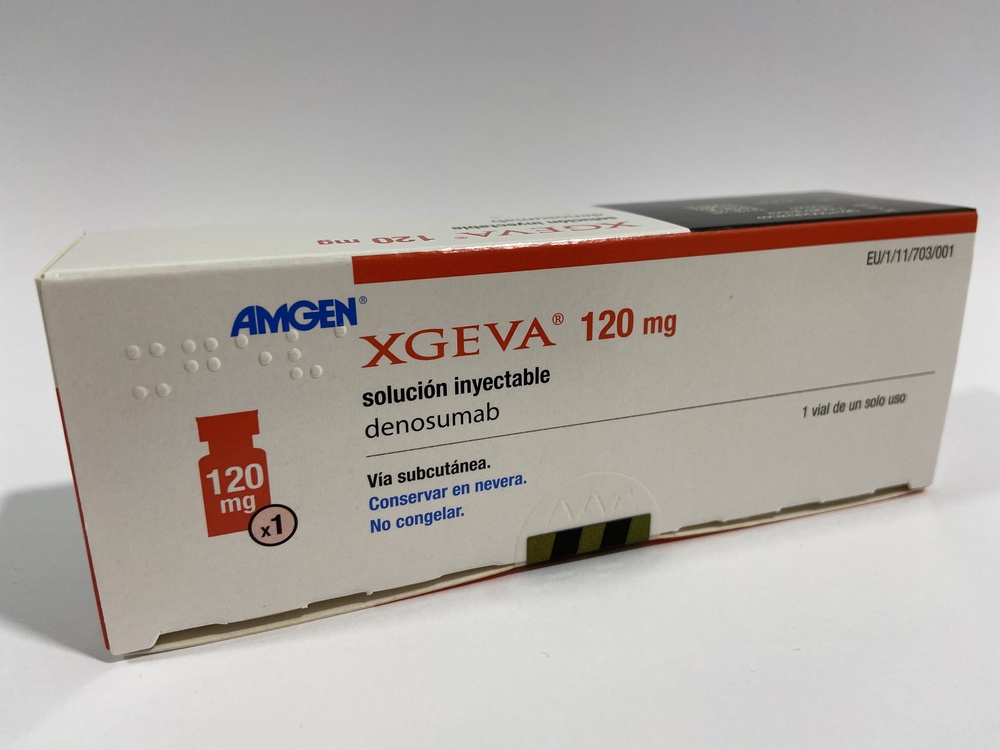
- Forma farmacéuticaINYECTABLE, 120 mg denosumab
- Código ATCM05BX04
- Principio activo
- Requiere recetaSí
- Fabricante
- ComposiciónHIDROXIDO DE SODIO (E 524) (SEGÚN REQUERIDO - mg), SORBITOL (78 mg mg)
- Esta información es de carácter general y no sustituye la consulta con un profesional sanitario.
- Alternativas a XGEVA 120 mg SOLUCION INYECTABLEForma farmacéutica: INYECTABLE, 120 mgPrincipio activo: DenosumabFabricante: Fresenius Kabi Deutschland GmbhRequiere recetaForma farmacéutica: INYECTABLE, 120 mgPrincipio activo: DenosumabFabricante: Fresenius Kabi Deutschland GmbhRequiere recetaForma farmacéutica: INYECTABLE, 60 mgPrincipio activo: DenosumabFabricante: Fresenius Kabi Deutschland GmbhRequiere receta
Médicos online para XGEVA 120 mg SOLUCION INYECTABLE
Comenta la dosis, los posibles efectos secundarios, interacciones, contraindicaciones o la revisión de receta de XGEVA 120 mg SOLUCION INYECTABLE, sujeto a valoración médica y a la normativa local.


Preguntas frecuentes
XGEVA 120 mg SOLUCION INYECTABLE requiere receta en España. Puedes confirmarlo con un médico online según tu caso.
El principio activo de XGEVA 120 mg SOLUCION INYECTABLE es Denosumab. Esta información ayuda a identificar medicamentos con la misma composición pero con diferentes nombres comerciales.
XGEVA 120 mg SOLUCION INYECTABLE es fabricado por Amgen Europe B.V.. La marca y el envase pueden variar según el distribuidor.
Los Médicos de familia, Psiquiatras, Dermatólogos, Cardiólogos, Endocrinólogos, Gastroenterólogos, Neumólogos, Nefrólogos, Reumatólogos, Hematólogos, Infectólogos, Alergólogos, Geriatras, Pediatras, Oncólogos pueden valorar la prescripción de XGEVA 120 mg SOLUCION INYECTABLE cuando esté clínicamente indicado. Puedes reservar una videoconsulta para comentar tu caso y las opciones de tratamiento.
La receta la emite un médico tras valorar tu estado de salud. En España, XGEVA 120 mg SOLUCION INYECTABLE se dispensa en las farmacias con esa receta médica. Una consulta online no garantiza su emisión: la decisión corresponde siempre al médico.
Para solicitar una valoración puedes usar Oladoctor:
Otros medicamentos con el mismo principio activo (Denosumab) incluyen BOMYNTRA 120 MG SOLUCION INYECTABLE EN JERINGA PRECARGADA, BOMYNTRA 120 MG SOLUCION INYECTABLE EN VIAL, CONEXXENCE 60 MG SOLUCION INYECTABLE EN JERINGA PRECARGADA. Pueden tener diferentes nombres comerciales o formulaciones, pero contienen el mismo componente terapéutico. Consulta siempre con un médico antes de cambiar o iniciar un nuevo medicamento.
