



VORICONAZOL 200 mg Inyectable Perfusión

Revisión de receta online
Un médico revisará tu caso y determinará si la prescripción es médicamente apropiada.

Habla con un médico sobre este medicamento
Comenta tus síntomas y las opciones de tratamiento en una consulta online.



Cómo usar VORICONAZOL SALA 200 MG POLVO PARA SOLUCION PARA PERFUSION EFG
Contenido del prospecto
- Introducción
- Qué es Voriconazol Sala 200 mg polvo para solución para perfusión y para qué se utiliza
- Qué necesita saber antes de empezar a usar Voriconazol Sala 200 mg polvo para solución para perfusión
- Cómo usar Voriconazol Sala 200 mg polvo para solución para perfusión
- Posibles efectos adversos
- Conservación de Voriconazol Sala 200 mg polvo para solución para perfusión
- Contenido del envase e información adicional
Introducción
Prospecto: información para el paciente
Voriconazol Sala 200 mg polvo para solución para perfusión EFG
Lea todo el prospecto detenidamente antes de empezar a usar este medicamento, porque
contiene información importante para usted.
- Conserve este prospecto, ya que puede tener que volver a leerlo.
- Si tiene alguna duda, consulte a su médico, farmacéutico o enfermero.
- Este medicamento se le ha recetado solamente a usted, y no debe dárselo a otras personas, aunque tengan los mismos síntomas que usted, ya que puede perjudicarles.
- Si experimenta efectos adversos, consulte a su médico, farmacéutico o enfermero, incluso si se trata de efectos adversos que no aparecen en este prospecto. Ver sección 4.
Contenido del prospecto
- Qué es Voriconazol Sala 200 mg polvo para solución para perfusión y para qué se utiliza
- Qué necesita saber antes de empezar a usar Voriconazol Sala 200 mg polvo para solución para perfusión
- Cómo usar Voriconazol Sala 200 mg polvo para solución para perfusión
- Posibles efectos adversos
- Conservación de Voriconazol Sala 200 mg polvo para solución para perfusión
- Contenido del envase e información adicional
1. Qué es Voriconazol Sala 200 mg polvo para solución para perfusión y para qué se utiliza
Este medicamento contiene el principio activo voriconazol. Voriconazol es un medicamento antifúngico. Actúa eliminando o impidiendo el crecimiento de los hongos que producen infecciones.
Se utiliza para el tratamiento de pacientes (adultos y niños de 2 años de edad o mayores) con:
- aspergilosis invasiva (un tipo de infección fúngica producida por Aspergillus sp),
- candidemia (otro tipo de infección fúngica producida por Candida sp) en pacientes no
neutropénicos (pacientes que no tienen un recuento anormalmente bajo de glóbulos blancos),
- infecciones graves invasivas producidas por Candida sp, cuando el hongo es resistente a
fluconazol (otro medicamento antifúngico),
- infecciones fúngicas graves producidas por Scedosporium spo por Fusarium sp(dos especies diferentes de hongos).
Este medicamento se utiliza en pacientes con infecciones fúngicas graves que pueden poner en riesgo la vida.
Prevención de infecciones fúngicas en los receptores de un trasplante de médula ósea con riesgo elevado.
Este medicamento debe utilizarse únicamente bajo supervisión médica.

¿No estás seguro de si este medicamento es adecuado para ti?
Comenta tus síntomas y tratamiento con un médico online.
2. Qué necesita saber antes de empezar a usar Voriconazol Sala 200 mg polvo para solución para perfusión
No useeste medicamento:
- si es alérgico a voriconazol o a sulfobutiléter betaciclodextrina sódica (incluida en la sección 6).
Es muy importante que informe a su médico o farmacéutico si está utilizando o ha utilizado recientemente otros medicamentos, incluso los adquiridos sin receta, o plantas medicinales.
Durante el tratamiento con voriconazol no debe tomar los medicamentos listados a continuación:
- Terfenadina (utilizado para la alergia).
- Astemizol (utilizado para la alergia).
- Cisaprida (utilizado para problemas digestivos).
- Pimozida (utilizado para trastornos mentales).
- Quinidina (utilizado para arritmias cardiacas).
- Ivabradina (utilizado para los síntomas de la insuficiencia cardíaca crónica).
- Rifampicina (utilizado para el tratamiento de la tuberculosis).
- Efavirenz (utilizado para el tratamiento del VIH) en dosis de 400 mg y superiores una vez al día.
- Carbamazepina (utilizado para tratar las convulsiones).
- Fenobarbital (utilizado para el insomnio grave y las convulsiones).
- Alcaloides ergotamínicos (p.ej.: ergotamina, dihidroergotamina; utilizados para la migraña).
- Sirolimus (utilizado en pacientes que han recibido un trasplante).
- Ritonavir (utilizado para el tratamiento del VIH) en dosis de 400 mg y superiores dos veces al día.
- Hierba de San Juan (hipérico, planta medicinal).
- Naloxegol (utilizado para tratar el estreñimiento causado específicamente por analgésicos, llamados opioides [p. ej., morfina, oxicodona, fentanilo, tramadol, codeína]).
- Tolvaptán (utilizado para tratar la hiponatremia [niveles bajos de sodio en sangre] o para ralentizar el deterioro de la función renal en pacientes con enfermedad renal poliquística).
- Lurasidona (utilizada para tratar la depresión),
- Venetoclax (usado para el tratamiento de pacientes con leucemia linfocítica crónica [LLC]).
Advertencias y precauciones
Consulte a su médico, farmacéutico o enfermero antes de empezar a usar este medicamento si:
- ha tenido una reacción alérgica a otros azoles.
- padece o ha padecido alguna vez una enfermedad del hígado. Si padece una enfermedad del hígado, su médico podría prescribirle una dosis más baja de este medicamento. Su médico también debería vigilar el funcionamiento de su hígado mientras está en tratamiento con este medicamento realizándole análisis de sangre.
- sabe que padece una cardiomiopatía, latidos irregulares del corazón, ritmo lento de los latidos del corazón o una anomalía en el electrocardiograma (ECG) denominada “síndrome del QTc prolongado”.
Debe evitar cualquier exposición al sol y a la luz solar durante el tratamiento. Es importante que se cubran las zonas expuestas y que se utilice una pantalla solar con un factor de protección solar (FPS) alto, ya que puede producirse una mayor sensibilidad de la piel a los rayos UV del sol. Esta puede incrementarse aún más por el uso de otros medicamentos que sensibilicen la piel a la luz solar, como metotrexato. Estas precauciones también son aplicables a los niños.
Mientras está en tratamiento con este medicamento informe a su médico si se le produce:
- quemadura solar
- erupción grave de la piel o ampollas
- dolor de huesos
Si desarrolla trastornos de la piel como los descritos anteriormente, es posible que su médico le remita a un dermatólogo, que tras la consulta puede considerar importante que se le examine de forma regular. Hay una pequeña probabilidad de que desarrolle cáncer de piel con el uso a largo plazo de este medicamento.
Si desarrolla signos de “insuficiencia suprarrenal” en los que las glándulas suprarrenales no producen cantidades suficientes de ciertas hormonas esteroides, tales como cortisol, que puede producir síntomas como: cansancio crónico o prolongado, debilidad muscular, pérdida de apetito, pérdida de peso, dolor abdominal, informe a su médico.
Si presenta signos del “síndrome de Cushing” en los que el cuerpo produce demasiada hormona
cortisol que puede provocar síntomas como: aumento de peso, joroba de grasa entre los hombros, cara redondeada, oscurecimiento de la piel del vientre, muslos, senos y brazos, piel fina, aparición de moretones con facilidad, nivel alto de azúcar en sangre, crecimiento excesivo de vello o sudoración excesiva, informe a su médico.
Su médico debe controlar el funcionamiento de su hígado y de sus riñones realizándole análisis de sangre.
Niños y adolescentes.
Este medicamento no debe administrarse a niños menores de 2 años.
Uso devoriconazol con otros medicamentos
Informe a su médico o farmacéutico si está tomando, ha tomado recientemente o podría tener que tomar cualquier otro medicamento.
Algunos medicamentos, cuando se usan al mismo tiempo que voriconazol, pueden afectar a la acción de este medicamento o bien voriconazol puede afectar a la acción de otros medicamentos.
Informe a su médico si está usando los siguientes medicamentos, ya que el tratamiento simultáneo con voriconazol debe evitarse si es posible:
- Ritonavir (utilizado para el tratamiento del VIH) a dosis de 100 mg dos veces al día.
- Glasdegib (utilizado para el tratamiento del cáncer); si necesita utilizar ambos medicamentos, su médico monitorizará su ritmo cardíaco frecuentemente.
Informe a su médico si está usando cualquiera de los siguientes medicamentos, ya que debe evitarse en la medida de lo posible el tratamiento al mismo tiempo que este medicamento, y puede necesitarse un ajuste de la dosis de voriconazol:
- Rifabutina (utilizado para el tratamiento de la tuberculosis). Si usted ya está en tratamiento con rifabutina, será necesario controlar su recuento sanguíneo y los efectos adversos de rifabutina.
- Fenitoína (utilizado para tratar la epilepsia). Si usted ya está en tratamiento con fenitoína, será necesario controlar la concentración de fenitoína en su sangre durante su tratamiento con este medicamento y podría ser necesario ajustar su dosis.
Comunique a su médico si está tomando alguno de los medicamentos siguientes, ya que puede necesitar un ajuste de dosis o un control para comprobar que estos medicamentos y/o voriconazol siguen produciendo el efecto deseado:
- Warfarina y otros anticoagulantes (por ejemplo: fenprocumon, acenocumarol; utilizados para disminuir la coagulación de la sangre).
- Ciclosporina (utilizado en pacientes que han recibido un trasplante).
- Tacrolimus (utilizado en pacientes que han recibido un trasplante).
- Sulfonilureas (por ejemplo: tolbutamida, glipizida y gliburida) (utilizados para la diabetes).
- Estatinas (por ejemplo: atorvastatina, simvastatina) (utilizados para reducir los niveles de colesterol).
- Benzodiazepinas (por ejemplo: midazolam, triazolam) (utilizados para el insomnio grave y el estrés).
- Omeprazol (utilizado para el tratamiento de úlceras de estómago).
- Anticonceptivos orales (si usa este medicamento mientras está utilizando anticonceptivos orales, puede experimentar efectos adversos como náuseas y trastornos menstruales).
- Alcaloides de la vinca (por ejemplo: vincristina y vinblastina) (utilizados para tratar el cáncer).
- Indinavir y otros inhibidores de la proteasa del VIH (utilizados para tratar la infección por VIH).
- Inhibidores de la tirosin quinasa (por ejemplo, axitinib, bosutinib, cabozantinib, ceritinib, cobimetinib, dabrafenib, dasatinib, nilotinib, sunitinib, ibrutinib, ribociclib) (utilizados para tratar el cáncer).
- Tretinoína (utilizado para tratar la leucemia).
- Inhibidores de la transcriptasa inversa no nucleósidos (por ejemplo: efavirenz, delavirdina y nevirapina) (utilizados para tratar la infección por VIH) (algunas dosis de efavirenz NO pueden tomarse al mismo tiempo que este medicamento).
- Metadona (utilizada para tratar la adicción a la heroína).
- Alfentanilo, fentanilo y otros opiáceos de acción corta tales como sufentanilo (analgésicos usados para operaciones).
- Oxicodona y otros opiáceos de acción prolongada como hidrocodona (utilizados para tratar el dolor moderado a grave).
- Medicamentos antiinflamatorios no esteroideos (por ejemplo, ibuprofeno, diclofenaco)
(utilizados para tratar el dolor y la inflamación).
- Fluconazol (utilizado para tratar infecciones por hongos).
- Everolimus (usado para tratar el cáncer de riñón avanzado y en pacientes que han recibido un trasplante).
- Letermovir (utilizado para prevenir la infección por citomegalovirus (cmv) tras un transplante de médula ósea).
- Ivacaflor: utilizado para tratar la fibrosis quística.
- Flucloxacilina (antibiótico utilizado contra infecciones bacterianas).
Embarazo y lactancia
No debe usar este medicamento durante el embarazo a menos que lo indique su médico. Las mujeres en edad fértil en tratamiento con este medicamento deben utilizar anticonceptivos eficaces. Póngase en contacto inmediatamente con su médico si se queda embarazada durante el tratamiento con este medicamento.
Si está embarazada o en periodo de lactancia, cree que podría estar embarazada o tiene intención de quedarse embarazada, consulte a su médico o farmacéutico antes de utilizar este medicamento.
Conducción y uso de máquinas
Este medicamento puede producir visión borrosa o molestias por una mayor sensibilidad a la luz. En caso de que le ocurra, no conduzca ni maneje herramientas o máquinas y comuníqueselo a su médico.
Este medicamentocontiene sodio
Este medicamento contiene 220,8 mg de sodio (componente principal de la sal de mesa/para cocinar) en cada vial. Esto equivale al 11 % de la ingesta diaria máxima de sodio recomendada para un adulto.
Este medicamentocontiene ciclodextrina
Este medicamento contiene 3.200 mg de ciclodextrina en cada vial equivalente a 160 mg/ml cuando se reconstituye en 20 ml. Si padece una insuficiencia renal, consulte con su médico antes de tomar este medicamento.
3. Cómo usar Voriconazol Sala 200 mg polvo para solución para perfusión
Siga exactamente las instrucciones de administración de este medicamento indicadas por su médico. En caso de duda, consulte de nuevo a su médico o farmacéutico.
Su médico determinará la dosis dependiendo de su peso y del tipo de infección que tenga.
Su médico puede cambiarle la dosis según su situación.
La dosis recomendada en adultos (incluyendo pacientes de edad avanzada) es la siguiente:
Vía intravenosa | |
Dosis durante las primeras 24 horas (dosis de carga) | 6 mg/kg cada 12 horas durante las primeras 24 horas |
Dosis tras las primeras 24 horas (dosis de mantenimiento) | 4 mg/kg dos veces al día |
Dependiendo de su respuesta al tratamiento, su médico puede disminuir la dosis a 3 mg/kg dos veces al día.
Su médico puede decidir reducir la dosis si padece una cirrosis de leve a moderada.
Uso en niños y adolescentes
La dosis recomendada en niños y en adolescentes es la siguiente
Vía intravenosa | ||
Niños de 2 a menos de 12 años de edad y adolescentes de 12 a 14 años de edad que pesan menos de 50 kg | Adolescentes de 12 a 14 años de edad que pesan 50 kg o más; y todos los adolescentes mayores de 14 años | |
Dosis durante las primeras 24 horas(dosis de carga) | 9 mg/kg cada 12 horas durante las primeras 24 horas | 6 mg/kg cada 12 horas durante las primeras 24 horas |
Dosis tras las primeras 24 horas(dosis de mantenimiento) | 8 mg/kg dos veces al día | 4 mg/kg dos veces al día |
Dependiendo de su respuesta al tratamiento, su médico podría aumentar o disminuir la dosis diaria.
Este medicamento debe ser reconstituido y diluido a la concentración correcta por el personal de farmacia o de enfermería del hospital (para más información ver el final de este prospecto).
Se administrará mediante perfusión intravenosa (en vena) con una velocidad máxima de 3 mg/kg por hora durante 1 a 3 horas.
Si usted o su hijo están tomando este medicamento para la prevención de infecciones fúngicas, su médico puede suspender la administración de voriconazol si usted o su hijo presentasen efectos adversos relacionados con el tratamiento.
Si olvidó una dosis de Voriconazol Sala 200 mg polvo para solución para perfusión
Teniendo en cuenta que recibirá este medicamento bajo estrecha supervisión médica, es poco probable que olvide una dosis. No obstante, comunique a su médico o farmacéutico si piensa que se ha olvidado una dosis.
Si interrumpe el tratamiento con Voriconazol Sala 200 mg polvo para solución para perfusión
El tratamiento con este medicamento se debe mantener durante todo el tiempo que su médico considere oportuno, no obstante la duración del tratamiento con este medicamento no debe superar los 6 meses.
Los pacientes con el sistema inmunológico comprometido o aquéllos con infecciones complicadas pueden necesitar tratamientos más largos para evitar que vuelva a aparecer la infección. Una vez que su situación mejore, puede sustituirse la perfusión intravenosa por la toma de comprimidos.
Cuando el médico suspenda el tratamiento con este medicamento, no debería presentar ningún efecto derivado de la interrupción.
Si tiene cualquier otra duda sobre el uso de este medicamento, pregunte a su médico, farmacéutico o enfermero.

¿Has empezado a tomar el medicamento y tienes preguntas?
Comenta tus síntomas y tratamiento con un médico online.
4. Posibles efectos adversos
Al igual que todos los medicamentos, este medicamento puede producir efectos adversos, aunque no todas las personas los sufran. Si aparece alguno, lo más probable es que sea leve y transitorio. No obstante, algunos pueden ser graves y precisar atención médica.
Efectos adversos graves - Dejar de usar este medicamento y acudir al médico inmediatamente
- Erupción cutánea.
- Ictericia, alteraciones en las pruebas sanguíneas de control de la función del hígado.
- Pancreatitis.
Otros efectos adversos
Muy frecuentes: pueden afectar a más de 1 de cada 10 personas
- Alteración visual (cambio de la visión, como visión borrosa, alteraciones visuales de los colores, intolerancia anormal a la percepción visual de la luz, ceguera para los colores, trastorno del ojo, halo visual, ceguera nocturna, visión oscilante, visión de chispas, aura visual, agudeza visual disminuida, claridad visual, pérdida parcial del campo visual habitual, manchas en el campo visual).
- Fiebre.
- Erupción cutánea.
- Náuseas, vómitos y diarrea.
- Dolor de cabeza.
- Hinchazón de las extremidades.
- Dolor de estómago.
- Dificultad para respirar.
- Enzimas hepáticas elevadas.
Frecuentes: pueden afectar hasta 1 de cada 10 personas
- Sinusitis, inflamación de las encías, escalofríos, debilidad.
- Recuento bajo, incluido el de carácter grave, de algunos tipos de glóbulos rojos (en ocasiones de tipo inmunitario) o blancos (en ocasiones acompañado de fiebre) en la sangre, recuento bajo de plaquetas que ayudan a que la sangre coagule.
- Niveles bajos de azúcar en la sangre, niveles bajos de potasio en la sangre, niveles bajos de sodio en la sangre.
- Ansiedad, depresión, confusión, agitación, insomnio, alucinaciones.
- Convulsiones, temblores o movimientos musculares incontrolados, hormigueo o sensaciones anormales en la piel, incremento del tono muscular, somnolencia, mareo.
- Hemorragia ocular.
- Problemas con el ritmo cardíaco que incluyen latido cardíaco muy rápido, latido cardíaco muy lento, desmayos.
- Hipotensión, inflamación de las venas (que puede estar asociada a la formación de coágulos sanguíneos).
- Dificultad aguda al respirar, dolor en el pecho, hinchazón de la cara (boca, labios y alrededor de los ojos), retención de líquido en los pulmones.
- Estreñimiento, indigestión, inflamación de los labios.
- Ictericia (color amarillento de la piel), inflamación del hígado y daño hepático.
- Erupciones de la piel, pudiendo llegar a ser graves, con ampollas y descamación caracterizadas por una zona plana y enrojecida, cubierta de pequeñas protuberancias que confluyen, enrojecimiento de la piel.
- Picor.
- Alopecia.
- Dolor de espalda.
- Fallo renal, presencia de sangre en orina, alteraciones en las pruebas de control de la función renal.
- Quemadura solar o reacción cutánea grave tras la exposición a la luz o al sol.
- Cáncer de piel.
Poco frecuentes: pueden afectar hasta 1 de cada 100 personas
- Síntomas de tipo gripal, irritación e inflamación del tracto gastrointestinal, inflamación del tracto gastrointestinal que provoca diarrea asociada a antibióticos, inflamación de los vasos linfáticos.
- Inflamación del tejido fino que tapiza la pared interna del abdomen y cubre los órganos
abdominales.
- Agrandamiento (en ocasiones doloroso) de los ganglios linfáticos, insuficiencia de médula ósea, aumento de los eosinófilos.
- Disminución de la función de la glándula adrenal, glándula tiroidea hipoactiva.
- Función cerebral anormal, síntomas parecidos a la enfermedad de Parkinson, daño en los nervios causando adormecimiento, dolor, hormigueo o quemazón en las manos o pies.
- Problemas con el equilibrio o la coordinación.
- Hinchazón del cerebro.
- Visión doble, enfermedades graves de los ojos, como: dolor e inflamación de los ojos y de los párpados, movimientos anormales de los ojos, daño del nervio óptico que produce alteración de la visión, inflamación de la papila óptica.
- Disminución de la sensibilidad al tacto.
- Alteración del sentido del gusto.
- Dificultad para oír, pitido en los oídos, vértigo.
- Inflamación de determinados órganos internos, páncreas y duodeno, hinchazón e inflamación de la lengua.
- Agrandamiento del hígado, fallo hepático, enfermedad de la vesícula biliar, cálculos biliares.
- Inflamación articular, inflamación de las venas bajo la piel (que puede estar asociada a la formación de un coágulo sanguíneo).
- Inflamación del riñón, proteínas en la orina, daños en el riñón.
- Frecuencia cardiaca muy alta o extrasístoles, en ocasiones con impulsos eléctricos erráticos.
- Electrocardiograma (ECG) anormal.
- Colesterol elevado en sangre, urea elevada en sangre.
- Reacciones alérgicas de la piel (en ocasiones graves), tales como enfermedad de la piel,
potencialmente mortal que provoca ampollas y llagas dolorosas en la piel y las membranas mucosas, especialmente en la boca, inflamación de la piel, habones, enrojecimiento de la piel e irritación, coloración rojiza o púrpura de la piel que puede ser causada por el bajo recuento de plaquetas, eccema.
- Reacción en la zona de perfusión.
- Reacción alérgica o respuesta inmunitaria exagerada.
- Inflamación del tejido que rodea al hueso.
Raros: pueden afectar hasta 1 de cada 1.000 personas
- Glándula tiroidea hiperactiva.
- Deterioro de la actividad cerebral como complicación grave de una enfermedad hepática.
- Pérdida de la mayor parte de las fibras del nervio óptico, opacidad de la córnea, movimiento involuntario de los ojos.
- Formación de ampollas por fotosensibilidad.
- Trastorno en el que el sistema inmunológico ataca a parte del sistema nervioso periférico.
- Problemas del ritmo cardiaco o de la conducción (en ocasiones potencialmente mortales).
- Reacción alérgica potencialmente mortal.
- Alteraciones en la coagulación sanguínea.
- Reacciones alérgicas de la piel (en ocasiones graves), tales como hinchazón rápida (edema) de la dermis, el tejido subcutáneo, la mucosa y las capas submucosas, placas pruriginosas y doloridas de piel engrosada y enrojecida con escamas plateadas de piel, irritación de la piel y las membranas mucosas, enfermedad de la piel potencialmente mortal que provoca que grandes porciones de la epidermis, la capa más superficial de la piel, se desprendan de las capas de piel que se encuentran debajo de ella.
- Pequeñas placas escamosas y secas en la piel, en ocasiones gruesas y con puntas o “cuernos”.
Efectos adversos con frecuencia no conocida
- Pecas y manchas pigmentadas.
Otros efectos adversos importantes cuya frecuencia no se conoce, pero que deben comunicarse al médico de inmediato:
- Placas rojas escamosas o lesiones de la piel en forma de anillo que pueden ser un síntoma de una enfermedad autoinmunitaria llamada lupus eritematoso cutáneo
Durante la perfusión, de forma infrecuente, ha habido reacciones con este medicamento (incluyendo enrojecimiento facial, fiebre, sudoración, incremento de la velocidad cardíaca y dificultad para respirar). El médico puede interrumpir la perfusión si esto sucede.
Puesto que se ha observado que este medicamento afecta al hígado y al riñón, su médico debe controlar la función hepática y renal mediante análisis de sangre. Advierta a su médico si tiene dolor de estómago o si las heces presentan una consistencia distinta.
Se han comunicado casos de cáncer de piel en pacientes tratados con este medicamento durante largos períodos de tiempo.
La frecuencia de las quemaduras solares o de las reacciones cutáneas graves tras la exposición a la luz o al sol fue más elevada en los niños. Si usted o su hijo presentan trastornos de la piel, su médico puede derivarles a un dermatólogo que, tras la consulta, podrá decidir que es importante que usted o su hijo se sometan a un seguimiento regular. Las enzimas hepáticas aumentadas también se observaron con mayor frecuencia en los niños.
Si cualquiera de estos efectos adversos persiste o es molesto, comuníqueselo a su médico.
Comunicación de efectos adversos
Si experimenta cualquier tipo de efecto adverso, consulte a su médico, farmacéutico o enfermero, incluso si se trata de posibles efectos adversos que no aparecen en este prospecto. También puede comunicarlos directamente a través del Sistema Español de Farmacovigilancia de Medicamentos de Uso Humano: www.notificaRAM.es. Mediante la comunicación de efectos adversos usted puede contribuir a proporcionar más información sobre la seguridad de este medicamento.
5. Conservación de Voriconazol Sala 200 mg polvo para solución para perfusión
Mantener este medicamento fuera de la vista y del alcance de los niños.
No utilice este medicamento después de la fecha de caducidad que aparece en la etiqueta. La fecha de caducidad es el último día del mes que se indica.
Una vez reconstituido, este medicamento debe utilizarse inmediatamente, aunque, si es necesario, puede conservarse hasta 24 horas entre 2ºC – 8ºC (en nevera). Este medicamento reconstituido debe diluirse primero con un diluyente para perfusión compatible antes de ser perfundido. (Para más información ver el final de este prospecto).
Los medicamentos no se deben tirar por los desagües ni a la basura. Pregunte a su farmacéutico cómo deshacerse de los envases y de los medicamentos que ya no necesita. De esta forma, ayudará a proteger el medio ambiente.
6. Contenido del envase e información adicional
Composición de Voriconazol Sala 200 mg polvo para solución para perfusión
- El principio activo es voriconazol.
- El otro componente es sulfobutiléter beta-ciclodextrina de sodio (ver sección 2, Voriconazol Sala 200mg polvo para solución para perfusión contiene ciclodextrina y sodio).
Cada vial contiene 200 mg de voriconazol, que equivalen a una solución concentrada de 10 mg/ml una vez reconstituida siguiendo las instrucciones indicadas por el personal de farmacia o de enfermería del hospital (ver la información al final de este prospecto).
Aspecto del producto y contenido del envase
Este medicamento se presenta en forma de polvo para solución para perfusión en viales de vidrio de un solo uso
Titular de la autorización de comercialización y responsable de la fabricación
Laboratorio Reig Jofre, S.A.
Gran Capitán, 10 – 08970
Sant Joan Despí, Barcelona
España
Fecha de la última revisión de este prospecto:Enero 2024
La información detallada y actualizada de este medicamento está disponible en la página web de la Agencia Española de Medicamentos y Productos Sanitarios (AEMPS) http://www.aemps.gob.es.
--------------------------------------------------------------------------------------------------------------------
Esta información está destinada únicamente a médicos y profesionales sanitarios:
Información sobre la reconstitución y la dilución
- Este medicamento necesita ser reconstituido con 19 ml de agua para preparaciones inyectables o 19 ml de cloruro de sodio 9 mg/ml (0,9%) para perfusión para obtener un volumen extraíble de 20 ml de concentrado transparente que contiene 10 mg/ml de voriconazol.
- Desechar el vial de este medicamento si el vacío no permite introducir el disolvente dentro del vial.
- Se recomienda el uso de una jeringa estándar de 20 ml (no automática) para garantizar que se dispensa la cantidad exacta (19,0 ml) de agua para preparaciones inyectables o de cloruro de sodio 9 mg/ml (0,9%).
El volumen requerido de concentrado reconstituido se añade posteriormente a una solución para perfusión compatible de las incluidas a continuación, para obtener una solución final de este medicamento que contenga de 0,5 a 5 mg/ml de voriconazol.
- Esta especialidad es para un único uso y cualquier solución no utilizada se debe desechar y solamente se deben utilizar soluciones transparentes sin partículas.
- No debe ser administrado en forma de bolus.
- Respecto a la información sobre la conservación, ver el apartado 5 “Conservación de Voriconazol Sala 200 mg polvo para solución para perfusión”.
Volúmenes requeridos de Voriconazol Sala 200 mg concentrado 10 mg/ml
Peso corpo-ral (kg) | Volumen de Voriconazol Sala concentrado (10 mg/ml) requerido para | ||||
Dosis de 3 mg/kg (número de viales) | Dosis de 4 mg/kg (número de viales) | Dosis de 6 mg/kg (número de viales) | Dosis de 8 mg/kg (número de viales) | Dosis de 9 mg/kg (número de viales) | |
10 | - | 4,0 ml (1) | - | 8,0 ml (1) | 9,0 ml (1) |
15 | - | 6,0 ml (1) | - | 12,0 ml (1) | 13,5 ml (1) |
20 | - | 8,0 ml (1) | - | 16,0 ml (1) | 18,0 ml (1) |
25 | - | 10,0 ml (1) | - | 20,0 ml (1) | 22,5 ml (2) |
30 | 9,0 ml (1) | 12,0 ml (1) | 18,0 ml (1) | 24,0 ml (2) | 27,0 ml (2) |
35 | 10,5 ml (1) | 14,0 ml (1) | 21,0 ml (2) | 28,0 ml (2) | 31,5 ml (2) |
40 | 12,0 ml (1) | 16,0 ml (1) | 24,0 ml (2) | 32,0 ml (2) | 36,0 ml (2) |
45 | 13,5 ml (1) | 18,0 ml (1) | 27,0 ml (2) | 36,0 ml (2) | 40,5 ml (3) |
50 | 15,0 ml (1) | 20,0 ml (1) | 30,0 ml (2) | 40,0 ml (2) | 45,0 ml (3) |
55 | 16,5 ml (1) | 22,0 ml (2) | 33,0 ml (2) | 44,0 ml (3) | 49,5 ml (3) |
60 | 18,0 ml (1) | 24,0 ml (2) | 36,0 ml (2) | 48,0 ml (3) | 54,0 ml (3) |
65 | 19,5 ml (1) | 26,0 ml (2) | 39,0 ml (2) | 52,0 ml (3) | 58,5 ml (3) |
70 | 21,0 ml (2) | 28,0 ml (2) | 42,0 ml (3) | - | - |
75 | 22,5 ml (2) | 30,0 ml (2) | 45,0 ml (3) | - | - |
80 | 24,0 ml (2) | 32,0 ml (2) | 48,0 ml (3) | - | - |
85 | 25,5 ml (2) | 34,0 ml (2) | 51,0 ml (3) | - | - |
90 | 27,0 ml (2) | 36,0 ml (2) | 54,0 ml (3) | - | - |
95 | 28,5 ml (2) | 38,0 ml (2) | 57,0 ml (3) | - | - |
100 | 30,0 ml (2) | 40,0 ml (2) | 60,0 ml (3) | - | - |
Este medicamento es un liofilizado estéril sin conservantes de dosis única. Por lo tanto, desde un punto de vista microbiológico, la solución debe utilizarse inmediatamente una vez reconstituida. Si no se utiliza inmediatamente, el tiempo y condiciones de conservación antes de su utilización, son responsabilidad del usuario, debiéndose mantener entre 2 y 8ºC durante un periodo máximo de 24 horas a menos que la reconstitución se haya realizado en condiciones asépticas controladas y validadas.
Soluciones para perfusión compatibles:
La solución reconstituida puede diluirse con:
Cloruro de sodio 0,9%
Solución de Ringer lactato a concentraciones 0, 5mg/ml y 5 mg/ml.
Sueros con glucosa al 5 % y solución de Ringer lactato a concentraciones 0,5 mg/ml y 5 mg/ml.
Suero con glucosa al 5 % y cloruro de sodio al 0,45 % a concentraciones 0,5 mg/ml y 5 mg/ml.
Suero con glucosa al 5 % a concentraciones 0, 5mg/ml y 5 mg/ml.
Suero con glucosa al 5 % en 20 mEq de cloruro potásico a concentraciones 0.5mg/ml y 5mg/ml.
Suero con cloruro de sodio al 0,45 % a concentraciones 0,5 mg/ml y 5 mg/ml.
Suero con glucosa al 5 % y cloruro de sodio al 0,9 % a concentraciones 0,5 mg/ml y 5 mg/ml.
Se desconoce la compatibilidad de voriconazol con otros diluyentes distintos a los específicamente citados anteriormente (o a los citados a continuación en “Incompatibilidades”).
Incompatibilidades:
Este medicamento no debe perfundirse en la misma vía o cánula simultáneamente con otras perfusiones de fármacos, incluida la nutrición parenteral (por ej. Aminofusin 10% Plus).
No se deben realizar perfusiones de hemoderivados simultáneamente a la administración de este medicamento.
La perfusión de nutrición parenteral total puede realizarse simultáneamente con la administración de este medicamento pero no en la misma vía o cánula.
Este medicamento no debe diluirse con suero de bicarbonato de sodio al 4,2%.
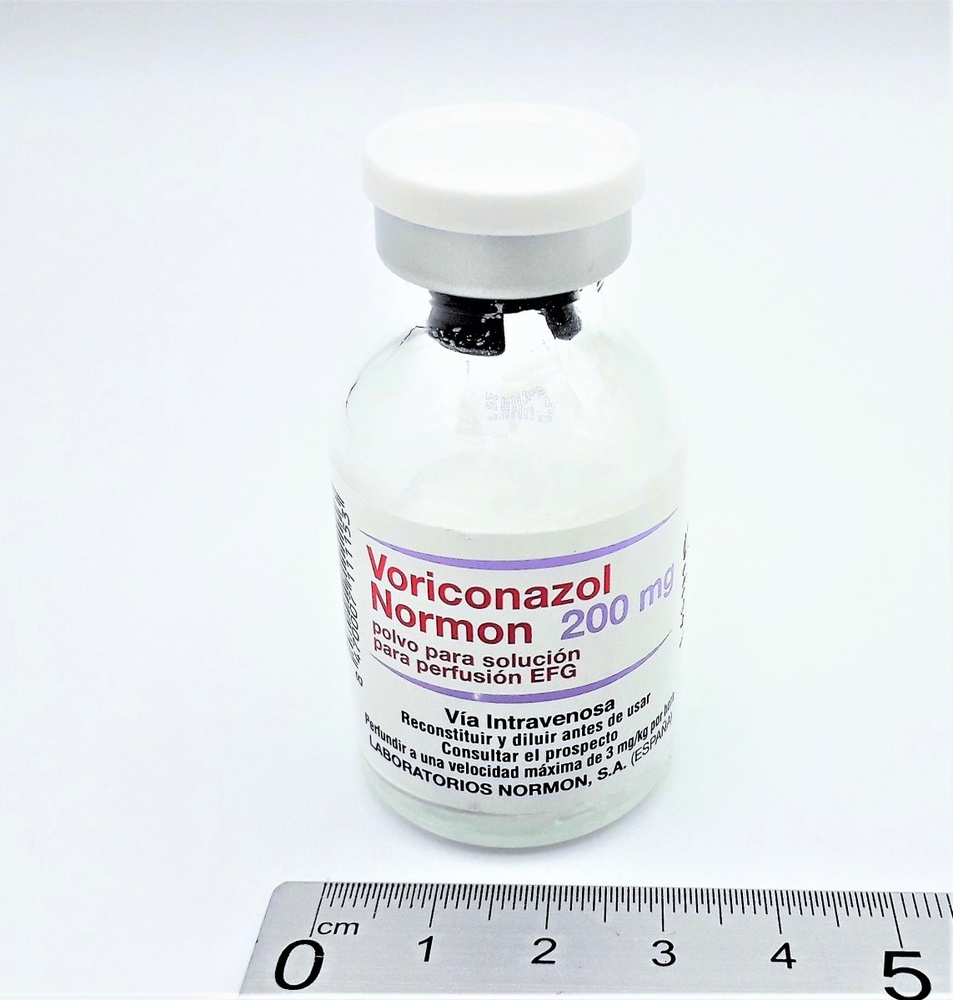
- País de registro
- Forma farmacéuticaINYECTABLE PERFUSION, 200 mg
- Código ATCJ02AC03
- Principio activo
- Requiere recetaSí
- Fabricante
- ComposiciónSULFOBUTILETER BETACICLODEXTRINA (3.200 mg mg)
- Esta información es de carácter general y no sustituye la consulta con un profesional sanitario.
- Alternativas a VORICONAZOL SALA 200 MG POLVO PARA SOLUCION PARA PERFUSION EFGForma farmacéutica: COMPRIMIDO, DesconocidoPrincipio activo: VoriconazolFabricante: Pfizer Europe Ma EeigRequiere recetaForma farmacéutica: COMPRIMIDO, DesconocidoPrincipio activo: VoriconazolFabricante: Pfizer Europe Ma EeigRequiere recetaForma farmacéutica: COMPRIMIDO, DesconocidoPrincipio activo: VoriconazolFabricante: Pfizer Europe Ma EeigRequiere receta
Médicos online para VORICONAZOL SALA 200 MG POLVO PARA SOLUCION PARA PERFUSION EFG
Comenta la dosis, los posibles efectos secundarios, interacciones, contraindicaciones o la revisión de receta de VORICONAZOL SALA 200 MG POLVO PARA SOLUCION PARA PERFUSION EFG, sujeto a valoración médica y a la normativa local.









Obtén una receta de VORICONAZOL SALA 200 MG POLVO PARA SOLUCION PARA PERFUSION EFG online
Rellena un formulario de 2 minutos
Cuéntanos tus síntomas, historial y el medicamento que necesitas.
Elige un médico o nosotros te asignamos uno
Escoge un especialista o te conectamos con el próximo médico disponible.
El médico revisa tu caso
Normalmente en 30 minutos. Puede hacerte preguntas adicionales por chat.
Recógela en cualquier farmacia
Receta electrónica enviada a tu correo, válida en toda España.
Preguntas frecuentes
VORICONAZOL SALA 200 MG POLVO PARA SOLUCION PARA PERFUSION EFG requiere receta en España. Puedes confirmarlo con un médico online según tu caso.
El principio activo de VORICONAZOL SALA 200 MG POLVO PARA SOLUCION PARA PERFUSION EFG es Voriconazol. Esta información ayuda a identificar medicamentos con la misma composición pero con diferentes nombres comerciales.
VORICONAZOL SALA 200 MG POLVO PARA SOLUCION PARA PERFUSION EFG es fabricado por Laboratorio Reig Jofre, S.A.. La marca y el envase pueden variar según el distribuidor.
Los Médicos de familia, Psiquiatras, Dermatólogos, Cardiólogos, Endocrinólogos, Gastroenterólogos, Neumólogos, Nefrólogos, Reumatólogos, Hematólogos, Infectólogos, Alergólogos, Geriatras, Pediatras, Oncólogos pueden valorar la prescripción de VORICONAZOL SALA 200 MG POLVO PARA SOLUCION PARA PERFUSION EFG cuando esté clínicamente indicado. Puedes reservar una videoconsulta para comentar tu caso y las opciones de tratamiento.
España cuenta con una infraestructura sanitaria bien desarrollada en ciudades principales como Madrid, Barcelona, Valencia y Sevilla. Las farmacias están ampliamente disponibles y operan bajo estrictas regulaciones, garantizando el acceso a medicamentos con receta.
Puedes comprar VORICONAZOL SALA 200 MG POLVO PARA SOLUCION PARA PERFUSION EFG en Madrid, Barcelona, Sevilla o Valencia en cualquier farmacia local con una receta válida.
Para obtener una receta, puedes utilizar Oladoctor:
Otros medicamentos con el mismo principio activo (Voriconazol) incluyen VFEND 200 mg COMPRIMIDOS RECUBIERTOS CON PELICULA, VFEND 200 mg COMPRIMIDOS RECUBIERTOS CON PELICULA, VFEND 200 mg COMPRIMIDOS RECUBIERTOS CON PELICULA. Pueden tener diferentes nombres comerciales o formulaciones, pero contienen el mismo componente terapéutico. Consulta siempre con un médico antes de cambiar o iniciar un nuevo medicamento.
