



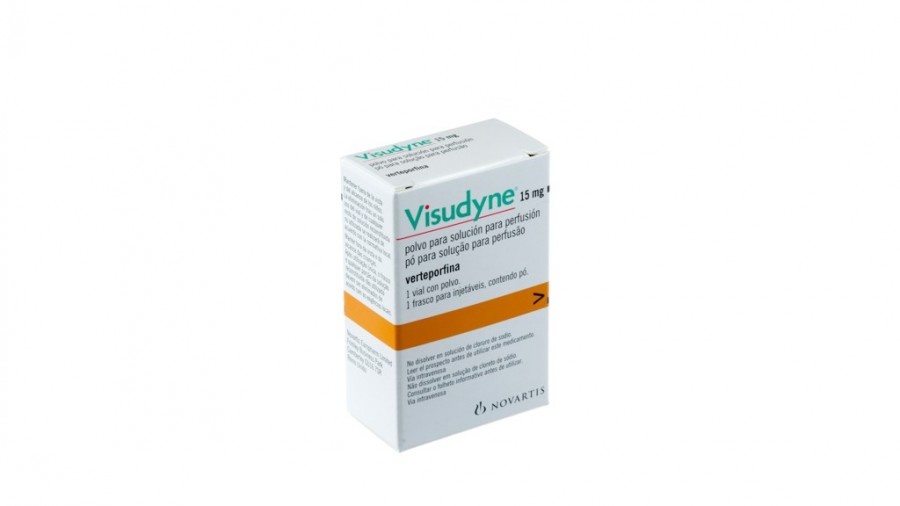
VISUDYNE 15 mg Polvo Para Solucion Para Perfusion

Revisión de receta online
Un médico revisará tu caso y determinará si la prescripción es médicamente apropiada.

Habla con un médico sobre este medicamento
Comenta tus síntomas y las opciones de tratamiento en una consulta online.



Cómo usar VISUDYNE 15 MG POLVO PARA SOLUCION PARA PERFUSION
Contenido del prospecto
- Introducción
- Qué es Visudyne y para qué se utiliza
- Qué necesita saber antes de que le sea administrado Visudyne
- Cómo usar Visudyne
- Posibles efectos adversos
- Conservación de Visudyne
- Contenido del envase e información adicional
Introducción
Prospecto: información para el usuario
Visudyne 15mg polvo para solución para perfusión
verteporfina
Lea todo el prospecto detenidamente antes deque le administren estemedicamento,porque contiene información importante para usted.
- Conserve este prospecto, ya que puede tener que volver a leerlo.
- Si tiene alguna duda, consulte a su médico, farmacéutico o enfermero.
- Este medicamento se le ha recetado solamente a usted, y no debe dárselo a otras personas aunque tengan los mismos síntomas que usted, ya que puede perjudicarles.
- Si experimenta efectos adversos, consulte a su médico, farmacéutico o enfermero, incluso si se trata de efectos adversos que no aparecen en este prospecto. Ver sección 4.
Contenido delprospecto
- Qué es Visudyne y para qué se utiliza
- Qué necesita saber antes de que le sea administrado Visudyne
- Cómo usar Visudyne
- Posibles efectos adversos
- Conservación de Visudyne
- Contenido del envase e información adicional
1. Qué es Visudyne y para qué se utiliza
Qué es Visudyne
Visudyne contiene el principio activo verteporfina, que se activa por la luz de un láser en un tratamiento denominado terapia fotodinámica. Cuando le administran una perfusión de Visudyne, éste se distribuye por su cuerpo a través de los vasos sanguíneos, incluyendo los vasos sanguíneos de la parte posterior del ojo. Cuando la luz del láser recae sobre el ojo, Visudyne es activado.
Para qué se utiliza Visudyne
Visudyne se utiliza para tratar la forma húmeda de degeneración macular asociada a la edad y la miopía patológica.
Estas enfermedades producen una pérdida de visión. La pérdida de visión está causada por nuevos vasos sanguíneos (neovascularización coroidea) que dañan la retina (la membrana sensible a la luz que recubre la parte posterior del ojo). Existen dos tipos de neovascularización coroidea: clásica y oculta.
Visudyne se utiliza para el tratamiento de la neovascularización coroidea predominantemente clásica en adultos con degeneración macular asociada a la edad, y también para el tratamiento de todos los tipos de neovascularización coroidea en adultos con miopía patológica.

¿No estás seguro de si este medicamento es adecuado para ti?
Comenta tus síntomas y tratamiento con un médico online.
2. Qué necesita saber antes de que le sea administrado Visudyne
No deberán administrarle Visudyne
- si es alérgicoa la verteporfina o a alguno de los demás componentes de este medicamento (incluidos en la sección 6).
- si tiene porfiria(una enfermedad rara que puede aumentar la sensibilidad a la luz).
- si padece algún problema de hígadograve.
Si se encuentra en alguna de estas situaciones, informe a su médico. No deben administrarle Visudyne.
Advertencias y precauciones
Consultea su médico, farmacéutico o enfermeroantes de que le sea administrado Visudyne
- Si sufre cualquier problema relacionado con la perfusión o síntoma durante o tras el tratamiento como dolor en el pecho, sudor, mareos, erupción, dificultad para respirar, sofocos, ritmo cardiaco irregular o convulsiones, informe a su médico o enfermero inmediatamente, ya que es posible que se tenga que interrumpir la perfusión y tratarle de manera urgente. Los problemas relacionados con la perfusión también pueden incluir pérdida repentina del conocimiento.
- Si tiene algún problema en el hígado o una obstrucción en el conducto biliar, informe a su médico antes de empezar el tratamiento con Visudyne.
- Si durante la perfusión, Visudyne se extravasa, y sobre todo, si el área afectada está expuesta a la luz, puede causar dolor, hinchazón, formación de ampollas y cambios en el color de la piel del área de filtración. Si esto ocurriera, debe pararse la perfusión, tratar la piel con compresas frías y proteger totalmente de la luz hasta que el color de la piel vuelva a ser normal. Puede ser que necesite tomar un analgésico.
- Presentará sensibilidad a la luz brillante durante 48 horas después de la perfusión. Durante este tiempo, evite la exposición directa a la luz solar, a las luces interiores brillantes como en salones de bronceado, luces halógenas brillantes, luz de lámparas de mucha potencia utilizadas en cirugía o por dentistas, o luz de dispositivos médicos emisores de luz, tales como oxímetros de pulso (utilizados para medir el oxígeno en la sangre). En el caso de que tenga que salir al exterior durante el día en las primeras 48 horas después del tratamiento, debe proteger la piel y sus ojos utilizando ropa protectora y gafas de sol oscuras. Los filtros solares no proporcionan protección. La luz interior tenue es segura.
- No permanezca en la oscuridad ya que la exposición a la luz interior normal ayudará a que su cuerpo elimine Visudyne en menos tiempo.
- Si notase algún problema ocular después del tratamiento, como pérdida de visión, informe a su médico.
Otros medicamentos y Visudyne
Informe a su médico, enfermero o farmacéutico si está tomando, ha tomado recientemente o pudiera tener que tomar cualquier otro medicamento.
Informe a su médico o farmacéutico si está tomando alguno de los siguientes medicamentos, ya que pueden hacer aumentar su sensibilidad a la luz:
- tetraciclinas o sulfonamidas (utilizados para tratar infecciones bacterianas),
- fenotiacinas (utilizados para tratar alteraciones psiquiátricas, o náuseas y vómitos),
- sulfonilurea (utilizado para tratar la diabetes),
- medicamentos utilizados para disminuir el azúcar en la sangre,
- diuréticos tiazídicos (utilizados para reducir la presión arterial alta),
- griseofulvina (utilizado para tratar infecciones fúngicas),
- bloqueantes de los canales de calcio (utilizados para tratar la presión arterial alta, la angina y los ritmos cardiacos anormales),
- antioxidantes como el beta-caroteno o medicamentos que pueden eliminar o inactivar los radicales libres (tales como dimetilsulfóxido (DMSO), formiato, manitol y alcohol),
- vasodilatadores (utilizados para ensanchar los vasos sanguíneos mediante la relajación de la musculatura lisa),
- o, si se está sometiendo a radioterapia,
Embarazo y lactancia
- Hay muy poca experiencia en el uso de Visudyne en mujeres embarazadas. Es importante que informe a su médico si está embarazada, cree que podría estar embarazada o tiene intención de quedarse embarazada. Sólo le administrarán Visudyne si su médico lo considera absolutamente imprescindible.
- La verteporfina pasa a la leche materna en pequeñas cantidades. Informe a su médico si está en periodo de lactancia. El/ella decidirán si le deben administrar Visudyne. Se recomienda que, si le administran Visudyne, no dé el pecho durante las 48 horas posteriores a la administración.
Consulte a su médico o farmacéutico antes de utilizar cualquier medicamento.
Conducción y uso de máquinas
Después del tratamiento con Visudyne, puede tener algunos problemas de visión, como visión anormal o disminuida, que pueden ser pasajeras. Si esto ocurre, no conduzca ni maneje herramientas o máquinas hasta que mejore su visión.
Visudyne contiene pequeñas cantidades de hidroxitolueno butilado (E321)
Este componente es irritante para los ojos, la piel y las membranas mucosas.
Por ello en caso decontacto directo con Visudyne, debe lavar minuciosamente la zona con agua.
3. Cómo usar Visudyne
El tratamiento con Visudyne es un proceso en dos etapas
- Primero su médico o farmacéutico preparará la solución para perfusión de Visudyne. Ésta será administrada por su médico o enfermero en una vena utilizando una bomba de perfusión (perfusión intravenosa).
- La segunda etapa es la activación de Visudyne en el ojo 15 minutos después del inicio de la perfusión. Su médico le colocará una lente de contacto especial en su ojo y lo tratará utilizando un láser especial. Se requerirán 83 segundos para que el láser libere la dosis necesaria para activar Visudyne. Durante este tiempo, debe seguir las instrucciones de su médico y mantener sus ojos inmóviles.
Si es necesario, la terapia con Visudyne puede repetirse cada 3 meses, hasta 4 veces por año.
Uso en niños
Visudyne es un tratamiento sólo para adultos y no está indicado su uso en niños.
Si ha recibido más Visudyne del que debe
En caso de sobredosificación con Visudyne, puede prolongarse el periodo durante el cual presenta sensibilidad a la luz y es posible que necesite seguir las instrucciones sobre protección indicadas en el apartado 2 durante más de 48 horas. Su médico le aconsejará al respecto.
La sobredosis de Visudyne y luz en el ojo tratado puede provocar una disminución severa de la visión.
Si tiene cualquier otra duda sobre el uso de este medicamento, pregunte a su médico o farmacéutico.

¿Has empezado a tomar el medicamento y tienes preguntas?
Comenta tus síntomas y tratamiento con un médico online.
4. Posibles efectos adversos
Al igual que todos los medicamentos, este medicamento puede producir efectos adversos, aunque no todas las personas los sufran.
Algunos efectos adversos pueden ser graves:
Frecuentes(pueden afectar hasta 1 de cada 10 pacientes)
- Trastornos oculares: disminución severa de la visión (pérdida de 4 líneas o más en los 7 días posteriores al tratamiento), alteraciones visuales tales como visión borrosa o confusa, destellos de luz, disminución de la visión y cambios en el campo de visión en el ojo tratado tales como sombras oscuras o grises, puntos ciegos o manchas negras.
- Trastornos generales: Hipersensibilidad (reacciones alérgicas), síncope (desvanecimiento), dolor de cabeza, mareo, dificultad en la respiración.
Poco frecuentes(pueden afectar hasta 1 de cada 100 pacientes)
- Trastornos oculares: hemorragia en la retina o en el humor vítreo (sustancia tipo gel transparente que rellena el globo ocular por detrás del cristalino), hinchazón o retención de líquido en la retina y desplazamiento de la retina en el ojo tratado.
- Efectos adversos en el lugar de inyección: al igual que con otro tipo de inyecciones, algunos pacientes experimentaron sangrado en el lugar de inyección, cambio en el color de la piel e hipersensibilidad. Si esto le ocurre, tendrá una mayor sensibilidad a la luz en aquella parte de la piel hasta que la coloración verde desaparezca.
- Trastornos generales: erupción, urticaria, picor
Raros(pueden afectar hasta 1 de cada 1.000 pacientes)
- Trastornos oculares: falta de irrigación sanguínea de la retina o coroides (la capa vascular del ojo) en el ojo tratado.
- Trastornos generales: sensación de malestar.
Frecuencia no conocida(la frecuencia no puede estimarse a partir de los datos disponibles)
- Trastornos oculares: desgarro en la capa coloreada de la retina, hinchazón o retención de líquido en la mácula.
- Trastornos generales: se han notificado reacciones vasovagales (desvanecimiento), sudoración, rubor o cambios en la presión sanguínea. En raras ocasiones las reacciones de hipersensibilidad y vasovagales pueden ser graves y de forma potencial incluir convulsiones.
- Se ha notificado ataque cardiaco, especialmente en pacientes con antecedentes previos de enfermedades del corazón, en algunos casos en las 48 horas siguientes al tratamiento con Visudyne. En el caso de sospecha de ataque cardiaco, busque atención médica inmediatamente.
- Muerte localizada del tejido de la piel (necrosis).
Si experimenta alguno de estos efectos adversos, informe a su médico inmediatamente.
Otros efectos adversos:
Frecuentes(pueden afectar hasta 1 de cada 10 pacientes)
- Efectos adversos en el lugar de inyección: al igual que con otro tipo de inyecciones, algunos pacientes experimentaron dolor, hinchazón, inflamación y exudación en el lugar de inyección.
- Trastornos generales: sensación de mareo (náuseas), reacciones tipo quemadura solar, cansancio, reacción asociada a la perfusión, que se presenta fundamentalmente como dolor en el pecho o dolor de espalda y aumento de los niveles de colesterol.
Poco frecuentes(pueden afectar hasta 1 de cada 100 pacientes)
- Trastornos generales: dolor, aumento de la presión sanguínea, aumento de la sensibilidad y fiebre.
Frecuencia no conocida(la frecuencia no puede estimarse a partir de los datos disponibles)
- Efectos adversos en el lugar de inyección: al igual que con otro tipo de inyecciones, algunos pacientes experimentaron formación de ampollas.
- Trastornos generales: cambios en la frecuencia cardiaca. Reacción asociada a la perfusión que puede irradiarse a otras áreas, incluyendo pero no limitado a la pelvis, hombros o caja torácica.
Comunicación de efectos adversos
Si experimenta cualquier tipo de efecto adverso, consulte a su médico, enfermero o farmacéutico, incluso si se trata de posibles efectos adversos que no aparecen en este prospecto. También puede comunicarlos directamente a través del sistema nacional de notificación incluido en el Apéndice V. Mediante la comunicación de efectos adversos usted puede contribuir a proporcionar más información sobre la seguridad de este medicamento.
5. Conservación de Visudyne
Mantener este medicamento fuera de la vista y del alcance de los niños.
No utilice este medicamento después de la fecha de caducidad que aparece en la caja después de “CAD” y en el vial después de “EXP”. La fecha de caducidad es el último día del mes que se indica.
No conservar a temperatura superior a 25?C. Conservar el vial en el embalaje exterior para protegerlo de la luz.
Se ha demostrado que la estabilidad química y física durante el uso es de 4 horas a 25?C. Desde un punto de vista microbiológico, el medicamento debe utilizarse inmediatamente. De no hacerlo así, las condiciones y tiempo de conservación durante el uso previo a su utilización, serán responsabilidad del usuario y no durará más de 4 horas a menos de 25?C protegido de la luz.
6. Contenido del envase e información adicional
Composición de Visudyne
- El principio activo es verteporfina. Cada vial contiene 15 mg de verteporfina. Tras la reconstitución, 1 ml contiene 2 mg de verteporfina. 7,5 ml de solución reconstituida contiene 15 mg de verteporfina.
- Los demás componentes son dimiristoil-fosfatidilcolina, fosfatidilglicerol de huevo, palmitato de ascorbilo, hidroxitolueno butilado (E321) y lactosa monohidrato.
Aspecto del producto y contenido del envase
Visudyne se suministra en forma de polvo verde oscuro a negro en un vial de vidrio transparente. Previo a la utilización, el polvo se reconstituye en agua para formar una solución opaca de color verde oscuro.
Visudyne está disponible en envases que contienen 1 vial de polvo.
Titular de la autorización de comercialización
CHEPLAPHARM Arzneimittel GmbH
Ziegelhof 24
17489 Greifswald
Alemania
Responsable de la fabricación
Delpharm Huningue S.A.S.
26 rue de la Chapelle
68330 Huningue
Francia
CHEPLAPHARM Arzneimittel GmbH
Ziegelhof 23-24
17489 Greifswald
Alemania
Fecha de la última revisión de este prospecto:
Otras fuentes de información
La información detallada de este medicamento está disponible en la página web de la Agencia Europea de Medicamentos: http://www.ema.europa.eu
Esta información está destinada únicamente a profesionales del sector sanitario:
Reconstituir Visudyne en 7,0 ml de agua para preparaciones inyectables para obtener 7,5 ml de una solución con una concentración de 2,0 mg/ml. Visudyne reconstituido es una solución opaca de color verde oscuro. Se recomienda que Visudyne reconstituido se compruebe visualmente antes de la administración en cuanto a la presencia de partículas y la decoloración. Para conseguir una dosis de 6 mg/m2 de superficie corporal (la dosis recomendada para el tratamiento) diluir la cantidad requerida de la solución de Visudyne en en una solución de dextrosa 50 mg/ml (5%) para perfusión hasta un volumen final de 30 ml. No utilizar solución de cloruro de sodio. Se recomienda usar un filtro estándar en la vía de perfusión con membranas hidrofílicas (tales como polietersulfon) de un tamaño de poro no inferior a 1,2 micrómetros.
Para las condiciones de conservación, por favor, ver el apartado 5 de este prospecto.
El vial y cualquier resto de solución reconstituida no utilizada deben desecharse después de su uso (un solo uso).
Si se vierte solución, debe recogerse con un paño húmedo. Se debe evitar el contacto con los ojos y la piel. Se aconseja utilizar guantes de goma y protección ocular. La eliminación del medicamento no utilizado y de todos los materiales que hayan estado en contacto con él, se realizará de acuerdo con la normativa local.
- País de registro
- Forma farmacéuticaINYECTABLE PERFUSION, Desconocida
- Código ATCS01LA01
- Disponibilidad en farmaciasProblema de suministro reportado
- Principio activo
- Requiere recetaSí
- Fabricante
- ComposiciónFOSFATIDILGLICEROL DE HUEVO (0 - mg), BUTILHIDROXITOLUENO (E321) (0 - mg), LACTOSA (0 - mg)
- Esta información es de carácter general y no sustituye la consulta con un profesional sanitario.
- Alternativas a VISUDYNE 15 MG POLVO PARA SOLUCION PARA PERFUSIONForma farmacéutica: INYECTABLE, 40 mg/mlPrincipio activo: AfliberceptFabricante: Sandoz GmbhRequiere recetaForma farmacéutica: INYECTABLE, 40 mg/mlPrincipio activo: AfliberceptFabricante: Sandoz GmbhRequiere recetaForma farmacéutica: INYECTABLE, 120 mg/mlPrincipio activo: BrolucizumabFabricante: Novartis Europharm LimitedRequiere receta
Médicos online para VISUDYNE 15 MG POLVO PARA SOLUCION PARA PERFUSION
Comenta la dosis, los posibles efectos secundarios, interacciones, contraindicaciones o la revisión de receta de VISUDYNE 15 MG POLVO PARA SOLUCION PARA PERFUSION, sujeto a valoración médica y a la normativa local.









Obtén una receta de VISUDYNE 15 MG POLVO PARA SOLUCION PARA PERFUSION online
Rellena un formulario de 2 minutos
Cuéntanos tus síntomas, historial y el medicamento que necesitas.
Elige un médico o nosotros te asignamos uno
Escoge un especialista o te conectamos con el próximo médico disponible.
El médico revisa tu caso
Normalmente en 30 minutos. Puede hacerte preguntas adicionales por chat.
Recógela en cualquier farmacia
Receta electrónica enviada a tu correo, válida en toda España.
Preguntas frecuentes
VISUDYNE 15 MG POLVO PARA SOLUCION PARA PERFUSION requiere receta en España. Puedes confirmarlo con un médico online según tu caso.
El principio activo de VISUDYNE 15 MG POLVO PARA SOLUCION PARA PERFUSION es Verteporfina. Esta información ayuda a identificar medicamentos con la misma composición pero con diferentes nombres comerciales.
VISUDYNE 15 MG POLVO PARA SOLUCION PARA PERFUSION es fabricado por Cheplapharm Arzneimittel Gmbh. La marca y el envase pueden variar según el distribuidor.
Los Médicos de familia, Psiquiatras, Dermatólogos, Cardiólogos, Endocrinólogos, Gastroenterólogos, Neumólogos, Nefrólogos, Reumatólogos, Hematólogos, Infectólogos, Alergólogos, Geriatras, Pediatras, Oncólogos pueden valorar la prescripción de VISUDYNE 15 MG POLVO PARA SOLUCION PARA PERFUSION cuando esté clínicamente indicado. Puedes reservar una videoconsulta para comentar tu caso y las opciones de tratamiento.
España cuenta con una infraestructura sanitaria bien desarrollada en ciudades principales como Madrid, Barcelona, Valencia y Sevilla. Las farmacias están ampliamente disponibles y operan bajo estrictas regulaciones, garantizando el acceso a medicamentos con receta.
Puedes comprar VISUDYNE 15 MG POLVO PARA SOLUCION PARA PERFUSION en Madrid, Barcelona, Sevilla o Valencia en cualquier farmacia local con una receta válida.
Para obtener una receta, puedes utilizar Oladoctor:
Otros medicamentos con el mismo principio activo (Verteporfina) incluyen AFQLIR 40 MG/ML SOLUCION INYECTABLE EN JERINGA PRECARGADA, AFQLIR 40 MG/ML SOLUCION INYECTABLE EN VIAL, BEOVU 120 MG/ML SOLUCION INYECTABLE EN JERINGA PRECARGADA. Pueden tener diferentes nombres comerciales o formulaciones, pero contienen el mismo componente terapéutico. Consulta siempre con un médico antes de cambiar o iniciar un nuevo medicamento.
