



VIAFLO 0,9% Cloruro Sódico y 0,15% Cloruro Potásico Solución para Perfusión

Revisión de receta online
Un médico revisará tu caso y determinará si la prescripción es médicamente apropiada.

Habla con un médico sobre este medicamento
Comenta tus síntomas y las opciones de tratamiento en una consulta online.



Cómo usar VIAFLO CLORURO SODICO 0,9% Y CLORURO POTASICO 0,15%, SOLUCION PARA PERFUSION
Contenido del prospecto
- Introducción
- Qué es Viaflo Cloruro sódico 0,9% y cloruro potásico 0,15% y para qué se utiliza
- Qué necesita saber antes de que le administren Viaflo Cloruro sódico 0,9% y cloruro potásico 0,15%
- Cómo usar Viaflo Cloruro sódico 0,9% y cloruro potásico 0,15%
- Posibles efectos adversos
- Conservación de Viaflo Cloruro sódico 0,9% y cloruro potásico 0,15%
- Contenido del envase e información adicional
Introducción
PROSPECTO: INFORMACIÓN PARA EL USUARIO
Viaflo Cloruro sódico 0,9% y cloruro potásico 0,15%, solución para perfusión
Principios activos: cloruro de sodio y cloruro de potasio
Lea todo el prospecto detenidamente antes de empezar a usar este medicamento porque contiene información importante para usted.
- Conserve este prospecto, ya que puede tener que volver a leerlo.
- Si tiene alguna duda, consulte a su médico o enfermero.
- Si experimenta efectos adversos, informe a su médico o enfermero, incluso si se trata de efectos adversos que no aparecen en este prospecto. Ver sección 4.
Este medicamento se denomina “Viaflo Cloruro sódico 0,9% y cloruro potásico 0,15%, solución para perfusión”, pero se hará referencia al mismo como Viaflo Cloruro sódico 0,9% y cloruro potásico 0,15% en el resto de este prospecto.
Contenido del prospecto:
- Qué es Viaflo Cloruro sódico 0,9% y cloruro potásico 0,15% y para qué se utiliza
- Qué necesita saber antes de que le administren Viaflo Cloruro sódico 0,9% y cloruro potásico 0,15%
- Cómo le administrarán Viaflo Cloruro sódico 0,9% y cloruro potásico 0,15%
- Posibles efectos adversos
- Conservación de Viaflo Cloruro sódico 0,9% y cloruro potásico 0,15%
- Contenido del envase e información adicional
1. Qué es Viaflo Cloruro sódico 0,9% y cloruro potásico 0,15% y para qué se utiliza
Viaflo Cloruro sódico 0,9% y cloruro potásico 0,15% es una solución de cloruro de sodio y cloruro de potasio en agua. El cloruro de sodio y el cloruro de potasio son sustancias químicas (comúnmente llamadas sales) que se encuentran en la sangre.
Viaflo Cloruro sódico 0,9% y cloruro potásico 0,15% se usa para tratar y prevenir:
- una pérdida de potasio del cuerpo (pérdida de potasio, por ejemplo, después del tratamiento con ciertos diuréticos [comprimidos para orinar])
- un nivel bajo de potasio en la sangre (hipopotasemia)
En situaciones que pueden causar la pérdida de agua y de cloruro de sodio incluyendo:
- cuando no puede comer o beber, debido a una enfermedad o a tras una intervención quirúrgica
- sudor excesivo causado por fiebre alta
- pérdida extensa de piel, como ocurre en quemaduras graves

¿No estás seguro de si este medicamento es adecuado para ti?
Comenta tus síntomas y tratamiento con un médico online.
2. Qué necesita saber antes de que le administren Viaflo Cloruro sódico 0,9% y cloruro potásico 0,15%
NO se le deberá administrar Viaflo Cloruro sódico 0,9% y cloruro potásico 0,15% si sufre alguna de las siguientes situaciones clínicas:
- si es alérgico al cloruro de sodio y cloruro de potasio o a alguno de los demás componentes de este medicamento (incluidos en la sección 6).
- si su sangre contiene niveles altos de potasio superiores a los normales (hiperpotasemia)
- si su sangre contiene niveles altos de cloruros superiores a los normales (hipercloremia)
- si su sangre contiene niveles altos de sodio superiores a los normales (hipernatremia)
- insuficiencia renal grave (cuando sus riñones no funcionan bien y requiere diálisis)
- si presenta insuficiencia cardíaca no compensada. Se trata de una insuficiencia cardíaca que no recibe el tratamiento adecuado y que ocasiona síntomas como:
- dificultad respiratoria
- hinchazón de los tobillos.
- enfermedad de Addison (función de la glándula suprarrenal deteriorada. Esta glándula produce hormonas que ayudan a controlar las concentraciones de las sustancias químicas en el cuerpo).
Advertencias y precauciones
Viaflo Cloruro sódico 0,9% y cloruro potásico 0,15% es una solución hipertónica (concentrada). Su médico tendrá esto en cuenta al calcular la cantidad de solución que le administrará.
Informe a su médico si tiene o ha tenido alguna de las siguientes situaciones clínicas:
- cualquier tipo de enfermedad del corazón o insuficiencia cardiaca
- insuficiencia renal
- insuficiencia adrenocortical ( enfermedad de las glándulas adrenales que afecta a las hormonas que controlan la concentración de sustancias químicas en el organismo)
- deshidratación aguda (una pérdida de agua del organismo, por ejemplo vómitos o diarrea)
- daño tisular extenso (como ocurre en quemaduras severas)
- si está recibiendo glucósidos cardíacos (cardiotónicos) usados para el tratamiento de insuficiencia cardiaca, como digitálicos o digoxina. Se realizarán controles regulares del nivel de potasio en su sangre.
- tensión arterial elevada (hipertensión)
- acúmulo de líquidos bajo la piel, particularmente bajo los tobillos (edema periférico)
- acúmulo de líquidos en el pulmón (edema pulmonar)
- presión de la sangre alta durante el embarazo (pre-eclampsia)
- cualquier otra condición asociada a la retención de sodio (cuando el organismo retiene demasiado sodio), tales como el tratamiento con esteroides (ver también Otros medicamentos y Viaflo Cloruro sódico 0,9% y cloruro potásico 0,15%)
- si tiene una afección que podría causar niveles elevados de vasopresina, una hormona que regula el líquido de su cuerpo. Puede tener demasiada vasopresina en su cuerpo porque, por ejemplo:
- ha tenido una enfermedad repentina y grave,
- tiene dolor,
- le han operado,
- tiene infecciones, quemaduras o lesión cerebral
- tiene enfermedades relacionadas con su corazón, hígado, riñones o sistema nervioso central,
- está tomando ciertos medicamentos (ver más adelante Otros medicamentos y Viaflo Cloruro sódico 0,9% y cloruro potásico 0,15%).
Esto puede aumentar el riesgo de que haya niveles bajos de sodio en la sangre y puede causar dolor de cabeza, náuseas, convulsiones, letargo, coma, inflamación del cerebro y la muerte. La inflamación del cerebro aumenta el riesgo de muerte y de daño cerebral. Las personas con mayor riesgo de inflamación cerebral son:
- niños
- mujeres (particularmente si está en edad fértil)
- las personas que tienen problemas con sus niveles de líquido cerebral, por ejemplo, debido a meningitis, sangrado en el cráneo o una lesión cerebral.
Cuando le estén administrando esta solución, su médico podrá tomar muestras de sangre y orina para controlar:
- la cantidad de líquido de su organismo
- sus signos vitales
- la cantidad de sustancias químicas como sodio y potasio en su cuerpo (sus electrolitos plasmáticos)
- la acidez de la sangre y de orina (su equilibrio ácido-base)
- el gráfico de su corazón (ECG)
Su médico tendrá en cuenta si está recibiendo nutrición parenteral (nutrición dada por infusión por vena). Durante el tratamiento prolongado con Viaflo Cloruro sódico 0,9% y cloruro potásico 0,15% usted puede necesitar que le den nutrición extra.
Otros medicamentos y Viaflo Cloruro sódico 0,9% y cloruro potásico 0,15%
Informe a su médico o farmacéutico si está utilizando o ha utilizado recientemente otros medicamentos, incluso los adquiridos sin receta.
Es particularmente importante que informe a su médico si está tomando:
- glucósidos cardíacos (cardiotónicos) como digitálicos o digoxina, usados para tratar la insuficiencia
- medicamentos que incrementan la concentración de potasio en sangre como:
- diuréticos ahorradores de potasio (algunos comprimidos que ayudan a eliminar agua, ej amilorida, espirolactona, triamtereno)
- inhibidores de la enzima convertidora de angiotensina (IECA) usados para el tratamiento de la tensión arterial elevada
- receptores antagonistas de la angiotensina II (usados para el tratamiento de la tensión arterial elevada)
- ciclosporinas (usadas para prevenir rechazo de transplantes)
- tacrolimus (usado para prevenir rechazo de transplantes y tratamiento de alteraciones de la piel)
- medicamentos que contengan potasio (por ejemplo suplementos con potasio o sustitutos de la sal con potasio)
- corticosteroides (medicamentos antiinflamatorios)
- Algunos medicamentos actúan sobre la hormona vasopresina. Estos pueden incluir:
- medicación antidiabética (clorpropamida)
- medicación para el colesterol (clofibrato)
- algunos medicamentos contra el cáncer (vincristina, ifosfamida, ciclofosfamida)
- inhibidores selectivos de la recaptación de serotonina (utilizados para tratar la depresión)
- antipsicóticos
- opiáceos para el alivio del dolor grave
- medicamentos para el dolor y/o la inflamación (también conocidos como AINE)
- medicamentos que imitan o fortalecen los efectos de la vasopresina, como desmopresina (utilizada para tratar el aumento de la sed y la micción), terlipresina (utilizada para tratar el sangrado del esófago) y oxitocina (utilizada para inducir el parto)
- medicamentos antiepilépticos (carbamazepina y oxcarbazepina)
- diuréticos (comprimidos que ayudan a orinar)
- Se recomienda precaución en pacientes tratados con litio. La eliminación de las sustancias químicas como sodio y de litio, por sus riñones, se puede incrementar durante la administración de Viaflo Cloruro sódico 0,9% y cloruro potásico 0,15%.
Uso de Viaflo Cloruro sódico 0,9% y cloruro potásico 0,15% con los alimentos y bebidas
Pregunte a su médico acerca de que puede comer o beber.
Fertilidad, embarazo y lactancia
Consulte a su médico o farmacéutico antes de utilizar cualquier medicamento. Informe a su médico si esta embarazada o en periodo de lactancia.
Viaflo Cloruro sódico 0,9% y cloruro potásico 0,15% se puede utilizar durante el embarazo. La cantidad que le administren será cuidadosamente controlada por su médico.
Si se añadiese otro medicamento a la solución para perfusión durante el embarazo o la lactancia, usted deberá:
- Consultar a su médico
- Leer el prospecto del medicamento que se le vaya a añadir
Conducción y uso de máquinas
Viaflo Cloruro sódico 0,9% y cloruro potásico 0,15% no afecta a su habilidad para conducir o usar máquinas.
3. Cómo usar Viaflo Cloruro sódico 0,9% y cloruro potásico 0,15%
Viaflo Cloruro sódico 0,9% y cloruro potásico 0,15% le será administrado por un médico o un enfermero. Su médico decidirá que cantidad necesita y cuando le será administrada, lo que dependerá de su edad, peso, condición clínica y biológica y de su estado de hidratación (la cantidad de agua en su organismo). La cantidad que reciba también puede verse influida por otros tratamientos que reciba
NO debe recibir Viaflo Cloruro sódico 0,9% y cloruro potásico 0,15% si hay partículas flotando en la solución o si el envase está dañado de algún modo.
La velocidad de perfusión será decidida por su médico
Si usted requiere un gran volumen o la perfusión rápida de Viaflo Cloruro sódico 0,9% y cloruro potásico 0,15%, su médico puede controlar su ECG (gráfico del corazón).
Generalmente Viaflo Cloruro sódico 0,9% y cloruro potásico 0,15% se le administrará a través de un tubo de plástico conectado mediante una aguja a una vena, casi siempre de su brazo. No obstante, su médico podría utilizar otro método para administrarle el medicamento
Antes y durante la perfusión su médico controlará:
- el potasio
- la cantidad de líquido en su cuerpo
- la acidez de la sangre y la orina
- la cantidad de electrolitos en su cuerpo (particularmente sodio, en pacientes con alto nivel de vasopresina, o que están tomando otros medicamentos que aumentan el efecto de la vasopresina).
Si tiene insuficiencia renal, recibirá una dosis menor.
Cualquier resto no utilizado de la solución deberá ser desechado. Usted NO debe recibir Viaflo
Cloruro sódico 0,9% y cloruro potásico 0,15% de una bolsa que haya sido utilizada parcialmente.
Si recibe más Viaflo Cloruro sódico 0,9% y cloruro potásico 0,15% del que debe
Si le administran demasiado Viaflo Cloruro sódico 0,9% y cloruro potásico 0,15% (sobredosificación), pueden producirse los siguientes síntomas:
- incremento de los niveles de potasio en la sangre (hiperpotasemia)
- hormigueo en los brazos y las piernas (parestesia)
- incapacidad para respirar (parálisis respiratoria)
- náuseas, vómitos, dolor abdominal
- disminución de la tensión arterial
- debilidad muscular
- latidos cardíacos irregulares (arritmias cardíacas)
- bloqueo cardíaco (latidos cardíacos muy lentos)
- parada cardíaca (el corazón deja de latir y la vida corre peligro)
- acúmulo de líquidos en los pulmones haciendo difícil la respiración (edema pulmonar)
- acúmulo de líquidos bajo la piel, particularmente bajo los tobillos (edema periférico)
Si observa alguno de estos síntomas, deberá informar a su médico inmediatamente. Su perfusión se detendrá y se le tratará dependiendo de los síntomas.
Si se ha añadido algún medicamento a Viaflo Cloruro sódico 0,9% y cloruro potásico 0,15% antes de la administración excesiva, dicho medicamento también puede causar síntomas. Debe leer la lista de posibles síntomas en el prospecto del medicamento añadido.
Si interrumpe la perfusión de Viaflo Cloruro sódico 0,9% y cloruro potásico 0,15%
Su médico decidirá si debe dejar de recibir esta perfusión
Si tiene cualquier otra duda sobre el uso de este producto, pregunte a su médico.

¿Has empezado a tomar el medicamento y tienes preguntas?
Comenta tus síntomas y tratamiento con un médico online.
4. Posibles efectos adversos
Al igual que todos los medicamentos, Viaflo Cloruro sódico 0,9% y cloruro potásico 0,15% puede producir efectos adversos, aunque no todas las personas los sufran.
Los efectos adversos que pueden ocurrir debido a la técnica de administración incluyen:
- fiebre (respuesta febril)
- infección en el punto de inyección
- dolor local o reacción (enrojecimiento o hinchazón en el sitio de administración)
- irritación e inflamación de la vena en la cual la solución es perfundida (flebitis). Esto puede ocasionar enrojecimiento, dolor o quemazón e hinchazón a lo largo de la vena en la cual se ha perfundido la solución.
- formación de un coágulo (trombosis venosa), en el lugar de la perfusión, que causan dolor, hinchazón o enrojecimiento en el área del coágulo
- fuga de la solución para perfusión a los tejidos que rodean la vena (extravasación), lo que puede dañar los tejidos y provocar la aparición de cicatrices
- un exceso de líquido en los vasos sanguíneos (hipervolemia)
- cualquier reacción alérgica
- incremento de los niveles de potasio en la sangre (hiperpotasemia)
- bajos niveles de sodio en la sangre que pueden adquirirse durante la hospitalización (hiponatremia nosocomial) y trastorno neurológico relacionado (encefalopatía hiponatrémica aguda). La hiponatremia puede provocar una lesión cerebral y la muerte debido a una hinchazón (edema / inflamación cerebral) (ver también la sección "Advertencias y precauciones").
- altos niveles de cloruros en sangre o bajos niveles de bicarbonato en sangre (acidosis hiperclorémica)
- parada cardíaca.
Si se ha añadido un medicamento a la solución para perfusión, éste también puede producir efectos adversos. Estos efectos adversos dependerán del medicamento añadido. Debe leer la lista de posibles síntomas en el prospecto del medicamento añadido.
Informe a su médico o enfermero si nota cualquiera de los efectos adversos listados o cualquier otro. Si tuviese lugar cualquiera de ellos, la perfusión debería detenerse.
Comunicación de efectos adversos:
Si experimenta cualquier tipo de efecto adverso, consulte a su médico o enfermero, incluso si se trata de posibles efectos adversos que no aparecen en este prospecto. También puede comunicarlos directamente a través del Sistema Español de Farmacovigilancia de medicamentos de Uso Humano: https://www.notificaram.es. Mediante la comunicación de efectos adversos usted puede contribuir a proporcionar más información sobre la seguridad de este medicamento.
5. Conservación de Viaflo Cloruro sódico 0,9% y cloruro potásico 0,15%
Mantener fuera de la vista y del alcance de los niños.
Viaflo Cloruro sódico 0,9% y cloruro potásico 0,15% no requiere condiciones especiales de conservación.
NO utilice este medicamento después de la fecha de caducidad que aparece en la bolsa después de CAD. La fecha de caducidad es el último día del mes que se indica.
No debe recibir Viaflo Cloruro sódico 0,9% y cloruro potásico 0,15% si hay partículas flotando en la solución o si el envase está dañado de algún modo.
6. Contenido del envase e información adicional
Composición de Viaflo Cloruro sódico 0,9% y cloruro potásico 0,15%
Los principios activos son:
- cloruro de potasio: 1,5 g por litro
- cloruro de sodio: 9 g por litro.
El único excipiente es agua para preparaciones inyectables
Aspecto del producto y contenido del envase
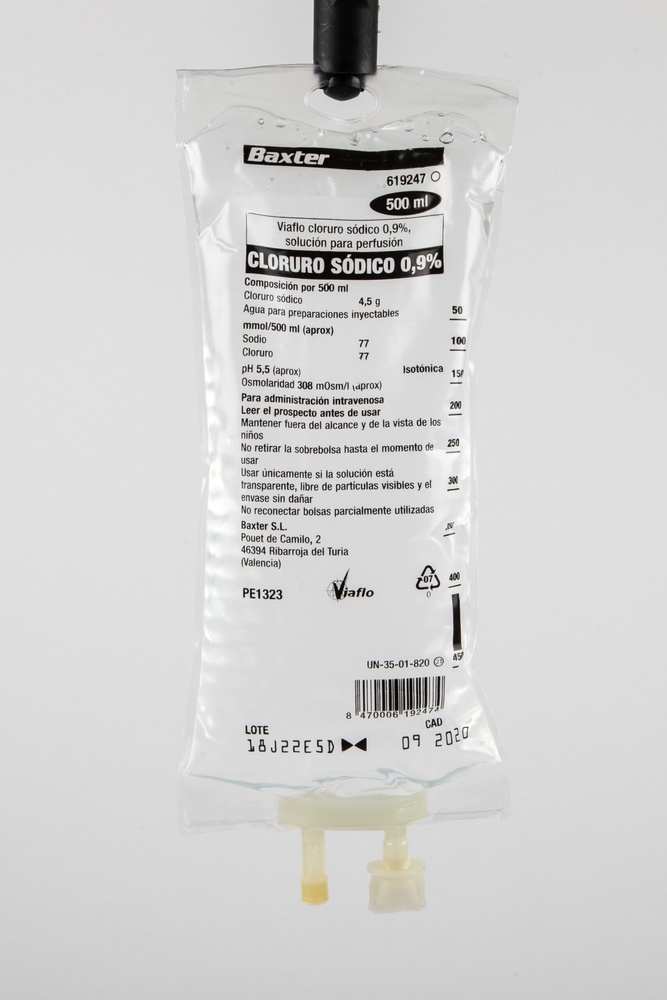
Viaflo Cloruro sódico 0,9% y cloruro potásico 0,15% es una solución transparente, libre de partículas visibles. Se presenta en bolsas de plástico de poliolefina/poliamida (Viaflo). Cada bolsa está envasada en una sobrebolsa protectora de plástico sellada.
Los tamaños de las bolsas son:
- 500 ml
- 1000 ml
Las bolsas son entregadas en cajas, cada una de las cuales contiene las siguientes cantidades:
- 20 bolsas de 500 ml
- 10 ó 12 bolsas de 1000 ml
Puede ser que no todos los envases se comercialicen.
Titular de la autorización de comercialización y responsable de la fabricación
Titular
Baxter S.L.
Pouet de Camilo 2, 46394 Ribarroja del Turia (Valencia)
Responsable de la fabricación:
Baxter SA
Boulevard René Branquart, 80
7860 Lessines, Bélgica
o
Bieffe Medital S.A.
Ctra. Biescas-Senegüé,
22666 Sabiñánigo (Huesca), España
Fecha de la última revisión de este prospecto: febrero 2019
La información detallada y actualizada de este medicamento está disponible en la página web de la Agencia Española de Medicamentos y Productos Sanitarios (AEMPS) http://www.aemps.gob.es/
……………………………………………………………………………………………………
Esta información está destinada únicamente a profesionales del sector sanitario
Manejo y preparación
Usar sólo si la solución es transparente, sin partículas visibles y si el envase no está dañado. Administrar inmediatamente después de conectar el equipo de perfusión.
No sacar la bolsa de su sobrebolsa hasta que esté lista para su uso.
La bolsa interior mantiene la esterilidad del producto.
No conectar los envases de plástico en serie. Este tipo de utilización puede producir embolias gaseosas debidas al aire residual arrastrado desde el envase primario antes de que se complete la administración del líquido contenido en el envase secundario.
La solución debe administrarse con un equipo estéril utilizando una técnica aséptica. El equipo debe ser cebado con la solución con el fin de prevenir la entrada de aire en el sistema.
Los medicamentos pueden introducirse antes o durante la perfusión a través del punto de inyección. Cuando se añadan medicamentos hay que comprobar la isotonicidad antes de la administración parenteral. Es imprescindible que la mezcla de los productos se haga en extremas condiciones de asepsia. Las soluciones que contienen medicamentos añadidos se deben usar inmediatamente y no almacenarse.
Después de la adición de medicamentos, no utilizar la solución si hay un cambio de color y/o la aparición de precipitados, complejos insolubles o cristales.
La adición de otros medicamentos o el uso de una técnica de administración incorrecta pueden causar la aparición de reacciones febriles por la posible introducción de pirógenos. En caso de una reacción adversa, la perfusión debe interrumpirse inmediatamente.
Deseche tras un solo uso.
Deseche los restos no utilizados.
No vuelva a conectar las bolsas a medio utilizar.
- Para abrir
- Saque la bolsa Viaflo de la sobrebolsa protectora inmediatamente antes de uso.
- Compruebe la ausencia de pequeñas fugas apretando con fuerza la bolsa interior. Si detecta fugas, deseche la solución, ya que puede que no sea estéril.
- Compruebe la transparencia de la solución y la ausencia de partículas extrañas. Deseche la solución si no es transparente o contiene partículas extrañas.
- Preparación para la administración
Use material estéril para la preparación y administración.
- Cuelgue el envase por el ojal
- Quite el protector de plástico de la vía de salida en la parte inferior del envase.
- Sujete con una mano la aleta pequeña del cuello del tubo de salida.
- Sujete con la otra mano la aleta grande de la tapa de cierre y gire.
- La tapa se desprenderá.
- Utilice una técnica aséptica para preparar la perfusión
- Conecte el equipo de administración. Consulte las instrucciones que acompañan al equipo para su conexión, cebado y administración de la solución.
- Técnicas para inyección de medicación añadida
La solución no debe administrarse ni en la aurícula ni en el ventrículo para prevenir la hiperpotasemia localizada, sino que debe administrarse en venas periféricas grandes o centrales para disminuir el riesgo de esclerosis.
Advertencia: Los medicamentos añadidos pueden ser incompatibles. (ver a continuación la sección 5 “incompatibilidades de medicamentos añadidos”)
Para añadir medicación antes de la administración
- Desinfecte el puerto de inyección
- Utilizando una jeringa con aguja de calibre 19 G (1,10 mm) a 22 G (0,70 mm), pinche en el puerto de inyección resellable e inyecte.
- Mezcle cuidadosamente la medicación y la solución. Para medicamentos de alta densidad, como el cloruro potásico, mueva los tubos suavemente mientras están en posición vertical y mezcle.
Precaución: no almacene bolsas con medicación añadida.
Para añadir medicación durante la administración
- Cierre la pinza del equipo
- Desinfecte el puerto de inyección
- Utilizando una jeringa con aguja de calibre 19 G (1,10 mm) a 22 G (0,70 mm), pinche en el puerto de inyección resellable e inyecte.
- Retire el envase del soporte intravenoso y/o gírelo para ponerlo en posición vertical.
- Vacíe ambos tubos golpeándolos suavemente mientras el envase está en posición vertical
- Mezcle cuidadosamente la solución y la medicación
- Vuelva a colocar el envase en la posición de uso, abra de nuevo la pinza y continúe la administración.
- Caducidad en uso (medicamentos añadidos)
Antes del uso, se debe establecer la estabilidad física y química de cualquier medicación adicional al pH de la solución Viaflo Cloruro sódico 0,9% y cloruro potásico 0,15% en el envase Viaflo.
Desde un punto de vista microbiológico, el producto diluido se debe utilizar de inmediato a menos que la adición de medicamentos se haya llevado a cabo en condiciones asépticas y validadas. Si no se utiliza inmediatamente, las condiciones y los tiempos de conservación empleados antes de su uso son responsabilidad del usuario
- Incompatibilidades de medicamentos añadidos
Como en todas las soluciones parenterales, la incompatibilidad de los medicamentos añadidos con la solución en bolsa Viaflo debe ser verificada antes de la adición.
En ausencia de estudios de compatibilidad, esta solución no debe ser mezclada con otros medicamentos.
Es responsabilidad del médico juzgar la incompatibilidad de la medicación añadida a Viaflo Cloruro sódico 0,9% y cloruro potásico 0,15% examinando un cambio eventual de color y/o una aparición ocasional de precipitado, complejos insolubles o cristales. Se debe consultar el prospecto del medicamento que va a ser añadido.
Antes de adicionar un medicamento, verificar que es soluble y estable en agua al pH de la solución Viaflo Cloruro sódico 0,9% y cloruro potásico 0,15% (pH: 4,5 – 7,0).
No deben usarse aquellos medicamentos que se sepa que son incompatibles.
- País de registro
- Forma farmacéuticaINYECTABLE PERFUSION, 0,9 % cloruro sodico; 0,15 % cloruro potasico
- Código ATCB05BB01
- Principio activo
- Requiere recetaSí
- Fabricante
- Esta información es de carácter general y no sustituye la consulta con un profesional sanitario.
- Alternativas a VIAFLO CLORURO SODICO 0,9% Y CLORURO POTASICO 0,15%, SOLUCION PARA PERFUSIONForma farmacéutica: INYECTABLE, 1361 mgPrincipio activo: electrolytesFabricante: Fresenius Kabi España, S.A.U.Requiere recetaForma farmacéutica: INYECTABLE PERFUSION, 2 % sodio cloruro/ 100 mlPrincipio activo: electrolytesFabricante: Fresenius Kabi España, S.A.U.Requiere recetaForma farmacéutica: INYECTABLE PERFUSION, 33 mg / 30 mg / 860 mgPrincipio activo: electrolytesFabricante: Fresenius Kabi España, S.A.U.Requiere receta
Médicos online para VIAFLO CLORURO SODICO 0,9% Y CLORURO POTASICO 0,15%, SOLUCION PARA PERFUSION
Comenta la dosis, los posibles efectos secundarios, interacciones, contraindicaciones o la revisión de receta de VIAFLO CLORURO SODICO 0,9% Y CLORURO POTASICO 0,15%, SOLUCION PARA PERFUSION, sujeto a valoración médica y a la normativa local.









Obtén una receta de VIAFLO CLORURO SODICO 0,9% Y CLORURO POTASICO 0,15%, SOLUCION PARA PERFUSION online
Rellena un formulario de 2 minutos
Cuéntanos tus síntomas, historial y el medicamento que necesitas.
Elige un médico o nosotros te asignamos uno
Escoge un especialista o te conectamos con el próximo médico disponible.
El médico revisa tu caso
Normalmente en 30 minutos. Puede hacerte preguntas adicionales por chat.
Recógela en cualquier farmacia
Receta electrónica enviada a tu correo, válida en toda España.
Preguntas frecuentes
VIAFLO CLORURO SODICO 0,9% Y CLORURO POTASICO 0,15%, SOLUCION PARA PERFUSION requiere receta en España. Puedes confirmarlo con un médico online según tu caso.
El principio activo de VIAFLO CLORURO SODICO 0,9% Y CLORURO POTASICO 0,15%, SOLUCION PARA PERFUSION es electrolytes. Esta información ayuda a identificar medicamentos con la misma composición pero con diferentes nombres comerciales.
VIAFLO CLORURO SODICO 0,9% Y CLORURO POTASICO 0,15%, SOLUCION PARA PERFUSION es fabricado por Baxter S.L.. La marca y el envase pueden variar según el distribuidor.
Los Médicos de familia, Psiquiatras, Dermatólogos, Cardiólogos, Endocrinólogos, Gastroenterólogos, Neumólogos, Nefrólogos, Reumatólogos, Hematólogos, Infectólogos, Alergólogos, Geriatras, Pediatras, Oncólogos pueden valorar la prescripción de VIAFLO CLORURO SODICO 0,9% Y CLORURO POTASICO 0,15%, SOLUCION PARA PERFUSION cuando esté clínicamente indicado. Puedes reservar una videoconsulta para comentar tu caso y las opciones de tratamiento.
España cuenta con una infraestructura sanitaria bien desarrollada en ciudades principales como Madrid, Barcelona, Valencia y Sevilla. Las farmacias están ampliamente disponibles y operan bajo estrictas regulaciones, garantizando el acceso a medicamentos con receta.
Puedes comprar VIAFLO CLORURO SODICO 0,9% Y CLORURO POTASICO 0,15%, SOLUCION PARA PERFUSION en Madrid, Barcelona, Sevilla o Valencia en cualquier farmacia local con una receta válida.
Para obtener una receta, puedes utilizar Oladoctor:
Otros medicamentos con el mismo principio activo (electrolytes) incluyen ACETATO SODICO 1M FRESENIUS KABI CONCENTRADO PARA SOLUCION PARA PERFUSION, APIROSERUM CLORURO SODICO 2% SOLUCIÓN PARA PERFUSION, APIROSERUM SOLUCION RINGER SOLUCION PARA PERFUSION. Pueden tener diferentes nombres comerciales o formulaciones, pero contienen el mismo componente terapéutico. Consulta siempre con un médico antes de cambiar o iniciar un nuevo medicamento.
