



VIAFLO 1,4% SOLUCIÓN PARA PERFUSIÓN

Revisión de receta online
Un médico revisará tu caso y determinará si la prescripción es médicamente apropiada.

Habla con un médico sobre este medicamento
Comenta tus síntomas y las opciones de tratamiento en una consulta online.



Cómo usar VIAFLO BICARBONATO SODICO 1,4%, SOLUCION PARA PERFUSION
Contenido del prospecto
- Introducción
- Qué es Viaflo Bicarbonato sódico 1,4% y para qué se utiliza
- Antes de usar Viaflo Bicarbonato sódico 1,4%
- Cómo Viaflo Bicarbonato sódico 1,4%
- Posibles efectos adversos
- Conservación de Viaflo Bicarbonato sódico 1,4%
- Información adicional
Introducción
PROSPECTO: INFORMACIÓN PARA EL USUARIO
VIAFLO BICARBONATO SÓDICO 1,4% solución para perfusión
Lea todo el prospecto detenidamente antes de empezar a usar el medicamento.
- Conserve este prospecto, ya que puede tener que volver a leerlo.
- Si tiene alguna duda, consulte a su médico o farmacéutico.
- Este medicamento se le ha recetado a usted y no debe dárselo a otras personas, aunque tengan los mismos síntomas, ya que puede perjudicarles.
- Si experimenta efectos adversos, consulte a su médico, farmacéutico o enfermero, incluso si se trata de efectos adversos que no aparecen en este prospecto.
Contenido del prospecto:
- Qué es Viaflo Bicarbonato sódico 1,4% y para qué se utiliza
- Antes de usar Viaflo Bicarbonato sódico 1,4%
- Cómo usar Viaflo Bicarbonato sódico 1,4%
- Posibles efectos adversos
- Conservación de Viaflo Bicarbonato sódico 1,4%
- Información adicional
1. Qué es Viaflo Bicarbonato sódico 1,4% y para qué se utiliza
Viaflo Bicarbonato sódico 1,4% es una solución para perfusión que se utiliza:
- En la acidosis metabólica (cuando la sangre se vuelve demasiado ácida).
En el tratamiento de la intoxicación por fenobarbital.

¿No estás seguro de si este medicamento es adecuado para ti?
Comenta tus síntomas y tratamiento con un médico online.
2. Antes de usar Viaflo Bicarbonato sódico 1,4%
NO se le debe administrar Viaflo Bicarbonato sódico 1,4% si sufre alguno de los siguientes trastornos:
- si es alérgico al bicarbonato de sodio o a cualquiera de demás componentes que aparecen al final de este prospecto
- si tiene un trastorno en el que la sangre se vuelve demasiado alcalina (alcalosis metabólica o respiratoria).
- si tiene un trastorno en el que la sangre se vuelve demasiado ácida debido a una insuficiencia respiratoria (acidosis respiratoria).
- si su sangre presenta niveles de calcio inferiores a los normales (hipocalcemia)
- si su sangre presenta niveles de cloruros inferiores a los normales (hipocloremia)
Tenga especial cuidado con Viaflo Bicarbonato sódico 1,4%:
Informe a su médico si tiene o ha tenido alguna de las siguientes situaciones clínicas:
- Cualquier estado que indique que sea más propenso a tener los niveles de potasio en sangre demasiado bajos (hipopotasemia).
- Cualquier situación que indique que retiene agua y sal (retención hidrosódica).
- Enfermedad cardiaca (insuficiencia cardiaca)
- Enfermedad renal o función renal empobrecida (fallo renal)
- Cualquier situación por la que reciba corticosteroides (por ejemplo si tiene una enfermedad inflamatoria como artritis o asma)
- Cualquier situación que indique la existencia de un incremento de la concentración de dióxido de carbono en su sangre (hipercapnia)
- Cualquier situación que indique la existencia de un trastorno hepático grave (cirrosis) y el almacenamiento de líquido en el cuerpo (síndrome ascítico-edematoso).
Cuando se le administre esta solución, el médico le extraerá muestras de sangre para determinar:
- La cantidad de sustancias químicas, como el sodio y el potasio, que hay en la sangre (sus electrolitos en plasma).
- La acidez de la sangre y de la orina (su equilibrio ácido-base y el pH del plasma).
Cuando se le administre esta solución, el médico controlará regularmente:
- El funcionamiento adecuado de su corazón, pulmones y riñones.
Si su sangre es demasiado ácida (acidosis metabólica) su médico analizará la causa. El bicarbonato sódico sólo es eficaz en caso de que ésta también sea tratada.
Uso de otros medicamentos
El bicarbonato sódico puede aumentar la concentración en la sangre de determinados medicamentos tales como: quinidina, flecainida, anfetamina, dexanfetamina, efedrina, pseudoefedrina o memantina.
El bicarbonato sódico puede disminuir la concentración en la sangre de determinados medicamentos como los salicilatos, el fenobarbital o e litio.
Debe informar a su médico si toma estos medicamentos mientras usa Viaflo Bicarbonato sódico 1,4%.
Informe a su médico o farmacéutico si está utilizando o ha utilizado recientemente otros medicamentos, incluso los adquiridos sin receta.
Su médico comprobará si las mezclas de otros medicamentos (que se le pueden administrar en vena) se pueden usar junto con Viaflo Bicarbonato sódico 1,4%
Embarazo y lactancia
No se recomienda administrar Viaflo Bicarbonato sódico 1,4% durante el embarazo o la lactancia.
Consulte a su médico o farmacéutico antes de utilizar cualquier medicamento.
Informe a su médico antes de la administración si:
- Está embarazada o espera estarlo.
- Si está en período de lactancia.
3. Cómo Viaflo Bicarbonato sódico 1,4%
Su médico decidirá la cantidad y la frecuencia de la administración necesarias según la enfermedad.
Viaflo Bicarbonato sódico 1,4% debe administrarse como una perfusión intravenosa lenta. Se inserta una aguja en la vena y el medicamento fluye lentamente hacia el interior del cuerpo.
Si recibe más bicarbonato sódico al 1,4% del que debiera
Puede desarrollar:
- alcalinidad en sangre elevada (alcalosis metabólica)
- problemas respiratorios (acidosis respiratoria)
- baja concentración de potasio en sangre (hipopotasemia)
- fallo cardiaco (insuficiencia cardiaca) o arritmias cardiacas
- inflamación aguda y/o acumulación de líquido en los pulmones (edema pulmonar)
- espasmos musculares dolorosos y temblores (convulsiones)
- sangrado en el interior del cerebro (hemorragia intracraneal) debido a un aumento de la concentración de dióxido de carbono en la sangre (hipercapnia) especialmente en neonatos y prematuros
Póngase inmediatamente en contacto con un médico si sufre alguno de estos síntomas.
Si tiene cualquier otra duda sobre el uso de este producto, pregunte a su médico o farmacéutico.

¿Has empezado a tomar el medicamento y tienes preguntas?
Comenta tus síntomas y tratamiento con un médico online.
4. Posibles efectos adversos
Al igual que todos los medicamentos, Viaflo Bicarbonato sódico 1,4% puede producir efectos adversos, aunque no todas las personas los sufran.
- alcalinidad en sangre elevada (alcalosis metabólica o respiratoria)
- concentración de potasio en sangre baja (hipopotasemia)
- concentración de calcio en sangre baja (hipocalcemia)
- concentración de sodio en sangre alta (hipernatremia)
- deterioro en el lugar de la perfusión (puede aparecer destrucción de tejidos en el punto de inyección tras la extravasación)
- acumulación de liquido en los tobillos (edema)
- cambios de humor y/o irritabilidad
- disminución en la presión de la sangre (hipotensión)
Si considera que alguno de los efectos adversos que sufre es grave o si aprecia cualquier efecto adverso no mencionado en este prospecto, informe a su médico o farmacéutico.
5. Conservación de Viaflo Bicarbonato sódico 1,4%
Mantener fuera del alcance y de la vista de los niños.
Viaflo Bicarbonato sódico 1,4% NO se debe administrar después de la fecha de caducidad que aparece en la bolsa. La fecha de caducidad es el último día del mes que se indica.
Este medicamento no requiere condiciones especiales de conservación.
Usar sólo si la solución es transparente, sin partículas visibles y si el envase no está dañado.
No sacar la bolsa de su sobrebolsa hasta que esté lista para su uso.
La bolsa interior mantiene la esterilidad del producto.
Los medicamentos no se deben tirar por los desagües ni a la basura. Pregunte a su farmacéutico cómo deshacerse de los envases y de los medicamentos que no necesita. De esta forma ayudará a proteger el medio ambiente
6. Información adicional
Composición de Viaflo Bicarbonato sódico 1,4%
El principio activo es:
Bicarbonato de sodio 1,4 g
Por cada 100 ml.
1 ml de solución contiene 14 mg de bicarbonato sódico.
Sodio 167 mmol/l
Carbonato 167 mmol/l
pH = 7,0 - 8,5
Osmolaridad: 334 mOsm/l
Los demás componentes son: agua para preparaciones inyectables y dióxido de carbono.
Aspecto de Viaflo Bicarbonato sódico 1,4% y contenido del envase
Viaflo Bicarbonato sódico 1,4% es una solución para perfusión que se presenta en una bolsa de plástico de 500 ml.
Cada bolsa está envasada en una sobrebolsa protectora de plástico sellada, cuya única función es la de protegerla.
El producto se comercializa en cajas de 20 bolsas de 500 ml.
Titular de la autorización de comercialización y responsable de la fabricación
Titular de la autorización de comercialización:
Baxter, S.L.
Pouet de Camilo 2, 46394 Ribarroja del Turia (Valencia)
Responsable de la fabricación:
Baxter SA
Boulevard René Branquart, 80
7860 Lessines
Bélgica
Bieffe Medital S.A.
Ctra de Biescas, Senegüé
22666 Sabiñánigo (Huesca)
España
Este prospecto ha sido aprobado en abril 2011
La información detallada y actualizada de este medicamento está disponible en la página web de la Agencia Española del Medicamento y Productos Sanitarios (AEMPS) http://www.aemps.gob.es/
---------------------------------------------------------------------------------------------------------------------------
Esta información está destinada únicamente a médicos o profesionales del sector sanitario
Viaflo Bicarbonato sódico 1,4% permite la regulación del equilibrio ácido-base del plasma. Sin embargo, la corrección de la acidosis metabólica con el bicarbonato sódico no proporciona ningún beneficio sin la corrección de la causa de origen.
Este medicamento puede agravar o revelar una hipopotasemia.
Compruebe la ausencia de hipopotasemia. En caso de que exista, administre una sal de potasio.
Tenga en cuenta la administración de sodio.
La alcalinidad de la solución es causante de numerosas incompatibilidades.
Compruebe la integridad de la bolsa y la transparencia de la solución antes de su uso.
Debido a la alcalinidad de esta solución, compruebe la compatibilidad antes de mezclar los medicamentos que se van a administrar concomitantemente en la perfusión y compruebe la transparencia y el color de la solución antes de la perfusión.
Al mezclar medicamentos que se administran mediante perfusión, tenga en cuenta el pH de la solución (alcalina) y la presencia de iones de bicarbonato y sodio.
Ejemplos típicos de incompatibilidad química: Todos los medicamentos con una reacción ácida en solución (incluyendo los clorohidratos, la insulina, etc.) y aquéllos cuya forma básica es insoluble (alcaloides, antibióticos, etc.).
Combinación que requiere precauciones de empleo:
Quinidina:aumento de la quinidina en plasma y riesgo de sobredosis (descenso de la excreción renal de la quinidina debido a la alcalinización urinaria).
Supervisión clínica, electrocardiograma y la posibilidad de monitorizar la concentración de quinidina si es necesario, ajuste de la posología durante y después del tratamiento alcalinizante.
Método de uso de la bolsa VIAFLO
La solución para perfusión debe ser controlada visualmente antes de su uso.
Usar sólo si la solución es transparente, sin partículas visibles y si el envase no está dañado. Administrar inmediatamente después de conectar el equipo de perfusión.
No sacar la bolsa de su sobrebolsa hasta que esté lista para su uso.
La bolsa interior mantiene la esterilidad del producto.
No conectar en serie envases de plástico. Este tipo de utilización puede producir embolias gaseosas debidas al aire residual arrastrado desde el envase primario antes de que se complete la administración del líquido contenido en el envase secundario.
La solución debe administrarse con un equipo estéril utilizando una técnica aséptica. El equipo debe ser cebado con la solución con el fin de prevenir la entrada de aire en el sistema.
Los aditivos pueden introducirse antes o durante la perfusión a través del punto de inyección.
Cuando se añadan aditivos hay que comprobar la isotonicidad antes de la administración parenteral. Es imprescindible que la mezcla de los productos se haga en extremas condiciones de asepsia. Las soluciones que contienen aditivos se deben usar inmediatamente y no almacenarse
La adición de medicamentos o el uso de una técnica de administración incorrecta pueden causar la aparición de reacciones febriles por la posible introducción de pirógenos. En caso de una reacción adversa, la perfusión debe interrumpirse inmediatamente.
Deseche después de un solo uso.
Deseche los envases parcialmente utilizados.
No vuelva a conectar las bolsas parcialmente utilizadas.
1- Para abrir
- Saque la bolsa Viaflo de la sobrebolsa protectora inmediatamente antes del uso.
- Compruebe la ausencia de pequeñas fugas apretando con fuerza la bolsa interior. Si detecta fugas, deseche la solución, ya que puede que no sea estéril.
- Compruebe la transparencia de la solución y la ausencia de partículas extrañas. Deseche la solución si no es transparente o contiene partículas extrañas.
2- Preparación para la administración
Use material estéril para la preparación y administración.
- Cuelgue el envase por el ojal
- - Quite el protector de plástico de la vía de salida en la parte inferior del envase.
- Sujete con una mano la aleta pequeña del cuello del tubo de salida.
- Sujete con la otra mano la aleta grande de la tapa de cierre y gire.
- La tapa se desprenderá.
- Utilice una técnica aséptica para preparar la perfusión
- Conecte el equipo de administración. Consulte las instrucciones que acompañan al equipo para su conexión, cebado y administración de la solución.
3- Técnicas para inyección de medicación añadida
Advertencia: Los medicamentos añadidos pueden ser incompatibles.
Para añadir medicación antes de la administración
- Desinfecte el punto de inyección
- Utilizando una jeringa con aguja de calibre 19 (1,10 mm) a 22 (0,70 mm), pinche en el punto de inyección resellable e inyecte.
- Mezcle cuidadosamente la medicación y la solución. Para medicamentos de alta densidad, como el cloruro potásico, mueva los tubos suavemente mientras están en posición vertical y mezcle.
Atención: no almacene bolsas con medicación añadida.
Para añadir medicación durante la administración
- Cierre la pinza del equipo.
- Desinfecte el punto de inyección.
- Utilizando una jeringa con aguja de calibre 19 (1,10 mm) a 22 (0,70 mm), pinche en el punto de inyección resellable e inyecte.
- Retire el envase del soporte intravenoso y/o gírelo para ponerlo en posición vertical.
- Vacíe ambos tubos golpeándolos suavemente mientras el envase está en posición vertical.
- Mezcle cuidadosamente la solución y la medicación.
- Vuelva a colocar el envase en la posición de uso, abra de nuevo la pinza y continúe la administración.
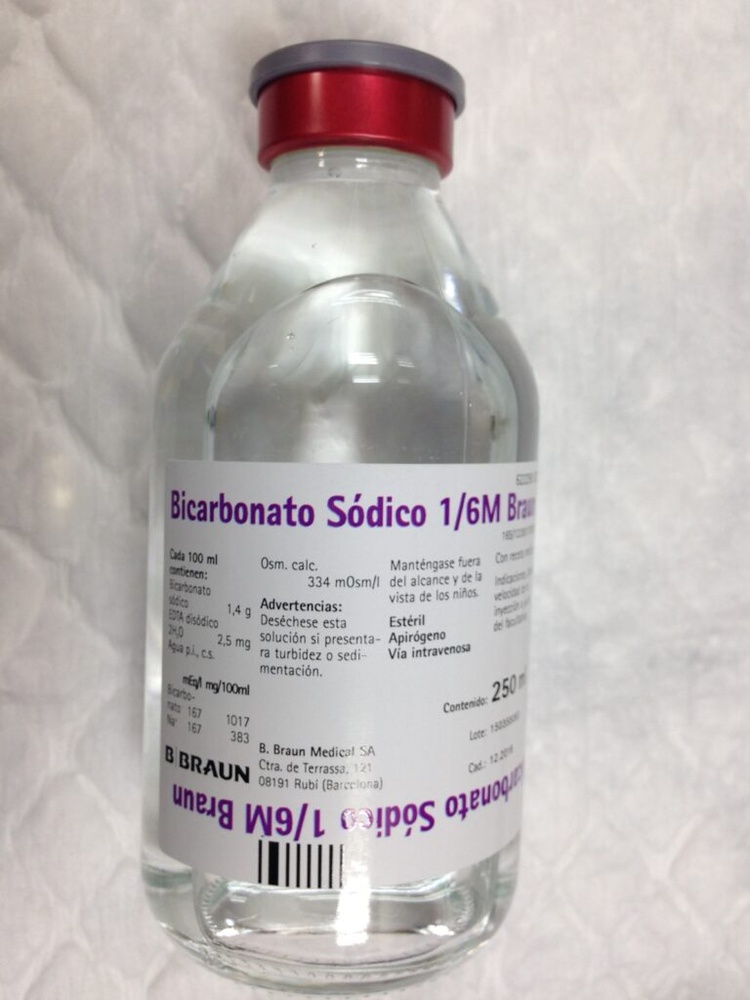
- País de registro
- Forma farmacéuticaINYECTABLE PERFUSION, 1,4%
- Código ATCB05XA02
- Principio activo
- Requiere recetaSí
- Fabricante
- Esta información es de carácter general y no sustituye la consulta con un profesional sanitario.
- Alternativas a VIAFLO BICARBONATO SODICO 1,4%, SOLUCION PARA PERFUSIONForma farmacéutica: INYECTABLE PERFUSION, 100 mlPrincipio activo: Sodio bicarbonatoFabricante: Fresenius Kabi España, S.A.U.Requiere recetaForma farmacéutica: INYECTABLE, 0,840 g sodio bicarbonato/10 mlPrincipio activo: Sodio bicarbonatoFabricante: Laboratorios Grifols S.A.Requiere recetaForma farmacéutica: INYECTABLE PERFUSION, 21 g bicarbonato sodicoPrincipio activo: Sodio bicarbonatoFabricante: Fresenius Kabi España, S.A.U.Requiere receta
Médicos online para VIAFLO BICARBONATO SODICO 1,4%, SOLUCION PARA PERFUSION
Comenta la dosis, los posibles efectos secundarios, interacciones, contraindicaciones o la revisión de receta de VIAFLO BICARBONATO SODICO 1,4%, SOLUCION PARA PERFUSION, sujeto a valoración médica y a la normativa local.









Obtén una receta de VIAFLO BICARBONATO SODICO 1,4%, SOLUCION PARA PERFUSION online
Rellena un formulario de 2 minutos
Cuéntanos tus síntomas, historial y el medicamento que necesitas.
Elige un médico o nosotros te asignamos uno
Escoge un especialista o te conectamos con el próximo médico disponible.
El médico revisa tu caso
Normalmente en 30 minutos. Puede hacerte preguntas adicionales por chat.
Recógela en cualquier farmacia
Receta electrónica enviada a tu correo, válida en toda España.
Preguntas frecuentes
VIAFLO BICARBONATO SODICO 1,4%, SOLUCION PARA PERFUSION requiere receta en España. Puedes confirmarlo con un médico online según tu caso.
El principio activo de VIAFLO BICARBONATO SODICO 1,4%, SOLUCION PARA PERFUSION es Sodio bicarbonato. Esta información ayuda a identificar medicamentos con la misma composición pero con diferentes nombres comerciales.
VIAFLO BICARBONATO SODICO 1,4%, SOLUCION PARA PERFUSION es fabricado por Baxter S.L.. La marca y el envase pueden variar según el distribuidor.
Los Médicos de familia, Psiquiatras, Dermatólogos, Cardiólogos, Endocrinólogos, Gastroenterólogos, Neumólogos, Nefrólogos, Reumatólogos, Hematólogos, Infectólogos, Alergólogos, Geriatras, Pediatras, Oncólogos pueden valorar la prescripción de VIAFLO BICARBONATO SODICO 1,4%, SOLUCION PARA PERFUSION cuando esté clínicamente indicado. Puedes reservar una videoconsulta para comentar tu caso y las opciones de tratamiento.
España cuenta con una infraestructura sanitaria bien desarrollada en ciudades principales como Madrid, Barcelona, Valencia y Sevilla. Las farmacias están ampliamente disponibles y operan bajo estrictas regulaciones, garantizando el acceso a medicamentos con receta.
Puedes comprar VIAFLO BICARBONATO SODICO 1,4%, SOLUCION PARA PERFUSION en Madrid, Barcelona, Sevilla o Valencia en cualquier farmacia local con una receta válida.
Para obtener una receta, puedes utilizar Oladoctor:
Otros medicamentos con el mismo principio activo (Sodio bicarbonato) incluyen BICARBONATO SODICO 1/6 M MEIN SOLUCION PARA PERFUSION, BICARBONATO SODICO 1M GRIFOLS SOLUCION INYECTABLE, VENOFUSIN BICARBONATO SÓDICO 1 M SOLUCIÓN PARA PERFUSIÓN. Pueden tener diferentes nombres comerciales o formulaciones, pero contienen el mismo componente terapéutico. Consulta siempre con un médico antes de cambiar o iniciar un nuevo medicamento.
