






Cómo usar VENTODUO 100 MICROGRAMOS/50 MICROGRAMOS/PULSACIÓN SUSPENSIÓN PARA INHALACIÓN EN ENVASE A PRESIÓN
Traducción generada por IA
Este contenido ha sido traducido automáticamente y se ofrece solo con fines informativos. No sustituye la consulta con un profesional sanitario.
Ver originalContenido del prospecto
Introducción
Prospecto: información para el usuario
Ventoduo 100 microgramos/50 microgramos / pulsación suspensión para inhalación en envase a presión
Salbutamol / Dipropionato de beclometasona
Lea todo el prospecto detenidamente antes de empezar a usar este medicamento, porque contiene información importante para usted.
- Conserve este prospecto, ya que puede tener que volver a leerlo.Si tiene alguna duda, consulte a su médico o farmacéutico.
- Este medicamento se le ha recetado solamente a usted, y no debe dárselo a otras personas aunque tengan los mismos síntomas que usted, ya que puede perjudicarles.
- Si experimenta efectos adversos, consulte a su médico o farmacéutico, incluso si se trata de efectos adversos que no aparecen en este prospecto. Ver sección 4.
Contenido del prospecto
- Qué es Ventoduo y para qué se utiliza
- Qué necesita saber antes de empezar a usar Ventoduo
- Cómo usar Ventoduo
- Posibles efectos adversos
- Conservación de Ventoduo
- Contenido del envase e información adicional
1. Qué es Ventoduo y para qué se utiliza
Ventoduo contiene dos principios activos, salbutamol y beclometasona dipropionato.
El salbutamol es un broncodilatador de corta duración. Los broncodilatadores relajan los músculos de las paredes de los conductos aéreos de los pulmones facilitando así la apertura de los conductos de aire para que se pueda respirar más fácilmente.
La beclometasona dipropionato es un corticosteroide que actúa disminuyendo la inflamación e irritación de los pulmones.
Ventoduo está indicado para el tratamiento del asma en pacientes que requieren un corticosteroide y un broncodilatador de acción corta y rápida.

2. Qué necesita saber antes de empezar a usar Ventoduo
No use Ventoduo:
- si es alérgico al salbutamol, a la beclometasona dipropionato o a cualquiera de los demás componentes de este medicamento (incluidos en la sección 6).
Advertencias y precauciones:
Consulte a su médico o farmacéutico antes de empezar a usar Ventoduo:
- Si ha tenido aftas en la boca
- Si su asma empeora o tiene mayor dificultad para respirar. Puede notar mas “pitidos” o sensación de ahogo o tener que utilizar su medicación con mucha más frecuencia de lo normal. Si le ocurre cualquiera de estas cosas, debe acudir a su médico lo antes posible.
- Si padece tuberculosis activa o latente.
- Si padece alteraciones graves en el corazón y de los vasos sanguíneos (cardiopatía grave, antecedentes de enfermedad cardiaca, ritmo cardiaco irregular, angina o hipertensión grave y no tratada). Si experimenta dolor en el pecho o los síntomas de su enfermedad cardiaca empeoran, consulte a su médico inmediatamente.
- Si padece tirotoxicosis (glándula tiroides hiperactiva), hipopotasemia (niveles de potasio en sangre disminuidos), aneurisma conocido (dilatación arterial) o diabetes mellitus (su médico puede hacerle controles de glucosa adicionales antes de empezar el tratamiento).
- Si padece feocromocitoma (un tumor de la médula adrenal).
- Si padece asma agudo. Este medicamento puede producir una bajada en los niveles de
potasio, que podría verse aumentada por la hipoxia (poco oxígeno).
- La bajada en los niveles de potasio que puede producir este medicamento también podría verse aumentada por los fármacos utilizados para tratar el asma.
- Si ha estado previamente en tratamiento con corticoides por vía oral. Su médico le puede recomendar controles regulares de la función de las glándulas adrenales y le indicará cómo ir reduciendo la dosis del tratamiento anterior. Puede necesitar un tratamiento sintomático complementario.
- Su médico le indicará cómo utilizar el inhalador. Debe utilizar este medicamento aunque no presente síntomas.
- Utilice siempre la dosis indicada por su médico. No debe aumentarla ya que podría producirle efectos adversos.
- El tratamiento con Ventoduo no debe interrumpirse de forma brusca, sino gradualmente. Su médico le indicará cómo hacerlo.
Póngase en contacto con su médico si presenta visión borrosa u otras alteraciones visuales.
Niños
Se recomienda controlar de forma regular la altura de los niños que reciben tratamiento prolongado con corticosteroides inhalados.
Uso en deportistas
Este medicamento contiene salbutamol, que puede producir un resultado positivo en las pruebas de control del dopaje.
Uso de Ventoduo con otros medicamentos
Informe a su médico si está tomando o ha tomado recientemente otros medicamentos, incluso los adquiridos sin receta.
Algunos medicamentos pueden aumentar los efectos de Ventoduo, por lo que su médico le hará controles minuciosos si está tomando estos medicamentos (incluidos algunos para el VIH: ritonavir, cobicistat).
Informe a su médico si está tomando los siguientes medicamentos:
- Medicamentos cardiacos y vasculares que pueden estrechar las vías aéreas (β- bloqueantes noselectivos como atenolol, propranolol).
- Otros fármacos broncodilatadores.
- Ciertos medicamentos para tratar la depresión, conocidos como inhibidores de la monoamino oxidasa (p.ej, moclobemida) y antidepresivos tricíclicos (p. ej, amitriptilina).
- Anestésicos (inductores de la pérdida parcial o total de la sensibilidad) como halotano.
- Medicamentos para el latido irregular del corazón, como digoxina.
- Derivados de la xantina (usados para ayudar con la respiración), tales como teofilina.
- Diuréticos (medicamentos para orinar), como furosemida.
- Disulfiram o metronidazol.
- Otros corticosteroides.
- Medicamentos para el VIH (p. ej, ritonavir, cobicistat).
Embarazo y lactancia
Si está embarazada o en periodo de lactancia, cree que podría estar embarazada o tiene intención de quedarse embarazada, consulte a su médico o farmacéutico antes de utilizar este medicamento.
Sólo se administrará Ventoduo durante el embarazo o la lactancia cuando, a criterio médico, el beneficio esperado para la madre sea mayor que cualquier posible riesgo para el feto.
Conducción y uso de máquinas
Aunque no son de esperar efectos sobre la capacidad para conducir y utilizar máquinas, usted deberá tener en cuenta la posibilidad de que se presenten mareos y temblores.
3. Cómo usar Ventoduo
Siga exactamente las instrucciones de administración de este medicamento indicadas por su médico. En caso de duda, consulte de nuevo a su médico o farmacéutico.
Ventoduo se administra por vía inhalatoria y se debe utilizar a demanda y no de forma regular.
Si su asma está activa (por ejemplo, tiene síntomas o crisis frecuentes, como dificultad para respirar que le dificulta hablar, comer o dormir, tos, sibilancias, opresión en el pecho o capacidad física limitada), debe informar inmediatamente a su médico, que le puede empezar a administrar un medicamento o aumentar la dosis de tratamiento, como un corticosteroide inhalado, para controlar su asma.
Informe a su médico lo antes posible si su medicamento parece no estar funcionando tan bien como de costumbre (por ejemplo, si necesita dosis más altas para aliviar sus problemas respiratorios o si su inhalador no le proporciona alivio durante al menos 3 horas), ya que su asma puede estar empeorando y usted puede necesitar un medicamento diferente.
Si utiliza Ventoduo más de dos veces por semana para tratar sus síntomas asmáticos, sin incluir el uso preventivo antes del ejercicio, esto indica un asma mal controlada y puede aumentar el riesgo de ataques de asma graves (empeoramiento del asma) que pueden tener complicaciones serias y pueden poner en riesgo su vida o incluso ser mortales. Se debe poner en contacto con su médico lo antes posible para revisar su tratamiento del asma.
Si utiliza a diario un medicamento contra la inflamación de sus pulmones, p.ej., un “corticosteroide inhalado”, es importante que siga utilizándolo con regularidad, aunque se sienta mejor.
Las dosis recomendada y máxima son:
Uso en adultos y adolescentes (a partir de 12 años):
Dosis recomendada: 2 inhalaciones (200 microgramos de salbutamol y 100 microgramos de beclometasona dipropionato), 1 ó 2 veces al día.
Dosis máxima: 2 inhalaciones (200 microgramos de salbutamol y 100 microgramos de
beclometasona dipropionato), 3 ó 4 veces al día.
Uso en niños de 5 a 11 años:
Dosis recomendada: 1 inhalación (100 microgramos de salbutamol y 50 microgramos de beclometasona dipropionato), 1 ó 2 veces al día.
Dosis máxima: 2 inhalaciones (200 microgramos de salbutamol y 100 microgramos de beclometasona dipropionato), 2 veces al día.
No debe incrementar la dosis o la frecuencia de administración por su cuenta, porque pueden producirse efectos adversos cuando se administran dosis excesivamente altas.
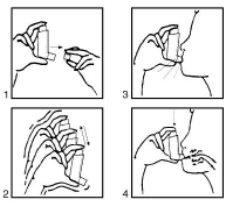
Instrucciones de uso:
- Quite la tapa (fig. 1). En caso de que sea un inhalador nuevo o no se haya utilizado durante varios días, agite el aerosol (fig. 2) y efectúe una pulsación para asegurar el buen funcionamiento del inhalador. En caso de que el inhalador se utilice regularmente pase a las instrucciones siguientes:
- Agite el inhalador (fig. 2).
- Elimine de sus pulmones la máxima cantidad
de aire posible.
- Adapte el aerosol a su boca según la posición que se indica en el dibujo (fig. 3).
- Haga una inspiración lo más profunda posible.
Debe oprimir, según las flechas del dibujo (fig. 4), el aparato mientras está haciendo esta inspiración.
- Retire el aerosol de su boca y procure retener el aire en sus pulmones durante unos segundos.
- Debe lavar periódicamente el pulsador-adaptador oral del aerosol. Para ello, retire el
pulsador del aerosol y límpielo con un trapo o bien con un pañuelo de papel.
- Guarde con la tapa colocada y para protegerlo del polvo y de la suciedad.
- Es recomendable enjuagarse la boca con agua después de cada aplicación.
El inhalador posee un indicador de dosis que se puede ver a través de un pequeño orificio o ventana del pulsador y que indica cuántas aplicaciones quedan. En este indicador de un inhalador nuevo se puede leer a través de la ventana del pulsador un “200”. Este número corresponde a la dosis que queda en el inhalador. A medida que se va utilizando el inhalador, el indicador de dosis va rotando de forma decreciente cada 5 - 7 pulsaciones hasta llegar a 0.
Cuando quedan aproximadamente 40 dosis el indicador cambia de verde a rojo (ver figura 5) con el fin de recordar al paciente que ha de consultar a su médico si ha de continuar el tratamiento o si necesita una nueva receta. Desechar el inhalador una vez el indicador llegue a “0”.
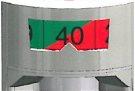
(figura 5)
Si usa más Ventoduo del que debe
Es importante que tome su dosis tal y como le ha indicado su médico. No debe aumentar ni disminuir su dosis sin supervisión médica.
Si utiliza más Ventoduo del recomendado pueden producirse alteraciones neuromusculares que van desde la debilidad muscular a la parálisis e insuficiencia respiratoria. También pueden producirse cambios en su electrocardiograma (ECG), y aumento del riesgo de toxicidad por otros medicamentos que pueda estar usando (digoxina).
En caso de sobredosis consulte inmediatamente a su médico o farmacéutico o llame al Servicio de Información Toxicológica, teléfono 91 562 04 20, indicando el medicamento y la cantidad utilizada.
Si olvidó tomar Ventoduo
No tome una dosis doble para compensar las dosis olvidadas. Inhalar la próxima dosis cuando corresponda.

4. Posibles efectos adversos
Al igual que todos los medicamentos, Ventoduo puede producir efectos adversos, aunque no todas las personas los sufran. A continuación se indican los efectos adversos asociados a Ventoduo clasificados por frecuencia.
Muy frecuentes (pueden afectar a más de 1 de cada 10 personas)
- Candidiasis en la boca y/o garganta (aftas)
Frecuentes (pueden afectar hasta 1 de cada 10 personas)
- Temblor generalmente en las manos, que está relacionado con la dosis
- Cefalea (dolor de cabeza)
- Mareos
- Ronquera y/o irritación de garganta.
- Taquicardia (ritmo cardiaco rápido)
Poco frecuentes (pueden afectar hasta 1 de cada 100 personas)
- Palpitaciones (ritmo cardiaco rápido o irregular)
- Calambres musculares transitorios
- Erupciones cutáneas, urticaria, prurito y/o eritema, hipotensión.
Raros(pueden afectar hasta 1 de cada 1.000 personas)
- Hipocalemia (niveles bajos de potasio en sangre)
La terapia con agonistas β2 puede dar lugar a una hipopotasemia potencialmente grave y este efecto puede verse incrementado por la administración concomitante de salbutamol y un corticosteroide.
- Neumonía eosinofílica (trastorno pulmonar)
Muy raros(pueden afectar hasta 1 de cada 10.000 personas)
- Alergias, que se manifiestan con hinchazón de párpados, cara, labios y/o garganta (angioedema).
- Alteraciones respiratorias como disnea (sensación de falta de aire o dificultad para respirar) y/o broncoespasmo (estrechamiento de las paredes de los bronquios con disminución de la entrada de aire).
- Reacciones anafilácticas o anafilactoides (reacciones alérgicas graves que pueden dificultar la respiración o alterar su nivel de consciencia).
- Ventoduo puede aumentar la producción normal de hormonas esteroideas, particularmente si ha estado tomando altas dosis durante largos periodos de tiempo. Los efectos incluyen:
- Retraso en el crecimiento en niños y adolescentes
- Disminución de la densidad mineral ósea (debilitamiento de los huesos)
- Cataratas y glaucoma (aumento de la presión del ojo)
- Síndrome de Cushing (Cara redondeada)
- Ansiedad, trastornos del sueño y cambios de humor, incluyendo hiperactividad e irritabilidad (fundamentalmente en niños).
- Arritmias cardiacas incluyendo fibrilación auricular, taquicardia supraventricular y extrasístoles (trastornos del ritmo del corazón)
Frecuencia no conocida
- Depresión o agresividad. Es más probable que estos efectos aparezcan en niños.
- Isquemia miocárdica (falta de riego sanguíneo en el corazón)
- Visión borrosa.
En los pacientes en que se produce ronquera o irritación de garganta puede ser útil enjuagarse la boca con agua inmediatamente después de la inhalación.
Como con otras terapias por vía inhalatoria, deberá tenerse en cuenta la posibilidad de aparición de broncoespasmo paradójico. Se debe suspender inmediatamente el tratamiento con Ventoduo, evaluar al paciente y si fuera necesario, instaurar una terapia alternativa. Esto ha de tratarse inmediatamente con un broncodilatador de acción rápida administrado por vía inhalatoria.
Comunicación de efectos adversos
Si experimenta cualquier tipo de efecto adverso, consulte a su médico o farmacéutico, incluso si se trata de posibles efectos adversos que no aparecen en este prospecto. También puede comunicarlos directamente a través del Sistema Español de Farmacovigilancia de Medicamentos de Uso Humano.Website: www.notificaRAM.es. Mediante la comunicación de efectos adversos usted puede contribuir a proporcionar más información sobre la seguridad de este medicamento.
5. Conservación de Ventoduo
Mantener este medicamento fuera de la vista y del alcance de los niños.
No conservar a temperatura superior a 30ºC. Conservar en el embalaje original para protegerlo de la luz. No congelar.
El envase está a presión. No debe ser perforado, roto o quemado aún cuando aparentemente esté vacío.
Si el inhalador estuviera frío, sacar el cartucho y calentar con la mano durante unos pocos minutos antes de usar. No utilizar ningún otro método para calentarlo.
No utilice este medicamento después de la fecha de caducidad que aparece en el envase después de Cad: La fecha de caducidad es el último día del mes que se indica.
Los medicamentos no se deben tirar por los desagües ni a la basura. Deposite los envases y los medicamentos que no necesita en el Punto SIGRE de la farmacia. En caso de duda pregunte a su farmacéutico cómo deshacerse de los envases y de los medicamentos que no necesita. De esta forma, ayudará a proteger el medio ambiente.
6. Contenido del envase e información adicional
Composición de Ventoduo
Los principios activos son: salbutamol (como sulfato) y beclometasona dipropionato.
Los demás componentes son: ácido oleico, etanol y 1,1,1,2-tetrafluoroetano (HFA-134a).
Cada pulsación contiene 100 microgramos de salbutamol (como sulfato) y 50 microgramos de beclometasona dipropionato.
Aspecto del producto y contenido del envase
Ventoduo se presenta en un envase a presión de 10 ml (200 pulsaciones) que libera el medicamento en forma de suspensión para su inhalación.
Titular de la autorización de comercialización y responsable de la fabricación
Laboratorio ALDO-UNIÓN, S.L.
Baronesa de Maldá, 73
08950 Esplugues de Llobregat (Barcelona)
ESPAÑA
Fecha de la última revisión de este prospecto:Agosto/2019
Otras fuentes de información
La información detallada y actualizada de este medicamento está disponible en la página Web de la Agencia Española de Medicamentos y Productos Sanitarios (AEMPS)
http://www.aemps.gob.es/
-

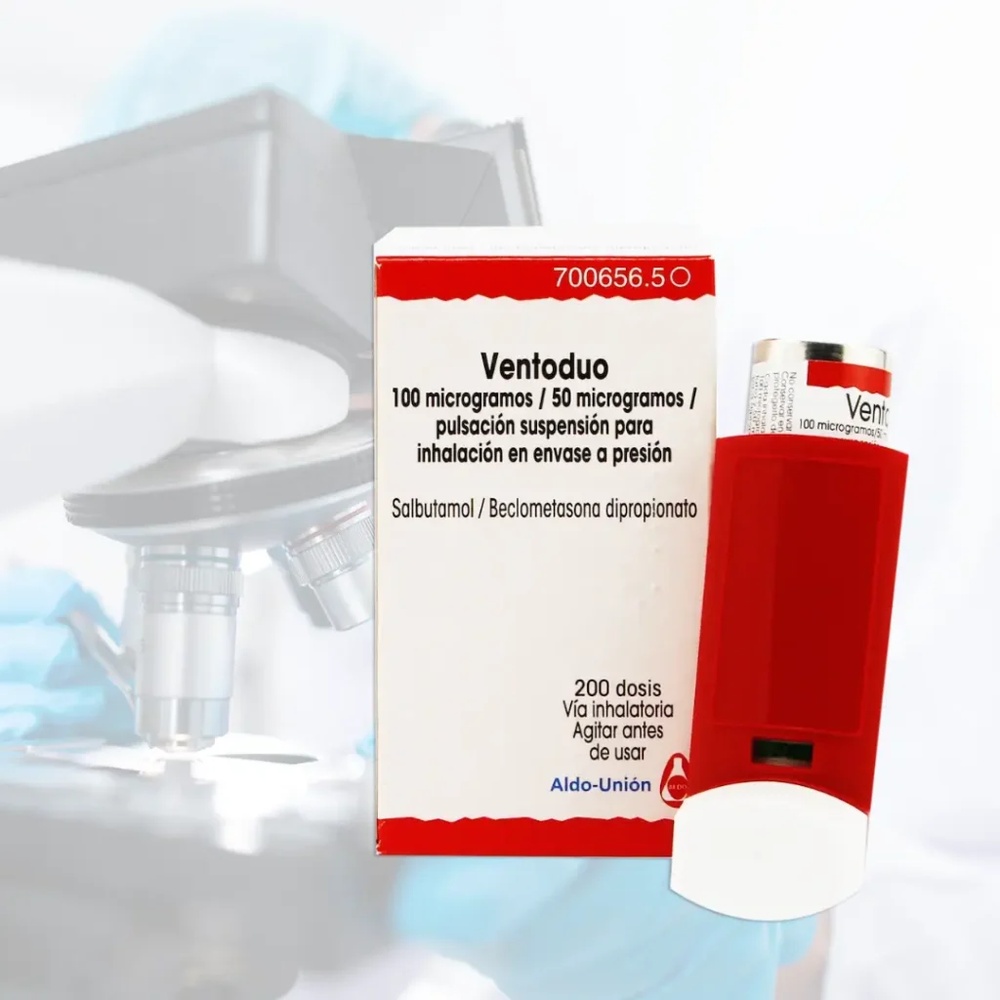
- País de registro
- Forma farmacéuticaINHALACIÓN PULMONAR, 50 microgramos/100 microgramos
- Código ATCR03AK13
- Precio medio en farmacia8.85 EUR
- Principio activo
- Requiere recetaSí
- Fabricante
- Esta información es de carácter general y no sustituye la consulta con un profesional sanitario.
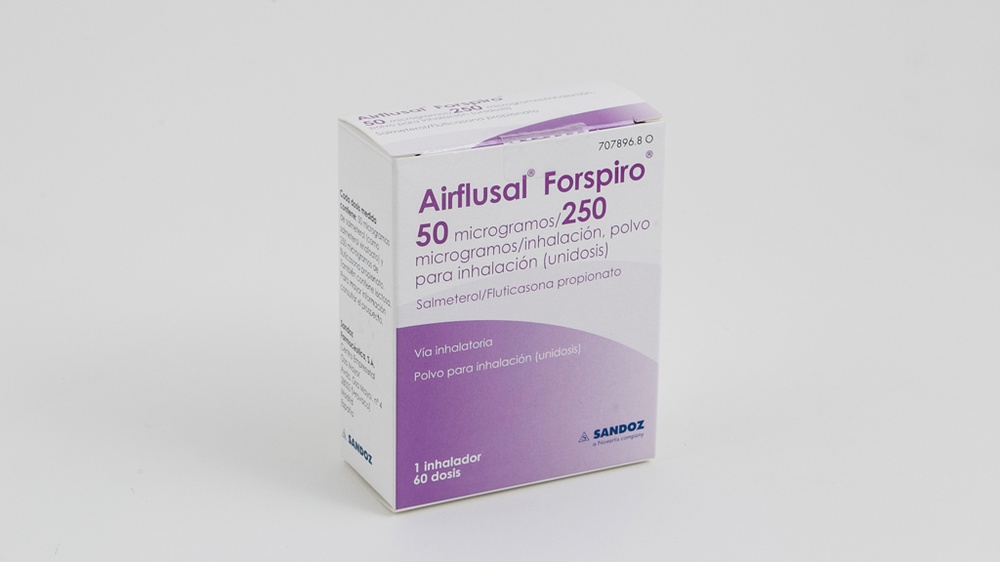
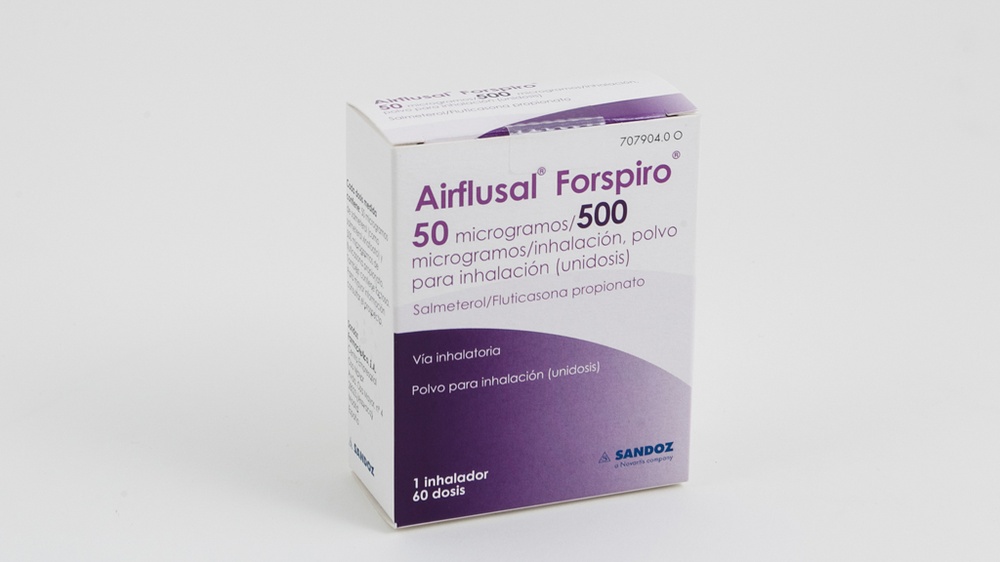
- Alternativas a VENTODUO 100 MICROGRAMOS/50 MICROGRAMOS/PULSACIÓN SUSPENSIÓN PARA INHALACIÓN EN ENVASE A PRESIÓNForma farmacéutica: INHALACIÓN PULMONAR, 50 microgramos/250 microgramosPrincipio activo: salmeterol and fluticasoneFabricante: Sandoz Farmaceutica S.A.Requiere recetaForma farmacéutica: INHALACIÓN PULMONAR, 50 microgramos/500 microgramosPrincipio activo: salmeterol and fluticasoneFabricante: Sandoz Farmaceutica S.A.Requiere recetaForma farmacéutica: INHALACIÓN PULMONAR, 50 microgramos /100 microgramosPrincipio activo: salmeterol and fluticasoneFabricante: Zentiva K.S.Requiere receta

Médicos online para VENTODUO 100 MICROGRAMOS/50 MICROGRAMOS/PULSACIÓN SUSPENSIÓN PARA INHALACIÓN EN ENVASE A PRESIÓN
Comenta la dosis, los posibles efectos secundarios, interacciones, contraindicaciones o la revisión de receta de VENTODUO 100 MICROGRAMOS/50 MICROGRAMOS/PULSACIÓN SUSPENSIÓN PARA INHALACIÓN EN ENVASE A PRESIÓN, sujeto a valoración médica y a la normativa local.



Obtén una receta de VENTODUO 100 MICROGRAMOS/50 MICROGRAMOS/PULSACIÓN SUSPENSIÓN PARA INHALACIÓN EN ENVASE A PRESIÓN online
Rellena un formulario de 2 minutos
Cuéntanos tus síntomas, historial y el medicamento que necesitas.
Elige un médico o nosotros te asignamos uno
Escoge un especialista o te conectamos con el próximo médico disponible.
El médico revisa tu caso
Normalmente en 30 minutos. Puede hacerte preguntas adicionales por chat.
Recógela en cualquier farmacia
Receta electrónica enviada a tu correo, válida en toda España.
Preguntas frecuentes
VENTODUO 100 MICROGRAMOS/50 MICROGRAMOS/PULSACIÓN SUSPENSIÓN PARA INHALACIÓN EN ENVASE A PRESIÓN requires receta en España. Puedes confirmarlo con un médico online según tu caso.
El principio activo de VENTODUO 100 MICROGRAMOS/50 MICROGRAMOS/PULSACIÓN SUSPENSIÓN PARA INHALACIÓN EN ENVASE A PRESIÓN es salbutamol and beclometasone. Esta información ayuda a identificar medicamentos con la misma composición pero con diferentes nombres comerciales.
El precio medio en farmacia de VENTODUO 100 MICROGRAMOS/50 MICROGRAMOS/PULSACIÓN SUSPENSIÓN PARA INHALACIÓN EN ENVASE A PRESIÓN es de aproximadamente 8.85 EUR. Puede variar según el fabricante y la forma farmacéutica.
VENTODUO 100 MICROGRAMOS/50 MICROGRAMOS/PULSACIÓN SUSPENSIÓN PARA INHALACIÓN EN ENVASE A PRESIÓN es fabricado por Laboratorio Aldo Union S.L.. La marca y el envase pueden variar según el distribuidor.
Los Médicos de familia, Psiquiatras, Dermatólogos, Cardiólogos, Endocrinólogos, Gastroenterólogos, Neumólogos, Nefrólogos, Reumatólogos, Hematólogos, Infectólogos, Alergólogos, Geriatras, Pediatras, Oncólogos pueden valorar la prescripción de VENTODUO 100 MICROGRAMOS/50 MICROGRAMOS/PULSACIÓN SUSPENSIÓN PARA INHALACIÓN EN ENVASE A PRESIÓN cuando esté clínicamente indicado. Puedes reservar una videoconsulta para comentar tu caso y las opciones de tratamiento.
España cuenta con una infraestructura sanitaria bien desarrollada en ciudades principales como Madrid, Barcelona, Valencia y Sevilla. Las farmacias están ampliamente disponibles y operan bajo estrictas regulaciones, garantizando el acceso a medicamentos con receta.
Puedes comprar VENTODUO 100 MICROGRAMOS/50 MICROGRAMOS/PULSACIÓN SUSPENSIÓN PARA INHALACIÓN EN ENVASE A PRESIÓN en Madrid, Barcelona, Sevilla o Valencia en cualquier farmacia local con una receta válida.
Para obtener una receta, puedes utilizar Oladoctor:
Otros medicamentos con el mismo principio activo (salbutamol and beclometasone) incluyen AIRFLUSAL FORSPIRO 50 MICROGRAMOS/250 MICROGRAMOS/INHALACION POLVO PARA INHALACION (UNIDOSIS), AIRFLUSAL FORSPIRO 50 MICROGRAMOS/500 MICROGRAMOS/INHALACION POLVO PARA INHALACION (UNIDOSIS), AMAIRA 50 MICROGRAMOS/100 MICROGRAMOS/INHALACION, POLVO PARA INHALACION (UNIDOSIS). Pueden tener diferentes nombres comerciales o formulaciones, pero contienen el mismo componente terapéutico. Consulta siempre con un médico antes de cambiar o iniciar un nuevo medicamento.
