


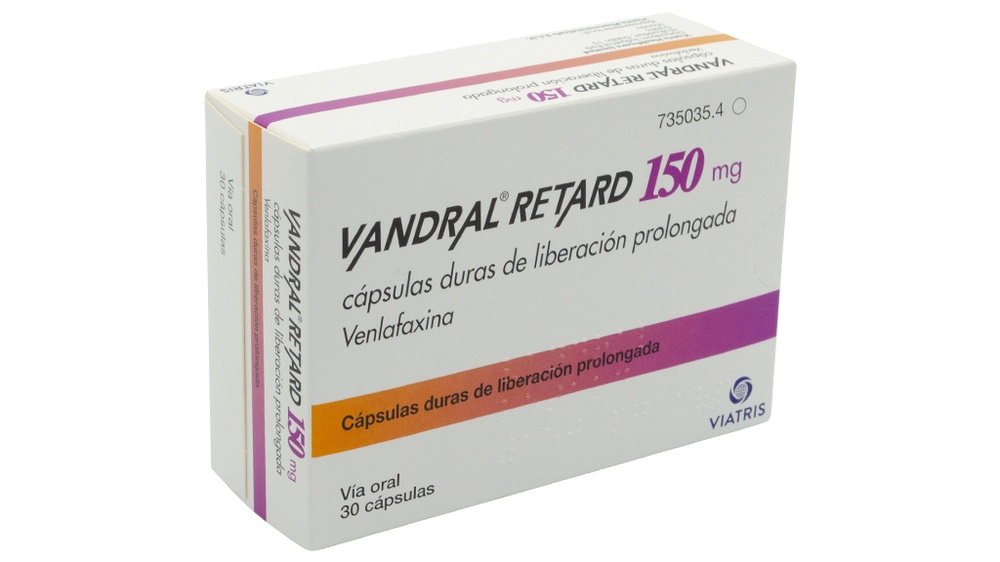
Vandral Retard 150 mg cápsulas duras de liberación prolongada

Revisión de receta online
Un médico revisará tu caso y determinará si la prescripción es médicamente apropiada.

Habla con un médico sobre este medicamento
Comenta tus síntomas y las opciones de tratamiento en una consulta online.



Cómo usar VANDRAL RETARD 150 mg CAPSULAS DURAS DE LIBERACION PROLONGADA
Contenido del prospecto
- Introducción
- Prospecto: información para el usuario
- Lea todo el prospecto detenidamente antes de empezar a tomar este medicamento, porque contiene información importante para usted.
- Contenido del prospecto:
- Qué es Vandral Retard y para qué se utiliza
- Qué necesita saber antes de empezar a tomar Vandral Retard
- No tome Vandral Retard
- Advertencias y precauciones
- Pensamientos de suicidio y empeoramiento de su depresión o trastorno de ansiedad
- Sus niveles de glucosa en sangre pueden ser alterados por Vandral Retard. Por lo tanto, las dosis de sus medicamentos para la diabetes pueden necesitar ser ajustadas.
- Niños y adolescentes
- Toma de Vandral Retard con alimentos, bebidas y alcohol
- No beba alcohol durante el tratamiento con Vandral Retard. La toma junto con alcohol puede provocar cansancio extremo e inconsciencia, y empeorar los síntomas de la depresión y de otras afecciones, como los trastornos de ansiedad.
- Embarazo, lactancia y fertilidad
- Conducción y uso de máquinas
- Vandral Retard contiene sodio
- Vandral Retard 150 mg y 225 mg cápsulas contienen menos de 23 mg de sodio (1mmol) por cápsula; esto es, esencialmente “exento de sodio”.
- Cómo tomar Vandral Retard
- Si toma más Vandral Retard del que debe
- Si olvidó tomar Vandral Retard
- Si interrumpe el tratamiento conVandral Retard
- Posibles efectos adversos
- Otros efectos adversos que pueden ocurrir
- Conservación de Vandral Retard
- Contenido del envase e información adicional
- Vandral Retard 75 mg:
- Vandral Retard 150 mg:
- Vandral Retard 225 mg:
- Aspecto del producto y contenido del envase
- Titular de la autorización de comercialización, responsable de la fabricación y representante local
- Este medicamento está autorizado en los estados miembros del Espacio Económico Europeo y en Reino Unido (Irlanda del Norte) con los siguientes nombres*:
Introducción
Prospecto: información para el usuario
Vandral Retard 75 mg cápsulas durasde liberación prolongada
Vandral Retard 150 mg cápsulas durasde liberación prolongada
Vandral Retard 225 mg cápsulas durasde liberación prolongada
venlafaxina

¿No estás seguro de si este medicamento es adecuado para ti?
Comenta tus síntomas y tratamiento con un médico online.
Lea todo el prospecto detenidamente antes de empezar a tomar este medicamento, porque contiene información importante para usted.
- Conserve este prospecto, ya que puede tener que volver a leerlo.
- Si tiene alguna duda, consulte a su médico o farmacéutico.
- Este medicamento se le ha recetado solamente a usted, y no debe dárselo a otras personas aunque tengan los mismos síntomas que usted, ya que puede perjudicarles.
- Si experimenta efectos adversos, consulte a su médico o farmacéutico, incluso si se trata de efectos adversos que no aparecen en este prospecto. Ver sección 4.
Contenido del prospecto:
- Qué es Vandral Retard y para qué se utiliza
- Qué necesita saber antes de empezar a tomar Vandral Retard
- Cómo tomar Vandral Retard
- Posibles efectos adversos
- Conservación de Vandral Retard
- Contenido del envase e información adicional

¿Has empezado a tomar el medicamento y tienes preguntas?
Comenta tus síntomas y tratamiento con un médico online.
1. Qué es Vandral Retard y para qué se utiliza
Vandral Retard contiene el principio activo venlafaxina.
Vandral Retard es un antidepresivo que pertenece a un grupo de medicamentos denominados inhibidores de la recaptación de serotonina y norepinefrina (ISRNs). Este grupo de medicamentos se utiliza para tratar la depresión y otros estados tales como los trastornos de ansiedad. No se comprende completamente cómo funcionan los antidepresivos, pero pueden ayudar a aumentar los niveles de serotonina y norepinefrina en el cerebro.
Vandral Retard es un tratamiento para adultos con depresión. También es un tratamiento para adultos con los siguientes trastornos de ansiedad: trastorno de ansiedad generalizada, trastorno de ansiedad social (miedo o evitación de las situaciones sociales), trastorno de pánico (ataques de pánico). Tratar los trastornos depresivos y de ansiedad adecuadamente es importante para ayudarle a sentirse mejor. Si no se trata, puede que su estado no desaparezca o puede agravarse y volverse más difícil de tratar.
2. Qué necesita saber antes de empezar a tomar Vandral Retard
No tome Vandral Retard
- Si es alérgico a venlafaxina o a cualquiera de los demás componentes de este medicamento (incluidos en la sección 6).
- Si también está tomando o ha tomado en los últimos 14 días, algún medicamento conocido como inhibidor de la monoaminooxidasa (IMAO) irreversible usado para tratar la depresión o la enfermedad de Parkinson. Tomar un IMAO irreversible junto con Vandral Retard, puede producir efectos adversos graves o incluso potencialmente mortales. Además, debe esperar al menos 7 días una vez que deje de tomar Vandral Retard antes de tomar cualquier IMAO (ver también la sección “Toma de Vandral Retard con otros medicamentos” y la información en esa sección sobre “Síndrome Serotoninérgico”).
Advertencias y precauciones
Consulte a su médico o farmacéutico antesde empezar a tomar Vandral Retard:
- Si utiliza otros medicamentos que tomados junto con Vandral Retard podrían aumentar el riesgo de desarrollar síndrome serotoninérgico (ver la sección “Toma de Vandral Retard con otros medicamentos”).
- Si tiene problemas en los ojos, tales como ciertos tipos de glaucoma (aumento de la presión en el ojo).
- Si tiene antecedentes de tensión arterial alta.
- Si tiene antecedentes de problemas de corazón.
- Si ha sido informado de que el ritmo de su corazón está alterado.
- Si tiene antecedentes de ataques (convulsiones).
- Si tiene antecedentes de niveles bajos de sodio en sangre (hiponatremia).
- Si tiene antecedentes de alteraciones hemorrágicas (tendencia a desarrollar cardenales o tendencia a sangrar fácilmente), o si está usando otros medicamentos que pueden aumentar el riesgo de hemorragia p.ej., warfarina (usado para prevenir coágulos de sangre), o si está embarazada (ver sección Embarazo, lactancia y fertilidad).
- Si tiene antecedentes de o si alguien de su familia ha tenido manía o trastorno bipolar (sentirse sobreexcitado o eufórico).
- Si tiene antecedentes de comportamiento agresivo.
Vandral Retard puede provocar una sensación de inquietud o una dificultad para sentarse o estar quieto durante las primeras semanas de tratamiento. Debe consultar a su médico si le ocurre esto.
No beba alcohol durante el tratamiento con Vandral Retard, ya que puede provocar cansancio extremo e inconsciencia. La toma junto con ciertos medicamentos y/o con alcohol puede empeorar los síntomas de la depresión y de otras afecciones, como los trastornos de ansiedad.
Pensamientos de suicidio y empeoramiento de su depresión o trastorno de ansiedad
Si está deprimido y/o tiene trastornos de ansiedad a veces puede tener pensamientos de hacerse daño o suicidarse. Estos pensamientos pueden aumentar al comenzar a tomar antidepresivos, ya que todos estos medicamentos tardan en actuar, generalmente unas dos semanas, aunque a veces más. Estos pensamientos también pueden producirse cuando su dosis disminuye o durante la interrupción del tratamiento con Vandral Retard.
Es más probable que le suceda esto:
- Si ha tenido previamente pensamientos de suicidio o de hacerse daño.
- Si es un adulto joven. La información de los ensayos clínicos ha mostrado un aumento del riesgo de conductas suicidas en adultos jóvenes (menos de 25 años de edad) con enfermedades psiquiátricas que se trataron con antidepresivos.
Si tiene pensamientos de hacerse daño o suicidarse en cualquier momento, póngase en contacto con su médico o acuda a un hospital directamente.
Puede encontrar útil contarle a un familiar o amigo cercano que está deprimido o que tiene un trastorno de ansiedad, y pedirles que lean este prospecto. Puede pedirles también que le digan si piensan que su depresión o ansiedad está empeorando, o si están preocupados acerca de los cambios en su conducta.
Sequedad bucal
Se ha informado de sequedad de boca en el 10% de pacientes tratados con venlafaxina. Esto puede aumentar el riesgo de que se pudran los dientes (caries). Por tanto, debe tener cuidado con su higiene dental.
Diabetes
Sus niveles de glucosa en sangre pueden ser alterados por Vandral Retard. Por lo tanto, las dosis de sus medicamentos para la diabetes pueden necesitar ser ajustadas.
Problemas sexuales
Algunos medicamentos del grupo al que pertenece Vandral Retard (llamados IRSN) pueden causar síntomas de disfunción sexual (ver sección 4). En algunos casos, estos síntomas persisten después de suspender el tratamiento.
Niños y adolescentes
Vandral Retard no deberá utilizarse normalmente en el tratamiento de niños y adolescentes menores de 18 años. Además, debe saber que en pacientes menores de 18 años existe un mayor riesgo de efectos adversos como intentos de suicidio, ideas de suicidio y hostilidad (predominantemente agresión, comportamiento de confrontación e irritación) cuando ingieren esta clase de medicamentos. Pese a esto, su médico puede prescribir este medicamento a pacientes menores de 18 años cuando decida que es lo más conveniente para el paciente. Si su médico ha prescrito este medicamento a un paciente menor de 18 años, y desea discutir esta decisión, por favor, vuelva a su médico. Debe informar a su médico si se desarrollan o empeoran alguno de los síntomas enumerados anteriormente cuando estos pacientes menores de 18 años están tomando Vandral Retard.
Además, la seguridad a largo plazo en relación con el crecimiento, la madurez y el desarrollo cognitivo y conductual, no ha sido demostrada.
Toma de Vandral Retard con otros medicamentos
Informe a su médico o farmacéutico si está utilizando o ha utilizado recientemente o podría tener que utilizar cualquier otro medicamento.
Su médico debe decidir si puede tomar Vandral Retard con otros medicamentos.
No comience ni deje de tomar cualquier medicamento, incluyendo los que se venden sin receta, remedios naturales y a base de plantas, antes de comprobarlo con su médico o farmacéutico.
- Inhibidores de la monoaminooxidasa usados para tratar la depresión o la enfermedad de Parkinson no se deben tomar con Vandral Retard. Dígale a su médico si ha tomado alguno de estos medicamentos en los últimos 14 días. (IMAO: ver sección “Qué necesita saber antes de empezar a tomar Vandral Retard”).
- Síndrome serotoninérgico:
Un estado potencialmente mortal, o reacciones parecidas al Síndrome Neuroléptico Maligno (SNM) (ver sección “Posibles Efectos Adversos”) pueden producirse con el tratamiento con venlafaxina, particularmente cuando se toma con otros medicamentos.
Ejemplos de estos medicamentos incluyen:
- Triptanes (usados para la migraña)
- Otros medicamentos para tratar la depresión, por ejemplo, ISRN, ISRS, antidepresivos tricíclicos o medicamentos que contienen litio
- Medicamentos que contienen anfetaminas (usadas para tratar el trastorno por déficit de atención con hiperactividad [TDAH], la narcolepsia y la obesidad)
- Medicamentos que contienen el antibiótico linezolid (usado para tratar infecciones)
- Medicamentos que contienen moclobemida, un IMAO (usado para tratar la depresión)
- Medicamentos que contienen sibutramina (usado para la pérdida de peso)
- Medicamentos que contienen opioides (por ejemplo, buprenorfina, tramadol, fentanilo, tapentadol, petidina o pentazocina) usados para tratar el dolor fuerte
- Medicamentos que contienen dextrometorfano (usado para tratar la tos)
- Medicamentos que contienen metadona (usado para el tratamiento de la adicción a opiáceos o para el tratamiento del dolor fuerte)
- Medicamentos que contienen azul de metileno (usado para tratar los niveles elevados de metahemoglobina en sangre)
- Productos que contienen hierba de San Juan (también denominada “Hypericum perforatum”, un remedio natural o a base de plantas usado para tratar la depresión leve)
- Productos que contienen triptófano (usados para problemas tales como sueño y depresión)
- Antipsicóticos (usados para tratar una enfermedad con síntomas tales como oír, ver o sentir cosas que no existen, creencias erróneas, suspicacia inusual, razonamiento poco claro y tendencia al retraimiento)
Los signos y síntomas del síndrome serotoninérgico pueden incluir una combinación de los siguientes:
inquietud, alucinaciones, pérdida de coordinación, latido cardiaco rápido, aumento de la temperatura corporal, cambios rápidos en la tensión arterial, reflejos hiperactivos, diarrea, coma, náuseas, vómitos.
En su forma más grave, el síndrome serotoninérgico puede parecerse al síndrome neuroléptico maligno (SNM). Los signos y síntomas del SNM pueden incluir una combinación de fiebre, latido cardiaco rápido, sudoración, rigidez grave de los músculos, confusión, aumento de las enzimas de los músculos (determinado por un análisis de sangre).
Informe a su médico inmediatamente o acuda a urgencias del hospital más cercano si cree que está experimentando el síndrome serotoninérgico.
Informe a su médico si está tomando medicamentos que puedan alterar el ritmo de su corazón.
Algunos ejemplos de estos medicamentos incluyen:
- Antiarrítmicos como quinidina, amiodarona, sotalol o dofetilida (utilizados para tratar el ritmo del corazón alterado)
- Antipsicóticos como tioridazina (ver también síndrome serotoninérgico más arriba)
- Antibióticos como eritromicina o moxifloxacino (utilizados para tratar infecciones por bacterias)
- Antihistamínicos (utilizados para tratar la alergia)
Los siguientes medicamentos también pueden interaccionar con Vandral Retard y deben usarse con precaución. Es especialmente importante mencionar a su médico o farmacéutico si está tomando medicamentos que contienen:
- Ketoconazol (un medicamento antifúngico).
- Haloperidol o risperidona (para tratar estados psiquiátricos).
- Metoprolol (un betabloqueante para tratar la tensión arterial elevada y problemas cardiacos).
Toma de Vandral Retard con alimentos, bebidas y alcohol
Vandral Retard debe tomarse con alimentos (ver sección 3 “Cómo tomar Vandral Retard”).
No beba alcohol durante el tratamiento con Vandral Retard. La toma junto con alcohol puede provocar cansancio extremo e inconsciencia, y empeorar los síntomas de la depresión y de otras afecciones, como los trastornos de ansiedad.
Embarazo, lactancia y fertilidad
Si está embarazada o en período de lactancia, cree que podría estar embarazada o tiene intención de quedarse embarazada, consulte a su médico o farmacéutico antes de utilizar este medicamento. Sólo debe tomar Vandral Retard tras discutir con su médico los posibles beneficios y los posibles riesgos para el niño no nacido.
Asegúrese de que su comadrona y/o médico sabe que está tomando Vandral Retard. Cuando se toman durante el embarazo, fármacos similares (ISRS) pueden aumentar el riesgo de un estado grave en bebés, denominado hipertensión pulmonar persistente del recién nacido (HPPRN), haciendo que el bebé respire más rápido y se ponga morado. Estos síntomas normalmente comienzan durante las primeras 24 horas tras el nacimiento del bebé. Si esto le ocurre a su bebé debe ponerse inmediatamente en contacto con su comadrona y/o médico.
Si toma Vandral Retard en la etapa final del embarazo puede producirse un mayor riesgo de sangrado vaginal abundante poco después del parto, especialmente si tiene antecedentes de alteraciones hemorrágicas. Su médico o matrona deben saber que usted está tomando Vandral Retard para poderle aconsejar.
Si está tomando este medicamento durante el embarazo, además de problemas con la respiración, otro síntoma que su bebé podría tener cuando nazca son problemas en la alimentación. Si su bebé tiene estos síntomas cuando nazca y está preocupada, póngase en contacto con su médico y/o comadrona quienes podrán aconsejarla.
Vandral Retard pasa a la leche materna. Existe un riesgo de un efecto para el bebé. Por tanto, debe tratar el caso con su médico y él decidirá si debe interrumpir la lactancia o interrumpir el tratamiento con este medicamento.
Conducción y uso de máquinas
No conduzca ni maneje herramientas o máquinas hasta que sepa cómo le afecta este medicamento.
Vandral Retard contiene sodio
Vandral Retard 150 mg y 225 mg cápsulas contienen menos de 23 mg de sodio (1mmol) por cápsula; esto es, esencialmente “exento de sodio”.
3. Cómo tomar Vandral Retard
Siga exactamente las instrucciones de administración de este medicamento indicadas por su médico. En caso de duda, consulte de nuevo a su médico o farmacéutico.
La dosis inicial normal recomendada para el tratamiento de la depresión, trastorno de ansiedad generalizada y trastorno de ansiedad social es de 75 mg por día. Su médico puede aumentar gradualmente la dosis y si es necesario todavía más hasta un máximo de 375 mg al día para la depresión. Si se le está tratando por trastorno de pánico, su médico comenzará con una dosis inferior (37,5 mg) y después aumentará la dosis gradualmente. La dosis máxima para el trastorno de ansiedad generalizada, trastorno de ansiedad social y trastorno de pánico es de 225 mg/día.
Tome Vandral Retard aproximadamente a la misma hora cada día, ya sea por la mañana o por la noche. Las cápsulas deben tragarse enteras con líquido y no deben abrirse, aplastarse, masticarse ni disolverse.
Vandral Retard debe tomarse con comida.
Si tiene problemas de hígado o de riñón, hable con su médico ya que puede ser necesario que su dosis de este medicamento sea diferente.
No deje de tomar este medicamento sin consultarlo con su médico (ver sección “Si interrumpe el tratamiento con Vandral Retard”).
Si toma más Vandral Retard del que debe
En caso de sobredosis o ingestión accidental, contacte con su médico, farmacéutico o llame al Servicio de Información Toxicológica, teléfono 91 562 04 20 indicando el medicamento y la cantidad ingerida.
La sobredosis puede poner en peligro su vida, especialmente con la toma simultánea de ciertos medicamentos y/o de alcohol (consulte Toma de Vandral Retard con otros medicamentos).
Los síntomas de una posible sobredosis pueden incluir palpitaciones, cambios en el nivel de vigilancia, (que va desde somnolencia a coma) visión borrosa, convulsiones o ataques y vómitos.
Si olvidó tomar Vandral Retard
Si no se ha tomado una dosis, tómela en cuanto lo recuerde. Sin embargo, si ya es la hora de su siguiente dosis, sáltese la dosis perdida y tome sólo una única dosis como habitualmente. No tome una dosis doble para compensar las dosis olvidadas. No tome más de la cantidad diaria de Vandral Retard, que le han recetado en un día.
Si interrumpe el tratamiento conVandral Retard
No deje de tomar su tratamiento ni reduzca la dosis sin el consejo de su médico, aun cuando se sienta mejor. Si su médico cree que ya no necesita Vandral Retard, puede pedirle que reduzca la dosis lentamente antes de interrumpir el tratamiento totalmente. Se sabe que se producen efectos adversos cuando las personas dejan de utilizar este medicamento, especialmente cuando se deja de tomar repentinamente o si la dosis se reduce muy rápidamente. Algunos pacientes pueden experimentar síntomas como pensamientos suicidas, agresividad, cansancio, mareos, falta de estabilidad, dolor de cabeza, insomnio, pesadillas, sequedad de boca, pérdida de apetito, náuseas, diarrea, nerviosismo, agitación, confusión, zumbidos en los oídos, hormigueo o, en escasas ocasiones, sensaciones de descarga eléctrica, debilidad, sudoración, convulsiones o síntomas similares a la gripe, problemas con la vista y aumento de la tensión arterial (que puede provocar dolor de cabeza, mareos, zumbidos en los oídos, sudoración, etc.).
Su médico le aconsejará cómo debe interrumpir gradualmente el tratamiento con Vandral Retard. Esto puede llevar varias semanas o meses. En algunos pacientes, la interrupción puede que tenga que producirse muy gradualmente durante meses o más. Si experimenta cualquiera de éstos u otros síntomas que le resulten molestos, consulte a su médico para que le aconseje.
Si tiene cualquier otra duda sobre el uso de este medicamento, pregunte a su médico o farmacéutico.
4. Posibles efectos adversos
Al igual que todos los medicamentos, este medicamento puede producir efectos adversos, aunque no todas las personas los sufran.
Si se produce cualquiera de los efectos siguientes, no tome más Vandral Retard. Comuníqueselo a su médico inmediatamente, o acuda a urgencias del hospital más cercano:
Poco frecuentes (pueden afectar hasta 1 de cada 100 personas)
- Hinchazón de la cara, boca, lengua, garganta, manos o pies y/o erupción hinchada con picor, dificultad al tragar o al respirar.
Raros (pueden afectar a hasta 1 de cada 1.000 personas)
- Opresión en el pecho, ruido al respirar, dificultad al tragar o al respirar.
- Erupción grave en la piel, picazón o urticaria (zonas elevadas de piel enrojecida o pálida que a menudo pica).
- Signos y síntomas del síndrome serotoninérgico que puede incluir agitación, alucinaciones, pérdida de coordinación, latidos rápidos del corazón, aumento de la temperatura corporal, cambios rápidos en la presión arterial, reflejos hiperactivos, diarrea, coma, náusea, vómitos.
En su forma más grave, el síndrome serotoninérgico puede parecerse al síndrome neuroléptico maligno (SNM). Los signos y síntomas del SNM pueden incluir una combinación de fiebre, latido rápido del corazón, sudoración, rigidez grave de los músculos, confusión, aumento de las enzimas de los músculos (determinado por un análisis de sangre).
- Signos de infección, como aumento de la temperatura, escalofríos, tiritona, cefalea, sudoración o síntomas similares a la gripe. Esto puede deberse a un trastorno de la sangre que puede derivar a un aumento del riesgo de infección.
- Erupción grave, que puede derivar en la formación de ampollas graves y a la descamación de la piel.
- Dolor de músculos inexplicable, molestias o debilidad. Esto puede ser un signo de rabdomiolisis.
Frecuencia no conocida (no puede estimarse a partir de los datos disponibles)
- Signos y síntomas de un estado denominado “miocardiopatía por estrés” que puede incluir dolor en el pecho, dificultad para respirar, mareos, desmayos, latidos cardíacos irregulares.
Otros efectos adversos sobre los que usted debe informar a su médicoson (la frecuencia de estos efectos adversos están incluidos en la lista inferior “otros efectos adversos que pueden ocurrir”):
- Tos, ruido al respirar y dificultad para respirar que pueden estar acompañados de un aumento de la temperatura.
- Heces (deposiciones) alquitranosas o sangre en heces.
- Picor, ojos o piel amarilla, orina oscura, que son síntomas de una inflamación del hígado (hepatitis).
- Problemas de corazón, como frecuencia cardiaca rápida o irregular, aumento de la presión arterial.
- Problemas en los ojos, como visión borrosa, pupilas dilatadas.
- Problemas en los nervios, como mareos, hormigueo, trastorno del movimiento (espasmos de los músculos y rigidez), convulsiones o ataques.
- Problemas psiquiátricos, como hiperactividad (sensación inusual de sobreexcitación).
- Efectos de retirada (ver sección “Cómo tomar Vandral Retard, si interrumpe el tratamiento con Vandral Retard”).
- Sangrado prolongado, si se corta o se hace una herida, puede tardar un poco más de lo normal en que se interrumpa el sangrado.
No se preocupe si observa bolitas blancas o pequeños gránulos en sus heces tras tomar este medicamento. Dentro de las cápsulas de Vandral Retard hay esferoides (pequeñas bolitas blancas) que contienen el principio activo (venlafaxina). Estos esferoides se liberan de la cápsula en el estómago. Como circulan a través del estómago e intestinos, venlafaxina se libera lentamente. La “vaina” del esferoide no se disuelve y se elimina en las heces. Por ello, aunque vea esferoides en las heces, la dosis del medicamento se ha absorbido.
Otros efectos adversos que pueden ocurrir
Muy frecuentes (pueden afectar a más de 1 de cada 10 personas)
- Mareo, dolor de cabeza, somnolencia.
- Insomnio.
- Náuseas, boca seca, estreñimiento.
- Sudoración excesiva (incluyendo sudores nocturnos).
Frecuentes (pueden afectar a hasta 1 de cada 10 personas)
- Disminución del apetito.
- Confusión, sentirse extraño, falta de orgasmo, disminución de la libido, agitación, nerviosismo, sueños anómalos.
- Temblor, una sensación de inquietud o incapacidad para permanecer sentado o estar quieto, hormigueo, percepción alterada del gusto, aumento del tono de los músculos.
- Alteraciones visuales incluyendo visión borrosa, pupilas dilatadas, incapacidad del ojo para cambiar automáticamente el enfoque de objetos distantes a cercanos.
- Zumbidos en los oídos (tinnitus).
- Latido cardiaco rápido, palpitaciones.
- Aumento de la presión arterial, sofocos.
- Dificultad para respirar, bostezos.
- Vómitos, diarrea.
- Erupción cutánea leve, picazón.
- Aumento de la frecuencia urinaria, incapacidad para orinar, dificultades para orinar.
- Irregularidades menstruales, tales como aumento del sangrado o aumento del sangrado irregular, eyaculación/orgasmo anómalos (varones), disfunción eréctil (impotencia).
- Debilidad (astenia), fatiga, escalofríos.
- Ganancia o pérdida de peso.
- Aumento del colesterol.
Poco Frecuentes (pueden afectar a hasta 1 de cada 100 personas)
- Hiperactividad, pensamientos acelerados y disminución de la necesidad de dormir (manía).
- Alucinaciones, sentirse separado de la realidad, orgasmo anómalo, falta de sentimientos o emociones, sentirse sobreexcitado, rechinar de los dientes.
- Desmayo, movimientos involuntarios de los músculos, alteración de la coordinación y del equilibrio.
- Sentirse mareado (sobre todo al levantarse demasiado deprisa), disminución de la presión arterial.
- Vómito de sangre, heces alquitranosas (deposiciones) o sangre en las heces, que puede ser un signo de hemorragia interna.
- Sensibilidad a la luz del sol, cardenales, caída del cabello anómala.
- Incapacidad para controlar la orina.
- Rigidez, espasmos y movimientos involuntarios de los músculos.
- Cambios ligeros en los niveles sanguíneos de enzimas del hígado.
Raros (pueden afectar a hasta 1 de cada 1.000 personas)
- Convulsiones o ataques.
- Tos, ruido al respirar y falta de aliento que pueden estar acompañados de una temperatura alta.
- Desorientación y confusión a menudo acompañada de alucinaciones (delirium).
- Exceso de ingesta de agua (conocido como SIADH).
- Disminución de los niveles de sodio en sangre.
- Dolor intenso en el ojo y visión reducida o borrosa.
- Latido del corazón anómalo, rápido o irregular, que puede conducir a desmayos.
- Dolor grave de abdomen o de espalda (que puede indicar un problema grave en el intestino, hígado o páncreas).
- Picor, ojos o piel amarillentos, orina oscura, síntomas similares a la gripe, que son síntomas de inflamación del hígado (hepatitis).
Muy raros (pueden afectar a hasta 1 de cada 10.000 personas)
- Sangrado prolongado, que puede deberse a un número reducido de plaquetas en la sangre que conduce a un aumento del riesgo de cardenales o hemorragias.
- Producción anómala de leche materna.
- Sangrado inesperado, por ejemplo, sangrado de las encías, sangre en orina o en el vómito, o la aparición de cardenales inesperados o rotura de vasos sanguíneos (venas rotas).
Frecuencia no conocida (no se puede estimar con los datos disponibles)
- Ideación suicida y comportamiento suicida, se han notificado casos de ideación y comportamiento suicida durante el tratamiento con venlafaxina o poco después de la interrupción del tratamiento (ver sección 2. “Qué necesita saber antes de tomar Vandral Retard”).
- Agresión.
- Vértigo.
- Sangrado vaginal abundante poco después del parto (hemorragia posparto), ver “Embarazo, lactancia y fertilidad” en la sección 2 para más información.
Vandral Retard produce algunas veces efectos no deseados de los que puede que no sea consciente, tales como aumentos de la presión arterial o un latido del corazón anómalo; cambios ligeros en los niveles sanguíneos de enzimas del hígado, sodio o colesterol. Con menos frecuencia, Vandral Retard puede reducir la función de las plaquetas de la sangre, lo que conduce a un aumento del riesgo de aparición de cardenales o hemorragia. Por tanto, su médico puede desear realizar análisis de sangre ocasionalmente, en particular si ha estado tomando Vandral Retard durante mucho tiempo.
Comunicación de efectos adversos
Si experimenta cualquier tipo de efecto adverso, consulte a su médico, farmacéutico o enfermero, incluso si se trata de posibles efectos adversos que no aparecen en este prospecto. También puede comunicarlos directamente a través del Sistema Español de Farmacovigilancia de Medicamentos de Uso Humano: http://www.notificaram.es. Mediante la comunicación de efectos adversos usted puede contribuir a proporcionar más información sobre la seguridad de este medicamento.
5. Conservación de Vandral Retard
Mantener este medicamento fuera de la vista y del alcance de los niños.
No utilice este medicamento después de la fecha de caducidad que aparece en el envase. La fecha de caducidad es el último día del mes que se indica.
No conservar a temperatura superior a 30ºC.
Los medicamentos no se deben tirar por los desagües ni a la basura. Deposite los envases y los medicamentos que no necesita en el Punto SIGRE de la farmacia.En caso de duda pregunte a su farmacéutico cómo deshacerse de los envases y los medicamentos que no necesita. De esta forma ayudará a proteger el medio ambiente.
6. Contenido del envase e información adicional
Composición de Vandral Retard
El principio activo es venlafaxina.
Vandral Retard 75 mg:
Cada cápsula de liberación prolongada contiene 84,85 mg de venlafaxina hidrocloruro, equivalentes a 75 mg de venlafaxina base.
Los demás componentes son:
Contenido de la cápsula:celulosa microcristalina, etilcelulosa, hipromelosa, talco.
Cubierta de la cápsula:gelatina, óxidos de hierro rojo y amarillo (E172), dióxido de titanio (E171).
Tinta de impresión de la cápsula:shellac, óxido de hierro rojo (E172), hidróxido de amonio, simeticona, propilenglicol.
Vandral Retard 150 mg:
Cada cápsula de liberación prolongada contiene 169,7 mg de venlafaxina hidrocloruro, equivalentes a 150 mg de venlafaxina base.
Los demás componentes son:
Contenido de la cápsula:celulosa microcristalina, etilcelulosa, hipromelosa, talco.
Cubierta de la cápsula:gelatina, óxidos de hierro rojo y amarillo (E172), dióxido de titanio (E171).
Tinta de impresión de la cápsula:shellac, hidróxido de sodio (ver sección 2), povidona, dióxido de titanio (E171), propilenglicol.
Vandral Retard 225 mg:
Cada cápsula de liberación prolongada contiene 254,52 mg de venlafaxina hidrocloruro, equivalentes a 225 mg de venlafaxina base.
Los demás componentes son:
Contenido de la cápsula:celulosa microcristalina, etilcelulosa, hipromelosa, talco.
Cubierta de la cápsula:gelatina, óxidos de hierro negro, rojo y amarillo (E172), dióxido de titanio (E171).
Tinta de impresión de la cápsula:shellac, hidróxido de sodio (ver sección 2), povidona, dióxido de titanio (E171), propilenglicol.
Aspecto del producto y contenido del envase
Vandral Retard 75 mg es una cápsula dura (gelatina) de liberación prolongada, opaca y de color melocotón, de 19,4 mm x 6,91 mm, con una ‘W’ y la dosis ‘75’ impresas en rojo.
Vandral Retard 75 mg está disponible en:
Envases con blísteres de 7, 10, 14, 15, 20, 28, 30, 50, 56, 60, 98, 100 cápsulas duras y envases clínicos de 500 (10x50) y 1.000 (10x100) cápsulas duras o en frascos de plástico (HDPE) de 14, 20, 50, 100 cápsulas duras y envases clínicos de 500 y 1.000 cápsulas duras.
Envases de blísteres unidosis de 14, 28, 84 y 100 cápsulas duras.
Vandral Retard 150 mg es una cápsula dura (gelatina) de liberación prolongada, opaca y de color naranja, de 23,5 mm x 7,65 mm, con una ‘W’ y la dosis ‘150’ impresas en blanco.
Vandral Retard 150 mg está disponible en:
Envases con blísteres de 7, 10, 14, 15, 20, 28, 30, 50, 56, 60, 98, 100 cápsulas duras y envases clínicos de 500 (10x50) y 1.000 (10x100) cápsulas duras o en frascos de plástico (HDPE) de 14, 20, 50, 100 cápsulas duras y envases clínicos de 500 y 1.000 cápsulas duras.
Envases de blísteres unidosis de 14, 28, 84 y 100 cápsulas duras.
Vandral Retard 225 mg es una cápsula opaca con cubierta de color gris claro y con cuerpo de color naranja oscuro, con “W” y “225” en impresión blanca
Vandral Retard 225 mg está disponible en:
Envases con blísteres de 7, 10, 14, 15, 20, 28, 30, 50, 56, 60, 98, 100 y envases clínicos de 500 (10x50) y 1.000 (10x100).
Envases de blísteres unidosis de 14, 28, 84 y 100 cápsulas duras.
Puede que solamente estén comercializados algunos tamaños de envases.
Titular de la autorización de comercialización, responsable de la fabricación y representante local
Titular de la autorización de comercialización
Viatris Healthcare Limited
Damastown Industrial Park
Mulhuddart, Dublín 15
Dublín
Irlanda
Responsable de la fabricación
Pfizer Manufacturing Deutschland GmbH
Mooswaldallee 1
79108 Freiburg Im Breisgau
Alemania
o
Pfizer Ireland Pharmaceuticals
Little Connell
Newbridge
County Kildare
Irlanda
Pueden solicitar más información respecto a este medicamento dirigiéndose al representante local del titular de la autorización de comercialización:
Viatris Pharmaceuticals, S.L.U.
Calle General Aranaz, 86
28027 Madrid
España
Este medicamento está autorizado en los estados miembros del Espacio Económico Europeo y en Reino Unido (Irlanda del Norte) con los siguientes nombres*:
Austria | Efectin ER 37,5 mg Kapseln Efectin ER 75 mg Kapseln Efectin ER 150 mg Kapseln |
Bélgica, Luxemburgo | Efexor-Exel 37,5 Efexor-Exel 75 Efexor-Exel 150 Efexor-Exel 225 |
Bulgaria | Efectin ER 75 mg Efectin ER 150 mg |
República Checa | Efectin ER 37.5 mg Efectin ER 75 mg Efectin ER 150 mg |
Chipre, Grecia, Estonia, Lituania, Portugal | Efexor XR |
Letonia | Efexor XR Efexor XR 75 Efexor XR 150 |
Dinamarca, Finlandia, Islandia, Noruega, Suecia | Efexor Depot |
Francia | Effexor L.P. |
Alemania | Trevilor retard 37,5 mg Trevilor retard 75 mg Trevilor retard 150 mg |
Irlanda, Malta, Reino Unido (Irlanda del Norte) | Efexor XL |
Paises Bajos | Efexor XR 37,5 Efexor XR 75 Efexor XR 150 |
Italia | Efexor Faxine |
Polonia | Efectin ER 37,5 Efectin ER 75 Efectin ER 150 |
Rumanía | Efectin EP 37.5 mg Efectin EP 75 mg Efectin EP 150 mg |
Eslovenia | Efectin ER 37,5 mg trde kapsule s podaljšanim sprošcanjem Efectin ER 75 mg trde kapsule s podaljšanim sprošcanjem Efectin ER 150 mg trde kapsule s podaljšanim sprošcanjem |
España | Vandral Retard 75 mg cápsulas duras de liberación prolongada Vandral Retard 150 mg cápsulas duras de liberación prolongada Vandral Retard 225 mg cápsulas duras de liberación prologada |
*[Por favor, tenga en cuenta que puede que no todos los productos y concentraciones de la lista estén comercializados].
Fecha de la última revisión de este prospecto: Julio 2023
La información detallada y actualizada de este medicamento está disponible en la página Web de la Agencia Española de Medicamentos y Productos Sanitarios (AEMPS) http://www.aemps.gob.es
- País de registro
- Forma farmacéuticaCAPSULA LIBERACION MODIFICADA, 150 mg venlafaxina hidrocloruro
- Código ATCN06AX16
- Precio medio en farmacia19.15 EUR
- Principio activo
- Requiere recetaSí
- Fabricante
- Esta información es de carácter general y no sustituye la consulta con un profesional sanitario.
- Alternativas a VANDRAL RETARD 150 mg CAPSULAS DURAS DE LIBERACION PROLONGADAForma farmacéutica: CAPSULA LIBERACION MODIFICADA, 150 mg venlafaxina hidrocloruroPrincipio activo: venlafaxinaFabricante: Adamed Laboratorios S.L.U.Requiere recetaForma farmacéutica: CAPSULA LIBERACION MODIFICADA, 75 mg venlafaxina hidrocloruroPrincipio activo: venlafaxinaFabricante: Adamed Laboratorios S.L.U.Requiere recetaForma farmacéutica: COMPRIMIDO, 37,5 mg venlafaxinaPrincipio activo: venlafaxinaFabricante: Almirall S.A.Requiere receta
Médicos online para VANDRAL RETARD 150 mg CAPSULAS DURAS DE LIBERACION PROLONGADA
Comenta la dosis, los posibles efectos secundarios, interacciones, contraindicaciones o la revisión de receta de VANDRAL RETARD 150 mg CAPSULAS DURAS DE LIBERACION PROLONGADA, sujeto a valoración médica y a la normativa local.







Preguntas frecuentes
VANDRAL RETARD 150 mg CAPSULAS DURAS DE LIBERACION PROLONGADA requiere receta en España. Puedes confirmarlo con un médico online según tu caso.
El principio activo de VANDRAL RETARD 150 mg CAPSULAS DURAS DE LIBERACION PROLONGADA es venlafaxina. Esta información ayuda a identificar medicamentos con la misma composición pero con diferentes nombres comerciales.
El precio medio en farmacia de VANDRAL RETARD 150 mg CAPSULAS DURAS DE LIBERACION PROLONGADA es de aproximadamente 19.15 EUR. Puede variar según el fabricante y la forma farmacéutica.
VANDRAL RETARD 150 mg CAPSULAS DURAS DE LIBERACION PROLONGADA es fabricado por Viatris Healthcare Limited. La marca y el envase pueden variar según el distribuidor.
Los Médicos de familia, Psiquiatras, Dermatólogos, Cardiólogos, Endocrinólogos, Gastroenterólogos, Neumólogos, Nefrólogos, Reumatólogos, Hematólogos, Infectólogos, Alergólogos, Geriatras, Pediatras, Oncólogos pueden valorar la prescripción de VANDRAL RETARD 150 mg CAPSULAS DURAS DE LIBERACION PROLONGADA cuando esté clínicamente indicado. Puedes reservar una videoconsulta para comentar tu caso y las opciones de tratamiento.
La receta la emite un médico tras valorar tu estado de salud. En España, VANDRAL RETARD 150 mg CAPSULAS DURAS DE LIBERACION PROLONGADA se dispensa en las farmacias con esa receta médica. Una consulta online no garantiza su emisión: la decisión corresponde siempre al médico.
Para solicitar una valoración puedes usar Oladoctor:
Otros medicamentos con el mismo principio activo (venlafaxina) incluyen DISLAVEN RETARD 150 mg CAPSULAS DE LIBERACION PROLONGADA EFG, DISLAVEN RETARD 75 mg CAPSULAS DE LIBERACION PROLONGADA EFG, DOBUPAL 37,5 mg COMPRIMIDOS. Pueden tener diferentes nombres comerciales o formulaciones, pero contienen el mismo componente terapéutico. Consulta siempre con un médico antes de cambiar o iniciar un nuevo medicamento.
