



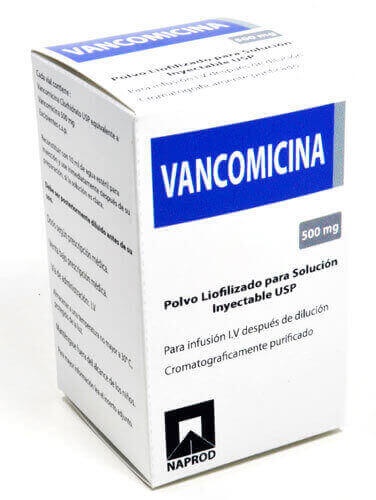
VANCOMICINA 500 mg Inyectable

Revisión de receta online
Un médico revisará tu caso y determinará si la prescripción es médicamente apropiada.

Habla con un médico sobre este medicamento
Comenta tus síntomas y las opciones de tratamiento en una consulta online.



Cómo usar VANCOMICINA SALA 500 MG POLVO PARA CONCENTRADO PARA SOLUCIÓN PARA PERFUSIÓN EFG
Contenido del prospecto
- Introducción
- Qué es Vancomicina Sala y para qué se utiliza
- Que necesita saber antes de empezar a utilizar Vancomicina Sala
- Cómo usar Vancomicina Sala
- Posibles efectos adversos
- Conservación de Vancomicina Sala
- Contenido del envase e información adicional
Introducción
Prospecto: información para el paciente
Vancomicina Sala 500 mg polvo para concentrado para solución para perfusión EFG
Lea todo el prospecto detenidamente antes de empezar a usar este medicamento, porque contiene información importante para usted.
- Conserve este prospecto, ya que puede tener que volver a leerlo.
- Si tiene alguna duda, consulte a su médico, farmacéutico o enfermero.
- Este medicamento se le ha recetado solamente a usted, y no debe dárselo a otras personas aunque tengan los mismos síntomas que usted, ya que puede perjudicarles.
- Si experimenta efectos adversos, consulte a su médico, farmacéutico o enfermero, incluso si se trata de efectos adversos que no aparecen en este prospecto. Ver sección 4.
Contenido del prospecto
- Qué es Vancomicina Sala y para qué se utiliza.
- Antes de la administración de Vancomicina Sala
- Cómo utilizar Vancomicina Sala
- Posibles efectos adversos.
- Conservación de Vancomicina Sala
- Contenido del envase e información adicional
1. Qué es Vancomicina Sala y para qué se utiliza
La vancomicina es un antibiótico que pertenece al grupo de los “glucopéptidos” y funciona eliminando ciertas bacterias que causan infecciones.
La Vancomicina en polvo se convierte en una solución para perfusión o solución oral.
Los antibióticos se utilizan para tratar infecciones bacterianas y no sirven para tratar infecciones víricas como la gripe o el catarro.
Es importante que siga las instrucciones relativas a la dosis, el intervalo de administración y la duración del tratamiento indicadas por su médico.
No guarde ni reutilice este medicamento. Si una vez finalizado el tratamiento le sobra antibiótico, devuélvalo a la farmacia para su correcta eliminación. No debe tirar los medicamentos por el desagüe ni a la basura.
La vancomicina se utiliza en todos los grupos de edad mediante perfusión intravenosa para el tratamiento de las siguientes infecciones graves:
- Infecciones de la piel y tejidos debajo de la piel.
- Infecciones de los huesos y de las articulaciones.
- Una infección de los pulmones llamada "neumonía".
- Infección del revestimiento interno del corazón (endocarditis) y para prevenir la endocarditis en pacientes con riesgo cuando se someten a procedimientos quirúrgicos mayores.
- Infección en la sangre ligada a las infecciones mencionadas anteriormente.
La vancomicina se puede administrar por vía oral en adultos y niños para el tratamiento de la infección de la mucosa intestinal, del intestino delgado y del intestino grueso con daño en las mucosas (colitis pseudomembranosa) causada por la bacteria Clostridium difficile.

¿No estás seguro de si este medicamento es adecuado para ti?
Comenta tus síntomas y tratamiento con un médico online.
2. Que necesita saber antes de empezar a utilizar Vancomicina Sala
No utilice vancomicina
Si usted es alérgico a la vancomicina o a alguno de los demás componentes de este medicamento (incluidos en la sección 6).
Advertencias y precauciones
Hable con su médico o farmacéutico del hospital o enfermera antes de usar vancomicina si:
- Ha sufrido una reacción alérgica a la teicoplanina, porque esto podría significar también que es alérgico a la vancomicina.
- Tiene un problema de audición, especialmente si usted es una persona de edad avanzada (es posible que necesite pruebas de audición durante el tratamiento).
- Tiene problemas en los riñones (por lo que necesita hacerse un análisis de sangre y pruebas de los riñones durante el tratamiento).
- Le están administrando la vancomicina en perfusión para el tratamiento de la diarrea asociada a infección por Clostridium difficileen lugar de por vía oral.
- Alguna vez ha desarrollado un sarpullido severo o descamación de la piel, ampollas y/o llagas en la boca después de tomar vancomicina.
Se han reportado reacciones cutáneas serias incluyendo el síndrome de Stevens-Johnson, necrólisis epidérmica tóxica, reacción a medicamentos con eosinofilia y síntomas sistémicos (DRESS), y pustulosis exantematosa generalizada aguda (AGEP) en asociación con el tratamiento de vancomicina. Deje de usar la vancomicina y busque atención médica inmediatamente si nota cualquiera de los síntomas descritos en la sección 4.
Se han informado de graves efectos secundarios que pueden provocar la pérdida de la visión tras la inyección de vancomicina en los ojos.
Hable con su médico o farmacéutico del hospital o enfermera durante el tratamiento con vancomicina si:
- Le están administrando la vancomicina durante mucho tiempo (puede que tenga que hacerse análisis de sangre, un análisis para comprobar el funcionamiento del hígado o de los riñones, durante el tratamiento).
- Desarrolla cualquier reacción en la piel durante el tratamiento.
- Desarrolló diarrea grave o crónica durante o después de usar vancomicina. Esto puede ser un signo de inflamación del intestino (colitis pseudomembranosa) que puede aparecer después del tratamiento con antibióticos.
Niños
La vancomicina se utiliza con especial cuidado en los bebés prematuros y los bebés pequeños, debido a que sus riñones no están completamente desarrollados y pueden acumular vancomicina en la sangre.
Para controlar los niveles de vancomicina en sangre, para este grupo de edad, se realizan análisis de sangre.
La administración simultánea de vancomicina y agentes anestésicos se ha asociado con enrojecimiento de la piel (eritema) y reacciones alérgicas en niños. Del mismo modo, el uso simultáneo con otros medicamentos tales como antibióticos aminoglucósidos, agentes anti-inflamatorios no esteroideos (NSAIDs, por ejemplo ibuprofeno) o anfotericina B (medicamento para tratar la infección producida por hongos) pueden aumentar el riesgo de daño en el riñón y por lo tanto será necesario realizar pruebas de los riñones y de la sangre de forma más frecuente.
Otros medicamentos y Vancomicina Sala
Informe a su médico o farmacéutico si está tomando, ha tomado recientemente, o pudiera tener que tomar cualquier otro medicamento, incluso los adquiridos sin receta médica.
Es necesario tener cuidado especial si está tomando o usando otros medicamentos, ya que algunos podrían interactuar con la vancomicina.
Los medicamentos siguientes pueden interaccionar con Vancomicina:
- Piperacilina/tazobactam, ya que podrían afectar a los riñones.
- Agentes anestésicos: la administración simultanea de vancomicina intravenosa y agentes anestésicos se ha asociado a enrojecimiento de la piel y reacciones alérgicas.
- Medicamentos para la relajación muscular.
- Medicamentos para las infecciones causadas por bacterias (por ejemplo, polimixina B, colistina, bacitracina y aminoglucósidos.
- Medicamentos para la micosis (anfotericina B).
- Medicamentos para la tuberculosis (viomicina).
- Medicamentos para el cáncer (cisplatino).
- Debe administrarse con precaucion en pacientes alérgicos a otro antibiótico glucopeptidico llamado teicoplanina ya que se han detectado reacciones alérgicas cruzadas.
Embarazo, lactancia y fertilidad
Si está embarazada o en periodo de lactancia, cree que podría estar embarazada o tiene intención de quedarse embarazada, consulte a su médico o farmacéutico del hospital antes de utilizar este medicamento. La vancomicina debe administrarse durante el embarazo y la lactancia únicamente en caso de necesidad evidente. La vancomicina accede a la placenta y puede provocar toxicidad en el feto. La vancomicina pasa a la leche humana.Su medico podría decidir que debe interrumpir la lactancia.
Conducción y uso de máquinas:
La influencia de la vancomicina sobre la capacidad para conducir y utilizar maquinas es nula o insignificante.
3. Cómo usar Vancomicina Sala
El personal médico le administrará la vancomicina durante su estancia en el hospital. Su médico decidirá la cantidad de medicamento que debe recibir cada día y cuánto tiempo durará el tratamiento.
Dosificación:
La dosis administrada dependerá de:
- su edad,
- su peso,
- la infección que tiene,
- el funcionamiento de los riñones,
- su capacidad auditiva,
- cualquier otro medicamento que esté tomando.
Administración intravenosa
Adultos y adolescentes (a partir de 12 años y mayores)
La dosis se calculará de acuerdo con su peso corporal. La dosis habitual de perfusión es de 15 a 20 mg por cada kg de peso corporal. Por lo general, se administra cada 8 a 12 horas. En algunos casos, el médico puede decidir dar una dosis inicial de hasta 30 mg por cada kg de peso corporal. La dosis diaria máxima no debe exceder de 2 g.
Uso en niños
Los niños de edades comprendidas entre un mes y menos de 12 años de edad
La dosis se calculará de acuerdo con su peso corporal. La dosis habitual de perfusión es de 10 a 15 mg por cada kg de peso corporal. Por lo general se administra cada 6 horas.
Recién nacidos prematuros y recién nacidos a término (de 0 a 27 días)
La dosis se calculará de acuerdo con la edad post-menstrual (tiempo transcurrido entre el primer día del último período menstrual y el nacimiento (edad gestacional) más el tiempo transcurrido después del nacimiento (edad postnatal).
Los pacientes de edad avanzada, las mujeres embarazadas y los pacientes con un trastorno en los riñones, incluyendo aquellos en diálisis, pueden necesitar una dosis diferente.
Administración oral
Adultos y adolescentes (de 12 a 18 años)
La dosis recomendada es de 125 mg cada 6 horas. En algunos casos, el médico puede decidir darle una dosis diaria más alta de hasta 500 mg cada 6 horas. La dosis diaria máxima no debe exceder de 2 g.
Si usted ha sufrido otros episodios (infección de la mucosa) antes, puede necesitar una dosis y una duración diferente de la terapia.
Uso en niños
Neonatos, lactantes y niños menores de 12 años
La dosis recomendada es de 10 mg por cada kg de peso corporal. Por lo general, se administra cada 6 horas. La dosis diaria máxima no debe exceder de 2g.
Forma de administración
La perfusión intravenosa significa que el medicamento fluye desde una botella de perfusión o bolsa a través de un tubo a uno de sus vasos sanguíneos y a su cuerpo. Su médico o enfermera, siempre administraran la vancomicina en la sangre y no en el músculo.
La vancomicina se administra en la vena durante al menos 60 minutos.
Si se administra para el tratamiento de trastornos gástricos (denominada colitis pseudomembranosa), el medicamento debe ser administrado como una solución para uso oral.
Duración del tratamiento
La duración del tratamiento depende de la infección y puede durar varias semanas.
La duración de la terapia puede ser diferente dependiendo de la respuesta individual al tratamiento para cada paciente.
Durante el tratamiento, se deben tomar muestras de sangre, muestras de orina y posiblemente realizar pruebas de audición, para buscar signos de posibles efectos secundarios.
Si Usted recibe más Vancomicina Sala de la que debe
Consulte inmediatamente a su médico o farmacéutico. En caso de sobredosis accidental, consulte con el Servicio de Información Toxicológica (teléfono: 915620420) indicando el medicamento y la cantidad administrada. Lleve este prospecto con usted.

¿Has empezado a tomar el medicamento y tienes preguntas?
Comenta tus síntomas y tratamiento con un médico online.
4. Posibles efectos adversos
Al igual que todos los medicamentos, este medicamento puede producir efectos adversos, aunque no todas las personas los sufran.
La vancomicina puede causar reacciones alérgicas, aunque las reacciones alérgicas graves (shock anafiláctico) son raras. Informe a su médico inmediatamente si nota cualquier sibilancia repentina, dificultad para respirar, enrojecimiento en la parte superior del cuerpo, erupción cutánea o picor.
Deje de usar la vancomicina y busque atención médica inmediatamente si nota cualquiera de los siguientes síntomas:
-Manchas rojizas no elevadas, como de diana o circulares en el tronco, a menudo con ampollas centrales, descamación de la piel, úlceras de boca, garganta, nariz, genitales y ojos. Estas erupciones cutáneas graves pueden ir precedidas de fiebre y síntomas similares a los de la gripe (síndrome de Stevens-Johnson y necrólisis epidérmica tóxica).
-Erupción generalizada, temperatura corporal elevada y aumento de tamaño de los ganglios linfáticos (síndrome de DRESS o síndrome de hipersensibilidad a medicamentos).
-Erupción roja, escamosa y generalizada con protuberancias bajo la piel y ampollas acompañadas de fiebre al inicio del tratamiento (pustulosis exantemática aguda generalizada).
La absorción de la vancomicina en el tracto gastrointestinal es insignificante. Sin embargo, si tiene un trastorno inflamatorio del tracto digestivo, especialmente si también tiene un trastorno renal, pueden aparecer efectos secundarios que se producen cuando la vancomicina se administra por perfusión.
Efectos adversos frecuentes (pueden afectar hasta 1 de cada 10 personas):
- Caída de la presión arterial.
- Falta de aire, respiración ruidosa (un sonido de tono alto producido por la obstrucción del flujo de aire en la vía aérea superior)
- Erupción e inflamación de la mucosa de la boca, picor, erupción que produce picor, urticaria
- Problemas en los riñones que se pueden detectar mediante un análisis de sangre
- Enrojecimiento de la parte superior del cuerpo y de la cara, inflamación de una vena
Efectos adversos poco frecuentes (pueden afectar hasta 1 de cada 100 personas):
- La pérdida temporal o permanente de la audición
Efectos adversos raros (pueden afectar hasta 1 de cada 1.000 personas):
- Disminución de los glóbulos blancos, de los glóbulos rojos y de las plaquetas (células responsables de la coagulación) de la sangre
- Aumento de algunos de los glóbulos blancos de la sangre.
- Pérdida del equilibrio, zumbido en los oídos, mareos
- Inflamación de los vasos de sangre
- Náuseas (sensación de malestar)
- Inflamación de los riñones e insuficiencia renal
- Dolor en los músculos del pecho y de la espalda
- Fiebre, escalofríos
Efectos adversos muy raros (pueden afectar hasta 1 de cada 10.000 personas):
- Aparición repentina de una reacción alérgica grave en la piel, con descamación o formación de ampollas. Esto puede estar asociado con una fiebre alta y con dolor en la articulaciones
- Paro del corazón
- Inflamación del intestino, que produce dolor abdominal y diarrea (que puede contener sangre)
Frecuencia no conocida (no puede estimarse a partir de los datos disponibles):
- Vómito, diarrea
- Confusión, somnolencia, falta de energía, hinchazón, retención de líquidos, disminución de la orina
- Erupción con hinchazón o dolor detrás de las orejas, en el cuello, ingles, debajo de la barbilla y las axilas (ganglios linfáticos inflamados), pruebas de sangre y pruebas del hígado anormales.
- Erupción con ampollas y fiebre.
Comunicación de efectos adversos
Si experimenta cualquier tipo de efecto adverso, consulte a su médico, farmacéutico o enfermero, incluso si se trata de posibles efectos adversos que no aparecen en este prospecto. También puede comunicarlos directamente a través del Sistema Español de Farmacovigilancia de Medicamentos de Uso Humano: www.notificaram.es.
Mediante la comunicación de efectos adversos usted puede contribuir a proporcionar más información sobre la seguridad de este medicamento.
5. Conservación de Vancomicina Sala
Mantener fuera de la vista y del alcance de los niños.
No utilice este medicamento después de la fecha de caducidad que aparece en el envase exterior y en el vial como CAD. La fecha de caducidad es el último día del mes que se indica.
Conservar protegido de la luz.
Antes de su reconstitución: No conservar a temperatura superior a 30°C.
Después de la reconstitución: Conservar entre 2°C y 8ºC (en nevera). Tiempo de conservación: 14 días (cuando se emplea dextrosa al 5% o cloruro sódico al 0,9% como disolvente) o 96 horas (cuando se emplea mezcla de dextrosa al 5% y cloruro sódico al 0,9%; o solución Ringer- lactato; o mezcla de solución Ringer-lactato y dextrosa al 5%; o solución de Ringer-acetato).
Los medicamentos no se deben tirar a los desagües ni a la basura. Deposite los envases y
los medicamentos que no necesita en el punto SIGRE de la farmacia. En caso de duda pregunte a su farmacéutico como deshacerse de los envases y los medicamentos que no necesita. De esta forma, ayudará a proteger el medio ambiente.
6. Contenido del envase e información adicional
Composición de Vancomicina Sala
El principio activo es vancomicina.
Vancomicina Sala 500 mg polvo para concentrado para solución para perfusión:
Cada vial contiene 500 mg de vancomicina hidrocloruro equivalente a 500.000 UI de vancomicina.
Aspecto del producto y contenido del envase
Vancomicina Sala 500 mg polvo para concentrado para solución para perfusión:
Envase conteniendo 1 vial con polvo liofilizado de color blanco o casi blanco o rosáceo para administración intravenosa que contiene 500 mg de vancomicina y envase clínico con 100 viales.
Otras fuentes de información
Asesoramiento/educación médica
Los antibióticos se utilizan para curar las infecciones producidas por bacterias. Son ineficaces contra las infecciones producidas por virus.
Si su médico le ha recetado antibióticos, los necesita precisamente para tratar su enfermedad actual.
A pesar de los antibióticos, algunas bacterias pueden sobrevivir o crecer. Este fenómeno se conoce como resistencia: algunos tratamientos con antibióticos se vuelven ineficaces.
El mal uso de antibióticos aumenta la resistencia. Usted puede incluso ayudar a que las bacterias se vuelvan resistentes y por lo tanto retrasar su curación o disminuir la eficacia de los antibióticos si no se respeta lo apropiado:
-la dosis
-el horario
-la duración del tratamiento
Por consiguiente, para preservar la eficacia de este medicamento:
1-Use los antibióticos únicamente cuando le sean prescritos.
2-Siga exactamente las instrucciones de la prescripción.
3-No vuelva a utilizar un antibiótico sin receta médica, incluso si usted quiere tratar una enfermedad similar.
Titular de la autorización de comercialización y responsable de la fabricación
Titular de la autorización de comercialización
Laboratorio Reig Jofre, S.A.
Gran Capitán, 10
08970 Sant Joan Despí (Barcelona)
España
Responsable de la fabricación
BIOMENDI, S.A.
Polígono Industrial s/n
01118 Bernedo (Álava). España
Laboratorio Reig Jofré, S.A.
Gran Capitán, 10
08970 Sant Joan Despí (Barcelona). España
Fecha de la última revisión de este prospecto:Enero 2021
La información detallada y actualizada de este medicamento está disponible en la página web de la Agencia Española de Medicamentos y Productos Sanitarios (AEMPS) http://www.aemps.gob.es/
----------------------------------------------------------------------------------------------------------------------
Información adicional para el profesional sanitario
Esta información está destinada únicamente a médicos o profesionales del sector sanitario
Vía de administración
El hidrocloruro de vancomicina es irritante para los tejidos y debe ser administrado por vía intravenosa segura e infusión intermitente. No se ha establecido eficacia y seguridad de la administración de vancomicina por vía intratecal, intralumbar o intraventricular. La Vancomicina no debe administrarse por vía intramuscular debido al riesgo de necrosis.
Puede presentarse dolor y tromboflebitis en muchos pacientes tratados con vancomicina por vía intravenosa, en ocasiones graves. Frecuencia y gravedad pueden minimizarse administrando el fármaco lentamente como una solución diluida y cambiando los lugares de perfusión de forma regular.
La administración en bolo de forma rápida (durante varios minutos) puede estar asociada con hipotensión (incluyendo shock y de forma muy rara, paro cardíaco) así como con respuestas histamínicas y erupción maculopapular o eritematosa (síndrome del hombre rojo o síndorme del cuello rojo.
La frecuencia de reacciones relacionadas con la perfusión (hipotensión, enrojecimiento, eritema, urticaria y prurito) aumenta con la administración concomitante de agentes anestésicos. Esto puede minimizarse mediante la administración de vancomicina por perfusión de al menos 60 minutos, antes de inducir la anestesia.
A pesar de que la inyección intravítrea no es una vía de administración autorizada para la vancomicina, se ha informado de formación de precipitados después de la inyección intravítrea de vancomicina y de ceftazidima para el tratamiento de la endoftalmitis, utilizando distintas jeringuillas y agujas. Los precipitados se disolvieron gradualmente, con un aclaramiento completo de la cavidad vítrea a lo largo de dos meses, y con una mejoría de la agudeza visual.
Las soluciones de vancomicina son ácidas y deben permanecer así para prevenir la formación de precipitados ya que pueden causar inestabilidad química o física cuando se mezcla con otras sustancias. Por lo tanto, se debe evitar su mezcla con soluciones alcalinas.
Se ha demostrado que las mezclas de soluciones de vancomicina y de antibióticos beta-lactámicos son físicamente incompatibles. La probabilidad de formación de precipitados aumenta con concentraciones más altas de vancomicina. Se recomienda lavar adecuadamente las vías intravenosas entre la administración de estos antibióticos. También se recomienda diluir las soluciones de vancomicina hasta una concentración igual o inferior a 5 mg/ml.
Modo de preparación de VANCOMICINA SALA 500 mg
Para la administración intravenosa
- Reconstitución: en el momento de empleo, agregar 10 ml de agua para inyección al vial que contiene 500 mg de vancomicina; así se obtendrá una concentración de 50 mg/ml.
- Dilución: inmediatamente después de la reconstitución diluir la solución reconstituida agregándola a 100 ml de diluyente.
La dosis deseada, diluida de esta manera, puede administrarse por infusión intravenosa durante 60 minutos por lo menos.
Para administración oral
La administración intravenosa de vancomicina no es eficaz para el tratamiento de la infección por Clostridium difficile, para esta indicación se debe administrar por vía oral.
- La administración en niños de 12 años y mayores:
- Para el primer episodio de una infección no grave por Clostridum difficile(ICD), la dosis recomendada de vancomicina es de 125 mg cada 6 horas durante 10 días. En caso de enfermedad grave o complicada esta dosis puede incrementarse a 500 mg cada 6 horas durante 10 días. La dosis máxima diaria no debe exceder los 2 g.
- En pacientes con recurrencias múltiples, puede considerar la posibilidad de tratar el episodio actual de ICD con vancomicina 125 mg cuatro veces al día, durante 10 días, seguido de una reducción gradual de la dosis hasta 125 mg/día o de un régimen intermitente, por ejemplo de 125-500 mg/día cada 2-3 días durante al menos 3 semanas.
- La administración en neonatos, lactantes y niños menores de 12 años:
- La dosis recomendada de vancomicina es 10 mg/kg por vía oral cada 6 horas durante 10 días. La dosis máxima diaria no debe exceder de 2 g.
- La duración del tratamiento debe adaptarse a la evolución clínica individual de los pacientes. Siempre que sea posible, se debe interrumpir el antibiótico sospechoso de causar la infección por Clostridium difficile. Asimismo, se debe garantizar un aporte adecuado de fluidos y electrolitos.
La dosis a administrar puede reconstituirse en 30 ml de agua y puede administrarse por boca o por sonda nasogástrica. Se pueden agregar jarabes saborizantes comunes a la solución para mejorar el sabor.
Velocidad de administración:
La administración en bolo de forma rápida (es decir, durante varios minutos) puede estar asociada a hipotensión, incluyendo shock y, de forma muy rara, paro cardíaco.
La vancomicina debe perfundirse lentamente en una solución diluida (2,5 a 5,0 mg/ml) a una velocidad no superior a 10 mg/min y durante un periodo no inferior a 60 minutos para evitar reacciones relacionadas con la perfusión rápida. La interrupción de la perfusión, generalmente, produce un cese inmediato de estas reacciones. Debe estar suficientemente diluida (al menos 100 ml por 500 mg o al menos 200 ml por 1.000 mg).
Los pacientes con restricción de líquidos, pueden recibir una solución de 500 mg/50 ml o 1.000 mg/100 ml, teniendo en cuenta que el riesgo de efectos no deseados relacionados con la perfusión puede aumentar a altas concentraciones.
- País de registro
- Forma farmacéuticaINYECTABLE, 500 mg vancomicina hidrocloruro
- Código ATCJ01XA01
- Principio activo
- Requiere recetaSí
- Fabricante
- Esta información es de carácter general y no sustituye la consulta con un profesional sanitario.
- Alternativas a VANCOMICINA SALA 500 MG POLVO PARA CONCENTRADO PARA SOLUCIÓN PARA PERFUSIÓN EFGForma farmacéutica: INYECTABLE PERFUSION, 1000 mgPrincipio activo: vancomicinaFabricante: Mip Pharma GmbhRequiere recetaForma farmacéutica: INYECTABLE PERFUSION, 500 mgPrincipio activo: vancomicinaFabricante: Mip Pharma GmbhRequiere recetaForma farmacéutica: INYECTABLE PERFUSION, 1000 mgPrincipio activo: vancomicinaFabricante: Laboratorios Normon S.A.Requiere receta
Médicos online para VANCOMICINA SALA 500 MG POLVO PARA CONCENTRADO PARA SOLUCIÓN PARA PERFUSIÓN EFG
Comenta la dosis, los posibles efectos secundarios, interacciones, contraindicaciones o la revisión de receta de VANCOMICINA SALA 500 MG POLVO PARA CONCENTRADO PARA SOLUCIÓN PARA PERFUSIÓN EFG, sujeto a valoración médica y a la normativa local.









Obtén una receta de VANCOMICINA SALA 500 MG POLVO PARA CONCENTRADO PARA SOLUCIÓN PARA PERFUSIÓN EFG online
Rellena un formulario de 2 minutos
Cuéntanos tus síntomas, historial y el medicamento que necesitas.
Elige un médico o nosotros te asignamos uno
Escoge un especialista o te conectamos con el próximo médico disponible.
El médico revisa tu caso
Normalmente en 30 minutos. Puede hacerte preguntas adicionales por chat.
Recógela en cualquier farmacia
Receta electrónica enviada a tu correo, válida en toda España.
Preguntas frecuentes
VANCOMICINA SALA 500 MG POLVO PARA CONCENTRADO PARA SOLUCIÓN PARA PERFUSIÓN EFG requiere receta en España. Puedes confirmarlo con un médico online según tu caso.
El principio activo de VANCOMICINA SALA 500 MG POLVO PARA CONCENTRADO PARA SOLUCIÓN PARA PERFUSIÓN EFG es vancomicina. Esta información ayuda a identificar medicamentos con la misma composición pero con diferentes nombres comerciales.
VANCOMICINA SALA 500 MG POLVO PARA CONCENTRADO PARA SOLUCIÓN PARA PERFUSIÓN EFG es fabricado por Laboratorio Reig Jofre, S.A.. La marca y el envase pueden variar según el distribuidor.
Los Médicos de familia, Psiquiatras, Dermatólogos, Cardiólogos, Endocrinólogos, Gastroenterólogos, Neumólogos, Nefrólogos, Reumatólogos, Hematólogos, Infectólogos, Alergólogos, Geriatras, Pediatras, Oncólogos pueden valorar la prescripción de VANCOMICINA SALA 500 MG POLVO PARA CONCENTRADO PARA SOLUCIÓN PARA PERFUSIÓN EFG cuando esté clínicamente indicado. Puedes reservar una videoconsulta para comentar tu caso y las opciones de tratamiento.
España cuenta con una infraestructura sanitaria bien desarrollada en ciudades principales como Madrid, Barcelona, Valencia y Sevilla. Las farmacias están ampliamente disponibles y operan bajo estrictas regulaciones, garantizando el acceso a medicamentos con receta.
Puedes comprar VANCOMICINA SALA 500 MG POLVO PARA CONCENTRADO PARA SOLUCIÓN PARA PERFUSIÓN EFG en Madrid, Barcelona, Sevilla o Valencia en cualquier farmacia local con una receta válida.
Para obtener una receta, puedes utilizar Oladoctor:
Otros medicamentos con el mismo principio activo (vancomicina) incluyen VANCOMICINA MIP 1000 MG POLVO PARA SOLUCION PARA PERFUSION EFG, VANCOMICINA MIP 500 MG POLVO PARA SOLUCION PARA PERFUSION EFG, VANCOMICINA NORMON 1000 MG POLVO PARA CONCENTRADO PARA SOLUCION PARA PERFUSION EFG. Pueden tener diferentes nombres comerciales o formulaciones, pero contienen el mismo componente terapéutico. Consulta siempre con un médico antes de cambiar o iniciar un nuevo medicamento.
