


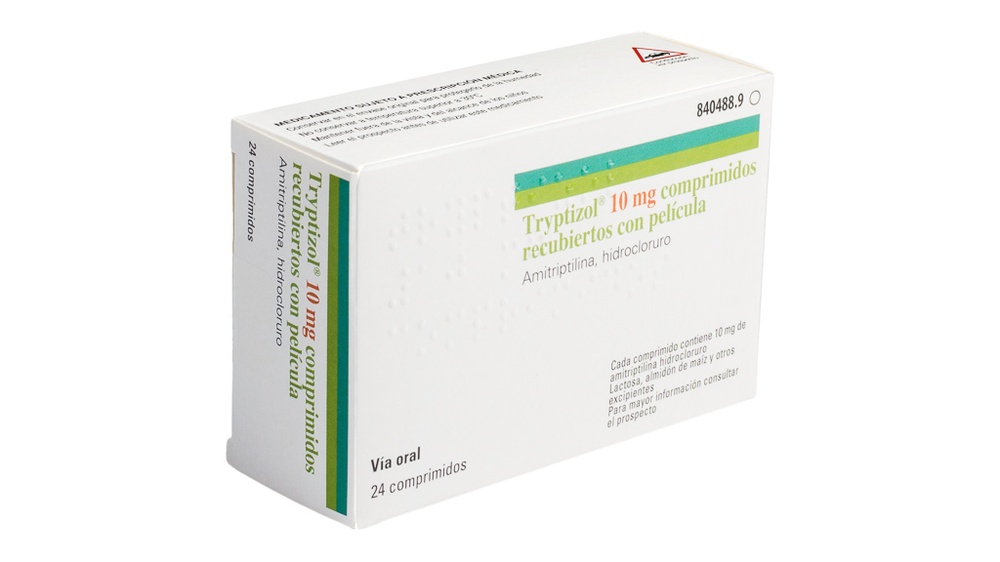
Tryptizol 10 mg comprimidos recubiertos con película

Solicitud de receta online
Un médico revisará tu caso y determinará si la prescripción es médicamente apropiada.

Habla con un médico sobre este medicamento
Comenta tus síntomas y las opciones de tratamiento en una consulta online.



Cómo usar TRYPTIZOL 10 mg COMPRIMIDOS RECUBIERTOS CON PELICULA
Contenido del prospecto
- Introducción
- Qué es Tryptizol y para qué se utiliza
- Qué necesita saber antes de empezar a tomar Tryptizol
- Cómo tomar Tryptizol
- Posibles efectos adversos
- Conservación de Tryptizol
- Contenido del envase e información adicional
Introducción
Prospecto: información para el paciente
Tryptizol 10 mg comprimidos recubiertos con película
amitriptilina, hidrocloruro
Lea todo el prospecto detenidamente antes de empezar a tomar este medicamento, porque contiene información importante para usted.
- Conserve este prospecto, ya que puede tener que volver a leerlo.
- Si tiene alguna duda, consulte a su médico o farmacéutico.
- Este medicamento se le ha recetado solamente a usted, y no debe dárselo a otras personas aunque tengan los mismos síntomas que usted, ya que puede perjudicarles.
- Si experimenta efectos adversos, consulte a su médico o farmacéutico, incluso si se trata de efectos adversos que no aparecen en este prospecto. Ver sección 4.
Contenido del prospecto
- Qué es Tryptizol y para qué se utiliza
- Qué necesita saber antes de empezar a tomar Tryptizol
- Cómo tomar Tryptizol
- Posibles efectos adversos
- Conservación de Tryptizol
- Contenido del envase e informaciónadicional
1. Qué es Tryptizol y para qué se utiliza
Tryptizol pertenece a un grupo de medicamentos llamados antidepresivos tricíclicos.
- Depresión en adultos (episodios de depresión mayor)
- Dolor neuropático en adultos
- Prevención del dolor de cabeza crónico tipo tensional en adultos
- Prevención de la migraña en adultos
- Incontinencia urinaria en niños de 6 o más años, sólo cuando otras causas orgánicas, como espinia bífida y trastornos relacionados, han sido excluidos y no se ha logrado una respuesta con otros tratamientos no farmacológicos o farmacológicos, incluyendo releajanteas musculares y desmopresina. Este medicamento sólo se debe prescribir por médicos con experiencia en el tratamiento de pacientes con escapes de orina persistentes

¿No estás seguro de si este medicamento es adecuado para ti?
Comenta tus síntomas y tratamiento con un médico online.
2. Qué necesita saber antes de empezar a tomar Tryptizol
No tome Tryptizol:
- si es alérgico a amitriptilina o a algunos de los demás componentes de este medicamento (incluidos en la sección 6)
- si ha tenido recientemente un ataque al corazón (infarto de miocardio)
- si ha tenido problemas de corazón como alteraciones del ritmo cardiaco detectadas en el electrocardiograma (ECG), bloqueo cardiaco o enfermedad coronaria
- si está tomando medicamentos conocidos como inhibidores de la monoamino oxidasa (IMAO)
- si ha tomado IMAO en los últimos 14 días
- si ha tomado moclobemida el día anterior
- si tiene una enfermedad hepática grave
- Si está tomando Typtizol, tiene que interrumpir el tratamiento con este medicamento y esperar 14 días antes de iniciar el tratamiento con un IMAO.
Este medicameto no debe usarse en niños menores de 6 años.
Advertencias y precauciones
Consulte a su médico o farmacéutico antes de empezar a tomar Tryptizol.
Pueden producirse trastornos del ritmo cardiaco e hipotensión si recibe una dosis alta de amitriptilina. Esto también puede ocurrir con las dosis habituales si tiene una enfermedad cardiaca preexistente.
El uso de Buprenorfina o Buprenorfina/naloxona junto con Tryptizol puede provocar síndrome serotoninérgico, una enfermedad potencialmente mortal (ver “Toma de Tryptizol con otros medicamentos”)
Se han notificado reacciones cutáneas graves, incluidas reacciones farmacológicas con eosinofilia y síntomas sistémicos (DRESS), en asociación con el tratamiento con Tryptizol. Deje de usar Tryptizol y busque atención médica de inmediato si nota cualquiera de los síntomas relacionados con estas reacciones cutáneas graves descritas en la sección 4.
Intervalo QT prolongado
Se han notificado un problema de corazón llamado “intervalo QT prolongado” (que aparece en el electrocardiograma [ECG]) y trastornos del ritmo cardiaco (latido del corazón rápido o irregular) con Tryptizol. Informe a su médico si:
- tiene una frecuencia cardiaca lenta
- tiene o ha tenido un problema en el que el corazón no puede bombear la sangre al organismo tal como debería (una situación llamada insuficiencia cardiaca)
- está tomando cualquier otra medicación que pueda causar problemas cardiacos, o
- tiene un problema que causa un nivel bajo de potasio o magnesio o un nivel alto de potasio en la sangre
- tiene una intervención quirúrgica programada, ya que puede ser necesario interrumpir el tratamiento con amitriptilina antes de que se le administren anestésicos. En caso de intervención quirúrgica urgente, se debe informar al anestesista sobre el tratamiento con amitriptilina
- tiene una glándula tiroides demasiado activa o recibe medicación para el tiroides
Pensamientos de suicidio y empeoramiento de la depresión
Si está deprimido es posible que a veces piense en hacerse daño a sí mismo o quitarse la vida. Este tipo de pensamientos pueden aumentar al iniciar por primera vez los antidepresivos, ya que todos estos medicamentos tardan en hacer efecto, habitualmente unas dos semanas, pero a veces más tiempo.
Puede ser más probable que tenga este tipo de pensamientos:
- Si ha tenido pensamientos de quitarse la vida o hacerse daño a sí mismo con anterioridad.
- Si es un adulto joven. La información de los ensayos clínicos ha mostrado un riesgo aumentado de conductas suicidas en los adultos jóvenes (menores de 25 años) con enfermedades psiquiátricas que recibieron tratamiento con un antidepresivo.
Si tiene pensamientos de hacerse daño a sí mismo o quitarse la vida, póngase en contacto con su médico o acuda a un hospital inmediatamente.
Puede resultarle útil contarle a un familiar o a un amigo íntimo que está deprimido y pedirles que lean este prospecto. Puede pedirles que le digan si creen que su depresión o ansiedad está empeorando o si están preocupados por cambios en su conducta.
Episodios de manía
Algunos pacientes con enfermedad maniaco‑depresiva pueden entrar en fase maniaca, que se caracteriza por ideas profusas que cambian rápidamente, alegría exagerada y actividad física excesiva. En estos casos, es importante que se ponga en contacto con su médico, que probablemente le cambiará la medicación.
Informe a su médico si tiene o ha tenido en el pasado cualquier problema médico, especialmente si tiene
- glaucoma de ángulo estrecho (pérdida de visión debida a una presión anormalmente alta en el ojo)
- epilepsia, antecedentes de convulsiones o crisis epilépticas
- dificultad para orinar
- aumento del tamaño de la próstata
- enfermedad de la tiroides
- trastorno bipolar
- esquizofrenia
- enfermedad del hígado grave
- enfermedad del corazón grave
- estenosis pilórica (estrechamiento de la salida del estómago) e íleo paralítico (bloqueo del intestino)
- diabetes, ya que puede ser necesario ajustarle el medicamento antidiabético
Si usa antidepresivos como los inhibidores selectivos de la recaptación de serotonina (ISRS), es posible que su médico considere cambiarle la dosis del medicamento (ver también la sección 2 “Toma de Tryptizol con otros medicamentos” y la sección 3).
Las personas de edad avanzada tienen una mayor probabilidad de sufrir ciertos efectos adversos como mareo cuando se pone en pie debido a una presión arterial baja (ver también la sección 4 “Posibles efectos adversos”).
Niños y adolescentes
Depresión, dolor neuropático, prevención del dolor de cabeza crónico tipo tensional y prevención de la migraña
No administre este medicamento a niños y adolescentes menores de 18 años para estos tratamientos ya que no se han realizado estudios de seguridad y eficacia a largo plazo para este grupo de edad.
Incotinencia urinaria nocturna
- Se debe realizar un ECG antes del inicio de la terapia con amitriptilina para descartar un síndrome del QT largo
- Estos medicamentos no deben tomarse al mismo tiempo que un fármaco anticolinérgico (ver también la sección 2 “Toma de Tryptizol con otros medicamentos”)
- Durante las fases tempranas del tratamiento con antidepresivos para trastornos distintos de la depresión también pueden producirse pensamientos y conductas suicidas; por lo tanto, al tratar a los pacientes con enuresis, se deben observar las mismas precauciones que al tratar a los pacientes con depresión
Toma de Tryptizol con otros medicamentos
Algunos medicamentos pueden afectar al funcionamiento de otros medicamentos y esto a veces puede causar efectos adversos graves.
Informe a su médico o farmacéutico si está tomando o ha tomado recientemente cualquier otro medicamento, como:
- inhibidores de la monoamino oxidasa (IMAO) como, p. ej., fenelzina, iproniazida, isocarboxazida, nialamida o tranilcipromina (utilizados para tratar la depresión) o selegilina (utilizada para tratar la enfermedad de Parkinson). Estos medicamentos no deben tomarse al mismo tiempo que Tryptizol (ver sección 2 “No tome Tryptizol”)
- adrenalina, efedrina, isoprenalina, noradrenalina, fenilefrina y fenilpropanolamina (que pueden estar presentes en medicamentos para la tos o los resfriados y en algunos anestésicos)
- medicamentos para tratar la presión arterial alta como, por ejemplo, los antagonistas de los canales del calcio (p. ej., diltiazem y verapamilo), la guanetidina, la betanidina, la clonidina, la reserpina y la metildopa
- fármacos anticolinérgicos como ciertos medicamentos para tratar la enfermedad de Parkinson y los trastornos gastrointestinales (p. ej., atropina, hiosciamina)
- tioridazina (utilizada para tratar la esquizofrenia)
- tramadol (para aliviar el dolor)
- medicamentos para tratar las infecciones producidas por hongos (p. ej., fluconazol, terbinafina, ketoconazol e itraconazol)
- sedantes (p. ej., barbitúricos)
- Buprenorfina o Buprenorfina/naloxona. Estos medicamentos pueden interaccionar con Tryptizol y puede experimentar síntomas como contracciones musculares rítmicas involuntarias, incluidos los músculos que controlan el movimiento de los ojos, agitación, alucinaciones, coma, sudoración excesiva, temblores, exageración de los reflejos, aumento de la tensión muscular, temperatura corporal superior a 38 ºC. Póngase en contacto con su médico si sufre estos síntomas.
- antidepresivos (p. ej., ISRS [fluoxetina, paroxetina, fluvoxamina], duloxetina y bupropion)
- medicamentos para ciertas enfermedades del corazón (p. ej., betabloqueantes y antiarritímicos)
- cimetidina (utilizada para tratar las úlceras de estómago)
- metilfenidato (utilizado para tratar el THDA)
- ritonavir (utilizado para tratar el VIH)
- anticonceptivos orales
- rifampicina (para tratar infecciones)
- fenitoína y carbamazepina (utilizadas para tratar la epilepsia)
- Hierba de San Juan (Hypericum perforatum), un medicamento a base de plantas utilizado para la depresión
- medicamentos para la tiroides
- Ácido valproico
También debe informar a su médico si está tomando o ha tomado recientemente medicamentos que puedan afectar al ritmo del corazón como, p. ej.:
- medicamentos para tratar los latidos cardiacos irregulares (p. ej., quinidina y sotalol)
- astemizol y terfenadina (utilizados para tratar las alergias y la rinitis estacional)
- medicamentos utilizados para tratar algunas enfermedades mentales (p. ej., pimozida y sertindol)
- cisaprida (utilizada para tratar ciertos tipos de indigestión)
- halofantrina (utilizada para tratar la malaria)
- metadona (utilizada para tratar el dolor y para la desintoxicación)
- diuréticos (”comprimidos para orinar” como, p. ej., furosemida)
Si va a someterse a una intervención quirúrgica y a recibir anestésicos generales o locales, debe informar a su médico de que está tomando este medicamento.
Asimismo, debe informar a su dentista de que toma este medicamento si va a recibir un anestésico local.
Toma de Tryptizol con alcohol
No se aconseja beber alcohol durante el tratamiento con este medicamento, ya que puede aumentar su efecto sedante.
Embarazo y lactancia
Si está embarazada o en periodo de lactancia, cree que podría estar embarazada o tiene intención de quedarse embarazada, consulte a su médico antes de utilizar este medicamento.
La amitriptilina no se recomienda durante el embarazo a menos que su médico lo considere claramente necesario y solo tras una cuidadosa consideración del beneficio y el riesgo. Si ha tomado este medicamento durante la última parte del embarazo, el recién nacido puede presentar síntomas de abstinencia como irritablidad, aumento de la tensión muscular, temblor, respiración irregular, mala succión, llanto fuerte, retención urinaria y estreñimiento.
Su médico le aconsejará si iniciar/continuar/suspender la lactancia o interrumpir el uso de este medicamento teniendo en cuenta el beneficio de la lactancia para el niño y el beneficio del tratamiento para usted.
Conducción y uso de máquinas
Este medicamento puede causar somnolencia y mareo, especialmente al inicio del tratamiento. No conduzca ni trabaje con herramientas o maquinaria si se nota afectado.
Tryptizol contiene lactosa.Si su médico le ha indicado que padece una intolerancia a ciertos azúcares, consulte con él antes de tomar este medicamento.
3. Cómo tomar Tryptizol
Siga exactamente las instrucciones de administración de este medicamento indicadas por su médico. En caso de duda, consulte de nuevo a su médico.
No todas las pautas posológicas pueden alcanzarse con todas las formas farmacéuticas/concentraciones. Se debe seleccionar la forma farmacéutica/concentración adecuada para las dosis iniciales y para cualquier aumento en las dosis posteriores.
Depresión
Adultos
La dosis inicial recomendada es de 25 mg dos veces al día.
Dependiendo de la respuesta al medicamento, es posible que su médico aumente gradualmente la dosis a 150 mg al día divididos en dos tomas.
Personas de edad avanzada (mayores de 65años) y pacientes con enfermedad cardiovascular
La dosis inicial recomendada es de 10-25 mgal día
Dependiendo de su respuesta al medicamento, es posible que su médico aumente gradualmente la dosis a una dosis diaria total de 100 mg divididos en dos tomas. Si recibe dosis de 100 mg ‑ 150 mg, puede que su médico tenga que realizarle seguimientos más frecuentes.
Uso en niños y adolescentes
Este medicamento no debe administrarse a niños o adolescentes para el tratamiento de la depresión. Para más información, ver sección 2.
Dolor neuropático, dolor de cabeza crónico tipo tensional y prevención de la migraña
Su médico ajustará la medicación en función de sus síntomas y su respuesta al tratamiento.
Adultos
La dosis inicial recomendada es de 10 mg ‑ 25 mg por la noche.
La dosis diaria recomendada es de 25 mg ‑ 75 mg.
Dependiendo de su respuesta al medicamento, es posible que su médico aumente gradualmente la dosis. Si se le administra una dosis superior a 100 mg diarios, su médico puede tener que realizar visitas de seguimiento más frecuentes. Su médico le indicará si debe tomar la dosis una sola vez al día o dividirla en dos tomas.
Personas de edad avanzada (mayores de 65años) y pacientes con enfermedad cardiovascular
La dosis inicial recomendada es de 10 mg -25 mg por la noche.
Dependiendo de su respuesta al medicamento, es posible que su médico aumente gradualmente la dosis. Si recibe dosis superiores a 75 mg al día, puede que su médico tenga que realizarle seguimientos más frecuentes.
Uso en niños y adolescentes
Este medicamento no debe administrarse a niños o adolescentes para el tratamiento del dolor neuropático, la prevención del dolor de cabeza crónico tipo tensional ni para la profilaxis de la migraña. Para más información, ver sección 2.
Incontinencia urinaria nocturna
Uso en niños y adolescentes
Dosis recomendadas para niños:
- menores de 6 años: ver sección 2 “No tome Tryptizol”
- de 6 a 10 años: 10 mg ‑ 20 mg. Para este grupo de edad se debe utilizar una forma farmacéutica más apropiada.
- de 11 o más años: 25 mg – 50 mg.
La dosis se debe aumentar gradualmente.
Tome este medicamento de 1 hora a una 1 hora y media antes de acostarse.
Antes de iniciar el tratamiento, su médico le realizará un ECG del corazón para comprobar si hay signos de latidos cardiacos inusuales.
Su médico reevaluará su tratamiento al cabo de 3 meses y, si es necesario, le realizará otro ECG.
No interrumpa el tratamiento sin consultar antes a su médico.
Pacientes con riesgos especiales
Los pacientes con enfermedades hepáticas o los que tienen lo que se conoce como un "metabolismo deficiente" suelen recibir dosis más bajas.
Su médico le puede extraer muestras de sangre para determinar el nivel de amitriptilina en la misma (ver también la sección 2).
Cómo y cuándo tomar Tryptizol
Este medicamento puede tomarse acompañado o no de alimentos.
Trague los comprimidos con un vaso de agua. No los mastique.
Duración del tratamiento
No cambie la dosis del medicamento ni interrumpa el tratamiento con él sin consultar antes a su médico.
Depresión
Al igual que con otros medicamentos para el tratamiento de la depresión, es posible que tarde unas semanas en notar una mejoría.
En la depresión, la duración del tratamiento es individual y suele durar un mínimo de 6 meses. Su médico decidirá la duración del tratamiento.
Siga tomando este medicamento todo el tiempo que le recomiende su médico.
La enfermedad subyacente puede persistir durante mucho tiempo. Si interrumpe demasiado pronto el tratamiento, los síntomas pueden reaparecer.
Dolor neuropático, prevención del dolor de cabeza crónico tipo tensional yprevención de la migraña
Es posible que tarde unas semanas en notar una mejoría del dolor.
Hable con su médico sobre la duración del tratamiento y siga tomando este medicamento todo el tiempo que le recomiende su médico.
Incontinencia urinaria nocturna
Su médico evaluará si se debe continuar con el tratamiento al cabo de 3 meses.
Si toma más Tryptizol del que debe
Contacte con su médico o el servicio de urgencias del hospital más cercano inmediatamente. Haga esto incluso aunque no tenga signos de molestias o intoxicación. Lleve consigo el envase de este medicamento si va al médico o al hospital.
En caso de sobredosis o ingestión accidental, consulte inmediatamente a su médico, farmacéutico o llame al Servicio de Información Toxicológica, teléfono: 91 562 04 20, indicando el medicamento y la cantidad ingerida.
Entre los síntomas de sobredosis se encuentran:
- pupilas dilatadas
- latidos cardiacos rápidos o irregulares
- dificultades para orinar
- sequedad de boca y lengua
- bloqueo intestinal
- crisis epilépticas
- fiebre
- agitación
- confusión
- alucinaciones
- movimientos incontrolados
- presión arterial baja, pulso débil, palidez
- dificultad para respirar
- coloración azulada de la piel
- disminución de la frecuencia cardiaca
- somnolencia
- pérdida de la conciencia
- coma
- diversos síntomas cardiacos, como bloqueo cardiaco, insuficiencia cardiaca, hipotensión, shock cardiogénico, acidosis metabólica, hipopotasemia
La sobredosis de amitriptilina en niños podría tener consecuencias graves. Los niños son especialmente propensos a coma, síntomas cardiacos, dificultad para respirar, convulsiones, concentraciones bajas de sodio en sangre, letargo, somnolencia, náuseas, vómitos y nivel elevado de azúcar en sangre.
Si olvidó tomar Tryptizol
Tome la siguiente dosis a la hora habitual. No tome una dosis doble para compensar las dosis olvidadas.
Si interrumpe el tratamiento con Tryptizol
Su médico decidirá cuándo y cómo interrumpir el tratamiento para evitar cualquier síntoma desagradable que pudiera producirse si se interrumpe bruscamente (p. ej., dolor de cabeza, sensación de malestar, insomnio e irritabilidad).
Si tiene cualquier otra duda sobre el uso de este medicamento, pregunte a su médico o farmacéutico.

¿Has empezado a tomar el medicamento y tienes preguntas?
Comenta tus síntomas y tratamiento con un médico online.
4. Posibles efectos adversos
Al igual que todos los medicamentos, este medicamento puede producir efectos adversos, aunque no todas las personas los sufran.
Si nota cualquiera de los siguientes síntomas, debe acudir a su médico inmediatamente:
- Ataques de visión borrosa intermitente, visión en arcoiris y dolor ocular.
Se le debe realizar una exploración ocular inmediatamente antes de poder proseguir el tratamiento con este medicamento. Estos síntomas pueden ser un signos de glaucoma agudo. Efecto adverso muy raro, puede afectar hasta 1 de cada 10.000 personas.
- Un problema del corazón “intervalo QT prolongado” (que se puede ver en su electrocardiograma). Efecto adverso frecuente, puede afectar hasta 1 de cada 10 personas.
- Estreñimiento importante, hinchazón del estómago, fiebre y vómitos.
Estos síntomas pueden deberse a una parálisis de partes del intestino. Efecto adverso raro, puede afectar hasta 1 de cada 1.000 personas.
- Cualquier grado de coloración amarillenta de la piel y de la parte blanca de los ojos (ictericia).
Es posible que su hígado esté afectado. Efecto adverso raro, puede afectar hasta 1 de cada 1.000 personas.
- Moratones, sangrados, palidez o dolor de garganta y fiebre persistentes.
Estos síntomas pueden ser los primeros signos de una posible afectación de la sangre o médula osea.
Los efectos sanguíneos pueden ser una disminución del número de glóbulos rojos (que transportan el oxígeno por el cuerpo), glóbulos blancos (que ayudan a combatir las infecciones) y plaquetas (que ayudan a la coagulación). Efecto adverso raro, puede afectar hasta 1 de cada 1.000 personas.
- Pensamientos o comportamientos suicidas. Efectos adversos raros, puede afectar hasta 1 de cada 1.000 personas.
Se han notificado los efectos adversos indicados a continuación en las siguientes frecuencias:
Muy frecuentes: pueden afectar a más de 1 de cada 10 personas
- adormecimiento/somnolencia
- temblor de las manos u otras partes del cuerpo
- mareo
- dolor de cabeza
- latido cardiaco irregular, fuerte o rápido
- mareo al ponerse en pie debido a baja presión arterial (hipotensiónortostática)
- sequedad de boca
- estreñimiento
- náuseas
- sudoración excesiva
- aumento de peso
- balbuceo o habla lenta
- agresión
- congestión nasal
Frecuentes: pueden afectar hasta a 1 de cada 10 personas
- confusión
- alteraciones sexuales (disminución del apetito sexual, problemas de erección)
- alteraciones de la atención
- cambios en el sentido del gusto
- entumecimiento u hormigueos en los brazos o las piernas
- alteraciones de la coordinación
- pupilas dilatadas
- bloqueo cardiaco
- fatiga
- concentración baja de sodio en la sangre
- agitación
- trastornos urinarios
- sensación de sed
Poco frecuentes: pueden afectar hasta a 1 de cada 100 personas
- excitación, ansiedad, dificultades para dormir, pesadillas
- convulsiones
- tínitus
- aumento de la presión arterial
- diarrea, vómitos
- exantema cutáneo, exantema en ronchas (urticaria), hinchazón de la cara y la lengua
- dificultades para orinar
- aumento en la producción de leche en la lactancia o secreción de leche materna sin lactancia.
- aumento de la presión en el globo ocular
- situaciones de colapso
- empeoramiento de la insuficiencia cardiaca
- empeoramiento de la función hepática (p. ej. enfermedad hepática colestásica)
- aumento de la presión en el globo ocular, ataques de visión borrosa intermitente, visión en arcoiris y dolor ocular
Raros: pueden afectar hasta a 1 de cada 1.000 personas
- disminución del apetito
- delirio (especialmente en pacientes de edad avanzada), alucinaciones
- ritmo cardíaco o patrón cardíaco anormalhinchazón de las glándulas salivales
- caída del cabello
- aumento de la sensibilidad a la luz del sol
- aumento del tamaño de las mamas en los hombres
- fiebre
- pérdida de peso
- resultados de pruebas de función hepática anómalas
Muy raros: puede afectar hasta 1 de cada 10.000 personas
- enfermedades del músculo cardíaco
- sensación de inquietud y necesidad de estar en continuo movimiento
- alteración de los nervios periféricos
- aumento agudo de la presión en el ojo
- formas particulares de ritmo cardíaco anormal (también llamado torsades de pointes)
- inflamación alérgica del alveolo pulmonar y del tejido pulmonar
Frecuencia no conocida (no puede estimarse a partir de los datos disponibles)
- ausencia de sensación de apetito
- aumento o descenso de los niveles de azúcar en sangre
- paranoia
- alteraciones del movimiento (movimientos involuntarios o movimientos disminuidos)
- inflamación por hipersensibilidad del músculo cardiaco
- hepatitis
- sofoco
- Ojos secos
- Deje de usar Tryptizol y busque atención médica de inmediato si nota alguno de los siguientes síntomas: Erupción generalizada, temperatura corporal elevada y aumento de tamaño de los ganglios linfáticos (DRESS o síndrome de hipersensibilidad a fármacos).
Se ha observado un aumento del riesgo de fracturas óseas en los pacientes tratados con este tipo de medicamentos.
Comunicación de efectos adversos
Si experimenta cualquier tipo de efecto adverso, consulte a su médico o farmacéutico, incluso si se trata de posibles efectos adversos que no aparecen en este prospecto. También puede comunicarlos directamente a través del Sistema Español de Farmacovigilancia de Medicamentos de Uso Humano: www.notificaram.es.
Mediante la comunicación de efectos adversos usted puede contribuir a proporcionar más información sobre la seguridad de este medicamento.
5. Conservación de Tryptizol
Mantener este medicamento fuera de la vista y del alcance de los niños.
No requiere condiciones especiales de conservación.
No utilice este medicamentodespués de la fecha de caducidad que aparece en el envase después de CAD. La fecha de caducidad es el último día del mes que se indica.
No utilice este medicamento si observa indicios de deterioro.
Los medicamentos no se deben tirar por los desagües ni a la basura. Deposite los envases y los medicamentos que no necesita en el punto SIGRE de la farmacia. En caso de duda pregunte a su farmacéutico cómo deshacerse de los envases y de los medicamentos que no necesita. De esta forma, ayudará a proteger el medio ambiente.
6. Contenido del envase e información adicional
Composición de Tryptizol
- El principio activo es amitriptilina hidrocloruro.
- Los demás componentes son lactosa hidratada, fosfato cálcico dibásico, celulosa en polvo, almidón de maíz, sílice coloidal, ácido esteárico, estearato magnésico, hidroxipropilmetilcelulosa (E464), hidroxipropilcelulosa (E463), dióxido de titanio (E171), talco, laca alumínica FD&C azul 2 y cera de carnauba.
Aspecto del producto y contenido del envase
Tryptizol se presenta en envases de 24 comprimidos recubiertos. Los comprimidos son redondos, biconvexos, de color azul.
Titular de la autorización de comercialización y responsable de la fabricación
Titular de la autorización de comercialización
PAN QUÍMICA-FARMACÉUTICA, S.A.
Rufino González, 50
28037 Madrid
España
Responsable de fabricación
ROVI Pharma Industrial Services, S.A.
Vía Complutense, 140
Alcalá de Henares 28805 – Madrid
(España)
Representante local
Laboratorios Farmacéuticos ROVI, S.A.
Julián Camarillo, 35
28037 Madrid
España
Fecha de la última revisión de este prospecto:Enero 2025.
La información detallada de este medicamento está disponible en la página web de la Agencia Española de Medicamentos y Productos Sanitarios (AEMPS) http://www.aemps.gob.es/.
- País de registro
- Forma farmacéuticaCOMPRIMIDO, 10 mg
- Código ATCN06AA09
- Precio medio en farmacia1.06 EUR
- Principio activo
- Requiere recetaSí
- Fabricante
- ComposiciónLACTOSA HIDRATADA (11,1 mg mg)
- Esta información es de carácter general y no sustituye la consulta con un profesional sanitario.
- Alternativas a TRYPTIZOL 10 mg COMPRIMIDOS RECUBIERTOS CON PELICULAForma farmacéutica: COMPRIMIDO, 10 mgPrincipio activo: amitriptilinaFabricante: Neuraxpharm Spain S.L.Requiere recetaForma farmacéutica: COMPRIMIDO, 25 mgPrincipio activo: amitriptilinaFabricante: Neuraxpharm Spain S.L.Requiere recetaForma farmacéutica: COMPRIMIDO, 50 mgPrincipio activo: amitriptilinaFabricante: Neuraxpharm Spain S.L.Requiere receta
Médicos online para TRYPTIZOL 10 mg COMPRIMIDOS RECUBIERTOS CON PELICULA
Comenta la dosis, los posibles efectos secundarios, interacciones, contraindicaciones o si una receta es apropiada para TRYPTIZOL 10 mg COMPRIMIDOS RECUBIERTOS CON PELICULA, sujeto a valoración médica y a la normativa local.







Preguntas frecuentes
TRYPTIZOL 10 mg COMPRIMIDOS RECUBIERTOS CON PELICULA requiere receta en España. Puedes confirmarlo con un médico online según tu caso.
El principio activo de TRYPTIZOL 10 mg COMPRIMIDOS RECUBIERTOS CON PELICULA es amitriptilina. Esta información ayuda a identificar medicamentos con la misma composición pero con diferentes nombres comerciales.
El precio medio en farmacia de TRYPTIZOL 10 mg COMPRIMIDOS RECUBIERTOS CON PELICULA es de aproximadamente 1.06 EUR. Puede variar según el fabricante y la forma farmacéutica.
TRYPTIZOL 10 mg COMPRIMIDOS RECUBIERTOS CON PELICULA es fabricado por Pan Quimica Farmaceutica S.A.. La marca y el envase pueden variar según el distribuidor.
Los Médicos de familia, Psiquiatras, Dermatólogos, Cardiólogos, Endocrinólogos, Gastroenterólogos, Neumólogos, Nefrólogos, Reumatólogos, Hematólogos, Infectólogos, Alergólogos, Geriatras, Pediatras, Oncólogos pueden valorar la prescripción de TRYPTIZOL 10 mg COMPRIMIDOS RECUBIERTOS CON PELICULA cuando esté clínicamente indicado. Puedes reservar una videoconsulta para comentar tu caso y las opciones de tratamiento.
La receta la emite un médico tras valorar tu estado de salud. En España, TRYPTIZOL 10 mg COMPRIMIDOS RECUBIERTOS CON PELICULA se dispensa en las farmacias con esa receta médica. Una consulta online no garantiza su emisión: la decisión corresponde siempre al médico.
Para solicitar una valoración puedes usar Oladoctor:
Otros medicamentos con el mismo principio activo (amitriptilina) incluyen AMITRIPTILINA HIDROCLORURO NEURAXPHARM 10 MG COMPRIMIDOS RECUBIERTOS CON PELICULA EFG, AMITRIPTILINA HIDROCLORURO NEURAXPHARM 25 MG COMPRIMIDOS RECUBIERTOS CON PELICULA EFG, AMITRIPTILINA HIDROCLORURO NEURAXPHARM 50 MG COMPRIMIDOS RECUBIERTOS CON PELICULA EFG. Pueden tener diferentes nombres comerciales o formulaciones, pero contienen el mismo componente terapéutico. Consulta siempre con un médico antes de cambiar o iniciar un nuevo medicamento.
