


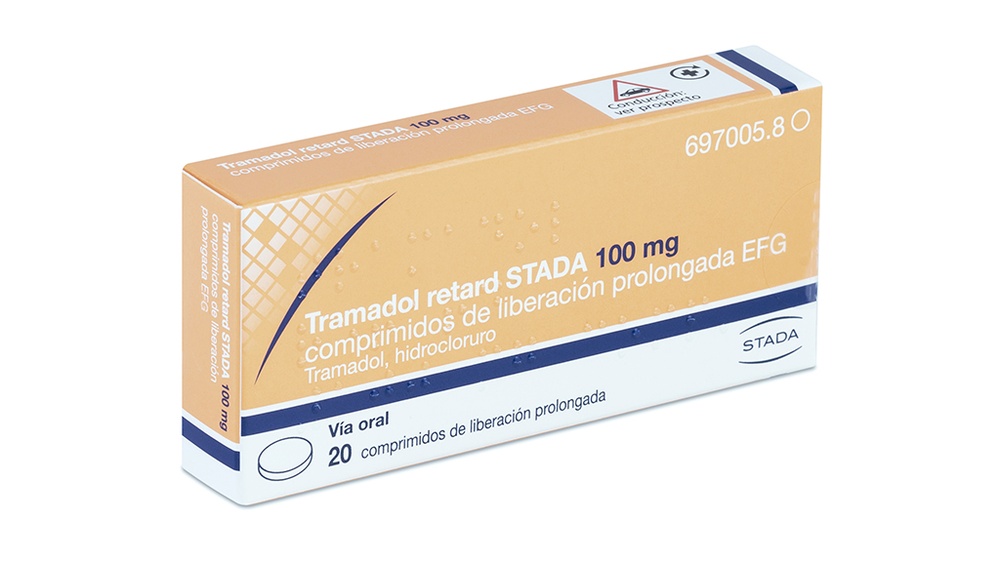
Tramadol Stada 100 mg comprimidos de liberación prolongada

Solicitud de receta online
Un médico revisará tu caso y determinará si la prescripción es médicamente apropiada.

Habla con un médico sobre este medicamento
Comenta tus síntomas y las opciones de tratamiento en una consulta online.



Cómo usar TRAMADOL RETARD STADA 100 MG COMPRIMIDOS DE LIBERACION PROLONGADA EFG
Contenido del prospecto
- Introducción
- Qué es Tramadol retard Stada y para qué se utiliza
- Qué necesita saber antes de empezar a tomar Tramadol retard Stada
- Cómo tomar Tramadol retard Stada
- Posibles efectos adversos
- Conservación de Tramadol retard Stada
- Contenido del envase e información adicional
Introducción
Prospecto: información para el usuario
Tramadol retard Stada 100 mg comprimidos de liberación
prolongada EFG
Hidrocloruro de tramadol
Lea todo el prospecto detenidamente antes de empezar a tomar este medicamento, porque contiene información importante para usted.
- Conserve este prospecto, ya que puede tener que volver a leerlo.
- Si tiene alguna duda, consulte a su médico o farmacéutico.
- Este medicamento se le ha recetado solamente a usted,y no debe dárselo a otras personas aunque tengan los mismos síntomas que usted, ya que puede perjudicarles.
- Si experimenta efectos adversos, consulte a su médico o farmacéutico, incluso si se trata de efectos adversos que no aparecen en este prospecto. Ver sección 4
Contenido del prospecto
- Qué es Tramadol retard Stada y para qué se utiliza
- Qué necesita saber antes de empezar a tomar Tramadol retard Stada
- Cómo tomar Tramadol retard Stada
- Posibles efectos adversos
- Conservación de Tramadol retard Stada
- Contenido del envase e información adicional
1. Qué es Tramadol retard Stada y para qué se utiliza
Tramadol es un analgésico perteneciente al grupo de los opioides que actúa sobre el sistema nervioso central. Alivia el dolor actuando sobre células nerviosas específicas de la médula espinal y del cerebro.
Tramadol retard se usa en el tratamiento del dolor moderado a intenso

¿No estás seguro de si este medicamento es adecuado para ti?
Comenta tus síntomas y tratamiento con un médico online.
2. Qué necesita saber antes de empezar a tomar Tramadol retard Stada
No tome Tramadol retard Stada
- Si es alérgico al principio activo o a alguno de los demás componentes de este medicamento (incluidos en la sección 6).
- En caso de intoxicaciones agudas originadas por alcohol, fármacos inductores del sueño, analgésicos o psicótropos (medicamentos que actúan sobre el estado de ánimo y las emociones).
- Si está tomando también inhibidores de la MAO (determinados medicamentos utilizados para el tratamiento de la depresión) o si los ha tomado durante los últimos 14 días antes de comenzar el tratamiento con tramadol (ver “Otros medicamentos y Tramadol retard Stada”).
- Si padece epilepsia y sus crisis convulsivas no están adecuadamente controladas con tratamiento.
- Como tratamiento del síndrome de abstinencia.
Advertencias y precauciones
Consulte a su médico o farmacéutico antes de empezar a tomar este medicamento
- Si piensa que tiene dependencia de otros analgésicos (opioides).
- Si presenta trastornos de la consciencia (si piensa que se va a desmayar).
- Si se encuentra en estado de shock (un signo de este estado puede ser el sudor frío).
- Si sufre un aumento de la presión dentro del cráneo (por ejemplo después de un traumatismo craneal o enfermedad cerebral).
- Si tiene dificultad para respirar.
- Si es epiléptico o padece crisis convulsivas, porque el riesgo de estas crisis puede aumentar.
- Si tiene alguna enfermedad de hígado o de riñón.
- Si sufre depresión y está tomando antidepresivos puesto que algunos pueden interactuar con el tramadol (véase “Otros medicamentos y Tramadol retard Stada”).
En tales casos, por favor consulte a su médico antes de tomar el medicamento.
Se han comunicado ataques de epilepsia en pacientes que tomaban tramadol a la dosis recomendada. El riesgo puede aumentar cuando la dosis de tramadol supera el límite recomendado de dosis diaria (400 mg).
Tolerancia, dependencia y adicción
Este medicamento contiene tramadol, que es un medicamento opioide. El uso repetido de opioides puede hacer que el fármaco sea menos eficaz (el organismo se acostumbra a él, lo que se conoce como tolerancia farmacológica). El uso repetido de tramadol también puede provocar dependencia, abuso y adicción, lo que podría dar lugar a una sobredosis potencialmente mortal. El riesgo de estos efectos adversos puede ser mayor con una dosis más alta y un uso más prolongado.
La dependencia o la adicción pueden provocar la sensación de falta de control sobre la cantidad de medicamento que debe usar o sobre la frecuencia con la que debe usarlo.
El riesgo de dependencia o adicción varía de una persona a otra. El riesgo de volverse dependiente
o adicto a tramadol puede ser mayor si:
- Usted o cualquier miembro de su familia han abusado del alcohol o experimentado dependencia de él, de medicamentos con receta o de drogas ilegales («adicción»).
- Es fumador.
- Ha tenido alguna vez problemas con el estado de ánimo (depresión, ansiedad o un trastorno de la personalidad) o ha seguido el tratamiento de un psiquiatra por otras enfermedades mentales.
- Si observa cualquiera de los siguientes síntomas mientras utiliza tramadol, podría ser un signo de dependencia o adicción:
- Necesita usar el medicamento durante más tiempo del indicado por su médico.
- Necesita usar una dosis superior a la recomendada.
- Está utilizando el medicamento por motivos distintos a los prescritos, por ejemplo, «para estar tranquilo» o «para ayudarle a dormir».
- Ha realizado intentos repetidos e infructuosos de dejar de usar el medicamento o controlar su uso.
- Se siente indispuesto cuando deja de usar el medicamento, y se siente mejor una vez que vuelve a tomarlo («efectos de abstinencia»).
Si nota cualquiera de estos signos, consulte a su médico para determinar la mejor modalidad de tratamiento para usted, cuándo es apropiado suspender el medicamento y cómo hacerlo de forma segura (ver sección 3, si interrumpe el tratamiento con tramadol).
Tramadol es transformado en hígado por una enzima. Algunas personas tienen una variación de esta enzima y esto puede afectar a cada persona de formas diferentes. En algunas personas, es posible que no se consiga un alivio suficiente del dolor, mientras que otras personas tienen más probabilidades de sufrir efectos adversos graves. Si nota cualquiera de los siguientes efectos adversos, debe dejar de tomar este medicamento y consultar con un médico de inmediato: respiración lenta o superficial, confusión, somnolencia, pupilas contraídas, malestar general o vómitos, estreñimiento, falta de apetito.
Trastornos respiratorios relacionados con el sueño
Tramadol puede provocar trastornos respiratorios relacionados con el sueño, como apnea del sueño (pausas en la respiración durante el sueño) e hipoxemia relacionada con el sueño (nivel bajo de oxígeno en la sangre). Entre los síntomas pueden incluirse pausas en la respiración durante el sueño, despertares nocturnos debidos a la falta de aliento, dificultad para mantener el sueño o somnolencia excesiva durante el día. Si usted u otra persona observa estos síntomas, póngase en contacto con su médico. Puede que su médico considere una reducción de la dosis.
Hable con su médico, farmacéutico o enfermero si experimenta alguno de los siguientes síntomas mientras toma tramadol:
Fatiga extrema, falta de apetito, dolor abdominal grave, náuseas, vómitos o presión arterial baja. Pueden ser indicadores de insuficiencia suprarrenal (niveles bajos de cortisol). Si tiene estos síntomas, póngase en contacto con su médico, que decidirá si necesita tomar suplementos hormonales.
Existe un débil riesgo de que experimente un síndrome serotoninérgico susceptible de aparecer después de haber tomado tramadol en combinación con determinados antidepresivos o tramadol en monoterapia. Consulte inmediatamente con un médico si presenta alguno de los síntomas ligados a este síndrome grave (ver sección 4 “Posibles efectos adversos”).
Niños
Este medicamento no es adecuado para niños menores de 12 años.
Uso en niños con problemas respiratorios
No se recomienda el uso de tramadol en niños con problemas respiratorios, ya que los síntomas de la toxicidad por tramadol pueden empeorar en estos niños.
Otros medicamentos y Tramadol retard Stada
Informe a su médico o a su farmacéutico si está utilizando, ha utilizado recientemente o podría tener que utilizar cualquier otro medicamento.
Debe evitarse el tratamiento simultáneo de tramadol con inhibidores de la monoaminooxidasa (IMAO) (unos medicamentos para el tratamiento de la depresión).
El efecto analgésico de tramadol así como la duración del mismo pueden reducirse si usted toma medicamentos que contengan:
- Carbamazepina (para crisis epilépticas)
- Pentazocina, nalbufina o buprenorfina (analgésicos);
- Ondansetrón (medicamento para prevenir las náuseas)
Su médico le indicará si debe tomar tramadol y a qué dosis. El riesgo de efectos adversos aumenta,
- Si toma tranquilizantes, fármacos inductores del sueño, otros analgésicos como la morfina y la codeína (también cuando se utiliza para la tos), y alcohol mientras toma tramadol. Le puede provocar más sueño o tener la sensación de ir a desmayarse. Si esto ocurre, consulte a su médico.
- Si está tomando medicamentos que faciliten o puedan provocar crisis convulsivas, como por ejemplo, algunos antidepresivos o antipsicóticos. El riesgo de tener convulsiones puede aumentar si toma tramadol al mismo tiempo. Su médico le dirá si tramadol es adecuado para usted.
- Si está tomando antidepresivos, tramadol puede interactuar con estos medicamentos y puede experimentar un síndrome serotoninérgico (véase la sección 4 “Posibles efectos adversos”).
- Si toma anticoagulantes cumarínicos (medicamentos que previenen la coagulación anormal de la sangre), como por ejemplo, la warfarina, junto con tramadol . El efecto de estos medicamentos en la coagulación sanguínea puede verse afectado y puede dar lugar a una hemorragia.
- El uso concomitante de tramadol con medicamentos sedantes tales como benzodiacepinas o medicamentos relacionados aumenta el riesgo de sufrir sedación, depresión respiratoria, coma o incluso muerte. Debido a esto, el uso concomitante solo debe considerarse cuando no son posibles otras opciones de tratamiento. Sin embargo, si su médico le receta tramadol retard junto con sedantes, la dosis y la duración del tratamiento concomitante deberá ser limitada por su médico.
Informe a su médico sobre todos los medicamentos sedantes que esté tomando y siga de cerca la recomendación de dosificación de su médico. Podría ser útil informar a amigos o parientes para que tengan conocimiento de los signos y síntomas indicados anteriormente. Contacte con su médico cuando experimente dichos síntomas.
- Si está tomando gabapentina o pregabalina para tratar la epilepsia o el dolor debido a problemas nerviosos (dolor neuropático)
Toma de Tramadol retard Stada con los alimentos, bebidas y alcohol
No consuma alcohol durante el tratamiento con tramadol ya que su efecto se puede intensificar. Los alimentos no influyen en el efecto de este medicamento.
Embarazo y lactancia
Si está embarazada o en período de lactancia, cree que podría estar embarazada o tiene intención de quedarse embarazada, consulte a su médico o farmacéutico antes de utilizar este medicamento.
Hay muy poca información con respecto a la seguridad de tramadol durante el embarazo humano. Por lo tanto, no debe tomar este medicamento si está embarazada.
La toma crónica durante el embarazo puede dar lugar a síndrome de abstinencia en los recién nacidos.
Tramadol se excreta en la leche materna. Por este motivo, no debe tomar este medicamento más de una vez durante la lactancia, o si toma tramadol más de una vez, debe interrumpir la lactancia.
Conducción y uso de máquinas
Pregunte a su médico si puede conducir o utilizar máquinas durante el tratamiento con tramadol. Es importante que antes de conducir o utilizar máquinas, observe como le afecta este medicamento. No conduzca ni utilice máquinas si siente sueño, mareo, tiene visión borrosa o ve doble, o tiene dificultad para concentrarse. Tenga especial cuidado al inicio del tratamiento, tras un aumento de la dosis, tras un cambio de formulación y/o al administrarlo conjuntamente con otros medicamentos.
3. Cómo tomar Tramadol retard Stada
Siga exactamente las instrucciones de administración de este medicamento indicadas por su médico. En caso de dudas, consulte de nuevo a su médico o farmacéutico.
Antes de iniciar el tratamiento y de forma regular durante el mismo, su médico también le explicará lo que puede esperar del uso de tramadol, cuándo y durante cuánto tiempo debe usarlo, cuándo debe ponerse en contacto con su médico y cuándo debe suspender el uso (ver también la sección 2).
La dosis se debe ajustar a la intensidad del dolor y su sensibilidad individual al dolor. Normalmente se debe tomar la menor dosis analgésica que produzca alivio del dolor.
A menos que su médico le haya dado instrucciones distintas, la dosis recomendada es:
Adultos y adolescentes mayores de 12 años
Un comprimido de Tramadol retard Stada 150 mg comprimidos de liberación prolongada dos veces al día (equivalente a 300 mg de hidrocloruro de tramadol por día), preferiblemente por la mañana y por la noche.
Si es necesario, su médico le puede prescribir una dosis diferente y más apropiada de este medicamento.
Si es necesario, la dosis puede aumentarse hasta 200 mg dos veces al día (equivalente a 400 mg de hidrocloruro de tramadol por día).
No tome más de 400 mg de hidrocloruro de tramadol al día, salvo que su médico así se lo haya indicado.
Pacientes ancianos
En pacientes ancianos (mayores de 75 años) la eliminación de tramadol puede ser lenta. Si este es su caso, su médico podría prolongar los intervalos de dosificación.
Pacientes con insuficiencia hepática o renal / diálisis
Si padece alguna enfermedad grave de hígado o riñón no debe tomar este medicamento. Si padece trastornos leves o moderados, su médico podría prolongar el intervalo de dosificación.
¿Cómo y cuándo debe tomar Tramadol retard Stada ?
Este medicamento se administra por vía oral.
Siempre se deben tragar los comprimidos enteros, no divididos ni masticados, con suficiente líquido, preferiblemente por la mañana y por la noche. Puede tomar el comprimido con el estómago vacío o con las comidas.
¿Durante cuánto tiempo debe tomar Tramadol retard Stada?
Este medicamento no debe administrarse durante más tiempo que el estrictamente necesario.
Si requiere un tratamiento prolongado, su médico controlará a intervalos cortos y regulares (si es necesario con interrupciones en el tratamiento) si debe continuar el tratamiento con Tramadol y con qué dosis.
Si estima que la acción de este medicamento es demasiado fuerte o débil, comuníqueselo a su médico o farmacéutico.
Uso en niños
Este medicamento no es adecuado para niños menores de 12 años.
Si toma más Tramadol retard Stada del que debe
Si usted ha tomado por error más tramadol del que debiera, generalmente no tendrá efectos negativos. Debe tomar la siguiente dosis como se ha prescrito.
Después de tomar dosis muy elevadas puede producirse contracción de la pupila, vómitos, disminución de la tensión arterial, aumento de las pulsaciones, colapso, disminución del nivel de consciencia hasta coma (inconsciencia profunda), ataques epilépticos y dificultad para respirar que puede llegar a parada respiratoria. En tal caso, avise inmediatamente a un médico.
En caso de sobredosis o ingestión accidental consulte inmediatamente a su médico, farmacéutico o llame al Servicio de Información Toxicológica, teléfono 91.562.04.20, indicando el medicamento y la cantidad tomada.
Si olvidó tomar Tramadol retard Stada
Si se olvida de tomar los comprimidos, es probable que el dolor vuelva a manifestarse. No tome una dosis doble para compensar las dosis olvidadas, simplemente continúe el tratamiento según le ha indicado su médico.
Si interrumpe el tratamiento con Tramadol retard Stada
Si interrumpe o finaliza el tratamiento con Tramadol retard Stada demasiado pronto, es probable que el dolor reaparezca. Si desea interrumpir el tratamiento debido a los efectos indeseables, consulte a su médico.
Generalmente no se producen efectos indeseables al finalizar el tratamiento con tramadol. Sin embargo, en raras ocasiones, cuando algunas personas que han estado tomando tramadol durante algún tiempo dejan de tomarlo repentinamente se pueden sentir mal. Se pueden sentir agitados, ansiosos, nerviosos o temblorosos. Se pueden sentir hiperactivos, tener dificultad para dormir o trastornos gástricos o intestinales. Muy pocas personas pueden llegar a tener ataques de pánico, alucinaciones, percepciones inusuales como picor, hormigueo y entumecimiento, y zumbido de oídos (acufenos). Rara vez, se han visto otros síntomas poco habituales del SNC, como confusión, delirios, percepción distorsionada de la personalidad propia (despersonalización) y alteraciones en la percepción de la realidad (desrealización) y delirios de persecución (paranoia). Si presenta alguno de estos síntomas después de interrumpir la toma de tramadol, por favor consulte a su médico.
Si tiene alguna duda sobre el uso de este medicamento, consulte a su médico o farmacéutico

¿Has empezado a tomar el medicamento y tienes preguntas?
Comenta tus síntomas y tratamiento con un médico online.
4. Posibles efectos adversos
Al igual que todos los medicamentos, tramadol puede tener efectos adversos, aunque no todas las personas los sufran. Normalmente la frecuencia de los efectos adversos se clasifica de la siguiente manera:
- Muy frecuentes (pueden afectar a más de 1 de cada 10 personas)
- Frecuentes (pueden afectar hasta 1 de cada 10 personas) - Poco frecuentes (pueden afectar hasta 1 de cada 100 personas)
- Raros (pueden afectar 1 de cada 1.000 personas)
- Muy raros (pueden afectar 1 de cada 10.000 personas)
- Frecuencia no conocida (no puede estimarse a partir de los datos disponibles)
Debe consultar al médico inmediatamente si presenta síntomas de una reacción alérgica tales como hinchazón de la cara, la lengua y/o la garganta y/o dificultad para tragar y sarpullido junto con dificultad para respirar. Los efectos adversos más frecuentes durante el tratamiento con tramadol retard son náuseas y mareo, que se producen en más de 1 de cada 10 pacientes.
Trastornos del metabolismo y de la nutrición
Frecuencia no conocida: Disminución de los niveles de azúcar en sangre.
Trastornos cardiacos y de la sangre:
Poco frecuentes: Efectos en el corazón y en la circulación sanguínea (latidos fuertes y rápidos del corazón, desmayo o colapso). Estos efectos adversos pueden presentarse especialmente en pacientes que están incorporados o que realizan un esfuerzo físico.
Raros: Latido lento del corazón, aumento de la presión arterial.
Trastornos del sistema nervioso
Muy frecuentes: Mareo.
Frecuentes: Dolores de cabeza, sueño.
Raros: Cambios en el apetito, sensaciones anormales (como por ejemplo picor, hormigueo y entumecimiento), temblor, respiración lenta, ataques epilépticos, tirones musculares, movimientos descoordinados, pérdida transitoria de la consciencia (síncope). Si se superan las dosis recomendadas, o si se toman otros medicamentos depresores de la función cerebral al mismo tiempo, la respiración puede enlentecerse. Pueden presentarse ataques epilépticos principalmente después de tomar altas dosis de tramadol o cuando se toman medicamentos que pueden provocar crisis epilépticas.
Frecuencia desconocida: Trastornos del habla.
Trastornos psiquiátricos
Raros: Alucinaciones, confusión, alteraciones del sueño, ansiedad y pesadillas. Pueden aparecer problemas psicológicos después del tratamiento con tramadol. Su intensidad y naturaleza puede variar (de acuerdo con la personalidad del paciente y a la duración del tratamiento). Estos problemas se pueden manifestar como un cambio del estado de ánimo (normalmente exceso de buen humor, ocasionalmente humor irritado), cambios en actividad (normalmente supresión, ocasionalmente aumento) y disminución de la percepción cognitiva y sensorial (cambios en los sentidos y en el reconocimiento, que pueden conducir a errores de juicio). Puede producirse dependencia.
Trastornos oculares
Raros: Visión borrosa.
Frecuencia desconocida: Dilatación excesiva de las pupilas (midriasis).
Trastornos respiratorios, torácicos y mediastínicosRaros: Falta de aliento (disnea). Se ha notificado empeoramiento del asma, sin embargo no se ha establecido una relación causal con tramadol.
Frecuencia no conocida: Hipo
Trastornos digestivos
Muy frecuentes: Náuseas.
Frecuentes: Vómitos, estreñimiento, sequedad de boca. P
oco frecuentes: Arcadas, problemas de estómago (por ejemplo, sensación de presión en el estómago, hinchazón), diarrea.
Trastornos de la piel
Frecuentes: Sudoración.
Poco frecuentes: Reacciones de la piel (por ejemplo, picor, sarpullido).
Trastornos musculares
Raros: Debilidad muscular.
Trastornos del hígado y las vías biliares
Muy raros: Aumento en valores de enzimas hepáticos.
Trastornos urinarios
Raros: Dificultad o dolor al orinar, menos cantidad de orina de lo normal.
Trastornos generales
Frecuentes: Fatiga.
Raros: En muy raras ocasiones se han notificado reacciones alérgicas (por ejemplo, dificultad para respirar, pitidos, hinchazón de la piel) y shock (fracaso circulatorio súbito). Si se toma tramadol durante un largo periodo de tiempo puede aparecer dependencia, aunque el riesgo es muy bajo. Cuando se suspende bruscamente el tratamiento, pueden aparecer signos de abstinencia (ver "Si deja de tomar Tramadol retard Stada ").
Si considera que alguno de los efectos adversos que sufre es grave o si aprecia cualquier efecto adverso no mencionado en este prospecto, informe a su médico o farmacéutico.
Frecuencia indeterminada (no puede estimarse a partir de los datos disponibles)
Síndrome serotoninérgico, que puede manifestarse mediante cambios del estado mental (por ejemplo agitación, alucinaciones, coma), y otros efectos, como fiebre, incremento de la frecuencia cardiaca, presión arterial inestable, contracciones musculares involuntarias, rigidez muscular, falta de coordinación y/o síntomas gastrointestinales (por ejemplo náuseas, vómitos, diarrea) (véase sección 2 “Qué necesita saber antes de empezar a tomar Tramadol retard Stada”).
Comunicación de efectos adversos:
Si experimenta cualquier tipo de efecto adverso, consulte a su médico o farmacéutico, incluso si se trata de posibles efectos adversos que no aparecen en este prospecto. También puede comunicarlos directamente a través del Sistema Español de Farmacovigilancia de medicamentos de Uso Humano: https://www.notificaram.es. Mediante la comunicación de efectos adversos usted puede contribuir a proporcionar más información sobre la seguridad de este medicamento.
5. Conservación de Tramadol retard Stada
Mantener fuera de la vista y del alcance de los niños.
Conserve este medicamento en un lugar seguro y protegido, al que no puedan acceder otras personas. Este medicamento puede causar daños graves e incluso ser mortal para las personas a las que no se les haya recetado.
Este medicamento no requiere condiciones especiales de conservación.
No utilice este medicamento después de la fecha de caducidad que aparece en la caja y en el blíster después de "EXP". La fecha de caducidad es el último día del mes que se indica.
Los medicamentos no se deben tirar por los desagües ni a la basura. Deposite los envases y los medicamentos que no necesita en el Punto SIGRE de la farmacia. En caso de duda pregunte a su farmacéutico cómo deshacerse de los envases y de los medicamentos que no necesita. De esta forma, ayudará a proteger el medio ambiente.
6. Contenido del envase e información adicional
Composición de Tramadol retard Stada
El principio activo es hidrocloruro de tramadol. Cada comprimido contiene 100 mg de hidrocloruro de tramadol.
Los demás componentes son: Hidrógeno fosfato de calcio dihidratado (E341), Hidroxipropilcelulosa (E463), Sílice coloidal anhidra (E551), Estearato magnésico (E470b)
Aspecto del producto y contenido del envase
Tramadol retard Stada 100 mg comprimidos de liberación prolongada son comprimidos de color blanquecino, redondos, biconvexos.
Tamaños de envase:
Estuche de blíster: 20 y 60 comprimidos
Titular de la autorización de comercialización y responsable de la fabricación
Titular de la autorización de comercialización
Laboratorio STADA, S.L.
Frederic Mompou, 5
08960 Sant Just Desvern (Barcelona)
España
Responsable de la fabricación
Farmaceutisch Analytisch Laboratorium Duiven B.V (FAL Duiven B.V)
Dijkgraaf 30, 6921 RL, Duiven
Holanda
O
Medochemie Ltd (Factory AZ)
2 Michael Erakleous Street, Agios Athanassios Industrial Area, Limassol, 4101
Chipre
Este prospecto ha sido aprobado en mayo 2024
La información detallada y actualizada de este medicamento está disponible en la página web de la Agencia Española de Medicamentos y Productos Sanitarios (AEMPS) http://www.aemps.es/
- País de registro
- Forma farmacéuticaCOMPRIMIDO LIBERACION MODIFICADA, 100 mg
- Código ATCN02AX02
- Precio medio en farmacia4.14 EUR
- Principio activo
- Requiere recetaSí
- Fabricante
- Esta información es de carácter general y no sustituye la consulta con un profesional sanitario.
- Alternativas a TRAMADOL RETARD STADA 100 MG COMPRIMIDOS DE LIBERACION PROLONGADA EFGForma farmacéutica: SOLUCIÓN/SUSPENSIÓN ORAL, 100 mg/mlPrincipio activo: tramadolFabricante: Grünenthal Pharma S.A.Requiere recetaForma farmacéutica: INYECTABLE, 100 MGPrincipio activo: tramadolFabricante: Grünenthal Pharma S.A.Requiere recetaForma farmacéutica: CAPSULA, 50 mgPrincipio activo: tramadolFabricante: Grünenthal Pharma S.A.Requiere receta
Médicos online para TRAMADOL RETARD STADA 100 MG COMPRIMIDOS DE LIBERACION PROLONGADA EFG
Comenta la dosis, los posibles efectos secundarios, interacciones, contraindicaciones o si una receta es apropiada para TRAMADOL RETARD STADA 100 MG COMPRIMIDOS DE LIBERACION PROLONGADA EFG, sujeto a valoración médica y a la normativa local.









Preguntas frecuentes
TRAMADOL RETARD STADA 100 MG COMPRIMIDOS DE LIBERACION PROLONGADA EFG requiere receta en España. Puedes confirmarlo con un médico online según tu caso.
El principio activo de TRAMADOL RETARD STADA 100 MG COMPRIMIDOS DE LIBERACION PROLONGADA EFG es tramadol. Esta información ayuda a identificar medicamentos con la misma composición pero con diferentes nombres comerciales.
El precio medio en farmacia de TRAMADOL RETARD STADA 100 MG COMPRIMIDOS DE LIBERACION PROLONGADA EFG es de aproximadamente 4.14 EUR. Puede variar según el fabricante y la forma farmacéutica.
TRAMADOL RETARD STADA 100 MG COMPRIMIDOS DE LIBERACION PROLONGADA EFG es fabricado por Laboratorio Stada S.L.. La marca y el envase pueden variar según el distribuidor.
Los Médicos de familia, Psiquiatras, Dermatólogos, Cardiólogos, Endocrinólogos, Gastroenterólogos, Neumólogos, Nefrólogos, Reumatólogos, Hematólogos, Infectólogos, Alergólogos, Geriatras, Pediatras, Oncólogos pueden valorar la prescripción de TRAMADOL RETARD STADA 100 MG COMPRIMIDOS DE LIBERACION PROLONGADA EFG cuando esté clínicamente indicado. Puedes reservar una videoconsulta para comentar tu caso y las opciones de tratamiento.
La receta la emite un médico tras valorar tu estado de salud. En España, TRAMADOL RETARD STADA 100 MG COMPRIMIDOS DE LIBERACION PROLONGADA EFG se dispensa en las farmacias con esa receta médica. Una consulta online no garantiza su emisión: la decisión corresponde siempre al médico.
Para solicitar una valoración puedes usar Oladoctor:
Otros medicamentos con el mismo principio activo (tramadol) incluyen ADOLONTA 100 mg/ ml SOLUCION ORAL, ADOLONTA 100 mg/2 ml SOLUCION INYECTABLE Y PARA PERFUSION, ADOLONTA 50 mg CAPSULAS DURAS. Pueden tener diferentes nombres comerciales o formulaciones, pero contienen el mismo componente terapéutico. Consulta siempre con un médico antes de cambiar o iniciar un nuevo medicamento.
