



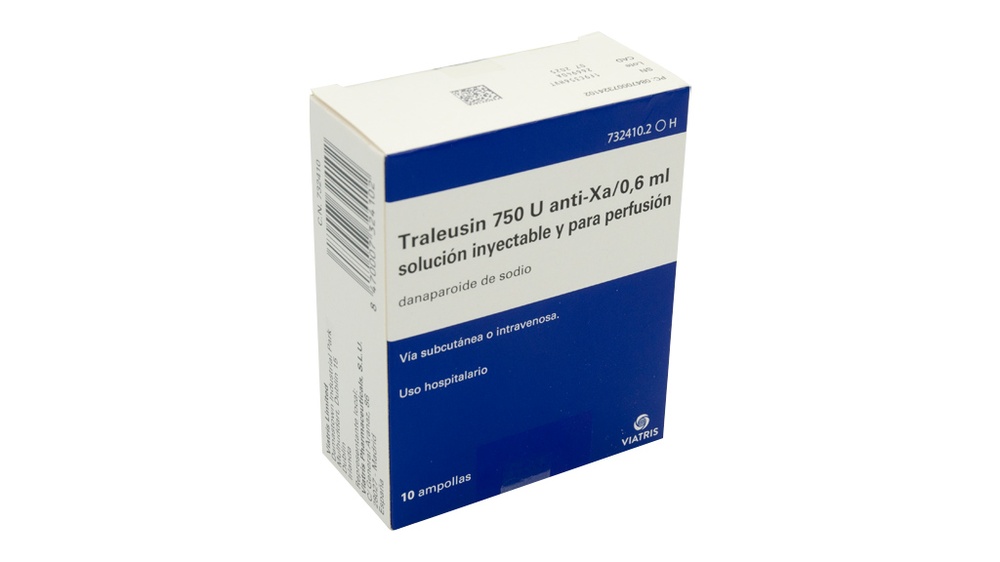
TRALEUSIN 750 U ANTI-XA/0.6 mL Injectable Solution and Perfusion Solution

Prescription review online
A doctor will review your case and decide whether a prescription is medically appropriate.

Talk to a doctor about this medicine
Discuss your symptoms and possible next steps in a quick online consultation.



How to use TRALEUSIN 750 U ANTI-XA/0.6 mL INJECTABLE SOLUTION AND PERFUSION SOLUTION
Contents of the leaflet
- Introduction
- What is Traleusin and what is it used for
- What you need to know before you use Traleusin
- How to use Traleusin
- Possible side effects
- Storage of Traleusin
- Contents of the pack and other information
Introduction
Package Leaflet: Information for the User
Traleusin 750U anti-Xa/0.6ml solution for injection and infusion
Sodium danaparoid
Read all of this leaflet carefully before you start using this medicine because it contains important information for you.
- Keep this leaflet, you may need to read it again.
- If you have any further questions, ask your doctor or pharmacist.
- If you experience any side effects, talk to your doctor or pharmacist, even if they are not listed in this leaflet. See section 4.
Contents of the package leaflet
- What is Traleusin and what is it used for
- What you need to know before you use Traleusin
- How to use Traleusin
- Possible side effects
- Storage of Traleusin
- Contents of the pack and other information
1. What is Traleusin and what is it used for
Traleusin contains sodium danaparoid and belongs to a group of medicines called antithrombotics.
Traleusin can be used to:
- Prevent blood clots in patients who can no longer receive heparin, including patients with a disease called heparin-induced thrombocytopenia(a significant decrease in platelet count due to hypersensitivity to heparin).
- Treat the formation of blood clots in blood vessels and is used in patients who need urgent prevention of blood coagulation due to the development or history of heparin-induced thrombocytopenia.

Not sure if this medicine is right for you?
Discuss your symptoms and treatment with a doctor online.
2. What you need to know before you use Traleusin
Do not use Traleusin
- if you are allergicto sodium danaparoid or any of the other ingredients of this medicine (listed in section 6);
- if you have had a haemorrhagic stroke(due to bleeding in the brain) in the last three months;
- if you have severe uncontrolled hypertension;
- if you have stomach or intestinal ulcers;
- if you have eye damagecaused by diabetes;
- if you are using Traleusin to treat blood clots in your body and are going to receive spinal or epidural anaesthesiaor lumbar puncturewithin 24 hours.
The following situations do not apply if you have a disease called heparin-induced thrombocytopeniaand no alternative treatment is available to prevent the formation of blood clots:
- if you are prone to severe bleeding, such as haemophilia, or have a higher risk of bleeding;
- if you have severe kidney or liver disorders;
- if you have an infection of the inner lining of the heart and heart valves(acute bacterial endocarditis);
- if you have bleeding that cannot be stopped;
- if you have damage to the central nervous systemor brain, or need to undergo surgery on the spine or eye.
Tell your doctor if any of these situations apply to you.
Warnings and precautions
Talk to your doctor before starting Traleusin if you have or have had any of the following conditions:
- if previous treatmentwith heparins (a group of antithrombotics frequently administered) caused a significant decrease in platelet count, known as heparin-induced thrombocytopenia, and a blood test determined that a similar effect cannot be ruled out if Traleusin is administered;
- kidney problems;
- liver problems;
- an ulcer in the digestive tract or other disease that may increase the risk of bleeding;
- low body weight (less than 55 kg) or overweight (more than 90 kg);
- if you are currently using medicines that may affect bleeding (see section 2 "Other medicines and Traleusin");
- sulphite hypersensitivity, as this can cause severe allergic reactions in asthmatic patients;
- if Traleusin is to be used during coronary bypass surgery;
- if you are going to receive spinal or epidural anaesthesia or lumbar puncture: a delay period should be observed between the administration of Traleusin and this procedure.
It is recommended that the healthcare professional record the name and batch number of the medicine being used.
Children and adolescents
Traleusin can be administered to children. Experience in children and adolescents with this medicine is limited. There is no experience with the administration of sodium danaparoid in children from 2 to 7 years.
Other medicines and Traleusin
Tell your doctor if you are taking, have recently taken or might take any other medicines. Traleusin may affect other medicines or vice versa.
Medicines that may increase the risk of bleeding when taken at the same time as Traleusin:
- medicines to prevent blood clotssuch as vitamin K antagonists(e.g. warfarin);
- medicines to dissolve blood clots(e.g. alteplase);
- medicines used as anti-inflammatory(such as NSAIDs and aspirin) for the treatment of rheumatic disorders, among others;
- medicines that may cause ulcers(e.g. corticosteroids).
Surgery and anaesthesia
If you are going to undergo a spinal puncture or surgery with epidural or spinal anaesthesia, tell your doctor that you are using sodium danaparoid. See "Do not use Traleusin". Also, tell your doctor if you have had any problems with your spine or if you have ever undergone spinal surgery.
Pregnancy, breastfeeding and fertility
Pregnancy and breastfeeding
If you are pregnant or breastfeeding, think you may be pregnant or are planning to have a baby, ask your doctor for advice before taking this medicine.
Limited information available does not suggest harmful effects. If another antithrombotic treatment is not acceptable for medical reasons, Traleusin can be administered during pregnancy and breastfeeding.
Fertility
No information is available on the effect of sodium danaparoid on fertility.
Driving and using machines
It is not known if Traleusin has any effect on the ability to drive or use machines.
Traleusin contains sodium sulphite
This may rarely cause severe hypersensitivity reactions and bronchospasm.
Traleusin contains sodium
This medicine contains less than 1 mmol of sodium (23 mg) per 0.6 ml, i.e. it is essentially "sodium-free".
3. How to use Traleusin
Administration will be carried out by a healthcare professional with the necessary training and experience. They will determine the correct dose for you and the time and method of injection.
A doctor or nurse will administer Traleusin to you. This medicine is administered by injection under the skin or as an injection or infusion into a vein. This medicine must not be injected into a muscle.
The recommended dose is:
Your doctor will calculate the dose of Traleusin you need based on:
- the underlying disease you are suffering from;
- the risk of blood clots;
- the risk of bleeding;
- your state of health and physical characteristics (e.g. weight);
- whether or not you are hypersensitive to heparins.
Prevention of blood clots when heparin cannot be administered
The dose for the prevention of blood clots depends on the patient's body weight. Treatment is continued for a maximum of 14 days. Sometimes, this medicine may be administered for a longer period.
Patients with a significant acute decrease in platelet count during heparin administration (thrombocytopenia, see section 1) usually require higher doses.
Treatment of blood clots in patients with heparin-induced thrombocytopenia
In patients with heparin-induced thrombocytopenia, the initial dose injected depends on the patient's body weight. After the initial dose, the dose is gradually reduced.
Vascular surgery or invasive vascular procedures
For vascular surgeries that do not require a bypass machine, the initial dose depends on the patient's body weight. Treatment continues for 5-7 days and is administered no less than 6 hours after surgery.
Cardiopulmonary procedure
Traleusin will be injected during surgery after the chest is opened (thoracotomy) and will continue to be administered for as long as necessary.
Due to the risk of bleeding, Traleusin should only be administered for the surgical procedure in patients who do not respond satisfactorily to other medicines for the prevention of blood clots, and whose surgery cannot be postponed.
Monitoring
Depending on your situation (e.g. if you have kidney problems or are overweight), your doctor may perform additional blood tests during treatment to adjust the dose.
Switching to treatment with oral anticoagulants
Your doctor may decide to switch you to treatment with oral anticoagulants.
Switching from Traleusin to anticoagulants called vitamin K antagonists (AVK)
Your doctor will perform a blood test called INR and will tell you when to stop Traleusin.
Use in children and adolescents
Traleusin can be administered to children. Your doctor will take into account the age and weight to determine the dose and may perform blood tests during treatment to adjust the dose. There is no experience with the administration of sodium danaparoid in children from 2 to 7 years.
If you use more Traleusin than you should
Since your doctor or nurse will closely monitor your condition, it is unlikely that you will be given too much Traleusin, and if necessary, they will adjust the dose.
If too high a dose is administered, you may experience unusual bleeding. This may be seen as:
- nosebleeds, bleeding gums;
- black stools (may indicate bleeding from the stomach or intestines);
- blood in the urine;
- unusually heavy menstrual periods.
Tell your doctor or nurse if you experience any of these symptoms or other symptoms of unusual bleeding.
If you forget to use Traleusin
Since your doctor or nurse will closely monitor your condition, it is unlikely that you will receive a dose of this medicine that is too low. If necessary, they will adjust the dose.
If you stop treatment with Traleusin
Your doctor will decide when to stop treatment with this medicine.
If you have any further questions on the use of this medicine, ask your doctor.

Started taking the medicine and have questions?
Discuss your symptoms and treatment with a doctor online.
4. Possible side effects
Like all medicines, this medicine can cause side effects, although not everybody gets them.
When heparin (an antithrombotic) is administered together with a spinal injection, bruising may occur in the spine. This happens very rarely (see section 2).
However, if you experience any of the following symptoms:
- back pain;
- tingling, numbness or weakness in the legs;
- problems with the intestines or bladder;
tell your doctor or nurse immediately, as you may need treatment.
Traleusin may increase the risk of bleeding. Bleeding may occur after surgery and bleeding or blood loss near the site of surgery.
Common (may affect up to 1 in 10 patients):
- Significant decrease in platelet count (thrombocytopenia) in patients hypersensitive to heparin
- Rash
- Increased bleeding after surgery
Uncommon (may affect up to 1 in 100 people):
- Bruising, pain or bleeding near the injection site
- Allergic reactions (hypersensitivity)
- Itching (pruritus)
Rare (may affect up to 1 in 1,000 patients):
- Increased bleeding or swelling with blood at the surgical site (haematoma)
- Decrease in platelet count due to an autoimmune disorder (autoimmune thrombocytopenia)
Reporting of side effects
If you experience any side effects, talk to your doctor or pharmacist, even if they are not listed in this leaflet. You can also report side effects directly via the Spanish Medicines Monitoring System: www.notificaRAM.es. By reporting side effects, you can help provide more information on the safety of this medicine.
5. Storage of Traleusin
The hospital will store this medicine under the appropriate storage conditions.
Keep this medicine out of the sight and reach of children.
Do not use this medicine after the expiry date which is stated on the carton after "EXP". The expiry date is the last day of the month shown.
Do not store above 30°C.
Store in the original package to protect from light. Do not refrigerate or freeze.
Do not use this medicine if you notice that the appearance has changed or if the packaging is damaged.
6. Contents of the pack and other information
Composition of Traleusin
- The active substance is sodium danaparoid (750 U anti-factor Xa in 0.6 ml solution).
- The other ingredients are sodium sulphite, sodium chloride, water for injections and hydrochloric acid (for pH adjustment).
Appearance and packaging of the product
Traleusin is a clear and colourless to pale yellow solution for injection and infusion.
It is available in glass ampoules (10 per carton). Each ampoule contains 0.6 ml of solution with 750 U anti-factor Xa of sodium danaparoid.
Marketing authorisation holder and manufacturer
Marketing authorisation holder
Viatris Limited
Damastown Industrial Park
Mulhuddart, Dublin 15
DUBLIN
Ireland
Manufacturer
FAMAR Health Care Services Madrid, S.A.U
Avda. Leganés, 62,
Alcorcón 28923
Madrid,
Spain
You can request more information about this medicine from the local representative of the marketing authorisation holder:
Viatris Pharmaceuticals, S.L.U.
C/ General Aranaz, 86
28027 - Madrid
Spain
This medicine is authorised in the Member States of the European Economic Area under the following names:
Netherlands: Danaparoid natrium Aspen, 750 anti-Xa eenheden/0,6 ml, oplossing voor injectie
Spain: Traleusin 750 U anti-Xa/0,6 ml solución inyectable y para perfusión
Date of last revision of this leaflet:May/2021
- Country of registration
- Dosage formINJECTABLE, 750 anti-Xa IU/0.6 ml
- ATC codeB01AB09
- Availability in pharmaciesSupply issue reported
- Active substance
- Prescription requiredYes
- Manufacturer
- CompositionSULFITO SODICO (1,5 mg/ml mg), CLORURO DE SODIO (0- 1,5 mg/ml mg)
- This information is for reference only and does not constitute medical advice. Always consult a doctor before taking any medication. Oladoctor is not responsible for medical decisions based on this content.
- Alternatives to TRALEUSIN 750 U ANTI-XA/0.6 mL INJECTABLE SOLUTION AND PERFUSION SOLUTIONDosage form: INJECTABLE PERFUSION, 1,000 IU Human Antithrombin IIIActive substance: antithrombin IIIManufacturer: Octapharma S.A.Prescription requiredDosage form: INJECTABLE PERFUSION, 500 IU human antithrombin IIIActive substance: antithrombin IIIManufacturer: Octapharma S.A.Prescription requiredDosage form: CAPSULE, 150 ULSActive substance: sulodexideManufacturer: Alfasigma Espana S.L.Prescription required
Online doctors for TRALEUSIN 750 U ANTI-XA/0.6 mL INJECTABLE SOLUTION AND PERFUSION SOLUTION
Discuss questions about TRALEUSIN 750 U ANTI-XA/0.6 mL INJECTABLE SOLUTION AND PERFUSION SOLUTION, including use, safety considerations and prescription review, subject to medical assessment and local regulations.









Get TRALEUSIN 750 U ANTI-XA/0.6 mL INJECTABLE SOLUTION AND PERFUSION SOLUTION Prescription Online
Fill in a 2-min form
Tell us your symptoms, history, and what medicine you're requesting.
Pick a doctor or let us assign
Choose a specialist or we'll match you with the next available doctor.
Doctor reviews your case
Usually within 30 minutes. They may ask follow-up questions via chat.
Collect from any pharmacy
Electronic prescription sent to your email — valid across Spain.
Frequently Asked Questions
TRALEUSIN 750 U ANTI-XA/0.6 mL INJECTABLE SOLUTION AND PERFUSION SOLUTION requires a prescription in Spain. You can check with a doctor online whether this medicine may be appropriate for your situation.
The active ingredient in TRALEUSIN 750 U ANTI-XA/0.6 mL INJECTABLE SOLUTION AND PERFUSION SOLUTION is danaparoid. This information helps identify medicines with the same composition but different brand names.
TRALEUSIN 750 U ANTI-XA/0.6 mL INJECTABLE SOLUTION AND PERFUSION SOLUTION is manufactured by Viatris Limited. Pharmacy brands and packaging may differ depending on the distributor.
Doctors such as Family doctors, Psychiatrists, Dermatologists, Cardiologists, Endocrinologists, Gastroenterologists, Pulmonologists, Nephrologists, Rheumatologists, Hematologists, Infectious disease physicians, Allergists, Geriatricians, Paediatricians, Oncologists may assess whether TRALEUSIN 750 U ANTI-XA/0.6 mL INJECTABLE SOLUTION AND PERFUSION SOLUTION is appropriate, depending on your situation and local regulations. You can book an online consultation to discuss your symptoms and possible next steps.
Spain has a well-developed healthcare infrastructure across major cities such as Madrid, Barcelona, Valencia, and Seville. Pharmacies are widely available and operate under strict regulations, ensuring access to prescribed medications.
You can buy TRALEUSIN 750 U ANTI-XA/0.6 mL INJECTABLE SOLUTION AND PERFUSION SOLUTION in Madrid, Barcelona, Seville, or Valencia at any local pharmacy with a valid prescription.
To obtain a prescription, you can use Oladoctor:
Other medicines with the same active substance (danaparoid) include ATENATIV 1000 IU POWDER AND SOLVENT FOR SOLUTION FOR INFUSION, ATENATIV 500 IU POWDER AND SOLVENT FOR SOLUTION FOR INFUSION, ATERINA 15 mg SOFT GEL CAPSULES. These may have different brand names or formulations but contain the same therapeutic ingredient. Always consult a doctor before switching or starting a new medicine.
