


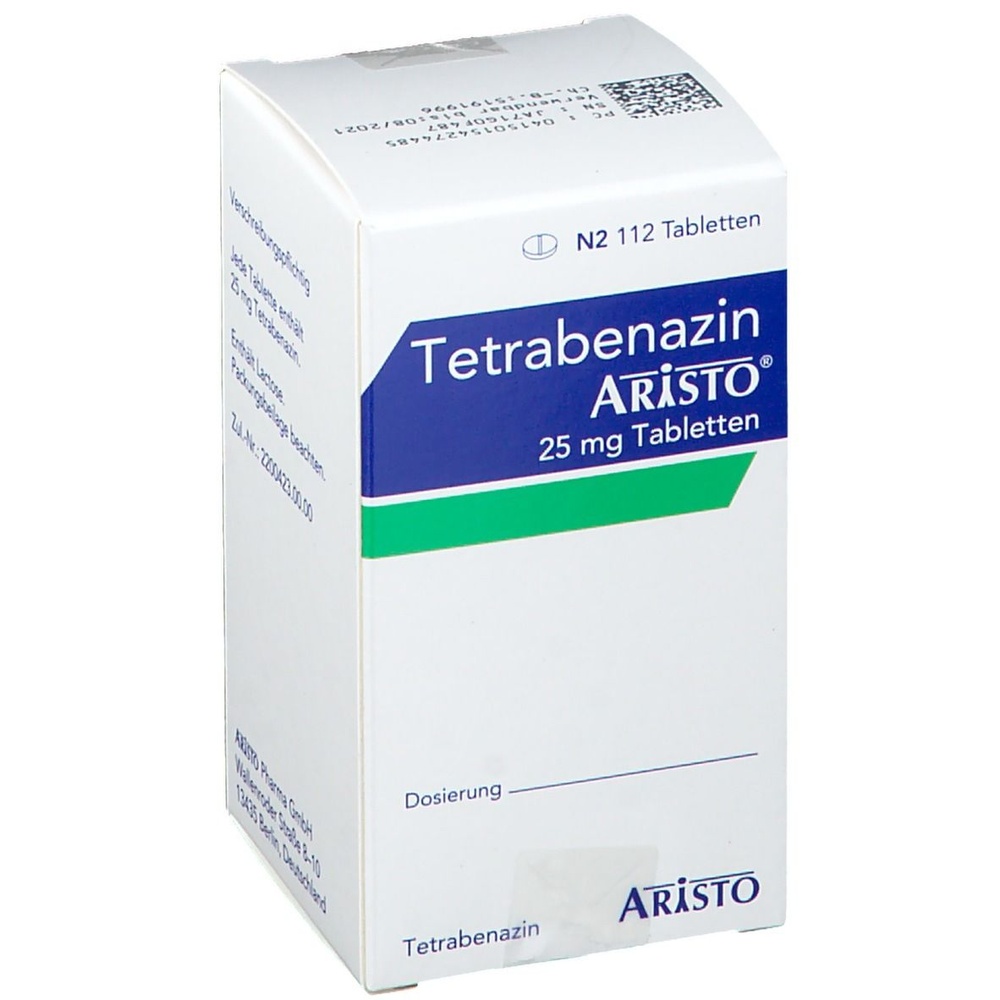
Tetrabenazina Aristo 25 mg comprimidos

Revisión de receta online
Un médico revisará tu caso y determinará si la prescripción es médicamente apropiada.

Habla con un médico sobre este medicamento
Comenta tus síntomas y las opciones de tratamiento en una consulta online.



Cómo usar TETRABENAZINA ARISTO 25 MG COMPRIMIDOS EFG
Contenido del prospecto
- Introducción
- Qué es Tetrabenazina Aristo y para qué se utiliza
- Qué necesita saber antes de empezar a tomar Tetrabenazina Aristo
- Cómo tomar Tetrabenazina Aristo
- Posibles efectos adversos
- Conservación de Tetrabenazina Aristo
- Contenido del envase e información adicional
Introducción
Prospecto: información para el usuario
Tetrabenazina Aristo 25 mg comprimidos EFG
tetrabenazina
Lea todo el prospecto detenidamente antes de empezar a tomar este medicamento, porque contiene información importante para usted.
- Conserve este prospecto, ya que puede tener que volver a leerlo.
- Si tiene alguna duda, consulte a su médico o farmacéutico.
- Este medicamento se le ha recetado solamente a usted, y no debe dárselo a otras personas aunque tengan los mismos síntomas que usted, ya que puede perjudicarles.
- Si experimenta efectos adversos, consulte a su médico o farmacéutico, incluso si se trata de efectos adversos que no aparecen en este prospecto. Ver sección 4.
Contenido del prospecto
- Qué es Tetrabenazina Aristo y para qué se utiliza
- Qué necesita saber antes de empezar a tomar Tetrabenazina Aristo
- Cómo tomar Tetrabenazina Aristo
- Posibles efectos adversos
- Conservación de Tetrabenazina Aristo
- Contenido del envase e información adicional
1. Qué es Tetrabenazina Aristo y para qué se utiliza
Tetrabenazina Aristo son comprimidos orales. La sustancia activa en Tetrabenazina Aristo es tetrabenazina.
La tetrabenazina inhibe el almacenamiento de neurotransmisores especiales en el cerebro. Esto reduce la transmisión de estímulos en las células nerviosas de determinadas regiones del cerebro que participan en la regulación de secuencias de movimiento individuales. Como resultado, se pueden controlar mejor los movimientos excesivos y/o involuntarios (hipercinesia). Estos movimientos excesivos y/o involuntarios pueden ser de origen orgánico (físico) (como la enfermedad de Huntington, por ejemplo). Sin embargo, también pueden ser causados por medicamentos, por ejemplo, después del uso prolongado de neurolépticos (medicamentos para el tratamiento de trastornos mentales). En este caso, la afección se denomina discinesia tardía (trastornos del movimiento tardío).
Tetrabenazina se usa para el tratamiento de las siguientes enfermedades:
- Movimientos excesivos y/o involuntarios (hipercinesia) en la enfermedad de Huntington.
- Discinesia tardía de moderada a grave (trastorno del movimiento tardío); tetrabenazina solo se puede utilizar para este trastorno del movimiento si otras opciones de tratamiento han fracasado.

¿No estás seguro de si este medicamento es adecuado para ti?
Comenta tus síntomas y tratamiento con un médico online.
2. Qué necesita saber antes de empezar a tomar Tetrabenazina Aristo
No tome Tetrabenazina Aristo
- si es alérgico a la tetrabenazina o a cualquiera de los demás componentes de este medicamento (incluidos en la sección 6)
- si tiene pensamientos de autolesionarse o suicidarse;
- si sufre depresión o si sus síntomas persisten a pesar del tratamiento antidepresivo;
- si tiene tumores dependientes de la hormona prolactina (por ejemplo, tumor pituitario o cáncer de mama);
- si tiene un tumor de la médula suprarrenal (feocromocitoma);
- si está en periodo de lactancia;
- si está tomando un inhibidor de la monoaminooxidasa (un tipo de medicamento antidepresivo) o ha tomado alguno en los últimos 14 días;
- si su función hepática está deteriorada;
- si está tomando medicamentos que contengan reserpina como sustancia activa;
- si padece la enfermedad de Parkinson o tiene parkinsonismo.
Advertencias y precauciones
Consulte a su médico o farmacéutico antes de empezar a tomar este medicamento.
- Si usted es metabolizador lento o intermedio de una enzima llamada CYP2D6, ya que en tal caso es posible que tenga que recibir una dosis diferente;
- si le han diagnosticado depresión o ha pensado o ha intentado suicidarse;
- si alguna vez ha tenido depresión.
Tratamiento de la discinesia tardía (trastornos del movimiento retardado)Pregúntale al médico si puedes ser considerado para el tratamiento con tetrabenazina. Él/ella le aconsejará en consecuencia. Sin embargo, la tetrabenazina es una sustancia de acción central, lo cual puede generar síntomas extrapiramidales y teóricamente causar discinesia tardía en humanos.
Inicio de la depresión (estado de ánimo depresivo)/tendencias suicidas (pensamientos o comportamientos suicidas)La tetrabenazina puede causar depresión o empeorar la depresión preexistente.Si sufre depresión, posiblemente se controle mediante la reducción de la dosis. Se han comunicado casos en los que los pacientes que toman tetrabenazina han desarrollado pensamientos suicidas o han mostrado comportamientos suicidas.
Si la depresión o los pensamientos suicidas son profundos, se debe considerar la interrupción del tratamiento con tetrabenazina y el comienzo del tratamiento con antidepresivos.
Si nota depresión durante el tratamiento con tetrabenazina, informe a su médico. Éste tomará las medidas necesarias.
Ira y comportamiento agresivoEn pacientes con depresión o antecedentes de otras enfermedades psiquiátricas que toman tetrabenazina, existe un riesgo potencial de desarrollar o empeorar la ira y el comportamiento agresivo.
Aparición de síntomas de Parkinson
Tetrabenazina puede inducir parkinsonismo y empeorar los síntomas preexistentes de la enfermedad de Parkinson. Si esto le ocurre, informe a su médico. Tomará las medidas necesarias.
Disfagia
La disfagia es un componente de la enfermedad de Huntington. Sin embargo, los medicamentos que reducen la transmisión dopaminérgica se han relacionado con dismotilidad esofágica (un trastorno de la motilidad en el esófago) y disfagia (trastorno de la deglución). La disfagia puede estar asociada con la neumonía por aspiración (un tipo de neumonía causada por la aspiración de cuerpos extraños o líquidos). Si tiene dificultades para tragar, consulte a su médico.
Aparición del Síndrome Neuroléptico Maligno
Puede aparecer en algunos pacientes el llamado Síndrome Neuroléptico Maligno (SNM) durante el tratamiento con tetrabenazina, en casos raros. Esta es una condición que amenaza la vida en casos raros, en los que se presenta fiebre alta, sudoración, fluctuaciones de la presión arterial, pulso irregular o rápido, trastornos del ritmo cardíaco, rigidez muscular y pérdida de conciencia.Si experimenta uno o más de estos síntomas, debe comunicárselo a su médico o acudir al hospital más cercano de inmediato.
Pacientes con antecedentes de tumores.Si se toma tetrabenazina durante un período de tiempo prolongado, pueden aumentar las concentraciones de prolactina (una hormona) en la sangre. Esta mayor concentración puede, en casos raros, fomentar el crecimiento de células en tumores de mama. Por este motivo, informe a su médico antes de tomar tetrabenazina si tiene antecedentes de algún tumor.
Pacientes con intervalo QTc prolongado
La tetrabenazina produce una ligera prolongación del intervalo QT en el ECG. Por lo tanto, se debe tener precaución en pacientes con síndrome de QT largo congénito y con antecedentes de trastornos del ritmo cardíaco, o en pacientes que toman otros medicamentos que puedan prolongar el intervalo QT.
Enfermedad cardiacaInforme a su médico si ha tenido problemas cardíacos recientemente como infarto de miocardio o enfermedad cardíaca inestable.
Agitación e inquietud
Informe a su médico si tiene alguna dificultad para mantenerse en posición sentada o de pie durante períodos prolongados (incapacidad de quedarse quieto) o si sufre inquietud o aumento de la inquietud. Puede que sea necesario reducir su dosis si sufre estos efectos secundarios.
Sedación y somnolencia
La tetrabenazina puede causar sedación (efecto calmante) o somnolencia (somnolencia o cansancio anormal). En este caso, debe abstenerse de realizar actividades que requieran un estado de alerta especial (p. ej., conducir o manejar maquinaria peligrosa).
Hipotensión ortostáticaSe puede producir una caída en la presión arterial, con síntomas de mareos al levantarse o pérdida de conocimiento (síncope) bajo ciertas condiciones en pacientes tratados con tetrabenazina (por ejemplo, al levantarse después de acostarse). Informe a su médico si le han dicho que tiene la presión arterial baja (asociada con síntomas como mareos, dolor de cabeza, corazón acelerado o colapso).
Unión a la melanina de los tejidos
La tetrabenazina y sus metabolitos pueden unirse a la melanina que contienen los tejidos, y se pueden acumular en estos tejidos mucho tiempo. Por lo tanto, es posible que la tetrabenazina pueda causar daños a estos tejidos con un uso prolongado. Si bien no existen recomendaciones específicas para exámenes oculares con regularidad, los médicos deben considerar los posibles efectos del uso a largo plazo de tetrabenazina en los ojos.
Ensayos de laboratorio
No se han notificado cambios clínicamente significativos en los parámetros de laboratorio en los ensayos con tetrabenazina. En los ensayos controlados, la tetrabenazina provocó un pequeño incremento medio de los valores de laboratorio de alanina-aminotransferasa (ALT) y aspartato-aminotransferasa (AST) en comparación con el placebo.
Otros medicamentos y Tetrabenazina Aristo
Informe a su médico o farmacéutico si está tomando, ha tomado recientemente o pudiera tener que tomar cualquier otro medicamento.
Si se toman al mismo tiempo, los siguientes medicamentos pueden interactuar con tetrabenazina:
- Levodopa, un medicamento para la enfermedad de Parkinson.
- Medicamentos con un efecto sedante en el cerebro, p. ej. neurolépticos, hipnóticos y opioides.
- Medicamentos para tratar la presión arterial alta (antihipertensivos) y betabloqueantes (medicamentos que reducen la frecuencia cardíaca y la presión arterial).
- Ciertos medicamentos que ralentizan la descomposición de la tetrabenazina, p. ej. fluoxetina, paroxetina, quinidina, duloxetina, terbinafina, amiodarona, sertralina.
- Medicamentos que prolongan el intervalo QT en el ECG, p. Ej. neurolépticos, ciertos antibióticos (gatifloxacina, moxifloxacina), ciertos antiarrítmicos (quinidina, procainamida, amiodarona, sotalol).
- Inhibidores de la MAO (ciertos antidepresivos): para evitar el riesgo de una posible interacción seria que resulte en una crisis hipertensiva, deben transcurrir al menos 14 días entre la interrupción del tratamiento con tetrabenazina y el inicio del tratamiento con un MAO, así como entre detener el inhibidor de la MAO y comenzar el tratamiento con tetrabenazina.
- Medicamentos analizados a través de CYP2D6 (por ejemplo, metoprolol, amitriptilina, imipramina, haloperidol y risperidona): los efectos de estos medicamentos pueden aumentar. El uso adicional de medicamentos que inhiben el CYP2D6 (por ejemplo, fluoxetina, paroxetina, quinidina, duloxetina, terbinafina, amiodarona o sertralina) también pueden aumentar este efecto.
- Reserpina: tetrabenazina no debe tomarse al mismo tiempo que reserpina. Se debe tener precaución cuando se le cambia a un paciente de reserpina a tetrabenazina y con un intervalo suficiente de varios días.
Tetrabenazina Aristo y alcohol
Si toma alcohol con tetrabenazina al mismo tiempo, puede potenciar el efecto sedante.
Fertilidad, embarazo y lactancia
Si está embarazada o en periodo de lactancia, cree que podría estar embarazada o tiene intención de quedarse embarazada, consulte a su médico o farmacéutico antes de utilizar este medicamento.
Embarazo
No existen datos suficientes sobre la seguridad de la tetrabenazina en mujeres embarazadas, por lo tanto, no se recomienda el uso de tetrabenazina durante el embarazo a menos que su médico lo considere totalmente necesario.
No es recomendable el uso de tetrabenazina durante el embarazo o en mujeres en edad fértil sin medidas anticonceptivas adecuadas.
Es esencial informar a su médico en caso de estar embarazada, si piensa que puede estar embarazada o tiene planeado quedarse embarazada. Su doctor decidirá si puede o no tomar tetrabenazina Aristo.
Lactancia
No debe dar el pecho mientras esté tomando este medicamento.
Fertilidad
Estudios en animales con tetrabenazina han demostrado que no hay efecto en el embarazo o supervivencia intrauterina. Los ciclos menstruales femeninos se prolongaron y se observó un retraso en la fase de fertilidad.
Conducción y uso de máquinas
No conduzca o maneje herramientas o máquinas ya que tetrabenazina puede causar somnolencia y por tanto, afectar a su capacidad de realizar tareas específicas.
Tetrabenazina Aristo contiene lactosa.
Cada comprimido contiene 63,4 mg de lactosa (como monohidrato). Si su médico le ha indicado que padece una intolerancia a ciertos azúcares, consulte con él antes de tomar este medicamento.
3. Cómo tomar Tetrabenazina Aristo
Siga exactamente las instrucciones de administración de este medicamento indicadas por su médico o farmacéutico. En caso de duda, consulte de nuevo a su médico o farmacéutico.
Durante la prescripción inicial, su médico aumentará la dosis de tetrabenazina gradualmente durante varias semanas hasta encontrar una dosis que reduzca sus síntomas y sea bien tolerado.
Nota
La dosis dependerá de los síntomas de la enfermedad y de la reacción/respuesta al tratamiento.
La dosis requerida puede variar de un paciente a otro. Por lo tanto, las siguientes recomendaciones de dosis son solo una guía. Siga siempre las órdenes de su doctor en relación a la dosis. Su doctor revisará la dosis en intervalos regulares.
Si tiene usted problemas hepáticos o renales, su doctor puede prescribirle una dosis diferente.
Dosis para movimientos incontrolables causados por Corea de Huntington
A menos que su médico le indique lo contrario, la dosis inicial habitual es de un comprimido de tetrabenazina tres veces al día.
Esta dosis se puede aumentar en un comprimido al día cada tres o cuatro días hasta conseguir la eficacia óptima.
No se debe superar la dosis máxima diaria de 8 comprimidos de tetrabenazina.
Dosis para la discinesia tardía (trastornos del movimiento tardío)
Adultos
A menos que su médico le indique lo contrario, la dosis inicial habitual es medio comprimido al día.
Si responde favorablemente al tratamiento, su médico aumentará gradualmente la dosis. Su médico puede interrumpir el tratamiento con tetrabenazina Aristo si:
- No hay mejoría en los síntomas clínicos después de aumentar la dosis;
- Se producen efectos secundarios graves
Reanudación del tratamientoSi su tratamiento fue interrumpido por más de 5 días o la interrupción de su tratamiento fue necesaria debido a una afección médica o debido al uso concomitante de otros medicamentos, su terapia con tetrabenazina debe ser retirada cuando se reanude. Dependiendo de su médico, la dosis debe iniciarse con 12,5 mg dos veces al día, esperar 7 días y luego aumentar hasta 12,5 mg por día.
Si usted nota efectos adversos tales como incapacidad para sentarse (acatisia), inquietud, parkinsonismo, deterioro del equilibrio, temblores, aumento de la salivación, depresión, imsomnio, ansiedad o una sedación intolerable, póngase en contacto con su médico.
Su médico decidirá si debe interrumpir su medicación o reducir la dosis.
Poblaciones especiales
Personas de edad avanzada y edad pediátrica
No se han realizado estudios específicos en ninguno de estos grupos de edad. Su doctor decidirá la dosis apropiada.
Las personas de edad avanzada generalmente reciben la dosis recomendada para adultos.
Los niños suelen empezar con la mitad de la dosis diaria de un adulto. Posteriormente esta dosis puede ser modificada lenta y cuidadosamente, dependiendo de la tolerancia y respuesta de cada individuo.
Hable con su doctor o farmacéutico si tiene la impresión de que el efecto de tetrabenazina es muy fuerte o muy débil.
Pacientes con insuficiencia hepática, insuficiencia renalSi tiene problemas de hígado o riñones, su médico puede recetarle una dosificación diferente y/o una dosis diferente.Antes de empezar a tomar tetrabenazina, consulte a su médico si usted es metabolizador lento o intermedio de una enzima llamada CYP2D6, ya que en tal caso es posible que tenga que recibir una dosis diferente
Forma de administraciónTetrabenazina es para uso oral.Tome los comprimidos con suficiente líquido (agua u otras bebidas no alcohólicas. No tome los comprimidos con alcohol) y no los mastique.Los comprimidos tienen una línea de rotura y se pueden dividir en dosis iguales. Esto permite tomar medios comprimidos.
Si toma más Tetrabenazina Aristo del que debe
Si toma demasiados comprimidos u otra persona toma accidentalmente su medicamento, contacte con su médico, farmacéutico u hospital más cercano o llame al Servicio de Información Toxicológica, teléfono: 91 562 04 20, indicando el medicamento y la cantidad ingerida.
Los síntomas de sobredosis incluyen espasmos musculares incontrolables que afectan a los ojos, cabeza, cuello y cuerpo, movimientos rápidos e incontrolables de los ojos, parpadeo excesivo del ojo, náuseas, vómitos, diarrea, sudoración, mareo, sensación de frío, confusión, alucinaciones, somnolencia, enrojecimiento/inflamación y temblor.
Si olvidó tomar Tetrabenazina Aristo
No tome una dosis doble para compensar las dosis olvidadas. Continúe tomando su dosis normal cuando le toque.
Si interrumpe el tratamiento conTetrabenazina Aristo
No cambie la dosis de tetrabenazina sin consultar antes a su médico. Si desea dejar de tomar tetrabenazina, también debe consultarlo antes con su médico.Si tiene cualquier otra duda sobre el uso de este medicamento, pregunte a su médico o farmacéutico.

¿Has empezado a tomar el medicamento y tienes preguntas?
Comenta tus síntomas y tratamiento con un médico online.
4. Posibles efectos adversos
Al igual que todos los medicamentos, este medicamento puede producir efectos adversos, aunque no todas las personas los sufran.
Efectos secundarios importantes o signos a tener en cuenta y medidas a tomar si se ve afectado
Si experimenta rigidez de los músculos o fiebre y alteración de la conciencia (como confusión o alucinaciones), deje de tomar tetrabenazina Aristo. Consulte a su médico o al hospital más cercano lo antes posible (ver también la sección 2 “advertencias y precauciones).
Contacte inmediatamente o acuda al hospital si experimenta los siguientes efectos adversos:
- Si experimenta rigidez muscular, fiebre o deterioro de la conciencia (p. ej., confusión o alucinaciones), deje de tomar Tetrabenazina. Consulte a su médico u hospital más cercano lo antes posible (ver también sección 2 "Advertencias y precauciones").
- Muy frecuentes (pueden afectar a más de 1 de cada 10 personas): Tetrabenazina Aristo puede causar depresión que, en algunas personas, puede llevar a pensamientos suicidas. Si se siente deprimido o muy triste, es posible que esté empezando a deprimirse y debe informar a su médico sobre este cambio.
- Muy raras (pueden afectar hasta 1 de cada 10.000 personas): si ha intentado suicidarse o si se ha autolesionado intencionadamente o si ha comenzado a pensar en autolesionarse intencionadamente.
Otros posibles efectos adversos
Muy frecuentes(pueden afectar a más de 1 de cada 10 personas)
- Depresión (sentimiento de tristeza), la cual se ha comunicado asociada con pensamientos y comportamientos suicidas. Si se siente decaído o muy triste o puede que esté empezando a estar deprimido debe informar al médico sobre este cambio.
- somnolencia
- síntomas de Parkinson como pérdida del equilibrio, temblores o aumento de la salivación
Frecuentes(pueden afectar hasta 1 de cada 10 personas)
- agitación
- confusión
- sensación de ansiedad
- insomnio
- disminución del apetito
Muy raras(pueden afectar hasta 1 de cada 10.000 personas)
- neumonía
- reducción del número de glóbulos blancos (leucopenia)
- movimientos rápidos e incontrolables de los ojos (crisis oculogiras)
- intolerancia a la luz (fotofobia)
- deshidratación
- agresión, enojo
- pensamientos suicidas, intención de hacerse daño a sí mismo o pensamiento de hacerse daño a si mismo.
- síndrome neuroléptico maligno (una afección en la que se producen fiebre alta, sudoración, fluctuaciones de la presión arterial, rigidez muscular y alteración de la conciencia), ver sección 2 "Advertencias y precauciones"
- sarpullido, prurito, urticaria
- pérdida de peso
- riesgo de caídas
Frecuencia no conocida(no puede estimarse a partir de los datos disponibles)
- alteración del equilibrio y movimientos descoordinados (ataxia)
- sensación de que no puede estar quieto (acatisia)
- espasmos musculares incontrolables (distonía)
- pérdida de memoria
- mareos
- desorientación
- nerviosismo
- inquietud
- trastornos del sueño
- latido cardíaco lento (bradicardia)
- descenso de la presión arterial con mareos al levantarse (hipotensión ortostática)
- crisis hipertensiva
- dificultades para tragar
- náuseas (malestar)
- vómitos
- dolor de estómago
- diarrea
- estreñimiento
- sequedad de boca
- sudoración
- periodos mensuales irregulares
- cansancio
- debilidad
- temperatura corporal reducida (hipotermia)
- aumento del apetito
- aumento de peso
Para evitar el riesgo de una intención potencialmente grave que desemboque en una crisis hipertensiva, se debe garantizar que transcurran al menos 14 días entre la interrupción de tetrabenazina Aristo y el inicio del tratamiento con inhibidor de la MAO, así como entre la interrupción del tratamiento del inhibidor de la MAO y el inicio del tratamiento con tetrabenazina Aristo.
Si toma Tetrabenazina durante períodos prolongados, la concentración de prolactina (una hormona de la glándula pituitaria) en sangre puede aumentar. Esto vuelve a la normalidad después de detener el tratamiento. Como resultado, se puede producir secreción anormal de leche materna (galactorrea), períodos mensuales ausentes o irregulares, agrandamiento de las mamas masculinas (ginecomastia), dolor en las mamas, agrandamiento de las mamas, tumores pituitarios (prolactinomas), trastornos orgásmicos e impotencia.
Comunicación de efectos adversos
Si experimenta cualquier tipo de efecto adverso, consulte a su médico o farmacéutico o enfermero, incluso si se trata de posibles efectos adversos que no aparecen en este prospecto. También puede comunicarlos directamente a través del Sistema Español de Farmacovigilancia de Medicamentos de Uso Humano: http://www.notificaram.es. Mediante la comunicación de efectos adversos usted puede contribuir a proporcionar más información sobre la seguridad de este medicamento.
5. Conservación de Tetrabenazina Aristo
Mantener este medicamento fuera de la vista y del alcance de los niños.
No utilice este medicamento después de la fecha de caducidad que aparece en el envase después de CAD. La fecha de caducidad es el último día del mes que se indica.
No conservar a temperatura superior a 30º. Mantener en el envase original para protegerlo de la luz.
Los medicamentos no se deben tirar por los desagües ni a la basura. Deposite los envases y los medicamentos que no necesita en el Punto SIGRE de la farmacia. Pregunte a su farmacéutico cómo deshacerse de los envases y de los medicamentos que no necesita. De esta forma, ayudará a proteger el medio ambiente.
6. Contenido del envase e información adicional
Composición de Tetrabenazina Aristo 25 mg comprimidos
El principio activo es tetrabenazina.
Los demás componentes son: lactosa monohidrato (ver sección 2, “Qué necesita saber antes de empezar a tomar Tetrabenazina Aristo), almidón de maíz, celulosa microcristalina, talco, estearato de magnesio y óxido de hierro amarillo (E172).
Aspecto del producto y contenido del envase
Comprimidos de color amarillo claro, redondos, con una línea de rotura en una cara y un diámetro aproximado de 7 mm ± 0,2 mm.
Los comprimidos se pueden dividir en dosis iguales.
Este medicamento está disponible en frascos con 112 comprimidos.
Titular de la autorización de comercialización y responsable de la fabricación
Aristo Pharma GmbH
Wallenroder Str. 8-10,
13435 Berlin, Alemania
Pueden solicitar más información respecto a este medicamento dirigiéndose al representante local del titular de la autorización de comercialización:
Aristo Pharma Iberia, S.L.
C/ Solana, 26
28850, Torrejón de Ardoz
Madrid. España
Este medicamento está autorizado en los Estados Miembros del Espacio Económico Europeo con los siguientes nombres:
Alemania: Tetrabenazin Aristo 25 mg Tabletten
Austria: Tetrabenazin Aristo 25 mg Tabletten
España: Tetrabenazina Aristo 25 mg comprimidos EFG
Italia: Tetrabenazina Aristo 25 mg compresse
Portugal: Tetrabenazina Aristo 25 mg comprimidos
Reino Unido: Tetrabenazine Aristo 25 mg tablets
Fecha de la última revisión de este prospecto: Diciembre 2024
La información detallada y actualizada de este medicamento está disponible en la página Web de la Agencia Española de Medicamentos y Productos Sanitarios (AEMPS) http://www.aemps.gob.es/
- País de registro
- Forma farmacéuticaCOMPRIMIDO, 25 mg
- Código ATCN07XX06
- Precio medio en farmacia123.54 EUR
- Principio activo
- Requiere recetaSí
- Fabricante
- ComposiciónLACTOSA MONOHIDRATO (66.690 mg mg)
- Esta información es de carácter general y no sustituye la consulta con un profesional sanitario.
- Alternativas a TETRABENAZINA ARISTO 25 MG COMPRIMIDOS EFGForma farmacéutica: COMPRIMIDO, 25 mgPrincipio activo: tetrabenazineFabricante: Bausch Health Ireland LimitedRequiere recetaForma farmacéutica: COMPRIMIDO, 25 mgPrincipio activo: tetrabenazineFabricante: Walter Ritter Gmbh & Co. KgRequiere recetaForma farmacéutica: COMPRIMIDO, 25 mgPrincipio activo: tetrabenazineFabricante: Sun Pharmaceutical Industries (Europe) B.V.Requiere receta
Médicos online para TETRABENAZINA ARISTO 25 MG COMPRIMIDOS EFG
Comenta la dosis, los posibles efectos secundarios, interacciones, contraindicaciones o la revisión de receta de TETRABENAZINA ARISTO 25 MG COMPRIMIDOS EFG, sujeto a valoración médica y a la normativa local.









Preguntas frecuentes
TETRABENAZINA ARISTO 25 MG COMPRIMIDOS EFG requiere receta en España. Puedes confirmarlo con un médico online según tu caso.
El principio activo de TETRABENAZINA ARISTO 25 MG COMPRIMIDOS EFG es tetrabenazine. Esta información ayuda a identificar medicamentos con la misma composición pero con diferentes nombres comerciales.
El precio medio en farmacia de TETRABENAZINA ARISTO 25 MG COMPRIMIDOS EFG es de aproximadamente 123.54 EUR. Puede variar según el fabricante y la forma farmacéutica.
TETRABENAZINA ARISTO 25 MG COMPRIMIDOS EFG es fabricado por Aristo Pharma Gmbh. La marca y el envase pueden variar según el distribuidor.
Los Médicos de familia, Psiquiatras, Dermatólogos, Cardiólogos, Endocrinólogos, Gastroenterólogos, Neumólogos, Nefrólogos, Reumatólogos, Hematólogos, Infectólogos, Alergólogos, Geriatras, Pediatras, Oncólogos pueden valorar la prescripción de TETRABENAZINA ARISTO 25 MG COMPRIMIDOS EFG cuando esté clínicamente indicado. Puedes reservar una videoconsulta para comentar tu caso y las opciones de tratamiento.
La receta la emite un médico tras valorar tu estado de salud. En España, TETRABENAZINA ARISTO 25 MG COMPRIMIDOS EFG se dispensa en las farmacias con esa receta médica. Una consulta online no garantiza su emisión: la decisión corresponde siempre al médico.
Para solicitar una valoración puedes usar Oladoctor:
Otros medicamentos con el mismo principio activo (tetrabenazine) incluyen NITOMAN 25 mg COMPRIMIDOS, TETMODIS 25 mg COMPRIMIDOS EFG, TETRABENAZINA SUN 25 MG COMPRIMIDOS EFG. Pueden tener diferentes nombres comerciales o formulaciones, pero contienen el mismo componente terapéutico. Consulta siempre con un médico antes de cambiar o iniciar un nuevo medicamento.
