



TACROLIMUS 0,5 mg CÁPSULAS DURAS

Revisión de receta online
Un médico revisará tu caso y determinará si la prescripción es médicamente apropiada.

Habla con un médico sobre este medicamento
Comenta tus síntomas y las opciones de tratamiento en una consulta online.



Cómo usar TACROLIMUS STADA 0,5 mg CAPSULAS DURAS EFG
Contenido del prospecto
- Introducción
- Qué es Tacrólimus Stada y para qué se utiliza
- Qué necesita saber antes de empezar a tomar Tacrólimus Stada
- Cómo tomar Tacrólimus Stada
- Posibles efectos adversos
- Conservación de Tacrólimus Stada
- Contenido del envase e información adicional
Introducción
Prospecto: Información para el usuario
Tacrólimus Stada 0,5 mg cápsulas duras EFG
Tacrólimus Stada 1 mg cápsulas duras EFG
Lea todo el prospecto detenidamente antes de empezar a tomar este medicamento, porque contiene información importante para usted.
- Conserve este prospecto, ya que puede tener que volver a leerlo.
- Si tiene alguna duda, consulte a su médico o farmacéutico.
- Este medicamento se le ha recetado solamente a usted, y no debe dárselo a otras personas, aunque tengan los mismos síntomas que usted, ya que puede perjudicarles.
- Si experimenta efectos adversos, consulte a su médico o farmacéutico, incluso si se trata de efectos adversos que no aparecen en este prospecto. Ver sección 4.
Contenido del prospecto
- Qué es Tacrólimus Stada y para qué se utiliza
- Qué necesita saber antes de empezar a tomar Tacrólimus Stada
- Cómo tomar Tacrólimus Stada
- Posibles efectos adversos
- Conservación de Tacrólimus Stada
- Contenido del envase e información adicional
1. Qué es Tacrólimus Stada y para qué se utiliza
Tacrólimus Stada pertenece al grupo de fármacos conocidos como inmunosupresores. Tras su trasplante de órgano (p. ej., hígado, riñón, corazón), el sistema inmunitario de su cuerpo intentará rechazar el nuevo órgano.
Tacrólimus se utiliza para controlar la respuesta inmune de su cuerpo, permitiéndole aceptar el órgano trasplantado.
Tacrólimus se utiliza con frecuencia en combinación con otros medicamentos que también suprimen el sistema inmunitario.
También puede recibir tacrólimus para tratar un rechazo que se esté produciendo de su hígado, riñón, corazón u otro órgano trasplantado cuando cualquier tratamiento previo que estuviera siguiendo no consigue controlar esta respuesta inmunitaria después de su trasplante.

¿No estás seguro de si este medicamento es adecuado para ti?
Comenta tus síntomas y tratamiento con un médico online.
2. Qué necesita saber antes de empezar a tomar Tacrólimus Stada
NO tome Tacrólimus Stada
- Si es alérgico a tacrólimus o a alguno de los demás componentes de este medicamento (incluidos en la sección 6).
- Si es alérgico a sirolimus o a cualquier antibiótico que pertenezca al subgrupo de antibióticos macrólidos (p. ej., eritromicina, claritromicina, josamicina).
Advertencias y precauciones
Consulte a su médico o farmacéutico antes de empezar a tomar Tacrólimus Stada.
- Necesitará tomar tacrólimus todos los días, siempre que precise inmunosupresión para prevenir el rechazo de su órgano trasplantado. Debe mantenerse en contacto con su médico de forma regular.
- Mientras esté tomando tacrólimus, es posible que su médico desee realizar de vez en cuando una serie de pruebas (incluyendo análisis de sangre y orina, pruebas de función cardiaca, análisis visuales y neurológicos). Esto es completamente normal y ayudará a su médico a decidir la dosis más adecuada de tacrólimus para usted.
- Por favor evite tomar cualquier preparado a base de plantas, por ej. la hierba de San Juan (Hypericum perforatum)o cualquier otro producto a base de plantas, ya que esto puede afectar a la efectividad y la dosis de tacrólimus que necesita recibir. Si tiene alguna duda, por favor consulte a su médico antes de tomar cualquier producto o preparado a base de plantas.
- Si tiene problemas de hígado o ha padecido alguna enfermedad que ha podido afectar a su hígado, por favor indíquelo a su médico ya que esto puede afectar a la dosis de tacrólimus que recibe.
- Si siente fuerte dolor abdominal acompañado o no de otros síntomas, como escalofríos, fiebre, náuseas o vómitos.
- Si tiene diarrea durante más de un día, por favor indíquelo a su médico ya que puede ser necesario adaptar la dosis de tacrólimus que recibe.
- Si tiene una alteración de la actividad eléctrica del corazón llamada “prolongación del intervalo QT”.
- Limite su exposición a la luz solar y luz UV mientras esté tomando tacrólimus utilizando ropa protectora adecuada, y utilizando crema protectora con un elevado factor de protección solar. Esto se debe al riesgo potencial de cambios malignos de la piel con la terapia inmunosupresora.
- Si necesita vacunarse, por favor informe antes a su médico. Él le aconsejará sobre la mejor forma de proceder.
- Se ha comunicado que algunos pacientes tratados con tacrólimus han aumentado el riesgo de desarrollar trastornos linfoproliferativos (ver sección 4). Pregunte a su médico para más información sobre estos trastornos.
- si tiene o ha tenido lesiones en los vasos sanguíneos de menor tamaño, conocidas como microangiopatía trombótica/púrpura trombocitopénica trombótica/síndrome hemolítico urémico. Informe a su médico si desarrolla fiebre, hematomas debajo de la piel (pueden aparecer como puntos rojos), cansancio inexplicable, confusión, coloración amarillenta de la piel o los ojos, descenso en el volumen de orina, pérdida de visión y convulsiones (ver sección 4). Cuando se toma tacrólimus junto con sirólimus o everólimus, el riesgo de que aparezcan estos síntomas puede aumentar.
Precauciones de manipulación:
Durante la preparación se debe evitar el contacto de cualquier parte del cuerpo como la piel o los ojos, así como respirar cerca de las soluciones para inyección, polvo o granulado contenidos en los productos tacrólimus. Si tal contacto se produce, lave la piel y los ojos.
Otros medicamentos y Tacrólimus Stada
Informe a su médico o farmacéutico si está tomando, ha tomado recientemente o pudiera tener que tomar cualquier otro medicamento, incluso los adquiridos sin receta y los preparados a base de plantas.
Tacrólimus no se debe tomar con ciclosporina.
Si necesita visitar a un médico diferente de su especialista en trasplantes, diga al médico que está tomando tacrólimus. Es posible que su médico necesite consultar a su especialista en trasplantes si usted debe usar otro medicamento que pudiera aumentar o reducir su nivel sanguíneo de tacrólimus.
Los niveles sanguíneos de tacrólimus pueden modificarse debido a otros medicamentos que esté tomando, y los niveles sanguíneos de otros medicamentos pueden modificarse por la administración de tacrólimus, lo que puede requerir la interrupción, un aumento o disminución de la dosis de tacrólimus.
Algunos pacientes han experimentado aumentos en los niveles sanguíneos de tacrólimus mientras tomaban otros medicamentos. Esto podría provocar efectos adversos graves, tales como problemas de riñón, problemas del sistema nervioso y trastornos del ritmo cardiaco (ver sección 4).
El efecto sobre los niveles sanguíneos de tacrólimus se puede producir muy pronto tras empezar a usar otro medicamento, así que puede que sea necesario monitorizar el nivel sanguíneo de tacrólimus de manera frecuente y continuada durante los primeros días de uso de otro medicamento y con frecuencia mientras continúe su uso. Algunos otros medicamentos pueden provocar que los niveles sanguíneos de tacrólimus se reduzcan, lo que puede aumentar el riesgo de rechazo del órgano trasplantado. En particular, debe informar a su médico si está utilizando o ha utilizado recientemente medicamentos con principios activos como:
- antifúngicos y antibióticos, especialmente los llamados antibióticos macrólidos empleados para el tratamiento de infecciones, p. ej., ketoconazol, fluconazol, itraconazol, posaconazol, voriconazol, clotrimazol, isavuconazol, miconazol, caspofungina, telitromicina, eritromicina, claritromicina, josamicina, azitromicina, rifampicina , rifabutina, isoniazida y flucloxacilina
- letermovir, utilizado para prevenir enfermedades causadas por CMV (citomegalovirus humano)
- inhibidores de la proteasa del VIH (p. ej., ritonavir, nelfinavir, saquinavir), el fármaco potenciador cobicistat y comprimidos combinados, o inhibidores de transcriptasa inversa no nucleósidos para VIH (efavirenz, etravirina, nevirapina), que se utilizan para tratar la infección por VIH.
- inhibidores de la proteasa del VHC (p. ej., telaprevir, boceprevir y la combinación ombitasvir/paritaprevir/ritonavir con o sin dasabuvir, elbasvir/grazoprevir, y glecaprevir/pibrentasvir), utilizados para tratar la infección por hepatitis C.
- nilotinib e imatinib, idelalisib, ceritinib, crizotinib, apalutamida, enzalutamida o mitotano (utilizado para tratar ciertos tipos de cáncer).
- ácido micofenólico, utilizado para suprimir el sistema inmunitario como prevención del rechazo del trasplante
- medicamentos para la úlcera de estómago y el reflujo ácido (p. ej., omeprazol, lansoprazol o cimetidina)
- antieméticos, utilizados para tratar náuseas y vómitos (p. ej., metoclopramida)
- hidróxido de magnesio-aluminio (antiácido), utilizados para tratar la acidez
- tratamientos hormonales con etinilestradiol (por ejemplo, la píldora anticonceptiva oral) o con danazol
- medicamentos que se utilizan para tratar la hipertensión o problemas cardiacos (tal como nifedipino, nicardipino, diltiazem y verapamilo)
- medicamentos antiarrítmicos (amiodarona) utilizados para controlar la arritmia (latido irregular del corazón)
- los medicamentos conocidos como “estatinas” que se utilizan para tratar el colesterol y los triglicéridos elevados
- los medicamentos antiepilépticos carbamazepina, fenitoína o fenobarbital
- metamizol, un medicamento utilizado para tratar el dolor y la fiebre.
- los corticosteroides prednisona y metilprednisolona,
- el antidepresivo nefazodona
- preparados a base de plantas que contengan la hierba de San Juan (Hypericum perforatum) o extractos de Schisandra sphenanthera.
- cannabidiol (los usos, entre otros, incluyen el tratamiento de las convulsiones).
Informe a su médico si está recibiendo tratamiento para la hepatitis C. El tratamiento farmacológico para la hepatitis C puede hacer que cambie su función hepática y puede afectar a los niveles sanguíneos de tacrólimus. Los niveles sanguíneos de tacrólimus pueden reducirse o aumentar dependiendo de los medicamentos recetados para la hepatitis C. Es posible que su médico necesite monitorizar estrechamente los niveles sanguíneos de tacrólimus y hacer los ajustes necesarios de la dosis de tacrólimus después de iniciar el tratamiento para la hepatitis C.
Informe a su médico si está tomando o necesita tomar ibuprofeno, anfotericina B, antibióticos (cotrimoxazol, vancomicina o antibióticos aminoglucósidos como gentamicina), o antivirales (p. ej. aciclovir, ganciclovir, cidofovir, foscarnet). Estos pueden empeorar los problemas renales o del sistema nervioso cuando se administran simultáneamente con tacrólimus.
Informe a su médico si está tomando sirólimus o everólimus. Cuando se toma tacrólimus junto con sirólimus o everólimus, el riesgo de que aparezca microangiopatía trombótica, púrpura trombocitopénica trombótica y síndrome hemolítico urémico puede aumentar (ver sección 4).
Su médico también necesita saber si está tomando suplementos de potasio o ciertos diuréticos ahorradores de potasio utilizados para insuficiencia cardíaca, hipertensión y nefropatía, (p. ej., amilorida, triamtereno o espironolactona), o los antibióticos trimetoprima o cotrimoxazol que pueden aumentar los niveles de potasio en la sangre, ciertos analgésicos (los llamados AINEs, p. ej., ibuprofeno) utilizados para fiebre, inflamación y dolor, anticoagulantes (diluyentes sanguíneos), o medicamentos orales para el tratamiento de diabetes, mientras está tomando tacrólimus.
Si necesita vacunarse, informe antes a su médico.
Toma de Tacrólimus Stada con alimentos y bebidas
Tome tacrólimus con el estómago vacío o de 2 a 3 horas después de una comida. Espere al menos una hora hasta la siguiente comida. Evite el pomelo (también en zumo) mientras esté en tratamiento con tacrólimus, puesto que puede afectar a sus niveles.
Embarazo y lactancia
Si está embarazada o en periodo de lactancia, cree que podría estar embarazada o tiene intención de quedarse embarazada, consulte a su médico o farmacéutico antes de utilizar este medicamento.
Tacrólimus pasa a la leche materna. Por lo tanto, no debe dar de mamar mientras recibe tacrólimus.
Conducción y uso de máquinas
No conduzca y no maneje herramientas o máquinas si se siente mareado o somnoliento, o tiene problemas para ver con claridad después de tomar este medicamento. Estos efectos se observan con mayor frecuencia si también toma alcohol.
Tacrólimus Stada contiene lactosa y sodio
Este medicamento contiene lactosa. Si su médico le ha indicado que padece una intolerancia a ciertos azúcares, consulte con él antes de tomar este medicamento.
Este medicamento contiene menos de 23 mg de sodio (1 mmol) por cápsula; esto es, esencialmente “exento de sodio”.
3. Cómo tomar Tacrólimus Stada
Siga exactamente las instrucciones de administración de este medicamento indicadas por su médico o farmacéutico. En caso de duda, consulte de nuevo a su médico o farmacéutico.
Asegúrese de que recibe el mismo medicamento con tacrólimus cada vez que recoja su prescripción médica, a menos que su especialista en trasplante haya acordado cambiar a otro medicamento diferente con tacrólimus.
Este medicamento debe tomarse dos veces al día. Si el aspecto de este medicamento no es el mismo de siempre, o si las instrucciones de dosificación han cambiado, consulte a su médico o farmacéutico lo antes posible para asegurarse de que tiene el medicamento correcto.
La dosis inicial para prevenir el rechazo de su órgano trasplantado será fijada por su médico calculándola según su peso corporal. Las dosis iniciales justo después del trasplante estarán generalmente dentro del intervalo de 0,075-0,30 mg por kg de peso corporal y por día dependiendo de su órgano trasplantado.
Su dosis depende de sus condiciones generales, y de otra medicación inmunosupresora que pueda estar tomando. Su médico necesitará realizarle análisis sanguíneos de manera regular para definir la dosis correcta, y para ajustar la dosis de vez en cuando. Su médico disminuirá habitualmente su dosis de tacrólimus una vez que sus condiciones se hayan estabilizado. Su médico le dirá exactamente cuántas cápsulas debe tomar, y su frecuencia.
Tacrólimus se toma por vía oral dos veces al día, habitualmente por la mañana y por la noche. En general debe tomar las cápsulas de tacrólimus con el estómago vacío o por lo menos una hora antes, o de 2 a 3 horas después de la comida. Se deben ingerir las cápsulas completas con un vaso de agua. Evite el pomelo y el zumo de pomelo mientras esté tomando las cápsulas de tacrólimus. No ingiera el desecante incluido en la bolsa de aluminio.
Si usted toma más Tacrólimus Stada del que debe
En caso de sobredosis o ingestión accidental, consulte inmediatamente a su médico o farmacéutico, o llame al Servicio de Información Toxicológica, teléfono: 91 562 04 20, indicando el medicamento y la cantidad ingerida. Se recomienda llevar el envase y el prospecto del medicamento al profesional sanitario.
Si olvidó tomar Tacrólimus Stada
No tome una dosis doble para compensar las dosis olvidadas.
Si olvida tomar sus cápsulas, espere al momento de la siguiente dosis y luego continúe como antes.
Si interrumpe el tratamiento con Tacrólimus Stada
La suspensión de su tratamiento puede aumentar el riesgo de rechazo de su órgano trasplantado. No suspenda el tratamiento a no ser que su médico se lo diga.
Si tiene cualquier otra duda sobre el uso de este medicamento, pregunte a su médico o farmacéutico.

¿Has empezado a tomar el medicamento y tienes preguntas?
Comenta tus síntomas y tratamiento con un médico online.
4. Posibles efectos adversos
Al igual que todos los medicamentos, este medicamento puede producir efectos adversos, aunque no todas las personas los sufran.
Tacrólimus reduce el mecanismo de defensa de su propio cuerpo para detener el rechazo del órgano trasplantado. De manera consecuente, su cuerpo no funcionará tan bien como habitualmente a la hora de luchar contra las infecciones. Por lo tanto, si usted está tomando tacrólimus, será más propenso a sufrir infecciones, por ejemplo, infecciones de la piel, boca, estómago e intestinos, pulmones y tracto urinario.
Algunas infecciones pueden ser graves o mortales y pueden incluir infecciones causadas por bacterias, virus, hongos, parásitos u otras infecciones. Informe a su médico de inmediato si presenta signos de una infección, incluyendo:
- fiebre, tos, dolor de garganta, sensación de debilidad o malestar general
- pérdida de memoria, dificultad para pensar, dificultad para caminar o pérdida de la visión: estos pueden deberse a una infección cerebral muy rara y grave, que puede ser mortal (leucoencefalopatía multifocal progresiva o LMP)
Pueden aparecer efectos adversos graves, incluyendo los que se enumeran a continuación.
Informe a su médico inmediatamente si tiene sospechas de sufrir alguno de los siguientes efectos adversos graves:
Efectos adversos graves frecuentes (pueden afectar hasta 1 de cada 10 personas):
- perforación gastrointestinal: fuerte dolor abdominal acompañado o no de otros síntomas, como escalofríos, fiebre, náuseas o vómitos
- función insuficiente de su órgano trasplantado
- visión borrosa
Efectos adversos graves poco frecuentes (pueden afectar hasta 1 de cada 100 personas):
- microangiopatía trombótica (lesiones en los vasos sanguíneos de menor tamaño) incluido el síndrome urémico hemolítico, una afección con los siguientes síntomas: producción de orina baja o nula (insuficiencia renal aguda), cansancio extremo, coloración amarillenta de la piel o los ojos (ictericia) y hematomas o sangrado anormales y signos de infección
Efectos adversos graves raros (pueden afectar hasta 1 de cada 1.000 personas):
- púrpura trombocitopénica trombótica (o PTT), una afección que incluye lesiones en los vasos sanguíneos de menor tamaño y se caracterizada por fiebre y hematomas debajo de la piel que pueden aparecer como puntos rojos, con o sin cansancio extremo inexplicable, confusión, coloración amarillenta de la piel o los ojos (ictericia), con síntomas de fallo renal agudo (volumen de orina bajo o nulo), pérdida de visión y convulsiones.
- necrólisis epidérmica tóxica: erosión y ampollas en la piel o las membranas mucosas, piel roja hinchada que puede desprenderse en grandes partes del cuerpo
- ceguera
Efectos adversos graves muy raros (pueden afectar hasta 1 de cada 10.000 personas):
- Síndrome de Stevens-Johnson: inexplicable dolor de piel generalizado, hinchazón facial, enfermedad grave con ampollas en la piel, boca, ojos y genitales, urticaria, hinchazón de la lengua, erupción cutánea roja o púrpura que se extiende, descamación de la piel
- Torsade de Pointes: cambio en la frecuencia cardiaca que puede venir o no acompañado de síntomas como dolor de pecho (angina), desmayos, vértigos o náuseas, palpitaciones (sintiendo los latidos cardiacos) y dificultad para respirar
Efectos adversos graves de frecuencia no conocida (la frecuencia no puede estimarse a partir de los datos disponibles):
- infecciones oportunistas (bacterianas, fúngicas, víricas y protozoarias): diarrea prolongada, fiebre y dolor de garganta
- se han comunicado tumores benignos y malignos tras el tratamiento como resultado de la inmunosupresión
- se han comunicado casos de aplasia eritrocitaria pura (una reducción muy severa del recuento de glóbulos rojos), anemia hemolítica (disminución del número de glóbulos rojos debido a una rotura anormal de éstos acompañado de cansancio) y neutropenia febril (una disminución en el tipo de glóbulos blancos que combaten las infecciones, acompañada de fiebre). No se conoce la frecuencia exacta con la que ocurren estos efectos adversos. Puede no tener síntomas o dependiendo de las condiciones de gravedad usted puede sentir: fatiga, apatía, palidez anormal de la piel (palidez), dificultad para respirar, mareo, dolor de cabeza, dolor de pecho y sensación de frío en manos y pies.
- casos de agranulocitosis (una disminución considerable en el número de glóbulos blancos acompañado de llagas en la boca, fiebre e infección(es)). Puede no tener síntomas o puede sentir fiebre, escalofríos y dolor de garganta de forma repentina
- reacciones alérgicas y anafilácticas con los síntomas siguientes: erupción cutánea con picazón repentina (ronchas), hinchazón de manos, pies, tobillos, cara, labios, boca o garganta (que pueden causar dificultad para tragar o respirar) y puede sentir que se va a desmayar
- síndrome de encefalopatía posterior reversible (SEPR): dolor de cabeza, confusión, cambios de estado de ánimo, ataques y alteraciones de la visión. Estos podrían ser signos de un trastorno conocido como síndrome de encefalopatía posterior reversible, que se ha comunicado en algunos pacientes tratados con tacrólimus
- neuropatía óptica (alteración del nervio óptico): problemas de visión como visión borrosa, cambios en la visión de los colores, dificultad para ver detalles o reducción del campo visual
Los siguientes efectos adversos pueden aparecer también después de haber recibido tacrólimus y pueden ser graves:
Efectos adversos muy frecuentes (puede afectar a más de 1 de cada 10 personas)
- aumento del azúcar en sangre, diabetes mellitus, aumento de potasio en sangre
- dificultad para dormir
- temblor, dolor de cabeza
- aumento de la presión sanguínea
- anomalías en las pruebas de función del hígado
- diarrea, náuseas
- problemas de riñón
Efectos adversos frecuentes (puede afectar hasta a 1 de cada 10 personas)
- disminución del recuento de células sanguíneas (plaquetas, glóbulos rojos o glóbulos blancos), aumento en el recuento de glóbulos blancos, cambios en el recuento de glóbulos rojos (ver análisis de sangre)
- disminución de magnesio, fosfato, potasio, calcio o sodio en sangre, sobrecarga de fluidos, aumento de ácido úrico o lípidos en sangre, disminución del apetito, aumento de acidez en la sangre, otros cambios de las sales sanguíneas
- síntomas de ansiedad, confusión y desorientación, depresión, cambios del humor, pesadillas, alucinaciones, trastornos mentales.
- convulsiones, alteraciones de la conciencia, hormigueo y entumecimiento (algunas veces doloroso) de manos y pies, mareo, disminución de la capacidad para escribir, alteraciones del sistema nervioso.
- aumento de la sensibilidad a la luz, alteraciones oculares.
- zumbidos en los oídos.
- disminución del flujo sanguíneo en los vasos cardiacos, latido cardiaco más rápido.
- hemorragias, bloqueo parcial o completo de los vasos sanguíneos, disminución de la presión sanguínea.
- dificultad en la respiración, cambios en el tejido pulmonar, acumulación de líquido alrededor del pulmón, inflamación de la faringe, tos, síntomas semejantes a la gripe.
- inflamaciones o úlceras que provocan dolor abdominal o diarrea, hemorragias del estómago, inflamaciones o úlceras de la boca, acumulación de líquido en el abdomen, vómitos, dolores abdominales, indigestión, estreñimiento, flatulencia, hinchazón, heces sueltas, problemas estomacales.
- cambios en la función y enzimas hepáticas, coloración amarillenta de la piel debido a problemas hepáticos, daño del tejido hepático e inflamación del hígado.
- picor, erupción, pérdida de pelo, acné, aumento de la sudoración.
- dolor en articulaciones, extremidades y espalda y pies, espasmos musculares
- función insuficiente de los riñones, menor producción de orina, dificultad o dolor al orinar.
- debilidad general, fiebre, retención de líquidos, dolor y malestar, aumento de la enzima fosfatasa alcalina en sangre, aumento de peso, sensación de temperatura alterada.
Efectos adversos poco frecuentes (puede afectar hasta a 1 de cada 100 personas)
- cambios en la coagulación de la sangre, disminución del recuento de todas las células sanguíneas.
- deshidratación, disminución de proteínas o azúcar en sangre, aumento de fosfato en sangre.
- coma, hemorragias cerebrales, derrame cerebral, parálisis, trastorno cerebral, alteraciones del habla y del lenguaje, problemas de memoria.
- opacidad del cristalino.
- dificultad en la audición.
- latido cardiaco irregular, parada del latido cardiaco, disminución de la función cardiaca, alteración del músculo cardiaco, aumento del músculo cardiaco, latido cardiaco más fuerte, electrocardiograma anormal, frecuencia cardiaca y pulso anormales.
- coágulos sanguíneos en una vena de una extremidad, shock.
- dificultades en la respiración, alteraciones del tracto respiratorio, asma.
- obstrucciones del intestino, aumento del nivel sanguíneo de la enzima amilasa, reflujo del contenido estomacal en la garganta, retraso del vaciado del estómago.
- dermatitis, sensación de quemazón bajo la luz del sol.
- trastornos articulares.
- dificultad para orinar, menstruación dolorosa y hemorragia menstrual anormal.
- fallo de algunos órganos, enfermedad semejante a la gripe, aumento de la sensibilidad al calor y al frío, sensación de presión en el pecho, nerviosismo o sensación rara, aumento de la enzima lactatodeshidrogenasa en sangre, pérdida de peso.
Efectos adversos raros (puede afectar hasta a 1 de cada 1.000 personas)
- pequeñas hemorragias en su piel debido a coágulos sanguíneos.
- aumento de la rigidez muscular.
- ceguera.
- sordera.
- acumulación de líquido alrededor del corazón.
- dificultad en la respiración aguda.
- formación de quistes en el páncreas.
- problemas con el flujo sanguíneo en el hígado.
- enfermedad grave con ampollas en la piel, boca, ojos y genitales, aumento del vello.
- sed, caída, sensación de opresión en el pecho, disminución de la movilidad, úlcera.
Efectos adversos muy raros (puede afectar hasta a 1 de cada 10.000 personas)
- debilidad muscular.
- ecocardiograma anormal.
- insuficiencia hepática, estrechamiento del vaso biliar.
- dolor al orinar con sangre en la orina.
- aumento del tejido graso.
Efectos adversos de frecuencia no conocida(no se puede estimar a partir de los datos disponibles)
- alteración del nervio óptico (neuropatía óptica)
Comunicación de efectos adversos
Si experimenta cualquier tipo de efecto adverso, consulte a su médico o farmacéutico, incluso si se trata de posibles efectos adversos que no aparecen en este prospecto. También puede comunicarlos a través del Sistema Español de Farmacovigilancia de Medicamentos de Uso Humano: https:/www.notificaram.es. Mediante la comunicación de efectos adversos usted puede contribuir a proporcionar más información sobre la seguridad de este medicamento.
5. Conservación de Tacrólimus Stada
Mantener este medicamento fuera de la vista y del alcance de los niños.
Conservar por debajo de 30ºC.
Conservar en el embalaje original (dentro de la bolsa de aluminio) para protegerlo de la humedad y la luz.
No utilice este medicamento después de la fecha de caducidad que aparece en el envase y en el blíster después de CAD. La fecha de caducidad es el último día del mes que se indica. Una vez que la bolsa de aluminio se abre, el medicamento debe ser utilizado dentro de un año.
Los medicamentos no se deben tirar por los desagües ni a la basura. Deposite los envases y los medicamentos que no necesita en el Punto SIGRE de la farmacia. Pregunte a su farmacéutico cómo deshacerse de los envases y de los medicamentos que ya no necesita. De esta forma, ayudará a proteger el medio ambiente.
6. Contenido del envase e información adicional
Composición de Tacrólimus Stada
Tacrólimus Stada 0,5 mg cápsulas duras EFG
El principio activo es tacrólimus.
Cada cápsula contiene 0,5 mg de tacrólimus.
Los demás componentes son:
- Contenido de la cápsula: Povidona K-30, croscarmelosa de sodio (E-468), lactosa, estearato de magnesio.
- Cubierta de la cápsula: dióxido de titanio (E-171), óxido de hierro amarillo (E-172), gelatina.
Tacrólimus Stada 1 mg cápsulas duras EFG
El principio activo es tacrólimus.
Cada cápsula contiene 1 mg de tacrólimus.
Los demás componentes son:
- Contenido de la cápsula: Povidona K-30, croscarmelosa de sodio (E-468), lactosa, estearato de magnesio.
- Cubierta de la cápsula: dióxido de titanio (E-171), gelatina.
Aspecto del producto y tamaño del envase
Tacrólimus Stada 0,5 mg cápsulas duras EFG
Cápsulas duras de tapa y cuerpo de color marfil que contienen polvo blanco.
Tacrólimus Stada 1 mg cápsulas duras EFG
Cápsulas duras de tapa y cuerpo de color blanco que contienen polvo blanco.
Tacrólimus Stada se presenta como tiras blíster que contienen 10 cápsulas dentro de una bolsa de aluminio protectora que incluye un desecante que protege las cápsulas de la humedad. No debe tragarse el desecante.
Tacrólimus Stada se encuentra disponible en envases con blísteres que contienen 10 cápsulas cada uno. Envases de 30, 50, 60, 100 y 150 cápsulas.
Puede que solamente estén comercializados algunos de los tamaños de envases.
Titular de la autorización de comercialización y responsable de la fabricación
Titular de la autorización de comercialización
Laboratorio STADA, S.L.
Frederic Mompou 5
08960 Sant Just Desvern (Barcelona)
España
Responsable de la fabricación
Laboratorios Cinfa, S.A.
Olaz-Chipi, 10.
Polígono Industrial Areta (Huarte-Pamplona (Navarra)) - 31620
España
o
STADA Arzneimittel AG
Stadastrasse 2- 18
D-61118 (Bad Vilbel)
Alemania
o
Eurogenerics, N.V.
Heizel Esplanade, b22 (Bruselas) - 1020
Bélgica
Este medicamento está autorizado en los Estados Miembros del EEE con los siguientes nombres:
Alemania Tacro-cell 0,5 mg/1 mg Hartkapseln
España Tacrólimus Stada 0,5 mg/1 mg cápsulas duras EFG
Fecha de la última revisión de este prospecto:abril 2023
La información detallada de este medicamento está disponible en la página web de la Agencia Española de Medicamentos y Productos Sanitarios (AEMPS) http://www.aemps.gob.es/
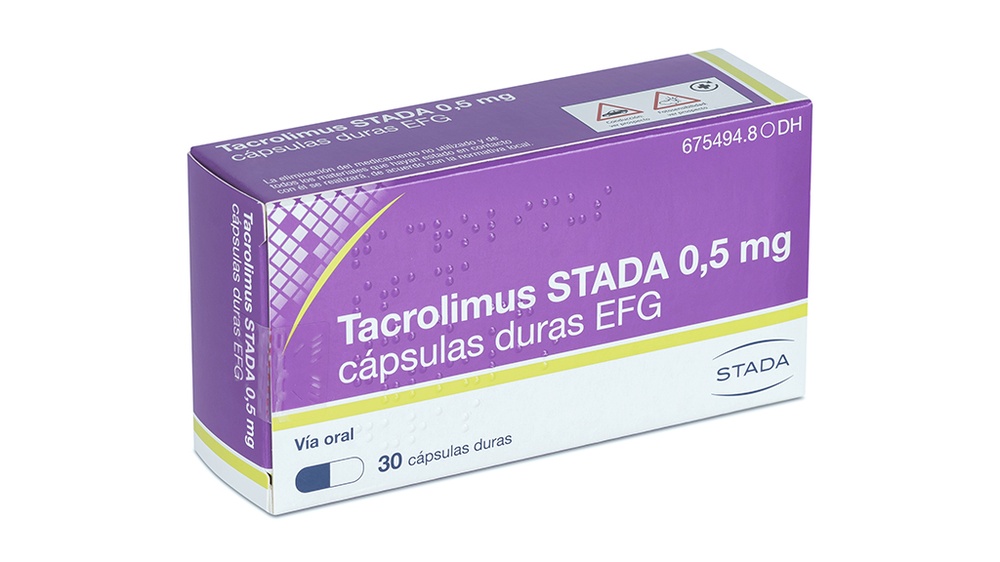
- País de registro
- Forma farmacéuticaCAPSULA, 0,5 mg
- Código ATCL04AD02
- Principio activo
- Requiere recetaSí
- Fabricante
- ComposiciónCROSCARMELOSA SODICA (25.0 mg mg), ETANOL ANHIDRO (30.0 mg mg), LACTOSA (109.1 mg mg)
- Esta información es de carácter general y no sustituye la consulta con un profesional sanitario.
- Alternativas a TACROLIMUS STADA 0,5 mg CAPSULAS DURAS EFGForma farmacéutica: CAPSULA, 0,5 mgPrincipio activo: TacrolimusFabricante: Sandoz Farmaceutica S.A.Requiere recetaForma farmacéutica: CAPSULA, 1 mgPrincipio activo: TacrolimusFabricante: Sandoz Farmaceutica S.A.Requiere recetaForma farmacéutica: CAPSULA, 2 mgPrincipio activo: TacrolimusFabricante: Sandoz Farmaceutica S.A.Requiere receta
Médicos online para TACROLIMUS STADA 0,5 mg CAPSULAS DURAS EFG
Comenta la dosis, los posibles efectos secundarios, interacciones, contraindicaciones o la revisión de receta de TACROLIMUS STADA 0,5 mg CAPSULAS DURAS EFG, sujeto a valoración médica y a la normativa local.
Obtén una receta de TACROLIMUS STADA 0,5 mg CAPSULAS DURAS EFG online
Rellena un formulario de 2 minutos
Cuéntanos tus síntomas, historial y el medicamento que necesitas.
Elige un médico o nosotros te asignamos uno
Escoge un especialista o te conectamos con el próximo médico disponible.
El médico revisa tu caso
Normalmente en 30 minutos. Puede hacerte preguntas adicionales por chat.
Recógela en cualquier farmacia
Receta electrónica enviada a tu correo, válida en toda España.
Preguntas frecuentes
TACROLIMUS STADA 0,5 mg CAPSULAS DURAS EFG requiere receta en España. Puedes confirmarlo con un médico online según tu caso.
El principio activo de TACROLIMUS STADA 0,5 mg CAPSULAS DURAS EFG es Tacrolimus. Esta información ayuda a identificar medicamentos con la misma composición pero con diferentes nombres comerciales.
TACROLIMUS STADA 0,5 mg CAPSULAS DURAS EFG es fabricado por Laboratorio Stada S.L.. La marca y el envase pueden variar según el distribuidor.
Los Médicos de familia, Psiquiatras, Dermatólogos, Cardiólogos, Endocrinólogos, Gastroenterólogos, Neumólogos, Nefrólogos, Reumatólogos, Hematólogos, Infectólogos, Alergólogos, Geriatras, Pediatras, Oncólogos pueden valorar la prescripción de TACROLIMUS STADA 0,5 mg CAPSULAS DURAS EFG cuando esté clínicamente indicado. Puedes reservar una videoconsulta para comentar tu caso y las opciones de tratamiento.
España cuenta con una infraestructura sanitaria bien desarrollada en ciudades principales como Madrid, Barcelona, Valencia y Sevilla. Las farmacias están ampliamente disponibles y operan bajo estrictas regulaciones, garantizando el acceso a medicamentos con receta.
Puedes comprar TACROLIMUS STADA 0,5 mg CAPSULAS DURAS EFG en Madrid, Barcelona, Sevilla o Valencia en cualquier farmacia local con una receta válida.
Para obtener una receta, puedes utilizar Oladoctor:
Otros medicamentos con el mismo principio activo (Tacrolimus) incluyen ADOPORT 0,5 mg CAPSULAS DURAS EFG, ADOPORT 1 mg CAPSULAS DURAS EFG, ADOPORT 2 MG CAPSULAS DURAS. Pueden tener diferentes nombres comerciales o formulaciones, pero contienen el mismo componente terapéutico. Consulta siempre con un médico antes de cambiar o iniciar un nuevo medicamento.
