



SUGAMMADEX TARBIS 100 MG/ML SOLUCION INYECTABLE

Revisión de receta online
Un médico revisará tu caso y determinará si la prescripción es médicamente apropiada.

Habla con un médico sobre este medicamento
Comenta tus síntomas y las opciones de tratamiento en una consulta online.



Cómo usar SUGAMMADEX TARBIS 100 MG/ML SOLUCION INYECTABLE EFG
Contenido del prospecto
- Introducción
- Qué es Sugammadex Tarbis y para qué se utiliza
- Qué necesita saber antes de empezar la administración de Sugammadex Tarbis
- Cómo se administra Sugammadex Tarbis
- Posibles efectos adversos
- Conservación de Sugammadex Tarbis
- Contenido del envase e información adicional
Introducción
Prospecto: información para el usuario
Sugammadex Tarbis 100 mg/ml solución inyectable EFG
Lea todo el prospecto detenidamente antes de que le administren este medicamento, porque contiene información importante para usted.
- Conserve este prospecto, ya que puede tener que volver a leerlo.
- Si tiene alguna duda, consulte a su anestesiólogo (anestesista) o a su médico.
- Si experimenta efectos adversos, consulte a su anestesista o a otro médico, incluso si se trata de efectos adversos que no aparecen en este prospecto. Ver sección 4.
Contenido del prospecto
- Qué es Sugammadex Tarbis y para qué se utiliza
- Qué necesita saber antes de empezar la administración de Sugammadex Tarbis
- Cómo se administra Sugammadex Tarbis
- Posibles efectos adversos
- Conservación de Sugammadex Tarbis
- Contenido del envase e información adicional
1. Qué es Sugammadex Tarbis y para qué se utiliza
Qué es Sugammadex Tarbis
Sugammadex Tarbis contiene el principio activo sugammadex. Se considera que sugammadex es un Agente Selectivo de Unión a Bloqueantes ya que sólo funciona con relajantes musculares específicos, el bromuro de rocuronio o bromuro de vecuronio.
Para qué se utiliza Sugammadex Tarbis
Si se tiene que operar, sus músculos deben estar completamente relajados, lo que facilita al cirujano la operación. Para esto, en la anestesia general le darán medicamentos para que sus músculos se relajen. Se llaman bloqueantes musculares, y por ejemplo son el bromuro de rocuronio y el bromuro de vecuronio. Como esos medicamentos también bloquean los músculos de la respiración, necesitará ayuda para respirar (respiración artificial) durante y después de su operación hasta que pueda respirar de nuevo por sí mismo.
Sugammadex se utiliza para acelerar la recuperación de los músculos después de una operación para que, de nuevo, pueda respirar por sí mismo más pronto. Lo hace combinándose con el bromuro de rocuronio o el bromuro de vecuronio en su cuerpo. Se puede utilizar en adultos siempre que se utilice bromuro de rocuronio o bromuro de vecuronio y en niños y adolescentes (entre 2 y 17 años), cuando se utilice el bromuro de rocuronio para un nivel moderado de relajación.

¿No estás seguro de si este medicamento es adecuado para ti?
Comenta tus síntomas y tratamiento con un médico online.
2. Qué necesita saber antes de empezar la administración de Sugammadex Tarbis
No debe recibir Sugammadex Tarbis
- si es alérgico al sugammadex o a alguno de los demás componentes de este medicamento (incluidos en la sección 6).
→ Informe a su anestesista si este es su caso.
Advertencias y precauciones
Consulte a su anestesista antes de empezar la administración de sugammadex
- si tiene alguna enfermedad del riñón o la ha tenido en el pasado. Esto es importante porque sugammadexse elimina de su cuerpo por los riñones.
- si tiene una enfermedad del hígado o la ha tenido anteriormente.
- si tiene retención de líquidos (edema).
- si padece alguna enfermedad que aumente el riesgo de presentar hemorragias (alteraciones de la coagulación de la sangre) o utiliza medicación anticoagulante.
Niños y adolescents
Este medicamento no está recomendado para niños menores de 2 años.
Otros medicamentos y Sugammadex Tarbis
→ Informe a su anestesista si está tomando, ha tomado recientemente o pudiera tener que tomar cualquier otro medicamento.
Sugammadex puede afectar a otros medicamentos o se puede ver afectado por ellos.
Algunos medicamentos reducen el efecto de Sugammadex Tarbis
→ Es especialmente importante que informe a su anestesista si ha tomado recientemente:
- toremifeno (se utiliza para tratar el cáncer de mama).
- ácido fusídico (un antibiótico).
Sugammadex Tarbis puede afectar a los anticonceptivos hormonales
- Sugammadex puede hacer que los anticonceptivos hormonales - como la “Píldora”, el anillo vaginal, implantes o un Dispositivo Intrauterino Hormonal (DIU-h) sean menos eficaces porque reduce la cantidad que le llega de la hormona progestágeno. La cantidad de progestágeno perdida a consecuencia del uso de sugammadex es aproximadamente la misma que se pierde cuando olvida una de las píldoras anticonceptivas.
→ Si usted está tomando la Píldorael mismo día que le administren sugammadex, siga las instrucciones en caso de olvido de un comprimido del prospecto de la píldora.
→ Si usted está utilizando otrosanticonceptivos hormonales (por ejemplo anillo vaginal, implante o DIU-h) deberá utilizar un método anticonceptivo complementario no hormonal (como el preservativo) durante los 7 días siguientes y seguir las recomendaciones del prospecto.
Efectos en los análisis de sangre
En general, sugammadex no tiene efectos sobre las pruebas de laboratorio. Sin embargo, puede afectar los resultados de un análisis de sangre cuando se miden los niveles de la hormona progesterona. Consulte a su médico si sus niveles de progesterona necesitan ser analizados en el mismo día en que recibe sugammadex.
Embarazo y lactancia
→ Informe a su anestesista si está embarazada o puede estar embarazada o si está en periodo de lactancia.
Es posible que aun así le administren sugammadex, pero es necesario discutirlo antes.
No se conoce si sugammadex puede pasar a la leche materna. Su anestesista le ayudará a decidir si interrumpe la lactancia, o si evita el tratamiento con sugammadex, considerando el beneficio de la lactancia para el bebé y el beneficio de sugammadex para la madre.
Conducción y uso de máquinas
Sugammadex no tiene ninguna influencia conocida sobre la capacidad para conducir y utilizar máquinas.
Sugammadex Tarbis contiene sodio
Este medicamento contiene hasta 9,17 mg de sodio (componente principal de la sal de mesa/para cocinar) en cada ml. Esto equivale al 0,47% de la ingesta diaria máxima de sodio recomendada para un adulto.
3. Cómo se administra Sugammadex Tarbis
Sugammadex le será administrado por su anestesista, o bajo la supervisión de su anestesista.
Dosis
Su anestesista calculará la dosis de sugammadex que necesita en función de:
- su peso
- la cantidad de bloqueante muscular que todavía le esté haciendo efecto.
La dosis habitual es de 2-4 mg por kg de peso corporal para adultos y para niños y adolescentes de entre 2-17 años. Se puede utilizar una dosis de 16 mg/kg en adultos, si se necesita la recuperación urgente de la relajación muscular.
Cómo se administra Sugammadex Tarbis
Sugammadex le será administrado por su anestesista. Se inyecta de una vez por vía intravenosa.
Si le inyectan más Sugammadex Tarbis del recomendado
Como su anestesista estará controlando la situación cuidadosamente, es improbable que le administren demasiado sugammadex. Pero incluso si esto sucede, es improbable que cause ningún problema.
Si tiene cualquier otra duda sobre el uso de este medicamento, pregunte a su anestesista o a otro médico.

¿Has empezado a tomar el medicamento y tienes preguntas?
Comenta tus síntomas y tratamiento con un médico online.
4. Posibles efectos adversos
Al igual que todos los medicamentos, este medicamento puede producir efectos adversos, aunque no todas las personas los sufran.
Si estos efectos adversos se producen mientras está bajo los efectos de la anestesia, será su anestesista quien los detectará y tratará.
Frecuentes (que pueden afectar hasta 1 de cada 10 personas)
- Tos
- Dificultades de las vías respiratorias que pueden incluir tos o movimientos como si estuviese despierto o tomando un respiro
- Anestesia superficial – se puede empezar a despertar, por lo que necesitará más anestésico. Esto puede hacer que se mueva o tosa al final de la operación
- Complicaciones durante el procedimiento, tales como cambios en la frecuencia cardiaca, tos o movimiento
- Disminución de la presión arterial debido a la intervención quirúrgica
Poco frecuentes (que pueden afectar hasta 1 de cada 100 personas)
- Dificultad al respirar debida a calambres musculares en las vías aéreas (broncoespasmo) que se producen en pacientes con antecedentes de problemas de pulmón
- Reacciones alérgicas (hipersensibilidad a medicamentos) - tales como erupción, enrojecimiento de la piel, hinchazón de su lengua y/o faringe, respiración difícil, cambios en la presión de la sangre o ritmo cardiaco, que algunas veces da como resultado una disminución grave de la presión de la sangre. Las reacciones de tipo alérgico o reacciones alérgicas graves pueden poner la vida en peligro Las reacciones alérgicas se comunicaron con mayor frecuencia en voluntarios conscientes sanos
- Reaparición de la relajación muscular después de la operación
Frecuencia no conocida
- Cuando se administra sugammadex se puede producir un enlentecimiento importante del corazón que puede llegar incluso hasta la parada cardiaca
Comunicación de efectos adversos
Si experimenta cualquier tipo de efecto adverso, consulte a su anestesista u otro médico, incluso si se trata de posibles efectos adversos que no aparecen en este prospecto. También puede comunicarlos directamente a través del Sistema Español de Farmacovigilancia de Medicamentos de Uso Humano: https://www.notificaram.es.
Mediante la comunicación de efectos adversos usted puede contribuir a proporcionar más información sobre la seguridad de este medicamento.
5. Conservación de Sugammadex Tarbis
La conservación estará a cargo de los profesionales del sector sanitario.
Mantener este medicamento fuera de la vista y del alcance de los niños.
No utilice este medicamento después de la fecha de caducidad que aparece en la caja y en la etiqueta después de “CAD”. La fecha de caducidad es el último día del mes que se indica.
Este medicamento no requiere ninguna temperatura especial de conservación.
Conservar el vial en el embalaje exterior para protegerlo de la luz.
Tras la primera apertura y dilución se ha demostrado estabilidad química y física en uso durante 24 horas entre 2 °C y 25 °C. Desde un punto de vista microbiológico, el producto diluido se debe utilizar inmediatamente. Si no se usa inmediatamente, los tiempos de almacenamiento en uso y las condiciones antes de su uso son responsabilidad del usuario.
Los medicamentos no se deben tirar por los desagües ni a la basura. Pregunte a su farmacéutico cómo desharcerse de los envases y de los medicamentos que ya no necesita. De esta forma ayudará a proteger el medio ambiente.
6. Contenido del envase e información adicional
Composición de Sugammadex Tarbis
El principio activo es sugammadex.
Cada ml de solución inyectable contiene sugammadex sódico equivalente a 100 mg de sugammadex.
Cada vial de 2 ml contiene sugammadex sódico equivalente a 200 mg de sugammadex.
Cada vial de 5 ml contiene sugammadex sódico equivalente a 500 mg de sugammadex.
Los demás componentes son agua para preparaciones inyectables, ácido clorhídrico 3,7% y/o hidróxido de sodio.
Aspecto del producto y contenido del envase
Una solución transparente, incolora a marrón ligeramente amarillenta.
Tamaños de paquete:
1 y 10 viales de 2 mL
1 y 10 viales de 5 mL.
Puede que solamente estén comercializados algunos tamaños de envases.
Titular de la autorización de comercialización
Tarbis Farma S.L.
Gran Vía Carlos III, 94
08028 Barcelona
España
Responsable de la fabricación
Amarox Pharma B.V.
Rouboslaan 32
2252 TR Voorschoten
Países Bajos
Pharmadox Healthcare Ltd,
KW20A Kordin Industrial Park,
Paola, PLA 3000,
Malta.
Este medicamento está autorizado en los estados miembros del Espacio Económico Europeo con los siguientes nombres:
Países Bajos: Sugammadex Amarox 100 mg/ml oplossing voor injectie
Alemania: Sugammadex Amarox 100 mg/ml Injektionslösung
España: Sugammadex Tarbis 100 mg/ml solución inyectable EFG
Fecha de la última revisión de este prospecto: agosto 2022
La información detallada y actualizada de este medicamento está disponible en la página Web de la Agencia Española de Medicamentos y Productos Sanitarios (AEMPS) http://www.aemps.gob.es/
---------------------------------------------------------------------------------------------------------------------------
Esta información está destinada únicamente a profesionales sanitarios:
Para obtener información detallada, consultar la Ficha Técnica o el Resumen de las Características del Producto de Sugammadex Tarbis.
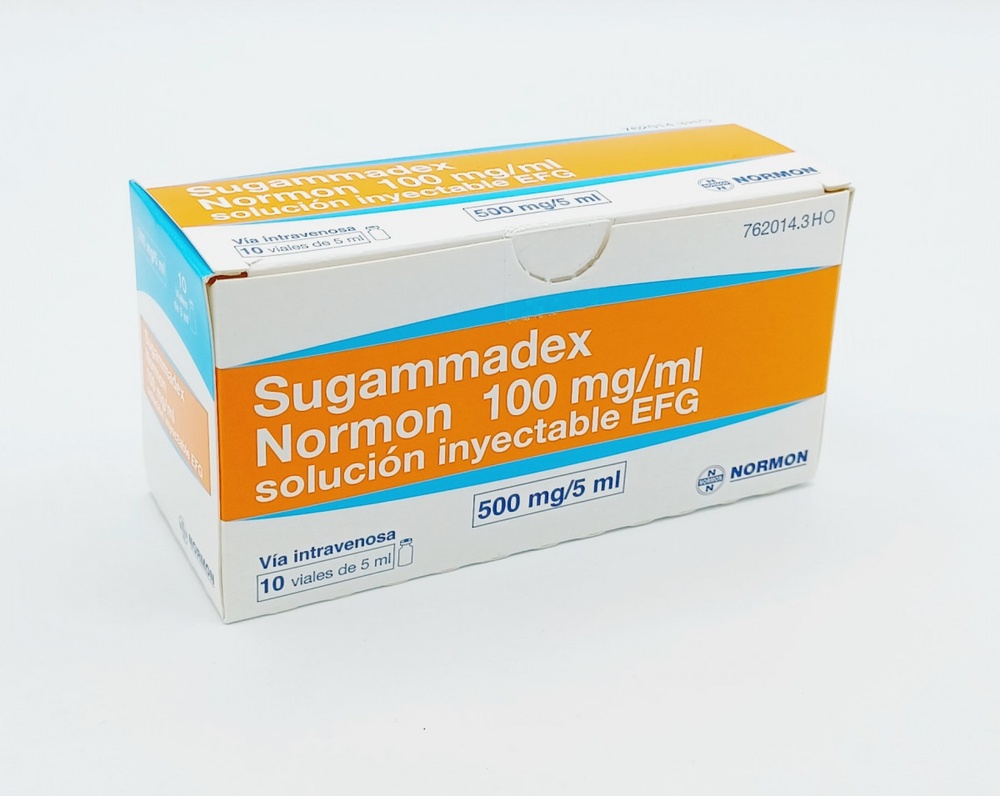
- País de registro
- Forma farmacéuticaINYECTABLE, 100 mg/ml
- Código ATCV03AB35
- Principio activo
- Requiere recetaSí
- Fabricante
- ComposiciónHIDROXIDO DE SODIO (E 524) (C.s pH mg)
- Esta información es de carácter general y no sustituye la consulta con un profesional sanitario.
- Alternativas a SUGAMMADEX TARBIS 100 MG/ML SOLUCION INYECTABLE EFGForma farmacéutica: INYECTABLE, 100 mgPrincipio activo: SugammadexFabricante: Merck Sharp & Dohme B.V.Requiere recetaForma farmacéutica: INYECTABLE, 100 mgPrincipio activo: SugammadexFabricante: Merck Sharp & Dohme B.V.Requiere recetaForma farmacéutica: INYECTABLE, 100 mg/mlPrincipio activo: SugammadexFabricante: Accord Healthcare S.L.U.Requiere receta
Médicos online para SUGAMMADEX TARBIS 100 MG/ML SOLUCION INYECTABLE EFG
Comenta la dosis, los posibles efectos secundarios, interacciones, contraindicaciones o la revisión de receta de SUGAMMADEX TARBIS 100 MG/ML SOLUCION INYECTABLE EFG, sujeto a valoración médica y a la normativa local.









Obtén una receta de SUGAMMADEX TARBIS 100 MG/ML SOLUCION INYECTABLE EFG online
Rellena un formulario de 2 minutos
Cuéntanos tus síntomas, historial y el medicamento que necesitas.
Elige un médico o nosotros te asignamos uno
Escoge un especialista o te conectamos con el próximo médico disponible.
El médico revisa tu caso
Normalmente en 30 minutos. Puede hacerte preguntas adicionales por chat.
Recógela en cualquier farmacia
Receta electrónica enviada a tu correo, válida en toda España.
Preguntas frecuentes
SUGAMMADEX TARBIS 100 MG/ML SOLUCION INYECTABLE EFG requiere receta en España. Puedes confirmarlo con un médico online según tu caso.
El principio activo de SUGAMMADEX TARBIS 100 MG/ML SOLUCION INYECTABLE EFG es Sugammadex. Esta información ayuda a identificar medicamentos con la misma composición pero con diferentes nombres comerciales.
SUGAMMADEX TARBIS 100 MG/ML SOLUCION INYECTABLE EFG es fabricado por Tarbis Farma S.L.. La marca y el envase pueden variar según el distribuidor.
Los Médicos de familia, Psiquiatras, Dermatólogos, Cardiólogos, Endocrinólogos, Gastroenterólogos, Neumólogos, Nefrólogos, Reumatólogos, Hematólogos, Infectólogos, Alergólogos, Geriatras, Pediatras, Oncólogos pueden valorar la prescripción de SUGAMMADEX TARBIS 100 MG/ML SOLUCION INYECTABLE EFG cuando esté clínicamente indicado. Puedes reservar una videoconsulta para comentar tu caso y las opciones de tratamiento.
España cuenta con una infraestructura sanitaria bien desarrollada en ciudades principales como Madrid, Barcelona, Valencia y Sevilla. Las farmacias están ampliamente disponibles y operan bajo estrictas regulaciones, garantizando el acceso a medicamentos con receta.
Puedes comprar SUGAMMADEX TARBIS 100 MG/ML SOLUCION INYECTABLE EFG en Madrid, Barcelona, Sevilla o Valencia en cualquier farmacia local con una receta válida.
Para obtener una receta, puedes utilizar Oladoctor:
Otros medicamentos con el mismo principio activo (Sugammadex) incluyen BRIDION 100 MG/ML SOLUCION INYECTABLE, BRIDION 100 MG/ML SOLUCION INYECTABLE, SUGAMMADEX ACCORD 100 MG/ML SOLUCION INYECTABLE EFG. Pueden tener diferentes nombres comerciales o formulaciones, pero contienen el mismo componente terapéutico. Consulta siempre con un médico antes de cambiar o iniciar un nuevo medicamento.
