



SUERORAL 20 g/1.5 g/3.5 g/2.9 g Solución/Suspensión Oral

Revisión de receta online
Un médico revisará tu caso y determinará si la prescripción es médicamente apropiada.

Habla con un médico sobre este medicamento
Comenta tus síntomas y las opciones de tratamiento en una consulta online.



Cómo usar SUERORAL CASEN POLVO PARA SOLUCION ORAL
Contenido del prospecto
- Introducción
- Qué es Sueroral y para qué se utiliza
- Qué necesita saber antes de empezar a tomar Sueroral
- Cómo tomar Sueroral
- Posibles efectos adversos
- Conservación de Sueroral
- Contenido del envase e información adicional
Introducción
Prospecto: información para el usuario
Sueroral Casen polvo para solución oral
Glucosa, cloruro sódico, citrato trisódico dihidratado, cloruro potásico
Lea todo el prospecto detenidamenteantes de empezar a tomar estemedicamento, porque contiene información importante para usted.
Siga exactamente las instrucciones de administración del medicamento contenidas en este prospecto o las indicadas por su médico o farmacéutico.
- Conserve este prospecto, ya que puede tener que volver a leerlo.
- Si necesita consejo o más información, consulte a su farmacéutico.
- Si experimenta efectos adversos, consulte a su médico o farmacéutico, incluso si se trata de efectos adversos que no aparecen en este prospecto. Ver sección 4.
- Debe consultar a un médico si empeora o si no mejora después de 5 días.
Contenido del prospecto:
- Qué es Sueroral y para qué se utiliza
- Qué necesita saber antes de empezar a tomar Sueroral
- Cómo tomar Sueroral
- Posibles efectos adversos
5 Conservación de Sueroral
- Contenido del envase e información adicional
1. Qué es Sueroral y para qué se utiliza
Sueroral pertenece a un grupo de medicamentos llamados formulaciones de sales para rehidratación oral.
Sueroral está indicado en la reposición oral de electrolitos y fluidos en pacientes con deshidratación particularmente asociada a diarrea aguda de diversos orígenes.
El objetivo del tratamiento es rehidratar al paciente y mantener la hidratación mediante reposición de las pérdidas posteriores causadas por diarrea, vómitos y pérdida normal de agua hasta que pueda reanudarse la nutrición adecuada.
Debe consultar a un médico si empeora o si no mejora después de 5 días.

¿No estás seguro de si este medicamento es adecuado para ti?
Comenta tus síntomas y tratamiento con un médico online.
2. Qué necesita saber antes de empezar a tomar Sueroral
No tome Sueroral :
- Si es alérgico a los principios activos (glucosa, cloruro sódico, citrato trisódico dihidratado, cloruro potásico) o a cualquiera de los demás componentes de este medicamento (incluidos en la sección 6).
- Si tiene escasa o nula secreción de orina
- Si tiene vómitos importantes y continuos
- Si tiene una malabsorción de glucosa ya conocida
- Si es usted diabético
- Si tiene incapacidad para beber
- Si padece obstrucción intestinal
- Si padece íleo paralítico
- Si tiene insuficiencia renal
- Si tiene perforación intestinal
- En prematuros y niños menores de 1 mes
- En abatimiento pre-shock, en el que se debe hacer la administración oral por sonda gástrica o intravenosa de suero Ringer y otros
Advertencias y precauciones
Consulte a su médico o farmacéutico antes de empezar a tomar Sueroral.
Tenga especial cuidado con Sueroral:
- Cuando la rehidratación parenteral está indicada, como en casos de deshidratación severa y vómitos continuos o frecuentes, ya que en este caso no es apropiada la administración de Sueroral.
- Si habitualmente consume leche de vaca no deberá tomar más de 150 ml cada cuatro horas, y si la diarrea empeorase, deberá suspender su consumo, sustituyéndola por otro alimento proteínico.
- Podrá comer alimentos de forma normal cuando se corrija la diarrea.
- La alimentación con leche materna debe continuar entre las administraciones de solución de rehidratación oral.
Uso de Sueroral con otros medicamentos
Comunique a su médico o farmacéutico si está utilizando o ha utilizdo recientemente o podría tener que utilizar cualquier otro medicamento..
Toma de Sueroral con alimentos y bebidas
No deben administrarse purgantes.
Embarazo, lactancia y fertilidad
Si está embarazada o en periodo de lactancia, cree que podría estar embarazada o tiene intención de quedarse embarazada, consulte a su médico o farmacéutico antes de utilizar este medicamento.
Conducción y uso de máquinas
Sueroral no afecta su capacidad para conducir o utilizar máquinas.
Sueroral contiene glucosa, sodio, potasio y colorante amarillo anaranjado S (E-110)
Este medicamento contiene glucosa. Si su médico le ha indicado que padece una intolerancia a ciertos azúcares, consulte con él antes de tomar este medicamento.
Los pacientes con diabetes mellitus deben tener en cuenta que este medicamento contiene 20 g de glucosa por sobre.
Los pacientes con dietas pobres en sodio deben tener en cuenta que este medicamento contiene 2.000mg (90mmol) de sodio por sobre.
Los pacientes con insuficiencia renal o con dietas pobres en potasio deben tener en cuenta que este medicamento contiene 780 mg (20mmol) de potasio por sobre.
Este medicamento puede producir reacciones alérgicas porque contiene colorante amarillo anaranjado S (E-110). Puede provocar asma, especialmente en pacientes alérgicos al ácido acetilsalicílico.
3. Cómo tomar Sueroral
Siga exactamente las instrucciones de administración de este medicamento indicadas por su médico o farmacéutico. En caso de duda, consulte de nuevo a su médico o farmacéutico. Sueroral se tomará bebido disolviendo el contenido de cada sobre siempre en un litro de agua potable. La solución debe prepararse y administrarse a temperatura ambiente.
El agua, si se considera necesario, puede haber sido hervida previamente pero no tras su preparación.
No deben añadirse otros ingredientes, como azúcar.
La dosis normal deberá ser calculada individualmente en función del peso del paciente y la gravedad de su enfermedad, aunque en general se recomiendan las siguientes dosis:
Uso en niños y adolescentes
Lactantes mayores de un mes:
La dosis recomendada es de aproximadamente 1-1,5 veces su volumen usual de alimento. Se recomienda administrar la solución frecuentemente, en pequeñas cantidades y lentamente
Los lactantes a los que se les administren 150 ml de solución por kilogramo de peso corporal en menos de 24 horas, deberán tomar agua frecuentemente para apagar la sed.
Niños a partir de 1 año:
La dosis recomendada es de aproximadamente 200 ml de solución por cada deposición diarreica. Se recomienda administrar la solución frecuentemente, en pequeñas cantidades y lentamente.
En niños, sobre todo si están débiles o tienen vómitos, es conveniente administrar la solución a razón de 25 a 30 ml a intervalos de 10 a 15 minutos.
En casos de gran debilidad puede administrarse la solución por sonda nasogástrica.
Si la deshidratación es escasa y, en niños menores de 2 años, el primer día de tratamiento se administrará una toma de agua sola por cada dos tomas de solución de Sueroral, todas del mismo volumen.
En los siguientes días, beber agua frecuentemente.
Adultos:
La dosis recomendada es de 200 a 400 ml de solución por cada deposición diarreica.
No existe una dosis máxima diaria recomendada por lo que la solución puede administrarse libremente ya que la sed del enfermo regula la cantidad de Sueroral.
Ancianos:
La dosis recomendada es la misma que para adultos.
Función hepática alterada:
En este caso no es necesario un ajuste de dosis.
Función renal alterada:
En pacientes con función renal alterada no se deberá tomar en ningún caso Sueroral.
En pacientes con diarreas muy frecuentes habrá que animarles a que beban y en los muy débiles habrá que ayudarles.
En casos de deshidratación grave que se traten por vía intravenosa con suero Ringer o solución fisiológica, una vez vencido el shock y el enfermo pueda beber, se puede continuar el tratamiento con la solución oral.
Duración del tratamiento: Se recomienda continuar el tratamiento mientras dure la diarrea, y una vez finalizada ésta, hasta que el médico lo considere necesario, lo que normalmente se consigue en 4 ó 5 días.
Si toma más Sueroral del que debe
En caso de sobredosis o ingestión accidental, consulte inmediatamente a su médico o farmacéutico o llame al Servicio de Información Toxicológica, teléfono: 91 562 04 20 (indicando el medicamento y la cantidad ingerida)
El síntoma que notará será una hinchazón de los párpados, si esto ocurriera deberá dejar de tomar Sueroral.
Si olvidó tomar Sueroral
No tome una dosis doble para compensar las dosis olvidadas.
Si tiene cualquier otra duda sobre el uso de este medicamento, pregunte a su médico o farmacéutico.

¿Has empezado a tomar el medicamento y tienes preguntas?
Comenta tus síntomas y tratamiento con un médico online.
4. Posibles efectos adversos
Al igual que todos los medicamentos, este medicamento puede producir efectos adversos, aunque no todas las personas los sufran. Los más habituales son los vómitos, que pueden aparecer cuando se administra demasiado rápidamente. En estos casos deberá interrumpir durante 10 minutos la administración de Sueroral y reanudarse dando cantidades menores más frecuentemente.
En pacientes con deterioro renal, la sobredosis puede dar lugar a hipernatremia e hiperkaliemia.
Comunicación de efectos adversos
Si experimenta cualquier tipo de efecto adverso, consulte a su médico, farmacéutico o enfermero, incluso si se trata de posibles efectos adversos que no aparecen en este prospecto. También puede comunicarlos directamente a través del Sistema Español de Farmacovigilancia de Medicamentos de Uso Humano (Website: www.notificaram.es).
Mediante la comunicación de efectos adversos usted puede contribuir a proporcionar más información sobre la seguridad de este medicamento.
5. Conservación de Sueroral
Mantener este medicamento fuera de la vista y del alcance de los niños.
No utilice este medicamento después de la fecha de caducidad que aparece en el envase, después de la abreviatura CAD. La fecha de caducidad es el último día del mes que se indica.
No requiere condiciones especiales de conservación.
Cuando no esté utilizando Sueroral puede conservar la solución nevera (entre 2ºC y 8ºC ) y debe desecharla a las 24 horas después de su preparación.
Los medicamentos no se deben tirar por los desagües ni a la basura. Deposite los envases y los medicamentos que no necesita en el Punto SIGRE de su farmacia. En caso de duda pregunte a su farmacéutico cómo deshacerse de los envases y de los medicamentos que no necesita. De esta forma, ayudará a proteger el medio ambiente.
6. Contenido del envase e información adicional
Composición de Sueroral
- Los principios activos son:
Cloruro sódico………………………….3,5 g
Cloruro potásico………………………..1,5 g
Citrato trisódico dihidratado…………...2,9 g
Glucosa…………...……………………..20,0 g
- Los demás componentes son:
Sistema aromatizante, compuesto por: maltodextrina, dextrosa, goma arábiga (E-414), ácido cítrico (E-330), ácido ascórbico (E-300), benzoato de sodio (E-211), extracto de origen natural rico en tocoferoles (E-306), Neohesperidina dihidrocalcona(E-959), goma ester (E-445).
Sacarina sódica (E-954)
Colorante amarillo anaranjado S (E-110)
Sílice coloidal anhidra
Aspecto del producto y contenido del envase
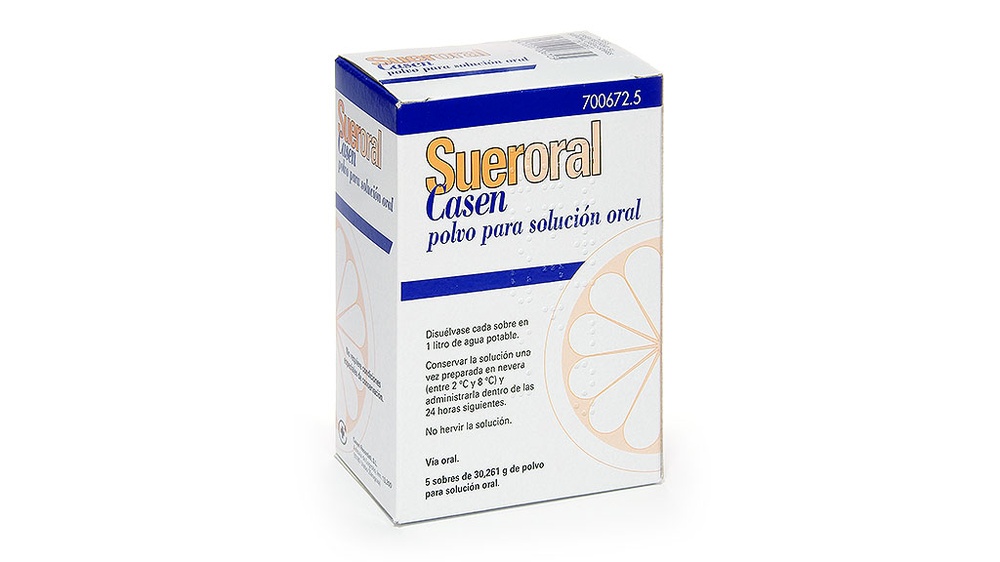
Sueroral se presenta en forma de sobres que contienen 30,261 g de polvo para solución oral cada uno. Cada envase contiene 5 sobres.
Titular de la autorización de comercialización y responsable de la fabricación
Casen Recordati, S.LAutovía de Logroño, km 13, 300
50180 Utebo - Zaragoza
Fecha de la última revisión de este prospecto:junio 1999
La información detallada y actualizada de este medicamento está disponible en la página web de la Agencia Española del Medicamento y Productos Sanitarios (AEMPS)http://www.aemps.gob.es/
- País de registro
- Forma farmacéuticaSOLUCIÓN/SUSPENSIÓN ORAL, 20 g / 1,5 g / 3,5 g / 2,9 g
- Código ATCA07CA91
- Precio medio en farmacia3.87 EUR
- Principio activo
- Requiere recetaNo
- Fabricante
- ComposiciónSACARINA SODICA (0.18 g mg), NARANJA PAL SUPER (E-110) (0,035 g mg)
- Esta información es de carácter general y no sustituye la consulta con un profesional sanitario.
- Alternativas a SUERORAL CASEN POLVO PARA SOLUCION ORALForma farmacéutica: SOLUCIÓN/SUSPENSIÓN ORAL, 43,6 mg / 24 mg / 258 mg / 32 mg / 149 mg / 5 g / 58,5 mg / 71 mgPrincipio activo: Oral rehydration salt formulationsFabricante: Laboratorios Ern S.A.Requiere recetaForma farmacéutica: SOLUCIÓN/SUSPENSIÓN ORAL, -Principio activo: Oral rehydration salt formulationsFabricante: Casen Recordati S.L.No requiere recetaForma farmacéutica: COMPRIMIDO, 2 mgPrincipio activo: LoperamidaFabricante: Uxa Farma S.A.No requiere receta
Médicos online para SUERORAL CASEN POLVO PARA SOLUCION ORAL
Comenta la dosis, los posibles efectos secundarios, interacciones, contraindicaciones o la revisión de receta de SUERORAL CASEN POLVO PARA SOLUCION ORAL, sujeto a valoración médica y a la normativa local.









Obtén una receta de SUERORAL CASEN POLVO PARA SOLUCION ORAL online
Rellena un formulario de 2 minutos
Cuéntanos tus síntomas, historial y el medicamento que necesitas.
Elige un médico o nosotros te asignamos uno
Escoge un especialista o te conectamos con el próximo médico disponible.
El médico revisa tu caso
Normalmente en 30 minutos. Puede hacerte preguntas adicionales por chat.
Recógela en cualquier farmacia
Receta electrónica enviada a tu correo, válida en toda España.
Preguntas frecuentes
SUERORAL CASEN POLVO PARA SOLUCION ORAL no requiere receta en España. Puedes confirmarlo con un médico online según tu caso.
El principio activo de SUERORAL CASEN POLVO PARA SOLUCION ORAL es Oral rehydration salt formulations. Esta información ayuda a identificar medicamentos con la misma composición pero con diferentes nombres comerciales.
El precio medio en farmacia de SUERORAL CASEN POLVO PARA SOLUCION ORAL es de aproximadamente 3.87 EUR. Puede variar según el fabricante y la forma farmacéutica.
SUERORAL CASEN POLVO PARA SOLUCION ORAL es fabricado por Casen Recordati S.L.. La marca y el envase pueden variar según el distribuidor.
Los Médicos de familia, Psiquiatras, Dermatólogos, Cardiólogos, Endocrinólogos, Gastroenterólogos, Neumólogos, Nefrólogos, Reumatólogos, Hematólogos, Infectólogos, Alergólogos, Geriatras, Pediatras, Oncólogos pueden valorar la prescripción de SUERORAL CASEN POLVO PARA SOLUCION ORAL cuando esté clínicamente indicado. Puedes reservar una videoconsulta para comentar tu caso y las opciones de tratamiento.
España cuenta con una infraestructura sanitaria bien desarrollada en ciudades principales como Madrid, Barcelona, Valencia y Sevilla. Las farmacias están ampliamente disponibles y operan bajo estrictas regulaciones, garantizando el acceso a medicamentos con receta.
Puedes comprar SUERORAL CASEN POLVO PARA SOLUCION ORAL en Madrid, Barcelona, Sevilla o Valencia en cualquier farmacia local con una receta válida.
Para obtener una receta, puedes utilizar Oladoctor:
Otros medicamentos con el mismo principio activo (Oral rehydration salt formulations) incluyen CITORSAL POLVO PARA SOLUCIÓN ORAL EN SOBRE, SUERORAL HIPOSODICO, ABECLIN 2 MG COMPRIMIDOS EFG. Pueden tener diferentes nombres comerciales o formulaciones, pero contienen el mismo componente terapéutico. Consulta siempre con un médico antes de cambiar o iniciar un nuevo medicamento.
