



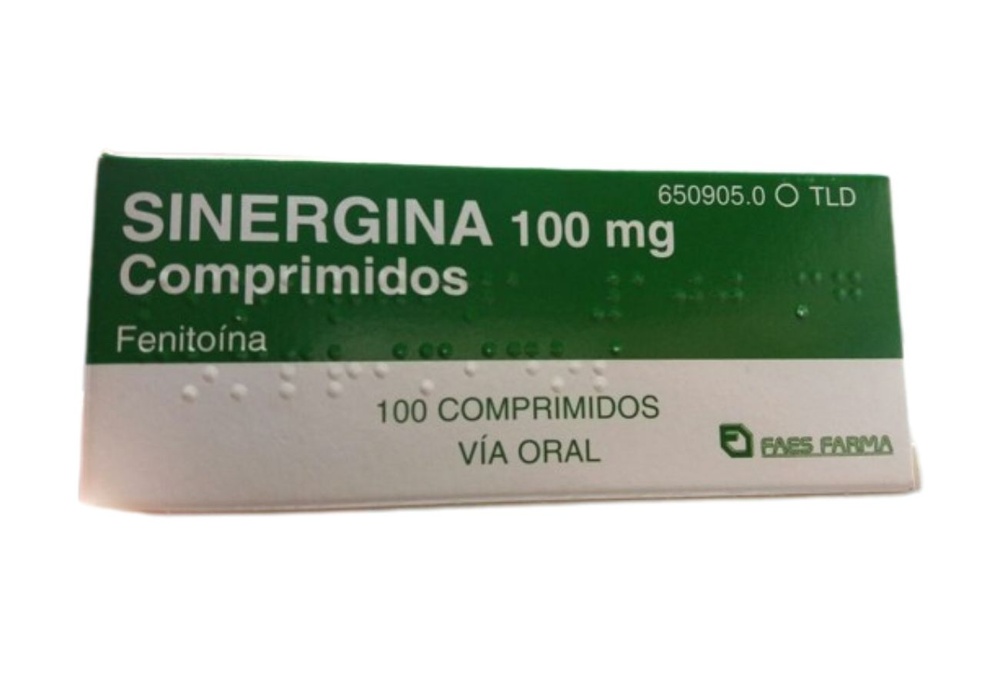
SINERGINA 100 mg Comprimidos

Revisión de receta online
Un médico revisará tu caso y determinará si la prescripción es médicamente apropiada.

Habla con un médico sobre este medicamento
Comenta tus síntomas y las opciones de tratamiento en una consulta online.



Cómo usar SINERGINA 100 mg COMPRIMIDOS
Contenido del prospecto
- Introducción
- Qué es Sinergina y para qué se utiliza
- Qué necesita saber antes de empezar a tomar Sinergina
- Cómo tomar Sinergina
- Posibles efectos adversos
- Conservación de Sinergina
- Contenido del envase e información adicional
Introducción
Prospecto: información para el paciente
Sinergina 100 mg comprimidos
Fenitoína
Lea todo el prospecto detenidamente antes de empezar a tomar este medicamento, porque contiene información importante para usted.
- Conserve este prospecto, ya que puede tener que volver a leerlo.
- Si tiene alguna duda, consulte a su médico o farmacéutico.
- Este medicamento se le ha recetado solamente a usted, y no debe dárselo a otras personas aunque tengan los mismos síntomas que usted, ya que puede perjudicarles.
- Si experimenta efectos adversos, consulte a su médico o farmacéutico, incluso si se trata de efectos adversos que no aparecen en este prospecto. Ver sección 4.
Contenido del prospecto
- Qué es Sinergina y para qué se utiliza
- Qué necesita saber antes de empezar a tomar Sinergina
- Cómo tomar Sinergina
- Posibles efectos adversos
- Conservación de Sinergina
- Contenido del envase e información adicional
1. Qué es Sinergina y para qué se utiliza
Sinergina contiene el principio activo fenitoína.
Fenitoína pertenece al grupo de medicamentos denominados antiepilépticos, que se utilizan para tratar la epilepsia.
Este medicamento está indicado en el tratamiento de los siguientes tipos de epilepsia: convulsiones tónico-clónicas generalizadas (convulsión de gran mal), crisis parciales complejas, así como en el tratamiento y prevención de las convulsiones en neurocirugía.

¿No estás seguro de si este medicamento es adecuado para ti?
Comenta tus síntomas y tratamiento con un médico online.
2. Qué necesita saber antes de empezar a tomar Sinergina
No tome Sinergina
- si es alérgico (hipersensible) a fenitoína o a alguno de los demás componentes de este medicamento (incluidos en la sección 6).
- si es alérgico a medicamentos del tipo hidantoínas.
- si está tomando un medicamento para el tratamiento de la infección VIH llamado delavirdina.
Advertencias y precauciones
Consulte a su médico o farmacéutico antes de empezar a tomar este medicamento.
- si padece una enfermedad del hígado, presenta otras enfermedades graves o es un paciente de edad avanzada. Si durante el tratamiento nota síntomas sugestivos de hepatitis, como ictericia (coloración amarillenta de la piel y del blanco de los ojos), debe consultar inmediatamente con su médico,
- si padece porfiria (enfermedad hereditaria que afecta a la biosíntesis de la hemoglobina),
- si es diabético, ya que fenitoína puede elevar los niveles de glucosa,
- si consume alcohol en grandes cantidades o si lo hace en pequeñas cantidades pero de forma habitual,
- si está en tratamiento con radioterapia craneal o está reduciendo su tratamiento con corticosteroides,
- si es de raza negra, su sistema inmunológico está deprimido, algún miembro de su familia o usted han tenido en el pasado un síndrome de hipersensibilidad medicamentosa (HSS) o síndrome de erupción medicamentosa con eosinofilia y síntomas sistémicos (DRESS) (síndrome que normalmente se presenta con fiebre, erupción de la piel, afectación de los ganglios linfáticos y de otros órganos, como el hígado, los riñones, el corazón, los pulmones y anomalías de la sangre), ya que tiene más riesgo de presentar este síndrome. Si durante el tratamiento presenta fiebre, erupción de la piel con hinchazón de los ganglios linfáticos, que pueden ser signos de hipersensibilidad al medicamento, debe consultar inmediatamente con su médico,
- se han descrito erupciones cutáneas que pueden ser amenazantes para la vida (síndrome de Stevens-Johnson y necrólisis epidérmica tóxica) con el uso de este medicamento. Efectos graves sobre la piel ocurren raramente durante el tratamiento con fenitoína. Inicialmente aparecen como puntos o manchas circulares rojizas, a menudo con una ampolla central. Otros signos adicionales que pueden aparecer son llagas en la boca, garganta, nariz, genitales y conjuntivitis (ojos hinchados y rojos). Estas erupciones en la piel que pueden ser amenazantes para la vida, a menudo van acompañadas de síntomas de gripe. El riesgo puede estar asociado con una variante de un gen en algunos sujetos de origen tailandés o chino. Si es de esta ascendencia y se le ha analizado previamente y sabe que tiene la variedad genética (HLA-B*1502), hable con su médico antes de tomar fenitoína. Si desarrolla erupciones o estos síntomas en la piel, acuda inmediatamente a un médico e infórmele de que está tomando este medicamento,
- si durante el tratamiento sufre un estado de confusión (como delirios, psicosis, etc.), que puede ser un signo de una excesiva cantidad de fenitoína en la sangre, debe consultar inmediatamente con su médico,
- un pequeño número de personas tratadas con antiepilépticos, como Sinergina, ha tenido pensamientos de hacerse daño o de matarse. Si en algún momento tiene estos pensamientos contacte inmediatamente con su médico,
- existe riesgo de daño al feto si se usa Sinergina durante el embarazo. Las mujeres en edad fértil deben utilizar métodos anticonceptivos efectivos durante el tratamiento con Sinergina (ver “Embarazo y lactancia”),
- si es de origen taiwanés, japonés, malayo o tailandés y las pruebas han demostrado que es portador de la mutación CYP2C9*3.
Durante el tratamiento con este medicamento es importante llevar a cabo una buena higiene bucal. De este modo podrá prevenir la aparición de efectos adversos en la zona bucal, como puede ser el engrosamiento de las encías.
Es muy importante que su médico controle su tratamiento en visitas periódicas y le haga análisis de forma regular para descartar la aparición de alteraciones de la sangre, vigilar la función de su hígado y también en algunas ocasiones para controlar la dosis de Sinergina más adecuada.
Interacción con las pruebas de laboratorio
Sinergina puede interferir con ciertos análisis de laboratorio que le realicen.
Fenitoína puede reducir los niveles séricos de yodo unido a proteínas. También puede producir resultados inferiores a los normales en los test de dexametasona o en el test de metirapona. Fenitoína puede producir aumentos de la glucosa sanguínea o de las concentraciones séricas de fosfatasa alcalina y gamma glutamil transpeptidasa (GGT), así como puede afectar a las pruebas de metabolismo del calcio y glucosa en sangre.
Otros medicamentos y Sinergina
Antes de utilizar un nuevo medicamento con Sinergina, debe consultarlo con su médico.
Informe a su médico o farmacéutico si está utilizando, ha utilizado recientemente o pudiera tener que utilizar cualquier otro medicamento, incluso los adquiridos sin receta médica.
Sinergina y ciertos medicamentos pueden influenciarse entre sí (interacciones), provocando un desajuste en los niveles de ambos medicamentos en sangre.
A continuación se resumen los medicamentos que pueden aumentar los niveles de fenitoína:
- Analgésicos/antiinflamatorios como azapropazona, fenilbutazona y salicilatos.
- Anestésicos como halotano.
- Antibióticos como cloranfenicol, eritromicina, isoniazida, sulfadiazina, sulfametizol, sulfametoxazol-trimetoprima, sulfafenazol, sulfisoxazol y sulfonamidas.
- Anticonvulsivantes como felbamato, oxcarbazepina, valproato sódico, succinimidas y topiramato.
- Antifúngicos como anfotericina B, fluconazol, itraconazol, ketoconazol, miconazol y voriconazol.
- Antineoplásicos como capecitabina y fluorouracilo.
- Benzodiazepinas/psicótropos como clordiazepóxido, diazepam, disulfiram, metilfenidato, trazodona, viloxazina.
- Bloqueantes de canales de calcio/agentes cardiovasculares como amiodarona, dicumarol, diltiazem, nifedipino, ticlopidina.
- Antagonistas-H2 como cimetidina.
- Inhibidores de la reductasa HMG-Co como fluvastatina.
- Hormonas como estrógenos.
- Inmunosupresores como tacrolimus.
- Antidiabéticos orales como tolbutamida.
- Inhibidores de la bomba de protones como omeprazol.
- Inhibidores de la recaptación de serotonina como fluoxetina, fluvoxamina, sertralina.
- Alcohol (ingesta aguda).
A continuación se resumen los medicamentos que pueden disminuir los niveles de fenitoína:
- Antibióticos como ciprofloxacino, rifampicina.
- Anticonvulsivantes como vigabatrina.
- Antineoplásicos como bleomicina, carboplatino, cisplatino, doxorubicina y metotrexato.
- Agentes antiulcerosos como sucralfato.
- Antirretrovirales como fosamprenavir, nelfinavir y ritonavir.
- Broncodilatadores como teofilina.
- Agentes cardiovasculares como reserpina.
- Ácido fólico.
- Agentes hiperglucemiantes como diazóxido.
- Hierba de San Juan.
- Alcohol (ingesta crónica).
- Preparados con calcio, incluyendo algunos antiácidos.
A continuación se resumen los medicamentos que pueden aumentar o disminuir los niveles de fenitoína:
- Antibióticos como ciprofloxacino.
- Anticonvulsivantes como carbamazepina, fenobarbital, valproato sódico y ácido valproico.
- Antineoplásicos.
- Psicótropos como clordiazepóxido, diazepam y fenotiazinas.
A continuación se resumen los fármacos cuyos niveles en la sangre y/o cuyos efectos pueden alterarse por la administración de fenitoína:
- Antibióticos como doxiciclina, rifampicina y tetraciclina.
- Anticoagulantes, por ejemplo, rivaroxabán, dabigatrán, apixabán y edoxabán.
- Anticonvulsivantes como carbamazepina, lamotrigina, fenobarbital, valproato sódico, ácido valproico.
- Antifúngicos de la familia de los azoles, como posaconazol y voriconazol.
- Antihelmínticos como albendazol, praziquantel.
- Antineoplásicos como tenipósido.
- Antirretrovirales como delavirdina, efavirenz, fosamprenavir, indinavir, lopinavir/ritonavir, nelfinavir, ritonavir y saquinavir.
- Broncodilatadores como teofilina.
- Bloqueantes de los canales de calcio/agentes cardiovasculares como digitoxina, digoxina, mexiletina, nicardipino, nimodipino, nisodipino, quinidina y verapamilo.
- Corticosteroides.
- Anticoagulantes cumarínicos.
- Ciclosporina.
- Diuréticos como furosemida.
- Inhibidores de la reductasa HMG-Co como atorvastatina, fluvastatina y simvastatina.
- Hormonas como estrógenos y anticonceptivos orales.
- Agentes hiperglucemiantes como diazóxido.
- Inmunosupresores.
- Bloqueantes neuromusculares como alcuronio, cisatracurio, pancuronio, rocuronio y vecuronio.
- Analgésicos opioides como metadona.
- Antidiabéticos orales como clorpropamida, gliburida y tolbutamida.
- Psicótropos/antidepresivos como clozapina, paroxetina, quetiapina y sertralina.
- Vitamina D.
- Lacosamida (antiepiléptico)
- Ticagrelor (inhibidor de la agregación plaquetaria)
Algunos medicamentos que se utilizan para tratar la depresión (antidepresivos tricíclicos) pueden precipitar la aparición de convulsiones en ciertos pacientes, por lo que el médico puede decidir cambiar la dosis de fenitoína.
Toma deSinerginacon alimentos, bebidas y alcohol
La ingesta aguda de alcohol puede aumentar los niveles de fenitoína mientras que la ingesta crónica de alcohol puede disminuirlos, por lo que usted no debe tomar alcohol durante el tratamiento con este medicamento.
Si usted ha recibido preparados de nutrición enteral y/o suplementos nutricionales puede que presente unos niveles plasmáticos de fenitoína más bajos de lo esperado. Por tanto, se recomienda que fenitoína no se administre junto con los preparados de nutrición enteral y/o suplementos vitamínicos. Puede ser que su médico le monitorice los niveles del medicamento en sangre.
Embarazo, lactancia y fertilidad
Si está embarazada o en periodo de lactancia, cree que podría estar embarazada o tiene intención de quedarse embarazada, consulte a su médico o farmacéutico antes de utilizar este medicamento.
Si está embarazada o cree que podría estarlo, informe a su médico inmediatamente. No deje de tomar el medicamento hasta que lo haya considerado con su médico. Dejar de tomar su medicamento sin consultar con su médico podría producir convulsiones que podrían ser peligrosas para usted y el feto. Su médico puede decidir cambiar su tratamiento.
Embarazo
Si cree que puede estar embarazada o piensa estarlo, informe a su médico antes de tomar Sinergina; él le indicará los riesgos potenciales a los que están expuestos usted y su bebé. Este medicamento, solo debe ser administrado a mujeres embarazadas si, a juicio del médico, el beneficio esperado para la madre es mayor que cualquier posible riesgo para el feto.
Sinergina puede producir anomalías congénitas graves. Si toma Sinergina durante el embarazo, su bebé tiene hasta 3 veces más riesgo de tener una anomalía congénita que las mujeres que no toman un medicamento antiepiléptico. Se han notificado anomalías congénitas graves, como anomalías en el crecimiento, el cráneo, la cara, las uñas, los dedos y el corazón. Algunas de estas se pueden producir a la vez como parte de un síndrome hidantoínico fetal.
Se han notificado problemas en el desarrollo neurológico (desarrollo del cerebro) en bebés nacidos de madres que utilizaron fenitoína durante el embarazo. Algunos estudios han demostrado que fenitoína afecta negativamente al desarrollo neurológico de los niños expuestos a fenitoína en el útero, aunque otros estudios no han encontrado tal efecto. No se puede descartar la posibilidad de un efecto sobre el desarrollo neurológico.
Fertilidad
Si es una mujer en edad fértil y no está planeando quedarse embarazada, debe utilizar un método anticonceptivo durante el tratamiento con Sinergina. Este medicamento puede afectar a la forma en que los anticonceptivos hormonales, como la píldora anticonceptiva, actúan y hacerlos menos eficaces para prevenir el embarazo. Consulte a su médico, quien considerará con usted el tipo de anticonceptivo más adecuado que debe utilizar mientras esté tomando Sinergina.
Si es una mujer en edad fértil y está planeando quedarse embarazada, consulte a su médico antes de suspender la anticoncepción y antes de quedarse embarazada sobre el cambio a otros tratamientos adecuados para evitar exponer al feto a fenitoína
Lactancia
No se recomienda la toma de Sinergina durante la lactancia.
Conducción y uso de máquinas
Fenitoína puede producir síntomas tales como somnolencia, mareo o alteraciones en la vista, y disminuir la capacidad de reacción. Estos efectos, así como la propia enfermedad, pueden dificultar su capacidad para conducir vehículos o manejar máquinas. Por lo tanto, no conduzca ni maneje máquinas, ni practique otras actividades que requieran especial atención, hasta que su médico valore su respuesta a este medicamento.
3. Cómo tomar Sinergina
Siga exactamente las instrucciones de administración de este medicamento indicadas por su médico o farmacéutico. Es muy importante que usted las cumpla estrictamente. Informe a su médico de cualquier causa que imposibilite la toma de este medicamento, como por ejemplo una operación.
En caso de duda, consulte de nuevo a su médico o farmacéutico.
Este medicamento debe tomarse con al menos medio vaso de agua. Si tiene tendencia a presentar náuseas o pesadez de estómago, podrá tomar el medicamento durante o después de las comidas.
Adultos
La dosis de inicio del tratamiento es de 300 mg de Sinergina al día repartidos en tres tomas iguales (1 comprimido cada 8 horas antes de las comidas). Su médico le indicará la dosis de mantenimiento que usted necesita, no debiendo exceder la dosis máxima de 600 mg al día.
Para pacientes que necesiten alcanzar de forma rápida unos niveles séricos altos de fenitoína en estado de equilibrio, la dosis de carga recomendada es de 1000 mg de fenitoína por vía oral, dividida en tres dosis [400 mg (4 comprimidos), 300 mg (3 comprimidos) y 300 mg (3 comprimidos)], a intervalos de 2 horas. Esto es necesario que se haga en pacientes hospitalizados ya que es necesaria la monitorización de los niveles séricos del fármaco. Pasadas 24 horas de la administración de la dosis de carga oral, su médico establecerá la dosis de mantenimiento.
Uso en personas de edad avanzada
La dosis de Sinergina en pacientes de edad avanzada que pueden estar tomando otros medicamentos necesita ser ajustada por parte de su médico.
Uso en niños y adolescentes
La dosis inicial es de 5 mg/kg/día repartida en 2-3 tomas iguales. A partir de aquí, la dosis de mantenimiento deberá ser establecida por su médico de forma individualizada, no debiendo exceder la dosis máxima de 300 mg/día.
La dosis diaria de mantenimiento recomendada es de 4mg/kg/día a 8 mg/kg/día. Si la dosis diaria no puede ser dividida equitativamente, la dosis mayor debe darse por la noche.
Esta presentación no es adecuada para su uso en recién nacidos, lactantes, niños y adolescentes o para pacientes para los que por su peso el ajuste de dosis no sea posible con esta presentación. Por ejemplo, pacientes de menos de 40 kilos de peso, debido a la imposibilidad de partir la dosis en al menos dos tomas separadas.
Las ranuras sirven únicamente para partir el comprimido si le resulta difícil tragarlo entero.
Si toma más Sinergina de la que debe
Es peligroso tomar Sinergina a dosis mayores de las debidas. Los síntomas iniciales son: movimientos involuntarios de los ojos, falta de coordinación muscular, dificultad para hablar, temblores, reflejos exagerados, somnolencia, adormecimiento, sueños muy prolongados, habla arrastrada, visión borrosa, náuseas y vómitos. El paciente puede llegar a un estado de coma e hipotensión.
En caso de sobredosis o ingestión accidental, consulte inmediatamente a su médico o farmacéutico o llame al Servicio de Información Toxicológica, teléfono: 91 562 04 20, indicando el medicamento y la cantidad ingerida.
Si olvidó tomar Sinergina
No tome una dosis doble para compensar las dosis olvidadas. Si olvida tomar una dosis, tómesela en cuanto se dé cuenta, a menos que se encuentre próximo a la siguiente dosis, en este caso, no tome la dosis olvidada y espere a la siguiente dosis continuando con su régimen de dosificación establecido. En caso de duda, consulte con su médico o farmacéutico.
Si interrumpe el tratamiento con Sinergina
No interrumpa el tratamiento con Sinergina a menos que se lo indique su médico. Si deja de tomar el medicamento de forma brusca puede aumentar la frecuencia de las convulsiones. Si su médico considera que es necesario interrumpir el tratamiento con este medicamento, él decidirá el tratamiento alternativo más adecuado para usted.
Si tiene cualquier otra duda sobre el uso de este medicamento, pregunte a su médico o farmacéutico.

¿Has empezado a tomar el medicamento y tienes preguntas?
Comenta tus síntomas y tratamiento con un médico online.
4. Posibles efectos adversos
Al igual que todos los medicamentos, este medicamento puede producir efectos adversos, aunque no todas las personas los sufran.
Informe a su médico inmediatamente,si experimenta alguno de los siguientes síntomas después de tomar este medicamento ya que pueden ser graves:
- si experimenta fiebre, erupción cutánea y/o ganglios linfáticos inflamados, especialmente durante los dos primeros meses de tratamiento, ya que pueden ser signos de reacciones de hipersensibilidad al medicamento.
- si presenta confusión mental, o una alteración mental grave, ya que esto puede ser una señal de que tiene cantidades altas de fenitoína en la sangre. Su médico analizará su sangre para determinar la cantidad de fenitoína y si lo considera necesario, puede que disminuya la dosis del medicamento o incluso puede que interrumpa el tratamiento.
- si aprecia moratones, fiebre o hemorragias bucales. Estos pueden ser los primeros síntomas de una anomalía en la sangre, incluyendo una disminución del número de glóbulos rojos, glóbulos blancos, o plaquetas. Su médico realizará análisis de sangre periódicos para detectar estos efectos.
- si experimenta náuseas, vómito, dolor abdominal, falta de apetito, diarrea, sensación de cansancio o debilidad, coloración amarillenta de la piel y los ojos, aumento del volumen del hígado, ya que pueden ser signos de problemas en el hígado.
- si desarrolla una erupción cutánea severa donde aparecen ampollas (que afecta también a la boca y a la lengua). Estos pueden ser síntomas de una afección conocida como síndrome de Stevens-Johnson, o necrolisis epidérmica tóxica (NET).
Otros efectos adversos que pueden aparecer son:
- Trastornos generales y alteraciones en el lugar de administración: reacción alérgica.
- Trastornos del sistema nervioso: nistagmo (movimientos anormales de los ojos), ataxia (inestabilidad), habla arrastrada, disminución de la coordinación, mareo, vértigo, insomnio, nerviosismo transitorio, sacudidas motoras (movimientos incontrolados de diferentes partes del cuerpo), dolor de cabeza, parestesias (hormigueo o disminución de la sensibilidad generalmente en un pie o en una mano), somnolencia. Raramente se han notificado casos de distintos tipos de discinesias (movimientos o posturas incontrolados de distintas partes del cuerpo). En tratamientos muy prolongados: polineuropatía periférica predominantemente sensorial (alteración de la sensación del dolor y tacto). Alteración del gusto.
- Trastornos de la piel y del tejido subcutáneo:endurecimiento de los rasgos faciales, engrosamiento de los labios, engrosamiento de las encías, hipertricosis (exceso de pelo localizado o generalizado).
- Trastornos del aparato reproductor y de la mama: enfermedad de Peyronie (endurecimiento fibroso del pene que provoca la desviación o curvatura del pene durante la erección).
- Trastornos gastrointestinales: vómitos, náuseas, estreñimiento.
- Trastornos del sistema inmunológico: lupus eritematoso sistémico (enfermedad inmunológica con afectación de distintos órganos), poliarteritis nodosa (un tipo de inflamación de las arterias), alteraciones en las inmunoglobulinas (proteínas producidas en la respuesta inmunitaria).
- Trastornos musculoesqueléticos y del tejido conjuntivo: se han notificado osteoporosis, (descalcificación de los huesos) y otras alteraciones, incluyendo disminución de los niveles de calcio, fósforo, vitamina D y fracturas. Consulte a su médico o farmacéutico si usted está en tratamiento prolongado con antiepilépticos, tiene antecedentes de osteoporosis o toma esteroides.
- Trastornos de la sangre y del sistema linfático: disminución en el número de un tipo de glóbulo rojo (aplasia pura de la serie roja).
- Trastornos vasculares: vasculitis (inflamación de las paredes de los vasos).
Otros efectos adversos en niños y adolescentes
Los acontecimientos adversos notificados son generalmente similares en niños y adultos. La hiperplasia gingival se produce con mayor frecuencia en pacientes pediátricos y en aquellos con mala higiene bucal.
Comunicación de efectos adversos
Si experimenta cualquier tipo de efecto adverso, consulte a su médico o farmacéutico, incluso si se trata de posibles efectos adversos que no aparecen en este prospecto. También puede comunicarlos directamente a través del Sistema Español de Farmacovigilancia de medicamentos de Uso Humano: https://www.notificaRAM.es/. Mediante la comunicación de efectos adversos usted puede contribuir a proporcionar más información sobre la seguridad de este medicamento.
5. Conservación de Sinergina
No requiere condiciones especiales de conservación.
Mantener este medicamento fuera de la vista y del alcance de los niños.
No utilice este medicamento después de la fecha de caducidad que aparece en el envase después de CAD. La fecha de caducidad es el último día del mes que se indica.
Los medicamentos no se deben tirar por los desagües ni a la basura. Deposite los envases y los medicamentos que no necesita en el Punto SIGRE de la farmacia. En caso de duda pregunte a su farmacéutico cómo deshacerse de los envases y de los medicamentos que no necesita. De esta forma, ayudará a proteger el medio ambiente.
6. Contenido del envase e información adicional
Composición de Sinergina 100 mg comprimidos
- El principio activo es fenitoína. Cada comprimido contiene 100 mg de fenitoína.
- Los demás componentes son: celulosa microcristalina, estearato magnésico y povidona K 29/32.
Aspecto del producto y contenido del envase
Sinergina 100 mg son comprimidos redondos, birranurados, ligeramente convexos, de 8 mm de diámetro y color blanco. Se presenta en un envase que contiene 100 comprimidos en blíster de PVC/AL.
Titular de la autorización de comercialización
Faes Farma, S.A.
Autonomia Etorbidea, 10
48940 Leioa (Bizkaia)
España
Responsable de la fabricación
Faes Farma, S.A.
Maximo Agirre Kalea, 14
48940 Leioa (Bizkaia)
España
O
Faes Farma, S.A.
Parque Científico y Tecnológico de Bizkaia
Ibaizabal Bidea, Edificio 901
48160 Derio (Bizkaia)
España
Fecha de la última revisión de este prospecto: Noviembre 2022
La información detallada y actualizada de este medicamento está disponible en la página Web de la Agencia Española de Medicamentos y Productos Sanitarios (AEMPS) http://www.aemps.gob.es
- País de registro
- Forma farmacéuticaCOMPRIMIDO, 100 mg
- Código ATCN03AB02
- Precio medio en farmacia3.12 EUR
- Principio activo
- Requiere recetaSí
- Fabricante
- Esta información es de carácter general y no sustituye la consulta con un profesional sanitario.
- Alternativas a SINERGINA 100 mg COMPRIMIDOSForma farmacéutica: CAPSULA, 100 mg fenitoína sodicaPrincipio activo: fenitoínaFabricante: Viatris Healthcare LimitedRequiere recetaForma farmacéutica: INYECTABLE, AMPOLLASPrincipio activo: fenitoínaFabricante: Altan Pharmaceuticals SaRequiere recetaForma farmacéutica: INYECTABLE, 50 mg fenitoina sodica/ mlPrincipio activo: fenitoínaFabricante: Laboratorios Rubio S.A.Requiere receta
Médicos online para SINERGINA 100 mg COMPRIMIDOS
Comenta la dosis, los posibles efectos secundarios, interacciones, contraindicaciones o la revisión de receta de SINERGINA 100 mg COMPRIMIDOS, sujeto a valoración médica y a la normativa local.



Obtén una receta de SINERGINA 100 mg COMPRIMIDOS online
Rellena un formulario de 2 minutos
Cuéntanos tus síntomas, historial y el medicamento que necesitas.
Elige un médico o nosotros te asignamos uno
Escoge un especialista o te conectamos con el próximo médico disponible.
El médico revisa tu caso
Normalmente en 30 minutos. Puede hacerte preguntas adicionales por chat.
Recógela en cualquier farmacia
Receta electrónica enviada a tu correo, válida en toda España.
Preguntas frecuentes
SINERGINA 100 mg COMPRIMIDOS requiere receta en España. Puedes confirmarlo con un médico online según tu caso.
El principio activo de SINERGINA 100 mg COMPRIMIDOS es fenitoína. Esta información ayuda a identificar medicamentos con la misma composición pero con diferentes nombres comerciales.
El precio medio en farmacia de SINERGINA 100 mg COMPRIMIDOS es de aproximadamente 3.12 EUR. Puede variar según el fabricante y la forma farmacéutica.
SINERGINA 100 mg COMPRIMIDOS es fabricado por Faes Farma S.A.. La marca y el envase pueden variar según el distribuidor.
Los Médicos de familia, Psiquiatras, Dermatólogos, Cardiólogos, Endocrinólogos, Gastroenterólogos, Neumólogos, Nefrólogos, Reumatólogos, Hematólogos, Infectólogos, Alergólogos, Geriatras, Pediatras, Oncólogos pueden valorar la prescripción de SINERGINA 100 mg COMPRIMIDOS cuando esté clínicamente indicado. Puedes reservar una videoconsulta para comentar tu caso y las opciones de tratamiento.
España cuenta con una infraestructura sanitaria bien desarrollada en ciudades principales como Madrid, Barcelona, Valencia y Sevilla. Las farmacias están ampliamente disponibles y operan bajo estrictas regulaciones, garantizando el acceso a medicamentos con receta.
Puedes comprar SINERGINA 100 mg COMPRIMIDOS en Madrid, Barcelona, Sevilla o Valencia en cualquier farmacia local con una receta válida.
Para obtener una receta, puedes utilizar Oladoctor:
Otros medicamentos con el mismo principio activo (fenitoína) incluyen EPANUTIN 100 mg CAPSULAS DURAS, FENITOINA ALTAN 50 MG/ ML SOLUCION INYECTABLE, FENITOINA RUBIO 50 MG/ML SOLUCIÓN INYECTABLE. Pueden tener diferentes nombres comerciales o formulaciones, pero contienen el mismo componente terapéutico. Consulta siempre con un médico antes de cambiar o iniciar un nuevo medicamento.
