



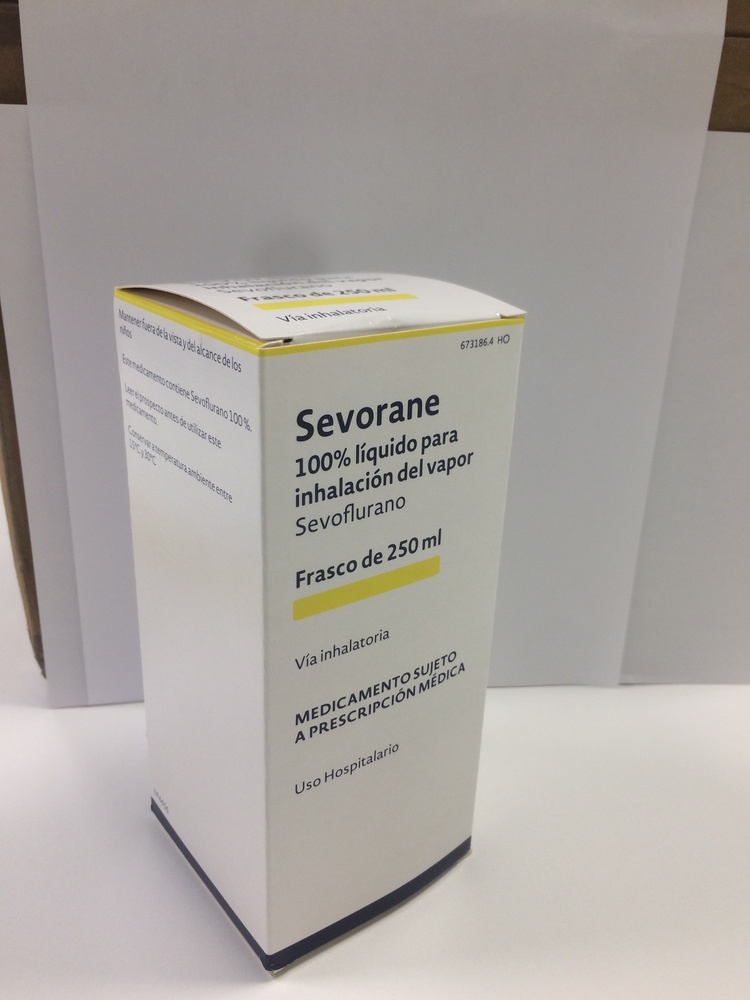
SEVORANE 1 ml/1 ml Inhalación Pulmonar

Revisión de receta online
Un médico revisará tu caso y determinará si la prescripción es médicamente apropiada.

Habla con un médico sobre este medicamento
Comenta tus síntomas y las opciones de tratamiento en una consulta online.



Cómo usar SEVORANE 100% LIQUIDO PARA INHALACION DEL VAPOR
Contenido del prospecto
- Introducción
- Qué es SEVORANE y para qué se utiliza
- Qué necesita saber antes de empezar a usar SEVORANE
- Cómo usar SEVORANE
- Posibles efectos adversos
- Conservación de SEVORANE
- Contenido del envase e información adicional
Introducción
Prospecto: información para el usuario
SEVORANE
100% líquido para inhalación del vapor
Sevoflurano
Lea todo el prospecto detenidamente antes de empezar a usar este medicamento, porque contiene información importante para usted.
- Conserve este prospecto ya que puede tener que volver a leerlo.Si tiene alguna duda, consulte a su médico, farmacéutico o enfermero.
- Este medicamento se le ha recetado a usted y no debe dárselo a otras personas, aunque tengan los mismos síntomas, ya que puede perjudicarles.
- Si experimenta efectos adversos, consulte a su médico, farmacéutico o enfermero, incluso si se trata de efectos adversos que no aparecen en este prospecto. Ver sección 4.
Contenido del prospecto:
- Qué es SEVORANE y para qué se utiliza
- Qué necesita saber antes de empezar a usar SEVORANE
- Cómo usar SEVORANE
- Posibles efectos adversos
- Conservación de SEVORANE
- Contenido del envase e información adicional
1. Qué es SEVORANE y para qué se utiliza
SEVORANE es un anestésico inhalatorio que pertenece al grupo de los hidrocarburos halogenados.
SEVORANE se utiliza para inducción y mantenimiento de la anestesia general en adultos y niños, hospitalizados o ambulatorios.

¿No estás seguro de si este medicamento es adecuado para ti?
Comenta tus síntomas y tratamiento con un médico online.
2. Qué necesita saber antes de empezar a usar SEVORANE
No use SEVORANE,
- Si es alérgico al sevoflurano o a alguno de los demás componentes de este medicamento (incluidos en la sección 6) o a otros anestésicos halogenados.
- Si es susceptible de hipertermia maligna
- Si le han comunicado que no deben someterle a una anestesia general.
Advertencias y precauciones
Consulte a su médico, farmacéutico o enfermero antes de empezar a usar SEVORANE.
- Se debe administrar mediante o bajo la supervisión de personas entrenadas para la administración de anestésicos generales, con instalaciones adecuadas para el mantenimiento de la vía aérea, ventilación artificial y oxígeno adicional y reanimación circulatoria.
- Debe conocerse exactamente la concentración de sevoflurano que está siendo liberada desde el vaporizador. Como los anestésicos volátiles difieren en sus propiedades físicas, sólo pueden utilizarse vaporizadores específicamente calibrados para sevoflurano. La administración de la anestesia general debe ser individualizada basándose en la respuesta del paciente.
- A medida que la anestesia es más profunda, se produce una disminución mayor de la presión sanguínea y depresión respiratoria.
- Si es sensible a la hipertermia maligna, se podría desencadenar un aumento en el metabolismo del músculo esquelético, produciendo necesidad elevada de oxígeno, hipercapnia (aumento de dióxido de carbono en sangre) y puede incluir rigidez muscular, pulso rápido (taquicardia), alteración de la respiración, coloración azulada de la piel, alteración del ritmo del corazón (arritmias) y/o presión sanguínea inestable. Durante la anestesia superficial pueden aparecer otros signos: hipoxia aguda (disminución súbita del oxígeno en el organismo), hipercapnia (aumento de dióxido de carbono en sangre) e hipovolemia (disminución del volumen circulante de sangre).
- En los ensayos clínicos, se notificó un caso de hipertermia maligna. Además, ha habido informes durante la postcomercialización de hipertermia maligna. Algunos de estos informes han sido mortales.
- El tratamiento de la hipertermia maligna incluye interrupción de SEVORANE y administración de dantroleno sódico por vía intravenosa.
- En raras ocasiones se han producido arritmias cardiacas (ritmo irregular de los latidos del corazón) y muerte en niños durante el postoperatorio, principalmente en pacientes con enfermedades que afectan al sistema nervioso y los músculos (como la distrofia muscular de Duchenne) y en muchos casos con la administración conjunta de otros fármacos que actúan a este nivel (succinilcolina).
- Si tiene problemas cardiacos, puede producirse un tipo de taquicardia que deberá tratar su médico ya que en casos excepcionales puede llegar a ser mortal.
- En pacientes pediátricos con la enfermedad de Pompe, se han notificado casos aislados de arritmia ventricular.
- Debe tenerse precaución en la administración de anestesia general, incluido cuando se utilice SEVORANE, a pacientes con trastornos mitocondriales.
- Después de la comercialización, se ha visto que hay raramente casos de enfermedad en el hígado de moderada a grave o de hepatitis (inflamación del hígado) con o sin ictericia (coloración amarilla en piel y ojos).
- Cuando SEVORANE se utilice en pacientes con una enfermedad hepática previa o en tratamiento con medicamentos que se conozca que pueden producir daño en el hígado, el médico debe decidir si lo utiliza o no.
- Si se expone repetidas veces a hidrocarburos halogenados, entre los que se incluye el SEVORANE, en un intervalo relativamente corto, puede aumentar su riesgo de sufrir daño hepático.
- La disminución de la tensión arterial está relacionada con la concentración de SEVORANE y la profundidad de la anestesia. Debe tenerse especial precaución en pacientes con tensión arterial más baja de lo usual, en pacientes con menor volumen sanguíneo u otros con problemas de ese tipo causados por ejemplo por otros medicamentos.
- Como con todos los anestésicos, es importante la estabilidad de la tensión arterial y del volumen sanguíneo para evitar la isquemia miocárdica (obstrucción del riego de la sangre al músculo del corazón) en pacientes con enfermedad de la arteria coronaria.
- Se debe evaluar cuidadosamente la recuperación de la anestesia general antes de abandonar la sala de recuperación.
- Aunque la recuperación de la consciencia después de la administración de SEVORANE ocurre generalmente en minutos, no ha sido estudiado el impacto sobre la función intelectual durante 2 ó 3 días tras la anestesia. Como con otros anestésicos, los pequeños cambios de humor pueden persistir durante algunos días después de la administración.
- Si tiene algún daño en las funciones del riñón.
- Si tiene riesgo de aumento de la presión intracraneal.
- El uso de SEVORANE se ha asociado con las convulsiones que han aparecido en jóvenes y adultos con o sin predisposición a los factores de riesgo. El anestesista juzgará si utiliza este medicamento o no en los casos que pueda haber riesgo de convulsiones.
- En niños se pueden producir convulsiones desde los 2 años de edad. El anestesista juzgará si utiliza este medicamento en los casos que pueda haber riesgo de convulsiones.
- El anestesista deberá sustituir adecuadamente los absorbentes de CO2 desecados.
- Si ha tomado medicamentos narcóticos u otros medicamentos que puedan provocar depresión respiratoria, su médico supervisará su respiración y le proporcionará asistencia si lo considera necesario.
Uso en personas mayores de 80 años
Si usted es un paciente de 80 años la dosis necesaria es aproximadamente la mitad de la requerida para uno de 20 años.
Uso de SEVORANE con otros medicamentos
Informe a su médico o farmacéutico si está utilizando, ha utilizado recientemente o pudiera tener que utilizar cualquier otro medicamento, especialmente aquellos utilizados para la tensión arterial, para trastornos del corazón, para tratar la ansiedad, para la tuberculosis, relajantes musculares, preparados de plantas medicinales, alcohol.
Informe a su médico si está en tratamiento con opiáceos como alfentanilo y sulfentanilo, ya que su combinación con SEVORANE puede conducir a una alteración conjunta y más importante del ritmo cardiaco, de la tensión sanguínea y de la frecuencia respiratoria.
Es importante que informe a su médico si está tomando o ha tomado recientemente alguno de los siguientes medicamentos:
- Succinilcolina (utilizado como relajante muscular durante la anestesia): su uso en combinación con sevoflurano puede provocar arritmias cardiacas graves durante el posoperatorio.
- Antidepresicos IMAO no selectivos. El tratamiento con estos medicamentos debe suspenderse 2 semanas antes de la operación.
- Antihipertensivos antagonistas del calcio, ya que hay riesgo de hipotensión, particularmente los derivados de la dihidropiridina.
- Beta-simpáticomiméticos (como isoprenalina) y alfa y beta simpaticomiméticos (como la epinefrina y la norepinefrina): debido al riesgo potencial de arritmias ventriculares sevoflurano se debe usar con precaución junto con estos medicamentos.
Embarazo, lactancia y fertilidad
Si está embarazada o en periodo de lactancia, cree que podría estar embarazada o tiene intención de quedarse embarazada, consulte a su médico o farmacéutico antes de utilizar este medicamento.
- No se debe utilizar durante el embarazo a menos que sea claramente necesario.
- Ha sido utilizado durante operaciones de cesárea. No se ha demostrado la seguridad de SEVORANE en el periodo de dilatación ni en el parto vaginal. SEVORANE tiene efectos relajantes sobre el útero con el consiguiente riesgo potencial de sangrado uterino. El médico decidirá si utilizarlo o no en esos casos.
- Se desconoce si SEVORANE o sus metabolitos se eliminan por la leche materna.
- Debe tenerse precaución cuando SEVORANE se administre a mujeres en periodo de lactancia.
- No se ha demostrado deterioro de la fertilidad en los animales tratados con SEVORANE.
Conducción y uso de máquinas
No conduzca ni maneje herramientas o máquinas después de haber recibido SEVORANE, ya que este medicamento puede afectar a su capacidad de reacción. Su médico le indicará cuánto tiempo debe esperar antes de volver a conducir o utilizar máquinas.
3. Cómo usar SEVORANE
Siga exactamente las instrucciones de administración del medicamento contenidas en este prospecto o las indicadas por su médico, farmacéutico o enfermero. En caso de duda pregunte a su médico, farmacéutico o enfermero.
SEVORANE se administra por un profesional sanitario debidamente entrenado, mediante un vaporizador especialmente calibrado para usar este producto, de forma que la concentración liberada se pueda controlar exactamente.
Su médico decidirá qué dosis de SEVORANE es la más aconsejable para usted.
Si usa más SEVORANE del que debe
Si usted recibe más SEVORANE del que debierael médico interrumpirá la administración y aplicará las medidas necesarias.
En caso de sobredosis o ingestión accidental, consultar al Servicio de Información Toxicológica, teléfono 91.562.04.20, indicando el medicamento y la cantidad ingerida.

¿Has empezado a tomar el medicamento y tienes preguntas?
Comenta tus síntomas y tratamiento con un médico online.
4. Posibles efectos adversos
Al igual que todos los medicamentos, este medicamento puede producir efectos adversos, aunque no todas las personas los sufran.
La mayoría de los efectos adversos son de carácter medio o moderado y transitorios.
Sevoflurano puede producir disminuciones de la función cardíaca y respiratoria.
Se han observado náuseas y vómitos en el período postoperatorio, secuelas comunes de la cirugía y la anestesia general, que pueden ser debidas a la anestesia inhalatoria, a otros agentes administrados durante o después de la operación, y a la respuesta del paciente al procedimiento quirúrgico.
Los efectos adversos más observados son los siguientes:
En pacientes adultos: disminución de la tensión arterial, náuseas, delirio y vómitos;
En pacientes de edad avanzada: enlentecimiento de la frecuencia de contracción del corazón, disminución de la tensión arterial y náuseas; y
En niños: agitación, tos, vómitos y náuseas.
En la Tabla siguiente se muestran todos los efectos adversos, al menos posiblemente relacionados con sevoflurano en los ensayos clínicos y en la experiencia postcomercialización, ordenados según la frecuencia y clasificación por órganos y sistemas de MedDRA. Se han utilizado los siguientes grupos de frecuencias: Efectos adversos muy frecuentes (en más de 1 de cada 10 personas); Efectos adversos frecuentes (entre 1 y 10 de cada 100 personas); Efectos adversos poco frecuentes (entre 1 y 10 de cada 1.000 personas); Efectos adversos raros (entre 1 y 10 de cada 10.000 personas); Efectos adversos muy raros (en menos de 1 de cada 10.000 personas), incluso acontecimientos aislados. Las reacciones adversas postcomercialización son notificadas de forma voluntaria en una población con una frecuencia de exposición desconocida. Por lo tanto no es posible estimar la frecuencia de las reacciones adversas y la frecuencia es “no conocida”. El tipo, la gravedad, y la frecuencia de los efectos adversos en pacientes a los que se les administró SEVORANE en los ensayos clínicos son comparables con los efectos adversos en pacientes con el tratamiento de referencia.
Efectos adversos derivados de los Ensayos Clínicos y de la Experiencia Postcomercialización
Clasificación órgano / sistema | Frecuencia | Reacciones adversas |
Trastornos del sistema inmunológico | No conocida | Reacción anafiláctica (reacción alérgica grave en todo el cuerpo) Reacción anafilactoide (reacción alérgica de otro tipo) Hipersensibilidad (reacción alérgica) |
Trastornos psiquiátricos | Muy frecuentes | Agitación |
Trastornos del sistema nervioso | Frecuentes | Somnolencia Mareo Dolor de cabeza |
Trastornos cardiacos | No conocida Muy frecuentes | Convulsión Distonía (contracciones involuntarias de los músculos) Bradicardia (disminución de los latidos del corazón) |
Frecuentes | Taquicardia (aumento de los latidos del corazón) | |
Poco frecuentes | Bloqueo auriculoventricular completo (trastorno del corazón) | |
No conocida | Paro cardiaco Prolongación del intervalo QT asociado a Torsade de Pointes | |
Trastornos vasculares | Muy frecuentes | Hipotensión (tensión arterial más baja de lo usual) |
Frecuentes | Hipertensión (tensión arterial más alta de lo usual) | |
Trastornos respiratorios, torá-cicos y mediastínicos | Muy frecuentes | Tos |
Frecuentes | Trastorno respiratorio Laringoespasmo (espasmo de la laringe) | |
No conocida | Broncoespasmo (espasmo de los bronquios) Disnea (dificultad para respirar) Sibilancias (sonido silbante al respirar) | |
Trastornos gastrointestinales | Muy frecuentes | Náuseas Vómitos |
Frecuentes | Hipersecreción salivar (exceso de saliva) | |
Trastornos hepatobiliares | No conocida | Hepatitis (inflamación del hígado) Insuficiencia hepática (mal funcionamiento del hígado) Necrosis hepática (zonas de tejido muerto en el hígado) |
Trastornos de la piel y del tejido subcutáneo | No conocida | Dermatitis de contacto (inflamación de la piel por contacto con alguna sustancia) Picor Erupción en la piel Hinchazón de la cara Urticaria |
Trastornos generales y alteraciones en el lugar de administración | Frecuentes | Escalofríos Pirexia (temperatura corporal elevada) |
No conocida | Molestias en el tórax Hipertermia maligna (ver debajo) | |
Exploraciones complementarias | Frecuentes | Glucosa en sangre anormal Prueba de función del hígado anormal Recuento de glóbulos blancos en sangre anormal Aumento de flúor |
Lesiones traumáticas, intoxicaciones y complicaciones de procedimientos terapéuticos | Frecuentes | Hipotermia (temperatura corporal más baja de lo usual) |
Descripción de reacciones adversas seleccionadas
Pueden aparecer aumentos transitorios de los niveles de flúor inorgánico en el suero durante y después de la anestesia con SEVORANE. Las concentraciones de flúor inorgánico alcanzan generalmente su máximo en las dos horas siguientes a la finalización de la anestesia con SEVORANE y vuelven a los niveles pre-operatorios dentro de las 48 horas siguientes. En los ensayos clínicos, las concentraciones elevadas de flúor no se asociaron con el deterioro de la función renal.
Existen escasos informes de hepatitis postoperatoria. Además, raramente ha habido informes postcomercialización de insuficiencia hepática y necrosis hepática asociados al empleo de anestésicos volátiles potentes, incluyendo SEVORANE. Sin embargo, la incidencia real y la relación de SEVORANE con estos acontecimientos no puede ser establecida con certeza.
Se han recibido escasos informes de hipersensibilidad (incluyendo dermatitis de contacto, erupción en la piel, disnea, sibilancias, molestias en el tórax, hinchazón de la cara o reacción anafiláctica), particularmente en asociación con la exposición profesional de larga duración a los anestésicos inhalados, incluyendo SEVORANE.
En individuos sensibles, los anestésicos inhalatorios potentes pueden desencadenar un estado hipermetabólico del músculo esquelético, produciendo una demanda muy alta de oxígeno y el síndrome clínico conocido como hipertermia maligna.
Población pediátrica
El empleo de SEVORANE se ha asociado con las convulsiones. Muchas de éstas han aparecido en niños desde los 2 años de edad y en jóvenes, la mayoría de los cuales no tenían factores de riesgo que les predispusieran a padecerlas. Debe realizarse un juicio clínico previo sobre el empleo de SEVORANE en pacientes que puedan tener riesgo de convulsiones.
Comunicación de efectos adversos
Si experimenta cualquier tipo de efecto adverso, consulte a su médico, farmacéutico o enfermero, incluso si se trata de posibles efectos adversos que no aparecen en este prospecto. También puede comunicarlos directamente a través del Sistema Español de Farmacovigilancia de medicamentos de Uso Humano: https://www.notificaram.es. Mediante la comunicación de efectos adversos usted puede contribuir a proporcionar más información sobre la seguridad de este medicamento.
5. Conservación de SEVORANE
Mantener este medicamento fuera de la vista y del alcance de los niños.
Debe conservarse a temperatura ambiente entre 15 y 30ºC.
No utilice este medicamento después de la fecha de caducidad que aparece en el envase después de CAD.:. La fecha de caducidad es el último día del mes que se indica.
6. Contenido del envase e información adicional
Composición de SEVORANE
El principio activo es sevoflurano. Este medicamento contiene sevoflurano 100%.
Contiene como mínimo 300 ppm de agua como protección frente al ácido de Lewis ambiental. No contiene otros aditivos ni conservantes.
Aspecto del producto y contenido del envase
SEVORANE se presenta como un líquido volátil no inflamable en envases ámbar de naftalato de polietileno de 250 ml. El líquido vaporizado se administra por vía inhalatoria con un vaporizador específico.
Titular de la autorización de comercialización y responsable de la fabricación
Titular de la autorización de comercialización:
AbbVie Spain S.L.U. Avenida de Burgos, 91- 28050 Madrid.
Responsable de la fabricación:
AbbVie S.r.l., S.R. 148 Pontina km 52 SNC, 04011 Campoverde di Aprilia (LT) Italia.
Fecha de la última revisión de este prospecto: Febrero 2016
La información detallada de este medicamento está disponible en la página web de la Agencia Española de Medicamentos y Productos Sanitarios (AEMPS) http://www.aemps.gob.es/
--------------------------------------------------------------------------------------------------------------------
Información adicional para el profesional sanitario
POSOLOGÍA
Debe seleccionarse la premedicación de acuerdo a las necesidades de cada paciente y a criterio del anestesista.
Anestesia quirúrgica
El sevoflurano debe administrarse a través de un vaporizador calibrado específicamente para ser utilizado con este medicamento de modo que se pueda regular la concentración liberada.
Debe conocerse la concentración de sevoflurano liberada por el vaporizador durante la anestesia. La dosificación debe ser individualizada y ajustada para conseguir el efecto deseado, según la edad y el estado clínico del paciente.
Inducción de la anestesia
La dosis debe ser individualizada y ajustada para conseguir el efecto deseado, según la edad y el estado clínico del paciente. Puede administrarse un barbitúrico de acción corta u otro fármaco de inducción por vía intravenosa, seguidos por la inhalación de sevoflurano. Se puede realizar la inducción de la anestesia mediante la inhalación de sevoflurano en oxígeno (O2) o en combinación con una mezcla de oxígeno-óxido nitroso (O2/N2O). Para la inducción de la anestesia, normalmente las concentraciones inhaladas de hasta el 8% de sevoflurano producen anestesia quirúrgica en menos de 2 minutos, tanto en adultos como en niños.
Mantenimiento de la anestesia
Los niveles de anestesia quirúrgica pueden mantenerse con concentraciones de 0,5 - 3% de sevoflurano en O2 con o sin el uso concomitante de óxido nitroso.
Tabla 1
Valores de CAM (concentración alveolar mínima) para adultos y pacientes pediátricos según la edad
Edad del paciente (años) | Sevoflurano en oxígeno | Sevoflurano en 65%N2O/35%O2 |
0 - 1 mes* | 3,3 % | |
1 - < 6 meses | 3,0 % | |
6 meses- < 3 años | 2,8 % | 2,0@ |
3 – 12 | 2,5 % | |
25 | 2,6 % | 1,4 % |
40 | 2,1 % | 1,1 % |
60 | 1,7 % | 0,9 % |
80 | 1,4 % | 0,7 % |
*Los neonatos son de edad gestacional a término. No se han determinado los valores de CAM en niños prematuros | ||
@ En los pacientes pediátricos de 1 a < 3 años se utilizó 60% N2O/40% O2 |
Despertar
Los tiempos de despertar, después de la anestesia con sevoflurano son generalmente cortos. Por lo tanto, los pacientes pueden necesitar precozmente tratamiento para el dolor postoperatorio.
Pacientes de edad avanzada
La CAM disminuye con la edad. La concentración media de sevoflurano para alcanzar la CAM en un paciente de 80 años es aproximadamente el 50% de la requerida en un paciente de 20 años.
Población pediátrica
Consultar la Tabla 1 para los valores de CAM según la edad en pacientes pediátricos.
INSTRUCCIONES PARA LA CORRECTA ADMINISTRACIÓN DEL PREPARADO
Sevoflurano se debe administrar con un vaporizador especialmente calibrado para este producto, utilizando un sistema de llenado designado para los vaporizadores específicos para sevoflurano u otros sistemas de llenado de los vaporizadores apropiado.
Sustitución de absorbentes de CO2desecados:
Se han notificado casos raros de calor extremo, humo y/o fuego espontáneo en la máquina de anestesia durante el uso de sevoflurano junto con el uso de absorbentes de CO2 desecado, específicamente aquellos que contienen hidróxido potásico. Un aumento inusualmente retardado o un descenso inesperado de la concentración inspirada de sevoflurano comparado con el ajuste del vaporizador puede estar asociado con calentamiento excesivo del contenedor del absorbente de CO2.
Puede aparecer una reacción exotérmica que aumenta la degradación de sevoflurano y la producción de los productos de degradación cuando el absorbente de CO2 llega a desecarse, como después del paso de gas seco a través de los contenedores del absorbente de CO2 durante un largo periodo. En el circuito respiratorio de una máquina experimental de anestesia que utilizaba absorbentes de CO2 desecado y concentraciones máximas de sevoflurano (8%) durante periodos de tiempo prolongados (> 2 horas) se observaron productos de degradación de sevoflurano (metanol, formaldehído, monóxido de carbono, y compuestos A, B, C y D). Las concentraciones de formaldehído observadas en el circuito respiratorio de anestesia (usando absorbentes que contienen hidróxido sódico) fueron consistentes con los niveles conocidos como causantes de irritación respiratoria leve. Se desconoce la relevancia clínica de los productos de degradación observados en este modelo experimental extremo.
Cuando un anestesista sospecha que el absorbente de CO2 puede estar desecado, se debe reemplazar antes de la administración de sevoflurano. El indicador de color de muchos de los absorbentes de CO2 no cambia necesariamente como resultado de la desecación. Por lo tanto, la falta de cambio de color significativo no se debe tomar como un seguro de hidratación adecuada. Los absorbentes de CO2 se deben reemplazar rutinariamente independientemente del color del indicador del absorbente de CO2.
INTERACCIONES
Se deben utilizar con precaución durante la narcosis con sevoflurano los agentes Beta-simpaticomiméticos como la isoprenalina y los agentes alfa y beta-simpaticomiméticos, como la adrenalina y la noradrenalina, debido a un riesgo potencial de arritmias ventriculares.
Inhibidores no-selectivos de la MAO:
Debe evitarse la combinación de inhibidores no selectivos de la MAO y sevoflurano por riesgo de colapso preoperatorio. El tratamiento debe interrumpirse 2 semanas antes de la cirugía.
Antagonistas del calcio:
Sevoflurano puede producir una marcada hipotensión, particularmente en combinación con derivados de la dihidropiridina. Se debe tener precaución en el uso de antagonistas del calcio concomitantemente con anestésicos inhalados, debido al riesgo de un efecto aditivo inotrópico negativo.
Succinilcolina:
La administración simultánea de succinilcolina y agentes anestésicos inhalables se ha asociado con casos raros de aumento de potasio sérico que resultaron en arritmias cardiacas y muerte durante el periodo postoperatorio en pacientes pediátricos.
Se ha demostrado que sevoflurano es seguro y eficaz cuando se administra conjuntamente con una amplia variedad de fármacos frecuentemente utilizados en intervenciones quirúrgicas como medicamentos que actúan en el sistema nervioso central y periférico, relajantes del músculo esquelético, agentes antiinfecciosos incluyendo aminoglucósidos, hormonas y sustitutos sintéticos, hemoderivados y fármacos cardiovasculares incluyendo epinefrina.
Epinefrina/Adrenalina
Sevoflurano es similar a isoflurano en la sensibilización del miocardio al efecto arritmogénico producido por la administración exógena de adrenalina.
Agentes simpaticomiméticos de acción indirecta
Existe un riesgo de episodio hipertensivo agudo con el uso concomitante de sevoflurano y los agentes simpaticomiméticos de acción indirecta (anfetaminas, efedrina).
Betabloqueantes
Sevoflurano puede aumentar los efectos inotrópico, cronotrópico y dromotrópico negativos de los betabloqueantes a través del bloqueo de mecanismos de compensación cardiovascular.
Verapamilo
Cuando verapamilo y sevoflurano fueron administrados al mismo tiempo se observó deterioro de la conducción auriculoventricular.
Hierba de San Juan
En pacientes tratados durante largo tiempo con hierba de San Juan se ha referido hipotensión grave y retardo en el despertar de la anestesia tras la utilización de los anestésicos halogenados inhalatorios.
Barbitúricos
La administración de sevoflurano es compatible con la de los barbitúricos utilizados habitualmente en las intervenciones quirúrgicas.
Benzodiazepinas y opiáeos
Se espera que la administración de benzodiazepinas y opiáceos disminuya la CAM de sevoflurano, al igual que ocurre con otros anestésicos inhalatorios. La administración de sevoflurano es compatible con la de las benzodiazepinas y opiáceos utilizados habitualmente en las intervenciones quirúrgicas.
Cuando se combina sevoflurano con opiáceos como alfentanilo y sufentanilo, puede conducir a un fallo sinergístico del ritmo cardiaco, de la tensión sanguínea y de la frecuencia respiratoria.
Inductores de CYP2E1
Los medicamentos y los compuestos que aumentan la actividad de la isoenzima CYP2E1 del citocromo P450, como isoniazida y alcohol, pueden aumentar el metabolismo de sevoflurano y conducir a aumentos significativos en las concentraciones plasmáticas de flúor. El uso concomitante de sevoflurano e isoniazida puede potenciar los efectos hepatotóxicos de la isoniazida.
Óxido nitroso
Como con otros anestésicos halogenados volátiles, la CAM de sevoflurano disminuye cuando se administra en combinación con óxido nitroso. La CAM equivalente se reduce el 50% en adultos y el 25% en pacientes pediátricos, aproximadamente.
Bloqueantes neuromusculares
Como ocurre con otros anestésicos inhalatorios, sevoflurano afecta a la intensidad y duración del bloqueo neuromuscular producido por los relajantes musculares no despolarizantes. Cuando se administra para suplementar la anestesia con alfentanilo-N2O, sevoflurano potencia el bloqueo neuromuscular inducido con pancuronio, vecuronio o atracurio. Los ajustes de dosis para estos relajantes musculares cuando se administran con sevoflurano son similares a los requeridos con isoflurano. No se ha estudiado el efecto de sevoflurano sobre la succinilcolina y la duración del bloqueo neuromuscular despolarizante.
La reducción de la dosis de los bloqueantes neuromusculares durante la inducción de la anestesia puede producir un retraso en las condiciones óptimas para la intubación endotraqueal o una relajación muscular inadecuada, debido a que la potenciación de los bloqueantes neuromusculares se observa a los pocos minutos de comenzar la administración de sevoflurano.
Entre los agentes no despolarizantes se han estudiado las interacciones con vecuronio, pancuronio y atracurio. En ausencia de guías específicas: (1) para intubación endotraqueal, no reducir la dosis de los relajantes musculares no despolarizantes; y (2) durante el mantenimiento de la anestesia, es probable que haya que reducir la dosis de los relajantes neuromusculares no despolarizantes cuando se compara con la anestesia con N2O/opiáceos. La administración de dosis suplementarias de relajantes musculares debe hacerse teniendo en cuenta la respuesta a la estimulación nerviosa.
SOBREDOSIS
En caso de sobredosis aparente debe realizarse lo siguiente: interrumpir la administración de SEVORANE, establecer una vía aérea, iniciar la ventilación asistida o controlada con oxígeno y mantener una función cardiovascular adecuada.
- País de registro
- Forma farmacéuticaINHALACIÓN PULMONAR, 1 ml sevoflurano/ml
- Código ATCN01AB08
- Principio activo
- Requiere recetaSí
- Fabricante
- Esta información es de carácter general y no sustituye la consulta con un profesional sanitario.
- Alternativas a SEVORANE 100% LIQUIDO PARA INHALACION DEL VAPORForma farmacéutica: INHALACIÓN PULMONAR, 1 ml/mlPrincipio activo: SevofluranoFabricante: Baxter S.L.Requiere recetaForma farmacéutica: INHALACIÓN PULMONAR, 100 % (V/V)Principio activo: SevofluranoFabricante: Elc Group S.R.O.Requiere recetaForma farmacéutica: INHALACIÓN PULMONAR, 100% v/vPrincipio activo: SevofluranoFabricante: Piramal Critical Care B.V.Requiere receta
Médicos online para SEVORANE 100% LIQUIDO PARA INHALACION DEL VAPOR
Comenta la dosis, los posibles efectos secundarios, interacciones, contraindicaciones o la revisión de receta de SEVORANE 100% LIQUIDO PARA INHALACION DEL VAPOR, sujeto a valoración médica y a la normativa local.









Obtén una receta de SEVORANE 100% LIQUIDO PARA INHALACION DEL VAPOR online
Rellena un formulario de 2 minutos
Cuéntanos tus síntomas, historial y el medicamento que necesitas.
Elige un médico o nosotros te asignamos uno
Escoge un especialista o te conectamos con el próximo médico disponible.
El médico revisa tu caso
Normalmente en 30 minutos. Puede hacerte preguntas adicionales por chat.
Recógela en cualquier farmacia
Receta electrónica enviada a tu correo, válida en toda España.
Preguntas frecuentes
SEVORANE 100% LIQUIDO PARA INHALACION DEL VAPOR requiere receta en España. Puedes confirmarlo con un médico online según tu caso.
El principio activo de SEVORANE 100% LIQUIDO PARA INHALACION DEL VAPOR es Sevoflurano. Esta información ayuda a identificar medicamentos con la misma composición pero con diferentes nombres comerciales.
SEVORANE 100% LIQUIDO PARA INHALACION DEL VAPOR es fabricado por Abbvie Spain, S.L.U.. La marca y el envase pueden variar según el distribuidor.
Los Médicos de familia, Psiquiatras, Dermatólogos, Cardiólogos, Endocrinólogos, Gastroenterólogos, Neumólogos, Nefrólogos, Reumatólogos, Hematólogos, Infectólogos, Alergólogos, Geriatras, Pediatras, Oncólogos pueden valorar la prescripción de SEVORANE 100% LIQUIDO PARA INHALACION DEL VAPOR cuando esté clínicamente indicado. Puedes reservar una videoconsulta para comentar tu caso y las opciones de tratamiento.
España cuenta con una infraestructura sanitaria bien desarrollada en ciudades principales como Madrid, Barcelona, Valencia y Sevilla. Las farmacias están ampliamente disponibles y operan bajo estrictas regulaciones, garantizando el acceso a medicamentos con receta.
Puedes comprar SEVORANE 100% LIQUIDO PARA INHALACION DEL VAPOR en Madrid, Barcelona, Sevilla o Valencia en cualquier farmacia local con una receta válida.
Para obtener una receta, puedes utilizar Oladoctor:
Otros medicamentos con el mismo principio activo (Sevoflurano) incluyen SEVOFLURANO BAXTER 100% LIQUIDO PARA INHALACION DEL VAPOR EFG, SEVOFLURANO ELC 100% LIQUIDO PARA INHALACION DEL VAPOR EFG, SEVOFLURANO PIRAMAL 100% LIQUIDO PARA INHALACION DEL VAPOR EFG. Pueden tener diferentes nombres comerciales o formulaciones, pero contienen el mismo componente terapéutico. Consulta siempre con un médico antes de cambiar o iniciar un nuevo medicamento.
