


Sabrilex 500 mg granulado para solución oral

Revisión de receta online
Un médico revisará tu caso y determinará si la prescripción es médicamente apropiada.

Habla con un médico sobre este medicamento
Comenta tus síntomas y las opciones de tratamiento en una consulta online.



Cómo usar SABRILEX 500 mg GRANULADO PARA SOLUCION ORAL
Contenido del prospecto
- Introducción
- Qué es Sabrilex y para qué se utiliza
- Qué necesita saber antes de empezar a tomar Sabrilex
- Advertencias y precauciones
- Toma de Sabrilex con otros medicamentos
- Embarazo, lactancia y fertilidad
- Conducción y uso de máquinas
- Cómo tomar Sabrilex
- Posibles efectos adversos
- Conservación de Sabrilex
- Contenido del envase e información adicional
- Aspecto del producto y contenido del envase
Introducción
Prospecto: información para el usuario
Sabrilex 500 mg granulado para solución oral
Vigabatrina
Lea todo el prospecto detenidamente antes de empezar a tomar este medicamento, porque contiene información importante para usted.
- Conserve este prospecto, ya que puede tener que volver a leerlo.Si tiene alguna duda, consulte a su médico o farmacéutico.
- Este medicamento se le ha recetado solamente a usted, y no debe dárselo a otras personas aunque tengan los mismos síntomas que usted, ya que puede perjudicarles.
- Si experimenta efectos adversos, consulte a su médico o farmacéutico, incluso si se trata de efectos adversos que no aparecen en este prospecto. Ver sección 4.
Contenido del prospecto
- Qué es Sabrilex y para qué se utiliza
- Qué necesita saber antes de empezar a tomar Sabrilex
- Cómo tomar Sabrilex
- Posibles efectos adversos
- Conservación de Sabrilex
- Contenido del envase e información adicional
1. Qué es Sabrilex y para qué se utiliza
Sabrilex se utiliza para ayudar a controlar varias formas de epilepsia.
Se utiliza junto con su actual medicación para tratar la epilepsia “difícil de controlar”. Inicialmente será prescrito por un especialista. Su respuesta al tratamiento estará vigilada.
Se utiliza también para controlar los espasmos infantiles (síndrome de West).

¿No estás seguro de si este medicamento es adecuado para ti?
Comenta tus síntomas y tratamiento con un médico online.
2. Qué necesita saber antes de empezar a tomar Sabrilex
No tome Sabrilex
- Si es alérgico a vigabatrina, o a cualquiera de los demás componentes de este medicamento (incluidos en la sección 6).
Advertencias y precauciones
Consulte a su médico antes de empezar a tomar Sabrilex si:
- está dando el pecho
- está embarazada o planea estarlo
- padece o ha padecido depresión o cualquier otra enfermedad psiquiátrica en el pasado
- ha tenido algún problema con sus riñones
- ha tenido algún problema con sus ojos.
La pérdida de campo visual (pérdida de visión desde los extremos de su campo de visión) puede aparecer durante el tratamiento con Sabrilex. Usted debe discutir esta posibilidad con su médico antes de empezar el tratamiento con este medicamento. Esta pérdida de campo visual puede ser grave, hasta llevar a visión en túnel o pérdida de visión, e irreversible por lo que debe ser detectada tempranamente. No se puede descartar que esta pérdida del campo visual empeore tras la interrupción del tratamiento. Es importante que informe rápidamente a su médico si usted nota cualquier cambio en su visión. Su médico deberá realizarle un examen del campo de visión y de la agudeza visual antes de empezar a tomar Sabrilex y a intervalos regulares durante el tratamiento. Sabrilex podría causar una disminución de la visión debido a problemas oculares como trastornos de la retina, visión borrosa, atrofia óptica o neuritis óptica (ver sección 4). Si su visión cambia, consulte a su oftalmólogo. |
Si desarrolla síntomas como somnolencia, disminución de la consciencia y de los movimientos (estupor) o confusión, consulte a su médico el cual decidirá si le reduce la dosis o le interrumpe el tratamiento.

¿Has empezado a tomar el medicamento y tienes preguntas?
Comenta tus síntomas y tratamiento con un médico online.
Un reducido número de personas que estaban siendo tratadas con antiepilépticos tales como la vigabatrina han tenido pensamientos de hacerse daño o de suicidarse. Si en algún momento tiene usted estos pensamientos, contacte inmediatamente con su médico.
Niños
Se han comunicado trastornos del movimiento en niños tratados para los espasmos infantiles (síndrome de West). Si observa trastornos inusuales del movimiento en el niño, consulte con su médico quien decidirá si es necesario considerar el cambio de tratamiento.
Toma de Sabrilex con otros medicamentos
Por favor comunique a su médico si está tomando clonazepam debido a que su uso conjunto con Sabrilex puede aumentar el riesgo de sedación.
Comunique a su médico o farmacéutico si está tomando, ha tomado recientemente o podría tener que tomar cualquier otro medicamento.
Sabrilex no debe tomarse en combinación con otros medicamentos que puedan tener efectos adversos relacionados con los ojos.
Embarazo, lactancia y fertilidad
Si está embarazada, cree que pudiera estar embarazada o tiene intención de quedarse embarazada, consulte a su médico antes de utilizar este medicamento. No tome Sabrilex durante el embarazo a menos que su médico le diga que lo haga. Sabrilex podría causar problemas al feto.
No obstante, no interrumpa bruscamente el tratamiento ya que esto puede poner en peligro la salud de la madre y del bebé.
Sabrilex pasa a la leche materna. Si está dando el pecho, pregunte a su médico antes de utilizar este medicamento. No se debe dar el pecho durante el tratamiento.
Conducción y uso de máquinas
No conduzca ni maneje máquinas si su epilepsia no está controlada.
Sabrilex a veces produce síntomas tales como somnolencia o mareo y su capacidad para concentrarse y reaccionar puede estar disminuida. Si aparecen estos síntomas durante su tratamiento con Sabrilex usted no debería realizar ninguna tarea peligrosa tales como conducir o manejar maquinaria.
Los trastornos visuales, que pueden afectar a su capacidad para conducir o manejar maquinaria, han aparecido en algunos pacientes que están tomando este medicamento. Si desea seguir conduciendo deberá ser examinado regularmente (cada seis meses) para descartar la presencia de trastornos visuales incluso si no nota ningún cambio en su visión.
3. Cómo tomar Sabrilex
Siga exactamente las instrucciones de administración de este medicamento indicadas por su médico. En caso de duda, consulte de nuevo a su médico.
Es importante seguir exactamente las instrucciones de su médico. Nunca cambie la dosis.
El médico prescribe la dosis y la ajusta individualmente para los pacientes.
No abra los sobres hasta el momento de tomar su medicamento. Para tomar una dosis, deber usted disolver todo el polvo del número de sobres que le hayan recomendado en medio vaso de agua lleno de agua fría o bebidas suaves como zumo de frutas o leche. Cuando todo el polvo se haya disuelto, beba toda la disolución sin dejar nada. Sabrilex puede tomarse antes o después de las comidas.
La dosis recomendada para iniciar el tratamiento es de 1 g (2 sobres) al día. No obstante, su médico puede aumentar o disminuir la dosis dependiendo de su respuesta al tratamiento; la dosis diaria normal para adultos es de 2 a 3 g (de 4 a 6 sobres). La dosis máxima recomendada es de 3 g al día.
Si es usted un paciente de edad avanzada y/o tiene problemas de riñón, su médico le prescribirá una dosis menor.
Uso en niños
Epilepsia parcial resistente
En niños la dosis está basada en la edad y el peso. La dosis recomendada para iniciar el tratamiento es 40 miligramos por kilo de peso por día. La siguiente tabla indica el número de sobres que se administraran a niños dependiendo de su peso corporal. Recuerde que esto solamente es una guía. El médico del niño decidirá si le prescribe una dosis ligeramente diferente.
Peso 10-15 kg 0,5-1 g (1-2 sobres)/día
15-30 kg 1-1,5 g (2-3 sobres)/día
30-50 kg 1,5-3 g (3-6 sobres)/día
Más de 50 kg 2-3 g (4-6 sobres)/día (dosis de adulto).
Niños con espasmos infantiles (Síndrome de West)
La dosis de inicio recomendada para lactantes con Síndrome de West (espasmos infantiles) es 50 miligramos por kilo de peso por día aunque algunas veces pueden administrarse dosis superiores.
Método de administración
La vía de administración es la vía oral (por la boca).
Trague siempre el comprimido con al menos medio vaso de agua.
Sabrilex puede tomarse antes o después de las comidas.
La dosis diaria puede ser tomada como una dosis única o dividida en dos dosis.
Si toma más Sabrilex del que debe
Si usted o su hijo toman accidentalmente demasiados sobres de Sabrilex, consulte inmediatamente a su médico o diríjase al servicio de urgencias del hospital más próximo, acompañado de este prospecto.
En caso de sobredosis o ingestión accidental, consultar al Servicio de Información Toxicológica. Teléfono 91 562 04 20.
Los posibles síntomas de sobredosis incluyen somnolencia o pérdida/disminución del nivel de consciencia.
Si olvidó tomar Sabrilex
Si olvidó tomar una dosis, tómela en cuanto lo recuerde. Si casi es el momento de tomar la siguiente dosis, únicamente tome una dosis. No tome una dosis doble para compensar las dosis olvidadas.
Si interrumpe el tratamiento con Sabrilex
No interrumpa la toma de este medicamento sin consultarlo con su médico. Si su médico decide interrumpir su tratamiento le dará recomendaciones sobre cómo reducir gradualmente la dosis. No lo interrumpa bruscamente ya que esto puede provocar que sus ataques aparezcan de nuevo.
Si tiene cualquier otra duda sobre el uso de este medicamento, pregunte a su médico o farmacéutico.
4. Posibles efectos adversos
Al igual que todos los medicamentos, este medicamento puede producir efectos adversos, aunque no todas las personas los sufran.
Al igual que con otros medicamentos antiepilépticos, algunos pacientes pueden experimentar un aumento del número de ataques (convulsiones) mientras están tomando este medicamento. Si le ocurre esto a usted o a su hijo, contacte con su médico inmediatamente.
Comunique inmediatamente a su médico si experimenta:
Efectos adversos muy frecuentes (pueden afectar a más de 1 de cada 10 pacientes)
- Cambios en el campo visual - Alrededor de 1/3 o el 33 por ciento de los pacientes tratados con Sabrilex pueden tener cambios en el campo visual (estrechamiento del campo visual). Este “defecto del campo visual” pueden ser de leve a grave. Estos son normalmente detectados tras meses o años de tratamiento con Sabrilex. Los cambios en el campo visual pueden ser irreversibles, por lo que deben detectarse tempranamente. Si usted o su hijo experimenta algún trastorno visual, contacte inmediatamente con su médico u hospital.
Otros efectos adversos incluyen:
Efectos adversos muy frecuentes (pueden afectar a más de 1 de cada 10 pacientes)
- Cansancio y acentuada somnolencia
- Dolor de articulaciones.
Efectos adversos frecuentes (pueden afectar hasta 1 de cada 10 pacientes)
- Dolor de cabeza
- Aumento de peso
- Temblor
- Hinchazón (edema)
- Mareo
- Sensación de entumecimiento u hormigueo
- Trastornos de concentración y memoria
- Trastornos psicológicos, incluyendo agitación, agresión, nerviosismo, irritabilidad, depresión, trastornos del pensamiento y reacción paranoide (trastorno mental progresivo), insomnio. Estos efectos adversos son generalmente reversibles con la reducción de la dosis o la suspensión gradual del tratamiento. No obstante no reduzca su dosis sin consultar antes con su médico. Contacte con su médico si experimenta estos efectos adversos
- Náuseas, vómitos y dolor abdominal
- Visión borrosa, visión doble y movimientos rápidos involuntarios de los ojos
- Trastornos del habla
- Disminución del número de glóbulos rojos (anemia)
- Caída poco habitual del pelo o pelo debilitado (alopecia).
Efectos adversos poco frecuentes (pueden afectar hasta 1 de cada 100 pacientes)
- Falta de coordinación en los movimientos, torpeza
- Trastornos psicológicos más graves tales como hipomanía, manía y psicosis
- Erupción en la piel.
Efectos adversos raros (pueden afectar hasta 1 de cada 1.000 pacientes)
- Reacción alérgica grave, que produce hinchazón de cara o hinchazón de garganta. Si experimenta alguno de estos síntomas comuníqueselo inmediatamente a su médico
- Urticaria
- Marcada sedación, estupor y confusión. Estos efectos adversos son normalmente reversibles al reducir la dosis o al interrumpir gradualmente el tratamiento. No obstante no reduzca su dosis sin consultar antes con su médico. Contacte con su médico si experimenta estos efectos adversos
- Intento de suicidio
- Otros trastornos del ojo tales como trastorno de la retina.
Efectos adversos muy raros (pueden afectar hasta 1 de cada 10.000 pacientes)
- Otros trastornos del ojo tales como neuritis óptica y atrofia óptica
- Alucinaciones
- Trastornos del hígado.
Efectos adversos de frecuencia no conocida (la frecuencia no puede estimarse a partir de los datos disponibles)
- Disminución de la agudeza visual
- Cambios anormales en las imágenes cerebrales tomadas por resonancia magnética
- Hinchazón en la capa protectora de células nerviosas en parte del cerebro como se observa en las imágenes de resonancia magnética.
Otros efectos adversos en niños
Efectos adversos muy frecuentes (pueden afectar a más de 1 de cada 10 pacientes)
- Excitación o inquietud.
Efectos adversos de frecuencia no conocida (no puede estimarse a partir de los datos disponibles)
- Trastornos del movimiento en niños tratados para los espasmos infantiles
- Cambios anormales en las imágenes cerebrales tomadas por resonancia magnética, particularmente en lactantes
- Hinchazón en la capa protectora de células nerviosas en parte del cerebro como se observa en las imágenes de resonancia magnética.
Comunicación de efectos adversos:
Si experimenta cualquier tipo de efecto adverso, consulte a su médico o farmacéutico, incluso si se trata de posibles efectos adversos que no aparecen en este prospecto. También puede comunicarlos directamente través del Sistema Español de Farmacovigilancia de medicamentos de Uso Humano: https://www.notificaram.es. Mediante la comunicación de efectos adversos usted puede contribuir a proporcionar más información sobre la seguridad de este medicamento.
5. Conservación de Sabrilex
Mantener este medicamento fuera de la vista y del alcance de los niños.
No utilice este medicamento después de la fecha de caducidad que aparece en el estuche y los sobres. La fecha de caducidad es el último día del mes que se indica.
Este medicamento no requiere condiciones especiales de conservación.
Los medicamentos no se deben tirar por los desagües ni a la basura. Deposite los envases y los medicamentos que no necesita en el Punto SIGRE de la farmacia. En caso de duda pregunte a su farmacéutico cómo deshacerse de los envases y de los medicamentos que no necesita. De esta forma, ayudará a proteger el medio ambiente.
6. Contenido del envase e información adicional
Composición de Sabrilex
- El principio activo es vigabatrina. Un sobre contiene 500 mg de vigabatrina.
- Los demás componentes son:
Povidona K30 (E1201).
Aspecto del producto y contenido del envase
Sabrilex granulado para solución oral es un polvo granulado blanco a blanquecino.
Está disponible en envases de 50, 60 o 100 sobres.
Puede que solamente estén comercializados algunos tamaños de envases.
Titular de la Autorización de Comercialización y Fabricante
El titular de la autorización de comercialización es:
sanofi-aventis, S.A.
C/ Rosselló i Porcel, 21
08016 Barcelona
España
El fabricante es:
Patheon France
Boulevard de Champaret
38300 Bourgoin-Jallieu (Francia)
O
Sanofi-Aventis Deutschland GmbH
Industriepark Hoechst-Brueningstrase 50
65926 Frankfurt am Main (Alemania)
Este medicamento está autorizado en los estados miembros del Espacio Económico Europeo con los siguientes nombres:
Austria:Sabril 500 mg lösliches Pulver
Dinamarca:Sabrilex
Finlandia:Sabrilex 500 mg rakeet oraaliliuosta varten
Francia:Sabril 500 mg granulés pour solution buvable en sachet-dose
Alemania:Sabril Beutel
Irlanda:Sabril 500 mg granules for oral solution
Italia:Sabril 500 mg granulato per soluzione orale
Países Bajos:Sabril 500 mg granulaat voor drank
Portugal:Sabril 500 mg granulado para soluçào oral
España:Sabrilex 500 mg granulado para solución oral
Suecia:Sabrilex 500 mg granulat till oral lösning
Reino Unido:Sabril 500 mg granules for oral solution
Fecha de la última revisión de este prospecto:enero 2021
La información detallada y actualizada de este medicamento está disponible en la página web de la Agencia Española de Medicamentos y Productos Sanitarios (AEMPS) http://www.aemps.gob.es/
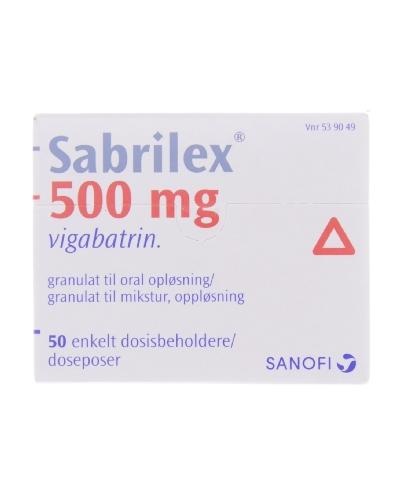
- País de registro
- Forma farmacéuticaSOLUCIÓN/SUSPENSIÓN ORAL, 500 mg
- Código ATCN03AG04
- Precio medio en farmacia30.13 EUR
- Principio activo
- Requiere recetaSí
- Fabricante
- Esta información es de carácter general y no sustituye la consulta con un profesional sanitario.
- Alternativas a SABRILEX 500 mg GRANULADO PARA SOLUCION ORALForma farmacéutica: COMPRIMIDO, 100 mgPrincipio activo: vigabatrinaFabricante: Orphelia PharmaRequiere recetaForma farmacéutica: COMPRIMIDO, 500 mgPrincipio activo: vigabatrinaFabricante: Orphelia PharmaRequiere recetaForma farmacéutica: COMPRIMIDO, 500 mgPrincipio activo: vigabatrinaFabricante: Sanofi Aventis S.A.Requiere receta
Médicos online para SABRILEX 500 mg GRANULADO PARA SOLUCION ORAL
Comenta la dosis, los posibles efectos secundarios, interacciones, contraindicaciones o la revisión de receta de SABRILEX 500 mg GRANULADO PARA SOLUCION ORAL, sujeto a valoración médica y a la normativa local.




Preguntas frecuentes
SABRILEX 500 mg GRANULADO PARA SOLUCION ORAL requiere receta en España. Puedes confirmarlo con un médico online según tu caso.
El principio activo de SABRILEX 500 mg GRANULADO PARA SOLUCION ORAL es vigabatrina. Esta información ayuda a identificar medicamentos con la misma composición pero con diferentes nombres comerciales.
El precio medio en farmacia de SABRILEX 500 mg GRANULADO PARA SOLUCION ORAL es de aproximadamente 30.13 EUR. Puede variar según el fabricante y la forma farmacéutica.
SABRILEX 500 mg GRANULADO PARA SOLUCION ORAL es fabricado por Sanofi Aventis S.A.. La marca y el envase pueden variar según el distribuidor.
Los Médicos de familia, Psiquiatras, Dermatólogos, Cardiólogos, Endocrinólogos, Gastroenterólogos, Neumólogos, Nefrólogos, Reumatólogos, Hematólogos, Infectólogos, Alergólogos, Geriatras, Pediatras, Oncólogos pueden valorar la prescripción de SABRILEX 500 mg GRANULADO PARA SOLUCION ORAL cuando esté clínicamente indicado. Puedes reservar una videoconsulta para comentar tu caso y las opciones de tratamiento.
La receta la emite un médico tras valorar tu estado de salud. En España, SABRILEX 500 mg GRANULADO PARA SOLUCION ORAL se dispensa en las farmacias con esa receta médica. Una consulta online no garantiza su emisión: la decisión corresponde siempre al médico.
Para solicitar una valoración puedes usar Oladoctor:
Otros medicamentos con el mismo principio activo (vigabatrina) incluyen KIGABEQ 100 MG COMPRIMIDOS SOLUBLES, KIGABEQ 500 MG COMPRIMIDOS SOLUBLES, SABRILEX 500 mg COMPRIMIDOS RECUBIERTOS CON PELICULA. Pueden tener diferentes nombres comerciales o formulaciones, pero contienen el mismo componente terapéutico. Consulta siempre con un médico antes de cambiar o iniciar un nuevo medicamento.
