



RYTMONORM 3,5 mg/ml SOLUCION INYECTABLE

Revisión de receta online
Un médico revisará tu caso y determinará si la prescripción es médicamente apropiada.

Habla con un médico sobre este medicamento
Comenta tus síntomas y las opciones de tratamiento en una consulta online.



Cómo usar RYTMONORM 3,5 mg/ml SOLUCION INYECTABLE
Contenido del prospecto
- Introducción
- Prospecto: información para el paciente
- Qué es Rytmonorm y para qué se utiliza
- Qué necesita saber antes de empezar a usar Rytmonorm
- Cómo usar Rytmonorm
- Posibles efectos adversos
- Conservación de Rytmonorm
- Contenido del envase e información adicional
- - - - - - - - - - - - - - - - - - - - - - - - - - - - - - - - - - - - - - - - - - - - - - - - - - - - - - - - - - - - - - - - - - -
- Esta información está destinada únicamente a profesionales del sector sanitario:
- Incompatibilidades
- Otras presentaciones
Introducción
Prospecto: información para el paciente
Rytmonorm 3,5 mg/ml solución inyectable
Hidrocloruro de Propafenona
Lea todo el prospecto detenidamente antes de empezar a usar el medicamento, porque contiene información importante para usted.
- Conserve este prospecto, ya que puede tener que volver a leerlo.
- Si tiene alguna duda, consulte a su médico, farmacéutico o enfermero.
- Este medicamento se le ha recetado solamente a usted y no debe dárselo a otras personas, aunque tengan los mismos síntomas que usted, ya que puede perjudicarles.
- Si experimenta efectos adversos, consulte a su médico, farmacéutico o enfermero, incluso si se trata de efectos adversos que no aparecen en este prospecto. Ver sección 4.
Contenido del prospecto
- Qué es Rytmonorm y para qué se utiliza
- Qué necesita saber antes de empezar a usar Rytmonorm
- Cómo usar Rytmonorm
- Posibles efectos adversos
- Conservación de Rytmonorm
- Contenido del envase e información adicional

¿No estás seguro de si este medicamento es adecuado para ti?
Comenta tus síntomas y tratamiento con un médico online.
1. Qué es Rytmonorm y para qué se utiliza
Rytmonorm es un medicamento que se utiliza para los trastornos del ritmo cardíaco de origen diverso. Pertenece a un grupo de medicamentos llamados antiarrítmicos de clase 1C de Vaughan Williams.
Rytmonorm se utiliza para el tratamiento y prevención de la taquicardia paroxística supraventricular que incluye fibrilación auricular y flutter paroxístico y taquicardia paroxística por fenómenos de reentrada que afectan al nodo auriculoventricular o vías accesorias (Síndrome de Wolf-Parkinson-White). Tratamiento y prevención de arritmias ventriculares que incluyen extrasístoles ventriculares sintomáticas y/o taquicardia ventricular no sostenida y sostenida.
2. Qué necesita saber antes de empezar a usar Rytmonorm
No use Rytmonorm
- Si es alérgico al principio activo o a alguno de los demás componentes de este medicamento (incluidos en la sección 6).
- Si tiene antecedentes de síndrome de Brugada (enfermedad hereditaria caracterizada por una anormalidad en el electrocardiograma (ECG) y un aumento del riesgo de muerte súbita) (ver Advertencias y precauciones).
- Si ha padecido un infarto de miocardio en los 3 meses anteriores al comienzo del tratamiento.
- Si padece o ha padecido una enfermedad significativa en su corazón como:
- insuficiencia cardíaca congestiva.
- shock cardiogénico a menos que la causa sea una arritmia.
- disminución grave de los latidos del corazón (bradicardia).
- presenta una disfunción del nódulo sinusal, defectos de la conducción auricular, bloqueo auriculoventricular de segundo grado o mayor o bloqueo de rama o bloqueo distal en ausencia de un marcapasos artificial.
- si padece una bajada intensa de la tensión arterial.
- Si sufre una alteración del equilibrio de sales en sangre (por ejemplo alteraciones del metabolismo del potasio).
- Si padece enfermedad pulmonar obstructiva grave.
- Si padece la enfermedad miastenia gravis.
- Si está tomando ritonavir (antirretroviral usado en el tratamiento de la infección por VIH, ver Uso de Rytmonorm con otros medicamentos).
Advertencias y precauciones
Consulte a su médico, farmacéutico o enfermero antes de empezar a usar Rytmonorm.
- Es esencial que cada paciente que reciba propafenona sea evaluado clínicamente y con un electrocardiograma antes y durante el tratamiento con Rytmonorm para determinar si la respuesta a la propafenona justifica el tratamiento continuado.
- Tras el tratamiento con este medicamento su médico debe descartar un síndrome de Brugada que puede haber estado presente sin dar ningún síntoma previo.
- Si lleva marcapasos pues el tratamiento puede afectarlo por lo que hay que controlarlo y, si fuera necesario, programarlo de nuevo.
- Si padece fibrilación auricular porque Rytmonorm puede dar lugar a la aparición de una arritmia más importante; ver Posibles efectos adversos.
- Si padece enfermedad cardíaca grave porque puede estar predispuesto a sufrir reacciones adversas graves y en ese caso estará contraindicada el tratamiento con este medicamento.
- Si padece asma u otra enfermedad obstructiva del aparato respiratorio crónica.
Niños
Sólo se han llevado a cabo estudios de interacción en adultos, por lo que se desconoce si dichas interacciones son similares en niños.
Pacientes de edad avanzada
En pacientes de edad avanzada, Rytmonorm debe utilizarse con sumo cuidado.
Uso de Rytmonorm conotros medicamentos
Informe a su médico o farmacéutico si está utilizando, ha utilizado recientemente o pudiera tener que utilizar cualquier otro medicamento.
Pueden aparecer más efectos adversos con Rytmonorm si se administra con anestésicos locales (p. ej. para la implantación de un marcapasos, intervenciones quirúrgicas u odontológicas), así como con otros fármacos que tienen efecto inhibitorio sobre el corazón como betabloqueantes (para la hipertensión) o algunos antidepresivos.
Informe a su médico si está tomando cualquiera de los siguientes medicamentos porque pueden aumentar sus niveles en sangre:
- venlafaxina (para la depresión)
- propranolol (para la hipertensión y la angina de pecho)
- metoprolol (para la hipertensión)
- desipramina (para la depresión)
- ciclosporina (para disminuir las defensas del organismo)
- teofilina (para el asma)
- digoxina (para problemas del corazón)
Si se observan signos de sobredosis, deben reducirse las dosis de estos medicamentos, según sea apropiado.
Informe a su médico si está tomando cualquiera de los siguientes medicamentos porque pueden aumentar sus niveles de hidrocloruro de propafenona en sangre por lo que puede necesitar ser monitorizado y que le ajusten la dosis:
- ketoconazol (contra los hongos)
- cimetidina (para la úlcera de estómago)
- quinidina (para la arritmia del corazón o contra el paludismo)
- eritromicina (antibiótico)
- fluoxetina (para la depresión)
- paroxetina (para la depresión)
También se produce un aumento de los niveles de hidrocloruro de propafenona con el zumo de pomelo.
El uso conjunto de Rytmonorm y de amiodarona puede producir alteraciones en el corazón. Puede ser necesario ajustar la dosis de los dos medicamentos.
El uso conjunto de propafenona y lidocaína aumenta el riesgo de efectos secundarios de lidocaína sobre el sistema nervioso central.
Informe a su médico si está tomando cualquiera de los siguientes medicamentos pues se puede reducir la eficacia de Rytmonorm:
- rifampicina (antibiótico)
- fenobarbital (sedante y antiepiléptico)
- fenitoína (antiepiléptico)
- carbamazepina
En el caso de tratamiento crónico con fenobarbital y/o rifampicina y Rytmonorm, debe monitorizarse la respuesta al tratamiento con Rytmonorm.
Informe a su médico si está recibiendo medicamentos para evitar la coagulación de la sangre (p.ej. acenocumarol o warfarina) porque Rytmonorm puede aumentar la eficacia de esos medicamentos aumentando el riesgo de sangrado. Si se observan signos de sobredosis deben reducirse adecuadamente las dosis de estos medicamentos.
Embarazo, lactancia y fertilidad
Si está embarazada o en periodo de lactancia, cree que podría estar embarazada o tiene intención de quedarse embarazada, consulte a su médico o farmacéutico antes de utilizar este medicamento.
No existen estudios adecuados y bien controlados en mujeres embarazadas. Rytmonorm no debe utilizarse durante el embarazo a menos que el beneficio esperado justifique el riesgo potencial para el feto. El hidrocloruro de propafenona atraviesa la barrera placentaria.
No se ha estudiado la excreción del hidrocloruro de propafenona en la leche materna. Los datos limitados sugieren que el hidrocloruro de propafenona puede pasar a la leche materna por lo que debe utilizarse con precaución en madres en periodo de lactancia.
Conducción y uso de máquinas
Durante el tratamiento, pueden aparecer visión borrosa, mareo, fatiga o bajada de tensión, por lo que si notase estos síntomas no deberá conducir automóviles ni manejar máquinas peligrosas.

¿Has empezado a tomar el medicamento y tienes preguntas?
Comenta tus síntomas y tratamiento con un médico online.
3. Cómo usar Rytmonorm
Rytmonorm inyectable se administra por vía intravenosa.
Siga exactamente las instrucciones de administración de este medicamento indicadas por su médico, farmacéutico o enfermero. En caso de duda, pregunte a su médico, farmacéutico o enfermero.
Su médico decidirá qué dosis de Rytmonorm es la más aconsejable para usted.
Adultos:
El tratamiento debe adaptarse individualmente y determinarse con un control del electrocardiograma y de la presión arterial.
Normalmente se suele administrar una dosis única de 1 mg/kg de peso, aunque con frecuencia puede obtenerse el efecto deseado con dosis de 0,5 mg/kg. En caso necesario puede aumentarse la dosis única a 2 mg/kg de peso corporal. No obstante, su médico decidirá qué dosis de Rytmonorm es la más aconsejable para usted.
El tratamiento debe iniciarse con la dosis más baja posible mientras se mantiene al paciente bajo una observación cuidadosa y con monitorización estrecha del ECG y de la presión arterial.
Las inyecciones intravenosas deben administrarse lentamente durante un periodo de tiempo de 3 a 5 minutos y el intervalo entre inyecciones no debe ser menor de 90 a 120 minutos. En caso de observarse una prolongación del intervalo QRS o del intervalo QT corregido para la frecuencia de más del 20% se debe suspender la administración de la inyección inmediatamente.
Infusión de corta duración
Cuando se administra Rytmonorm en infusión de corta duración, de una a tres horas, la velocidad de dosificación es de 0,5 a 1 mg/minuto.
Infusión intravenosa lenta
Cuando se administra Rytmonorm en infusión intravenosa lenta, por lo general es suficiente con una dosis diaria máxima de 560 mg. Debe utilizarse glucosa o fructosa (5%) para obtener la solución. No debe usarse solución fisiológica de cloruro sódico debido a la posibilidad de precipitación.
Pacientes con insuficiencia hepática
No se recomienda ajuste de la dosis en pacientes con insuficiencia hepática moderada. Estos pacientes deben comenzar con la dosis más baja recomendada y ser monitorizados cuidadosamente. Los pacientes con insuficiencia hepática grave deben comenzar con la mitad de la dosis o menos que la recomendada para los pacientes con la función hepática normal. Estos pacientes deben ser monitorizados cuidadosamente y el ajuste de la dosis debe basarse en los síntomas clínicos.
Pacientes con insuficiencia renal
No se requiere ajuste de la dosis con la dosificación intravenosa en los pacientes con insuficiencia renal aunque la propafenona debe administrarse con cuidado en este tipo de pacientes.
Pacientes de edad avanzada
Rytmonorm debe ser administrado cuidadosamente poniendo especial altención en la evidencia clínica y electrocardiográfica de toxicidad.
Uso en niños
No existe experiencia en niños.
Si usted estima que la acción de Rytmonorm es demasiado fuerte o débil, comuníqueselo a su médico o farmacéutico.
Si usa más Rytmonorm del que debe
Si recibe más Rytmonorm del que debe, puede notar efectos en el corazón y bajada de la tensión, que en casos graves puede causar shock cardiovascular. A menudo aparece dolor de cabeza, mareo, visión borrosa, hormigueo o adormecimiento de la piel, temblor, náuseas, estreñimiento y sequedad de boca.
En las intoxicaciones graves se observan convulsiones, hormigueo o adormecimiento de la piel, somnolencia, coma y parada respiratoria. Ha habido casos de muerte.
Si esto ocurriera, debe vigilarse al paciente en una unidad de cuidados intensivos.
Si ha usado más Rytmonorm del que debe, consulte inmediatamente a su médico o farmacéutico o llame al Servicio de Información Toxicológica, teléfono 91 562 04 20, indicando el medicamento y la cantidad ingerida.
4. Posibles efectos adversos
Al igual que todos los medicamentos, este medicamento puede producir efectos adversos, aunque no todas las personas los sufran.
Los efectos adversos se clasifican en muy frecuentes (pueden afectar a más de 1 de cada 10 personas), frecuentes (pueden afectar hasta 1 de cada 10 personas), poco frecuentes (pueden afectar hasta 1 de cada 100 personas), y de frecuencia no conocida (no puede estimarse a partir de los datos disponibles).
Las reacciones adversas muy frecuentes relacionadas con el tratamiento con propafenona son mareo, trastornos de la conducción cardiaca (alteraciones en el corazón) y palpitaciones.
Dentro de cada grupo, las reacciones adversas se presentan en orden decreciente de gravedad, de más grave a menos grave, cuando pudo determinarse la gravedad que suponía para el paciente.
Se han notificado los siguientes efectos adversos:
Trastornos de la sangre y del sistema linfático
-Poco frecuentes: disminución de plaquetas (células de la sangre que intervienen en la coagulación).
-Frecuencia no conocida: disminución de glóbulos blancos (células de la sangre que actúan defendiendo al cuerpo de las infecciones o de sustancias extrañas, puede manifestarse por la aparición de infecciones frecuentes con fiebre, escalofríos o dolor de garganta), disminución de granulocitos (un tipo de glóbulos blancos que puede predisponer a que se contraigan infecciones), reducción grave de granulocitos o neutrófilos (agranulocitosis, enfermedad en la que la persona es más propensa a padecer infecciones).
Trastornos del sistema inmunológico
-Frecuencia no conocida: hipersensibilidad1.
1 Puede manifestarse por colestasis (detención del flujo de la bilis hacia el duodeno), alteraciones de la sangre y erupción en la piel.
Trastornos del metabolismo y de la nutrición
-Poco frecuentes: disminución del apetito.
Trastornos psiquiátricos
-Frecuentes: ansiedad, trastornos del sueño.
-Poco frecuentes: pesadillas.
-Frecuencia no conocida: estado de confusión.
Trastornos del sistema nervioso
-Muy frecuentes: mareo2.
-Frecuentes: dolor de cabeza, percepción alterada del sabor.
-Poco frecuentes: breve pérdida de consciencia (síncope), coordinación anormal, sensación de hormigueo, adormecimiento o acorchamiento en cualquier parte del cuerpo pero más frecuentemente en pies, manos, brazos o piernas (parestesia).
-Frecuencia no conocida: convulsiones, síntomas extrapiramidales (movimientos involuntarios), inquietud.2 Excluyendo vértigo
Trastornos oculares
Frecuentes: visión borrosa.
Trastornos del oídoy del laberinto
Poco frecuentes: vértigo
Trastornos cardiacos
-Muy frecuentes: trastornos en la conducción cardiaca3 (alteraciones en el corazón), palpitaciones
-Frecuentes: bradicardia sinusal (frecuencia cardiaca lenta), reducción en los latidos del corazón (bradicardia), taquicardia (aumento en los latidos del corazón), flutter auricular (ritmo cardiaco anormal que ocurre en la aurícula cardiaca).
-Poco frecuentes: taquicardia ventricular (aumento de los latidos del corazón que se inicia en los ventrículos y con más de 100 latidos por minuto), arritmia4 (alteración de la frecuencia cardiaca que puede aumentar, disminuir o volverse irregular).
-Frecuencia no conocida: fibrilación ventricular, insuficiencia cardiaca5, frecuencia cardiaca reducida.
3 Incluyendo bloqueo sinoauricular, bloqueo auriculoventricular y bloqueo intraventricular
4 La propafenona puede estar asociada con efectos proarrítmicos que se manifiestan como un aumento en la frecuencia cardiaca (taquicardia) o fibrilación ventricular. Algunas de estas arritmias pueden ser poner en peligro la vida y pueden requerir reanimación para prevenir un desenlace potencialmente mortal.
5 Puede aparecer un empeoramiento de una insuficiencia cardiaca preexistente.
Trastornos vasculares
-Poco frecuentes: hipotensión (disminución de la tensión arterial).
-Frecuencia no conocida: hipotensión al estar mucho tiempo de pie y/o al ponerse de pie (hipotensión ortostática).
Trastornos respiratorios, torácicos y mediastínicos
-Frecuentes: disnea (falta de aire o dificultad para respirar).
Trastornos gastrointestinales
-Frecuentes: dolor abdominal, vómitos, náuseas, diarrea, estreñimiento, sequedad de boca.
-Poco frecuentes: distensión abdominal (hinchazón del vientre), flatulencia (gases).
-Frecuencia no conocida: arcadas, molestia gastrointestinal.
Trastornos hepatobiliares
-Frecuentes: función anormal del hígado
-Frecuencia no conocida: lesión hepática, obstrucción del flujo de la bilis del hígado (colestasis), hepatitis, ictericia (piel y ojos amarillos)
Exploraciones complementarias
Frecuentes::pruebas de la función hepática anormal detectadas en los análisis de sangre como aumento de la aspartato aminotransferasa, aumento de alanina aminotransferasa, aumento de gamma-glutamil transferasa y aumento de fosfatasa alcalina sanguínea.
Trastornos de la piel y del tejido subcutáneo
-Poco frecuentes: urticaria, picor, erupción en la piel, eritema (rojez en la piel).
Trastornos musculoesqueléticos y del tejido conjuntivo
-Frecuencia no conocida: síndrome parecido al lupus (enfermedad autoinmunitaria).
Trastornos del aparato reproductor y de la mama
-Poco frecuentes: impotencia (disfunción eréctil).
-Frecuencia no conocida: recuento de esperma disminuido7
7 El descenso en el recuento del esperma es reversible al interrumpir la administración de propafenona.
Trastornos generales y alteraciones en el lugar de administración
-Frecuentes: dolor torácico, astenia (sensación de cansancio), fatiga, fiebre.
Comunicación de efectos adversos
Si experimenta cualquier tipo de efecto adverso, consulte a su médico, farmacéutico o enfermero, incluso si se trata de posibles efectos adversos que no aparecen en este prospecto. También puede comunicarlos directamente a través del Sistema Español de Farmacovigilancia de medicamentos de Uso Humano: https://www.notificaram.es. Mediante la comunicación de efectos adversos usted puede contribuir a proporcionar más información sobre la seguridad de este medicamento.
5. Conservación de Rytmonorm
Mantener este medicamento fuera de la vista y del alcance de los niños.
No conservar a temperatura superior a 30 °C.
No utilice este medicamento después de la fecha de caducidad que aparece en el envase después de CAD. La fecha de caducidad es el último día del mes que se indica.
Los medicamentos no se deben tirar por los desagües ni a la basura. Deposite los envases y los medicamentos que no necesita en el Punto SIGRE de la farmacia. Pregunte a su farmacéutico cómo deshacerse de los envases y de los medicamentos que ya no necesita. De esta forma ayudará a proteger el medio ambiente.
6. Contenido del envase e información adicional
Composición de Rytmonorm
- El principio activo es hidrocloruro de propafenona. Cada ampolla de 20 ml contiene 70 mg de hidrocloruro de propafenona.
- Los demás componentes (excipientes) son: glucosa monohidrato y agua para preparaciones inyectables.
Aspecto del producto y contenido del envase
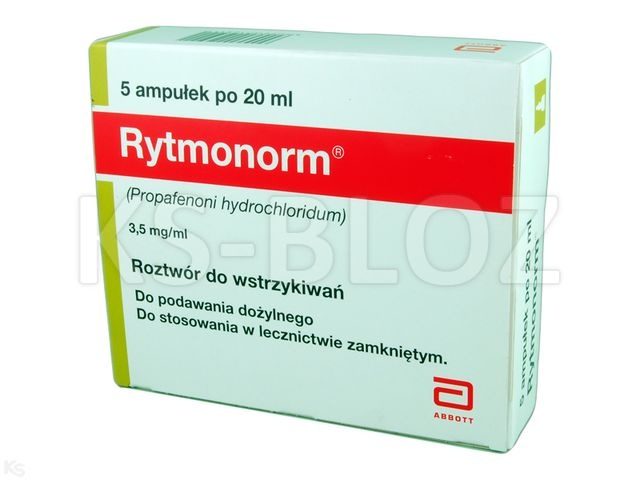
Cada envase contiene 5 ampollas de 20 ml de una solución transparente e incolora en vidrio incoloro.
Titular de la autorización de comercialización y responsable de la fabricación
Titular
Teva B.V.,
Swensweg 5, 2031GA
Haarlem, Paises Bajos
Responsable de la fabricación:
FAMAR HEALTH CARE SERVICES MADRID, S.A.U.
Avda. de Leganés, 62. 28923
Alcorcón-Madrid.
Pueden solicitar más información respecto a este medicamento dirigiéndose al representante local del titular de la autorización de comercialización:
Teva Pharma, S.L.U.
C/ Anabel Segura, 11, Edificio Albatros B, 1ª planta
Alcobendas 28108 Madrid
España
Fecha de la última revisión de esteprospecto: Marzo 2019
La información detallada de este medicamento está disponible en la página web de la {Agencia Española de Medicamentos y Productos Sanitarios (AEMPS)} (http://www.aemps.gob.es/)
- - - - - - - - - - - - - - - - - - - - - - - - - - - - - - - - - - - - - - - - - - - - - - - - - - - - - - - - - - - - - - - - - -
Esta información está destinada únicamente a profesionales del sector sanitario:
Para la continuación del tratamiento por vía oral y para la prevención de nuevos trastornos del ritmo se hallan disponibles los comprimidos recubiertos de Rytmonorm 150 mg y 300 mg.
Tratamiento de la sobredosis
Síntomas de sobredosis:
Síntomas miocárdicos:Los efectos de la sobredosis del hidrocloruro de propafenona en el miocardio se manifiestan como alteraciones en la génesis y en la conducción de los estímulos cardíacos como prolongación del intervalo PQ, ensanchamiento del complejo QRS, supresión del automatismo del nódulo sinusal, bloqueo AV, taquicardia ventricular, flutter ventricular y fibrilación ventricular. La reducción de la contractilidad (efecto inotrópico negativo) puede provocar hipotensión que, en casos graves, puede causar shock cardiovascular.
Síntomas no cardiacos:puede aparecer frecuentemente cefalea, mareo, visión borrosa, parestesia, temblor, náuseas, estreñimiento y sequedad de boca. En casos extremadamente raros, se han notificado convulsiones con la sobredosis. También se ha notificado muerte.
En las intoxicaciones graves pueden aparecer crisis tonicoclónicas, parestesias, somnolencia, coma y parada respiratoria.
Tratamiento:
Además de las medidas generales de emergencia es necesaria la monitorización y corrección de los parámetros vitales del paciente (según sea necesario) en una unidad de cuidados intensivos.
La desfibrilación así como la infusión de dopamina e isoprenalina han sido eficaces en el control del ritmo y de la tensión arterial. Las convulsiones han sido aliviadas con diazepan intravenoso. Pueden ser necesarias medidas generales de soporte como la asistencia respiratoria mecánica y el masaje cardiaco externo.
Las tentativas de eliminación mediante hemoperfusión son de eficacia limitada.
La hemodiálisis no es eficaz debido a la alta unión a las proteínas (> 95%) y al gran volumen de distribución.
Incompatibilidades
Rytmonorm inyectable no debe mezclarse con soluciones salinas fisiológicas puesto que puede precipitar.
Otras presentaciones
Rytmonorm 150 mg comprimidos recubiertos. Envases con 30 y 60 comprimidos recubiertos.
Rytmonorm 300 mg comprimidos recubiertos. Envases con 20 y 60 comprimidos recubiertos.
- País de registro
- Forma farmacéuticaINYECTABLE, 70 mg propafenona hidrocloruro/ 20 ml
- Código ATCC01BC03
- Disponibilidad en farmaciasProblema de suministro reportado
- Principio activo
- Requiere recetaSí
- Fabricante
- ComposiciónGLUCOSA MONOHIDRATO (1076 mg mg)
- Esta información es de carácter general y no sustituye la consulta con un profesional sanitario.
- Alternativas a RYTMONORM 3,5 mg/ml SOLUCION INYECTABLEForma farmacéutica: COMPRIMIDO, 150 mg propafenona hidrocloruroPrincipio activo: propafenoneFabricante: Teva B.V.Requiere recetaForma farmacéutica: COMPRIMIDO, 300 mg propafenona hidrocloruroPrincipio activo: propafenoneFabricante: Teva B.V.Requiere recetaForma farmacéutica: INYECTABLE, 10 mg flecainida acetato/mlPrincipio activo: flecainideFabricante: Viatris Healthcare LimitedRequiere receta
Médicos online para RYTMONORM 3,5 mg/ml SOLUCION INYECTABLE
Comenta la dosis, los posibles efectos secundarios, interacciones, contraindicaciones o la revisión de receta de RYTMONORM 3,5 mg/ml SOLUCION INYECTABLE, sujeto a valoración médica y a la normativa local.
Obtén una receta de RYTMONORM 3,5 mg/ml SOLUCION INYECTABLE online
Rellena un formulario de 2 minutos
Cuéntanos tus síntomas, historial y el medicamento que necesitas.
Elige un médico o nosotros te asignamos uno
Escoge un especialista o te conectamos con el próximo médico disponible.
El médico revisa tu caso
Normalmente en 30 minutos. Puede hacerte preguntas adicionales por chat.
Recógela en cualquier farmacia
Receta electrónica enviada a tu correo, válida en toda España.
Preguntas frecuentes
RYTMONORM 3,5 mg/ml SOLUCION INYECTABLE requiere receta en España. Puedes confirmarlo con un médico online según tu caso.
El principio activo de RYTMONORM 3,5 mg/ml SOLUCION INYECTABLE es propafenone. Esta información ayuda a identificar medicamentos con la misma composición pero con diferentes nombres comerciales.
RYTMONORM 3,5 mg/ml SOLUCION INYECTABLE es fabricado por Teva B.V.. La marca y el envase pueden variar según el distribuidor.
Los Médicos de familia, Psiquiatras, Dermatólogos, Cardiólogos, Endocrinólogos, Gastroenterólogos, Neumólogos, Nefrólogos, Reumatólogos, Hematólogos, Infectólogos, Alergólogos, Geriatras, Pediatras, Oncólogos pueden valorar la prescripción de RYTMONORM 3,5 mg/ml SOLUCION INYECTABLE cuando esté clínicamente indicado. Puedes reservar una videoconsulta para comentar tu caso y las opciones de tratamiento.
España cuenta con una infraestructura sanitaria bien desarrollada en ciudades principales como Madrid, Barcelona, Valencia y Sevilla. Las farmacias están ampliamente disponibles y operan bajo estrictas regulaciones, garantizando el acceso a medicamentos con receta.
Puedes comprar RYTMONORM 3,5 mg/ml SOLUCION INYECTABLE en Madrid, Barcelona, Sevilla o Valencia en cualquier farmacia local con una receta válida.
Para obtener una receta, puedes utilizar Oladoctor:
Otros medicamentos con el mismo principio activo (propafenone) incluyen RYTMONORM 150 mg COMPRIMIDOS RECUBIERTOS, RYTMONORM 300 mg COMPRIMIDOS RECUBIERTOS, APOCARD 10 mg/ml SOLUCION INYECTABLE. Pueden tener diferentes nombres comerciales o formulaciones, pero contienen el mismo componente terapéutico. Consulta siempre con un médico antes de cambiar o iniciar un nuevo medicamento.
