



RYBELSUS 3 mg Comprimidos

Revisión de receta online
Un médico revisará tu caso y determinará si la prescripción es médicamente apropiada.

Habla con un médico sobre este medicamento
Comenta tus síntomas y las opciones de tratamiento en una consulta online.



Cómo usar RYBELSUS 3 MG COMPRIMIDOS
Contenido del prospecto
- Introducción
- Qué es Rybelsus y para qué se utiliza
- Qué necesita saber antes de empezar a tomar Rybelsus
- Cómo tomar Rybelsus
- Posibles efectos adversos
- Conservación de Rybelsus
- Contenido del envase e información adicional
Introducción
Prospecto: información para el paciente
Rybelsus 3mg comprimidos
Rybelsus 7mg comprimidos
Rybelsus 14mg comprimidos
Rybelsus 25mg comprimidos
Rybelsus 50mg comprimidos
semaglutida
Lea todo el prospecto detenidamente antes de empezar a tomar este medicamento, porque contiene información importante para usted.
- Conserve este prospecto, ya que puede tener que volver a leerlo.
- Si tiene alguna duda, consulte a su médico, farmacéutico o enfermero.
- Este medicamento se le ha recetado solamente a usted, y no debe dárselo a otras personas aunque tengan los mismos síntomas que usted, ya que puede perjudicarles.
- Si experimenta efectos adversos, consulte a su médico, farmacéutico o enfermero, incluso si se trata de efectos adversos que no aparecen en este prospecto. Ver sección 4.
Contenido del prospecto
- Qué es Rybelsus y para qué se utiliza
- Qué necesita saber antes de empezar a tomar Rybelsus
- Cómo tomar Rybelsus
- Posibles efectos adversos
- Conservación de Rybelsus
- Contenido del envase e información adicional
1. Qué es Rybelsus y para qué se utiliza
Rybelsus contiene el principio activo semaglutida. Es un medicamento que se utiliza para reducir los niveles de azúcar en sangre.
Rybelsus se utiliza para tratar la diabetes tipo 2 cuando no está controlada de forma adecuada con dieta y ejercicio en adultos (18 años de edad o más):
- como única medicación: cuando no se puede utilizar metformina (otro medicamento para la diabetes) o
- con otros medicamentos para la diabetes: cuando estos no son suficientes para controlar sus niveles de azúcar en sangre. Estos pueden ser medicamentos que se toman por vía oral o ser inyectados como la insulina.
Es importante que continúe con la dieta y el plan de ejercicio que le haya indicado su médico, farmacéutico o enfermero.
¿Qué es la diabetes tipo 2?
La diabetes tipo 2 es una afección en la cual su cuerpo no produce suficiente insulina, y la insulina que produce su cuerpo no reduce el azúcar en sangre como debería. En algunos casos, su cuerpo puede producir demasiado azúcar en la sangre. Si su nivel de azúcar en sangre aumenta y permanece alto durante un largo periodo de tiempo, puede dar lugar a efectos dañinos tales como problemas cardiacos, enfermedad renal, trastornos oculares y mala circulación en las extremidades. Por este motivo es importante mantener sus niveles de azúcar en sangre dentro de un rango normal.

¿No estás seguro de si este medicamento es adecuado para ti?
Comenta tus síntomas y tratamiento con un médico online.
2. Qué necesita saber antes de empezar a tomar Rybelsus
No tome Rybelsus
- si es alérgico a semaglutida o a alguno de los demás componentes de este medicamento (incluidos en la sección 6).
Advertencias y precauciones
Consulte a su médico, farmacéutico o enfermero antes de empezar a tomar Rybelsus.
Trazabilidad
Con objeto de mejorar la trazabilidad de los medicamentos biológicos, registre el nombre y el número de lote (indicado en el cartonaje y blíster) del medicamento que está tomando y proporcione esta información cuando notifique cualquier efecto adverso.
Información general
Este medicamento no es igual que la insulina y no se debe usar si:
- padece diabetes tipo 1 (su cuerpo no produce nada de insulina)
- desarrolla cetoacidosis diabética. Esto es una complicación de la diabetes que se caracteriza por un alto nivel de azúcar en sangre, dificultad para respirar, confusión, sed excesiva, aliento de olor dulce o sabor dulce o metálico en la boca.
Si sabe que va a someterse a una intervención quirúrgica en la que se someterá a anestesia (estado de sueño), informe a su médico de que está tomando Rybelsus.
Problemas de estómago e intestinales y deshidratación
Durante el tratamiento con este medicamento, es posible que tenga náuseas, vómitos o diarrea. Estos efectos adversos pueden causar deshidratación (pérdida de líquidos). Es importante que beba suficiente líquido para prevenir la deshidratación. Esto es especialmente importante si tiene problemas renales. Si tiene alguna duda, consulte a su médico.
Dolor de estómago intenso y continuo cuya causa pudiera ser una inflamación del páncreas
Si tiene un dolor intenso y continuo en la zona del estómago acuda al médico de inmediato, ya que podría ser un síntoma de inflamación del páncreas (pancreatitis aguda).
Nivel de azúcar en sangre bajo (hipoglucemia)
La toma de una sulfonilurea o la administración de insulina con Rybelsus puede aumentar el riesgo de experimentar bajos niveles de azúcar en sangre (hipoglucemia). Consulte la sección 4 para conocer los síntomas de aviso de un bajo nivel de azúcar en sangre.
Es posible que su médico le pida que mida sus niveles de azúcar en sangre. Esto ayudará a decidir si es necesario cambiar la dosis de sulfonilurea o insulina para reducir el riesgo de bajo
nivel de azúcar en sangre.
Enfermedad ocular diabética (retinopatía)
Una mejora brusca del control del nivel de azúcar en sangre puede provocar un empeoramiento temporal de la enfermedad ocular diabética. Si padece enfermedad ocular diabética y experimenta problemas oculares durante el tratamiento con este medicamento, consulte a su médico.
Respuesta al tratamiento
Si la respuesta al tratamiento con semaglutida es menor de lo esperado, puede deberse a una baja absorción por la variabilidad en la absorción y baja biodisponibilidad absoluta. Debe seguir las instrucciones indicadas en la sección 3 para conseguir un efecto óptimo de semaglutida.
Niños y adolescentes
Este medicamento no está recomendado en niños y adolescentes menores de 18 años, ya que la seguridad y eficacia no se ha establecido en este grupo de edad.
Otros medicamentos y Rybelsus
Informe a su médico o farmacéutico si está tomando, ha tomado recientemente o pudiera tener que tomar cualquier otro medicamento.
En particular, informe a su médico, farmacéutico o enfermero si está utilizando medicamentos que contengan alguno de los siguientes componentes:
- levotiroxina utilizada para tratar enfermedades relacionadas con el tiroides. Esto se debe a que su médico puede necesitar comprobar sus niveles de hormonas tiroideas si está tomando Rybelsus junto con levotiroxina.
- warfarina u otros medicamentos similares orales para reducir la coagulación de la sangre (anticoagulantes orales). Puede ser necesario realizar análisis de sangre frecuentes para determinar la capacidad de coagulación de su sangre.
- Si está utilizando insulina, su médico le informará de cómo reducir la dosis de insulina y le recomendará hacer seguimiento de sus niveles de azúcar en sangre de manera más frecuente con el fin de evitar hiperglucemia (alto nivel de azúcar en sangre) y cetoacidosis diabética (una complicación de la diabetes que ocurre cuando el cuerpo no puede descomponer la glucosa porque no hay suficiente insulina).
Embarazo y lactancia
Si está embarazada o en periodo de lactancia, cree que podría estar embarazada o tiene intención de quedarse embarazada, consulte a su médico antes de utilizar este medicamento.
Este medicamento no se debe utilizar durante el embarazo porque se desconoce si afecta al bebé no nacido. Por tanto, debe utilizar métodos anticonceptivos mientras se toma este medicamento. Si desea quedarse embarazada, consulte con su médico cómo cambiar su tratamiento ya que debe interrumpir el uso de este medicamento al menos con dos meses de antelación. Si se queda embarazada mientras usa este medicamento, consulte con su médico inmediatamente, ya que será necesario cambiarle el tratamiento.
No utilice este medicamento durante el periodo de lactancia. Este medicamento pasa a la leche materna, y no se sabe cómo puede afectar a su bebé.
Conducción y uso de máquinas
Es poco probable que Rybelsus pueda afectar a su capacidad para conducir y utilizar máquinas.
Algunos pacientes se pueden sentir mareados al tomar Rybelsus. Si se siente mareado, tenga especial cuidado al conducir o utilizar máquinas. Consulte con su médico para más información.
Si utiliza este medicamento con una sulfonilurea o insulina, puede experimentar un bajo nivel de azúcar en sangre (hipoglucemia), lo que a su vez, puede reducir su capacidad de concentración. No conduzca o use máquinas si experimenta algún síntoma de bajo nivel de azúcar en sangre. Consulte la sección 2, “Advertencias y precauciones”, para obtener información sobre el aumento del riesgo de experimentar un bajo nivel de azúcar en sangre y la sección 4 para conocer los síntomas de aviso de un bajo nivel de azúcar en sangre. Consulte a su médico para más información.
Rybelsus contiene sodio
Este medicamento contiene 23 mg de sodio (componente principal de la sal de mesa/para cocinar) en cada comprimido. Esto equivale al 1 % de la ingesta diaria máxima de sodio recomendada para un adulto.
3. Cómo tomar Rybelsus
Siga exactamente las instrucciones de administración de este medicamento indicadas por su médico. En caso de duda, consulte de nuevo a su médico o farmacéutico.
Cuánto tomar
- La dosis inicial es un comprimido de 3 mg una vez al día durante un mes.
- Después de un mes, su médico aumentará la dosis a un comprimido de 7 mg una vez al día.
- Su médico le indicará que mantenga la dosis durante un mes como mínimo antes de aumentar a una dosis superior.
- Es posible que su médico aumente la dosis de manera escalonada a un comprimido de 14 mg, 25 mg o 50 mg una vez al día si se necesita.
- Su médico le prescribirá la dosis adecuada para usted. No modifique su dosis a menos que su médico se lo haya indicado.
- Rybelsus siempre se debe tomar como un comprimido al día. No debe tomar dos comprimidos para obtener el efecto de una dosis mayor.
Toma de este medicamento
- Tome el comprimido de Rybelsus con el estómago vacío después de un período de ayuno recomendado de al menos 8 horas.
- Tráguese el comprimido de Rybelsus entero con un sorbo de agua (hasta 120 ml). No parta, triture o mastique el comprimido, ya que no se sabe si afecta a la absorción de semaglutida.
- Después de tomar el comprimido de Rybelsus, espere al menos 30 minutos antes de comer, beber o tomar otros medicamentos orales. Esperar menos de 30 minutos disminuye la absorción de semaglutida.
Si toma más Rybelsus del que debe
Si toma más Rybelsus del que debe, consulte con su médico inmediatamente. Es posible que experimente efectos adversos como náuseas.
Si olvidó tomar Rybelsus
Si olvidó tomar una dosis, omita la dosis olvidada y tome la dosis normal al día siguiente.
Si interrumpe el tratamiento con Rybelsus
No interrumpa el tratamiento con este medicamento sin consultar con su médico. Si lo interrumpe, puede que aumenten sus niveles de azúcar en sangre.
Si tiene cualquier otra duda sobre el uso de este medicamento, pregunte a su médico, farmacéutico o enfermero.

¿Has empezado a tomar el medicamento y tienes preguntas?
Comenta tus síntomas y tratamiento con un médico online.
4. Posibles efectos adversos
Al igual que todos los medicamentos, este medicamento puede producir efectos adversos, aunque no todas las personas los sufran.
Efectos adversos graves
Frecuentes(pueden afectar hasta 1 de cada 10 personas)
- complicaciones de la enfermedad ocular diabética (retinopatía). Consulte a su médico si experimenta problemas oculares, como cambios en la visión durante el tratamiento con este medicamento.
Raros(pueden afectar hasta 1 de cada 1 000 personas)
- reacciones alérgicas graves (reacciones anafilácticas). Debe buscar inmediatamente ayuda médica e informar a su médico inmediatamente si experimenta síntomas tales como problemas respiratorios, hinchazón de la cara y la garganta, sibilancias, palpitaciones, piel pálida y fría, mareo o debilidad.
- inflamación del páncreas (pancreatitis aguda) que puede causar dolor intenso en el estómago y la espalda que no desaparece. Debe consultar a un médico de inmediato si experimenta estos síntomas.
Frecuencia no conocida(la frecuencia no puede estimarse a partir de los datos disponibles)
- obstrucción intestinal. Una forma grave de estreñimiento con otros síntomas como dolor de estómago, hinchazón abdominal, vómitos etc.
Otros efectos adversos
Muy frecuentes (pueden afectar a más de 1 de cada 10 personas)
- bajo nivel de azúcar en sangre (hipoglucemia), cuando se usa este medicamento con otros medicamentos que contienen una sulfonilurea o insulina. Puede que su médico reduzca la dosis de estos medicamentos antes de empezar a tomar este medicamento.
- náuseas; este efecto desaparece normalmente con el tiempo.
- diarrea; este efecto desaparece normalmente con el tiempo.
Los síntomas de aviso de un bajo nivel de azúcar en sangre pueden aparecer repentinamente. Algunos de estos síntomas son: sudor frío, piel fría y pálida, dolor de cabeza, palpitaciones, náuseas o apetito excesivo, cambios en la visión, somnolencia o sensación de debilidad, nerviosismo, ansiedad o confusión, dificultad de concentración o temblores.
Su médico le indicará cómo tratar el bajo nivel de azúcar en sangre y qué tiene que hacer en el caso de que presente estos síntomas de aviso.
Frecuentes(pueden afectar hasta 1 de cada 10 personas)
- bajo nivel de azúcar en sangre (hipoglucemia) cuando este medicamento se utiliza con medicamentos orales para la diabetes distintos a sulfonilurea o insulina
- disminución del apetito
- sensación de mareo
- vómitos – este efecto desaparece normalmente con el tiempo y puede ocurrir con más frecuencia al aumentar la dosis a 25 mg y 50 mg
- dolor de estómago
- hinchazón de estómago
- estreñimiento
- malestar de estómago o indigestión
- estómago inflamado (gastritis); los síntomas incluyen dolor de estómago, náuseas o vómitos
- reflujo o ardor de estómago; también se denomina “enfermedad por reflujo gastroesofágico”
- gases (flatulencia)
- cansancio
- aumento de las enzimas pancreáticas (como lipasa y amilasa) en análisis de sangre
- cambio en la sensibilidad de la piel – este efecto desaparece normalmente con el tiempo y puede ocurrir con las dosis de 25 mg y 50 mg
- dolor de cabeza.
Poco frecuentes(pueden afectar hasta 1 de cada 100 personas)
- reacciones alérgicas como sarpullido, picor o ronchas
- cambio en el sabor de la comida y la bebida.
- pulso rápido
- eructos
- un retraso en el vaciamiento del estómago
- piedras en la vesícula biliar
- pérdida de peso
Comunicación de efectos adversos
Si experimenta cualquier tipo de efecto adverso, consulte a su médico, farmacéutico o enfermero, incluso si se trata de posibles efectos adversos que no aparecen en este prospecto. También puede comunicarlos directamente a través del sistema nacional de notificación incluido en el Apéndice V. Mediante la comunicación de efectos adversos usted puede contribuir a proporcionar más información sobre la seguridad de este medicamento.
5. Conservación de Rybelsus
Mantener este medicamento fuera de la vista y del alcance de los niños.
No utilice este medicamento después de la fecha de caducidad que aparece en el blíster y en el envase después de CAD. La fecha de caducidad es el último día del mes que se indica.
Conservar en el envase original para protegerlo de la luz y la humedad.
Este medicamento no requiere ninguna temperatura especial de conservación.
Los medicamentos no se deben tirar por los desagües ni a la basura. Pregunte a su farmacéutico cómo deshacerse de los envases y de los medicamentos que ya no necesita. De esta forma, ayudará a proteger el medio ambiente.
6. Contenido del envase e información adicional
Composición de Rybelsus
- El principio activo es semaglutida. Cada comprimido contiene 3, 7, 14, 25 o 50 mg de semaglutida.
- Los demás componentes en los comprimidos de 3 mg, 7 mg y 14 mg son salcaprozato de sodio, povidona K90, celulosa microcristalina y estearato de magnesio. Ver también sección 2, “Rybelsus contiene sodio”.
- Los demás componentes en los comprimidos de 25 mg y 50 mg son salcaprozato de sodio y estearato de magnesio. Ver también sección 2 “Rybelsus contiene sodio”.
Aspecto de Rybelsus y contenido del envase
Los comprimidos de Rybelsus 3 mg son de color entre blanco y amarillo claro y su forma es ovalada (7,5 mm x 13,5 mm). Presentan un "3" en una cara y la palabra "novo" en la otra.
Los comprimidos de Rybelsus 7 mg son de color entre blanco y amarillo claro y su forma es ovalada (7,5 mm x 13,5 mm). Presentan un "7" en una cara y la palabra "novo" en la otra.
Los comprimidos de Rybelsus 14 mg son de color entre blanco y amarillo claro y su forma es ovalada (7,5 mm x 13,5 mm). Presentan un "14" en una cara y la palabra "novo" en la otra.
Los comprimidos de Rybelsus 25 mg son de color entre blanco y amarillo claro y su forma es ovalada (6,8 mm x 12 mm). Presentan un "25" en una cara y la palabra "novo" en la otra.
Los comprimidos de Rybelsus 50 mg son de color entre blanco y amarillo claro y su forma es ovalada (6,8 mm x 12 mm). Presentan un "50" en una cara y la palabra "novo" en la otra.
Los comprimidos de 3 mg, 7 mg, 14 mg, 25 mg y 50 mg se presentan en blísteres de alu/alu y los tamaños de envase disponibles son de 10, 30, 60, 90 y 100 comprimidos.
Puede que solamente estén comercializados algunos tamaños de envases.
Titular de la autorización de comercialización y responsable de la fabricación
Novo Nordisk A/S
Novo Allé
DK-2880 Bagsværd
Dinamarca
Fecha de la última revisión de este prospecto:
Otras fuentes de información
La información detallada de este medicamento está disponible en la página web de la Agencia Europea de Medicamentos: https://www.ema.europa.eu/
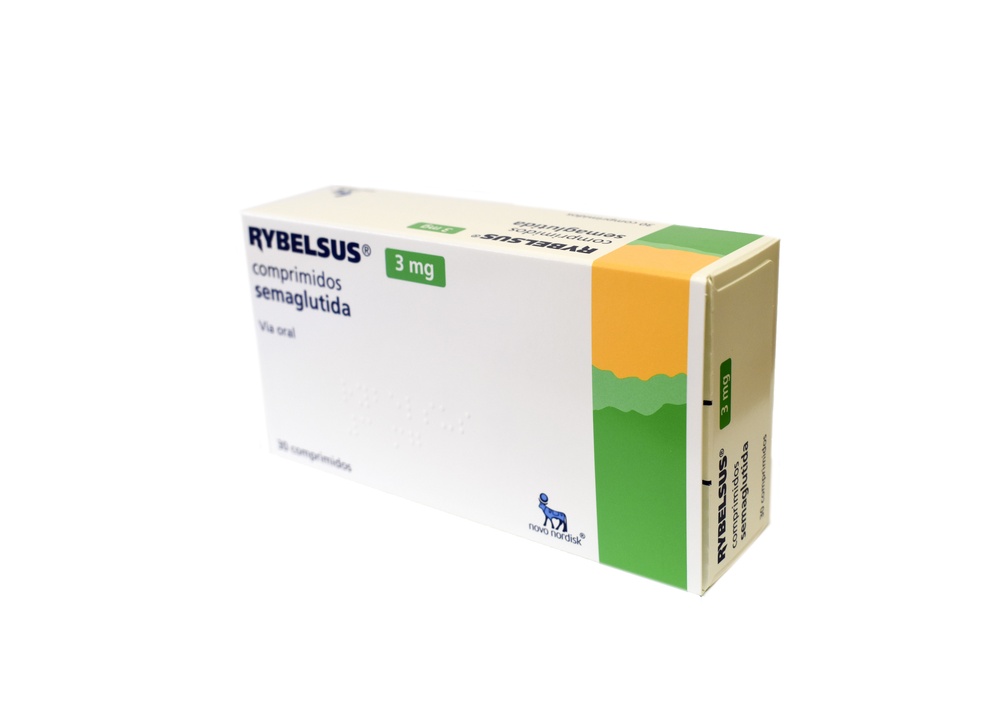
- País de registro
- Forma farmacéuticaCOMPRIMIDO, 3 mg
- Código ATCA10BJ06
- Precio medio en farmacia132.77 EUR
- Principio activo
- Requiere recetaSí
- Fabricante
- Esta información es de carácter general y no sustituye la consulta con un profesional sanitario.
- Alternativas a RYBELSUS 3 MG COMPRIMIDOSForma farmacéutica: INYECTABLE, 0,25 mgPrincipio activo: SemaglutidaFabricante: Novo Nordisk A/SRequiere recetaForma farmacéutica: INYECTABLE, 0.5 mgPrincipio activo: SemaglutidaFabricante: Novo Nordisk A/SRequiere recetaForma farmacéutica: INYECTABLE, 1 mgPrincipio activo: SemaglutidaFabricante: Novo Nordisk A/SRequiere receta
Médicos online para RYBELSUS 3 MG COMPRIMIDOS
Comenta la dosis, los posibles efectos secundarios, interacciones, contraindicaciones o la revisión de receta de RYBELSUS 3 MG COMPRIMIDOS, sujeto a valoración médica y a la normativa local.

Obtén una receta de RYBELSUS 3 MG COMPRIMIDOS online
Rellena un formulario de 2 minutos
Cuéntanos tus síntomas, historial y el medicamento que necesitas.
Elige un médico o nosotros te asignamos uno
Escoge un especialista o te conectamos con el próximo médico disponible.
El médico revisa tu caso
Normalmente en 30 minutos. Puede hacerte preguntas adicionales por chat.
Recógela en cualquier farmacia
Receta electrónica enviada a tu correo, válida en toda España.
Preguntas frecuentes
RYBELSUS 3 MG COMPRIMIDOS requiere receta en España. Puedes confirmarlo con un médico online según tu caso.
El principio activo de RYBELSUS 3 MG COMPRIMIDOS es Semaglutida. Esta información ayuda a identificar medicamentos con la misma composición pero con diferentes nombres comerciales.
El precio medio en farmacia de RYBELSUS 3 MG COMPRIMIDOS es de aproximadamente 132.77 EUR. Puede variar según el fabricante y la forma farmacéutica.
RYBELSUS 3 MG COMPRIMIDOS es fabricado por Novo Nordisk A/S. La marca y el envase pueden variar según el distribuidor.
Los Médicos de familia, Psiquiatras, Dermatólogos, Cardiólogos, Endocrinólogos, Gastroenterólogos, Neumólogos, Nefrólogos, Reumatólogos, Hematólogos, Infectólogos, Alergólogos, Geriatras, Pediatras, Oncólogos pueden valorar la prescripción de RYBELSUS 3 MG COMPRIMIDOS cuando esté clínicamente indicado. Puedes reservar una videoconsulta para comentar tu caso y las opciones de tratamiento.
España cuenta con una infraestructura sanitaria bien desarrollada en ciudades principales como Madrid, Barcelona, Valencia y Sevilla. Las farmacias están ampliamente disponibles y operan bajo estrictas regulaciones, garantizando el acceso a medicamentos con receta.
Puedes comprar RYBELSUS 3 MG COMPRIMIDOS en Madrid, Barcelona, Sevilla o Valencia en cualquier farmacia local con una receta válida.
Para obtener una receta, puedes utilizar Oladoctor:
Otros medicamentos con el mismo principio activo (Semaglutida) incluyen OZEMPIC 0,25 MG SOLUCION INYECTABLE EN PLUMA PRECARGADA, OZEMPIC 0,5 MG SOLUCION INYECTABLE EN PLUMA PRECARGADA, OZEMPIC 1 MG SOLUCION INYECTABLE EN PLUMA PRECARGADA. Pueden tener diferentes nombres comerciales o formulaciones, pero contienen el mismo componente terapéutico. Consulta siempre con un médico antes de cambiar o iniciar un nuevo medicamento.
